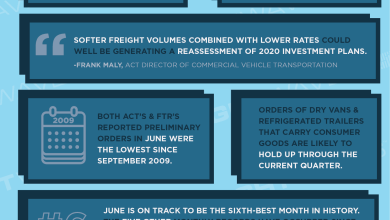
Trucking carrier sentiment suppressed by weak rate environment and economic uncertainty: Ritchie Bros.
Ritchie Bros. say more carrier exits are needed to rebalance the trucking market.

To view more FreightWaves infographics, click here
Stephens investment conference trucking equipment highlights Supply chain challenges were the main focus at the Stephens annual investment conference earlier this month in Nashville, Tennessee. Executives said driver recruiting and broader supply chain bottlenecks were slightly easing, but purchasing and procuring equipment has gotten notably tougher. Lack of trailers becoming new driver shortage: Derek Leathers, […]
Many carriers expanded their fleets after the 2018 freight boom and were rewarded with an extremely challenging oversupplied market in 2019. The current pattern looks eerily similar to early 2018, but are they comparable?
One of the results of the 2017-18 freight market boom was an increase in the cost of operating that held over into a slower 2019 when capacity became abundant. Costs are on the rise once again as carriers struggle to find drivers to capture market share.
In today’s edition of The Daily Dash, truck drivers are driving faster this holiday season. Plus Gatik plans to remove drivers from its vehicles in 2021 and New Year’s resolutions for fleets looking to reduce their risk.
Andrew Cox and Seth Holm debate the resurgence of bitcoin and the value of buying new trucks as a fleet.
The Q3 pattern for truck makers continued at Daimler Trucks with orders recovering dramatically from the second quarter but sales and earnings trailing because deliveries fell due to the pandemic.
In today’s edition of The Daily Dash, OOIDA will back FMCSA in a lawsuit defending hours-of-service changes. Plus, regional carriers could see a strong holiday season and equipment orders are up and that could complicate 2020 rate forecasting.
Market Expert Mike Baudendistel looks at the prospects for the truck original equipment manufacturers in 2020.
Why are Class 8 orders a deeply cyclical, lagging indicator of truck demand?
Volvo Group reported a significant jump in its fourth-quarter income, but truck orders and net sales declined compared with 2018 numbers.
Trailer orders are plunging during the month of June.
The data that can be gathered from a truck’s telematics has caused a shift from selling trucks as products to selling trucks as solutions to owners’ issues.
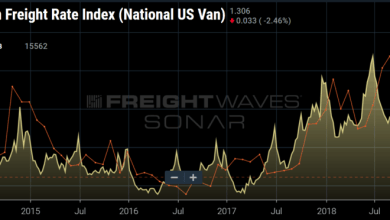
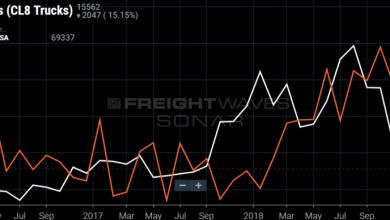
National spot market price movement has a surprisingly tight relationship with new truck orders.
Capacity is still being added to the market. Truck orders numbers for both new and used models support this.
ACT Research is forecasting 335,000 truck orders in 2019, but a sharp dropoff in 2020.
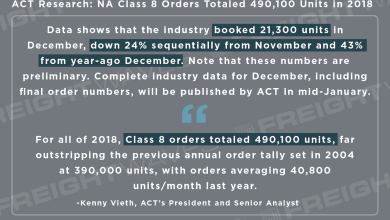
ACT Research: NA Class 8 orders totaled 490,100 units in 2018.
The numbers year-on-year are still way up, but there’s been a definite sign of some slowdown.
North American Class 8 net orders came in around 42,800 units in September, falling 19 percent from August’s 53,069 units, according to preliminary data released by ACT Research.