




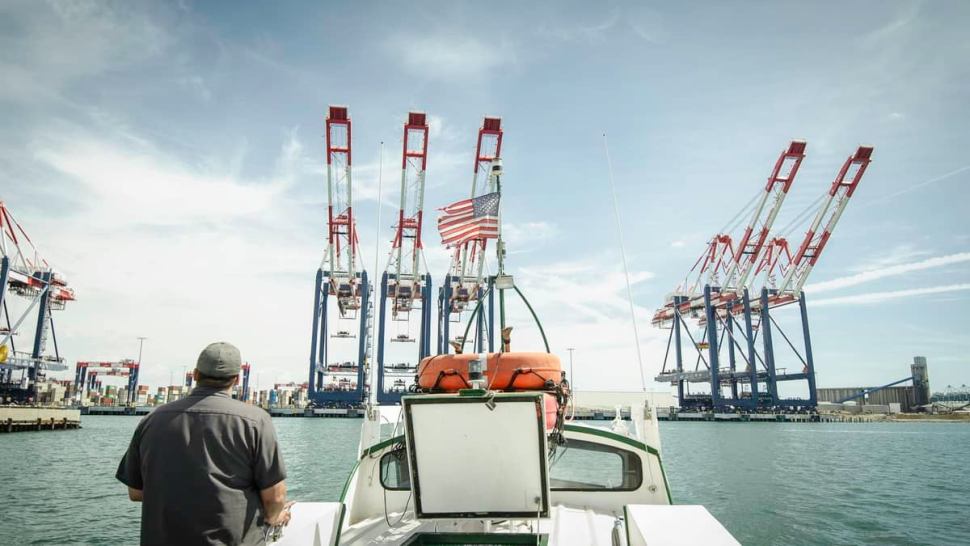
Automation and “digitization” of container terminals can lead to job losses and reduced tax revenue that have a substantial effect on local economies.
That’s the conclusion of a study by Prism Economics and Analysis commissioned by the International Longshore and Warehouse Union Canada.
It examined what might result from full or partial automation of container terminals in the British Columbia ports of Prince Rupert, Delta and Vancouver. Concerns about automation was one of the major issues in contract negotiations between the ILWU and terminal operators that was only resolved after a short-lived work stoppage in May.
Prism’s research is just the first in a number of studies that will examine the issue of port automation. Several have been ordered by local and state authorities in the wake of a decision by APM Terminals to automate its terminal in Los Angeles. APMT’s plans sparked protests by ILWU workers and sympathetic members of the community.
The U.S. Maritime Administration also is analyzing port automation.
Longshore work provides a significant portion of the middle-class and high-income jobs in the three British Columbia cities at which container terminals are located, Prism said.
Based on a 2016 census, it found, “Longshore employment accounts for 26% of all jobs paying more than $70,000 in Prince Rupert, 11% in Delta and 2% in Vancouver. Longshore employment accounts for 66% of all jobs paying more than $100,000 in Prince Rupert, 23% in Delta and 3% in Vancouver.”
Prism looked at the impact automation could have under two scenarios: what it called “brownfield” port automation where an existing terminal is upgraded and “greenfield” projects that “involve building a new facility, eliminating the need to remodel or demolish existing structures, and are more likely to be fully automated.”
It used two Australian container terminals to model the effect of automation. Patrick Terminals in Port Botany was its example of a brownfield project. In 2014, that terminal employed 436 workers on site. In 2016, following automation, the terminal employed as few as 213 workers. Victoria International Container Terminal (VICT) in Melbourne was its example of a fully automated terminal. It is capable of operating with a workforce of as few as 150 workers, most of whom perform management, administrative or remote computer operations. In comparison, a conventional terminal in Prince Rupert operates with a total workforce of 525 workers.
As a result, the study concluded semi-automated terminals reduced labor in “targeted occupations” by 50% and fully automated terminals could reduce labor in targeted occupations by 90%.
The study also claimed that automation of a third of the the TraPac terminal in Los Angeles resulted in a labor reduction of 40% to 50% and that the automated greenfield Long Beach Container Terminal resulted in a workforce reduction of between 70% to 75% of longshore labor.
“Although there was a slight increase in maintenance and repair labor stemming from automation, the jobs created were unable to offset the high number of longshore jobs lost,” Prism said.
What would the loss of longshore jobs mean in the three British Columbia cities?
The report concluded in the brownfield scenario, “nearly 6,000 jobs provincially, over 2,300 jobs in Delta, more than 2,200 jobs in Vancouver and in excess of 700 jobs in Prince Rupert are at risk.”
In the greenfield scenario, “risk employment almost doubles: more than 10,780 jobs provincially, 4,100 jobs in Delta, over 4,000 jobs in Vancouver and over 1,200 jobs in Prince Rupert.”
The study also pointed to a 2018 McKinsey & Company report to support its contention that “there is some evidence that anticipated improvements in productivity and profitability are not always realized through port automation.”
McKinsey said in that report, “While operating expenses may decline following automation, overall productivity may also decline and return on capital invested may be lower than industry norms.”
Jeff Scott, the chairman of the board of directors of the British Columbia Maritime Employers Association, which negotiates contracts with the ILWU Canada, in a written statement said the agreement reached in May with the union “provides a period of stability that is in the interests of all British Columbians.”
“We have witnessed 34% job rate growth since 2008 as well as established a record-setting 9 million hours worked last year. We are committed to continuing to work with all those potentially impacted by the prospect of automation in B.C.,” said Scott, who is also the president and chief executive officer of Fraser Surrey Docks. “We are confident that this collaborative approach will ensure that B.C.’s maritime economy remains strong.”
Brokerage Compliance Symposium
The day before F3. Every compliance issue you face - fraud exposure, carrier liability, FMCSA rules, cargo theft, insurance gaps - navigated by attorneys and operators defining best practices in a changing industry.
F3 Awards Dinner
The night before F3. FreightTech100 companies honored. FreightTech 25 and Shipper of Choice winners revealed live. Cocktail reception into dinner and live music - 300 industry leaders in one purpose-built room.
F3: Future of Freight Festival
Industry-defining keynotes, rapid-fire technology demos, and industry leaders networking in experiences across Chattanooga - plus the inaugural F3 Awards Dinner featuring the FreightTech and Shipper of Choice reveals.
The day before F3. Every compliance issue you face - fraud exposure, carrier liability, FMCSA rules, cargo theft, insurance gaps - navigated by attorneys and operators defining best practices in a changing industry.
The Signal at Chattanooga Choo Choo • Chattanooga, TN Register NowThe night before F3. FreightTech100 companies honored. FreightTech 25 and Shipper of Choice winners revealed live. Cocktail reception into dinner and live music - 300 industry leaders in one purpose-built room.
The Signal at Chattanooga Choo Choo • Chattanooga, TN Register NowIndustry-defining keynotes, rapid-fire technology demos, and industry leaders networking in experiences across Chattanooga - plus the inaugural F3 Awards Dinner featuring the FreightTech and Shipper of Choice reveals.
The Signal at Chattanooga Choo Choo • Chattanooga, TN Register Now