




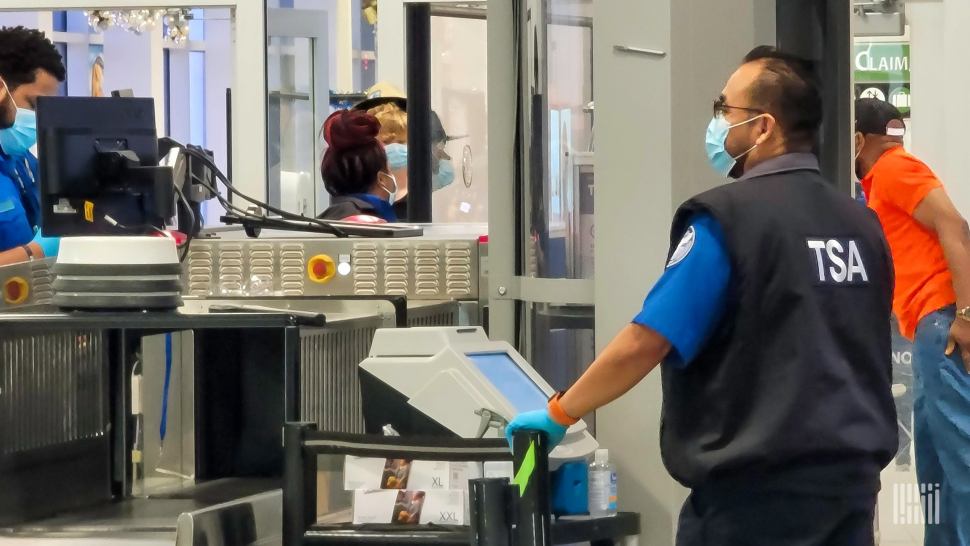
The new Trump administration’s directive that federal employees return to the office full time will drive away skilled professionals who are protecting the aviation system from terrorist threats, a former Transportation Security Administration official warned Friday.
Douglas Brittin, who headed the TSA’s air cargo division a decade ago, said in a letter to the House Homeland Security Committee that the the mandate to phase out remote work without sufficient planning or accommodation will lead to “significant attrition, including the loss of irreplaceable institutional knowledge and expertise” and undermine the agency’s ability to recruit and retain specialized personnel.
A self-inflicted brain drain would hurt current air cargo security programs, such as third-party canine inspections, as well standard security screening processes and adoption of new screening technologies for passenger checkpoints and cargo, that the TSA is working to upgrade and improve with the Airforwarders Association and other industry stakeholders, Brittin said.
“Losing experienced personnel during these important initiatives will jeopardize their success and, by extension, our national security,” he said.
Aviation remains a high-profile target for terrorists and rogue nations. Air cargo security recently came under scrutiny after Western intelligence agencies alleged Russia’s military intelligence unit was behind a plot to smuggle booby-trapped incendiary devices onto DHL Express cargo jets in Europe last summer. The packages caught fire on the ground at DHL’s air facility in Leipzig, Germany, and a logistics hub in Birmingham, United Kingdom. U.S. and European security officials say they believe the parcel bombs were a test run for future attacks against U.S.-bound aircraft.
Skilled professionals experienced at security operations, planning and risk mitigation are needed to address such threats to cargo and passenger security, Brittin stressed.
He urged Chairman Mark Green, R-Tenn., and ranking member Bennie Thompson, D-Miss., to press the administration to extend the return-to-office deadline by six months for key divisions such as air cargo and canine inspections so the TSA can retain talent and ensure program continuity.
President Trump last week signed an executive order instructing agencies to stop remote work practices and directing workers to return to their desks. A subsequent directive from the Office of Personnel Management provides details on how agency heads are to implement the return to in-person work. Trump campaigned on a platform of increasing federal workforce efficiency and accountability. According to the administration, telework has resulted in empty offices, diminished performance and challenges in supervision and training.
Many federal workers disagree that they aren’t working hard or doing quality work for taxpayers.
The previous rules allowed subject-matter experts to build careers on flexible work arrangements and TSA to recruit and retain specialized personnel, according to Brittin.
He added that the recent relocation of TSA’s headquarters from Arlington, Virginia — across the Potomac River from downtown Washington, D.C. — to Springfield, Virginia, makes it more difficult to house an influx of workers. “The new facility lacks the capacity to accommodate the volume of personnel currently teleworking, making the return-to-office transition logistically impractical and likely to create an untenable work environment,” Brittin said.
Homeland Security advisory committees put on freeze
The security situation, he added, is also undermined by the recent departure of the Air Cargo Division director and the vacancy left by Trump’s firing of TSA Administrator David Pekoske. The deputy administrator’s position at TSA is also vacant.
Ben Currier served as executive director of TSA’s air cargo security division until his abrupt departure three weeks ago to take a position at the Department of Defense. His successor has yet to be named.
Meanwhile, the Department of Homeland Security has effectively suspended the operation of key federal advisory committees involved in aviation and cross-border freight security. Private-sector members of the Aviation Security Advisory Committee (ASAC) and the Commercial Operations Advisory Committee (COAC), which supports Customs and Border Protection, were advised in a Jan. 20 memo from then-DHS Acting Secretary Benjamine Huffman that the department is revoking membership in all advisory committees as part of a “commitment to eliminating the misuse of resources and ensuring that DHS activities prioritize our national security.” The Federal Railroad Administration also has an advisory committee.
The ASAC was mandated by Congress in 1988 after the PanAm 103 bombing. Congress also established COAC.
The decision on the TSA’s advisory body “eliminates a vital platform for collaboration between government and industry stakeholders, undermining efforts to safeguard the flying public and protect our nation’s commerce,” the Airforwarders Association said in a statement. “Disbanding this committee at such a critical time weakens our collective ability to respond to evolving threats. We urge the President and his administration to reconsider this decision immediately and reinstate ASAC as an essential advisory body.”
Marianne Rowden, CEO of the E-Merchants Trade Council, said via email that by cancelling current membership, “the Trump Administration may be evaluating the mission of advisory committees and whether they match the priorities that the President has set for each agency while gauging the resources to staff the advisory committees.”
Click here for more FreightWaves stories by Eric Kulisch.
RECOMMENDED READING:
Brokerage Compliance Symposium
The day before F3. Every compliance issue you face - fraud exposure, carrier liability, FMCSA rules, cargo theft, insurance gaps - navigated by attorneys and operators defining best practices in a changing industry.
F3 Awards Dinner
The night before F3. FreightTech100 companies honored. FreightTech 25 and Shipper of Choice winners revealed live. Cocktail reception into dinner and live music - 300 industry leaders in one purpose-built room.
F3: Future of Freight Festival
Industry-defining keynotes, rapid-fire technology demos, and industry leaders networking in experiences across Chattanooga - plus the inaugural F3 Awards Dinner featuring the FreightTech and Shipper of Choice reveals.
The day before F3. Every compliance issue you face - fraud exposure, carrier liability, FMCSA rules, cargo theft, insurance gaps - navigated by attorneys and operators defining best practices in a changing industry.
The Signal at Chattanooga Choo Choo • Chattanooga, TN Register NowThe night before F3. FreightTech100 companies honored. FreightTech 25 and Shipper of Choice winners revealed live. Cocktail reception into dinner and live music - 300 industry leaders in one purpose-built room.
The Signal at Chattanooga Choo Choo • Chattanooga, TN Register NowIndustry-defining keynotes, rapid-fire technology demos, and industry leaders networking in experiences across Chattanooga - plus the inaugural F3 Awards Dinner featuring the FreightTech and Shipper of Choice reveals.
The Signal at Chattanooga Choo Choo • Chattanooga, TN Register Now