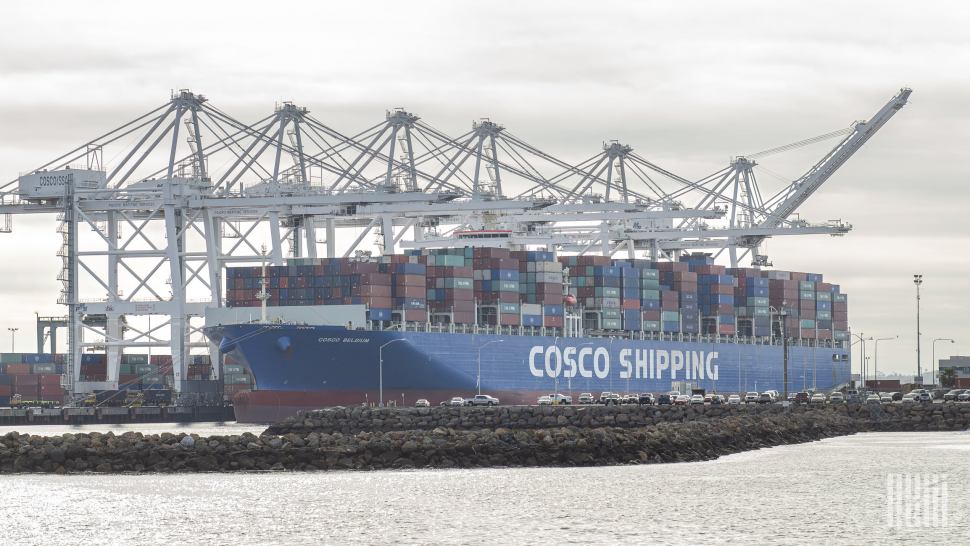
The United States Trade Representative on Sunday officially announced the one-year suspension of port fees on China-built cargo ships docking at American ports.
The announcement came just days after USTR in an unusual move gave the public all of one day to submit comments on the proposal.
The fees, which went into effect Oct. 14, followed an investigation begun under the Biden administration that found China used unfair trade practices and other advantages to build a dominant position in shipbuilding. The U.S. dunned vessels built at Chinese shipyards at the rate of $50 per net ton per voyage, meaning large ships could be liable for millions of dollars in fees for a typical rotation.
“The action will be suspended for one year, and as of 12:01 a.m. Eastern Standard Time on November 10, 2025,” USTR said in a formal notice.
China has also dropped retaliatory port fees on U.S.-flag ships, part of a wide-ranging trade agreement reached during a meeting between President Donald Trump and China’s Xi Jinping in South Korea last month.
The fees led some shipping lines to reconfigure U.S. services, shuffling port rotations and shifting tonnage out of some voyages to lessen the financial impact. Other shipping companies saw the departure of U.S. directors as China’s charges penalized carriers with American ownership stakes.
Washington earlier this year exempted from the charges some bulk ships arriving empty for loading of U.S. agricultural and energy products after complaints from American shippers.
China’s state-owned carrier Cosco, the world’s fourth-largest container, and Hong Kong’s OOCL had made few changes, choosing to absorb the fees.
But some observers criticized the move, noting the fees were promoted as a way to help underwrite a revival of the American maritime sector.
“Suspending these port fees is a significant strategic mistake,” said Hunter Stires, a maritime consultant and former strategist to current Navy Secretary John Phelan, in a LinkedIn post. “Billed as a “reciprocal” move, it is in fact anything but reciprocal. Withdrawing U.S. fees on over 10,000 Chinese ships in order to remove China’s retaliatory fees on 183 U.S. ships is rightly understood as an American surrender cleverly cloaked in pretended symmetry.
“Now is the time to double down through diplomacy to rally U.S. allies, particularly in Europe, to join a multilateral port fee regime on Chinese ships, enabling the world’s maritime democracies to level the playing field and reclaim their maritime industries that have suffered so dearly by China’s anticompetitive actions.”
Find more articles by Stuart Chirls here.
Related coverage:
Suez Canal, ocean lines discuss return of global shipping
Retailers expect container import decline to accelerate in ’26
Port Houston CEO: Maritime industry must adapt as trade markets shift
Brokerage Compliance Symposium
The day before F3. Every compliance issue you face - fraud exposure, carrier liability, FMCSA rules, cargo theft, insurance gaps - navigated by attorneys and operators defining best practices in a changing industry.
F3 Awards Dinner
The night before F3. FreightTech100 companies honored. FreightTech 25 and Shipper of Choice winners revealed live. Cocktail reception into dinner and live music - 300 industry leaders in one purpose-built room.
F3: Future of Freight Festival
Industry-defining keynotes, rapid-fire technology demos, and industry leaders networking in experiences across Chattanooga - plus the inaugural F3 Awards Dinner featuring the FreightTech and Shipper of Choice reveals.
The day before F3. Every compliance issue you face - fraud exposure, carrier liability, FMCSA rules, cargo theft, insurance gaps - navigated by attorneys and operators defining best practices in a changing industry.
The Signal at Chattanooga Choo Choo • Chattanooga, TN Register NowThe night before F3. FreightTech100 companies honored. FreightTech 25 and Shipper of Choice winners revealed live. Cocktail reception into dinner and live music - 300 industry leaders in one purpose-built room.
The Signal at Chattanooga Choo Choo • Chattanooga, TN Register NowIndustry-defining keynotes, rapid-fire technology demos, and industry leaders networking in experiences across Chattanooga - plus the inaugural F3 Awards Dinner featuring the FreightTech and Shipper of Choice reveals.
The Signal at Chattanooga Choo Choo • Chattanooga, TN Register Now