WASHINGTON – Port executives heard some good news for a change, that legislation to provide funding for transportation and infrastructure is making steady progress thanks to bipartisan support in a key Senate committee.
At the same time, Democratic senators paused negotiations on permitting reform, one of President Trump’s key re-campaign tenets, over the administration’s canceling of some blue state projects.
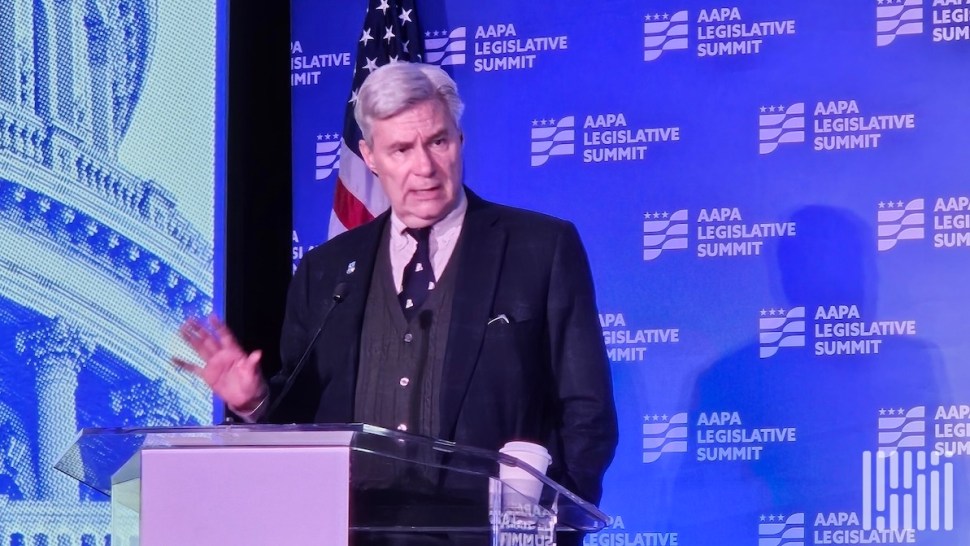
The Surface Transportation Act covering highway spending and the Water Resources Development Act funding the U.S. Army Corps of Engineers] and its projects, “are both on their way forward,” said Sen. Sheldon Whitehouse of Rhode Island, ranking Democrat on the Environment and Public Works committee, at a meeting of the American Association of Port Authorities. The committee is chaired by Republican Shelly Moore Capito of West Virginia, “and I can tell you that we are working very well together, not only on those bills, but on other issues,” including permitting reform negotiations, which he termed a leading issue.
“There’s plenty of activity going on between permitting reform, the highway bill, and water [Army Corps] bill,” Whitehouse said. “That’s going forward on a good, solid, sensible, bipartisan basis. So we’re off to a good start.”
Ocean State native Whitehouse acknowledged that ports are businesses that have to pay their bills but also serve as gateways for $2 trillion worth of goods that flow in the U.S. economy each year.
“So, it’s obviously very important that as programs and projects are developed by the Department of Transportation or the Corps that they’d be sensible, that they hold recipients to account, that they not be wasted funds,” he said. “Those issues, which are relatively minor in the context of $2 trillion in traffic, should not interfere with the flow through the gateway.”
He said members are pressing hard for more flexibility in the bills to accommodate rapidly rising costs for ports programs and projects.
“We think that flexibility makes sense, to not have to worry because suddenly expenses went up a lot and now you’re over the program cap, and everything has to be relitigated,” said Whitehouse. “Those sorts of things get in the way of what is really important about your business, and that is the traffic that flows through it, keeping that moving effectively. So, we are very aware, both chairman Capito and myself, and we are looking to try to be helpful in that regard.”
Whitehouse, in his fourth term and a leading Senate voice on climate change, is pressing port development decision-making based on the best available data about flood and coastal risk conditions. He said that Rhode Island officials have found the Federal Emergency Management Agency’s (FEMA’s) flood maps “comically, and often tragically, inaccurate. They don’t use the best available technologies to determine flood risk, and tend to overlook changes in weather patterns from climate change because they don’t want to get into that conversation. So, they ignore obvious predictions.”
The state built StormTools, its own coastal flood prediction model, to make sure that the decisions made about its coasts and ports are informed by top quality data.
Whitehouse said big private equity firms, banks, commercial real estate companies and insurers are buying up all the expertise they can find in flood risk prediction, so that they can make the best quality decisions and as investors, potentially arbitrage their knowledge advantage over people who are still relying on “deficient and defective” FEMA data.
Whitehouse said lawmakers and business need to “lift our game” in terms of understanding the scope of the problem that ranges beyond simply raising docks and piers. He recalled a conversation with the then-commanding officer of Virginia’s Naval Station Norfolk, the largest Navy base on the East Coast.
“He warned that within about 20 years that base would probably no longer be of utility to the Navy and that was eight years ago, so we’re well into his prediction window. And, it wouldn’t be because they couldn’t raise the piers; it would be because neighboring Hampton Roads is pretty flat. And when floods come, can you also raise all the roads to the piers? Can you also raise all the schools? Can you also raise the shopping center that gets flooded out? Can you build the whole community to flood-proof it? Because it takes that whole community around the piers of Naval Station Norfolk to support its essential military function.”
Whitehouse said policy makers in Washington are keenly aware of the hazards faced by ports that he said are beginning to feel a real geographic edge on their business. “We really need to make sure we get the data right, so that the best possible decisions are being made [about development],” he said.
The senator also warned about the dangers that climate risk presents to the U.S. economic system, echoed not just by environmentalists but by the chairman of the Federal Reserve and the chief economist of the Federal Home Loan Mortgage Corporation, “that climate change is making weather impacts so much worse and so much less predictable that it damages insurance markets. And we’re seeing it already a lot in Florida. All you have to do is ask them about home insurance, and you’ll get an earful.”
When climate risk makes insurance unaffordable or unavailable, Whitehouse said, that can lead to property becoming uninsurable, and unmortgageable. That property then becomes hard to sell, crashing property values – a precursor of recession.
“When Ernest Hemingway went bankrupt he was asked, ‘How’d that happen?’ He said, ‘Gradually, and then all at once.’ I am worried that we are well into the ‘gradually’ part of this with insurance.”
Whitehouse finished by speaking to the campaign of political retribution by Trump that’s entered into government decision-making in unprecedented ways.
“We saw it with $11 billion in projects that Trump OMB (Office of Management and Budget) ordered to be canceled, all in blue states,” he said. “And they weren’t coy about it, they said it’s because we didn’t vote for legislation that the president wanted. A world in which the grant programs that our economy depends on and that red and blue Americans depend on is affected by political interference is not a good world.”
Whitehouse said Democrats are pushing back, and he joined with New Mexico’s Martin Heinrich of the Energy and Natural Resources Committee to pause negotiations on permitting reform.
“Solar projects seem to be never leaving the Secretary of the Interior’s desk, and plainly illegal stop-work orders were repeatedly dropped on fully permitted and nearly complete offshore wind projects. We just said, ‘If that’s the way you’re going to be, these conversations are over.’
“It took about six weeks for that to sink in but as of today, we’re now seeing that we’re turning to the negotiating table, because Interior is starting to clear those funded projects, and we’re going to be looking for assurances that the offshore wind projects can be concluded without further mischief and interference.”
Whitehouse said he is wary of interference in USACE decisions.
“That’s where that $11-billion hit came through Army Corps decisions, the Army Corps has never been political like that before, and we’re seeing some of it through highway decisions, as well.”
While he said Transportation Secretary Sean Duffy has been “quite good, we’re more watchful about that, because we don’t want to go there.”
There may be a pause, Whitehouse said, in water bill or highway bill negotiations “if the political interference and retribution in highway and Army Corps projects merits that intervention. It worked with respect to permitting reform, and now we are back on track and we think that the base dam of clean energy permitting is broken and the business has started to flow. We can always go back to pause on that if it turns out that it was just a stutter-step to get us back to negotiating and wasn’t real.
“But we want that bill to pass, we’re going to take them on faith that this is something real. We’re going to trust, we’ll verify, and we’re going to keep going forward. The hazard to that progress is more than anything else, illegal unjustified, partisan interference and ongoing projects for purposes of political retribution.”
He said the more voices from the private sector that can be heard by the administration will be helpful.
“There’s every reason to believe that the bipartisanship in the committee will hold, that the goodwill between me and chairman Capito will hold that the economic urgency of getting those bills done, and getting those improvements made will drive the day but there is always the danger that really extreme partisanship will break that up.
“I hope that’s not the case.”
Video produced by Stuart Chirls, see more of my reporting here.
Related coverage:
Marad’s Carmel says U.S. must build new maritime system
After Trump photo op, CMA CGM will re-flag 30 ships in France
Strait of Hormuz closure: How supply shocks threaten American crops
Why Strait of Hormuz maritime access is also its biggest weakness
Brokerage Compliance Symposium
The day before F3. Every compliance issue you face - fraud exposure, carrier liability, FMCSA rules, cargo theft, insurance gaps - navigated by attorneys and operators defining best practices in a changing industry.
F3 Awards Dinner
The night before F3. FreightTech100 companies honored. FreightTech 25 and Shipper of Choice winners revealed live. Cocktail reception into dinner and live music - 300 industry leaders in one purpose-built room.
F3: Future of Freight Festival
Industry-defining keynotes, rapid-fire technology demos, and industry leaders networking in experiences across Chattanooga - plus the inaugural F3 Awards Dinner featuring the FreightTech and Shipper of Choice reveals.
The day before F3. Every compliance issue you face - fraud exposure, carrier liability, FMCSA rules, cargo theft, insurance gaps - navigated by attorneys and operators defining best practices in a changing industry.
The Signal at Chattanooga Choo Choo • Chattanooga, TN Register NowThe night before F3. FreightTech100 companies honored. FreightTech 25 and Shipper of Choice winners revealed live. Cocktail reception into dinner and live music - 300 industry leaders in one purpose-built room.
The Signal at Chattanooga Choo Choo • Chattanooga, TN Register NowIndustry-defining keynotes, rapid-fire technology demos, and industry leaders networking in experiences across Chattanooga - plus the inaugural F3 Awards Dinner featuring the FreightTech and Shipper of Choice reveals.
The Signal at Chattanooga Choo Choo • Chattanooga, TN Register Now