Chart of the Week: National Truckload Index– USA SONAR: NTI.USA
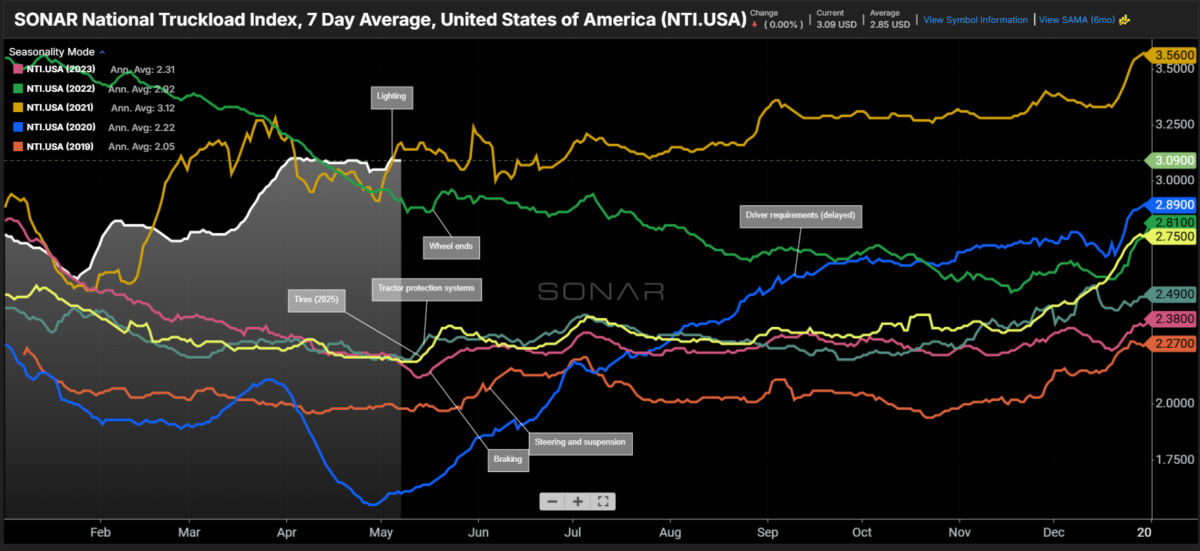
International Roadcheck is a 72-hour period when members of the Commercial Vehicle Safety Alliance (CVSA) conduct a heightened period of inspections on commercial vehicles. Since 2022, they have designated two primary areas of focus — one for the driver and one for the vehicle. Its impact on the domestic trucking market varies from a non-event (2020 did not produce a strong noticeable move in spot rates) to sharp 6-8% spikes in spot rates. This year’s period starts May 12 and focuses on ELDs and cargo securement.
The CVSA states that International Roadcheck inspects nearly 15 trucks and motorcoaches every minute during the 72-hour period throughout North America, making it the largest targeted enforcement program on commercial motor vehicles in the world.
Last year, there were 56,178 inspections with a vehicle out-of-service (OOS) rate of 18.1% and a driver OOS rate of 5.9%. The vehicle inspection focus was tires, which accounted for 21.4% of vehicle OOS violations, while hours of service (HOS) — though not a focus area — led driver OOS violations at 32.4%. The falsified logs focus accounted for 10% of total driver OOS violations.
For context, Roadcheck week tire violations accounted for roughly 4.5% of the entire year’s tire violations in just three days. False RODS violations accounted for roughly 5% of the year’s total false log violations in less than 1% of the calendar year. The 56,000 inspections represent approximately 1.4% of total annual inspections across North America.
So while this period does not represent a large share of annual OOS violations, the elevated OOS rate, heightened visibility, and concentrated enforcement do influence the market — as many drivers choose to avoid certain areas or take the week off, temporarily reducing capacity.
Roadcheck week does not affect all carriers equally. Larger fleets are generally more motivated to maintain compliance given the increased liability exposure they carry. Their scale makes them more susceptible to litigation when drivers or vehicles are found non-compliant. Smaller carriers and owner-operators carry less payout potential and are less likely to be involved in nuclear verdicts.
Tender data skews toward larger fleets given its reliance on electronic transmission infrastructure, which smaller carriers are less likely to have. So while tender rejection rates have increased just over a percentage point on average in recent years, this is driven more by the pull of elevated spot rates and increased load availability than by an actual reduction in capacity.
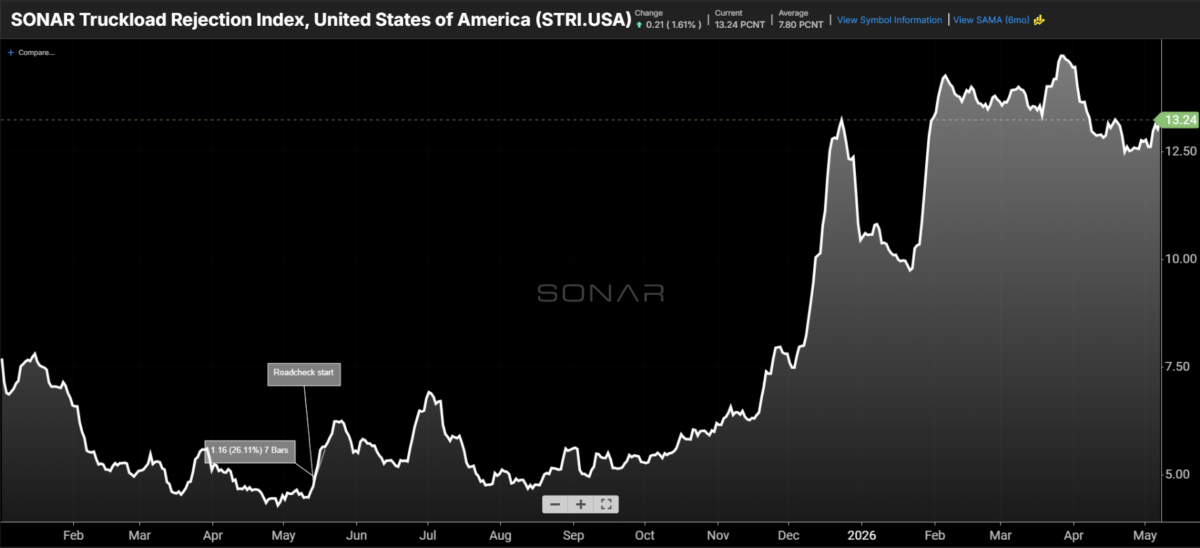
Last year’s inspection period started May 13 and produced one of the stronger increases in tender rejection rates for the period, with an approximately 117 basis point increase during the week. Rejection rates continued to climb heading into Memorial Day weekend, which complicates a clean analysis of Roadcheck’s standalone impact. Rejection rates increased from 4.48% on May 11 and peaked at 6.25% on May 25, with Memorial Day falling on May 26.
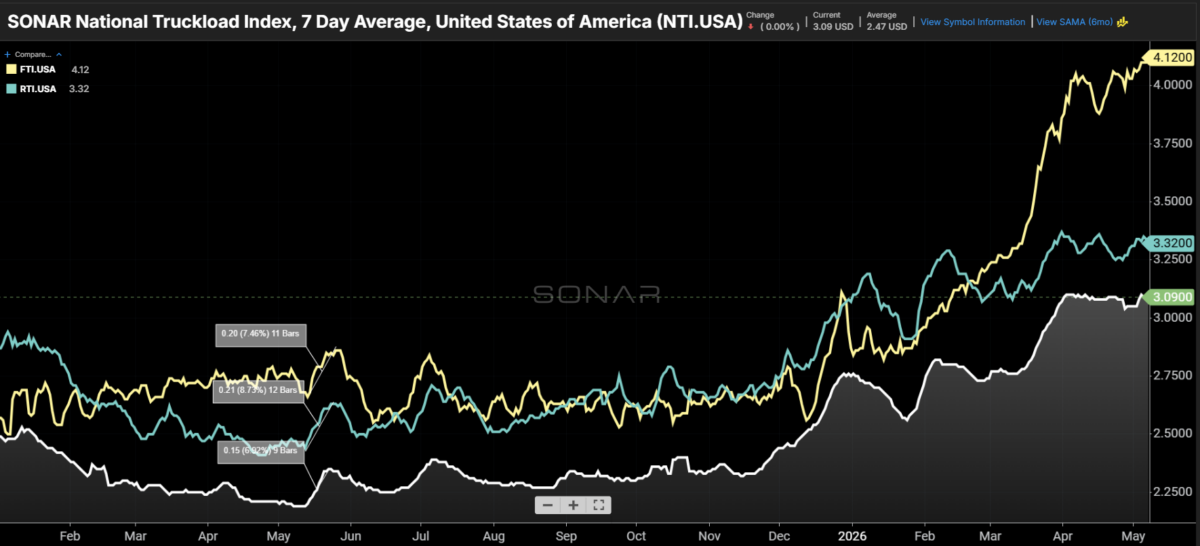
Dry van spot rates were the least responsive last year, increasing roughly 7%, including the Memorial Day effect. Reefer had the strongest response at just under 9%, and flatbed came in around 7.5% higher. Separating Roadcheck’s influence from Memorial Day’s is difficult given the proximity of the two events.
It should be noted that not all inspection focus areas generate OOS violations — ABS systems in 2023 being one example. One of this year’s focus areas, cargo securement, has a relatively limited scope in terms of what can result in an OOS order.
In the bigger picture, the inspection period is short-lived, but its timing can make the impact feel larger than it is. It traditionally coincides with a period of rising freight demand and holiday-driven capacity disruption, which may amplify its perceived significance. Compared to broader market forces, the impact of this week is relatively modest — though it can make an already challenging environment more difficult and contribute to a more volatile start to the summer shipping season.
About the Chart of the Week
The FreightWaves Chart of the Week is a chart selection from SONAR that provides an interesting data point to describe the state of the freight markets. A chart is chosen from thousands of potential charts on SONAR to help participants visualize the freight market in real time. Each week a Market Expert will post a chart, along with commentary, live on the front page. After that, the Chart of the Week will be archived on FreightWaves.com for future reference.
SONAR aggregates data from hundreds of sources, presenting the data in charts and maps and providing commentary on what freight market experts want to know about the industry in real time.
Brokerage Compliance Symposium
The day before F3. Every compliance issue you face - fraud exposure, carrier liability, FMCSA rules, cargo theft, insurance gaps - navigated by attorneys and operators defining best practices in a changing industry.
F3 Awards Dinner
The night before F3. FreightTech100 companies honored. FreightTech 25 and Shipper of Choice winners revealed live. Cocktail reception into dinner and live music - 300 industry leaders in one purpose-built room.
F3: Future of Freight Festival
Industry-defining keynotes, rapid-fire technology demos, and industry leaders networking in experiences across Chattanooga - plus the inaugural F3 Awards Dinner featuring the FreightTech and Shipper of Choice reveals.
The day before F3. Every compliance issue you face - fraud exposure, carrier liability, FMCSA rules, cargo theft, insurance gaps - navigated by attorneys and operators defining best practices in a changing industry.
The Signal at Chattanooga Choo Choo • Chattanooga, TN Register NowThe night before F3. FreightTech100 companies honored. FreightTech 25 and Shipper of Choice winners revealed live. Cocktail reception into dinner and live music - 300 industry leaders in one purpose-built room.
The Signal at Chattanooga Choo Choo • Chattanooga, TN Register NowIndustry-defining keynotes, rapid-fire technology demos, and industry leaders networking in experiences across Chattanooga - plus the inaugural F3 Awards Dinner featuring the FreightTech and Shipper of Choice reveals.
The Signal at Chattanooga Choo Choo • Chattanooga, TN Register Now