




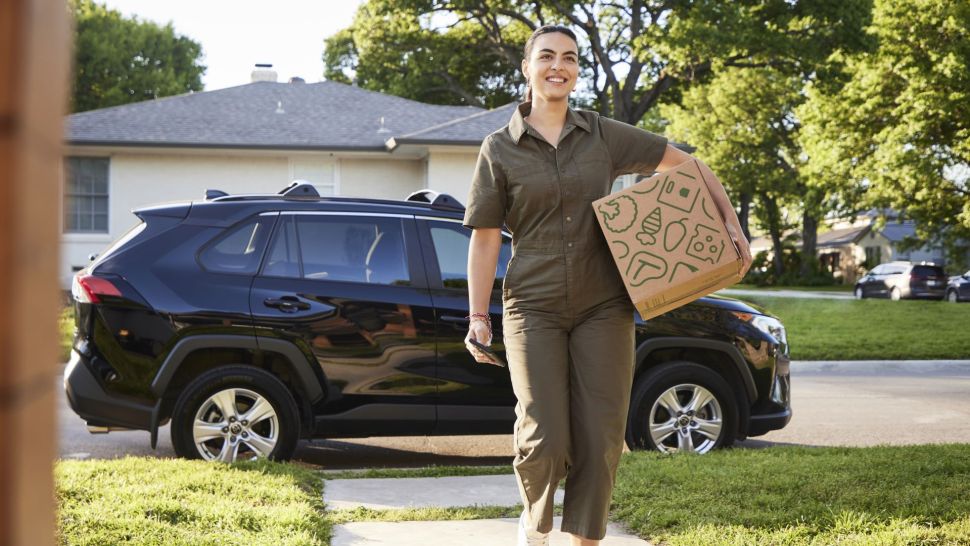
Three non-traditional last-mile parcel delivery companies recently announced network expansions, a major executive hire and a new sales partnership as the competition for market share continues to intensify in a sector where demand has flattened in recent years and there is excess capacity.
All the companies offer lower shipping rates than FedEx and UPS by using non-employee delivery agents — often referred to as gig drivers — and self-developed apps for matching them to available parcels for delivery. They, and a host of other regional carriers drawn by the growth of online shopping, are racing to build out their networks and capabilities, touting one-to-three day delivery and strong on-time performance claims. Many are also trying to match FedEx and UPS in shipment management technology. FedEx and UPS are already losing market share to large retailers with their own delivery services and independent carriers, according to analysts.
But there are questions about whether the market can sustain so many providers and whether profit margins can sustain expensive network buildouts.
In a column published Tuesday, exclusively on FreightWaves, ShipMatrix President Satish Jindel urged FedEx to adopt the gig driver model for B2C home deliveries, saying it would quickly take business from rival carriers and boost its bottom line.
ShipMatrix estimates U.S. parcel volume will grow at a compound annual rate of 4% over the next three years to 26.8 billion in 2027, with most of the growth handled by alternative carriers, including Amazon.
Here are some recent developments in the U.S. domestic small-package delivery industry.
Veho seeks deeper e-commerce partnerships
Veho, which provides home delivery for e-commerce brands and logistics providers, has added Ann Arbor, Michigan; Akron, Ohio; and Greensboro/Winston-Salem, North Carolina, to its service area, the company said last week in a news release. The service rollout puts the New York-based courier on track to reach 60 markets and 128 million consumers by the end of 2025, up from 46 markets at the start of the year.
Veho had a soft launch of service in Greensboro and Winston-Salem in February, and now is delivering more than 10,000 parcels per week. The company said that type of growth is driving investment in parcel injection, sortation and distribution capacity in the Southeast, including the move to a regional hub outside Atlanta that has five times the processing capacity of its previous location.
Expansion of delivery service in Ann Arbor builds on last year’s entry into the Detroit delivery market. Veho’s delivery platform in Akron started two weeks ago and is responsible for thousands of deliveries each week, according to the news release.
Veho this year has expanded its geographic reach to Southern California, New York City, St. Louis, Cleveland, Pittsburgh, Richmond, Virginia; and Louisville, Kentucky.
Last week, Veho appointed Neel Madhvani to the newly created position of chief product officer. All product and operations teams will report to him.
A veteran of three large supply chain organizations, Madhvani was hired so Veho can ensure products it develops are what e-commerce shippers want and that operations meet expectations, as merchandise and logistics begin to merge into a unified service, officials said. The goal is to make its delivery experience a differentiator for e-commerce brands — by offering multiple product tiers, expanding into new categories and building software tools that help them manage, measure and optimize their customer experience beyond delivery — so consumers won’t hesitate to make a purchase at checkout
“Our focus will be on designing service levels, optionality, and other products that e-commerce leaders want, improve their customer relationships, and help them get a better return on their shipping spend – as well as enhance the technical and operational capabilities to ensure we deliver on that promise,” said Madhvani in the news release.
As chief product officer at Copart, a major automobile remarketing and logistics network, Madhvani led product, design, analytics and customer service, driving significant and rapid increase in customer satisfaction, according to a news release. He previously worked at Chewy, overseeing the end-to-end shopping experience and the infrastructure backbone supporting sales. Before that, Madhvani led Staples’ industrial division, where he helped run warehouses, integrate sales and operations, and deliver high-volume fulfillment.
Veho is pushing to introduce advanced technology that allows shoppers to provide delivery instructions, control the delivery window or speed up and slow down delivery based on when the person will be home, similar to tech capabilities offered by Amazon. Surveys show consumers tend to buy more from brands when the delivery experience is smooth, reliable and offers some control.
“That’s what Neel’s working on. Building those products, getting us further integrated into the checkout screen, and then ensuring the operations can fulfill the promise,” Veho spokesman Evan Wagner explained in an email exchange. “At Chewy, he helped design the playbook for creating emotional connection in e-commerce, the small, human gestures that made customers feel looked after. At Veho, he’s trying to take that same thinking and apply it to the doorstep experience — making delivery feel like an extension of a brand, not just a transaction.”
FedEx and UPS already have shipment management technology that offers brands and consumers flexible shipping options. Both offer free versions and paid subscriptions. Free versions have limited ability to affect the delivery, but provide notifications, tracking and other features.
UPS My Choice, for example, allows customers to get packages delivered to a UPS shipping station, different address or to a neighbor, request delivery within a two-hour window and add delivery instructions for the driver, often for an upcharge.
With FedEx Delivery Manager, customers can redirect a package from a residential destination to retail pickup locations, like a Walgreens or FedEx Office store, free of charge, where someone else can also be authorized to pick up the package. The technology also allows recipients to virtually sign in advance for a package that requires authorization for proof of delivery. Recipients can also save delivery instructions for drivers.
John Costanzo, president and CEO of LDK Global Logistics said he’s not aware of any capability yet that enables a carrier to speed up or slow down delivery once a shipment is already in route.
“Speeding up/ slowing down deliveries would be very difficult to do because it’s antithetical to optimization of delivery routes, adding expense and delay to the delivery process,” Costanzo told FreightWaves in an email exchange. “The use of shipping centers and parcel lockers is much more effective and efficient, and it gives the consignee the same ability to retrieve their packages when it’s convenient for them to do so.”
SpeedX geographic expansion
SpeedX, which is investing hundreds of millions of dollars to build out its U.S. footprint over an 18-month period, earlier this month said on LinkedIn that it plans to service more than 15,000 U.S. zip codes by the first quarter of 2026, up from 11,000 currently.
Gofo
Parcel delivery startup Gofo announced this week that Cirro E-commerce, an end-to-end provider of international small-parcel logistics and fulfillment services in the United States, Europe and Oceania, will serve as its strategic sales partner in the U.S. Cirro essentially is adding Gofo to the list of last-mile carriers, which includes DHL, FedEx, UPS and the U.S. Postal Service, it offers retail brands.
Gofo this month opened super hubs in Newark, New Jersey, and Los Angeles ahead of the peak shipping season. In addition to the $150 million investment, Gofo operates more than 100 automated hubs and stations and a U.S. line-haul network with more than 30 routes. Its delivery service, which provides next-day delivery around major hubs and three-to-five day delivery across states and regions, is available in 49 of the top 50 markets, according to the company.
Click here for more FreightWaves/American Shipper stories by Eric Kulisch.
RELATED STORIES:
US parcel market to grow 36% by 2030, Pitney Bowes says
Last-mile delivery startup SpeedX buys e-commerce logistics specialist
Veho beefs up parcel sorting capacity for peak season, future growth
Brokerage Compliance Symposium
The day before F3. Every compliance issue you face - fraud exposure, carrier liability, FMCSA rules, cargo theft, insurance gaps - navigated by attorneys and operators defining best practices in a changing industry.
F3 Awards Dinner
The night before F3. FreightTech100 companies honored. FreightTech 25 and Shipper of Choice winners revealed live. Cocktail reception into dinner and live music - 300 industry leaders in one purpose-built room.
F3: Future of Freight Festival
Industry-defining keynotes, rapid-fire technology demos, and industry leaders networking in experiences across Chattanooga - plus the inaugural F3 Awards Dinner featuring the FreightTech and Shipper of Choice reveals.
The day before F3. Every compliance issue you face - fraud exposure, carrier liability, FMCSA rules, cargo theft, insurance gaps - navigated by attorneys and operators defining best practices in a changing industry.
The Signal at Chattanooga Choo Choo • Chattanooga, TN Register NowThe night before F3. FreightTech100 companies honored. FreightTech 25 and Shipper of Choice winners revealed live. Cocktail reception into dinner and live music - 300 industry leaders in one purpose-built room.
The Signal at Chattanooga Choo Choo • Chattanooga, TN Register NowIndustry-defining keynotes, rapid-fire technology demos, and industry leaders networking in experiences across Chattanooga - plus the inaugural F3 Awards Dinner featuring the FreightTech and Shipper of Choice reveals.
The Signal at Chattanooga Choo Choo • Chattanooga, TN Register Now