




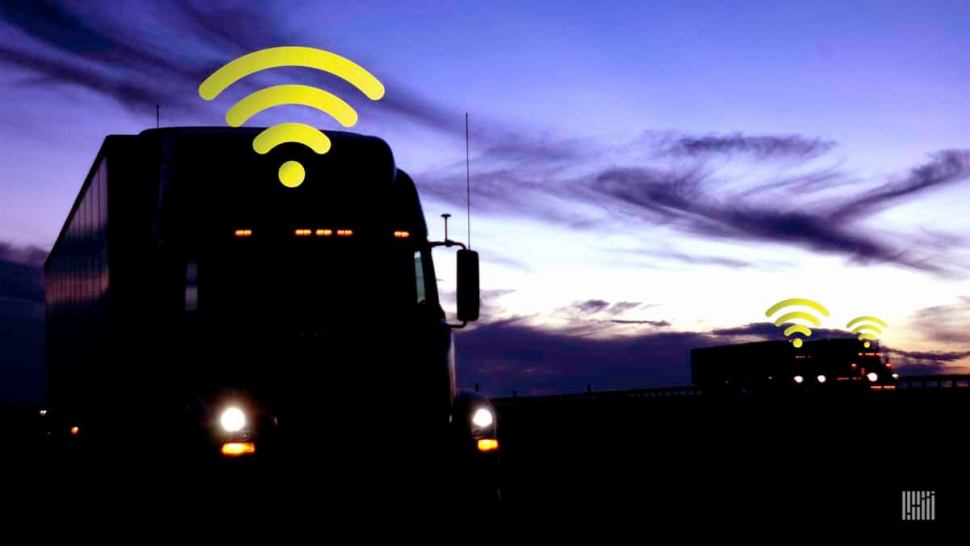
A top transportation lawmaker is pressuring the Biden administration to reconsider a proposal that trucking advocates say could hinder the deployment of truck platooning and other connected-vehicle automation.
In a letter sent Thursday to the Federal Communications Commission (FCC), House Transportation and Infrastructure Chairman Peter DeFazio, D-Oregon, warned that the independent agency’s decision last year to share the 5.9 GHz frequency band with unlicensed Wi-Fi could hinder progress on so-called vehicle-to-everything (V2X) technology, which is essential to platooning automation.
“The parameters in the FCC’s First Report and Order (R&O) will make V2X communications vulnerable to harmful interference and leave V2X with little dedicated spectrum,” DeFazio said. “If the interference issues are not resolved, V2X may have no usable spectrum at all.”
Commercial trucking companies have been relying on the 5.9 GHz band for testing truck platooning, whereby convoys following at extremely short distances require the technology to maintain safety.
“With short-range commercial truck platooning where trucks follow close behind each other, reaction time is incredibly important. When the lead truck steps on the brake, the following truck has seconds to react,” truck platooning expert Alberto Lacaze, co-founder and president of Robotic Research, told FreightWaves last year.
The FCC’s move to carve out more bandwidth for Wi-Fi was backed heavily by the telecommunications industry. But DeFazio pointed out that the decision ignored safety concerns raised by the U.S. Department of Transportation, which has contended that the 5.9 GHz band is needed for advanced driver assistance safety systems that hold the promise of drastically reducing fatal accidents.
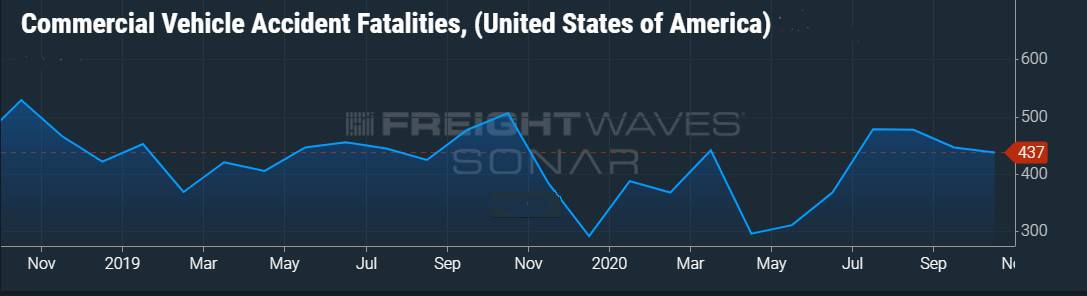
To learn more about FreightWaves SONAR, click here.
The decision was also opposed by 38 members of Congress, state departments of transportation and trucking advocates such as the American Trucking Associations, DeFazio said. “Instead, the commission, ‘which is not an auto safety expert,’ according to FCC Commissioner Michael O’Rielly, approved an unsafe proposal that stands to undermine roadway safety,” DeFazio said.
“It is my hope that the FCC will take a more measured approach to the 5.9 GHz band under the Biden administration and provide the proper consideration to the impacts that this decision stands to have on the lives of the traveling public.”
DeFazio’s request was supported by Shailen Bhatt, president and CEO of ITS America, which advocates for transportation technology.
“With the recent National Safety Council’s alarming estimates that 42,060 people died on U.S. roadways last year – an 8% jump – now is not the time to give away a majority of this spectrum,” Bhatt asserted. “In addition, state and local transportation agencies have invested hundreds of millions of dollars in this lifesaving technology that would be wasted if the FCC plows ahead with its plan.”
FCC officials were not immediately available to comment.
Related articles:
Brokerage Compliance Symposium
The day before F3. Every compliance issue you face - fraud exposure, carrier liability, FMCSA rules, cargo theft, insurance gaps - navigated by attorneys and operators defining best practices in a changing industry.
F3 Awards Dinner
The night before F3. FreightTech100 companies honored. FreightTech 25 and Shipper of Choice winners revealed live. Cocktail reception into dinner and live music - 300 industry leaders in one purpose-built room.
F3: Future of Freight Festival
Industry-defining keynotes, rapid-fire technology demos, and industry leaders networking in experiences across Chattanooga - plus the inaugural F3 Awards Dinner featuring the FreightTech and Shipper of Choice reveals.
The day before F3. Every compliance issue you face - fraud exposure, carrier liability, FMCSA rules, cargo theft, insurance gaps - navigated by attorneys and operators defining best practices in a changing industry.
The Signal at Chattanooga Choo Choo • Chattanooga, TN Register NowThe night before F3. FreightTech100 companies honored. FreightTech 25 and Shipper of Choice winners revealed live. Cocktail reception into dinner and live music - 300 industry leaders in one purpose-built room.
The Signal at Chattanooga Choo Choo • Chattanooga, TN Register NowIndustry-defining keynotes, rapid-fire technology demos, and industry leaders networking in experiences across Chattanooga - plus the inaugural F3 Awards Dinner featuring the FreightTech and Shipper of Choice reveals.
The Signal at Chattanooga Choo Choo • Chattanooga, TN Register Now