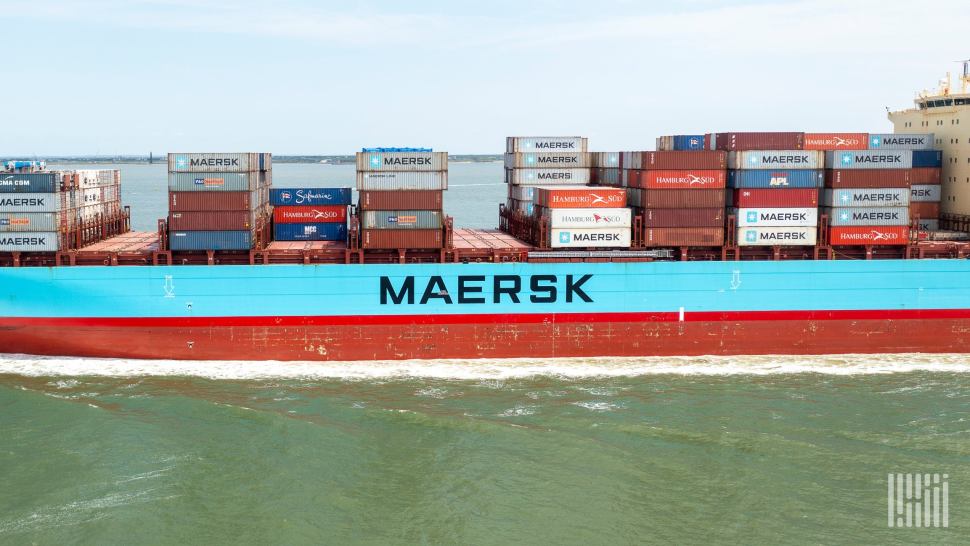
Maersk on Friday said that one of its container ships had successfully completed a voyage through the Red Sea and Gulf of Aden.
Maersk said that the Singapore-flagged Maersk Sebarok, a 6,500-TEU ship currently operating on the MECL service connecting India with the United States East and Gulf coasts, transited the Bab el-Mandeb Strait and Red Sea Dec. 18-19.
But the world’s second-largest liner operator said it has no plans for a full return to the Suez Canal route.
“We are closely monitoring developments and exploring opportunities for a safe and sustainable return to East-West Suez transit,” Maersk (MAERSK-B.CO) said on its website. “We can now share that an initial transit has successfully been completed.”
Major container and tanker vessel operators in early 2024 began to divert services away from the Red Sea, a key route connecting Asia, Europe, the Mediterranean and U.S., after Houthi militia in Yemen launched attacks on shipping in support of the Palestinians.
Diverted voyages around the tip of Africa add operational expense and as much as two weeks to a typical voyage. But recent falling diesel prices have led some analysts to speculate that the longer voyages are actually more cost-effective than paying tolls to transit the Suez Canal.
“Whilst this is a significant step forward, it does not mean that we are at a point where we are considering a wider East-West network change back to the trans-Suez corridor,” the statement said.
Maersk said that as long as security thresholds ensure the safety of ships, crew and cargo, it will consider continuing a stepwise approach towards a gradual return to east-west services via the Suez Canal and Red Sea.
“The first step is this initial sailing, followed by a limited number of additional trans-Suez sailings. However, there are no planned sailings currently.”
Find more articles by Stuart Chirls here.
Related coverage:
Despite headwinds, Port of Los Angeles nears 10M TEUs
ONE returns to Red Sea with new service
Report: China demands control of Panama ports operator
Carriers look to higher rates, fewer sailings on key Asia-US route
Brokerage Compliance Symposium
The day before F3. Every compliance issue you face - fraud exposure, carrier liability, FMCSA rules, cargo theft, insurance gaps - navigated by attorneys and operators defining best practices in a changing industry.
F3 Awards Dinner
The night before F3. FreightTech100 companies honored. FreightTech 25 and Shipper of Choice winners revealed live. Cocktail reception into dinner and live music - 300 industry leaders in one purpose-built room.
F3: Future of Freight Festival
Industry-defining keynotes, rapid-fire technology demos, and industry leaders networking in experiences across Chattanooga - plus the inaugural F3 Awards Dinner featuring the FreightTech and Shipper of Choice reveals.
The day before F3. Every compliance issue you face - fraud exposure, carrier liability, FMCSA rules, cargo theft, insurance gaps - navigated by attorneys and operators defining best practices in a changing industry.
The Signal at Chattanooga Choo Choo • Chattanooga, TN Register NowThe night before F3. FreightTech100 companies honored. FreightTech 25 and Shipper of Choice winners revealed live. Cocktail reception into dinner and live music - 300 industry leaders in one purpose-built room.
The Signal at Chattanooga Choo Choo • Chattanooga, TN Register NowIndustry-defining keynotes, rapid-fire technology demos, and industry leaders networking in experiences across Chattanooga - plus the inaugural F3 Awards Dinner featuring the FreightTech and Shipper of Choice reveals.
The Signal at Chattanooga Choo Choo • Chattanooga, TN Register Now