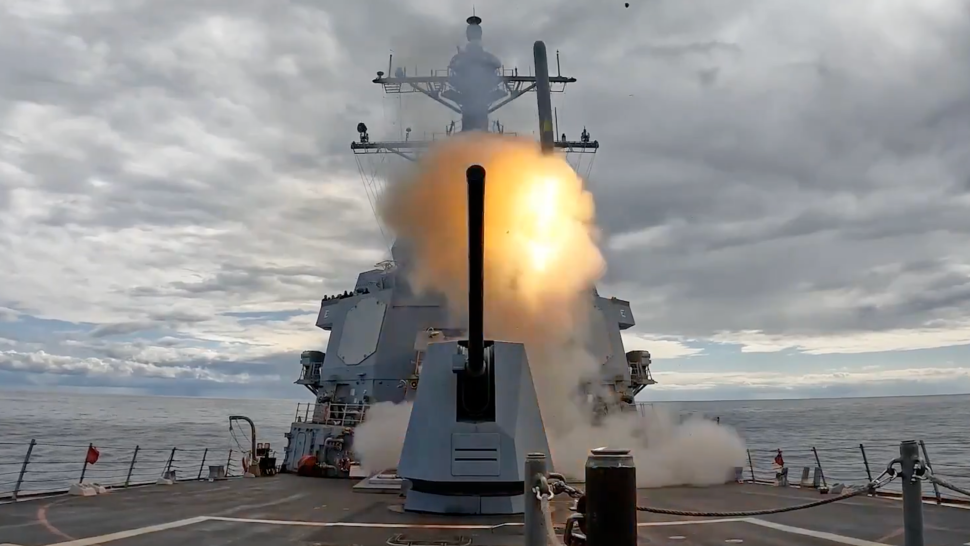
While tanker vessels came under fire in the Strait of Hormuz, container lines were suspending operations to Persian Gulf ports following the joint Israel-U.S. attack on Iran.
Media reports said ports in the United Arab Emirates and Dubai’s port of Jebel Ali were hit by Iranian missiles, and that Tehran had attacked at least three tankers in the strait. A fire began at Jebel Ali after an incoming drone was intercepted.
While the strait has not been officially closed, several liner operators suspended operations to the Persian Gulf, and ordered their vessels to seek shelter.
Hormuz is the gateway for Persian Gulf energy transport, with about 20% of the world’s crude oil supply passing through its waters. While futures prices ticked up late Sunday, analysts note that 80% of Iran’s oil is sold to China, so it’s unclear what the extended effect could be on global markets.
The United Kingdom Maritime Trade Operations Centre, which monitors maritime security in the Middle East and Indian Ocean region, reported a number of attacks against vessels on Sunday.
Shipping was caught in the crossfire after Tehran responded following Saturday’s Epic Fury attack that killed Iran’s leader, Ayatollah Ali Khamenei, and other high-ranking government and military officials.
U.S. Central Command on Sunday denied Iranian claims that it hit the carrier USS Abraham Lincoln with a ballistic missile.
Maersk (MAERSK-B.CO), CMA CGM and Mediterranean Shipping Co. suspended or shifted vessel services to the region.
CMA CGM also announced an Emergency Conflict Surcharge of $2,000 for 20-foot, $3,000 per 40-foot and $4,000 per refrigerated container. The surcharge covers all Red Sea ports in Saudi Arabia, Egypt, Jordan, Djibouti, Sudan and Eritrea, as well as Persian Gulf destinations.
Maersk prior to the outbreak of hostilities said the deteriorating security situation led it to divert the MECL service to the United States and ME11 to North Europe away from the Suez Canal route and around Africa. The carrier had only recently restarted regular rotations through the Red Sea.
Iran-sponsored Houthi rebels in Yemen warned they would resume attacks that all but shut down Suez transits for the largest container carriers since late 2023.
“There is no viable alternative to getting containers in or out of ports such as Jebel Ali by ocean if the Persian Gulf is off limits,” said Xeneta analyst Peter Sand, in an email to FreightWaves. “Carriers will instead omit these calls on east-west services and drop boxes at a least-worst alternative port for onward transportation by road. This will cause severe disruption and port congestion at a regional level, but will not have a major impact on a global scale when compared to the seismic influence of conflict in the Red Sea.”
Sand noted ex-Asia container rates had ticked up since Feb. 15 as the U.S. massed forces near the Gulf.
Read more articles by Stuart Chirls here.
Related coverage:
UPDATED: Iran-backed Houthi warn of new Red Sea attacks
Court dismisses longshore union lawsuit against Virginia ports over automation
What trade war? Near-record imports at top US container port
Brokerage Compliance Symposium
The day before F3. Every compliance issue you face - fraud exposure, carrier liability, FMCSA rules, cargo theft, insurance gaps - navigated by attorneys and operators defining best practices in a changing industry.
F3 Awards Dinner
The night before F3. FreightTech100 companies honored. FreightTech 25 and Shipper of Choice winners revealed live. Cocktail reception into dinner and live music - 300 industry leaders in one purpose-built room.
F3: Future of Freight Festival
Industry-defining keynotes, rapid-fire technology demos, and industry leaders networking in experiences across Chattanooga - plus the inaugural F3 Awards Dinner featuring the FreightTech and Shipper of Choice reveals.
The day before F3. Every compliance issue you face - fraud exposure, carrier liability, FMCSA rules, cargo theft, insurance gaps - navigated by attorneys and operators defining best practices in a changing industry.
The Signal at Chattanooga Choo Choo • Chattanooga, TN Register NowThe night before F3. FreightTech100 companies honored. FreightTech 25 and Shipper of Choice winners revealed live. Cocktail reception into dinner and live music - 300 industry leaders in one purpose-built room.
The Signal at Chattanooga Choo Choo • Chattanooga, TN Register NowIndustry-defining keynotes, rapid-fire technology demos, and industry leaders networking in experiences across Chattanooga - plus the inaugural F3 Awards Dinner featuring the FreightTech and Shipper of Choice reveals.
The Signal at Chattanooga Choo Choo • Chattanooga, TN Register Now