Jaguar Transport Holdings, which owns or controls 11 other short lines, is seeking to buy two railroads in Washington state, the company said this week in filings with the Surface Transportation Board.
The transaction would include the Columbia Basin Railroad and the Central Washington Railroad. The Columbia Basin operates 86 miles of track — 73 owned by the railroad and 13 leased from BNSF — in a series of lines centered around Warden, Wash., southwest of Spokane. The Central Washington operates 80 miles of track in two disconnected sections in or near Yakima, Wash. The two railroads date to 1986.
The July 14 filings by Joplin, Mo.-based JTH said the intention is to close the deal by Aug. 13. However, BNSF Railway must approve the transaction; its agreement to sell the lines used by the two railroads includes right-of-first-refusal language giving the Class I railroad the option to repurchase the lines in the event of a transfer of control. The filing says closing will depend on BNSF’s pending response.
Financial and other terms of the sale were redacted from the CBRW and CWR STB filings.
The Jaguar Rail Holdings unit of JTH operates eight short lines: the Southwestern Railroad in New Mexico; Texas & Eastern; Oregon Eastern; Missouri Eastern; Charlotte Western and Kinston Railroad, both in North Carolina; Waterloo Railroad in Iowa; and the recently created Kansas City West Bottoms Railroad.
Two other railroads, the Cimarron Valley Railroad in Kansas, Oklahoma, and Colorado, and Washington Eastern Railroad, are controlled through Wyoming & Colorado, operator of the Oregon Eastern. The West Memphis Base Railroad is controlled through a separate JTH affiliate.
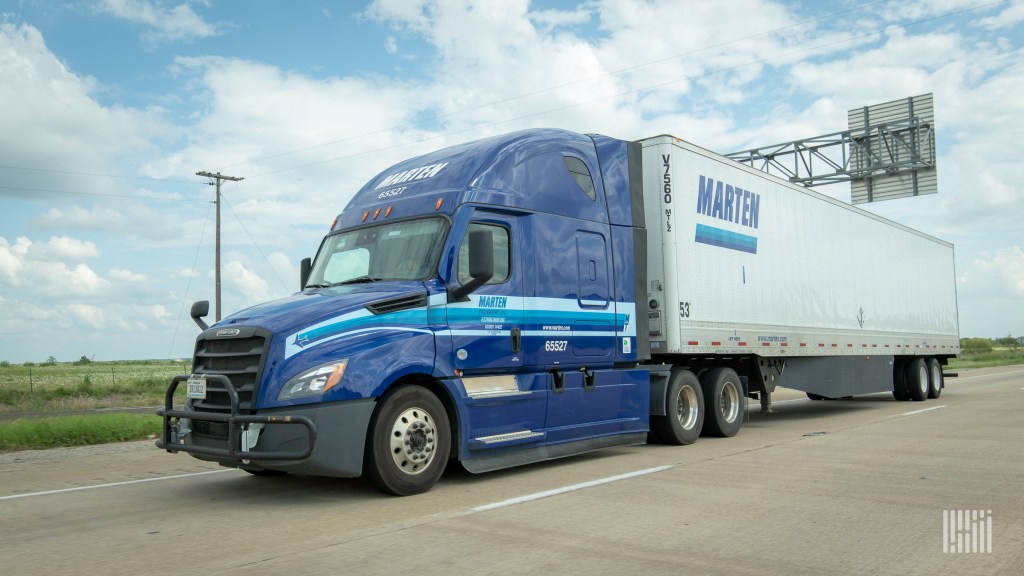
A smaller Marten turns in a second quarter of 2025 much like a year earlier
Marten Transport turned in a second quarter performance that by various metrics was an echo of the corresponding quarter of 2024, but it did so on a base that reflected a somewhat smaller company.
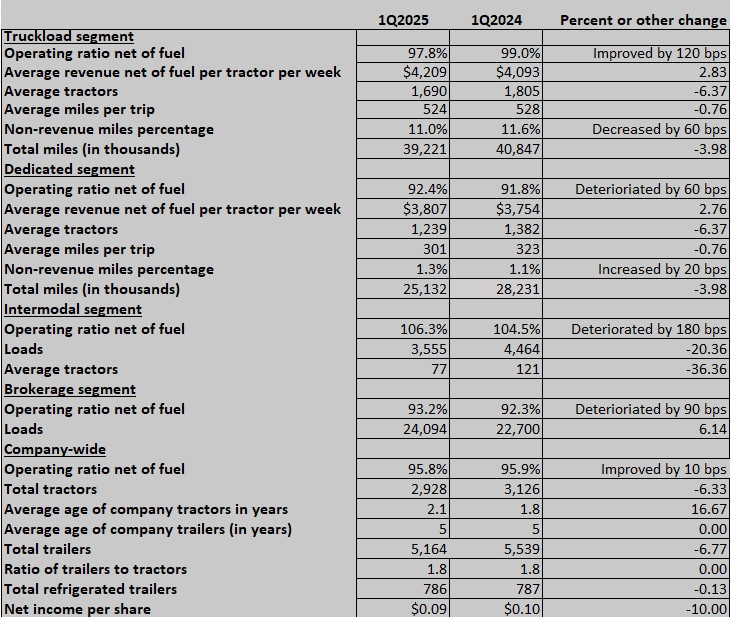
Compared to the second quarter of 2024, Marten’s revenue was down 6.6%. Its total number of tractors declined 6.3%. Total trailers were down 6.8%. It drove fewer miles in both its Truckload and Dedicated segments.
End result: net income was down about 9%. But there were several operating measures that showed improvement.
Marten’s operating ratio (OR) net of fuel in its Truckload segment, its largest by revenue, improved 120 basis points to 97.8% from 99%. Its Dedicated segment did see a deterioration in its OR, but it was only down 60 bps to 92.4% from 91.8%.
There was deterioration in the OR for its intermodal segment (down 180 bps to 106.3%) and its brokerage segment (down 90 bps to 93.2%).
The net result was where the year-on-year comparison looks most similar. Marten’s (NASDAQ: MRTN) company-wide OR in the second quarter of 2025 net of fuel was 95.2%. A year earlier, it was 95.3%.
There’s another financial metric in the report signaling that Marten has strengthened its business in one respect: its balance sheet, which shows cash and cash equivalent on hand at $35 million at the end of the quarter, up from $17.3 million just since the end of 2024.
The somewhat smaller size of Marten can also be seen in its figure for salaries, wages and benefits. They declined to $78.6 million from $86.5 million a year ago. For the six months, the number is down to $157.4 million compared to $175.3 million in the first half of 2024.
One expenditure that barely changed over the last year: purchased transportation. It was $43.1 million in the quarter, down from $43.2 million a year earlier. That suggests Marten moved a larger percentage of its freight with independent owner operators, given the decline in salaries and wages.
In his prepared remarks–Marten does not conduct an earnings call with analysts–Executive Chairman Randolph Marten focused on the company’s Dedicated and Brokerage segments for the last six months and full year, though he did not specifically mention the quarterly performance of those segments.
“Our unique multifaceted business model’s value continued to be highlighted by the operating results of our dedicated and brokerage operations for the first six months of this year and throughout last year,” he said in his remarks.
But for the quarter, operating income at Dedicated and Brokerage were significantly lower on a year-to-year comparison.
Dedicated dropped 18.4% year over year, to an operating income of $5.43 million from a year earlier. Brokerage fell 6.8% to operating income of $2.7 million.
For the six months, Dedicated’s operating income was down 35.4% and Brokerage was down 13.1%. Truckload increased 27.4%.
However, on an outright dollar basis, although Truckload produced about 40% of the company’s operating revenue, Dedicated and Brokerage each produced more dollars of operating income. And both had lower ORs than Truckload.
Dedicated’s operating income of $5.42 million was about 230% of Truckload’s, and Brokerage of $2.89 million was about 115% of Truckload, which came in at $2.34 million.
Brokerage also increased its operations. For the six months, brokerage loads rose 4%. They were up 6.1% for the second quarter.
Marten released its earnings while equity markets were open, which is unusual for any public company.
Marten’s stock showed no outright reaction to the earnings release. ,At approximately 3 p.m., it was up just 0.15%, or 2 cents, to $13.15.
It has been a tough year for Marten shareholders. In the last 52 weeks, Marten stock is down about 28.5%, though in the last 3 months it is up 2.25%, per Barchart data.
Randolph Marten acknowledged the market that it continues to face in its operations. “Our earnings have continued to be heavily pressured by the considerable duration and depth of the freight market recession’s oversupply and weak demand – and the cumulative impact of inflationary operating costs, freight rate reductions and freight network disruptions,” he said in the prepared statement.
Most of the expenses listed by Marten in its earnings report were not noticeably higher with one exception: insurance.
Second quarter insurance and claims expenses rose to $15.85 million from $12.56 million a year earlier. For the six months, the comparison was $29.23 million in the first half of 2025 and $24.22 million last year.
There is a growing theme in the trucking segment that a bottom may have been reached because of an expected drop in capacity as a result of federal enforcement of regulations regarding a driver’s ability to speak English. Marten addressed that in his prepared remarks.
“We remain focused on minimizing the freight market’s impact – and the impact of the U.S. and global economies with the current trade policy volatility – while investing in and positioning our operations to capitalize on profitable organic growth opportunities,” Marten said. “We expect such growth opportunities to be positively impacted by anticipated additional industry capacity exits relating to increased enforcement of the English Language Proficiency and B-1 visa regulations.”
Supply Chain AI Symposium to feature execs from Augment, project44, GenLogs, and HappyRobot
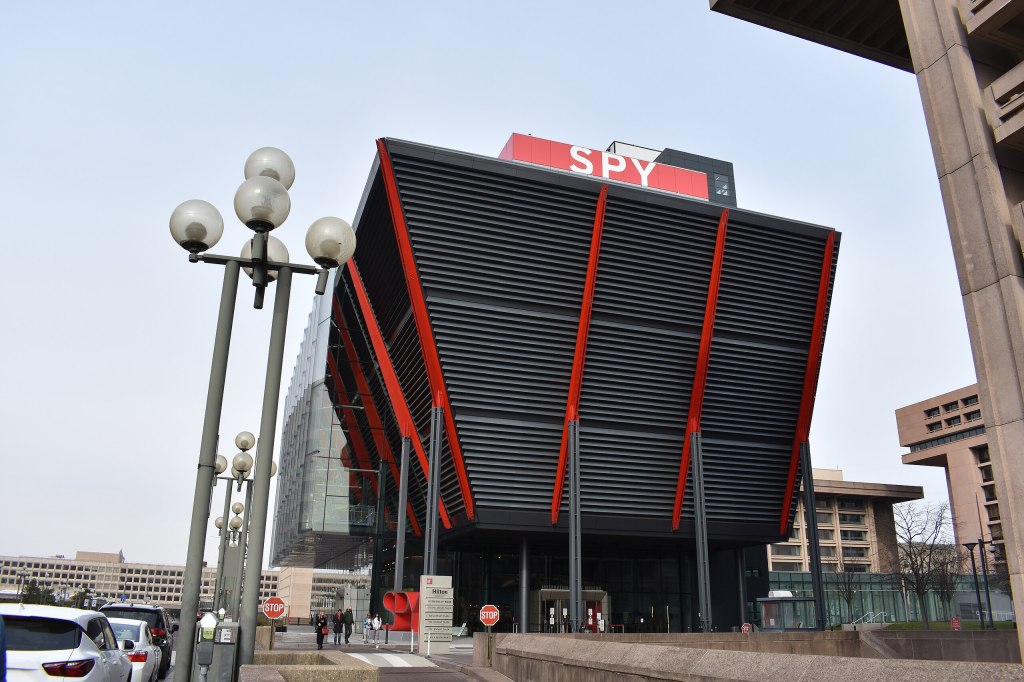
FreightWaves is gearing up to host its pioneering Supply Chain AI Symposium at the historic International Spy Museum in Washington, DC, on July 30, 2025. The event promises to bring together a dynamic mix of industry leaders, innovators, and AI enthusiasts who are at the forefront of transforming the logistics landscape. Among the notable speakers at the symposium are Harish Abbott, Jett McCandless, Ryan Joyce, and Javi Palafox, whose experiences and insights into AI-driven advancements in FreightTech will help symposium attendees stay on the leading edge.
Harish Abbott, the CEO and Co-founder of Augment, stands out as a visionary in logistics technology. With an impressive background in e-commerce fulfillment and AI innovations, Abbott’s latest venture, Augment, is at the cutting-edge of enhancing productivity within the logistics industry. Augment’s platform focuses on automating routine tasks, thus boosting operator efficiency and turning complex operational challenges into innovative solutions. Abbott’s experience includes substantial roles at Amazon and the successful founding of companies like Deliverr, which have been pivotal in facilitating rapid, scalable logistics solutions across global supply networks. His leadership at Augment continues to address inefficiencies in logistics through AI, wielding the potential to drive substantial improvements in supply chain operations.
Jett McCandless, the Founder and CEO of project44, is another highlight of the symposium. Honored for his innovative contributions to supply chain intelligence, McCandless has been instrumental in redefining supply chain visibility. Project44, under his guidance, has become a trailblazer in utilizing SaaS technology to promote real-time visibility across global logistics networks. The company integrates data and automation to optimize transportation processes, significantly enhancing supply chain resilience and operational efficiency. McCandless, with over 20 years of experience, brings a wealth of knowledge in aligning traditional logistics practices with cutting-edge technology, having previously served in executive roles contributing to scaling operations and strategic growth at GlobalTranz.
Ryan Joyce, co-founder and CEO of GenLogs, merges his intelligence community expertise with logistics innovation. Having spent over a decade in U.S. intelligence and counter-terrorism, Joyce brings a unique perspective to the logistics industry by applying counter-terrorism methodologies to combat freight fraud and inefficiency. Through GenLogs’ cutting-edge freight intelligence platform, Joyce enhances supply chain visibility with real-time data insights using a nationwide sensor network. His leadership aims to provide brokers, carriers, and shippers with actionable intelligence to improve security and operational efficiency within the $7 trillion logistics market.
Javi Palafox, Co-Founder and COO of HappyRobot, blends financial strategy and technological innovation. Transitioning from corporate finance into startup innovation, Palafox has played a crucial role in developing AI-driven communication tools designed for logistics. HappyRobot’s voice agents automate numerous logistical operations, aiming to address inefficiencies and reduce operational costs significantly. Palafox’s role is pivotal in leveraging AI to enhance operational efficiency while ensuring seamless integration within existing logistics frameworks. This focus on product development and fundraising, along with his strategic approach to using AI for real-world problems, makes him a valuable addition to the symposium’s roster of speakers.
The Supply Chain AI Symposium will delve into topics beyond individual company achievements, fostering an environment of knowledge exchange through panel discussions, case studies, and keynote addresses. Attendees will gain insights into innovative AI applications in logistics, exploring how these technologies are revolutionizing supply chain efficiency, visibility, and sustainability.
As the logistics sector sits on the brink of a new digital era, participation in the Supply Chain AI Symposium is crucial for industry veterans and emerging innovators alike.
Registrations for the event are already open and spots are expected to fill quickly. Interested participants are encouraged to secure their place promptly to access the full range of opportunities available at this transformative gathering. Mark your calendars for July 30, 2025, and prepare to engage with leading minds who are driving the future of AI in logistics.
Prologis says warehouse ‘demand is piling up’
Logistics warehouse operator Prologis boasted a record leasing pipeline as “broader economic uncertainty begins to clear” following April’s Liberation Day tariff announcements. The company cautioned that conditions will likely “remain choppy” over the next few quarters but said leased space utilization is increasing and “demand is piling up.”
The San Francisco-based real estate investment trust said Wednesday that customers are actively signing leases, albeit at a slower-than-normal pace. The company’s leasing pipeline of 130 million square feet was up 19% year over year in the second quarter and now stands at “historically high levels.”
“With every passing day there’s more water building up behind the dam,” said Hamid Moghadam, Prologis co-founder and CEO, on a quarterly call with analysts. “I think every bit of business that’s delayed is going to translate to more business in the future.”
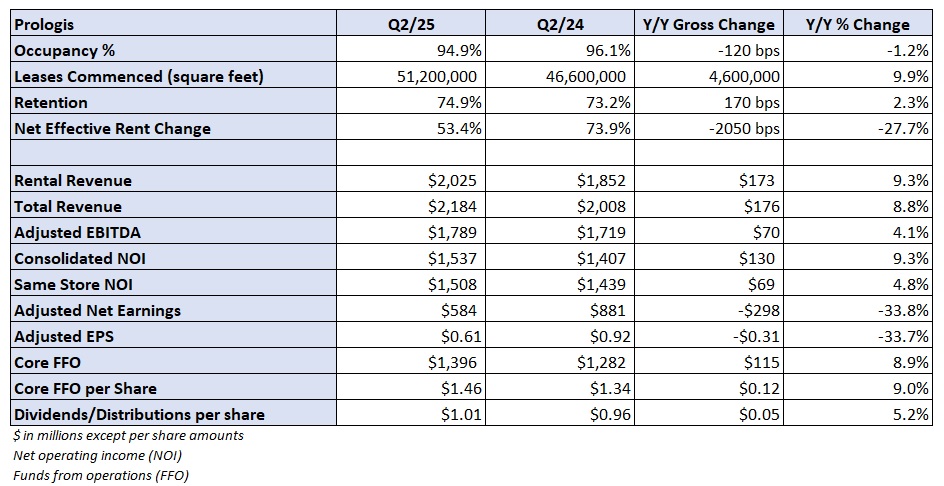
Occupancy across Prologis’ (NYSE: PLD) portfolio was 94.9% in the second quarter, 120 basis points lower y/y, but level with the first quarter as market conditions appear to have stabilized. The company ended the quarter with the portfolio 95.1% occupied, which it said is 290 bps ahead of the broader market.
Table: Prologis’ key performance indicators
Prologis reported second-quarter core funds from operations (FFO) of $1.46 per share before the market opened on Wednesday, which was 4 cents above the consensus estimate and 12 cents higher y/y. Total revenue increased 9% to $2.18 billion as new leases commenced rose 10% to 51.2 million square feet.
Leasing activity slumped 20% shortly after the April tariff announcements but improved throughout the period, ending the quarter just 10% lower than normal. Roughly one-third of Prologis’ leasing activity in the quarter came from 3PLs. That was a little lower than the prior two quarters, but those periods saw outsized activity from logistics operators.
The company raised its full-year FFO guidance range to $5.80 to $5.85 per share, which was roughly 1% higher than the prior guide at the midpoint of the range.
The new outlook assumes average occupancy in a range of 94.75% to 95.25% and development starts between $2.25 billion and $2.75 billion. The new guide for starts is back in line with the company’s initial outlook for 2025, which was issued in January.
Importantly, Moghadam said that the market has seen a 7.4% median vacancy rate since 2000, with vacancy exceeding that level 44% of the time. He believes the market has already topped out at a mid-7% vacancy rate and noted that at 5% vacancy, the landlord regains pricing power. (Market rents were off 1.4% in the quarter.)
A fear of missing out and inflationary concerns are likely to push tenants away “from being very conservative to being much more aggressive,” Moghadam said.
“I think if you have people that are pulling the trigger on big capital improvements … they are going to take comfort by seeing other people make the same decisions.”
Shares of PLD were up 1.4% at 2:28 p.m. EDT on Wednesday compared to the S&P 500, which was up 0.2%.
Cross-border trucking company accused of labor violations
Authorities in the U.S. have asked the government of Mexico to investigate whether Tijuana-based Liber Gennesys Group has denied the right of truck drivers to organize for bargaining purposes.
The U.S. Trade Representative (USTR) said Tuesday an interagency committee received a complaint on June 12 from the Supply Chain Transporters Union (SITRABICS) in Mexico, and Rethink Trade at the American Economic Liberties Project, a nonprofit advocacy group.
“The petition alleges that Liber Gennesys and its affiliated and/or successor companies have violated workers’ rights by using intimidation and harassment to discourage workers from supporting the SITRABICS union and have dismissed workers due to union activity,” the USTR said.
Liber Gennesys and its affiliates, including San Diego-based Transportista Kamu, provide transportation services for Hyundai Motor Co. in Mexico and the U.S., according to the USTR.
The complaint against Liber Gennesys Group falls under the labor provisions of the United States-Mexico-Canada free trade agreement’s rapid response mechanism.
Mexico has 10 days to decide whether to conduct a review and 45 days to investigate the claims and present its findings.
SONAR adds intermodal savings rates
Building upon SONAR intermodal and dry van contract rate data already available in the platform, as of today, intermodal savings rates are now included in SONAR, as a national average, for 63 individual lanes, and two indices.
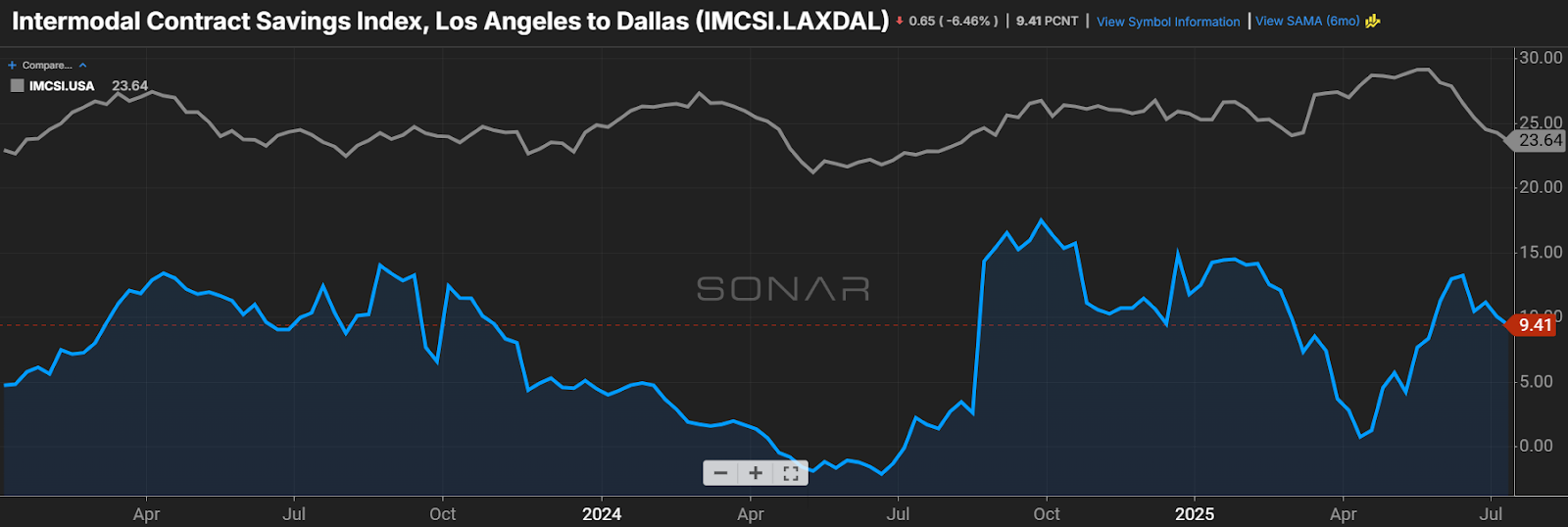
The LA to Dallas lane is competitive between truckload and intermodal with a 9% average intermodal savings rate. That’s below the national average of 23%. (Chart: SONAR)
The intermodal savings rate is the percent savings that a shipper can expect to realize by using domestic rail intermodal rather than truckload. It is the calculated percent difference between rates that include fuel surcharges for both modes. The inclusivity of fuel surcharges is important because the greater fuel efficiency of intermodal is a significant component of the overall savings versus truckload.
The new dataset primarily targets shippers that move freight in dense corridors and/or longer haul lanes where rail intermodal could potentially be a viable option over truckload.
The 63 lanes chosen for the index are those with sufficient intermodal density to make intermodal a viable option for most shippers that can tolerate “truckload plus a day” service levels. The individual lanes were also selected on the basis of those where sufficient intermodal rate data is available.
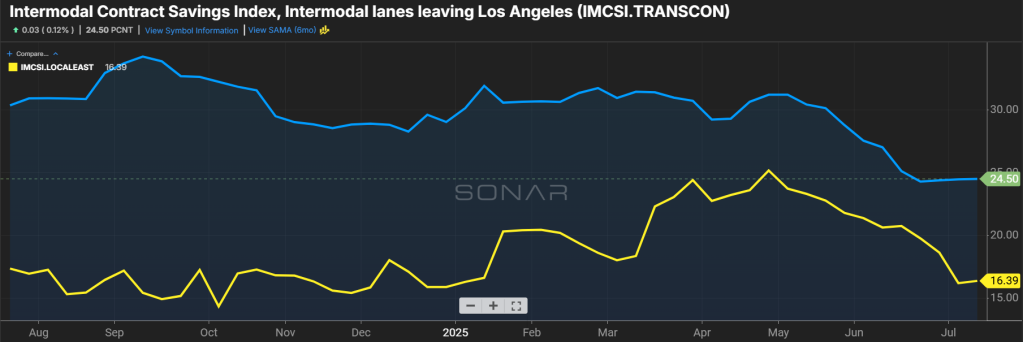
The Transcontinental Index displays the average intermodal savings of five dense intermodal lanes outbound from Los Angeles. The objective is to give importers a quick read on changes in rates to move goods to consumption centers after they are transloaded from international containers into 53’ domestic containers. Meanwhile, the Local East Index displays the average savings of nine lanes in the eastern one-third of the US. That grouping of lanes is intended to represent those that are highly competitive with dry van, and therefore, more influenced by truckload market conditions. Truckload contracts are often repriced more frequently than intermodal contracts, so a tightening in market conditions could cause the savings rate to rise, at least temporarily, all else being equal. For additional detail, see the Intermodal Savings Index Knowledge Center Article.
Report: White House maritime chief leaving
Ian Bennitt, the senior director for maritime and industrial capacity at the National Security Council, is leaving the White House office, according to a published report.
Bennitt is expected to leave for the private sector, Reuters reported, quoting anonymous sources. Brian McCormack, the NSC’s chief of staff, also has left to become chief of staff for Republican Sen. Bill Hagerty, an ally of President Trump.
Ian Bennitt
The departures come amid restructuring at the NSC that has eliminated some sections while combining others.
Bennitt did not immediately respond to messages seeking comment.
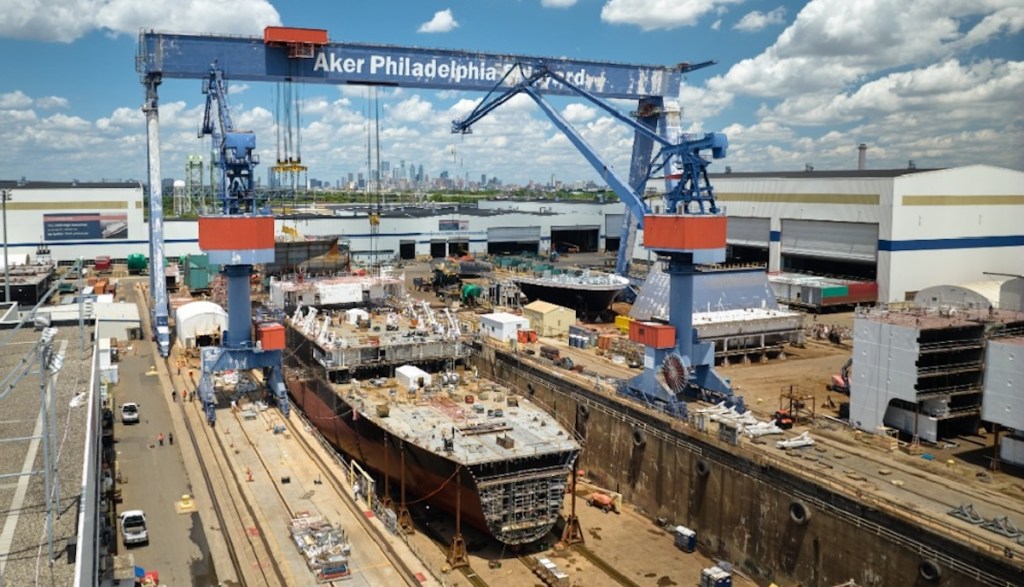
The NSC maritime office was created shortly after President Donald Trump in April signed an executive order designed to revitalize U.S. shipbuilding while blunting China’s growing dominance over global shipping.
But five of the office’s seven staff had left by early July, according to the Wall Street Journal.
Reuters reported that the State Department is now overseeing maritime matters, and that the NSC office had been moved to the Office of Management and Budget, the latter confirmed by White House spokesperson Anna Kelly on X. No other details were provided.
TextLocate transforms the driver communication landscape
The logistics industry has long struggled with inefficient communication methods that frustrate drivers and waste valuable time for brokers and carriers. TextLocate addresses these pain points through its innovative SMS-based system.
As the dominant driver communication provider in the logistics industry, TextLocate combines chat capabilities and image capture with location tracking – a powerful combination that leverages workflow automation to elevate driver visibility to unprecedented levels, all without using a mobile app.
Tenstreet recently acquired TextLocate. This strategic acquisition aims to enhance driver communications with new freight visibility features while implementing automation to save time, improve transparency and reduce friction throughout the logistics network.
For drivers, the benefits are immediate and substantial. Instead of being interrupted by constant check calls during breaks or driving time, drivers receive messages through TextLocate’s SMS system. This allows them to relax during breaks and send their location with just a few taps on their phone while still maintaining effective communication.
“The amount of phone calls going unanswered today is astronomical. There is so much spam,” said TextLocate CEO Ryan Rogers.
While drivers are often annoyed by phone calls, they have also historically been hesitant to embrace other tools. This is especially true of app-based solutions that require extensive set-up. TextLocate effectively removes this friction.
“We caught on super fast because what the drivers love is this: There is no interruption,” Rogers said. “They don’t have to download an app. They don’t have to put in a username. They don’t have to put in their password. We’ve taken the speedbumps and the complexity out of simple communication.”
This simplicity extends to other essential tasks. TextLocate makes it as straightforward as sending a text for drivers to provide proof of delivery (POD) or report equipment issues. Everything is associated with a driver’s phone number and load ID, creating a streamlined process that eliminates traditional friction points.
For brokers and carriers, TextLocate transforms daily operations. By eliminating time-consuming check calls, brokers can redirect that time to make more sales calls, creating additional opportunities to close deals. The system ensures precise location data, reducing errors and miscommunication that plague traditional methods.
“The value add for companies is having automated messaging and two-way communication all via text,” Rogers states. “We only work in logistics. We have built everything we have around traditional base text messaging, and we have built it from a logistics perspective.”
The accuracy provided by TextLocate helps brokers make better decisions and provide reliable updates to clients, enhancing overall freight management capabilities. Brokers can even share these updates with customers directly through TextLocate’s email forwarding tool, adding another layer of service and transparency.
Integration with Tenstreet’s other services
This acquisition will bolster Tenstreet’s extensive line of driver-centric efficiency and logistics tools. TextLocate will integrate with the Driver Pulse app, used by millions of drivers each year to manage both their daily work and broader careers. The combined offering will also join forces with TruckMap, Tenstreet’s trucking-specific navigation platform, and True Load Time, its detention-management service.
With TextLocate’s proven driver fraud deterrence capabilities and Tenstreet’s established commitment to privacy, compliance and security, both companies share a dedication to protecting driver data and identity. This ensures that drivers, brokers and carriers can operate with confidence in the system’s integrity.
“With its driver-first focus, TextLocate is a natural fit for Tenstreet. The combined functionality will augment communications throughout the supply chain, improving relationships and adding new efficiencies – two things we constantly strive for in product development and in our own strategic growth,” Tim Crawford, CEO of Tenstreet, said.
The acquisition represents a significant development in the evolution of logistics communication. TextLocate launched in 2021 with the explicit goal of streamlining logistics management and better connecting logistics providers and drivers.
Rogers shared his motivation for creating TextLocate and his vision for the future under Tenstreet.
“The inefficiencies of traditional communication methods are what drove me to create a solution that actually facilitates communication, simplifies your day, and makes it easy for drivers. I’m beyond excited to work alongside the Tenstreet team to continue revolutionizing logistics and communications for the entire industry,” Rogers said.
The combined capabilities of both companies promise to address long-standing challenges in the industry through technology that prioritizes driver experience while delivering improved operational outcomes.
Ports back bill to limit Customs charging for inspection services
Ahead of an expected expansion by the Trump administration, port operators are backing a House bill that would limit Customs and Border Protection’s billing of ports for inspection services.
The American Association of Port Authorities (AAPA) in a release endorsed the reintroduction of the bipartisan CBP Securing Ports and America’s Commerce and Economy (SPACE) Act by U.S. Reps. Laurel Lee (R-Fla.) and Marie Gluesenkamp Perez (D-Wash.). The measure, H.R. 4336, aims to address a critical aspect of U.S. port operations by ensuring that Customs and Border Protection is adequately funded, thus facilitating what it said would be optimal functioning of America’s ports.
According to a summary from the lawmakers, the act aims to clarify CBP’s leasing authority for operational space at seaports and other facilities, close enforcement gaps due to inadequate infrastructure, and enhance coordination with port authorities to bolster U.S. supply chain security.
Traditionally, the cost associated with government inspection operations at ports has been the responsibility of the federal government.
“CBP Officers’ work is crucial to the safety, health, and vitality of America’s ports,” said Cary Davis, AAPA president and chief executive, in a release. “The costs of government inspection operations are historically and constitutionally, a federal government responsibility.”
The agency has indicated that it wants ports to cover the cost of screening equipment or operations may be halted.
When introducing the bill, the lawmakers noted that Customs officers at many seaports operate in temporary or makeshift facilities because outdated legal restrictions prevent the agency from obtaining long-term leases.
The act aims to reutilize the existing user fees collected by the CBP, creating a more transparent financial strategy that ensures responsibility and sufficiency at the federal level.
This legislation is particularly significant given the vital role that ports play as economic engines and gateways for international trade.
“In our post-Covid world, more people are now aware of the supply chain and the interconnectedness between ports and all of the partners necessary to keep product and people moving,” said Richard J. Hendrick, CEO of the Port of Albany, in the release.
The bill has garnered support from a coalition of 27 trade, transportation, supply chain, and agriculture organizations.
The AAPA said that the legislation not only presents a path towards enhanced operational efficiency at ports but also potentially bolsters the resilience of the supply chain. By securing federal funding for CBP, ports can focus resources on improving infrastructure and expanding capacity, ultimately benefiting the economy at large.
“Ports’ roles as economic engines and gateways for American products are strengthened when CBP is doing all it can to support them,” said Julianna Marler, CEO of the Port of Vancouver, Wash. “This sentiment underscores the necessity of the proposed legislation to facilitate a cooperative framework that enhances the capacity and functionality of American ports.”
Werner loses again on issue of deaf driver, but dollar amounts are a lot lower
(Editor’s note: the article has been amended to add further context to the Werner decision not to hire Victor Robinson.)
Werner Enterprises has lost on appeal in a case that at one point saw it facing a $36 million penalty for not hiring a deaf driver–later reduced by a federal court–who had gone through a company training program.
The financial stakes in the case brought by the Equal Employment Opportunity Commission under the provisions of the Americans with Disabilities Act are now about $372,000, a far cry from a jury’s decision in 2023 to award deaf truck driver Victor Robinson about 107 times that figure.
The unanimous decision last week from an Eighth Circuit Court of Appeals three-judge panel fully affirmed all the September 2023 decisions from both a jury trial in the U.S. District Court for Nebraska and later decisions handed down from the bench over post-trial motions.
EEOC awards have a cap
The affirmation includes a reduction in the original punitive damages awarded by the jury. That reduction came after the court ruled that EEOC awards are capped at $300,000.
The EEOC was the plaintiff in the case on behalf of Victor Robinson.The defendants along with Werner (NASDAQ: WERN) included Drivers Management LLC, which is Werner’s training subsidiary.
Werner made several points on appeal, all of which were rejected by the appellate court.
A recap of the case in the recent appellate court decision noted that Robinson had a “medical variance” from the Federal Motor Carrier Safety Administration (FMCSA). That waiver is needed for a deaf driver to obtain a CDL. It was obtained in 2015.
With the variance in hand, Robinson enrolled in Roadmaster, the driving school owned by Werner. His training involved not just a regular trainer but also an interpreter for the deaf, “who communicated with Robinson from the backseat of the vehicle throughout the process,” according to the court’s recap of the case’s history.
‘We can’t hire you’
In September 2016, Robinson completed the training and received his CDL. But soon after, according to the recap of the case by the appellate court, Werner Vice President of Safety and Compliance Jamie Hamm told him on a call, “I’m sorry, we can’t hire you because of your deafness.” However, Hamm has denied she said that.
More specifically, according to the court’s decision recapping what led up to that declaration, “Hamm testified she ultimately declined to hire Robinson because she could not identify any means by which he could safely communicate with his trainer while driving, without diverting attention from the roadway.” The court’s recap also said Hamm had told Robinson during that call that “Werner could not hire him because she could not identify any safe means by which he could complete the in-cab training portion of the placement driver program.”
The call took place, according to the court, after Robinson had been told he had been preapproved for employment by recruiter Erin Marsh in an email. After calling Marsh – using a relay service for the phone call –the two talked about, according to the court, “‘the job, the orientation, providing interpreting services,’ and other general matters.”
The district court’s decision in January 2024 to award back pay to Robinson of about $35,000 lists several driving jobs Robinson had after not being hired at Werner, none of which lasted very long; only one, with Stan Koch Trucking, reached 12 months. Other jobs on his record included with J.B. Hunt (NASDAQ: JBHT) and U.S. Xpress, now part of Knight Swift (NYSE: KNX).
The roughly $372,000 award is a combination of the punitive damages, capped at $300,000, the backpay, plus interest and other costs.
“Werner is disappointed with the court’s decision,” a Werner spokesperson told FreightWaves in an email responding to a request for comment.
“Notably, in June of 2023, a jury in that same court found in Werner’s favor on nearly identical facts. The company operates with the mantra that nothing we do is worth getting hurt or hurting others, whether that be its professional drivers, customers or the motoring public at large.”
In a May 2024 series of decisions on post-trial motions in the case, the district court summed up the basis for the jury’s decision against Werner. “The jury determined that Robinson was qualified to perform the job to which he applied, he could have safely performed the essential functions of the job with a reasonable accommodation, and Werner’s refusal to hire Robinson was not based on business necessity,” District Court Judge John Gerrard wrote.
There were multiple issues raised by Werner in its appeal over events in the trial. They included the question of “causation” and whether Robinson’s dismissal was because of his deafness; whether Robinson’s overall driving record (which included several accidents) could be introduced to the jury; Werner objections to the admission of emails sent between Werner executives on the decision-making to deny Robinson employment; whether hiring a deaf driver would provide “undue hardship” for Werner; and whether the FMCSA waiver meant Werner could not deny Robinson employment on the basis of his deafness.
Ultimately, the appellate court did not side with Werner on any of the points made in its appeal.