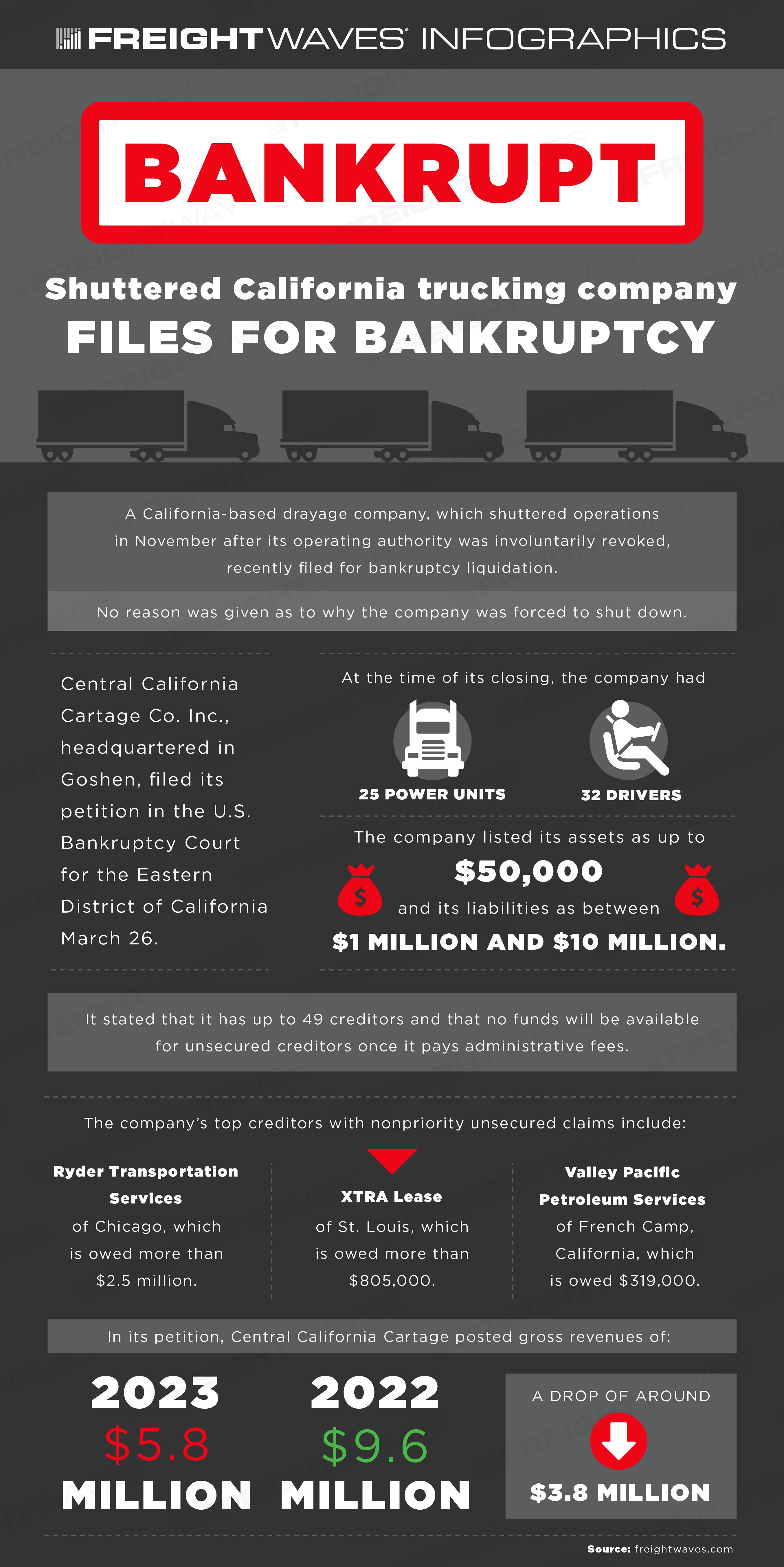
FreightWaves Infographics: Shuttered California trucking company files for bankruptcy

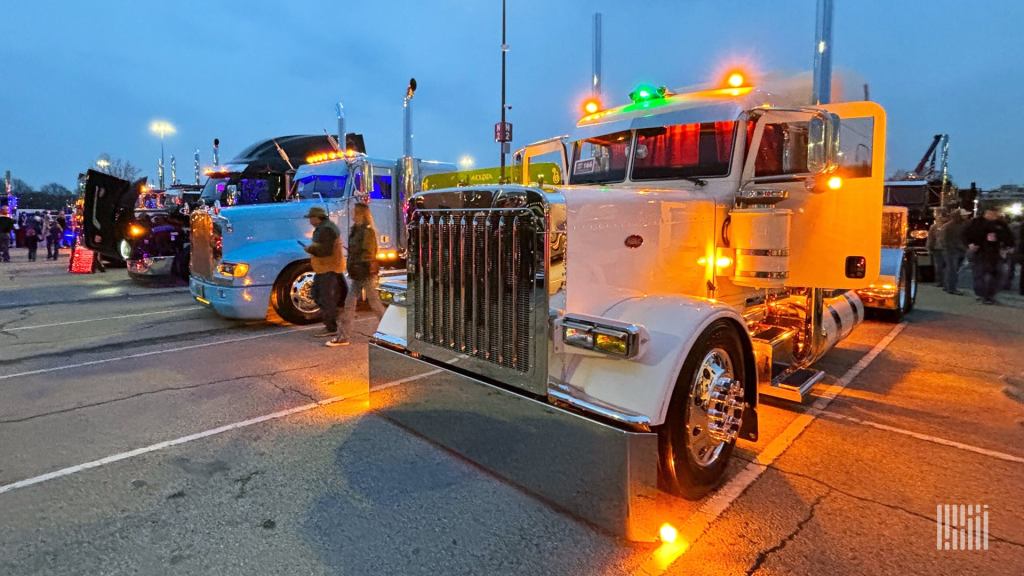
In March, Louisville, Kentucky, hosted the 52nd Mid-America Trucking Show, an event drawing a dynamic spectrum of stakeholders ranging from trucking companies, technology providers and OEMs to parts manufacturers and industry experts. This annual gathering serves as both a showcase of emerging trends and a celebration of the trucking lifestyle.
FreightWaves seized the opportunity to dive into current innovations, conducting interviews with four FreightTech companies poised to revolutionize operations in the trucking industry.
Owner-operator solutions provider TrueNorth Technologies has built a phone app, available on both iOS and Android systems, to enable independent drivers to run their businesses with the same efficiencies as enterprise trucking companies.
The company’s technology helps book loads with its hundreds of 3PL partners — including Newtrul, Ryder, C.H. Robinson and Loadsmart — and run back-office operations.
Jin Stedge, CEO of TrueNorth, said the company’s specialized rate features help carriers quickly understand the fixed and variable costs of a load before dedicating themselves to it. She also explained that TrueNorth’s in-house dispatching services help support owner-operators who might be too busy to watch load boards for the next hot load.
“Our dispatch service allows carriers to let someone else handle the entire load-booking process. Because our dispatchers use TrueNorth tools to book, we can offer our dispatch service for a fraction of the usual cost, just over 1% of gross revenue,” she told FreightWaves.
Understanding that problems can arise while using a phone app to book loads, the company offers high levels of customer service to avoid the pitfalls that often take new carriers out of the market.
“We offer a service targeted toward first-year authorities, where we hand-hold them through their New Entrant Safety Audit, help them with permits and walk them through their first insurance renewal,” said Stedge, who started building these systems after establishing her trucking company, TrueNorth Transportation, in 2020.
TrueNorth plans to release its new solutions soon, including a feature to help carriers share their availability in real time and offering integrations into ELD systems to streamline business management processes.
For now, the company is utilizing automation to its full potential.
“We send out personalized load recommendations to drivers. … We use [optical character recognition] to automatically process our load documents so our carriers don’t need to manually enter any information, and we plan to continue to use AI in any way that can give owner-ops an advantage over large fleets,” Stedge explained.
Bulk commodities platform BulkLoads has created a marketplace for a very niche mode of transportation. Its app connects over 12,000 bulk freight trucking companies to the agricultural sector, along with a suite of services including a TMS, factoring services, permitting services and compliance tools.
Tyler Allison, BulkLoads’ marketing manager, explained to FreightWaves how its technology has learned the operations behind bulk shipping and helped keep this specialized trailer type moving for its customers.
“An example comes from RC Trucking in Kansas, who are users of our TMS. They previously dedicated about 33 hours a week to invoicing customers and handling paperwork. With our TMS, this time has been drastically reduced to just three hours a week, as the system
automates most of their tasks. This change is a testament to how our technology fosters not just cost savings, but also streamlined operations and an enhanced experience for drivers,” Allison said.
To avoid cybersecurity and fraud issues plaguing the industry, the company uses a third-party auditor to implement best practices and protocols for major compliance frameworks and is currently completing its Service Organization Control Type 2 framework to keep its user data safe and private from its third-party integrators. Its systems are also replicated off-site for disaster recovery purposes.
Since this particular type of shipping is nuanced, BulkLoads is actively invested in AI to meet its niche customer needs.
“Our dev team is continuously enhancing our tech with new features tailored to our customers’ needs. Our business model is client-focused, and our tech is built out on industry needs and feedback from our users,” said Allison.
To educate its drivers and shippers, the company also hosts The BulkLoads Podcast. You can check out its episodes from MATS here.
Compliance platform FreightValidate helps mitigate fraud in the industry by ensuring regulatory compliance of the industry’s brokers and carriers. Both parties can search its database by Motor Carrier or Department of Transportation number and identify fraudulent parties in their network of partners.
“Our platform serves as a safety net, particularly when data received on applications falls through the cracks due to lapses in verification by the Federal Motor Carrier Safety Administration. By offering a comprehensive identity and compliance verification platform, we fill the gap left by incomplete or inaccurate data, mitigating fraud risks and ensuring regulatory compliance,” Dale Prax, founder, president and CEO of the company, told FreightWaves.
“We hope that the FMCSA adopts some of the practices we have in place to be part of the new-entrant audit. We believe that every broker, carrier and forwarder should be required to undergo the new-entrant audit, which includes substantial carrier and individual identity verification and compliance verification before the issuance of an MC number.”
Prax told FreightWaves that the company’s cybersecurity and protection of its user data is paramount. It currently also offers a secure platform where trucking companies can confidently engage in facial recognition verification for identity authentication and compliance checks.
Its focus is to bring evolving technologies to carriers of all sizes to prove they are the company they represent and avoid more fraud and theft in the transportation industry.
“Our latest development: hands-free carrier and broker identity and compliance validation check through our mobile app, Siri or Alexa,” Prax said. “With this technology, drivers, shippers, carriers or any freight Industry stakeholder can obtain validation status for brokers and shippers simply by asking Siri or Alexa from their mobile device. This is a technology that no one else has.”
Fintech product LoadPay is still under development by Triumph Financial. The product will allow truckers to manage their banking and fuel expenses, and potentially get paid earlier by customers through linking to TriumphPay’s payments network. The goal is to make it easier for small fleets to run and grow their business through an all-in-one financial solution.
Triumph Financial originally unveiled LoadPay during its earnings announcement in January.
LoadPay, described as a “digital wallet,” aims to alleviate working capital challenges for smaller carriers. The company plans to incentivize “power users,” including brokers and factoring companies, to promote LoadPay, emphasizing its separate branding from TriumphPay. Triumph Financial CEO Aaron Graft views this strategy as creating a network of networks, maximizing LoadPay’s success through widespread distribution among industry stakeholders.
While the company attended MATS to gain feedback from owner-operators and small fleets, specifics on LoadPay’s launch date and features remain undisclosed.
Trucker Path introduced Trucker Path for Brokerages on Wednesday to help smaller brokers manage loads more efficiently. It offers enhanced visibility and streamlines operations, enabling brokers to dispatch directly to drivers and track loads. The app also benefits carriers, improving safety and productivity. The company plans to showcase the new technology at TIA’s Capital Ideas conference next Wednesday.
Chicago-based FourKites and BuyCo, a leading container shipping platform, announced on Wednesday a new partnership to offer shippers comprehensive visibility and control throughout the container shipping process. With access to BuyCo’s global carrier network and FourKites’ supply chain visibility tools, shippers can optimize routes, reduce costs and mitigate risks.
Uber Freight taps industry veterans for commercial, final-mile growth
Sheer Logistics acquires CargoBarn to expand brokerage specialties

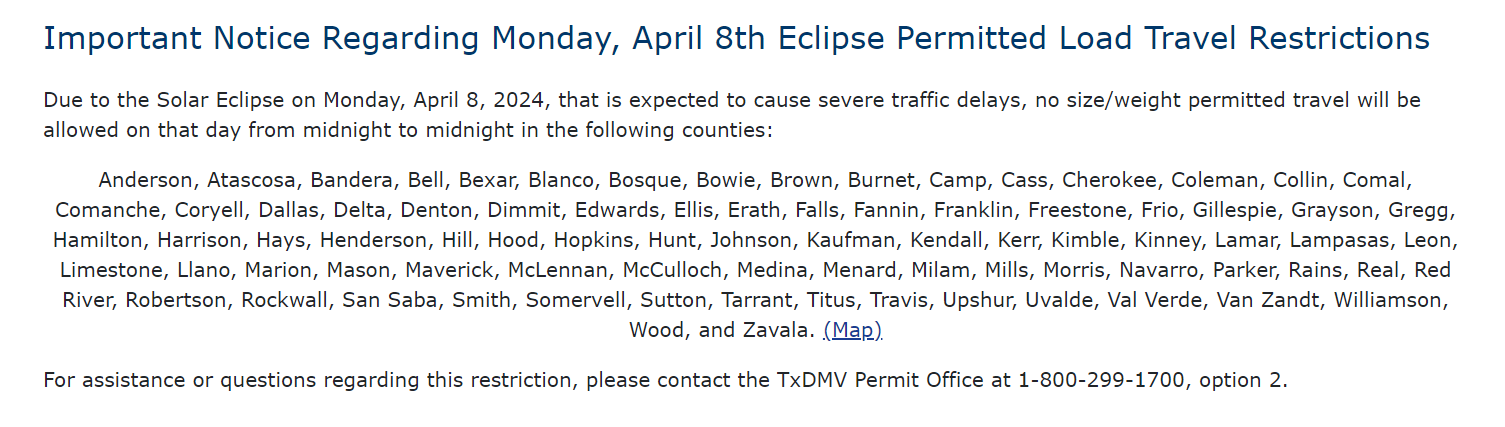
The Texas Department of Motor Vehicles recently announced there will be no oversize loads allowed to travel from midnight Sunday to midnight on Monday, the day of the solar eclipse.
About 1 million people from out of state are expected to travel to Texas to see the eclipse on Monday, according to the Texas Department of Transportation (TxDOT).
All four of the Lone Star State’s largest cities — Dallas, San Antonio, Austin and Fort Worth — are along the eclipse’s path of totality, where the moon’s shadow completely blocks out the light of the Sun.
“It’s difficult to predict the exact levels of congestion, but some areas could see four times the normal rush hour levels of traffic,” a TxDOT spokesman said in an email to FreightWaves.
“That means heavy travel delays throughout the state, and it’s important for drivers to plan for that. TxDOT has been able to prepare well in advance for this event in coordination with multiple state agencies, and we will have 24/7 emergency operations available.”
From Texas to Maine, almost 4 million people are expected to travel in order to view the total eclipse, according to transportation officials. Overall, more than 34 million people in the U.S. are expected to view the spectacle.
Some trucking companies are anticipating disruptions because of the increased number of vehicles on roadways from the event.
“Since a total solar eclipse doesn’t happen very often, we anticipate a high level of traffic and potential road closures to secondary roads due to the increase of tourism within the line of totality,” Amos Rogan, Averitt Express’ less-than-truckload operations leader, told FreightWaves. “With that, we will caution our drivers to maintain a high level of safety and vigilance to ensure that they do not get caught in a situation where we are compromising our equipment nor putting the general public in harm’s way.”
Averitt Express is a Cookeville, Tennessee-based less-than-truckload carrier with more than 5,700 tractors and 13,000 trailers and 85 locations across the country. Averitt’s team consists of more than 8,000 associates, according to its website.
The Texas Trucking Association (TXTA) said it expects increased traffic on Monday but is not anticipating any major impact on freight movements.
“TXTA does not expect any major changes in the trucking industry due to the eclipse. As of now, it’s being treated like any other short-lived ‘weather’ event,” John Esparza, TXTA president and CEO, told FreightWaves. “We do expect an increase in traffic in the areas where the eclipse can be seen due to an increase in visitors. Therefore, the state is addressing this alongside the communities being impacted. TXTA does not have any knowledge of trucking operations being impacted though.”
TxDOT officials predict traffic flows will be the heaviest on Monday afternoon and evening, after the solar eclipse event ends.
“We do expect the most traffic impacts to be in the hours right after the eclipse, and that could continue into the evening,” TxDOT said. “However, as many people travel to see the eclipse, there could be heavy traffic impacts before, during and after the eclipse which could continue into Tuesday.”
The Texas ban on oversize loads on Monday includes more than 80 counties, about a 480-mile stretch through the state. Some vehicles potentially affected by this ban include truck-tractor combinations and vehicles hauling wide loads in excess of 8-feet 6-inches.
The ban on oversize loads is one of the latest measures local and state governments are taking to deal with a massive influx of traffic expected for the celestial event.
Ahead of the solar eclipse, some state transportation departments and trucking associations have advised truckers to stay off the roads on Monday.
In February, the Arkansas Department of Transportation (ARDOT) released its 2024 Solar Eclipse Traffic Management Plan, asking carriers to take a voluntary “truck holiday” and park their vehicles for the day.
“Severe congestion is expected on the entire Arkansas State Highway System during the
eclipse, to such an extent that the day may be mostly unproductive for freight vehicles.
ARDOT will engage the Arkansas Trucking Association in an effort to encourage truckers
to adjust their travel schedule so they are not trapped on the roadways with eclipse-related traffic,” ARDOT said in a statement.
About 1.5 million people are expected to travel from Arkansas from outside the state to view the eclipse, according to ARDOT. The department also expects about 500,000 in-state residents to travel from their homes to the path of totality.
“Any way you cut it, it’s going to be crowded that day,” ARDOT Spokesperson Dave Parker told THV11. “Our roads are going to be tested.”
Eclipse’s impact on freight volumes remains unclear
It’s unclear whether trucking freight will be slower on Monday.
North America’s last total solar eclipse was in August 2017, when the shadow of the moon tracked a path across the U.S. from Oregon to South Carolina.
It’s estimated the 2017 Eclipse cost U.S. employers almost $700 million in lost productivity, with some areas experiencing as much as $200 million in losses due to absenteeism, according to a blog post Challenger Gray & Christmas, a Chicago-based executive outplacement firm.
“American employers will see at least $694 million in missing output for the roughly 20 minutes workers will take out of their workday on Monday to stretch their legs, head outside the office and gaze at the nearly two-and-a-half minute eclipse,” Challenger, Gray & Christmas said.
Some carriers, like Averitt, will be letting their employees take some time to watch the eclipse event.
“We know this is a unique event, and we understand that people will want to watch this amazing phenomenon unfold — the next one not occurring again in the continental 48 states until 2045,” Rogan said. “We’ve even provided glasses to our own associates to safely view the eclipse when it happens. However, our commitment to maintaining a high level of service, quality, and safety remains of utmost importance. We will continue to work with our customers, associates, and local authorities to navigate through this event properly.”
Welcome to the WHAT THE TRUCK?!? Newsletter. In this issue, eclipse warnings have some rattled, freight brokerage closures accelerate and more.
Black hole sun
Total eclipse of the heartland — On Monday, “A total solar eclipse will take place across the United States directly impacting 15 States and numerous metropolitan areas, including Dallas/Fort Worth, Little Rock, Indianapolis, Cleveland, and Buffalo.”
According to the Department of Transportation, an estimated 32 million people are living within the path of totality, which will begin in Texas at 1:27 p.m. CDT and end in Maine at 3:35 p.m. EDT.
If you’re directly in the path of totality, you could experience up to 4 minutes and 27 seconds of darkness.
We just had an eclipse in 2017. Why’s there so much panic this year?
“It’s a conspiracy!” — Nobody freaked out about this seven years ago, but now we have reports of road shutdowns, confused animals, stock outages and Texas halting oversize loads. What’s the big deal?
The DOT says it’s “Building off the lessons learned from the 2017 eclipse.” According to NASA, not only will this eclipse last twice as long as the previous one, but the cornea blocking the sun will also be larger by 40-plus miles.
This in turn is driving a ton of traffic along that route you can see above. As we all learned during the pandemic, when you have a lot more people than usual buying up stock of anything, it can create shortages, whether that be toilet paper or fuel.
Plus, this is America. There’s money to be made in chaos.
Another reason? Not only did the reporting of the eclipse become a story, but the panic around that also got legs. What we’ve got is an information ouroboros.
What you need to know
Truckers in Texas, be warned: 83 Texas counties have banned oversize loads from midnight to midnight on Monday.
If you’re anywhere in the pathway, note that congestion could be as much as four times more than usual rush-hour traffic, according to a spokesperson from the Texas Department of Transportation.
Mind the gap — Operation Lifesaver would also like to remind all eclipse peepers and truckers to be track-aware. Do not idle, park, stand on or treat train tracks as anything other than active during the eclipse.
Are you going to join the mob and watch the eclipse? Let me know.
Need some eclipse or space gear? Go here.
Freight brokerage closures accelerate
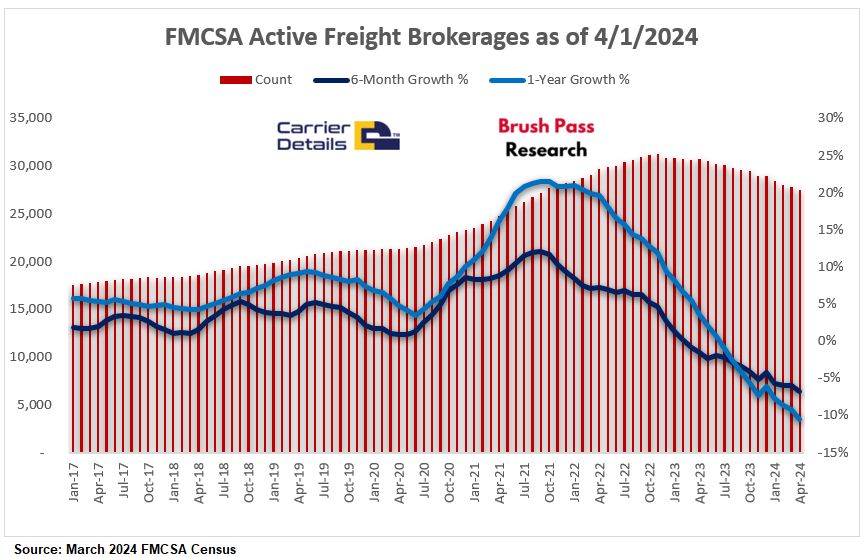
The bottom is deeper — The pandemic-era capacity glut that struck trucking also hit brokerages. According to new data from Brush Pass Research, in March, freight brokerage closures accelerated to 10.6%! So, why does the market feel so soft? Well, there are still 35% more freight brokerages now than there were five years ago despite two years of contraction.
77,000 smolts bolt
Oregon Department of Fish and Wildlife
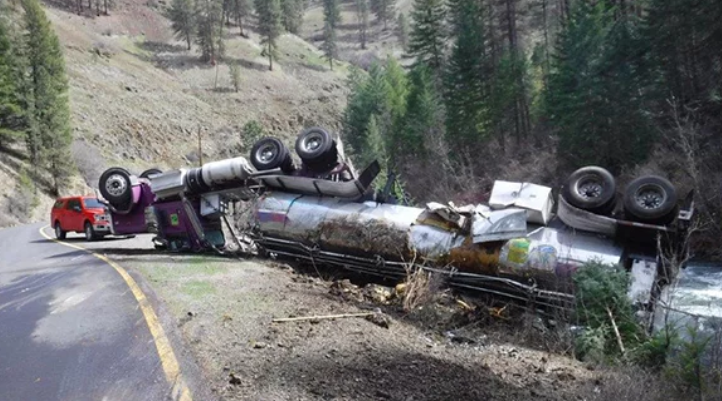
The great escape — Over 77,000 salmon escaped into Lookingglass Creek when a tanker truck toppled down an embankment in northeast Oregon. Only problem is that they were destined for the Imnaha River, which is 90 miles east. Even worse, according to NPR, “25,529 smolts died.”
The good news is that was not the worst place for the tanker to flounder. “We are thankful the ODFW employee driving the truck was not seriously injured, said Andrew Gibbs, ODFW fish hatchery coordinator for eastern Oregon. “This should not impact our ability to collect future brood stock or maintain full production goals in the future.”
The rest of the noise
70-year-old California trucking company, freight brokerage closes abruptly (FreightWaves)
WTT Friday
Eclipsemania; rebuilding Baltimore; supply chain education — This Friday on WHAT THE TRUCK?!?, I’m talking to Operation Livesaver’s Jennifer DeAngelis about eclipse readiness, being track-aware and freight disruptions.
Dredging Contractors of America’s William Doyle talks about the recovery and rebuilding surrounding the Key Bridge in Baltimore. How long will it take, what needs to be done and what role does dredging play in rebuilding this key connector in Charm City.
Calvin University stops by to show off its supply chain program. We’ll learn all about what is offered at the university and how students are getting hands-on experience with major shippers while there.
Kinaxis’ Polly Mitchell-Guthrie lays out supply chain impacts from the Key Bridge collapse and highlights disruptions in auto and retail.
Plus, latest news, weirdness and trends.
Catch new shows live at noon EST Mondays, Wednesdays and Fridays on FreightWaves LinkedIn, Facebook, X or YouTube or on demand by looking up WHAT THE TRUCK?!? on your favorite podcast player. And at 5 p.m. Eastern on SiriusXM’s Road Dog Trucking Channel 146.
Now on demand
The world’s first road-to-rail autonomous solution?
Baltimore bridge collapse: One week later
Thanks for reading and feel free to forward this to a friend.
Subscribe to the show
Or simply look up WHAT THE TRUCK?!? on your favorite podcast player.
Don’t be a stranger,
Dooner


Emissions requirements for trucking are set to get stricter. The Environmental Protection Agency recently released a 1,155-page final ruling on Phase 3 greenhouse gas emission standards for heavy-duty vehicles covering model years 2027 through 2032. Jason Cannon of the Commercial Carrier Journal writes, “Motor carriers will have more time (2027-2030) to build out a zero-emissions infrastructure, but the flip-side is stronger emissions limits in 2031 and 2032.” The desired end state is more zero-emission vehicles. Under the new rules, Cannon notes, “roughly 30% of heavy-duty vocational trucks would need to be zero-emission by 2032 and 40% of regional day cabs.”
For zero-emission trucks and other vehicles, the challenge remains the cost. FreightWaves’ John Gallagher writes, “A new Class 8 diesel truck costs roughly $180,000 compared with up to $400,000 for a battery-electric truck, according to estimates.” Gallagher cites a recent interview on National Public Radio during which Gabe Klein, executive director of the U.S. Joint Office of Energy and Transportation said “cost parity” hasn’t been achieved yet but subsidies are one option. Klein said, “That’s why the federal government is providing subsidies, to bring it down closer to cost parity.” Another challenge is lack of infrastructure, but Klein is optimistic, adding, “I will also say the charging infrastructure is of course a limiting factor. So we need to make sure everybody has access, not just the big fleets and companies.”
Initial reactions from trucking lobbying groups appear less enthused. American Trucking Associations President and CEO Chris Spear said in a statement, “The post-2030 targets remain entirely unachievable given the current state of zero-emission technology, the lack of charging infrastructure and restrictions on the power grid.” Owner-Operator Independent Drivers Association President Todd Spencer believes the rules create “unworkable” requirements. Spencer said, “This administration appears more focused on placating extreme environmental activists who have never been inside a truck than the small business truckers who ensure that Americans have food in their grocery stores and clothes on their backs.”


On Monday, a total solar eclipse will cross into the U.S. from Mexico beginning around 1:30 p.m. Central time and exiting through Maine around 3:30 p.m. Eastern, according to NASA. The last total solar eclipse to cross North America was on Aug. 21, 2017, and the next will not cross North America until 2044. Naturally, total solar eclipses bring increased vehicle traffic from across the U.S. to witness the event.
A fact sheet released by the Federal Highway Administration forecasts that “increased traffic to remote areas could cause other safety impacts, such as the presence of illegally parked vehicles in unsafe areas (e.g., shoulders or medians), or the increased potential of igniting wildfires in dry areas.”
In addition, solar eclipses bring an increased risk for vehicle crashes. Tim Menard, CEO of Lyt, told Fleet Owner, “There was a significant increase in fatal car crashes in the United States around the time of the 2017 total solar eclipse. Industry studies found a 31% increase in traffic risks around the time of the eclipse … . In absolute terms, this is an average of one extra crash-involved person every 25 minutes and one extra crash fatality every 95 minutes.”
States in the path of totality are enacting measures restricting some freight types and encouraging commercial vehicles to avoid the impacted areas. Fleet Owner’s Jenna Hume writes, “While restrictions are being placed on oversized loads, most states only ask truck drivers to avoid traveling in high-traffic areas of their states before, during, and after the eclipse; truck drivers and/or fleets will not be penalized for any actual travel conducted.” Vermont, Texas and Arkansas are among the states asking for reduced commercial vehicle traffic. For Texas, no overweight and over-dimension travel is permitted on that day from midnight to midnight.

Recent data from ACT Research shows preliminary March Class 8 net orders were 17,300 units, down 10,400 units compared to February. Compared to March 2023, net orders fell 8.7%. Steve Tam, ACT’s vice president and analyst, said in the release, “Nascent improvements in the freight market and select OEMs’ efforts to smooth demand, notwithstanding forced conservatism among a portion of the truck buying populace, capped Class 8 order activity in March.” While Tam cautions waiting for March order volume details, initial reactions suggest waning demand for tractors in March.
Looking at potential drivers of demand, areas outside the for-hire trucking sector were drivers of growth from the previous months. Given recent order data, this trend may be slowing. FreightWaves SONAR Head of Freight Market Intelligence Zach Strickland wrote in the Daily Watch, a newsletter for SONAR subscribers, “Looking at national carrier truck counts, only a few showed annual growth in the fourth quarter of 2023. Knight-Swift and Schneider both grew by acquisition. ACT Research has inferred that most of the outperformance of expectation has come from areas outside the for-hire truckload market, such as private fleets and vocational support for growing infrastructure around nearshoring.”

Summary: Outbound tender lead times have risen, but truckload carriers remain buffeted by lower spot rates and loosening capacity in the contract market. Tender lead times rose in the past week from 2.87 days on March 25 to 3.11 days. This is the highest recorded tender lead time since Jan. 3’s 3.13 days. Tender lead times increase leading up to major holidays or events during which customers feel they may struggle to find capacity if they tender loads closer to pickup. End of month and end of quarter can also be instances when an increase in tender lead times is warranted, to ensure product is recorded before the next fiscal quarter begins.
For outbound tender rejections, rates increased a paltry 30 basis points week over week from 3.48% to 3.78%. Hopes of an early boom before produce season for reefer carriers were similarly muted, with reefer outbound tender rejection rates rising 46 bps w/w from 4.58% to 5.04%. For flatbed carriers who forgo the luxury of no-touch freight and prefer binders, chains, straps and tarps while braving the elements, outbound tender rejection rates delivered, rising 287 bps w/w from 13.15% on March 25 to 16.02%. Warmer weather should continue to buoy flatbed demand as job sites in regions with harsh winter climates return to full capacity.
NHTSA reports fatality, injury uptick in latest truck crash stats (FreightWaves)
Kevin Rutherford’s MATS talk derailed by broker transparency argument (OverDrive)
Truck lease purchase deals come under heavy fire at MATS and in court (FreightWaves)
Pride Group’s bankruptcy filing underscores impact of trucking downturn (FreightWaves)
FMCSA urges truck driving schools to apply for grant money (FreightWaves)
Missouri court upholds nuclear verdict, blasts carrier’s safety practices (FreightWaves)
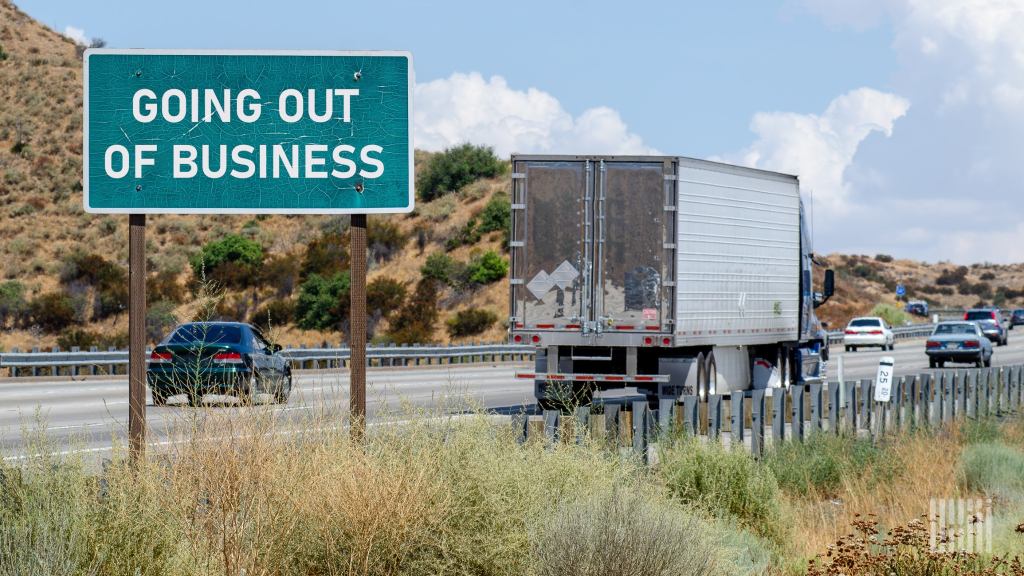
A California trucking company has shuttered operations after 19 years of hauling general freight throughout the state.
At the time of its closure Monday, Frank Jauregui Trucking of Fontana, had 32 trucks and the same number of drivers, according to the Federal Motor Carrier Safety Administration’s SAFER website.
This is the second Fontana-based carrier to cease operations this week after the formerly family-owned Tony’s Express, a 70-year-old less-than-truckload carrier, closed its doors a year after selling the company to John Ohle in March 2023.
Frank Jauregui, who is listed as the CFO of the intrastate-only company, declined FreightWaves’ request to comment about why the company shut its doors.
A source familiar with the situation told FreightWaves that the trucking company is looking to sell its tractors, trailers and equipment.

According to FMCSA data, the agency granted Jauregui Trucking’s contract authority in April 2005, but its Bodily Injury Property Damage coverage was canceled Monday. The company’s cargo and general liability insurance are slated to be canceled Friday.
Prior to its closure, the company’s trucks had been inspected 57 times, and 20 had been placed out of service for a 35% out-of-service rate over the preceding 24 months. That is higher than the industry’s national average of around 22%, according to FMCSA data.
The company’s drivers had been inspected 56 times, and eight were placed out of service over a two-year period, resulting in a 14.3% out-of-service rate. The national average for drivers is about 6.7%.
This is a developing story.
Do you have a news tip to share? Send me an email or message me @cage_writer on X, formerly known as Twitter. Your name will not be used without your permission.
Read more articles here:
70-year-old California trucking company, freight brokerage closes abruptlyJury finds Colorado trucker guilty of vehicular homicide in 2022 crash
Shuttered California trucking company files for bankruptcy
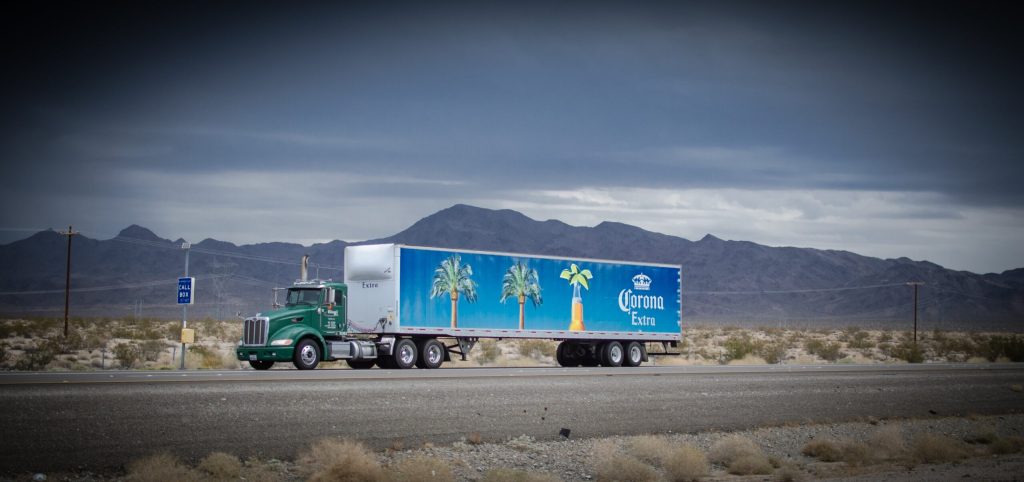
Eight men from the Bronx face federal charges in a beer-theft scheme in which prosecutors say the men swiped the booze from railroad cars and distribution facilities in the Northeast.
The suspects, indicted by a federal grand jury in the Southern District of New York, had a penchant for Corona and Modelo beers shipped from Mexico, the indictment says. They allegedly made off with the booze in Connecticut, Massachusetts, New Jersey and New York.
Jose Cesari, who goes by “Cry”; Miguel Cintron; Luis Izquierdo, who goes by “Luis Zapata”; Wakiem Johnson, who goes by “Waka”; Kemar Bonitto; Deylin Martinez-Guerrero; Antonio Gonzalez; and Justin Bruno face charges in the scheme.
“For years, the Beer Theft Enterprise has operated brazenly, allegedly breaking into railyards and beverage distribution facilities throughout the Northeast and filling U-Haul box trucks to the brim with cases of beer,” said U.S. Attorney Damian Williams. “That dangerous and disruptive conduct — sometimes allegedly accompanied by the threat of violence — has left several beverage distribution and railroad companies ailing.”
The thefts started in July 2022 and ended in March, authorities allege, and involved hundreds of thousands of dollars’ worth of beer over that nearly two-year period.
Authorities say the men operated under the cover of night, often driving a U-haul truck and cutting a hole in fencing to access the beer. They often took the beer back to the Bronx where they sold it.
Cesari is the reported ringleader. The indictment says he monitored police scanners to keep track of law enforcement.
He also attempted to recruit new members, charging documents say. In July 2022, Cesari allegedly posted a photo of a railroad track on Instagram and wrote, “Need workers who want to make money [money bag emoji].” In another post, he said recruits would make at least $100,000 per month. He posted again on March 14, saying that he was “taking all applications” and that “if you are trying to get money with me, send an application in,” the indictment says.
Cesari remains at large. The other men are in custody.
“Train heists harken back to the days of the Wild West and gunslingers riding horses, stealing loot from rail cars,” said FBI Special Agent in Charge James E. Dennehy. “The romanticized image has nothing to do with the modern-day criminals we allege took part in a theft ring in New Jersey, New York, and beyond that targeted railyards and beverage distribution centers.”
The New York Times reported that attorneys for most of the defendants did not provide comment on the charges, and that it had no information about attorneys for Cesari or Bonitto.

On a recent episode of Taking the Hire Road, Jeremy Reymer chatted with Candi Coate, certified director of safety (CDS) and the north region corporate safety leader for Highway Transport. The pair discussed the importance of embracing the industry and building a network.
Like many logistics professionals, Coate stumbled into the industry by surprise. After spending several years in a sales role that kept her on the road, she was presented with the opportunity to move into a safety position at a trucking company.
While Coate had never considered a career in transportation before, she embraced the chance to spend more time at home with her children while also learning a whole new set of professional skills. The rest is history.
It wasn’t long before Coate realized that, at its core, transportation is a people business. She poured her time and energy into getting to know the people around her — including truck drivers and other safety professionals — in order to excel in her new role.
“I found a passion I never knew I had,” Coate said.
That passion for building relationships and keeping people safe prompted Coate to learn all she could about regulations and compliance while continuing to grow an industry network. Eventually, this path led her to pursuing her CDS credentials, a process she encourages all safety professionals to consider.
Coate reiterated that the relationships she formed through the CDS process — as well as by joining various industry associations — have transformed both her personal and professional lives. Other safety professionals have become some of her closest friends, which she attributes to the shared goals and values involved in safety work.
Asked how smaller fleets with tighter budgets can prioritize safety and compliance without breaking the bank, Coate reiterated the importance of industry relationships. While joining large associations may be a financial stretch for these companies, there are smaller organizations that can serve the same purpose.
“If you can’t afford to be involved in bigger organizations, get involved at your local level,” Coate said. “You can learn about the regulations and the things you can do as a safety professional to reduce crashes and keep safety at the forefront.”
Coate also made it clear that keeping drivers safe is a task that extends far beyond the safety department, engaging folks across the entire industry.
“We’ve got so much work to do to get our roads to the safety level we need,” she said. “You don’t have to be a safety professional to help work toward safer roadways.”
Click here to learn more about Highway Transport.
Other highlights from this episode of Taking the Hire Road
Book recommendation: “The Human Touch in Workplace Safety” by Kevin Burns
Sponsors: Career Now Brands, The National Transportation Institute, Infinit-I, Workhound, Asurint, Transportation Marketing Group, Seiza, Drive My Way, DriverReach, F|Staff, Trucksafe

WASHINGTON — Federal regulators are bracing for disputes over container fees caused by routing cancellations in the wake of the Francis Scott Key Bridge collapse.
Shortly after the collapse early on March 26 that closed the Port of Baltimore, MSC, the world’s largest ocean carrier, advised customers that containers en route to the port would be diverted for unloading at alternate U.S. East Coast ports, and that the carriage contract would be declared terminated at the alternate port instead of at an inland destination via truck or rail.
Cargo booked on ships bound for the Port of Baltimore had estimated arrival dates throughout the month of April.
For containers booked for Baltimore but not yet loaded at origination ports, MSC told customers to declare whether they wanted their cargo to be carried to alternate ports.
Because MSC and other ocean carriers are canceling inland transport as part of their Baltimore cargo, “I’m sure we’re going to have all sorts of issues,” Carl Bentzel, member of the Federal Maritime Commission, told FreightWaves.
“Carriers may deviate to another port where there aren’t as many chassis available, as was the case in Baltimore, so you could have issues on pickup and return of empty containers. These dislocations could result in problems with detention and demurrage. There will be lots of work for the FMC, unfortunately.”
The agency’s new demurrage and detention rule, which goes into effect May 26, could help sort out disputes before they get too far along, Bentzel said. The rule establishes new requirements for how ocean carriers and terminal operators must bill for fees associated with late pickup and drop-off of containers at ports and intermodal facilities. It also clarifies who can be billed, the process for disputing late fees and billing time frames.
The FMC’s Maritime Transportation Data Initiative — a project started in November 2021 and spearheaded by Bentzel — could prove even more valuable in dealing with supply chain disruptions, he said, and recent incidents could prove catalysts for getting the initiative up and running.
“If you take into account the Panama Canal, the Red Sea and now Baltimore, I think you’re having more schedule adjustments than have ever been required in the history of shipping. I think all three should motivate a greater understanding and transparency in shipping. We’re going to see lots of examples of dysfunction and challenges on getting accurate information.”
Like the U.S. Department of Transportation’s Freight Logistics Optimization Works (FLOW) initiative, the purpose of MTDI is to give carriers, shippers, ports, marine terminals operators and others real-time position and estimated arrival times for container shipments, and to harmonize status information of containers while they are in storage at terminals.
But unlike FLOW, a voluntary program that does not set performance standards, MTDI envisions requiring that ocean carriers provide scheduling information that will be made publicly available at all major container ports.
Bentzel is currently converting recommendations on the initiative generated from the maritime industry into the Maritime Transportation Data System (MDTS).
“This will be in-transit visibility requirements for containers that would provide shippers some level of understanding as to estimated arrival times at each berth in the United States and would encompass all intermodal cargo shipments operating in the U.S.,” he said.
The FMC plans to issue a second round of information collection on the project to build on current recommendations from the public.
“I’m still in the convincing mode — there are some carriers who are hesitant to see any kind of a mandate. That’s why I’d like to continue to build a record to get this done.”
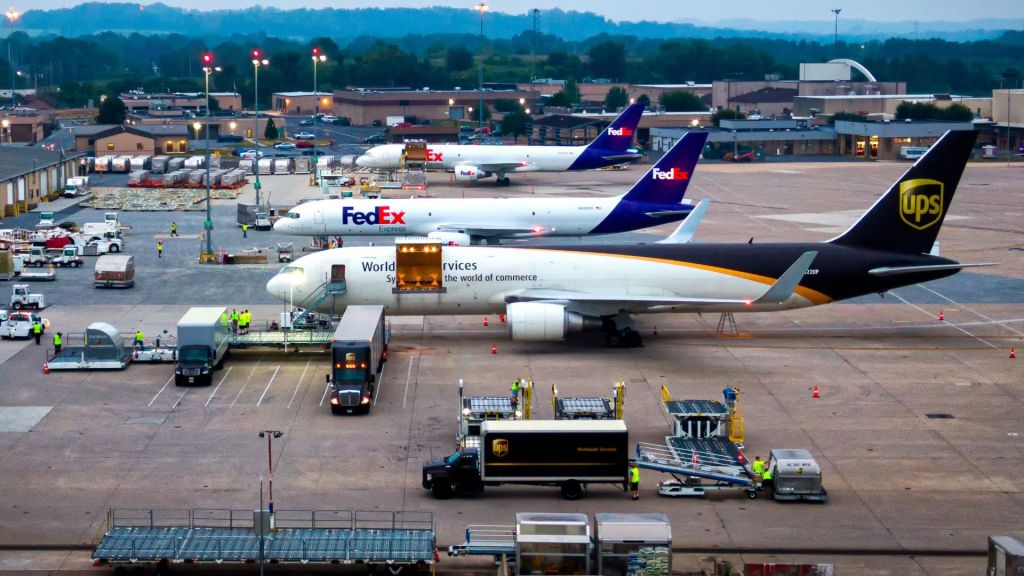
The U.S. Postal Service’s decision this week not to renew a contract with FedEx, worth more than $1.5 billion per year, for domestic air transport and award it to UPS after more than two decades actually benefits all three parties, according to industry analysts.
At face value, the arrangement seems a blow for FedEx (NYSE: FDX), which will lose one of its biggest customers when the existing contract expires on Sept. 29. And it raises questions about how UPS (NYSE: UPS) can make a decent profit flying mail if rival FedEx was struggling to do so.
But experts said the change meets the needs of the three organizations, each of which is undergoing substantial transformation in a shifting parcel environment. For FedEx Express, losing the postal business means it now has the freedom to aggressively move ahead with shrinking its large air network in conjunction with a huge corporate initiative to control costs.
The new agreement has a minimum base term of 5 1/2 years, under which UPS will transport first-class mail, Priority Mail and Priority Express Mail.
“It’s a win-win-win,” Satish Jindel, president of parcel shipping consultancy ShipMatrix, told FreightWaves.
The long-standing relationship between FedEx and the U.S. Postal Service was widely expected to change. The only question was whether FedEx would relinquish some, or all, of the air cargo business.
It was difficult for the express carrier to eke out a profit as the Postal Service in recent years shifted volume from air to ground transportation to improve truck utilization and reduce expenses as demand for next-day service decreased. The quasigovernmental agency implemented new delivery standards to help with that transition. It now promises Priority Mail service in one to three days instead of two and has extended delivery windows for Ground Advantage packages. The latest goal is to cut overall transportation costs by $3 billion over the next two years.
A large portion of FedEx Express’ air network is geared to daytime flying for the Postal Service. The company had to absorb more per-unit operating costs as the traditional postal subsidy for its fixed infrastructure slowly evaporated. FedEx’s payments from the Postal Service dropped to $1.6 billion in the fiscal year that ended Sept. 30, 2023, from $1.9 billion, said David Hendel, a transportation attorney at Culhane Meadows who tracks the Postal Service’s top suppliers. His report last year showed FedEx’s revenue from the Postal Service was more than $2.1 billion in fiscal year 2021.
Company executives repeatedly made clear that they were willing to walk away from the postal business unless it included more favorable terms and a smaller route structure.
Jindel said losing the postal contract is a blessing in disguise for FedEx, which is undergoing a watershed consolidation of its FedEx Express, Ground and Freight units into a single network — something management gave a lot of thought to before proceeding and projects will provide $4 billion in annual efficiency gains.
“It probably makes sense for them not to be aggressive in trying to retain that business, and focus on getting the integration right. And then, when that opportunity comes up again, they may be in a more cost-effective position to bid on it,” said Jindel, a founding member of small-package carrier RPS that FedEx acquired in 1998 and renamed FedEx Ground.
FedEx’s campaign to take out $4 billion in structural costs by the end of fiscal year 2025 already includes accelerating the retirement of aging aircraft, parking underutilized aircraft until demand picks up and relying more on truck feeder services. The company is also redesigning the air network to move express and deferred shipments in segregated overnight and daytime blocks to improve efficiency.
Barclays transportation analyst Brandon Oglenski said in a research note that FedEx is likely to remove significant capacity from its air network next year when it no longer needs infrastructure to support the Postal Service, which will help boost the Express unit’s profit margins.
Freight experts said FedEx will be able to cut daytime flying and consolidate routes.
“With the U.S. Postal Service now out of the picture, and volume decreasing, FedEx will probably look to consolidate aircraft operations in small-to-medium-sized markets within close proximity, to drive savings,” said Dean Maciuba, managing partner at Crossroads Parcel Consulting and a longtime FedEx executive. “However, this type of operational change could also drive earlier pickup and later delivery times in the market that loses its aircraft.”
The risk is that shippers, which prefer the latest pickup and earliest delivery times possible, could seek out other carriers.
Anthony DeRuijter, an analyst at global research firm Third Bridge, said FedEx could collapse routes for Great Falls and Billings, Montana, for example, “and take out redundant flight hours.”
Another way FedEx can reduce costs, Maciuba explained, is by outsourcing ground support services at smaller air stations that are currently held by more expensive employees or shrinking teams by combining duties since there will be fewer flights.
Savings will be less if management redeploys aircraft under the new “Tricolor” initiative to go after more deferred freight, Oglenski said. FedEx has said it plans to use international and domestic daytime flights to handle shipments common to the less-than-truckload sector, which it distinguishes from low-yielding general cargo typically handled by freight forwarders.
Pilots will be one of the primary losers as FedEx shrinks its airline. A FedEx executive said in a private meeting late last year, reported by FreightWaves, that up to 300 pilots would no longer be needed if postal flying were substantially reduced. The number of surplus pilots is likely higher than that with the contract’s complete termination now confirmed.
On the other side of the ledger, UPS gets a contract with a five-and-a-half-year minimum base term that adds about $1.5 billion to its top line and volume to increase density on its trunk routes in a market with slow growth opportunity.
Some investment analysts expressed concern that UPS’ returns from the Postal Service business will be marginal and won’t help achieve the target 13% operating margin by 2026.
Jindel said that won’t be a problem because UPS is laser-focused on costs and will save money by using its ground network to support the air cargo contract — something FedEx wasn’t able to do because its air and ground networks were siloed.
“UPS has been running an integrated air and ground network for over 25 to 30 years. I don’t see them having to add any extra airplanes. So it helps them offset that fixed cost and spread that over another base of packages,” he said.

Oglenski agreed, saying UPS likely offered the Postal Service cheaper linehaul transportation services “by relying less on air capacity, especially between market locations that can be reached with one to two day trucking solutions.” UPS might need to deploy some incremental air assets in the daytime air network because its fleet is much smaller than FedEx’s, he added, but any extra costs are probably covered through the new contract.
Plus, the postal volumes help backfill Second-Day Air volumes UPS has lost in recent years as Amazon does more two-day delivery with its own logistics network, noted Derek Lossing, a former Amazon logistics executive who runs consulting firm Cirrus Global Advisors, on LinkedIn. UPS said average daily package volume fell 7.4% in the fourth quarter, with the deferred air product falling faster (18.9%) than next-day air or ground.
UPS also had an advantage in its negotiations with the Postal Service, Jindel said. For years, FedEx and UPS have offered retailers products that balance speed and price by injecting packages in the postal network for final-mile delivery. FedEx over time shifted that last-mile delivery traffic in-house to FedEx Ground drivers, while UPS still gives 60% of SurePost packages to the post office. And UPS Mail Innovations gives nearly 100% of its lightweight parcels and bulk mail, such as annual reports, to the Postal Service for the last mile.
“You would have to expect that the post office would look more favorably to them for the air service,” Jindel said.
Click here for more FreightWaves stories by Eric Kulisch.
Sign up for the weekly American Shipper Air newsletter here.