NHTSA reports fatality, injury uptick in latest truck crash stats

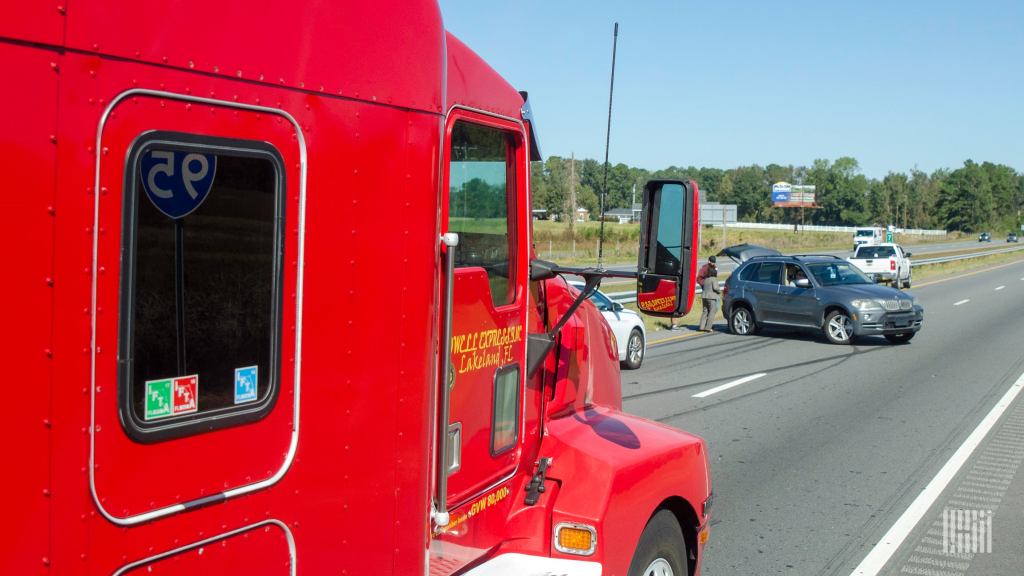
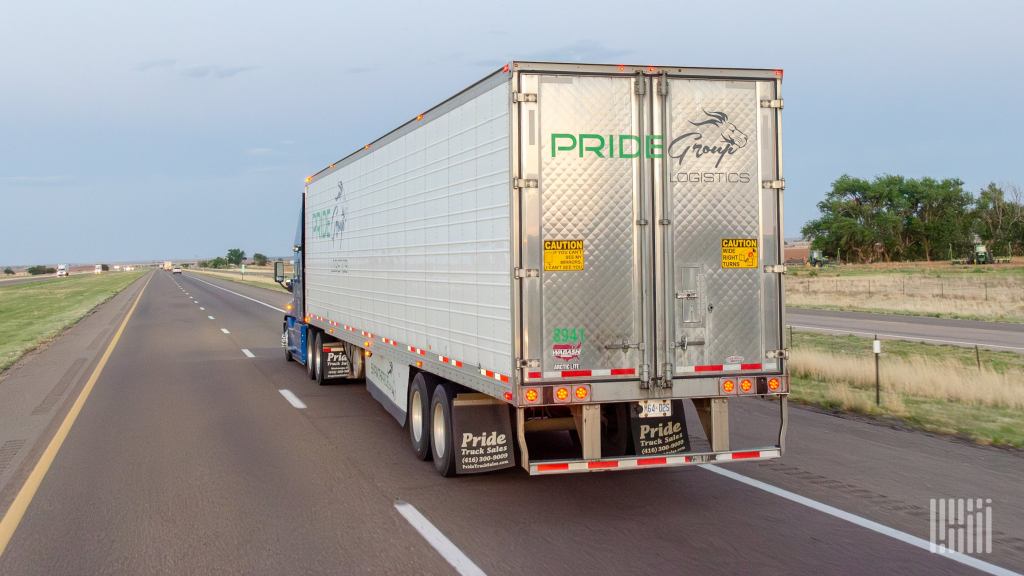
truck in highway accident

WASHINGTON — Deaths and injuries resulting from crashes involving large trucks are increasing at a slower rate, but safety advocates assert regulators still are not doing enough to address the problem.

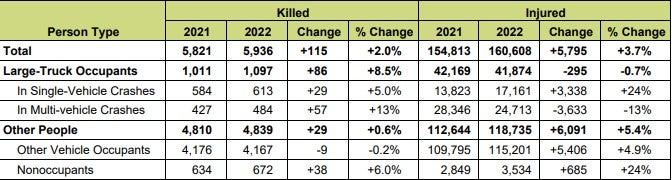
According to the latest estimates published by the National Highway Traffic Safety Administration, 5,936 people were killed in crashes involving medium- and heavy-duty trucks weighing over 10,000 lbs. (weight classes 3-8), a 2% increase from 5,821 deaths in 2021. That compares with estimates by the agency last year showing a 17% increase between 2020 and 2021.

NHTSA also estimated 160,608 injuries involved in such crashes in 2022, a 3.7% increase from 2021. That compared with a 9% increase in injuries between 2020 and 2021.

Despite the slower death and injury rates, the increasing numbers are “unacceptable,” according to the Truck Safety Coalition, a victim advocates group.


Source: NHTSA’s “Traffic Safety Facts,” April 2024

TSC noted that NHTSA’s latest data represents a 75% increase in truck crash fatalities since 2009. “Despite passenger vehicles being safer than ever, 97% of fatalities occur to passenger vehicle occupants in large truck crashes,” the group stated.

TSC Board President Tami Friedrich called on U.S. Transportation Secretary Pete Buttigieg “to take action and urgently proceed with rulemaking to require the use of speed limiters and automatic emergency braking in large trucks as soon as possible” — rulemakings strongly opposed by owner-operators. “No one else needs to die because of bureaucratic inaction.”

The group also urged DOT to require rear and side underride guards on all commercial trucks, and pushed FMCSA to initiate rulemaking requiring a knowledge test for new carriers to show they understand safety rules and regulations.

In addition, “existing safety measures must be protected, and industry-friendly rollbacks must be resisted, such as removing any requirements for direct supervision of commercial learner’s permit drivers who lack experience driving dangerous large trucks,” TSC stated.

Click for more FreightWaves articles by John Gallagher.

Dali owner, manager seek to cap liability in Baltimore bridge collapse

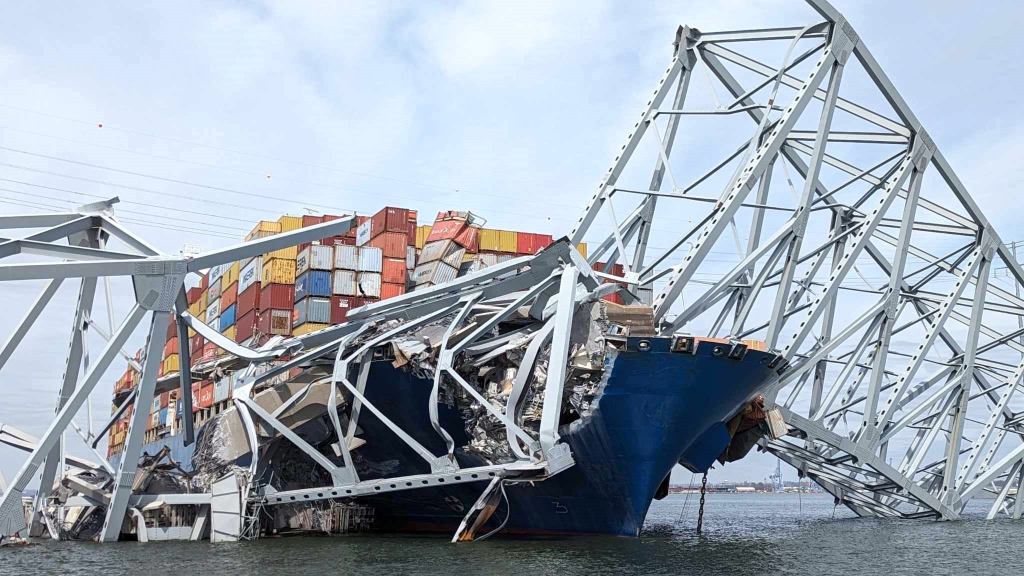
The owner and operator of the Dali, the cargo ship that struck the Francis Scott Key Bridge in Baltimore, are asking a federal court to limit their liability in the disaster that collapsed the bridge and killed six people.

Grace Ocean, the owner of the Singapore-flagged Dali, and Synergy Marine, the manager of the ship, filed a joint petition Monday in the U.S. District Court for the District of Maryland seeking to cap liability at about $43.7 million. The Dali, which was carrying about 4,700 containers, crashed into the Key Bridge in the early morning of March 26. Within moments, the bridge collapsed into the Patapsco River, killing two construction workers; four remain missing and are presumed dead.

The petition says the ship left the Port of Baltimore around 12:40 a.m. that day, with two tugs alongside and a pilot on board. After the tugs cast off the ship, the Dali entered the shipping channel around 1:08 a.m. Seven to 10 minutes later, the ship lost power and propulsion before briefly regaining power only to lose it again moments later.

The crew dropped anchor after losing power a second time, the petition says. The Dali crashed into the bridge around 1:28 a.m.

The companies want to limit their liability to $43.67 million, which is the value of the ship and cargo minus the cost for repairs and salvage, the petition says. The filing is a routine procedure for cases litigated under U.S. maritime law. 

The bridge’s collapse and subsequent closure of the Port of Baltimore is expected to have a major negative impact on the global freight industry and the Maryland economy. The port in 2023 handled a record $80 billion of foreign cargo.

Officials have vowed to clear the channel as quickly as possible to begin shipping from the port once again. Crews have started removing the bridge wreckage.

70-year-old California trucking company, freight brokerage closes abruptly

A 70-year-old California-based less-than-truckload carrier ceased operations Thursday, leaving over 200 truck drivers, warehouse workers and office personnel without jobs, paychecks and paid time off (PTO).

The formerly family-owned company, Tony’s Express, headquartered in Fontana, had 87 drivers and 42 power units at the time of its closure, according to the Federal Motor Carrier Safety Administration’s SAFER website. The company also had around 10 linehaul drivers, who were owner-operators.

John Ohle, CEO of Tony’s Express, sent a text message Thursday, which was obtained by FreightWaves, to his employees that the company was closing its doors that day and could not cover the previous week’s payroll or workers’ PTO. Their medical coverage ended Saturday.

“The current market just didn’t support our ability to operate and be a profitable company, and the cost of fuel in California made it very difficult,” Ohle told FreightWaves. “We were in very serious discussions with two different companies about coming in and partnering or taking over Tony’s, and those fell apart at the very end, and literally, it was a last-minute decision.”

Ohle said he plans to have Tony’s Express employees paid but did not provide a date for when that might occur.

“We’re working right now to make sure we mitigate that situation and get everybody paid,” he said.

Red flags

Some former Tony’s employees said they saw the writing on the wall months ago that the company was in financial trouble and left after their hours were cut and the company’s mechanics’ shop and on-site fuel island closed.

Ohle said these decisions were necessary to boost the company’s bottom line.

“We shut down the shop because it was inefficient and we saved money by going through a full lease and maintenance program with Penske, which is a great operation,” he said. “When I took over, I thought I could save the company, that I could pull a team together and save it.”

On March 24, four days before the company ceased operations, former Tony’s Express workers said they received a text from Ohle informing them that the company would not be running trucks the following day “due to a truck insurance issue.”

In texts obtained by FreightWaves, Ohle sent out a second message March 25 that the company was “still troubleshooting our current insurance issue and require that all employees remain off” the following day.

They never returned to work.

According to FMCSA data, Tony’s Bodily Injury Property Damage (BIPD) coverage is slated to be canceled on May 1. However, the company obtained new broker bond coverage for its freight brokerage in February.

“When we received the first text, I believed we were going back to work and that it was an insurance issue that would get fixed,” one truck driver, who asked to remain anonymous for fear of retaliation, told FreightWaves. “It was a shock when I received the final text that the company was closing and we weren’t getting paid. We all have mortgages, rent and bills to pay, and now we don’t have medical coverage for our families.”

Better times

Former Tony’s Express employees spoke fondly of the company’s previous owners, Anthony “Tony” Raluy and his brother, George Raluy, who sold the family-owned trucking company that their father started in 1954 to Ohle in March 2023.

Tony Raluy, who maintained his CDL until his retirement at 80, died six months after selling the company.

One driver, who worked for the company for nearly 15 years, described Tony Raluy as a hands-on boss. He could be seen driving the fuel tanker truck around the yard, took time out of his day to talk with his employees and knew everyone’s name.

“He even took the time to help teach a former dockworker to become a truck driver — that driver retired from Tony’s Express last year after 46 years,” another former employee said. “Tony wouldn’t have told us he was closing down the company by a text message. He and George would have done things much differently — they had a lot of respect in this industry after 70 years in Southern California, and we were loyal to the Raluys because they cared about their employees and not just the business.”

More red flags

Tony’s Express had switched from direct deposit to issuing paper checks in the past few months. Several employees, mainly at the Stockton location, complained that their paychecks had bounced during this time, according to a source familiar with the situation. Some banks refused to accept a second paper check from the company after their first ones bounced.

The source said office personnel are owed two weeks’ pay because they were salaried employees, while drivers and others are only owed one week’s pay.

“He [Ohle] smoked us all week, stringing us along for four days that we were coming back and would get paid that week,” the former Tony’s employee said.

In recent months, one ex-employee claims some company executives, including Ohle, started paying lumper fees on their personal credit cards, which could add up to thousands of dollars per day, instead of adding funds to Comdata to pay the lumpers who were unloading Tony’s trucks at customers’ warehouses.

Along with its headquarters in Fontana, Tony’s operated a facility in Stockton, California, which had around 65 drivers, and two satellite yards in Phoenix and Las Vegas, which had about five drivers apiece at the time of its closure. They lost their jobs on March 28.

One former driver said Ohle cut back their hours from 12 to eight per day a few months ago. 

“We weren’t happy about it but we accepted it because we had steady jobs and many of us had worked there for about 15 or 20 years,” the LTL driver, who didn’t want his name disclosed for fear of retaliation, told FreightWaves. “But after all of the sacrifices we made to help the company, the company sure didn’t help us in the end.”

Tony’s Express did not file a Worker Adjustment and Retraining Notification (WARN) Act notification with the California Employment Development Department of the company’s impending closure. Companies with over 100 employees are required to give a 60-day notice of a planned shutdown.

Ohle said there wasn’t time to file a WARN notice because the deals he had in the works to absorb Tony’s Express failed at the last minute. California’s WARN Act makes an exception for mass layoffs caused by business circumstances that were not “reasonably foreseeable at the time that 60-day notice would have been required.”

With over 40 years of experience in the trucking industry, Ohle bought another family-owned trucking company, C&M Transportation Inc. of Kansas City, Kansas, in 2002. However, two years later, he abruptly shuttered operations after closing the majority of the company’s terminals and reducing its workforce from around 150 employees to 70, according to the Kansas City Business Journal.

Ohle admitted that C&M “had come up short on paydays in recent months,” according to the news outlet. “We did not sufficiently fund some of our checks. But we have paid people to make sure they’re whole.”

Asked about the closure of C&M Transportation 20 years ago, Ohle blamed the company’s collapse on a failed attempt to take the cartage company public “with some people in California.” 

“It did not work out because it [C&M] probably should have been closed when I bought it because it was losing money,” he told FreightWaves. “The situation at Tony’s Express hurts a lot more because I thought I could turn things around and make it profitable again.”

What’s next?

Several people told FreightWaves that they have filed for unemployment but are actively looking for new jobs in the trucking and logistics industry.

Without paychecks and health insurance, some said they are in a financial bind and unsure if Tony’s Express will pay them what they are owed and pay out their PTO.

“We are all in a bind and believe this could have been handled much differently if the company had told us they were in trouble and had filed a WARN notice 60 days ago so we could have started looking for new jobs,” a former employee said. “But nope, we found out in a text message that we didn’t have jobs, health insurance, weren’t getting paid.”

Do you have a news tip to share? Send me an email or message me @cage writer on X, formerly Twitter. Your name will not be used without your permission.

Jury finds Colorado trucker guilty of vehicular homicide in 2022 crash
Shuttered California trucking company files for bankruptcy
DAT blames ‘external forces’ for intermittent service outages
Illinois trucking company with 171 drivers files for bankruptcy

Feds mandate 2-person minimum for most train crews

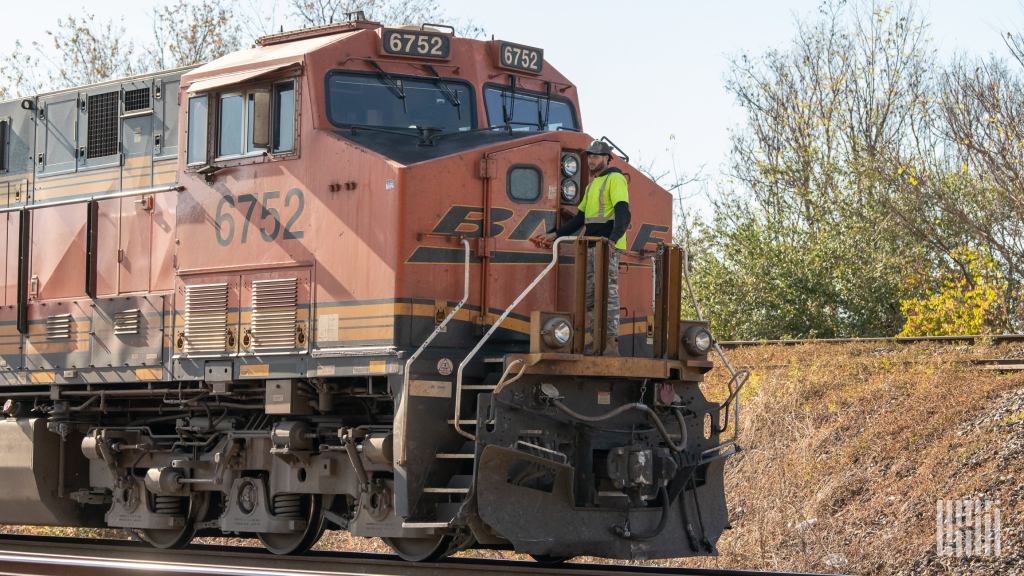
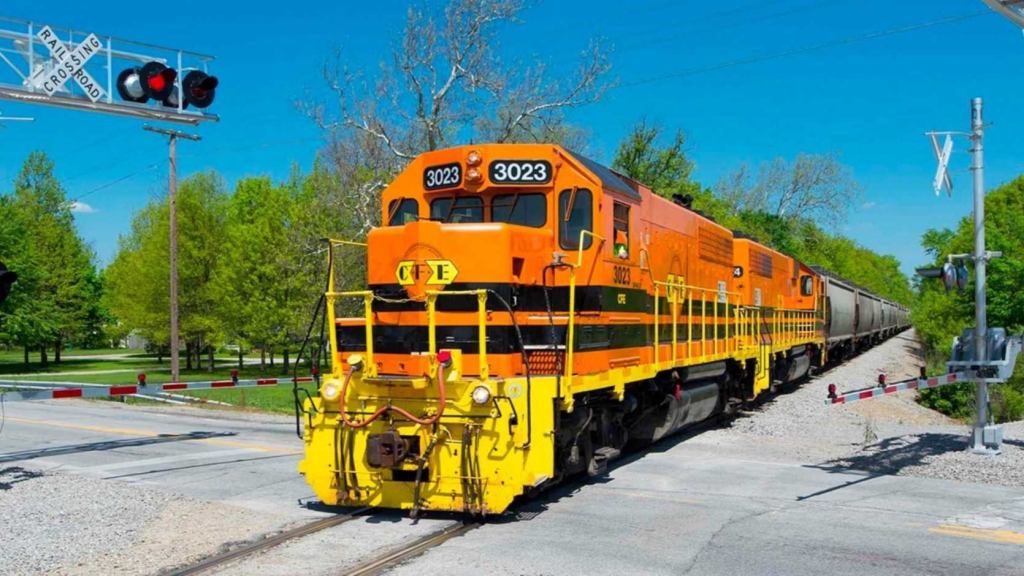
BNSF locomotive

WASHINGTON — Large freight railroads will have to undergo a rigorous approval process if they want to streamline operations down to one-person train crews.

The new requirement is part of the Federal Railroad Administration’s final rule announced on Tuesday mandating a two-person crew minimum on trains operated by Class 1 railroads unless a railroad can obtain approval for a one-person crew from FRA.

Such an approval will require railroads to demonstrate to FRA, through a petition and public comment period, that they can maintain appropriate safety levels. Railroads that do receive special one-person train crew approval must submit an annual report to FRA summarizing the safety of the operation.

“Common sense tells us that large freight trains, some of which can be over three miles long, should have at least two crew members on board — and now there’s a federal regulation in place to ensure trains are safely staffed,” said U.S. Transportation Secretary Pete Buttigieg in announcing the final rule.

“This rule requiring safe train crew sizes is long overdue, and we are proud to deliver this change that will make workers, passengers, and communities safer.”

The Department of Transportation said codifying crew staffing requirements at the federal level also ensures that rail operations are governed by consistent safety rules in all states. “This is an on-going issue as Ohio, Virginia, and Colorado, among others, have recently considered legislation to require two-person rail crews,” DOT stated.

The rule differs slightly from the initial proposed rulemaking issued in 2022 in how it treats Class II and III freight railroads, according to FRA. It allows, in limited cases, such smaller railroads to start or continue certain one-person train crew operations by notifying the agency and complying with new safety standards.

The rule was supported by the Transportation Trades Department (TTD) of the AFL-CIO.

“Rail workers experience the risks of the job daily, and have made it clear that two-person crews are inherently necessary to ensure the safe operation of our rail systems,” commented TTD President Greg Regan.

“While the FRA has considered action on crew size for almost a decade, operational and safety changes across the rail industry the last several years have only heightened the need for strong crew size regulations.”

The new regulation departs from actions taken by the FRA under former President Donald Trump. In 2019, the agency withdrew a previous consideration of a train crew size rule, explaining that railroads had maintained a strong safety record in the absence of regulation and that regulating train crew staffing was not necessary or appropriate for rail operations to be conducted safely.

Rail lobby slams rule

That point was underscored by the Association of American Railroads in opposing the rule.

“FRA is doubling down on an unfounded and unnecessary regulation that has no proven connection to rail safety,” said AAR President and CEO Ian Jefferies. “Instead of prioritizing data-backed solutions to build a safer future for rail, FRA is looking to the past and upending the collective bargaining process.”

Because collective bargaining has historically managed railroad staffing and crew size policies, AAR contends, FRA’s “overreach” now inserts the agency between labor and management.

“Railroads are committed to working with our union counterparts and policymakers to build on this momentum and advance proven solutions that meaningfully advance safety,” Jefferies said. “Unfortunately, the crew size rule takes the industry in the exact opposite direction.”

Click for more FreightWaves articles by John Gallagher.

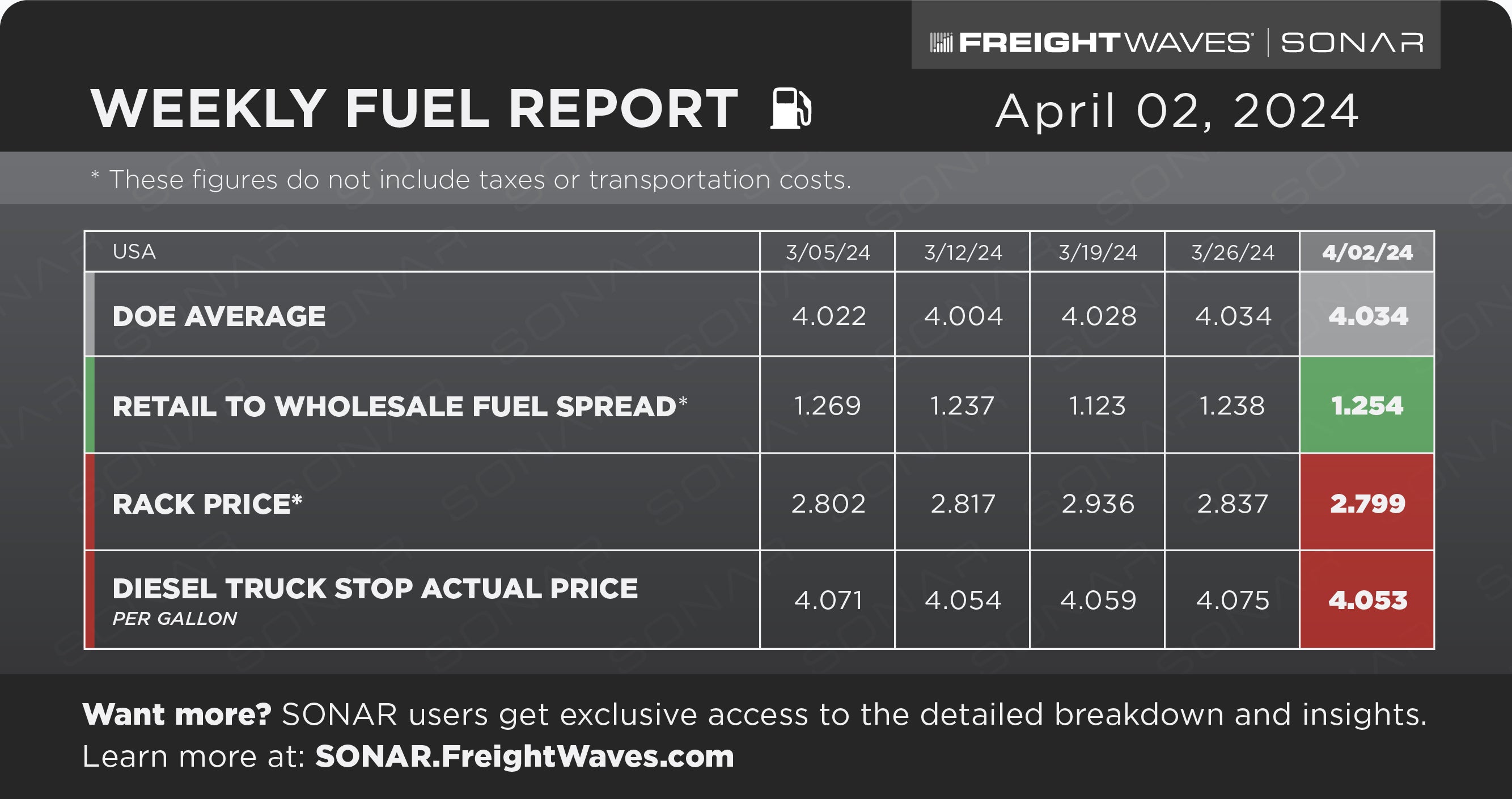
Weekly Fuel Report: April 02, 2024


Learn more at SONAR.FreightWaves.com

2 agencies cut short-line operator G&W’s rating, cite debt-funded dividend

The detailed finances of short-line rail operator Genesee & Wyoming (G&W) haven’t been available since it was bought by an infrastructure-focused investment firm in 2019. 

But G&W has publicly traded debt, and that means rating agencies issue reports on certain aspects of its finances. And last week, in a report that is almost two reports in one, S&P Global Ratings (NYSE: SPGI) reduced its rating on G&W debt even as it gave a strong outlook on the company’s North American short-line business.

Moody’s (NYSE: MCO) also reduced its debt rating on G&W to Ba3 from Ba2. The move by S&P took the debt rating down to BB from BB+. The ratings by the two agencies are considered equivalent. Both are below investment grade.The immediate trigger for the downgrades is G&W’s refinancing of a financing package that involves a term loan and a revolving line of credit, actions that will result in $920 million in net additional secured debt. G&W is taking on the additional debt to fund a $761 million dividend payment to Brookfield Infrastructure, which owns G&W.

According to G&W, it owns or leases more than 100 freight railroads, with 7,300 employees serving a total of 3,000 customers in North America and Europe. Moody’s said the number of short-line railroads in the G&W portfolio is 110.

In North America, its railroads operate in 43 U.S. states and five Canadian provinces. It operates on more than 13,000 track miles.Primary owner Brookfield (NYSE: BIP) is a publicly traded company. Singapore’s sovereign wealth fund, GIC, also has an ownership stake in G&W. And while Brookfield does report the performance of its total rail operations — adjusted earnings before interest, taxes, depreciation and amortization of $411 million and funds from operations of $317 million in 2023 — it does not break out G&W. Brookfield also has rail operations in Australia and Brazil.The cuts in the company’s ratings stem from both agencies seeing the credit metrics at G&W deteriorating as a result of the additional debt load.The S&P report said the new debt structure will push the company’s debt load to 5.5 times EBITDA, which is above the company’s “downgrade threshold” of 4.5X and will cut the ratio of funds from operations to 10%. The downgrade threshold for that metric is 13%.

Moody’s said it expects the G&W debt-to-EBITDA ratio at the close of 2024 to be 5.5X compared to 4.2X when 2023 finished.

Refinancing and a dividend payment

The full transaction involves G&W issuing $3.43 billion in new debt to refinance existing debt and pay the dividend, resulting in the net debt increase of about $920 million.

S&P also noted that G&W plans on spinning off its U.K. and European rail operations. That will reduce EBITDA by $40 million to $45 million, which impacts the debt-to-EBITDA ratio at the company.

Reducing intermodal exposure seen as a plus

On the surface, the ratings cuts are negative. But the S&P Global outlook for G&W’s North American business was otherwise solidly positive, while Moody’s was somewhat more cautious. 

The European operations are mostly intermodal, according to S&P.  With that division no longer part of the company, G&W will “become a bulk commodity-focused rail freight transporter with a presence across North America that has limited exposure to intermodal loads.”

“Intermodal loads are subject to more volatility than bulk and industrial goods and are also more susceptible to substitution by trucks, especially for shorter hauls,” S&P wrote. “Therefore, we believe that the company’s remaining operations will be more resilient to underlying economic conditions.”

And the outlook for those remaining operations sketched out by S&P is solidly positive. Margins at G&W post-European spinoff will be improved “because carrying bulk and industrial goods generates higher revenue per carload.” Evidence of that: The European operations to be spun off accounted for about a third of consolidated G&W revenue and only about 7% of its reported EBITDA. (The EBITDA figure specific to G&W was not disclosed but would be available to S&P Global analysts.)

After the divestiture, S&P Global said, EBITDA margins will improve by 600 to 700 basis points, to the 38% to 39% range. 

G&W issues statement

A spokesman for G&W, asked to comment about the ratings changes, issued a statement that was largely a review of what had occurred, with some perspective on the new structure of the European operations.

“G&W is planning to opportunistically refinance its debt, extending maturities into the 2030s and also enhancing the flexibility of credit terms,” the spokesman said. “As part of the refinancing, we are also separating our North American and UK/Europe companies into stand-alone, sister businesses. Each business will continue to be owned by Brookfield Infrastructure and GIC, and each business will have discrete, stand-alone financing. Our proposed financial structure is reflected in G&W’s latest credit rating from Standard & Poor’s, which remains solid at ‘BB.’”

S&P Global expects Brookfield to maintain its investment in G&W, seeing it as “modestly strategic.”

“G&W is still one of its parent’s largest investments and we believe it aligns with BIP’s strategy of investing in infrastructure assets,” S&P wrote. “Therefore, we believe BIP would provide some support to G&W under certain circumstances — such as during periods of financial distress — and view the railroad as important to its parent’s long-term strategy, given the scale of the investment.”

S&P’s outlook on G&W is stable, meaning an upgrade or downgrade is not likely. In noting that stable rating, S&P gave more support to its optimistic outlook for the short-line operator. Moody’s also has a stable outlook on G&W.

“The stable outlook reflects that, given the wide range of commodities it hauls and the geographic diversity of its operations, we expect the demand for G&W’s services will remain steady over the next year, leading to stable (free operating cash flow) generation,” S&P said. “We expect the company will remain disciplined in using excess cash flow for shareholder distributions while maintaining its debt levels.”

More articles by John Kingston

Wisconsin court affirms Amazon Flex drivers were not independent contractors

Texas trucking company employee gets over 5 years for payroll fraud

RXO gets negative outlook from Moody’s but keeps investment-grade rating

Sheer Logistics acquires CargoBarn to expand brokerage specialties

Managed transportation provider Sheer Logistics announced Tuesday it has acquired freight brokerage CargoBarn. The strategic move enhances Sheer Logistics’ brokerage services, diversifying the type of freight in its portfolio. The acquisition aims to strengthen the company’s ability to handle future cyclical market shifts. Terms of the acquisition were not disclosed.

“We see this as a very timely acquisition in the context of bolstering a foundation to be ready for what the next year or two looks like from a cyclicality perspective,” said Sheer Logistics CEO Joel Gard in an interview with FreightWaves.

In 2022, Sheer Logistics announced it had completed a debt and equity co-investment with industry veterans Eddie Leshin and Brian Winshall of Woodlawn Partners and Monroe Capital LLC, who facilitated the investment. 

The pair had backgrounds at American Backhualers and C.H. Robinson. They plan to use the investment to expand on Sheer Logistics’ technology vision while growing the company’s talent pool to build and sell the technology.

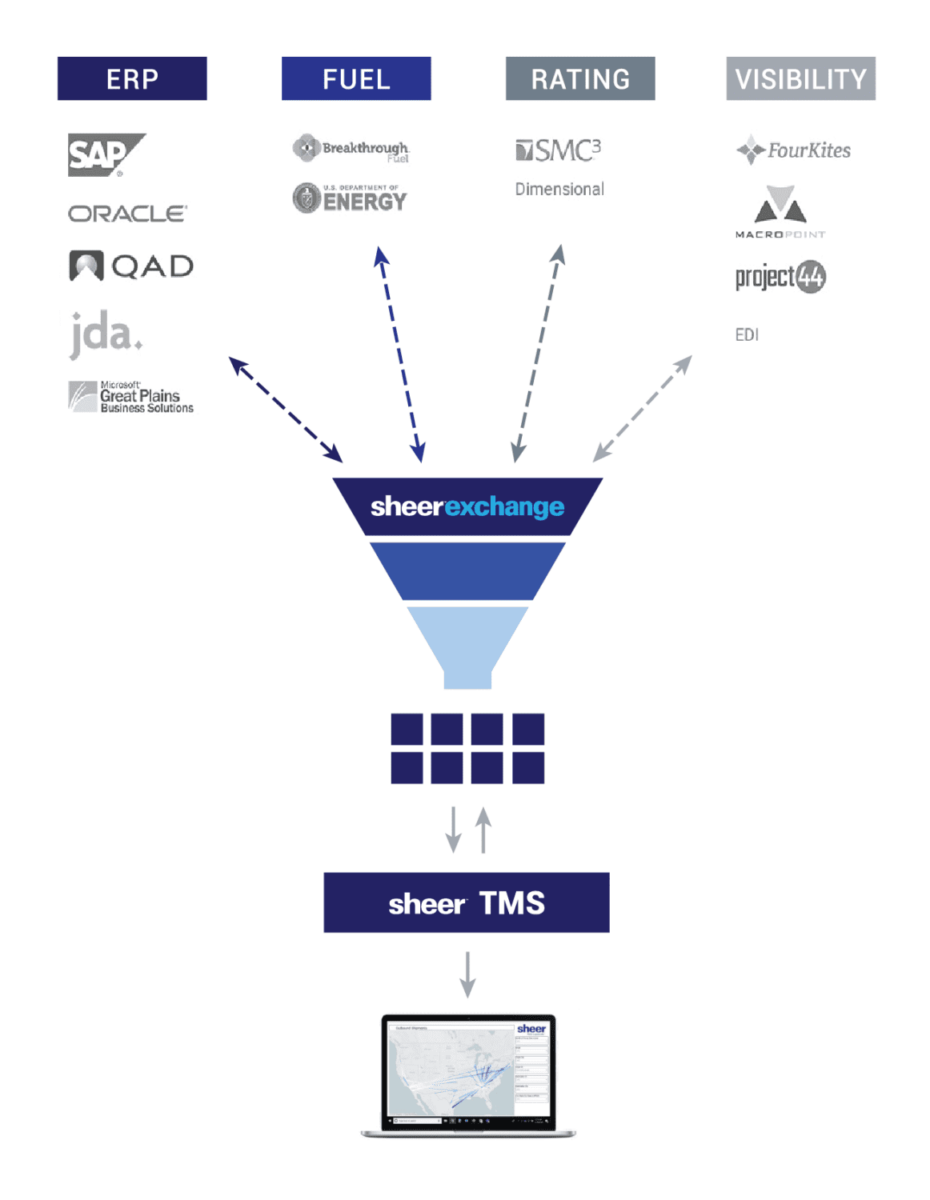
Sheer’s technology tree. (Photo: Sheer Logistics)

In January, the company enlisted Gard to spearhead its digital transformation, focusing on enhancing Sheer’s transportation management system and its integration platform-as-a-service, SheerExchange.

Gard clarified to FreightWaves that although this isn’t strictly a technology acquisition, it presents Sheer with an opportunity to extend managed services to CargoBarn’s existing clientele. Additionally, it allows Sheer’s technology-focused team to pull insights from the specialized brokerage, aiding in the development of future offerings.

“From a 3PL brokerage perspective, the structure and process in place at CargoBarn were very attractive. Getting the core bones of brokerage built on role specialization gives us a more expansive platform to grow efficiently on the brokerage side,” he said.

Sheer will take over CargoBarn’s current offices in Fresno, California; Atlanta; Dallas; and Jacksonville, Florida, which Gard said will help with recruiting the best talent across the country to sell its tech-driven managed services.

Overall, Gard said this is not a “one-and-done” situation and will continue to drive M&A activity in the future.

“There are a host of factors that go into any sort of M&A transaction. We are certainly now benefiting from a very engaged ownership group that is holding us accountable to an aggressive growth plan for the next few years. … Additional M&A activity is certainly not outside the realm of outcomes for us at the moment.”


Blue Yonder to acquire One Network for $839M

Venture 53 invests in Heale Labs’ tokenization technology

Uber Freight extends Powerloop drop-and-hook network nationally

Bankrupt charter airline iAero to cease operations

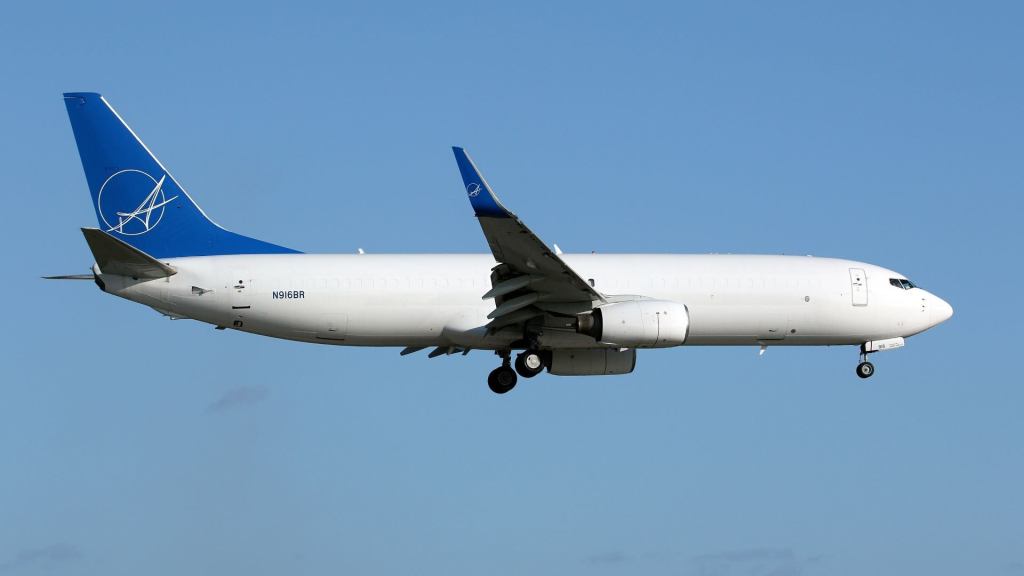
A blue-tailed white jet approaches an airport with wheels down. View from the side.

iAero Airways, the largest passenger charter and cargo carrier in the U.S., will cease operations on Saturday after an unsuccessful effort to restructure the company under bankruptcy protection, President Timothy Rainey informed employees.

Headquartered in Greensboro, North Carolina, iAero operates several narrowbody cargo jets for DHL Express. Other customers include the National Hockey League and U.S. Immigration and Customs Enforcement. The airline’s main flying base is at Miami International Airport. 

“It is with great regret that without continuing DIP financing from our lenders or an alternative lender, we have been directed to prepare to suspend all revenue operations of the airline at the end of the day on April 6,” Rainey said Monday in a memo to staff members that that was obtained by FreightWaves.

The airline received $22.5 million in debtor-in-possession financing from Synovus Financial Corp. when it filed for bankruptcy reorganization last September and an additional $5 million in March, which allowed it to keep operating.

Synovus, which has first priority over the company’s assets, recently agreed to sell 28 Boeing 737 passenger aircraft to Eastern Airlines in exchange for assuming $71 million in first-lien debt, but iAero has been unable to find anyone interested in running the DHL cargo and NHL business, said Rainey.

iAero, founded in 1997 as Swift Air before its 2019 acquisition by iAero Group, is one of the few domestic passenger airlines to still operate older Boeing 737 Classics. It has about 30 active aircraft and a dozen more parked or in storage. The operating fleet includes about eight 737-300s and 11 737-400s, plus a dozen newer 737-800s, according to various fleet databases.

As of September, iAero Airways conducted about 100 flights per week for DHL, utilizing 12 dedicated freighters. Cargo revenue became a significant source of revenue during the COVID crisis and by 2022 represented 12% of total revenue, according to the bankruptcy filing. 

iAero provides its own aircraft for some of the routes it operates for DHL. Other aircraft it flies in the DHL network are owned by DHL, with iAero providing crews and maintenance. Some of the freighters wear the DHL livery, including at least one 737-800. The freighters operate in the United States and between Miami; Santo Domingo, Dominican Republic; and San Juan, Puerto Rico.

Other primary customers include professional and college sports teams, musical groups, and travel service companies in Cuba. The airline also handles deportation flights for the Department of Homeland Security, its largest customer. And Texas Gov. Greg Abbott, a Republican, chartered iAero to transport migrants to Chicago as part of his campaign to shift the burden of immigration to Democrat-controlled cities, according to the Chicago Tribune

iAero ran into financial difficulties when slower cash flow made it difficult to service an $860 million debt load, which in turn made it difficult to raise additional capital. According to court documents, business problems included mismanagement and alleged fraud by previous leadership, the downturn in leisure passenger flying during COVID, a temporary cessation of flight service for DHS and a $29 million adverse arbitration award as a result of a contract dispute with a sales agency.

iAero Airways generated $345 million in gross revenue during 2022, according to its bankruptcy filing. The holding company also owns a business that conducts light aircraft maintenance and airframe checks, and an engine maintenance, repair and overhaul business. As of last fall, the three sister companies employed 860 people. 

iAero’s demise potentially removes a large chunk of capacity from the charter market, opening the door for rivals such as Global Crossing Airlines, also based in Miami, to pick up customers.

All iAero employees will be compensated for work conducted through April 6, the memo said.

Eastern is a small airline that currently operates four Boeing 767 widebody passenger jets and two Boeing 777s, mostly on a charter basis. It offered some scheduled service to South America from New York a couple years ago. The company has 14 planes on its books, but eight of the aircraft have not flown in months, according to aircraft tracking site FlightRadar24.

 A judge for the U.S. Bankruptcy Court for the Southern District of Florida in Miami is scheduled on April 8 to make a decision on whether to approve the asset sale to Eastern Airlines. Under terms of its stalking horse bid, any party that makes a higher offer for iAero has to pay a $2 million breakup fee.

Multiple creditors oppose the sale of assets to Eastern Airlines, arguing that the sale process is designed to benefit Synovus at the expense of all other stakeholders. Private Jet Services Group, the general sales agency, alleges iAero and former president Jeffrey Conry, now an executive at Eastern, struck a non-cash sweetheart deal to help iAero’s owners avoid paying $102 million for breach of contract that began when Conry was at iAero.

All-cargo operator Western Global Airlines, headquartered in Estero, Florida, exited bankruptcy protection earlier this year.

Click here for more FreightWaves stories by Eric Kulisch.

Sign up for the weekly American Shipper Air newsletter here

RECOMMENDED READING:

Western Global Airlines exits bankruptcy with better balance sheet

Benchmark diesel price under $4 a gallon for first time in 8 weeks

The benchmark diesel price used for most fuel surcharges moved below the $4-a-gallon mark this week, another sign that for all the developments that seem primed to send prices higher, “balance” appears to be the best word to describe the market for now.

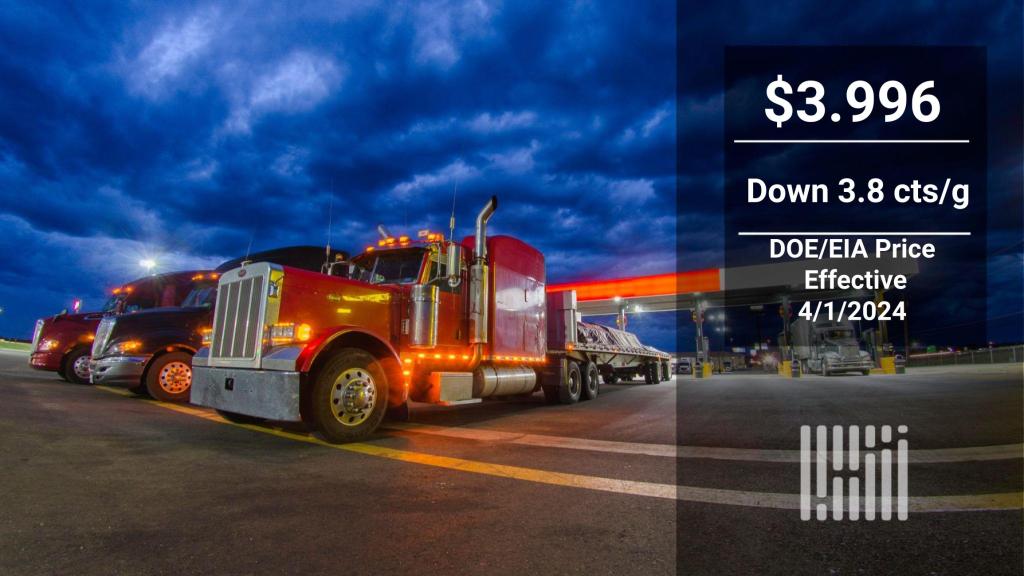
The Department of Energy/Energy Information Administration average retail diesel price fell 3.8 cents per gallon to $3.996 Monday. It is the first time below the $4 mark since Feb. 5.

That early February price was followed by a one-week surge of 21 cents per gallon to $4.109. But since then, prices have been trending lower, and the latest DOE/EIA number puts it 11.3 cents less than that recent high. 

The downward trend is continuing even as the drums are mostly beating on the side of market bulls. Most notably, the price of Brent crude, the world’s benchmark, settled Monday at $87.42 a barrel. It was $81.92 on March 12. 

Monday’s minor move comes as the futures price for ultra low sulfur diesel (ULSD) on the CME commodity exchange continues to trade in a relatively narrow range, particularly compared to the volatility that has marked oil trade since the pandemic began.

That three-year run was marked by a collapse in prices followed by soaring levels as global economics snapped back into an oil market that had seen global output slide due to COVID-related cutbacks. That was followed by rising crude output from countries including the U.S. that pushed global crude prices down; recent forecasts that prices would bounce back over the $100-a-barrel mark have not come anywhere close to being realized.

Futures prices for ULSD dropped below $2.80 a gallon Feb. 20. In the 29 trading days since then, the high settlement on CME was $2.7882 a gallon, but the the low settlement during that period came on Wednesday at $2.5986. That price from last week was the lowest settlement since Jan. 8.

ULSD on CME has posted two consecutive days of gains since then, settling Monday at $2.6271 a gallon.

Whereas diesel over the past few years often has been a market leader, it is now trailing the rising Brent market by a significant amount. On March 12, the spread between Brent and ULSD was roughly 66 cents a gallon. After Monday’s trading, the spread was down to about 54.7 cents.

Besides the rise in crude, the case for a bullish market, particularly in diesel, is coming primarily from the potential impact of continuing Ukrainian attacks on Russian oil refineries. Given that Russian refineries are configured for a particularly strong diesel yield, that means the bullish case tends to focus on that fuel.

In a report that circulated Monday, Helima Croft, the chief energy analyst at RBC Capital Markets, wrote that RBC believes attacks by Ukraine have affected five refineries that are “facing significant throughput disruptions,” with throughput down 650,000 barrels a day from a year ago.

In her report, Croft also raised the prospect of Ukraine expanding its attacks to Russian facilities that export crude and products such as gasoline and diesel..

Bloomberg reported that Russia plans to reduce its diesel exports to the lowest level in five months because of the impact of the attacks. The reduction will be about 570,000 barrels a day, down about 21% compared to exports of 724,000 barrels a day from the ports last month.

But in what is something of the reverse of that, Mexico, according to Bloomberg, plans to reduce exports of crude to increase refinery processing rates and increase the country’s output of gasoline and diesel.

If Russian refineries are affected by the Ukrainian attacks but crude export facilities are not, that could lead to more crude available for export. The Mexican plan would be the opposite: less crude being exported but more of it to be processed in the country’s refineries. 

The Mexican refining sector has long been troubled by inefficiencies. But Bloomberg reported that in February, Mexico’s six refineries “operated near the highest rates seen in more than six years.” The country also has added 340,000 barrels a day of refining capacity with the opening of its Dos Bocas refinery.

In U.S. physical markets, where barrels are traded for physical delivery on barges or on a pipeline, there is no sign of growing tightness.

Those markets are traded as a differential between the physical price in a delivery point such as the U.S. Gulf Coast and the CME ULSD price.

For example, deliveries of ULSD on the Buckeye Pipeline, which services the region including Illinois, Pennsylvania and into New York, the differential for physical barrels was plus 8.5 cents a gallon Monday, according to price reporting service DTN. It has traded near the 7 cents-a-gallon level for several weeks, standing right at 7 on March 12.

Prices for barges in New York Harbor have not moved from plus 1 cent for weeks. In Group 3, a midcontinent area that includes Oklahoma and Kansas, the differential was plus 5.75 cents a gallon Monday, the same price DTN reported on March 15.

More articles by John Kingston

Wisconsin court affirms Amazon Flex drivers were not independent contractors

Texas trucking company employee gets over 5 years for payroll fraud

RXO gets negative outlook from Moody’s but keeps investment-grade rating

Pride Group’s bankruptcy filing underscores impact of trucking downturn

After Pride Group, one of Canada’s largest trucking and leasing companies, filed for bankruptcy protection last week amid a capacity glut and low rates, President and CEO Sulakhan “Sam” Johal is warning that an “unorganized demise” of the company threatens “the livelihoods of many thousands of families.”

The company was founded by Johal and his brother Jasvir Johal, vice president, in 2010. It operates 50 owned and leased locations across Canada and the U.S., controlling a fleet of 20,000 tractor-trailers that are owned, leased, contracted for service, serviced or securitized by Pride Group. It offers domestic and cross-border transportation services in Canada and the U.S. and operates truck dealerships and service centers in both countries.

The Mississauga, Ontario-based company was profitable until the pandemic, according to Sam Johal. Following the downturn across the trucking industry after the pandemic, the family-owned company was unable to pay its debts.

“Increased spot freight prices, and low diesel prices and interest rates during the pandemic led to an increase in trucking and logistics supply,” the company said in its bankruptcy filing in the Ontario Superior Court of Justice. “This ultimately resulted in an oversupply of trucking and logistic services which resulted in declining spot freight prices at the same time that diesel prices and interest rates went back up.

“This simultaneous reduction in pricing and increase in costs negatively impacted the Pride Group’s revenue, while also decreasing the demand for truck sales, because the industry was no longer viewed as a good investment for the new owner-operators that form the foundation of the Pride Group’s customer base.

“The foregoing headwinds combined to put tremendous pressure on [Pride Group’s] business, which had grown exponentially due to the demand during the COVID-19 Pandemic.

“By December 2023, many of the lenders either cut off availability under their facilities or the facilities maxed out, which hindered the [Pride Group’s] ability to fund new inventory and lease sales. As a result, the [Pride Group] had nominal cash sales and no new lease sales in January 2024. Without the ability for the [Pride Group] to provide leasing options to customers (because of the frozen leaseline financing facilities), sales have fallen substantially and liquidity has been severely  impacted.”

More than 20 lenders have claims totaling more than $637 million in debt from Pride Group, including financial institutions such as Mitsubishi Capital ($88.3 million), Daimler Truck Financial Canada ($193 million), Daimler U.S. ($69.7 million), Paccar Financial ($46.9 million) and Volvo Financial Services Canada ($9.8 million).

The Pride Group directly employs 669 people, including 369 in Canada, 200 in India and 100 in the United States. The company also has 405 independent contractors, including 369 individuals in Canada.

Pride Group filed Thursday for creditor protection under the Companies’ Creditors Arrangement Act (CCAA) in Canada, which gives the company a stay of proceedings for at least 10 days.

“We have taken these steps to commence the CCAA proceedings and to seek recognition under the Chapter 15 cases so that we can maintain our current operations, stabilize our business, establish governance controls and monitoring, and develop a plan to restructure for the benefit of our stakeholders. We believe this is in the best interests of all of our employees, customers, business partners and other stakeholders,” the company said in a news release.

The bankruptcy protection filing came after Mitsubishi HC Capital filed lawsuits accusing the Pride Group of defaulting on payments they had personally guaranteed. Mitsubishi HC Capital is seeking damages of $100 million in the lawsuits.

Sam Johal said if the company is unable to reorganize and is forced to cease operations, the closure could have ripple effects throughout the trucking industry. Many of the Pride Group’s customers and drivers are from the Southeast Asian community, according to court documents.

“The fallout from an unorganized demise of the Pride Group on the Canadian and U.S. owner-operator trucking communities in particular will be catastrophic, as will the spiral effects on all of the businesses that they support in their local communities. The livelihoods of many thousands of families are at stake,” according to Sam Johal.

More articles by Noi Mahoney

Canada’s Pride Group files for bankruptcy protection, faces $100M lawsuit
Investment surges in Mexico as companies shift supply chains, plan new factories

State of Freight: Reasons to be bullish on second half of 2024