Tractor demand no longer necessarily a gauge for market health

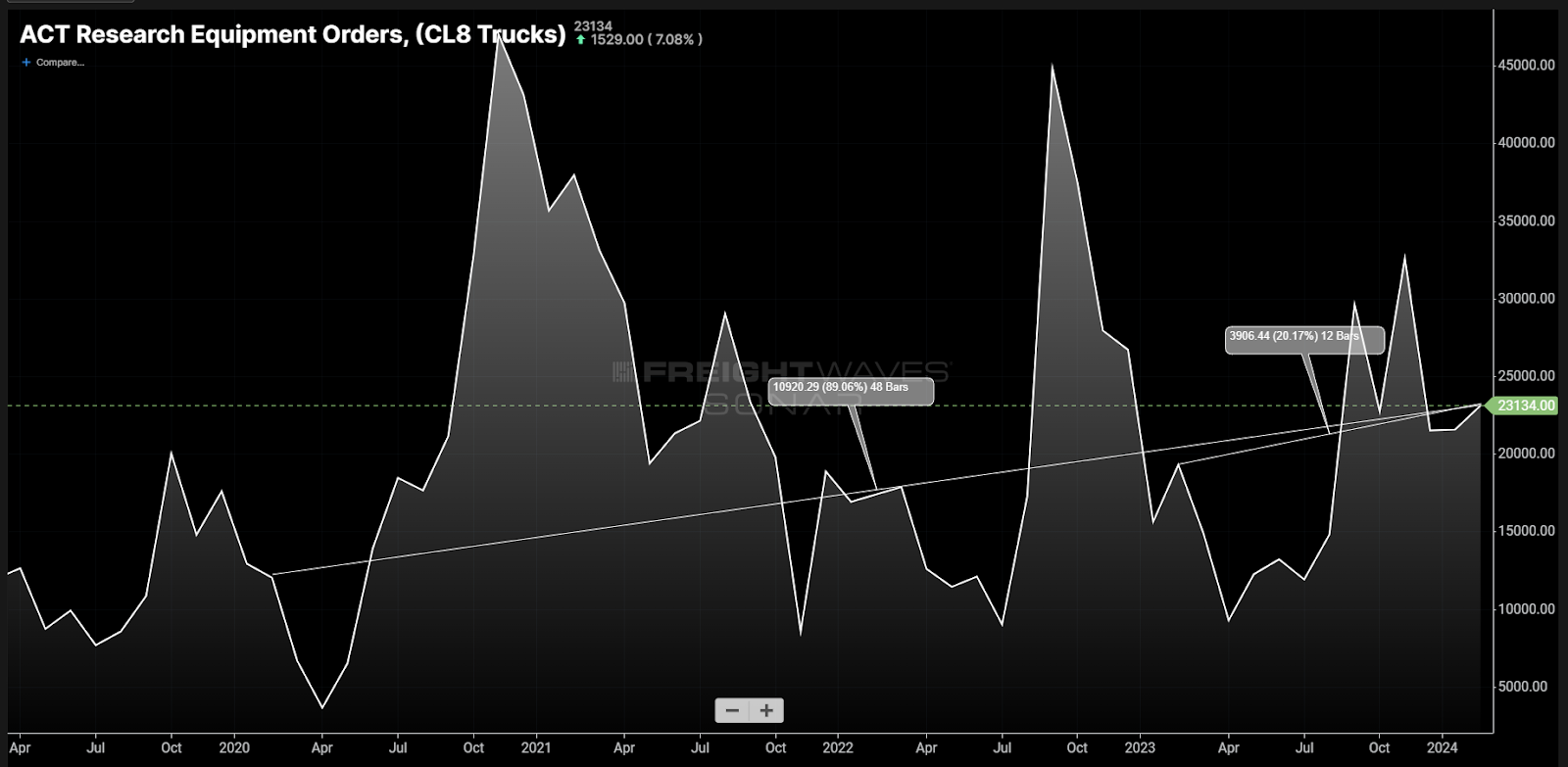
Chart of the Week: ACT Research Equipment Orders – Class 8  SONAR: ORDERS.CL8

Class 8 truck orders remained unseasonably strong through the first few months of 2024, outperforming last February by over 20%, according to ACT Research. Freight-hauling semi trucks typically dominate this category and have been a good indicator of industry health, but like many indicators, this value’s implications have changed.

Ask transportation service providers the state of the national freight market, and they will all say the same thing: It is awful. National truckload carriers are already tempering expectations for investors in Q1.
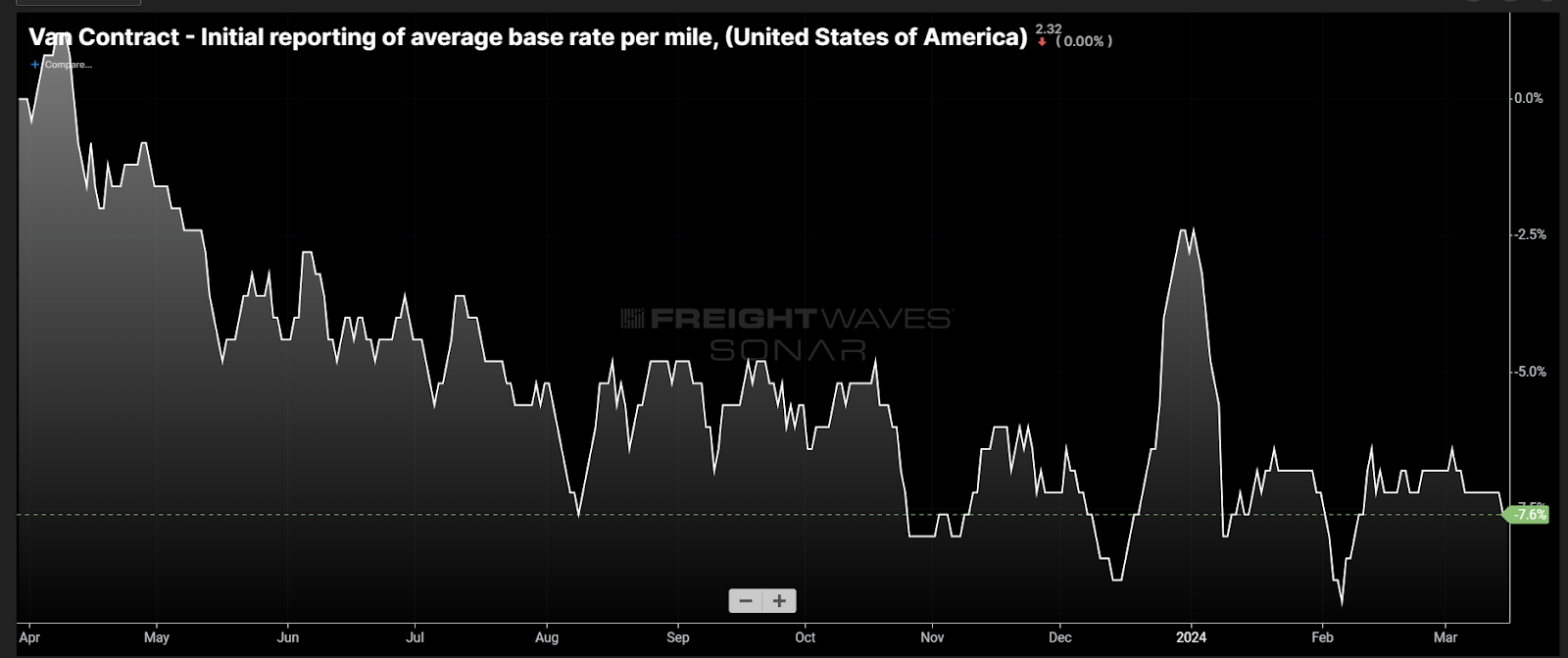
Long-term contract rates for dry van truckload freight continue to deflate, showing over 7% lower year over year in early March. In other words, there is very little reason to expect this category of truck orders to show signs of strengthening.

ACT offers up a few explanations, stating that private fleet growth and some level of increased vocational spending thanks to government spending on infrastructure and nearshoring efforts are propping up the order levels.

This makes sense, seeing as how the domestic freight market has been fractured since the pandemic began in 2020.
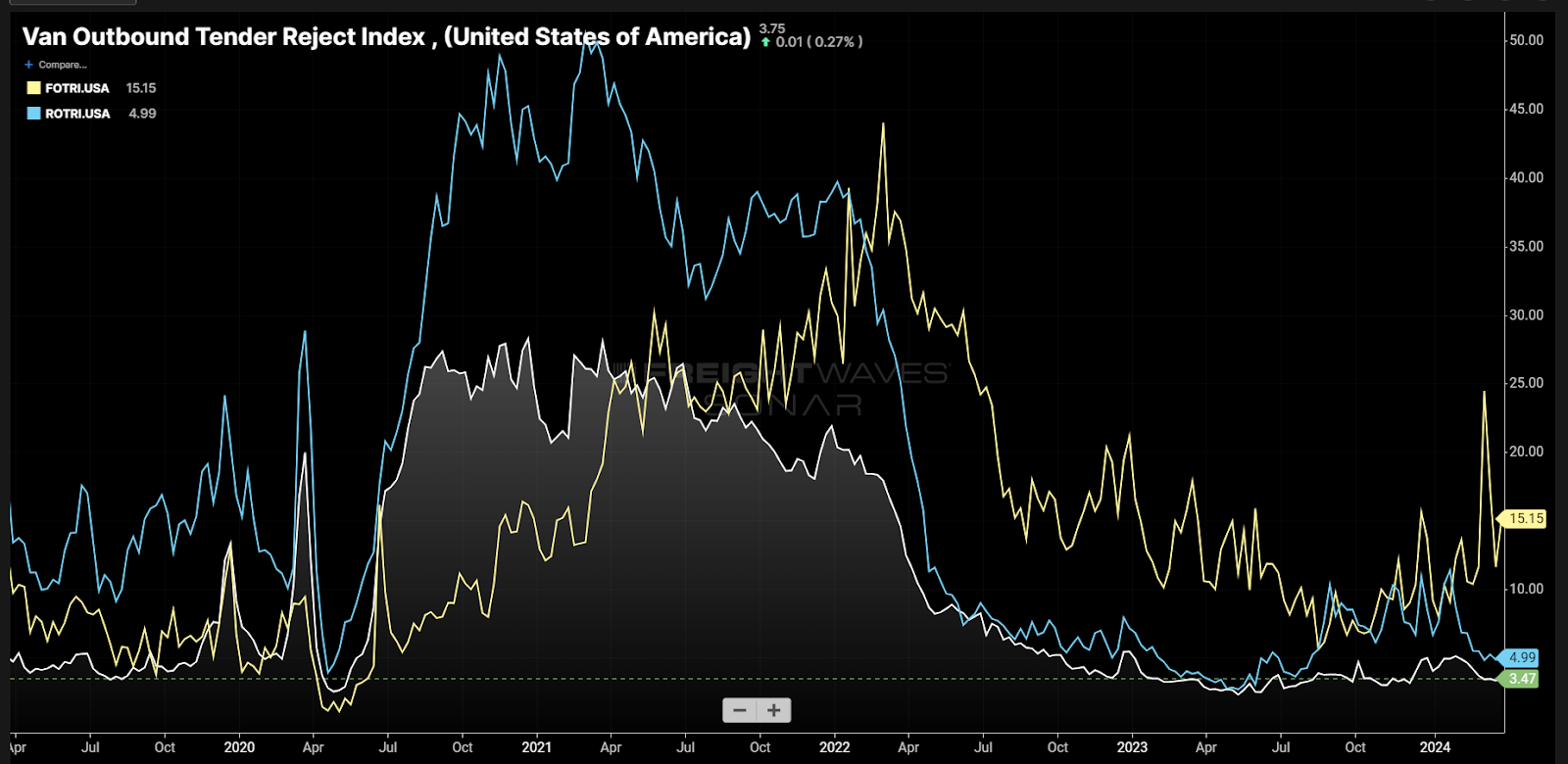
Looking at rejection rates by trailer type, the flatbed market (FOTRI) had an entirely different trajectory from refrigerated (ROTRI) and dry van (VOTRI). Tender rejection rates for flatbed took a while to increase, peaking after refrigerated and van started to plummet. 

This was largely due to the type of freight being consumer goods. Flatbed freight skews toward industrial and construction activity, which was throttled by supply chain and production limitations in 2020-21.

The flatbed market has been healthier after the pandemic because it got less attention and fewer new entrants during that period. Flatbed’s increasing national rejection rate supports the concept that heavy equipment is in higher demand around vocational efforts as well as in this truckload segment.

The less-than-truckload market has also had a different experience from the broader trucking market, thanks in part to the failure last year of the nation’s third-largest carrier, Yellow.
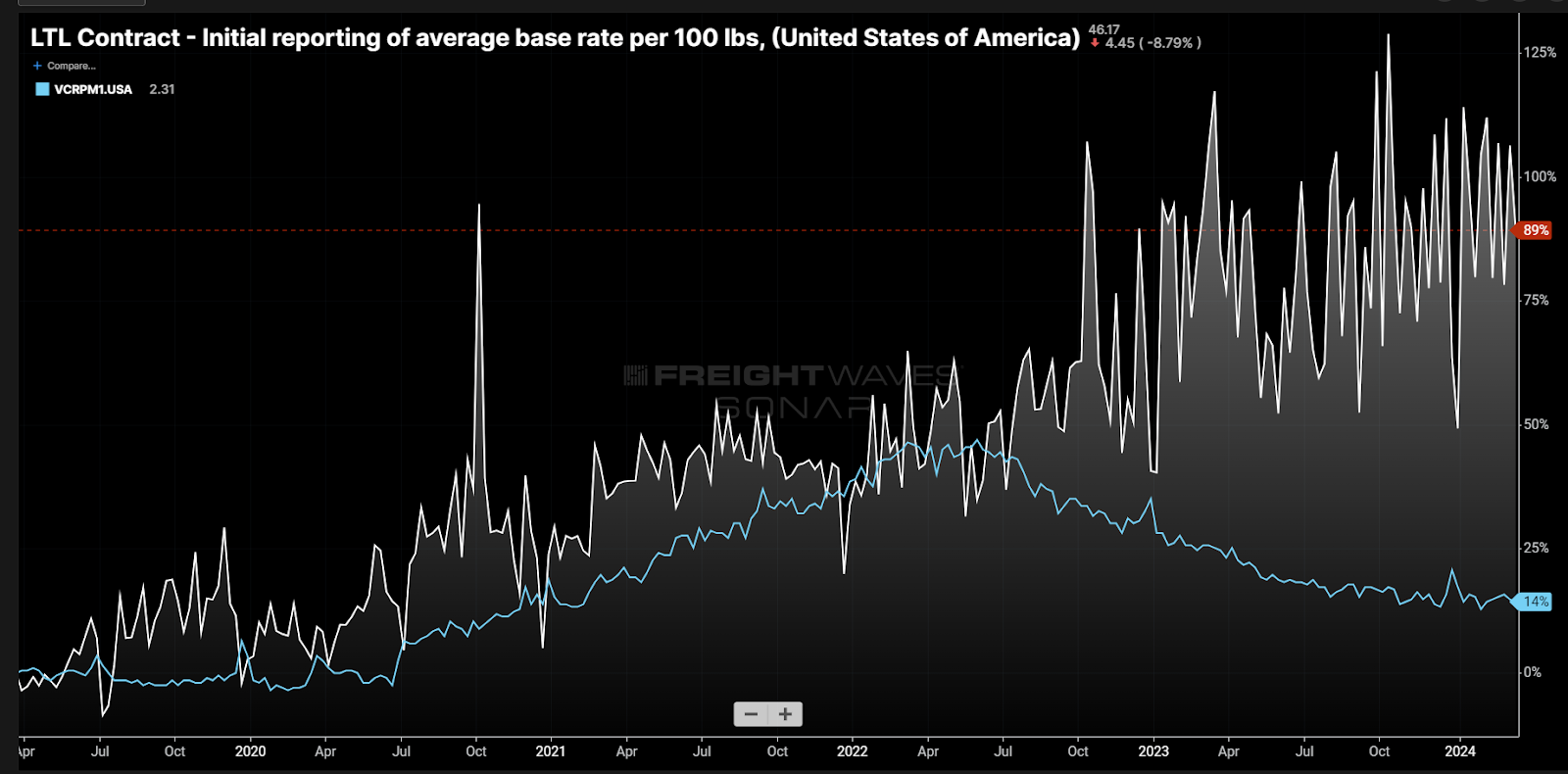
LTL contract rates (LCWT1) tend to follow dry van truckload with a lag of six to nine months. Just as LTL contracts were showing signs of weakening last spring, the news broke around Yellow’s troubles with the Teamsters. This appeared to help keep rates elevated as shippers scrambled to diversify their provider base away from the struggling carrier.

While the LTL space has not been completely inoculated against the overall conditions of the trucking market, it definitely got a strong buffer and was able to maintain more pricing discipline than truckload providers. Todd Maiden recently reported on ArcBest as a shining example of this effect.

Taking a sampling of publicly traded truckload carriers, most posted annual drops in average truck counts. 
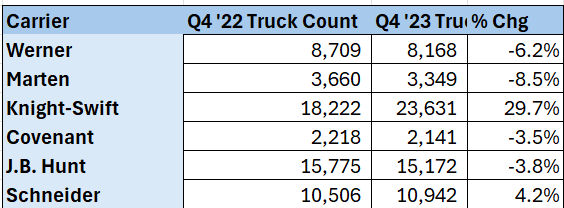
The two exceptions from this sample are related to acquisitions. Knight-Swift acquired U.S. Xpress, and Schneider acquired M&M Transport Services. Neither grew its fleet outside of consolidation.

Point being, the narrative that Class 8 order growth is a combination of continued fleet replenishment and investment outside the for-hire truckload environment has strong support. 
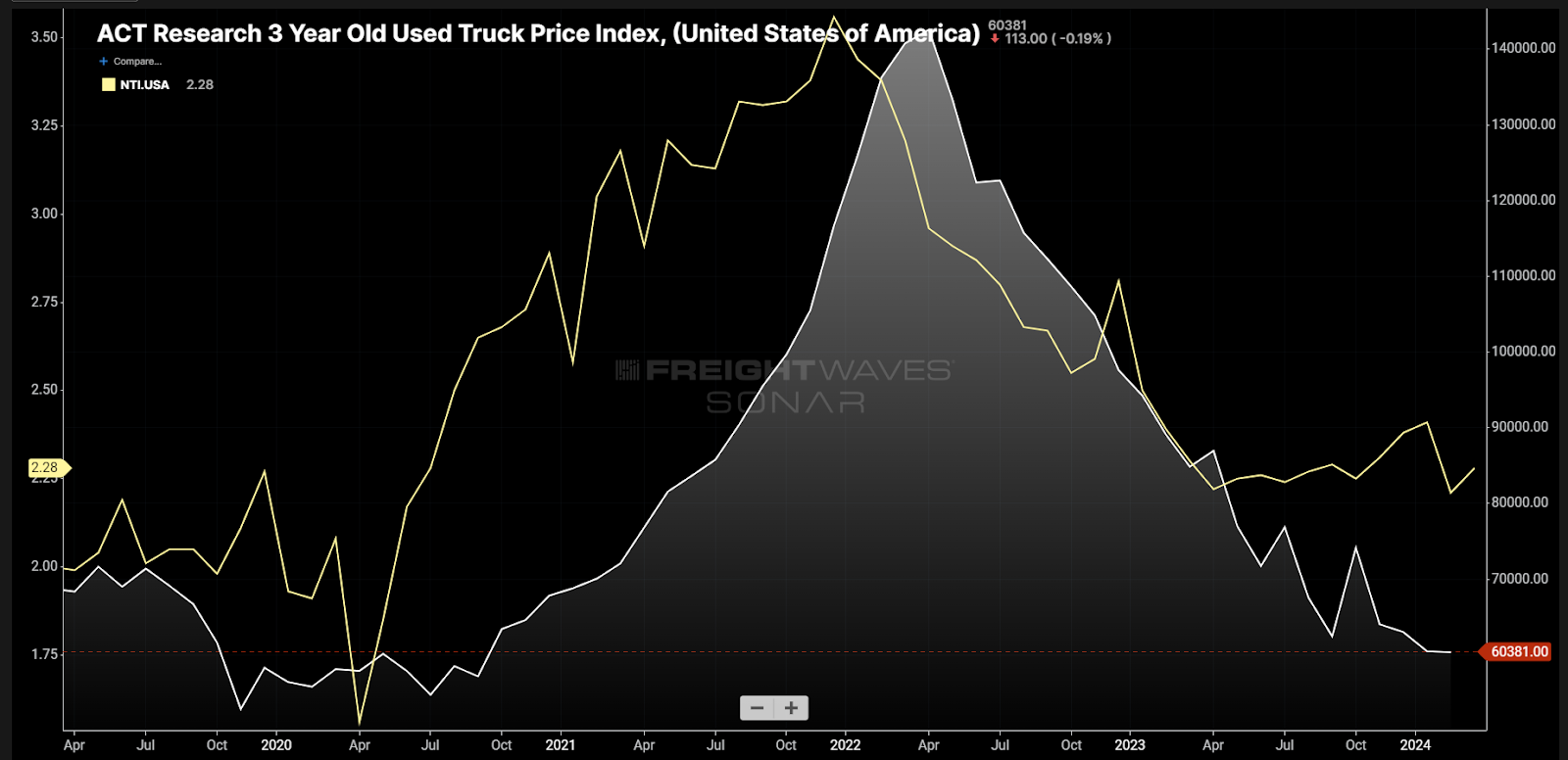
A better indicator of industry health is the average used truck price, seen above for 3-year-old models (UT3) reported by ACT Research. Prices have plummeted behind the spot market collapse in 2022 and have been dropping since. This data point has its biases as well but seems better suited than new orders to explain the current market.

As has been the story with numerous high-level traditional macroeconomic indicators, Class 8 order volume’s relationship with and ability to explain its environment has changed. Understanding value beyond traditional thought has become increasingly important.

About the Chart of the Week

The FreightWaves Chart of the Week is a chart selection from SONAR that provides an interesting data point to describe the state of the freight markets. A chart is chosen from thousands of potential charts on SONAR to help participants visualize the freight market in real time. Each week a Market Expert will post a chart, along with commentary, live on the front page. After that, the Chart of the Week will be archived on FreightWaves.com for future reference.

SONAR aggregates data from hundreds of sources, presenting the data in charts and maps and providing commentary on what freight market experts want to know about the industry in real time.

The FreightWaves data science and product teams are releasing new datasets each week and enhancing the client experience.

To request a SONAR demo, click here.
Canada’s Pride Group files for bankruptcy protection, faces $100M lawsuit

One of Canada’s biggest trucking carriers has filed for bankruptcy protection after lender Mitsubishi HC Capital America filed a lawsuit seeking $100 million.

Pride Group filed Thursday for creditor protection under the Companies’ Creditors Arrangement Act (CCAA) in Canada, which gives the company a stay of proceedings for at least 10 days.

“We have taken these steps to commence the CCAA proceedings and to seek recognition under the Chapter 15 cases so that we can maintain our current operations, stabilize our business, establish governance controls and monitoring, and develop a plan to restructure for the benefit of our stakeholders. We believe this is in the best interests of all of our employees, customers, business partners and other stakeholders,” the company said in a news release.

The bankruptcy protection filing came after Mitsubishi HC Capital filed lawsuits accusing the Pride Group’s Sulakhan “Sam” Johal, president and CEO, and Jasvir Johal, vice-president, of defaulting on payments they had personally guaranteed, according to TruckNews

Mitsubishi HC Capital is seeking damages of $100 million in the lawsuits.

Mississauga, Ontario-based Pride Group is a North American truckload carrier operating a fleet of 391 tractors and 1,200 trailers with terminals in Ontario, Quebec, Alberta and Illinois.

Pride Group acquired Texas-based truckload carrier Arnold Transportation Systems in 2022. The acquisition increased Pride Group’s transportation assets to 805 trucks and 2,600 trailers in Canada and the U.S.

Along with Mitsubishi HC Capital, more than 20 other lenders have filed claims totaling $637 against Pride Group, according to filings with the U.S. Bankruptcy Court for the District of Delaware. They include Daimler Truck Financial Canada ($193 million), Daimler U.S. (US$69.7 million), Paccar Financial ($46.9 million), and Volvo Financial Services Canada ($9.8 million).

Jury finds Colorado trucker guilty of vehicular homicide in 2022 crash

A jury in Weld County, Colorado, has found a Colorado truck driver guilty of five counts of vehicular homicide stemming from a 2022 crash that killed a Wyoming family of five that was traveling home from a birthday celebration.

The jury also found Jesus Puebla, 27, of Denver, guilty Wednesday of careless driving, reckless driving, vehicular assault, a commercial vehicle safety violation and driving without a CDL.

In June 2022, Puebla, who was driving a 1999 Kenworth T800 straight truck, was involved in a crash near Mead, Colorado, that killed Aaron Godinez, Godinez’s fianceé, Halie Everts, their 3-month-old daughter, Tessleigh, and Aaron Godinez’s parents, Emiliano Godines, 51, and Christina Godines, 47. All lived in Campbell County, Wyoming.

Investigators estimate that Puebla was traveling at 75 mph when he slammed into the 2015 Ford Edge SUV driven by Godinez, who was traveling less than 10 mph because of stopped traffic ahead on Interstate 25.

As of publication, Puebla’s defense attorney, James Colgan, had not responded to FreightWaves’ request seeking comment about the verdict.

At trial, Puebla testified that his brakes failed when he tried to stop to avoid the crash.

A wrongful death lawsuit filed by Emiliano and Christina Godines’ surviving children, Christian Godinez and Abigail Godinez, claims Puebla did not have a valid CDL or medical card as required by the Federal Motor Carrier Safety Administration to operate a commercial motor vehicle.

At the time of the crash, the Colorado State Patrol found that the brakes on the straight truck that was driven by Puebla “were out of adjustment.”

The truck was registered to Carlos Coreas, owner of Lucky 22 Inc. of Arvada, Colorado, but was not listed on the trucking company’s insurance policy until hours after the crash.

In a denial-of-coverage letter dated March 16, 2023, the trucking company’s insurance provider, Progressive, which is underwritten by Artisan and Truckers Casualty Co., states that a Lucky 22 employee attempted to add the truck that Puebla was driving to its insurance policy hours after the fatal crash.

According to the letter, obtained by FreightWaves, the Lucky 22 employee did not mention the crash when seeking to add the truck to its policy and provided photos of the truck that were requested by the insurance company showing no damage. Two days later, Lucky 22 added five more trucks to its policy.

While Puebla was an employee of Lucky 22, the accident report indicates the truck was displaying the U.S. Department of Transportation number of Caminantes Trucking.

The Long Beach, California, trucking company officially has the same name as its owner, Jose Mauricio Coreas, but conducted business as Caminantes Trucking before its contract authority was revoked in January, according to FMCSA’s SAFER website. 

Investigators claim Coreas subcontracted with other carriers to haul mail for the U.S. Postal Service. Those carriers included Lucky 22 Inc., which is owned by his son, Carlos Coreas.

Prior to the crash, Puebla was hauling a load of mail to Greeley, Colorado, from Denver.

Caminantes, listed as an intrastate-only company, had 46 power units and 37 drivers. According to FMCSA data, Caminantes Trucking was involved in 11 crashes — two of them fatal — over a two-year period.

In February 2023, the Postal Service announced it was severing its mail contract with Caminantes Trucking. The company that Puebla drove for, Lucky 22, also did not have its for-hire operating authority with FMCSA at the time of the crash, court filings state.

According to the court docket, Puebla’s sentencing hearing is slated for June 21.

Do you have a news tip to share? Send me an email or message me @cage_writer on X, formerly Twitter. Your name will not be used without your permission.

Shuttered California trucking company files for bankruptcy
DAT blames ‘external forces’ for intermittent service outages
Illinois trucking company with 171 drivers files for bankruptcy

Blue Yonder to acquire One Network for $839M

Supply chain solutions provider Blue Yonder announced Friday it has signed an agreement to acquire One Network Enterprises and its AI platforms that provide end-to-end supply chain visibility, planning tools, order fulfillment and payment solutions to manage supplier and carrier resources.

The deal comes in at approximately $839 million and is contingent on the fulfillment of standard requirements including regulatory approval. Blue Yonder expects it to close in Q2 or Q3 this year.

“Blue Yonder offers the most complete portfolio in the industry, spanning from planning to execution. Coupled with our network and multi-enterprise, multi-tier platform, we’re poised to form a backbone of this new supply chain of the future,” said Greg Brady, chairman and founder of One Network.

According to One Network, the company hosts over 150,000 trading partners within its technology ecosystem. Blue Yonder customers will now be able to share data with these partners and utilize them to avoid potential disruptions and risk to their own supply chains.

Additionally, Blue Yonder said it should improve the supplier and carrier relationship, reducing order creation to fulfillment process from days to minutes, and decreasing costs for end consumers.

“Supply chains have become more complex, and as more and more companies reduce risk by diversifying sourcing of products globally, there is an increased demand for the sharing of information and resources across the whole value chain. This, along with increased disruptions and geopolitical risks, has put pressure on organizations to build more resilient and robust supply chains. … Combined with One Network’s capabilities, Blue Yonder will establish itself as a leading supply chain solutions company that can offer a unified, end-to-end supply chain ecosystem,” said Duncan Angove, CEO of Blue Yonder.

In 2021, Panasonic acquired Blue Yonder, marking a strategic shift toward integrating operational efficiency software with its renowned hardware offerings. This move aimed to establish a comprehensive one-stop solution for end consumers, blending Panasonic’s hardware expertise with Blue Yonder’s operational software capabilities.

Over the past five quarters, Blue Yonder has focused its attention on the supply chain technology space, acquiring factory planning solution Flexis AG and reverse logistics technology Doddle. While those transactions did not disclose costs, Blue Yonder did confirm that with these three deals, it has invested more than $1 billion in supply chain acquisitions.


3 supply chain software providers tell their latest stories at NRF

Scheduling Standards Consortium grows ranks, readies API release

A look at US disasters involving boats hitting bridges

Tuesday’s bridge collapse in Baltimore wasn’t the first time a bridge crumbled after being struck by a ship or boat.

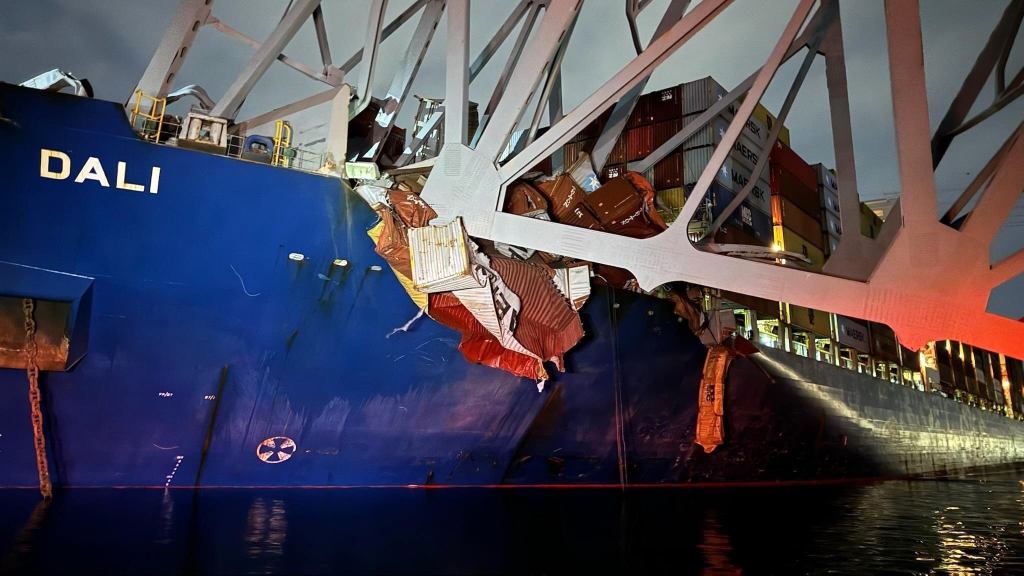
The Francis Scott Key Bridge collapsed into the Patapsco River early Tuesday morning when cargo ship Dali slammed into it after experiencing power issues. Two people are confirmed dead and four are presumed dead.

The 1.6-mile bridge served as a major roadway for some 35,000 Marylanders every day and overlooked the Port of Baltimore, an important auto hub for the supply chain. The Biden administration has approved $60 million for emergency work in response to the collapse.

Here’s a look at other disasters caused by boats hitting bridges.

Big Bayou Canot: 47 killed, 103 injured 

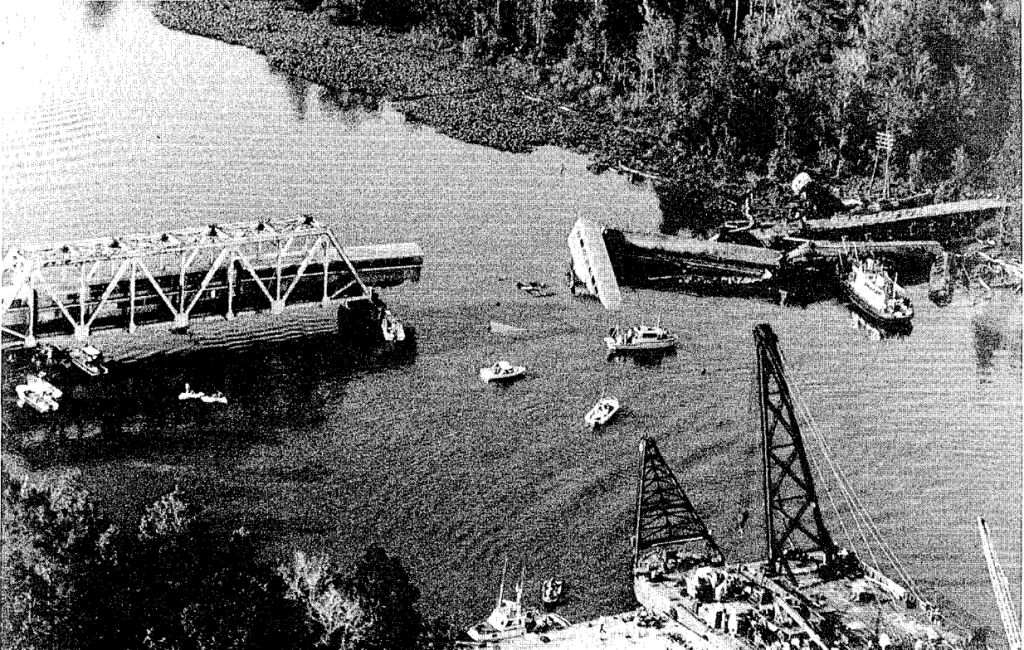
Towboat Mauvilla was pushing barges in dense fog on Sept. 22, 1993, when it slammed into the Big Bayou Canot railroad bridge near Mobile, Alabama. Within minutes of the bridge being displaced, an Amtrak train traveling from Los Angeles to Miami hit the bridge and derailed. Several train cars plummeted into the water, killing 47 people and injuring 103.

Towboat Mauvilla hit the Big Bayou Canot railroad bridge near Mobile, Alabama, on Sept. 22, 1993. (Photo: NTSB)

Sunshine Skyway Bridge: 35 killed

The bridge, which spanned Lower Tampa Bay in Florida, collapsed on May 9, 1980, when freight ship Summit Venture hit a support column during a sudden storm. Vehicles, including a Greyhound bus with 26 people, plunged into the water, killing 35 people.

Interstate 40 Bridge: 14 killed, 11 injured

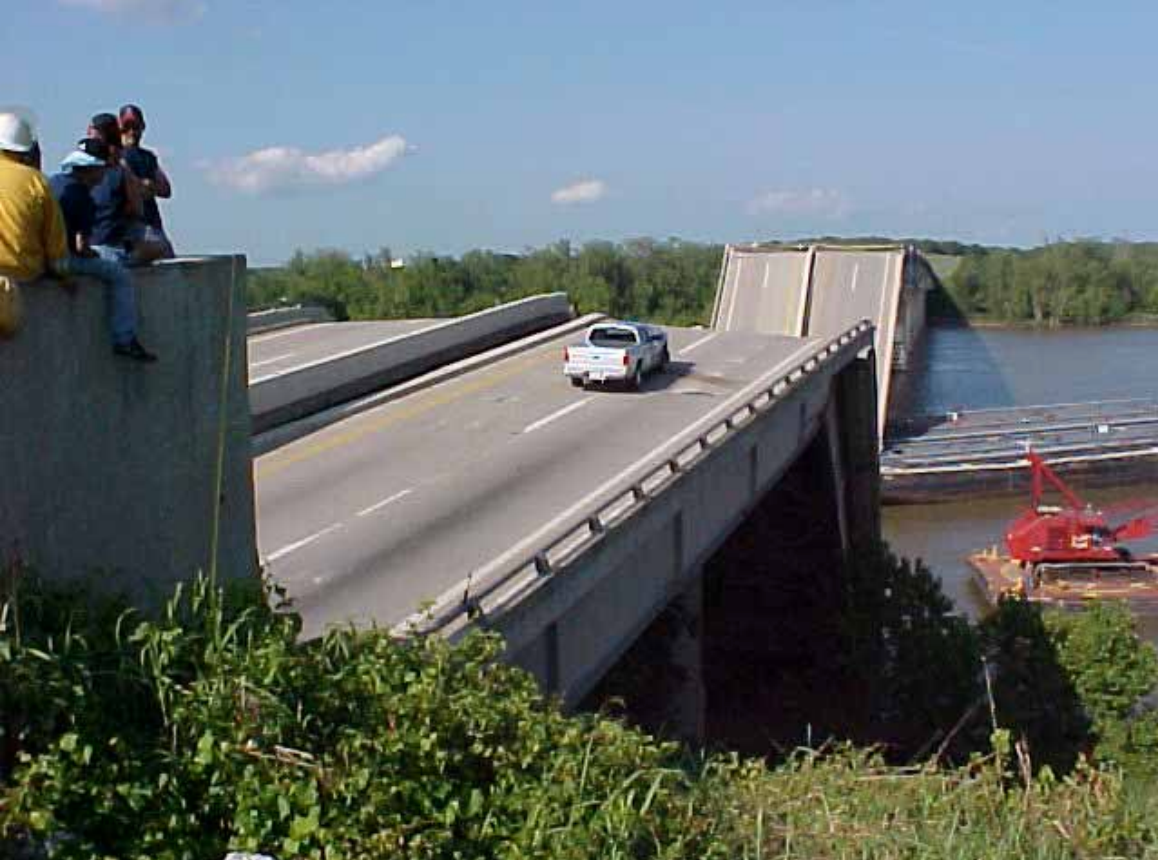
Towboat Robert Y. Love was transporting barges on the Arkansas River in Oklahoma on May 26, 2002, when it lost control of the tow, sending barges crashing into the pier of the bridge. A section of the bridge collapsed into the river, sending vehicles and tractor-trailers into the water. Fourteen people died and 11 were injured; survivors received help from nearby fishermen participating in a competition.

Towboat Robert Y. Love was transporting barges on the Arkansas River in Oklahoma on May 26, 2002, when it lost control of the tow, sending barges crashing into the pier of Interstate 40 Bridge in Webbers Falls, Oklahoma. (Photo: NTSB)

Sidney Lanier Bridge: 10 killed, 11 injured 

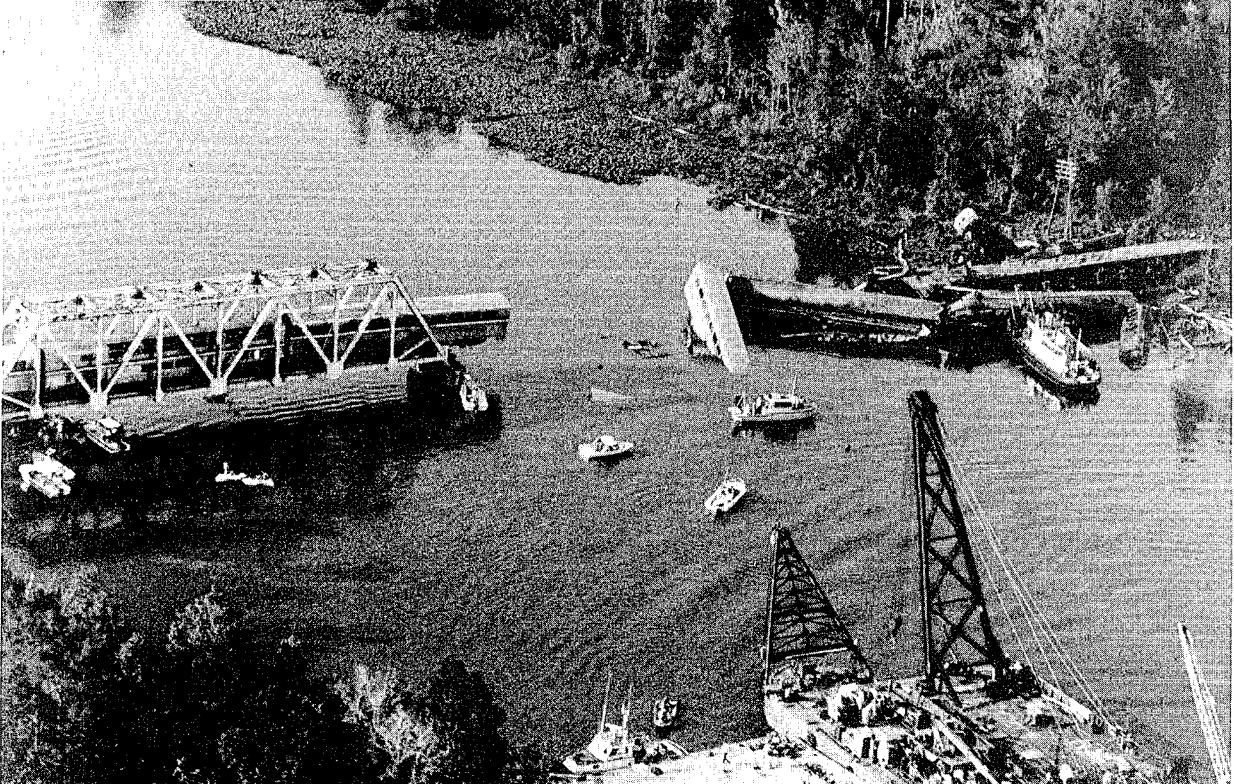
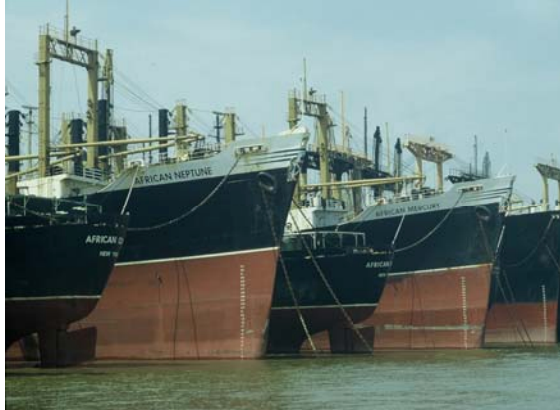
Within 15 minutes of leaving the Brunswick, Georgia, docks, on Nov. 7, 1972, the African Neptune slammed into the bridge, causing it to collapse. Ten people died in the disaster, and 11 were hurt. Polish freighter Ziemia Bialostocka hit the same bridge in 1987, resulting in no deaths but causing $1.4 million in damage.

The African Neptune hit the Sidney Lanier Bridge in Brunswick, Georgia, on Nov. 7, 1972. (Photo: Maritime Administration)

Queen Isabella Causeway: 8 killed, 3 injured  

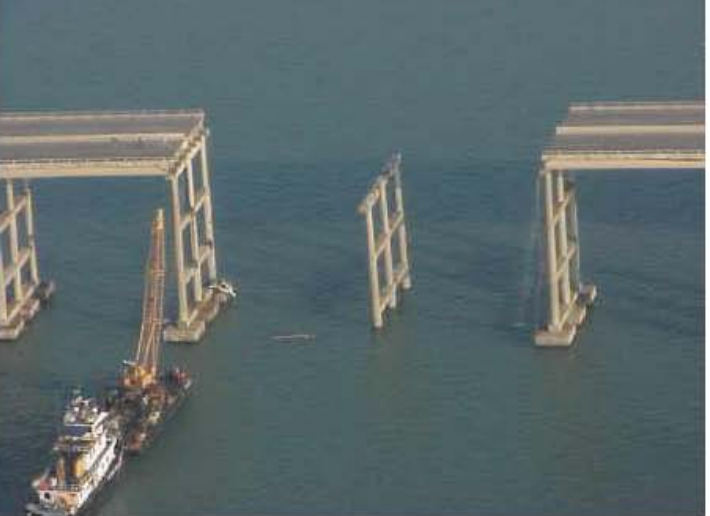
A tow boat with four barges collided with the Texas bridge that connected South Padre Island to Port Isabel on Sept. 15, 2001. Drivers coming from South Padre Island couldn’t see the missing spans until after they reached the peak of the bridge, giving them little time to react. Ten cars drove off the bridge, killing eight people and injuring three.

A tow boat hit the Queen Isabella Causeway that connected South Padre Island to Port Isabel on Sept. 15, 2001. (Photo: United States Coast Guard)

Lake Pontchartrain Causeway: 6 killed 

The Louisiana bridge crumbled into Lake Pontchartrain on June 16, 1964, when a tugboat hit it. A Continental Trailways bus fell into the lake, killing six passengers.

John P. Grace Memorial Bridge: 5 killed 

Nicaragua Victory was anchored in the Cooper River in Charleston, South Carolina, when it drifted during a storm and slammed into the bridge on Feb. 24, 1946. Part of the bridge crumbled into the river. One vehicle, carrying a family of five, fell into the river, killing them.

Judge William Seeber Bridge: 1 killed, 2 injured 

Tugboat Chris crashed into a support pier of the New Orleans bridge on May 28, 1993. The bridge fell into the waterway below, bringing with it two vehicles. One person died and two others were seriously injured. 

Eads Bridge: 50 injured 

Anne Holley was towing barges when it hit the Eads Bridge in St. Louis on April 4, 1998. Eight barges broke away and three hit a permanently moored gambling vessel below the bridge, injuring 50 people.

FreightTech Friday: Dock scheduling provider focuses on end-user experience


Prioritizing driver experience in dock scheduling tools

Investment in dock scheduling software has recently gained significant traction, with market projections indicating an annual growth rate of 11.34% until 2029, culminating in a $10.2 billion market.

In a recent interview with FreightWaves, dock scheduling and yard management software provider C3 Solutions spoke on this burgeoning market. The company highlighted a greater potential return on these technology investments — particularly through integration of AI — if you consider the end-user experience.

Chief Revenue Officer Greg Braun stressed that being driver-centric is important for building these products.

“If a shipper is setting up what we call a strategic capacity plan, you’re going to be maximizing the throughput of your facility, avoiding drivers waiting for no reason,” he said. “That plan has a major impact on carriers. If a driver has to wait, they are wasting hours and it’s not efficient for the shipper. The shipper is going to end up paying for wait time, and the frustrated driver is not going to want to deliver at your facility, which will affect shipper costs over time.”

He stressed that drivers are the end users interacting with tools that affect a company’s reputation in the supply chain. Carriers will make more money by turning drivers around quicker and minimizing dead time spent waiting.

Braun explained that drivers are finding ways to share dock and yard feedback through review sites, and not having up-to-date technology is giving companies poor reputations among their fellow local delivery points.

“If you make these investments, drivers will want to deliver at your location, which means shipments and deliveries are not going to cost you as much. Drivers will be more open to take your desired rate if they know they won’t waste time servicing you,” he said.

To ensure the driver experience is up to par, Braun pointed to a well-designed user interface and the ability of drivers to provide feedback as two ways to secure that better experience.

“We have user experience guys that all they do is think about improving our hybrid screens and finding constant feedback from drivers who use our systems,” he said. “These guys are constantly A/B testing, meaning if we change this then what will the reaction be from drivers? We have a vision of how we want them to use these tools, but we compare that to how they are actually using it in real time.”

C3 Solutions also thinks AI innovation will improve driver experience. A recent blog post by the company discusses these dock problems and how the next generation of AI could revolutionize in-house efficiencies including predictive scheduling, connectivity to driver availability, automated communication and optimized real-time schedules.

Gather AI raises $17M, led by Bain Capital Ventures

Inventory management solutions provider Gather AI announced Wednesday it has closed on a $17 million Series A-1 round led by Bain Capital Ventures. Participation in the round included Tribeca Venture Partners, Dundee Venture Capital, Expa and Bling Capital.

The company has raised $34 million since being founded in 2017.

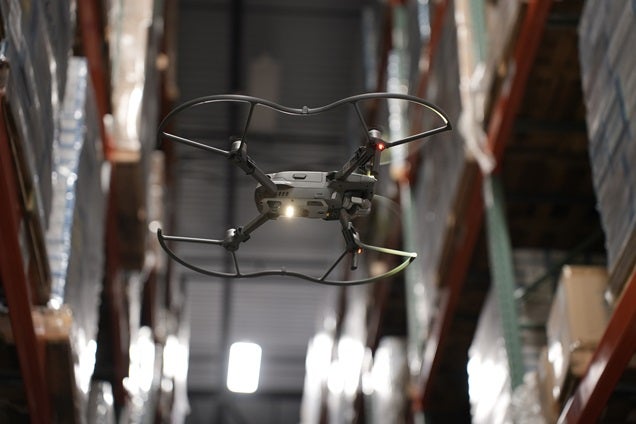
A Gather AI drone. (Photo: Gather AI)

“Gather AI’s cutting-edge computer vision and workflow software, purpose-built for inventory monitoring, has seen significant commercial adoption and rapid growth separating them from the field of other venture-backed startups. … We are excited to welcome Gather AI to our portfolio of companies such as Kiva, ShipBob, FourKites, and Vention that are leveraging AI and software in the physical world,” said Bain Capital Ventures partner Ajay Agarwal in the release. 

Using AI, computer vision and autonomous drones, the company provides real-time inventory visibility for clients. Gather AI drones fly through warehouses, scan operations and report back to warehouse management systems what is available in the warehouse.

According to the company, this leads to a 66% reduction in inventory database errors. 
The company currently works with companies including Geodis, NFI Industries, Barrett Distribution and DPI Specialty Foods. With its latest raise, Gather AI is looking to expand its sales and operations teams to reach new customers.

“We’re already seeing the positive impact of Gather AI on customers spanning third-party logistics, retail, food and beverage, and manufacturing,” said Sankalp Arora, co-founder and CEO of Gather AI. “AI-powered cameras will transform supply-chain traceability to have a similar impact that barcodes did in the 1980s, and our technology is at the forefront of this transformation.”

Brief Bytes

Bestpass, the toll management solutions provider, named Shay Demmons chief product officer and Scott Chao chief marketing officer on Monday. CEO Tom Fogarty emphasized their extensive industry experience. Chao brings expertise in company growth, having served at Appspace. Demmons, with over 25 years in product development, joins from GPS Insight. 

Visibility solutions provider Overhaul introduced CompliTrack, a deviceless tracking solution for over-the-road logistics, on Wednesday. Integrated with ELD providers, the solution offers shipment tracking while enhancing compliance and security without embedded Internet-of-Things devices. Leveraging carrier ELD data, it enables instant insights, advanced alerts and detailed reporting tools to avoid fraud. Customers can also integrate with LE Connect for enhanced security measures.

Mobile robotics technology provider Geekplus, in partnership with consultancy Hy-Tek Intralogistics, on Wednesday completed the installation of a Shelf-to-Person solution for a rural lifestyle retailer, streamlining e-commerce operations by 45%, according to the companies. This type of solution uses mobile robots to move inventory shelving and pallets to pick stations, limiting the number of steps a picker needs to take. Hy-Tek is actively showcasing Geekplus robots at its Innovation Lab, with plans for further collaborations.


Other FreightTech news from this week:

Venture 53 invests in Heale Labs’ tokenization technology

‘Truck-to-truck worms’ introduced via ELDs could threaten major fleet disruption

How Bestpass drives fleet happiness

Running on Ice: Why is food waste rampant in supply chains?

Blue Truck on a sheet of ice over a blue background and Running on Ice Logo

All thawed out 

(Photo: Jim Allen/FreightWaves)

The market for food is one of the U.S.’s largest industries, with revenue amounting to over $1 trillion. But errors in the supply chain create an alarming amount of food waste. According to ReFed, “last year, 88.7 million tons of food went unsold or uneaten in the United States – roughly 38% of the country’s total food supply. The vast majority of this – nearly 78 million tons of food – became food waste, meaning it failed to make it back into the human food supply chain.”

According to Food Engineering Magazine, “Consumers are blamed for wasting as much as 37% of the food in the American supply chain.”

Given that there is already significant food scarcity in the country, having so much lost or unavailable for consumption isn’t the best feeling. Not only does food waste prevention lower greenhouse gas emissions, but it also helps feed people who otherwise could go hungry.

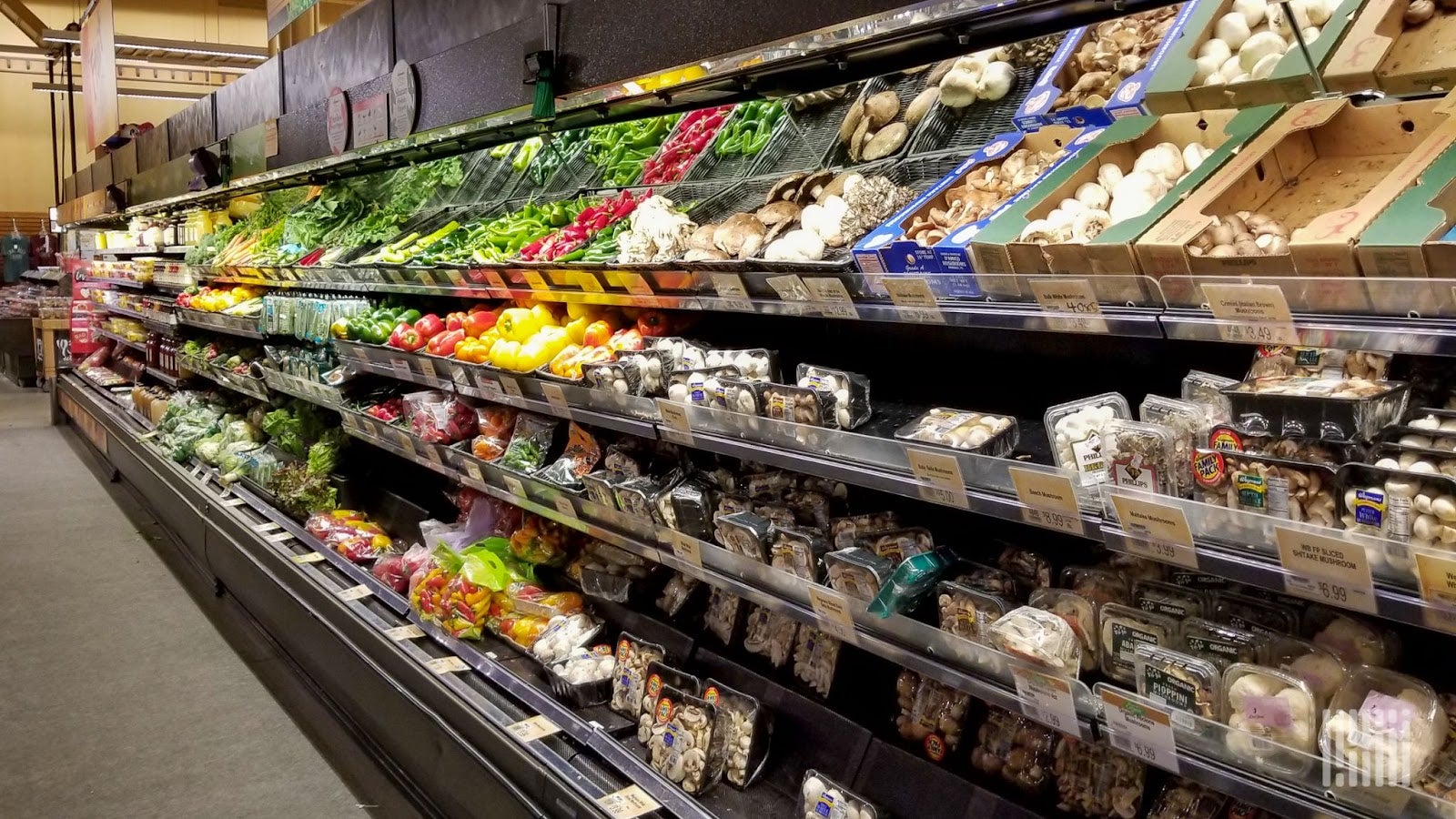
A McKinsey & Co. report, “Reducing food loss: What grocery retailers and manufacturers can do”, cited an example of loss just among 100 tomatoes. “Field-grown tomatoes were tracked from farm to the retailer. Starting with 100 tomatoes ready for harvest, only 73 to 81 survive the harvest operation. Next, one or two tomatoes are lost on their way to handling and grading. After handling and grading, 67 to 77 tomatoes survive and go on to processing and packaging. Finally, only 59 to 72 tomatoes make it to the retailer. At this point some tomatoes will not be sold — either due to visual appearance or quickly approaching sell-by dates.”

That 30%-40% again pops up as waste throughout the supply chain. Whether it’s improper reefer temperatures, storage, poor inventory management, the causes of losses here and there are endless.

What solutions can resolve that very clear and present issue? Let’s get into it.

McKinsey’s research found four areas to curb losses, which could help reduce upstream loss by 50% to 70%: Minimize production and processing loss, minimize transit loss, sell more of what is produced and processed, and structurally prevent loss.

The study presented solutions to problems big and small. 

  • Strong visibility tools so shippers know exactly what temperature products are at, as well  as what produce can be mixed together and what cannot. For example, putting bananas and avocados on the same truck is a bad idea because each can cause the other to ripen a lot faster.
  • Inventory management in the warehouse. Knowing where goods are, what status they’re in and what goods are being stored around them matters. Strong inventory management can help prevent spoiling of produce that needs to get out at a certain time. That means adjusting from the first-in, first-out policy to what absolutely needs to go to avoid spoilage.
  • Diverting goods. If a grocer has high expectations for deliveries and over half the produce will not meet the grocer’s quality requirements (for example, ugly produce), the unattractive but still edible food can be diverted to food shelters or other organizations so it can be donated to those in need.

Most importantly, though, there needs to be a conversation around reframing what food loss is and what it means. Since there is a fair amount of food loss at the farm level, there has to be buy-in from all in the organization to make reduction of waste a priority. Food loss needs to be seen as a result of inefficiencies and missed opportunities across production, procurement, R&D, the supply chain and sales. Therefore, reducing food loss should be seen as a potential value — an opportunity to improve both the top and bottom lines.

No one wants to bank on 30%-40% of product going to waste. Everything from little changes all the way up to switching suppliers and vendors can make a difference to increase revenue and get more people fed.

Cold chain lanes

SONAR Ticker: WAIT

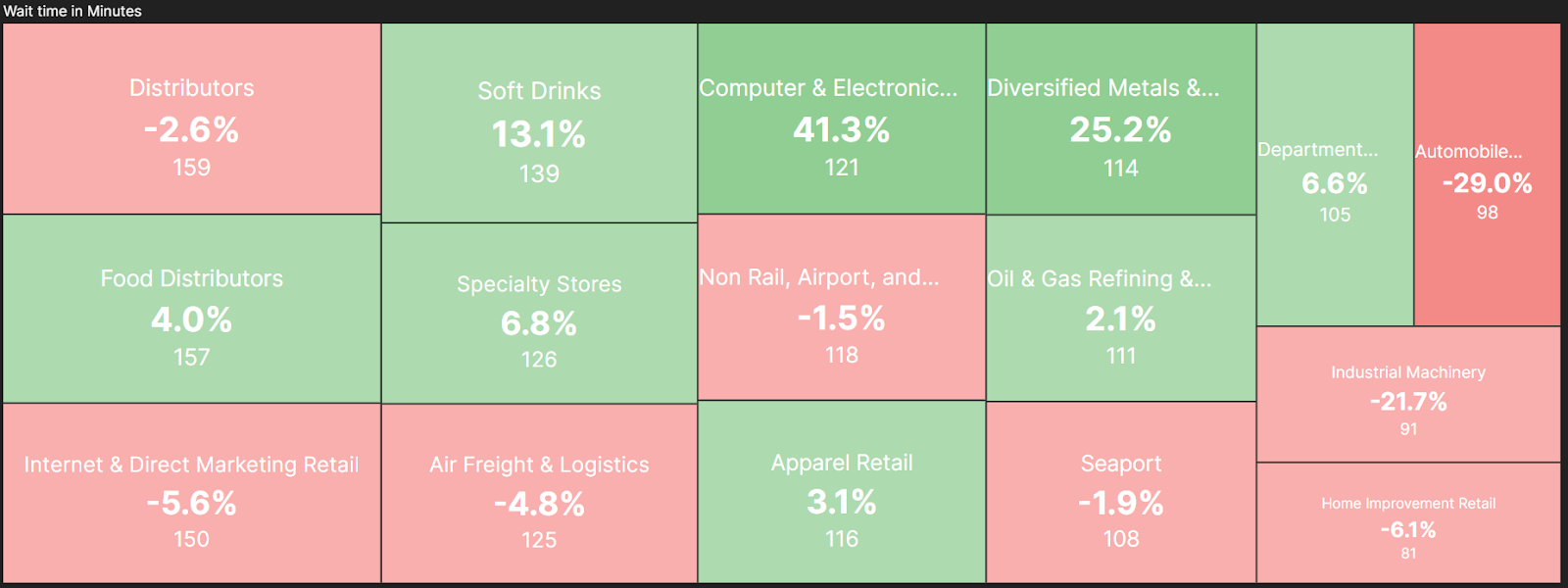
This week’s SONAR chart takes a look at wait times across 16 industries that make up the majority of industries in the U.S. and how many minutes, on average, a truck spends at a shipper or receiver location for loading and unloading. This includes distribution centers, seaports, airport air cargo facilities, railroad classification yards and intermodal ramps. Averages are compared month to month.

The industries in green have seen increases in wait times, while the ones in red have seen wait times drop. Most notably, automobile manufacturers have seen the largest decrease in wait times. Average waits there are 98 minutes, so a little over an hour and a half. The biggest increase came in computers and electronic retail. Its wait time shot up 41.3%, for over two hours of waiting for drivers.  

Is SONAR for you? Check it out with a demo!

Shelf life

FDA Revokes Standards of Identity for Frozen Cherry Pie

Kirkland advises I Squared Capital on acquisition of WOW Logistics

Oreo announces 3 new frozen treats for St. Patrick’s Day

Agile Cold Storage to build $45.9M facility in Pearl River, Louisiana

Wanna chat in the cooler? Shoot me an email with comments, questions or story ideas at moconnell@www.freightwaves.com.

See you on the internet.

Mary

If this newsletter was forwarded to you, you must be pretty chill. Join the coolest community in freight and subscribe for more at www.freightwaves.com/subscribe.

Is same-day delivery worth the hype? – WTT

On Episode 699 of WHAT THE TRUCK?!?, Dooner is joined by Roadie CEO Marc Gorlin to talk about the company’s latest report, “Is Same-Day Delivery Worth the Hype?” We’ll look at the costs, logistics and consumer demands driving this category and if retailers are winning.

EOS’ Gregory Hayes talks about how the U.S. Navy is retaking control of its supply chain via reshoring and 3D printing. We’ll learn the latest on how 3D printing is being used at the most demanding level.

Trey Griggs and Dan Lindsey’s Broker Carrier Summit is coming up, and they’re here with all the details on this event. We’ll find out how they intend to bring carriers and brokers together through this summit.

Dynamic Logistix’s Troy Cook talks about navigating uncertain waters by using data.

Plus, Penguin’s bobbleheads recovered; taking your kids on the road; when yard dogs attack; and more.

Watch on YouTube

Subscribe to the WTT newsletter

Apple Podcasts

Spotify

More FreightWaves Podcasts

What To Know About The Francis Scott Key Bridge Collapse In 90 Seconds

Biden administration acknowledges ‘challenge’ with new truck emissions rule

Trucks filling up with diesel fuel.

WASHINGTON — The Biden administration acknowledged that its aggressive push to decarbonize trucking will be costly — but that the federal government will be here to help.

“The overarching challenge is aligning the market-driven desire from fleets to adopt zero-emission freight vehicles with the resources required to make it successful, and right now, they cost more,” said Gabe Klein, executive director of the U.S. Joint Office of Energy and Transportation.

Speaking to NPR before the release on Friday of the U.S. Environmental Protection Agency’s new phase-three truck emissions rule, Klein said that “cost parity” has yet to be reached that would make electric trucks as affordable. A new Class 8 diesel truck costs roughly $180,000 compared with up to $400,000 for a battery-electric truck, according to estimates.

“That’s why the federal government is providing subsidies, to bring it down closer to cost parity,” he said. “I will also say the charging infrastructure is of course a limiting factor. So we need to make sure everybody has access, not just the big fleets and companies.”

EPA’s “Greenhouse Gas Emissions Standards for Heavy-Duty Vehicles – Phase 3” final rule, which applies to model years 2027 through 2032, avoids 1 billion tons of greenhouse gas emissions — equivalent to the emissions from more than 13 million tanker trucks’ worth of gasoline, according to the agency. EPA also estimated $13 billion in annualized public health benefits.

“In finalizing these emissions standards for heavy-duty vehicles like trucks and buses, EPA is significantly cutting pollution from the hardest working vehicles on the road,” commented EPA Administrator Michael Regan. “Building on our recently finalized rule for light- and medium-duty vehicles, EPA’s strong and durable vehicle standards respond to the urgency of the climate crisis by making deep cuts in emissions from the transportation sector.”

Timelines loosened

According to the rule’s preamble, the new standards for heavy-duty trucks include less stringent standards for all vehicle categories in model years (MY) 2027, 2028, 2029 and 2030 than had been originally proposed last year.

In addition, while emissions standards for sleeper cabs in the final rule begin in MY2030 as proposed, they are less stringent for that year and for MY2031. However, they are equivalent in stringency to what EPA had proposed for MY2032, the preamble notes.

While placating environmental groups, much of the trucking firmly opposes the rule despite adjustments made to the final rule.

“The post-2030 targets remain entirely unachievable given the current state of zero-emission technology, the lack of charging infrastructure and restrictions on the power grid,” commented American Trucking Associations President and CEO Chris Spear.

He stressed that while the final rule includes lower zero-emission vehicle rates for the initial model years, rates in the later years will drive battery-electric and hydrogen investment and limit other potential zero-emission options.

“While we are disappointed with today’s rule, we will continue to work with EPA to address its shortcomings and advance emission-reduction targets and timelines that are both realistic and durable,” Spear said.

Owner-Operator Independent Drivers Association President Todd Spencer called the new rules “unworkable” requirements.

“This administration appears more focused on placating extreme environmental activists who have never been inside a truck than the small business truckers who ensure that Americans have food in their grocery stores and clothes on their backs,” Spencer said.

Daimler throws in support

But not all companies involved in heavy-duty trucking opposed the rule, particularly companies that have been investing heavily in zero-emission technologies, like vehicle manufacturer Daimler Truck North America (DTNA). The company had lobbied EPA for less aggressive timelines when the rule was proposed.

“We thank the agency for addressing industry concern about the challenges of the early years of the rule and we remain committed to upholding the spirit of this regulation,” commented DTNA vice president Sean Waters.

“Ultimately, the successful transition of the commercial vehicle industry is dependent on the availability of reliable zero-emission charging and refueling infrastructure and the ability to conduct business at a reasonable cost of ownership,” he added.

Charging availability and cost was questioned by much of the trucking industry, which commissioned a recent study estimating the cost to install charging infrastructure at $1 trillion.

Incentives needed

The Biden administration’s Klein pushed back on cost concerns, however, pointing to incentives provided at the federal level.

“We’ve already invested $253 million through the Department of Transportation — that’s charging and fueling infrastructure grants — just recently,” he said.

“But there’s also a great deal of private sector funding. And really the goal here is to supplement the private sector, not to supplant their funding.” 

Click for more FreightWaves articles by John Gallagher.