Oil and gas field services provider Enservco Corp. announced it has entered an agreement to acquire Buckshot Trucking for $5 million.
Founded in 2017, Buckshot provides hot shot, dedicated and less-than-truckload services to the oil and gas industry. It primarily serves the Rocky Mountain region but also has operations in North Dakota and Texas. The company’s website lists more than 100 customers.
The transaction is expected to diversify Enservco’s (NYSE: ENSV) business and provide revenue stability as Buckshot’s operations are year-round and less impacted by inclement weather than Enservco’s. Enservco primarily serves the shale industry by supporting drilling, completion, production and maintenance activities at onshore well sites.
Both companies are based in Colorado.
“Buckshot provides a strong complement to our current service offerings with the added benefit of not being winter weather dependent,” said Rich Murphy, chairman and CEO of Enservco. “Buckshot will also provide a substantial improvement in operational and financial visibility, which benefits our business, shareholders, and other stakeholders.”
The cash and stock transaction is subject to ordinary closing conditions as well as shareholder approval. There is a potential earnout of $500,000 based on future growth and financial performance. Enservco said it has to raise capital to fund the $3.75 million cash portion of the transaction. The deal is expected to close by the end of the second quarter.
Last year, Buckshot generated $8.2 million in revenue, doubling its top line over the past two years, and $2.3 million in earnings before interest, taxes, depreciation and amortization.
At just north of two times EBITDA and less than one times annual revenue, the deal price is on the low end of recent transaction valuations. The acquisition is expected to be immediately accretive to Enservco’s earnings as it is a “higher margin business.”
Buckshot’s founders and staff will remain in place.
“In addition to our identified list of potential expansion targets in current markets, we look forward to expanding our business into other areas based on Enservco’s extensive operational footprint and customer base,” said Buckshot founder Tony Sims.
On Monday, Grace Sharkey and I interviewed Paul Jarrett, co-founder and CEO of Bulu, a 3PL and fulfillment provider for subscription box services and other direct-to-consumer offerings. The company’s customers include Disney and GNC, and it has helped clients launch over 50 subscription boxes.
Virtually every consumer-facing company should make every attempt to offer a valued subscription box. Subscription boxes allow brands to engage with core customers and receive feedback on new products before they are marketed more widely. They can also serve as an outlet for excess inventory.
Offering subscription box services come with many challenges, including processing payments for a customer base that changes greatly each month and tracking a large volume of often low-value inventory that has expiration dates. In addition, customers’ expectations are high when they open a box — wow them or they’ll bounce. Keep in mind that those subscription dollars compete with the likes of Netflix and even with print magazines. Changes to advertising policies on Apple and Facebook have required shifts in marketing strategies.
View the full episode here or catch up on past episodes here.
Unilever bolsters revenue growth prospects with announced ice cream divestiture
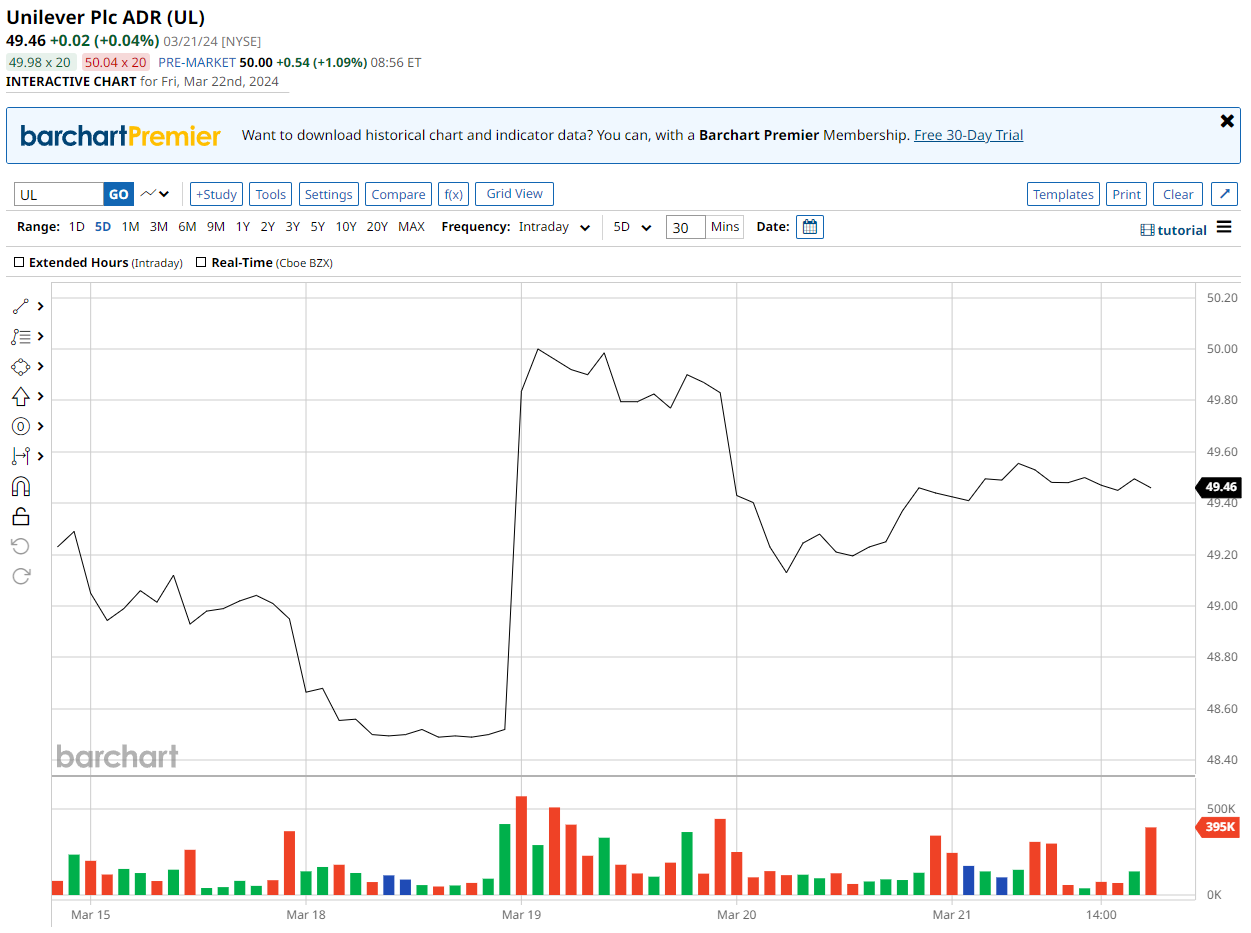
Unilever shares rose this week after the company announced a planned ice cream divestiture and 7,500 job cuts. Chart: Barchart.com Inc.
This week’s news on the planned ice cream divestiture was something that most analysts expected at some point. An eventual divestiture of the ice cream business seemed to be the most likely rationale last year for the reorganization of the company’s financials in 2022, which included making ice cream its own segment.
For all the drama regarding Ben & Jerry’s politics and its position on the Middle East, it appears to me that the rationale had far more to do with the ice cream segment’s underperformance. Last year, Unilever’s ice cream segment grew only 2.3% on a volume decline of 6% and a price increase of 8.8%. That was both slower volume growth and higher elasticity than the company’s other segments. Other CPG giants have taken similar action, including Nestle with its “cut the tail to move the head” strategy. Other disadvantages associated with Unilever’s ice cream business include a more complicated frozen supply chain, which lacks synergies with its other segments, and the ice cream segment’s relatively high capital intensity.
Weak truckload rates pressure intermodal volume in Chicago-to-Atlanta lane
I recommend that domestic intermodal shippers use SONAR to track intermodal volume, intermodal spot rates, and dry van contract and spot rates in their lanes — even if all those do not appear directly relevant.
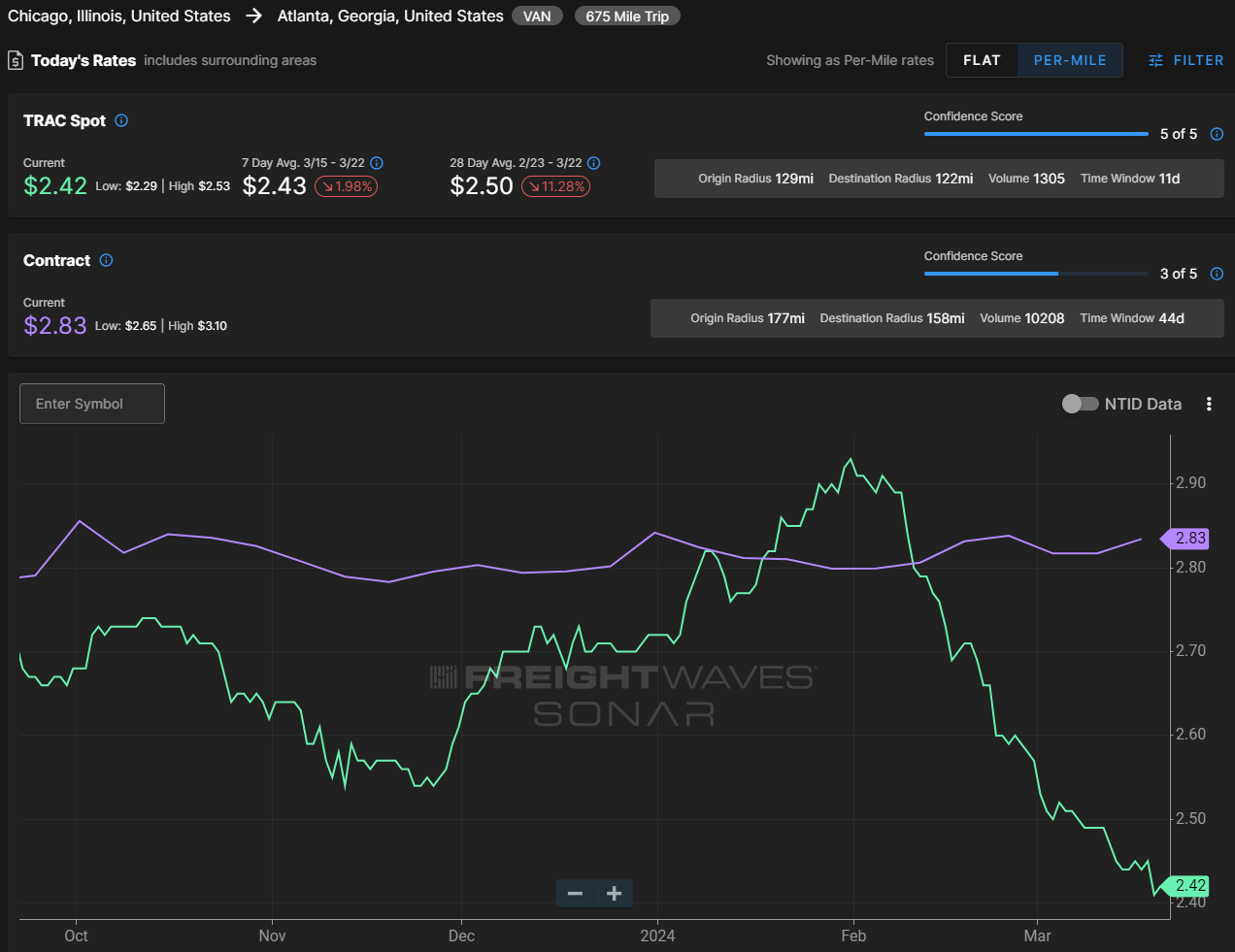
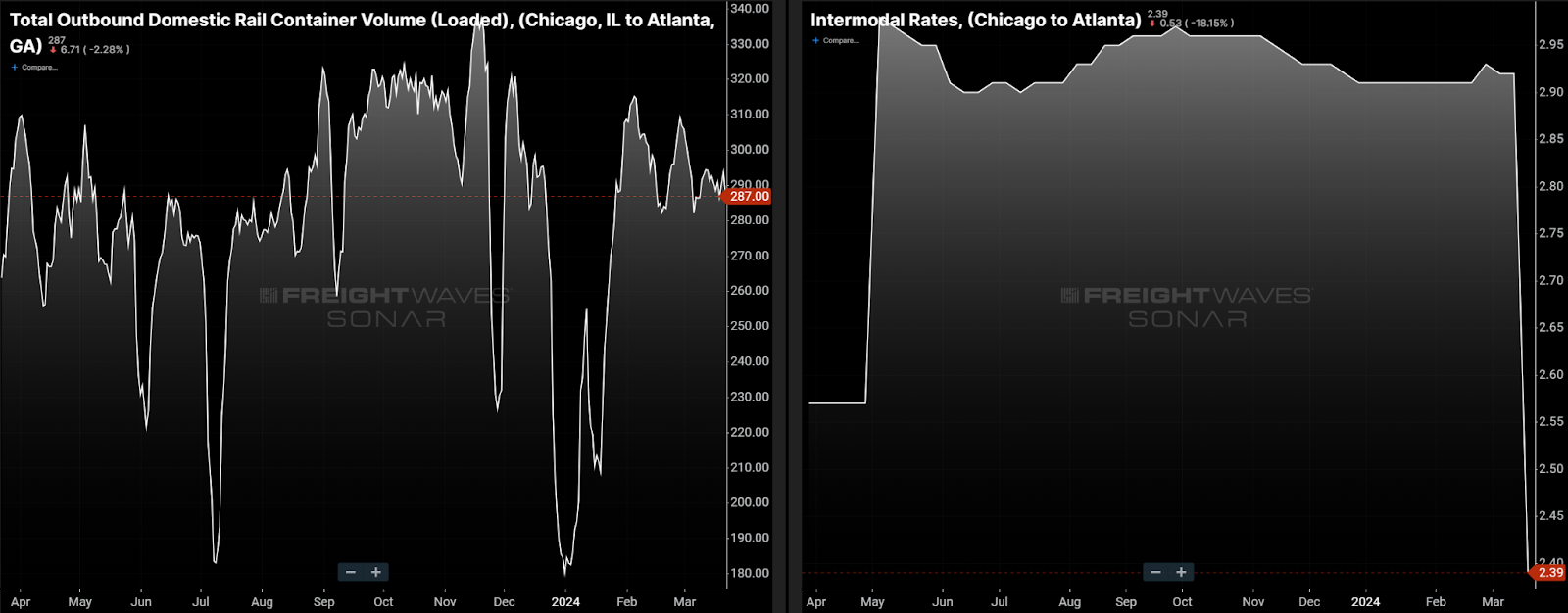
For instance, the modally competitive Chicago-to-Atlanta lane has shown rate decline in recent weeks for both intermodal and truckload. The door-to-door intermodal spot rate to move 53-foot containers from Chicago to Atlanta declined from $2.92 a mile to $2.39, including fuel, in the past week.
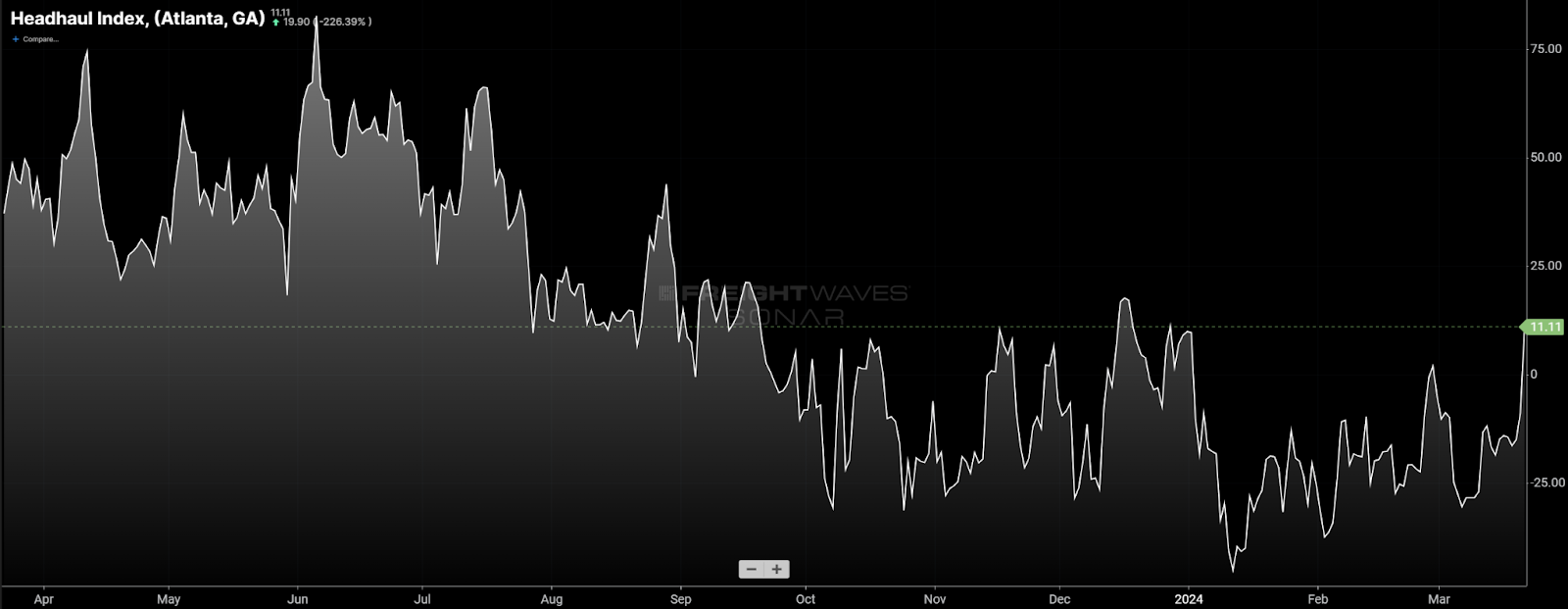
That appears to be a response to falling truckload rates. Those falling rates, in turn, appear to be driven by Atlanta flipping to become a headhaul market (HAUL.ATL is currently 11.1), which makes carriers more willing to head there. Market Dashboard (one of the SONAR applications) shows a current dry van truckload spot rate of $2.42 a mile, down from $2.90 in early February and $2.55 in early March. Meanwhile, the average dry van contract rate is $2.83 per mile.
Turning to intermodal volume shown via the SONAR ORAIL ticker, daily 53-foot containerized intermodal volume averaged 287 containers a day in the past week, which is at the low end of the recent range of 280-320 containers a day. That could be for a number of reasons, including poor rail service, but in the context of weak truckload rates, I suspect that some shippers that might otherwise have used intermodal are opting for the convenience of the highway.
Left chart: Loaded containerized domestic intermodal volume in the Chicago-to-Atlanta lane.
Right chart: Intermodal spot rate to move 53-foot containers door to door, including fuel.
Why data standardization is key to streamlined logistics
The views expressed here are solely those of the author and do not necessarily represent the views of FreightWaves or its affiliates.
Recently I wrote about the role of unified supply chain platforms, which enable convergence and help companies navigate the complex global market. The reality is that to streamline the supply chain, it requires not just unification of the technologies used and standardization of process, but also data standardization. Data plays a starring role, providing real-time insights, optimizing operations and ensuring timely deliveries. But without a common language and data definitions, even the most sophisticated data sets can become a chaotic jumble. This is where data standardization comes in, acting as the conductor that ensures everyone is moving in unison.
Data standardization has been more successful in some industries but not in the complex world of logistics.
The International Standard Book Number (ISBN) is a prime example of successful data standardization. It assigns a unique identifier to every book edition, enabling efficient cataloging, ordering and inventory management across publishers, distributors and bookstores. The health care industry has Health Level Seven (HL7), a set of international standards for exchanging information electronically. It enables the exchange of patient medical records, lab results and other vital data among hospitals, clinics, pharmacies and insurance companies. The financial services industry has the International Bank Account Number (IBAN) and Society for Worldwide Interbank Financial Telecommunication (SWIFT), a messaging system for secure financial transactions.
There are specific reasons why the logistics industry faces unique hurdles when it comes to data standardization. Logistics involves a vast network of players, from manufacturers and distributors to logistics providers and retailers as well as customers. Each participant may have its own internal systems and data formats, making standardization a complex undertaking. Logistics often operates across international borders, with varying regulations and data privacy laws. Achieving a globally accepted standard can be challenging. Many logistics companies still rely on legacy IT systems that are not designed to handle standardized data exchange. Upgrading these systems can be expensive and time-consuming. Standardization ultimately requires collaboration and investment from all stakeholders. The benefits may not be immediately apparent to every participant, making it difficult to achieve widespread adoption.
Inconsistency of data can have significant consequences. Imagine a scenario where a box labeled “10 widgets” arrives at a warehouse, but upon inspection, it contains 12. This simple discrepancy, caused by a difference in unit of measurement (boxes versus individual units), can have a ripple effect. Inventory records become inaccurate, deliveries are delayed, and production schedules are thrown into disarray. This is just one example of the problems that arise from data inconsistency in the supply chain.
Inconsistent data formats and definitions make it difficult to gain a clear picture of inventory levels, shipment locations and potential disruptions. Misinterpretations of data can lead to delays in order fulfillment, incorrect product shipments and increased processing times. When different players use different data formats, communication becomes fragmented, hindering collaboration and proactive problem-solving. Data inconsistencies necessitate manual intervention and rework, leading to increased labor costs and missed opportunities for efficiency gains.
Data standardization acts as the force that brings order to the chaos. In warehousing, standards exist for pallet sizes, container dimensions and warehouse layout optimization, promoting efficient space utilization and product handling.For transportation management, standardization in areas like electronic freight tenders, routing guides and shipment status updates are streamlining communication between logistics providers and shippers.
By establishing a set of common definitions, formats and protocols for exchanging information across the supply chain, it can bring further benefits to the logistics industry and enhance supply chains. Standardized data allows for real-time tracking of shipments, inventory levels and potential disruptions across the entire supply chain network. Streamlined data exchange facilitates faster processing, reduces manual intervention and optimizes logistics operations. A common data language fosters better communication and collaboration between stakeholders, enabling proactive problem-solving and improved decision-making. By eliminating data errors and streamlining processes, standardization reduces costs associated with manual intervention and rework. Finally, accurate and timely deliveries, facilitated by efficient logistics, lead to happier customers and improved brand reputation.
But data standardization is not an easy task in logistics. It requires collaboration among industry players, government agencies and technology providers to develop and adopt common data standards. There needs to be a bigger focus on implementing data management platforms that facilitate standardized data exchange, and analysis is essential. But it does not stop there. Employees need training to understand and work with standardized data formats and processes. And finally, as technology evolves and new needs arise, data standards must be continuously reviewed and updated.
In today’s interconnected world, a data-driven approach is essential for a successful supply chain. By embracing data standardization, logistics providers and all stakeholders within the supply chain can unlock a future of seamless communication and optimized operations, as well as a more resilient and efficient ecosystem. And despite all the current challenges around data standardization, progress is being made. We see several industry initiatives that try to drive this standardization. (Examples are GS1, NFDH, ASTN F49 and IATA.) Cloud-based platforms and data management solutions are facilitating easier data exchange and integration between disparate systems. And governments in some regions are implementing regulations that require companies to adopt certain data standards for compliance purposes. The recently approved EU Supply Chain Law (CSDDD) might indirectly promote data standardization by requiring companies to map their supply chains and report on environmental and human rights practices. This could necessitate more structured data collection and potentially lead to a push for standardized formats.
Look for more articles from me every week on FreightWaves.com.
About the author
Bart De Muynck is an industry thought leader with over 30 years of supply chain and logistics experience. He has worked for major international companies, including EY, GE Capital, Penske Logistics and PepsiCo, as well as several tech companies. He also spent eight years as a vice president of research at Gartner and, most recently, served as chief industry officer at project44. He is a member of the Forbes Technology Council and CSCMP’s Executive Inner Circle.
Foremost Group CEO was intoxicated when she reversed into pond, report says
Angela Chao, a shipping CEO and sister-in-law to Senate Minority Leader Mitch McConnell, was intoxicated when she drove into a pond at her Texas ranch last month, according to a report from the Blanco County Sheriff’s Office.
The sheriff’s office ruled Chao’s death an “unfortunate accident,” according to the report on the investigation released Wednesday. An autopsy was not performed on Chao, but a toxicology test revealed her blood alcohol concentration was nearly three times the legal limit in Texas.
Chao was the CEO of shipping company Foremost Group and the sister of Elaine Chao, the former Trump administration secretary of transportation who is married to McConnell.
Chao, 50, died Feb. 11 not long after having dinner with close friends on her 4,500-acre ranch in Johnson City, about 48 miles west of Austin. The group had gathered for a weekend at the property, which is home to multiple stock ponds, dwellings and buildings, the report said.
Chao left a guesthouse, where she had been spending time with friends, at 11:37 p.m. on Feb. 10. She entered the Tesla for a short drive back to her main residence on the property. Minutes later, security camera footage showed her Tesla Model X reverse over limestone blocks and go into the pond, the report said.
Not long after the Tesla entered the water, the vehicle’s lights were no longer visible.
At 11:42 p.m., a friend at the guesthouse received a call from Chao telling her that “she had driven her vehicle into the pond,” the report said. The friend told Chao to leave the car, but she said she couldn’t, the friend later told law enforcement.
The friend stayed on the phone with Chao for eight minutes, as she described water coming into the vehicle. As the water level in the car grew higher and higher, Chao “said her goodbyes,” her friend told authorities, according to the report.
The friend got into a kayak and paddled toward the Tesla, and another friend swam to the car, climbing on top of it and trying to reach Chao.
Just after midnight, law enforcement and firefighters arrived and started rescue operations. A sheriff’s deputy used a tool to break through a driver-side window of the Tesla and located Chao. An EMS worker attempted lifesaving measures, but Chao was pronounced dead at the scene at 1:40 a.m. on Feb. 11.
Chao was the youngest daughter of the Foremost Group’s founder and honorary chairman, James S.C. Chao.
According to Angela Chao’s website, she earned an undergraduate degree from Harvard College and a graduate degree from Harvard Business School (HBS). While attending HBS, Chao wrote a case study on ocean carriers that is still part of the required curriculum for first-year HBS students, according to the Foremost Group.
Chao joined the Foremost Group in 1996. Her father, a former sea captain born in China, founded the company in New York in 1964. She became chair and CEO in 2018.
The Foremost Group is a global dry bulk shipping company whose clients include Cargill Inc., Louis Dreyfus Commodities Rotterdam and NYK Line, according to the company. The Foremost Group has a fleet of 33 ships valued at $1.2 billion.
In a 2020 interview with FreightWaves, Chao discussed the effects the coronavirus pandemic could have on the global shipping industry.
If freight brokers weren’t so preoccupied with celebrating competitor missteps, one of them might have beaten Robert Bosch to RevX — a spot load aggregation tool that also flags double brokering.
The cloud-based RevX is the second product from the German auto supplier’s global Logistics Operating System (L.OS), aimed at simplifying technology and operational processes in transportation and logistics. L.OS launched in December with a goal of generating more than $540 million in freight-related revenue annually by 2030.
Bosch revealed RevX — developed in the U.S. for the U.S. — on Thursday at the Mid-America Trucking Show in Louisville, Kentucky, a target-rich environment for the industry stakeholders Bosch wants to attract. The goal is reducing the 35% empty miles that trucks run every year, according to the U.S. Department of Transportation’s Bureau of Transportation Statistics.
“Think about what just a 5% reduction in empty miles would mean to the industry,” said Luke Hugel, who oversees Bosch Mobility Platform and Solutions, North America.
Robert Bosch mobility executive Luke Hugel oversaw development of RevX, a load-matching system that aggregates up to 1.5 million available spot loads. (Photo: Robert Bosch)
The subscription-based software as a service provides a view of more than 1.5 million available loads across five or more load boards including giants Uber Freight, DAT, TruckStop and up to 65,000 private brokerages whose loads typically are not publicly listed.
Up to 50% savings in load discovery and booking via RevX
It could save 33%-50% of the time a dispatcher spends discovering and booking a load, Hugel told me.
That varies based on fleet size and complexity. A regional dispatcher focused on a group of trucks would make more queries than a dispatcher covering a dedicated route and seeking only loads for backhaul.
“The reality is that there’s not one source that they use. Most dispatchers are looking across multiple load boards and multiple brokers,” Hugel said. “So the first value proposition of the RevX solution is to aggregate.
“Instead of a dispatcher having eight tabs open, now they can see their search results in one spot,” Hugel said. RevX focuses on true revenue and costs of loads, leaving soft sides of the business like driver amenities to others to figure out. RevX features a single call or email for a dispatcher to win the load in a competitive marketplace.
Eventually, Bosch sees adding an AI-based load recommendation engine. That would free the dispatcher to focus on communication duties instead of searching for loads.
Shade-throwing brokers could have done this
Load boards and brokers are eager to participate because it helps them get more loads covered while potentially growing their business. As a systems, software and hardware developer, Bosch more than knows the trucking business. In selecting and winning loads, it is a facilitator, not a competitor.
Why hasn’t this already been done?
“You don’t have to look far to see some of the animosity between the load boards,” Hugel said, referring to negative comments over DAT’s intermittent service outages. “They’re very good at throwing shade when the other guy has a problem. That is one constraint of why an existing broker wouldn’t be able to do this.
“They have that natural competitive environment whereas we don’t have a load board ourselves.”
Understanding RevX means knowing what it isn’t. For example, driver app aggregator Platform Science and Geotab Marketplace’s fleet management software are not comparable.
“This is a dispatcher’s tool,” Hugel said. “This is not a telematics-driven offering. You don’t need anything more than an ELD, which is required by law.”
RevX flags double-brokered loads
RevX has the ability to spot and flag double-brokering, “one of the biggest nerve points in the industry,” Hugel said.
“If a search comes back with the same load from multiple sources, it is showing where that original posting was, and you can see who’s posting. We spent a significant amount of time with that question because we feel there is value for the industry in doing this. No one wants to be associated with double-brokered loads.”
As for launching RevX, Bosch is offering it free for one month to anyone that wants it.
Nikola will seek a third boost in authorized shares
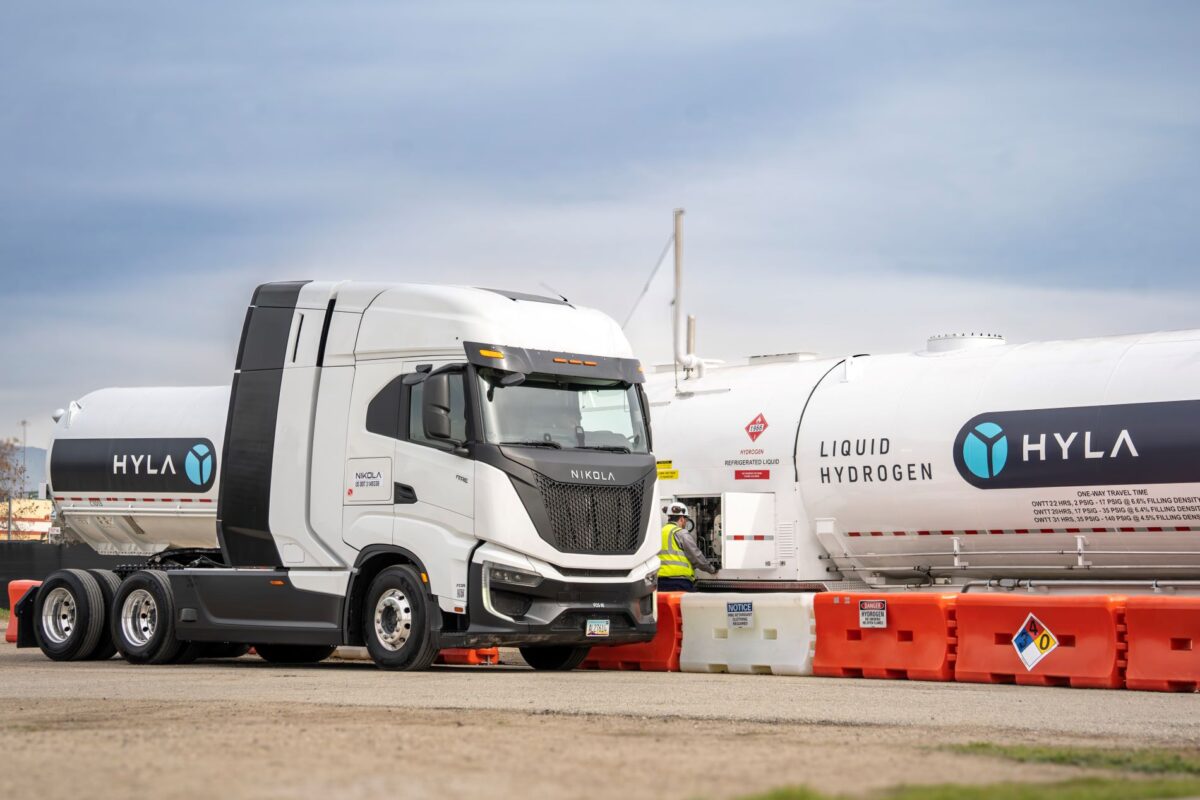
Nikola celebrated the opening of its first Hyla high-pressure modular fueling station in Ontario, California, on Thursday. Alas, the fuel cell electric vehicle (FCEV) and hydrogen fuel distributor faces other high-pressure matters.
Nikola CEO Steve Girsky at the company’s grand opening of its first modular fueling station for hydrogen in Ontario, California. (Photo: Nikola)
Hydrogen fuel is pricey and scarce. Parts deliveries are slow, contributing to the trucks’ production costs outstripping what Nikola can charge for them by hundreds of thousands of dollars each.
Nikola celebrated the opening of its first high-pressure modular fueling station in Ontario, California. (Photo: Nikola)
Nikola (NASDAQ: NKLA) has moves that could allow it to wrestle free. Most likely is a reverse stock split. The company could exchange a single share of stock for a multiple of existing shares. That would cosmetically push the price above a dollar, the threshold the Nasdaq requires for 30 consecutive days to stop the delisting clock. Another option is seeking a 180-day extension, which Nasdaq often allows.
An unexplained run-up — possibly a short squeeze — in Nikola shares last year saw them rise from 54 cents to $3.40 in two months. Whatever the reason, it was more than enough for Nasdaq to lift a delisting warning to Nikola it had issued in May. The share price has since tumbled, languishing between 60 and 70 cents since early March.
Solid Q1 revenue could help Nikola’s case
The Nasdaq doesn’t have to recognize a reverse split as meaningfully raising the price of the stock. But in many cases, it does. If Nikola shows significant Q1 revenue from selling Tre FCEVs, the exchange could consider it positive momentum, even with a lagging stock price.
Having issued new shares to raise cash, Nikola’s outstanding share count has swelled to more than a billion. Seeking shareholder approval to authorize more shares for the third time in three years might be cosmetically more palatable with fewer authorized shares. Adding to the existing authorization of 1.6 billion shares might not.
“We also need to increase our authorized common stock, which is subject to stockholder approval, and we may not be able to obtain such approval on a timely basis or at all,” the filing said.
Nikola’s cash position isn’t helped by having to chase down convicted founder Trevor Milton to collect on a $165 million arbitration award.
Workhorse CEO Rick Dauch never shies away from tough questions. And that doesn’t change in this interview at the recent Work Truck Show in Indianapolis.
When a spinoff acts like a share buyback
Cummins Inc. decided some time ago that its filtration business, a heroic player in repurposing feedstock for N95 masks during the pandemic, was no longer a good fit in the company’s strategy. But Cummins saw it as a good business nonetheless.
On-highway, heavy-, medium- and light-duty trucks, off-highway industrial equipment, and power generation use filtration products. Cummins makes engines for all of them.
“We are always looking at our portfolio,” CEO Jennifer Rumsey told me in a recent Truck Tech podcast interview. “The filtration business has some great technology and great capability. [But] their opportunity to grow really starts to diverge to different areas than where Cummins is growing.”
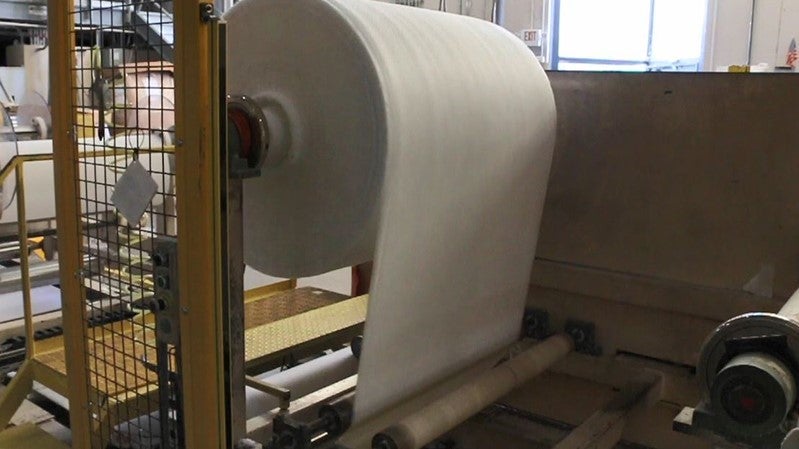
Cummins filtration material was used to make N95 masks during the pandemic. (Photo: Cummins)
In 2022, the engine and power products maker began splitting off and standing up Atmus Filtration Technologies. Cummins put money into Atmus ahead of a $273 million initial public offering in May. It retained 80.5% of the new company, valued at $1.5 billion.
The Columbus, Indiana-based company on Monday completed an exchange of shares in the new company for its stake. Though not technically a share buyback, Cummins took in 5.5 million shares of its stock from investors in exchange for about 67 million Atmus shares.
“Establishing a new business made the most sense for our investors,” Rumsey said.
Jay Kesten, an associate professor in the Florida State University College of Law who specializes in corporate law, mergers and acquisitions, lauded the move.
“Cummins’ spinoff strategy is an elegant win-win,” he told me. “The company’s current shareholders [get] to invest in either Cummins or Atmus as a stand-alone company or to remain invested in both simultaneously. At the same time, Cummins reduced its outstanding stock float – similar to a share buyback – without the usual depletion of its cash reserves.”
Truck Tech episode No. 59: A look at Workhorse’s $34 million plant makeover
The Workhorse plant in Union City, Indiana, has been completely revamped to build the all-new W56 electric step van and maybe other future products.
That’s it for this week. Thanks for reading and watching. Click here to get Truck Tech via email on Fridays. And catch the latest in major events and hear from the top players on “Truck Tech” at 3 p.m. Wednesdays on the FreightWaves YouTube channel.Your feedback and suggestions are always welcome. Write to aadler@www.freightwaves.com.
State of Freight: Reasons to be bullish on second half of 2024
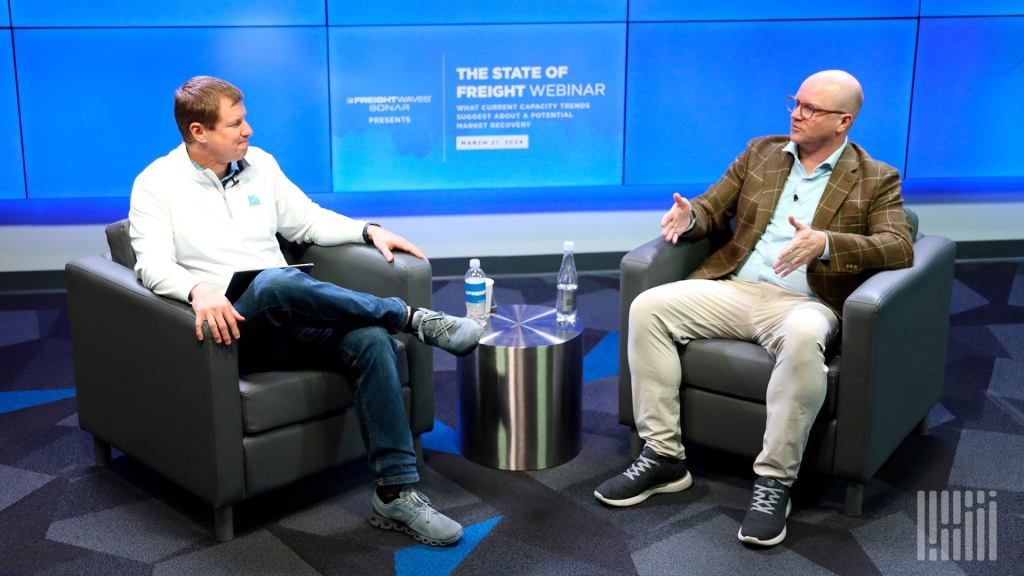
FreightWaves’ State of Freight webinar for March offered a bit of optimism that the freight market could improve at some point later this year.
Craig Fuller, FreightWaves CEO and founder, and Zach Strickland, director of freight market intelligence, said while they don’t see any clear signs of a significant boost in the overall freight industry, there are signals that the market is moving in the right direction.
Here are five takeaways from the webinar:
2024 could be ‘more of a normal year’ for the freight industry
Both Fuller and Strickland noted that people constantly ask them, “When is the market going to flip?”
“Everyone wants to know,” Fuller said.
Strickland pointed to FreightWaves’ Outbound Tender Reject Index for the U.S. (OTRI.USA) as a good indicator of current market conditions. The index measures carriers’ willingness to accept the loads that are tendered to them by shippers under contract terms.
“I feel like this index is going to be the one that shows us the fastest. … We have kind of fallen back into this 3.8% rejection range. Now that is higher than it was this time last year, but only marginally,” Strickland said.
FreightWaves’ Outbound Tender Reject Index (OTRI.USA) shows that current tender rejections in 2024 (white line) are hovering around 3.8%, higher than 2023 (blue), but far below 2022 (green), which was a record-breaking year in the freight industry. To learn more about FreightWaves SONAR, click here.
“If we look at the [OTRI.USA] chart, you look at where it was last year and this year; there’s a tiny gap between the two,” Fuller said. “I think the question that I would be asking if I’m running a supply chain is, ‘Do we think it’s going to trend like last year, which was sort of an anomaly?’ Typically, May is when the market starts to pick up. I think it’s going to be more of a normal year. There’s a lot of reasons to be bullish in the second half of the year. I think it’s going to look more like a typical May sort of in the second quarter than what we saw last year.”
Spring seasonality will help spur market demand
“March is traditionally kind of a transition month, not just for the weather, but for freight as well,” Strickland said. “I think typically we do see some volumes kind of start cranking up a little bit — nothing that’s terribly dramatic, but it does signify kind of a turning of that doldrum of the winter into something a little bit more active.”
Fuller said spring is when products and commodities such as construction materials and home and gardening supplies start moving.
“The big-box retailers do really well this time of year because of the gardening and yard work that people need to do,” Fuller said. “Summer apparel is also important and let’s not forget beverages. This time of year beverages are in hot demand, and when we get to Memorial Day, beverages will heat up. This is always a good time for freight, because it’s the spring season.”
Strickland noted that while spring seasonality will help increase freight demand, excess capacity remains.
“We still have an oversupply situation in the market,” Strickland said. “I think people have underestimated just how oversupplied the market is.”
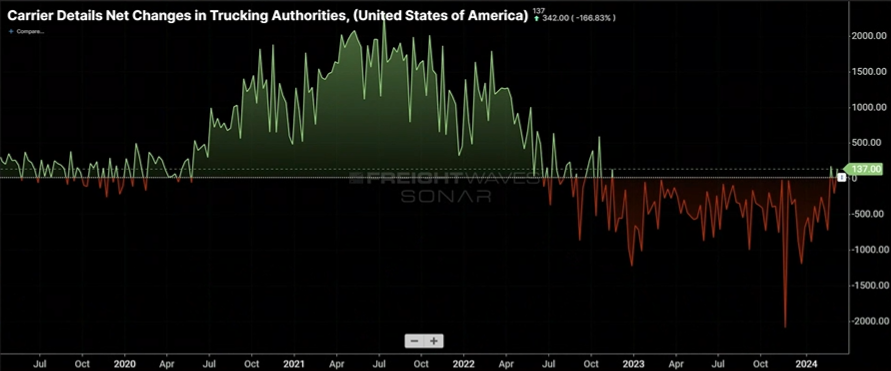
According to FreightWaves’ Net Changes in Authorities (CDNCA.USA) index, there has been a slight upward trend in authority changes in the past few months. To learn more about FreightWaves SONAR, click here.
While there may be too much capacity in the dry van sector, the specialized trucking space has seen more capacity recently moving into the market, Strickland said.
According to FreightWaves’ Net Changes in Authorities (CDNCA.USA) index, there has been a slight upward trend in authority changes in the past few months.
“The [CDNCA] chart has been in the red all of 2023, and it looks like we’re kind of pulling up into the green right now,” Strickland said. “Now, just because it is going green doesn’t mean that capacity is growing. We have had what I would consider a little bit of a directional shift. We have seen a little bit of a shift away from the general commodity entrance into the other kind of modes, like oil and gas transport — things in bulk, flatbed, as well as refrigerated trucks.”
Federal infrastructure spending has kept the economy moving
Both Fuller and Strickland said they were not expecting U.S. GDP to currently be up more than 5% from the same period last year.
“We got it wrong about GDP. I certainly thought that the second half of last year was going to be a lot tougher,” Fuller said. “We thought that the student loan deferments were going to hurt things. There were credit issues in the market. The bank failures certainly caught everyone off guard, and people thought it would really reverberate for the economy. None of that happened.”
At this time last year, one of the biggest burdens more than 25 million Americans were facing was the end of student loan forbearance. Fuller wrote about it in an article titled “An unusually terrible freight market may get a lot worse.”
Fuller said while consumer spending didn’t completely fall off, it was government spending that helped keep the economy afloat.
“What is sort of harder to understand and track is the government stimulus, not to consumers’ wallets, but in infrastructure programs, like the Inflation Reduction Act, the CHIPS and Science Act, the [Bipartisan Infrastructure Law]. Those things put a significant amount of government dollars into the economy,” Fuller said. “I think what happened is where we saw softness in the freight economy, those things have sort of overridden this, and that’s what kept the economy going.”
Trump threatens more tariffs on China if he is reelected
Former U.S. President Donald Trump has said he would impose more tariffs on Chinese goods if he wins the election in November. Trump said if he wins a second term, he will add 60% tariffs on all Chinese goods to the U.S.
“You talked about what happened before when a lot of folks were trying to pre-run, bringing in a lot of products to avoid those tariffs,” Fuller said. “Do we think that shippers are going to do the same thing this year? In the anticipation of an uncertain election season, are they going to pre-run their shipments? Or is this going to be a situation where they wait to see who ends up winning and then make those decisions later?”
Strickland said Chinese companies may know how to avoid those tariffs, and that’s by using Mexico as a back door for imports to the U.S.
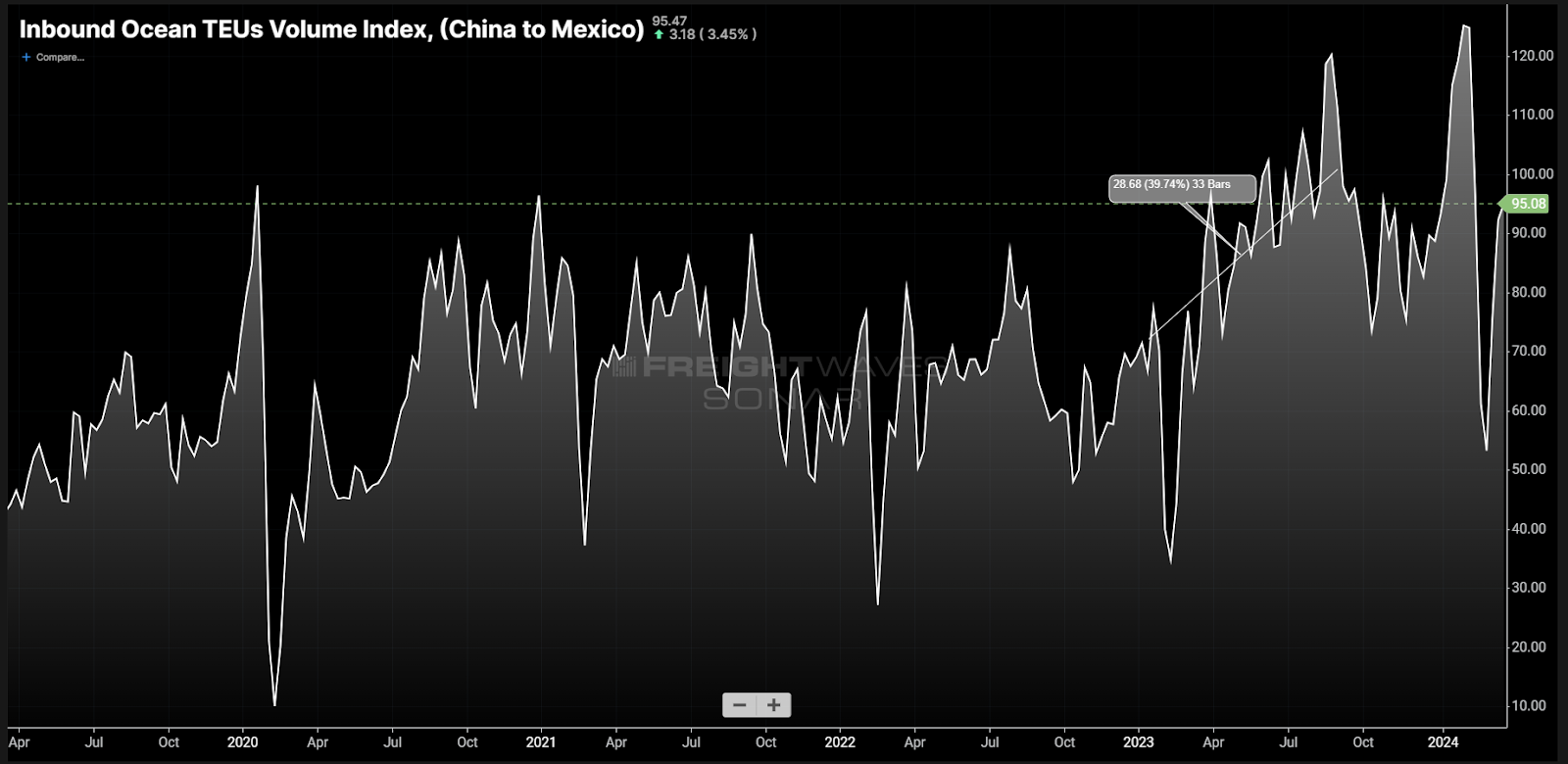
“I think China has already figured out a way through this. Our inbound ocean twenty-foot equivalent unit volume index for imports from China to Mexico (IOTI.CHNMEX) shows that it’s up 40% compared to last year,” he said. “Now, this is different from the 2019 trade war between the U.S. and China when everything came in through ports in California.”
FreightWaves’ SONAR Inbound Ocean Twenty-foot Equivalent Unit (TEU) Volume Index shows that imports from China to Mexico (IOTI.CHNMEX) have been increasing since 2019.
“A lot of people have been talking about this and speculating, but I think it’s a really important story, because it actually proves exactly what you’ve said, which is that Mexico is benefiting greatly from China,” Fuller said.
Texas is becoming the new California in freight transportation
Fuller said he remembers 20 years ago when Texas was a backhaul market with very little freight coming out of the state.
“In terms of freight concentration, I remember when Texas was a territory where trucks went in there, but they didn’t leave. There was very little being produced there,” he said. “What’s happened is the rise of the distribution centers, and the sort of reemergence of Mexico as a major trade partner has really shifted Texas into the role that California used to play in freight and trucking when I was in the industry 20-something years ago.”
In 2023, Mexico surpassed Canada and China as the top U.S. trading partner for the year, totaling $798 billion in trade.
Fuller and Strickland noted that Laredo, Texas, and Port Houston have benefited from Mexico’s emergence as the top U.S. trading partner over the past year.
“Laredo is the second-largest growth market in the United States right behind Phoenix,” Fuller said. “Phoenix is getting some of that California benefit as people are pulling freight out of warehouses in California and adding them to warehouses in Phoenix.”
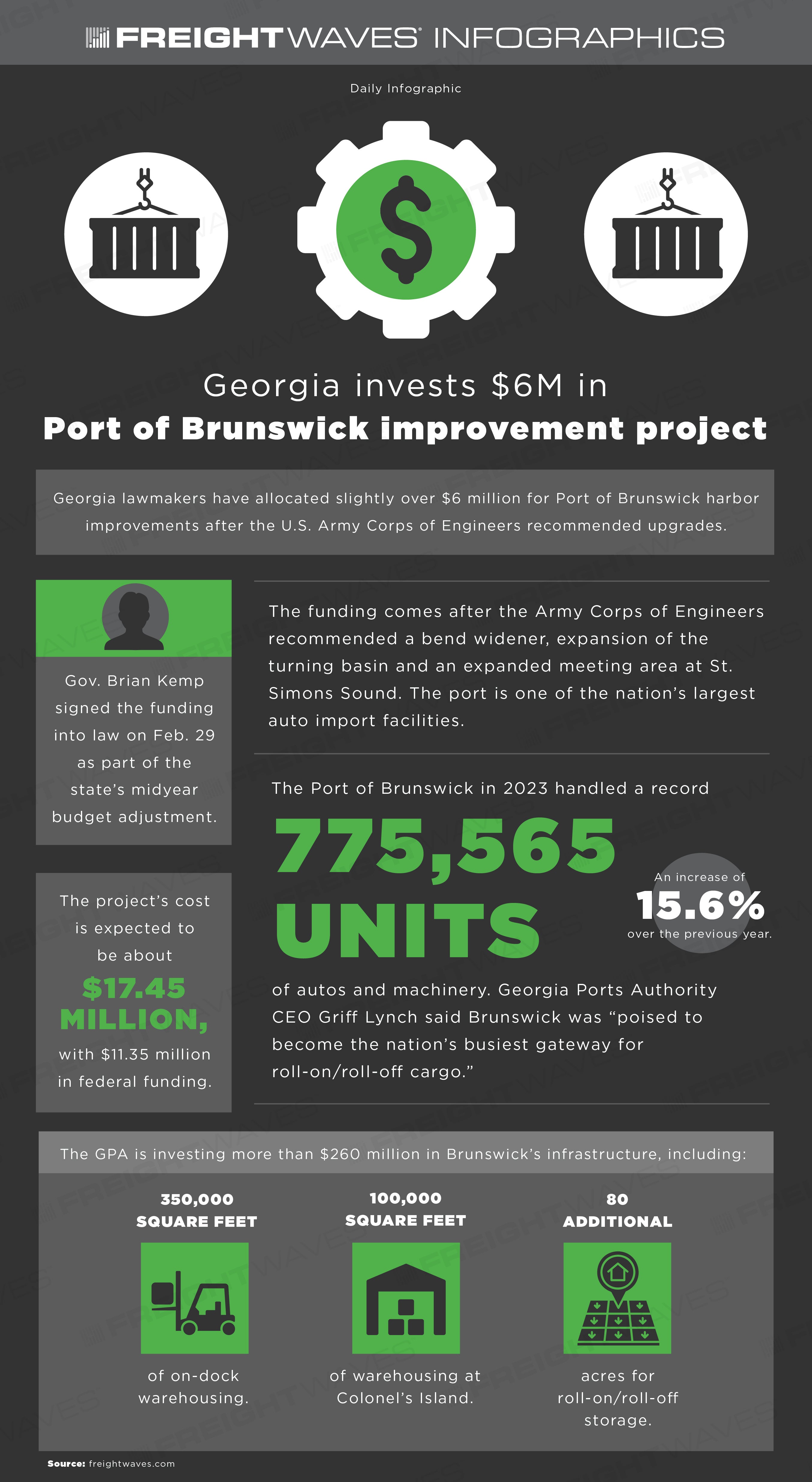
Daily Infographic: Georgia invests $6M in Port of Brunswick improvement project
To view more FreightWaves infographics, click here
FedEx posts strong quarterly results
FedEx Corp. late Thursday reported adjusted earnings of $3.86 per diluted share in its fiscal 2024 third quarter, well above analysts’ estimates of $3.45 per share, sending shares up sharply in after-hours trading.
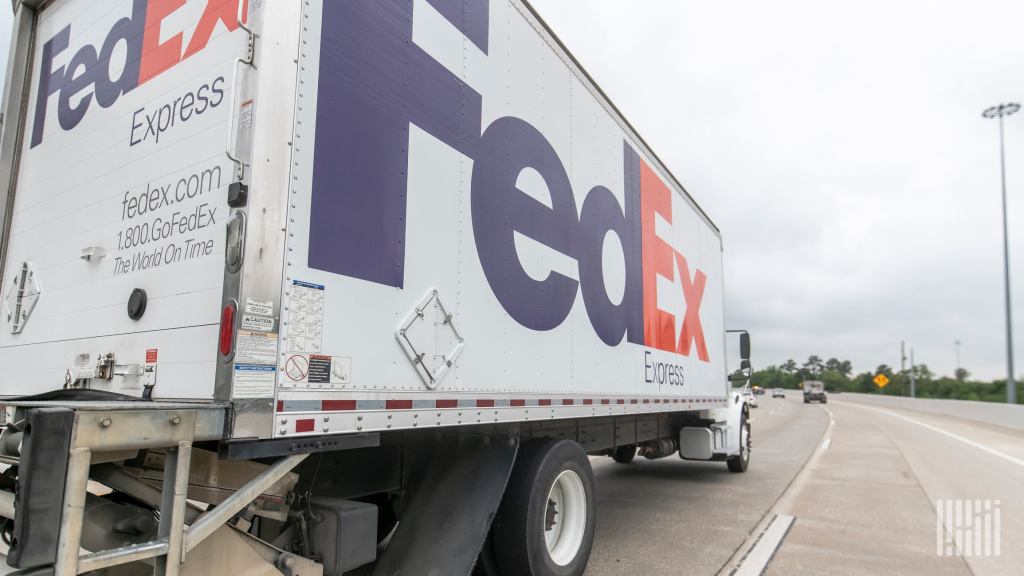
The company (NYSE: FDX) said cost cuts and efficiency improvements offset continued macroeconomic weakness. FedEx Express, the company’s air and international unit posted improved operating results despite lower revenue. FedEx Ground’s operating results increased due to lower structural costs and higher base yields. Cost per package was flat.
FedEx Freight, the company’s less-than-truckload unit, posted lower operating results due to lower fuel surcharges, less volume and reduced weight per shipment, the company said.
The company adjusted its full-year fiscal 2024 guidance, moving up the top and bottom ends of its range to $17.25 to $18.25 a share, from $17 to $18 per share. FedEx expects to hit its FY 2024 commitments of $1.8 billion in permanent cost reductions from its DRIVE transformation program.
The company said its board had authorized a new $5 billion share repurchase program, which is in addition to the $600 million in shares that remain available for purchase under a 2021 authorization program.
FedEx shares were up nearly 13% in after-hours trading after rising nearly 2% during the regular session.
House lawmakers crack down on Chinese ocean freight data
WASHINGTON — House lawmakers have passed a bill giving regulators new power to investigate potential violations of the law by the producer of one of the most closely watched container freight indexes.
The Ocean Shipping Reform Implementation Act of 2023, which passed the chamber on Thursday by a vote of 393-24, targets China’s Shanghai Shipping Exchange (SSE). SSE publishes the Shanghai Containerized Freight Index, an aggregator of spot market data on which container freight rates in the trans-Pacific ocean trades are based.
The legislation — if also approved by the Senate — would allow the Federal Maritime Commission to look into potential advantages the SSE provides China, including the ability of the Chinese government to manipulate container freight markets to the disadvantage of U.S. businesses and consumers.
It also cracks down on Logink, a logistics management platform operated by China, by banning its use in the U.S. by port operators and marine terminals that use federal grant money.
A 2022 issue brief by the U.S.-China Economic and Security Review Commission asserted that Logink’s aggregation of global freight data could provide China “an informational edge” that is anticompetitive.
“If LOGINK makes data on global transactions available to Chinese entities free or for less cost than it provides them to other users, or if it only provides certain data to Chinese entities, these entities may be able to act with an unfair advantage on international market trends ahead of other firms,” the report states.
“All this could help Chinese firms compete on unequal footing in the nearly $1 trillion third-party logistics industry, in particular the freight forwarding services market estimated at just under $200 billion.”
“One real focus of this bill … is that it makes it harder for the Chinese Communist Party to be able to use the Shanghai Shipping Exchange or the LOGINK platform to be able to gather up all of this exquisite data about the world’s supply chains and shipping information and have it be used against our country and others,” the bill’s sponsor, U.S. Rep. Dusty Johnson, R-S.D., said on the House floor earlier this week.
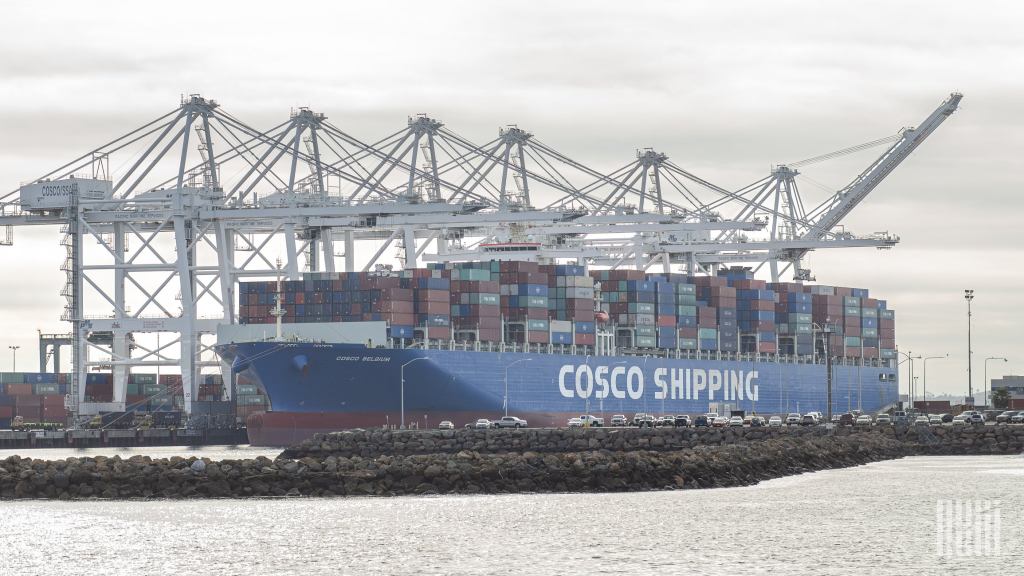
Chinese container lines such as Cosco, the world’s fourth-largest liner operator, could also receive enhanced scrutiny under the legislation, which would designate a private vessel based in a nonmarket economy as a “controlled carrier” over which FMC has authority to regulate to ensure fair market rates.
New advisory committees for ports, ocean carriers
To help FMC create policies to ensure competitive container shipping markets, the legislation creates two advisory committees to complement its current shipper advisory committee: a National Port Advisory Committee and a National Ocean Carrier Advisory Committee.
The port committee will consist of 13 members, five representing marine terminal operators, five representing port authorities and three representing labor. Of the nine members of the carrier committee, at least three will represent intermediaries such as freight forwarders or non-vessel-operating common carriers.
Additional policies in the legislation include requiring the FMC to work with the maritime industry to set a new data standard for maritime freight logistics, including contracting with a third party to develop a new standard.
It also prohibits the FMC from requiring ocean carriers to report information that is already reported to other federal agencies, such as the Army Corps of Engineers, U.S. Customs and Border Protection, and the Department of Commerce.
Trucking companies look to solar panels to reduce costs
Trucking companies look to solar panels to reduce costs
(Photo: GP Transco)
The persistent low freight rate environment paired with higher costs is encouraging fleets to come up with creative solutions to save costs in the form of solar panels on tractor trailers. Dry van carrier GP Transco is installing solar panels on its entire fleet of around 600 trucks after testing the tech on 10 trucks over a six-month period. In an interview with FreightWaves, Brett Wilkie, vice president of maintenance and safety for GP Transco, estimated that the technology will save $1,700 per tractor per year. This was calculated assuming an average diesel price of $4 per gallon and annual mileage of 110,000 miles per truck.
An added benefit is reducing the parasitic drain on batteries from modules on the truck, which are constantly powered and steadily drain the tractor’s battery. FreightWaves’ Todd Maiden writes, “The bigger draws on a truck’s battery system come from the use of the in-cab heating and cooling system as well as the use of small appliances and electronics like refrigerators, microwaves and televisions. However, there is always some draw on batteries as advanced telematics, smart sensors and cameras on newer trucks are continuously working.”
One provider of solar panels used on tractor trailers originally designed the panels for the U.S. Army to use on military vehicles, drones and gensets. But over-the-road trucking presents new challenges compared to the battlefield. Venkatesan Murali, founder and CTO at MerlinSolar, told FreightWaves, “We realized very quickly that trucking, commercial transportation is probably the toughest place to deploy solar panels.” After deploying the panels for trucking fleets, Murali said the panels tripled the average 18-month lifetime of EPU batteries, with some drivers reporting going an entire 34-hour reset period without idling the tractor for power.
Maintenance parts and labor costs fall while labor rates and shop sales grow
The annual Fullbay/TMC State of Heavy-Duty Repair Report used survey data from over 1,000 individual survey respondents and shop data from North America, Australia and New Zealand. Compared to 2022, heavy-duty repair shops reported a 40% increase in counter sales while labor rates increased approximately $10 per hour. Compared to trucking’s low margins, maintenance providers saw better profits from more demand. The report adds that over 40% of respondents reported a net profit of 11%-20% For the ongoing technician shortage, there appears to be a strategy of job hopping. Per the report, only 25% of technicians indicated they worked at only three or fewer shops throughout the course of their career.
The Decisiv/TMC North American Service Event Benchmark Report uses data from Decisiv’s service management platform that covers over 300,000 monthly maintenance and repair events from over 5,000 service locations. The report notes the Q4 2023 decline quarter over quarter came from parts costs, which fell 2.2% while labor declined 0.2%. Year over year saw a decline in parts paired with a rise in labor. The report said, “On a year-over-year basis, combined parts and labor costs in [the] final quarter of 2023 were 0.2% higher than the same quarter in 2022. However, in the annual comparison, a 2.2% drop in parts prices was offset by a 4.0% rise in labor costs.” For diesel technicians, continued demand remains, with a recent TechForce Foundation Transportation Technician Supply & Demand Report forecasting, “177,000 new entrants in the diesel technician field are needed between 2022 and 2026.”
Market update: February truck auction pricing falls in February
A recent report from J.D. Power Valuation Services hinted at the impact Yellow Corp.’s truck and trailer bankruptcy liquidation is having on the marketplace with the first major sale of equipment on March 5. The report notes the impact of those day cabs, which are a fixture of LTL carriers: “Prior to last week, it was unusual to see a noticeable number of late-model single-axle daycabs in the marketplace, and selling prices reflected this increased supply.” The full impact won’t be understood until the next report is published in April, which will include the March sales data.
For February, while total late-model sleeper units sold compared to January was similar, the price paid continues to fall. FreightWaves’ Brinley Hineman writes, “The number of late-model sleepers sold in February was comparable to the January figure. However, prices dropped significantly, particularly among trucks that hit the 5-year-old mark in January. The report found that the average price in February of model-year 2020 sleeper tractors was $37,064 — a nearly 26% decrease from January.” The report notes current pricing is approximately 65% higher than late 2019 but 37% higher when taking inflation into account.
FreightWaves SONAR spotlight: First day of spring fails to warm up spot market
(Source: FreightWaves SONAR)
Summary: Spot market rates on the first day of spring, which was Tuesday, more closely resemble the first day of fall 2023, according to recent data from the FreightWaves National Truckload Index 7-Day Average. In the past week, NTI spot market rates rose 4 cents per mile from $2.24 all-in on March 11 to $2.28 per mile. Reefer spot market rates also posted a decline, falling 2 cents per mile w/w from $2.51 all-in to $2.49. For the week ahead, recent upward movements in daily spot market movements (NTID) suggest further strengthening for dry van rates, but the case for a sustained rally remains elusive.
One headwind for an improvement in spot market rates is lower outbound tender rejection rates, which forces more contracted carriers to compete for spot market loads to fill load volume gaps. Currently the Nationwide Outbound Tender Reject Index is at 3.81%. It only rose 7 basis points w/w from 3.74% on March 11. Dry van rejection rates remain depressed compared to the national average, with VOTRI increasing a paltry 14 bps w/w from 3.37% to 3.51%. Reefer outbound tender rejection rates (ROTRI) were a bright spot, rising 86 bps w/w from 4.64% to 5.5%.