Truck of the Future: 5 takeaways from a CERAWeek discussion

(Editor’s note: the article has been edited to reflect that some statements by David Roh were initially misattributed to another panelist).

HOUSTON — The roughly 9,000 attendees at the CERAWeek energy conference had a multitude of presentations about transitioning to new forms of energy and away from hydrocarbons. But only one focused on the future of trucking.

Three executives from diverse trucking industry backgrounds answered questions from Greg Genette of S&P Global Mobility at a panel titled “Truck of the Future.” S&P Global (NYSE: SPGI) is the producer of CERAWeek.

Here are some key points from the roughly half-hour discussion.

— Hydrogen in transport has often been thought of primarily as a fuel to power a fuel cell, where the energy in the hydrogen is transformed into electricity to power an electric motor. But combustion of hydrogen is still on the agenda as a possible transport solution.

“Combustion engine-powered vehicles, at least from the initial cost perspective, have an opportunity,” Rakesh Aneja, vice president and chief of the zero-emission transformation group at Daimler Truck North America, said about the future of hydrogen. Given that there aren’t enormous changes needed in the drivetrain for a hydrogen internal combustion engine, Aneja said the key issue will be the development of hydrogen tanks and delivery systems that will be on board the vehicle. Hydrogen molecules are “tricky,” Aneja said, “and there certainly are some development challenges to be overcome. But the power train is more or less similar and the additional cost comes from the hydrogen tank system and the delivery of it.”

The assumption in the CERAWeek discussion was that the hydrogen would be delivered as its own molecule. Discussion of using hydrogen for propulsion in the form of ammonia did not come up, but combusting ammonia to produce energy from hydrogen creates significant nitrous oxide emissions. Ammonia is a combination of hydrogen and nitrogen.

Mohammad Fatouraie, the director of engineering for power solutions at Robert Bosch, which makes power systems such as fuel cells, noted that hydrogen combustion does not qualify as a zero-emission vehicle under the California Advanced Clean Fleets rule. That would mean that hydrogen processed through a fuel cell would need to be utilized to propel a truck using the element.

— Any discussion on the future of trucking deals not only with fuel but also with autonomous vehicles. The panel gave David Roh, the director of business development at autonomous truck software developer Plus, the opportunity to speak about the recent partnership between Plus and the various brands of Traton, including Navistar.

“If we tried to deploy commercial development of our level four autonomous solution on scale, we need to have tight integration with the OEMs on a serious production level,” Roh said. “Beyond that, we need to make sure we can also provide testing and validation on the autonomous operations with fleet operators.”

The cooperation agreement with Traton, a division of Volkswagen, is expected to make it possible to bring autonomous vehicles into the market “at an accelerated pace,” Roh said. It will allow deployment “as soon as we can actually convince the fleet operators with our autonomous operations,” he added.

—Navistar and its recent news regarding autonomous vehicles also was in the background in comments by Roh. He discussed the potential for trucking using autonomous vehicles to grab market share from what he called “other modes of transport, such as carbon-intensive air transport.”

If “everything goes smoothly” with autonomous vehicles, Roh said, a cross-country truck trip can be taken in two days. At that point, it’s competitive with airfreight. “We’re essentially looking at a scenario where a fleet is the most efficient.” He described that as “awesome.” 

— There was no definitive “hydrogen is the future of trucking” declaration. Part of that was due to the fact that the discussion at CERAWeek was not just about Class 8 tractors, in which a battery-powered future is considered unlikely due to weight and the length of time needed to recharge a truck for time-stressed drivers. Aneja said hydrogen has a “complementary” role to play “with respect to propulsion technology.”

“We are evaluating and developing both fuel-cell vehicles and hydrogen combustion engines as well,” the Daimler executive said.

Fatouraie said individual situations may necessitate individual solutions. For example, he noted that the operating temperature of a fuel cell is about 80 degrees Celsius (176 degrees Fahrenheit). Operating a fuel cell in weather conditions like “summer in Texas,” which was his example, creates efficiency issues. That is where “hybridization” can come in, in which a battery system on board the vehicle can be called on to provide power when conditions might not be optimal for fuel cells.

“So it is really going to depend on the use cases, the applications and the choice of the overall power,” Fatouraie said.

— While some of the discussions about an energy future at CERAWeek have long timelines, Bosch’s Fatouraie said 2027 is an “inflection point” in the pace of electrifying light-duty vehicles. He did not specifically define “inflection point” but suggested that by that time, there will be clarity on a variety of issues, including the state of infrastructure for refueling and the “total cost of ownership,” a factor in determining the success of alternative fuels that includes such things as the savings on fuel and maintenance and the impact of tax considerations.

Leading up to 2027, Fatouraie said there will be resolutions to questions of electrification versus hydrogen, infrastructure improvements, and the deployment of pilot programs to prove out the pathways that will succeed.

More articles by John Kingston

Analysts at CERAWeek know 2023 oil market predictions didn’t pan out, look to 2024

Hydrogen mania at key energy conference in ’23 more tempered in ’24

Further appeals to block AB5 from California trucking seen as a long shot

Third parties saw emails, court says in letting p44 defamation lawsuit proceed

In a ruling that hinged on who received some sensitive emails, the Illinois Supreme Court ruled Thursday that project44 may move forward with its defamation lawsuit against rival visibility provider FourKites.

“We plan to continue on the merits of the case,” Jennifer Coyne, general counsel for project44, told FreightWaves.

The dispute began with emails sent to project44 executives in May 2019, alleging accounting improprieties and ties to organized crime at project44. The first email, from “Ken Adams,” accused the company of financial wrongdoing and mafia connections, while the second, from “Jason Short,” criticized project44’s technology.

Project44 denied the claims and sued FourKites for defamation and civil conspiracy in April 2020.

During pre-suit discovery, project44 found that both emails were accessed from IP addresses linked to FourKites India. Additionally, the phone number associated with the Ken Adams account matched the CEO’s number listed in Securities and Exchange Commission documents for FourKites.

What’s the holdup?

In Illinois, defamation claims require proof of false statements, publication to a third party and harm to reputation. Defamation can be categorized as “per se” or “per quod,” with per se not requiring proof of actual damage.

FourKites attempted to dismiss project44’s lawsuit in 2020, arguing the emails lacked publication and didn’t meet per se defamation criteria.

Project44 appealed the dismissal, and an appellate court decided in project44’s favor.

The court emphasized a corporation’s concern for its reputation among employees, reinstating the defamation suit. The case went to the Illinois Supreme Court in January this year for review and to clarify the state’s defamation laws in the matter.

The review

The Illinois Supreme Court focused on when sending emails constitutes publication to a third party and if there was tangible harm to reputation.

FourKites argued the recipients at project44 were akin to the company itself, disputing the publication claim. Scott Gilbert, an attorney for FourKites,  emphasized the influence of executive leadership on a company’s reputation.

Project44 attorney Douglas Albritton likened the emails to corporate sabotage, asserting they aimed to disrupt project44’s workplace. 

Both sides debated who qualifies as the company versus a third party.

FourKites questioned the time lapse between emails and complaints to prove reputational harm, while project44 cited defamation per se law, claiming proof of actual harm was unnecessary.

The ruling

On Thursday, the court outlined the requirements for a defamation claim, emphasizing the need for false statements, unprivileged publication to a third party and damage.

FourKites argued they weren’t published to third parties since they were sent to project44’s leadership.

The court rejected that argument, noting that communication among corporate employees can constitute publication for defamation purposes, even if they’re managerial-level employees.

It affirmed that corporations and their employees have separate identities and interests, making communication to corporate employees publication to third parties.

The court also addressed concerns about reputational harm, stating that in defamation per se cases, proof of actual damage to reputation isn’t required.

Additionally, the court clarified that qualified privilege remains a defense against defamation, but its application arises after establishing the elements of defamation, including publication.

Ultimately, the court ruled in favor of project44, finding that the Circuit Court erred in dismissing the complaint. It affirmed the appellate court’s decision to reverse that dismissal and remanded the case for further proceedings.

“The Court clearly understood the harm such defamatory content can cause even when sent only to an organization’s own leadership team and Board members,” Coyne said. “This decision holds competitors accountable for attempted sabotage by anonymously sending harmful falsehoods to corporate decisionmakers.”

FreightWaves reached out to FourKites but did not hear back by publication deadline.

Transfix launches tools to tackle fraud across freight industry

Digital freight marketplace operator Transfix Inc. announced Thursday it has launched Transfix Shield, which aims to help shippers, carriers and brokers root out identity fraud across the commercial transportation industry.

Transfix Shield includes RateCon Shield and Facility Shield, tools available to all freight brokerages and shippers. The tools are designed to help users protect their business, as well as those of their carrier partners, and consumers from the impact of freight fraud, according to Jonathan Salama, Transfix’s CEO and co-founder.

“Fraud affects everyone. It’s like a full circle that begins with the shippers, brokers, carriers that are moving the freight,” Salama told FreightWaves. “When fraud happens in the freight industry, it costs brokers, carriers and ultimately it costs regular consumers, because it gets passed on to consumers.”

The Transportation Intermediaries Association (TIA) contends that fraud in trucking is costing the industry as much as $800 million.

“There’s a surge of malicious actors engaging in illegal activity, registering with the Federal Motor Carrier Safety Administration as carriers and perpetrating fraud, theft and holding freight hostage in situations without any legal consequences,” said Jeffrey Tucker, testifying on behalf of the TIA at a hearing before the U.S. House Transportation and Infrastructure Committee in January.

New York-based Transfix is a digital freight marketplace connecting shippers and more than 30,000 carriers. The company was founded in 2013 by Salama and Chairman and President Drew McElroy.

RateCon Shield adds a layer of security to a brokerage’s operation and the carrier’s business to detect bad actors impersonating legitimate freight brokers.

Fraudsters often pose as legitimate brokers, assuming a broker’s identity, and offer loads to carriers, according to Salama.

“After the carrier accepts and delivers the load, they contact the unknowing legitimate broker for payment, but the fraudster has disappeared and the carrier goes unpaid,” Salama said. “These frauds can cripple a carrier’s business.”

RateCon Shield works by automating the addition of a QR code to rate confirmation documents, helping carriers validate the authenticity of loads and the brokers offering them. 

Transfix launched a pilot run of RateCon Shield last summer, which was well received by customers, Salama said.

“Since we launched it, we haven’t had any fraud issues, or haven’t heard of any issues or problems from customers,” he said.

Dan O’Sullivan, CEO of logistics provider United States of Freight, said RateCon Shield will be a differentiator in the freight industry.

“It builds credibility with both our shipper and carrier partners,” O’Sullivan said. “Partnering with an organization that had real skin in the game was also important for us. Transfix not only developed RateCon Shield, but they use it on every load.”

Facility Shield, which is in beta testing and soon to be available to shippers, provides fraud prevention capabilities at the facility level. The tool is designed to help shippers protect their facilities and associated loads through proprietary validation systems and processes that give shippers a new layer of security to verify carriers before they enter a facility, helping to reduce theft.

RateCon Shield and Facility Shield can integrate via API connection, are designed for a flexible and fast onboarding experience, and do not require users, whether carriers or facility employees, to download any additional apps.

Salama said both RateCon Shield and Facility Shield will be volume subscription-based services available to anyone who wants to use them.

“Fraud is an issue that will never get solved unless we all come together as an industry,” he said.

More articles by Noi Mahoney

Cargo thefts spiked 68% in Q4, led by food and beverage freight

Container shipments from China to Mexico skyrocketed in January

Location, cost drive international firms south of the border

Illinois Supreme Court rules project44’s defamation case can continue

Project44 has won a major battle in its ongoing defamation suit against competitor FourKites. The Illinois Supreme Court ruled Thursday that emails in question were published to a third party, and that the Cook County Circuit Court must try the case.

The two FreightTech rivals have been battling it out in the courts after project44 accused FourKites of being behind a defamation campaign via email to two members of project44’s board. Emails from pseudonyms “Ken Adams” at kenadams8558@gmail.com and “Jason Short” at jshort5584@gmail.com alleged improprieties at project44 and even alluded to the company having a connection to the Chicago mafia. Both emails claimed to be from former project44 employees, hoping to warn board members of wrongdoing.

An investigation by project44 found that IP addresses from which the emails were sent belonged to “individuals associated with FourKites,” the court stated.

The Cook County Circuit Court in Illinois previously agreed with FourKites to grant a motion to dismiss the case, but the appellate court forced further proceedings after an appeal. The Supreme Court upheld the appellate court ruling.

This is a developing story.

Parcel carriers still operating according to 1980s narrative

UPS and FedEx delivery trucks side by side on a city street

By Satish Jindel
The views expressed here are solely those of the author and do not necessarily represent the views of FreightWaves or its affiliates.

In many respects, the parcel market of 2024 still looks very much like that of 40 years ago when RPS broke into a practical monopoly of UPS. While transit time is faster for ground service, the service offerings, operational network and technology have largely remained unchanged.

For example, the transit time commitments for overnight express delivery are still 10:30 a.m. and noon, the bar codes are the same despite major advancement in technology, and the zone concept — developed by the U.S. Postal Service many decades ago and before the interstate highways were built for faster transportation — is the same.

Even more shocking is that both FedEx and UPS still have a three-day deferred service as part of their portfolio of express services when their ground service is now faster in many lanes and at a considerably lower cost.

Furthermore, while the express services offered guaranteed delivery or money back for service failure, that guarantee was first suspended with the start of the COVID-19 pandemic in March 2020.

Then, after the pandemic was over, the guarantee was only restored for overnight express service. As such, two-day air express and three-day deferred express services offer no premium value for the much higher charge while being no faster, and at times being even slower than ground service.

And, since 1985, the customers have evolved dramaticall,y resulting in the following changes: More products are ordered online and 24 hours a day, thereby offering opportunity for pickup even in the morning, with more deliveries made to residences than 30 years ago.

Even businesses have the ability to communicate more frequently in a day, allowing premium express parcels to be delivered at desired times for different office complexes, and to avoid parcels being shipped for overnight delivery by 7:30 a.m. only for the delivery driver to find the offices are not open.

In addition, a combination of routing software and skills of AI now allows carriers to optimize their service offerings that meet their operational network to balance customer preferences with delivery density to achieve a higher level of customer experience at a lower cost, which was impractical in the past.

Among the three national for-hire carriers, the Postal Service has been the only one to realign its parcel service offering. Last summer, when it combined three parcel services (first class, parcel select ground and retail ground) into Ground Advantage and included $100 of insurance, it made the least expected bold move.

The result has been its two-to-five-day commitment time has been well received, and ShipMatrix data on millions of parcels shows that it now has on-time performance approaching the high-90% mark normally reserved for FedEx and UPS.

And, if the Postal Service can rapidly complete the realignment of the Priority Mail (which is not a mail service so why not brand it as Priority Advantage?) parcel network so as to achieve on-time performance to match that of Ground Advantage and that of the deferred express services of FedEx and UPS, it will stand to gain market share.

In addition to the changes pushed by the Postal Service and Amazon, the parcel market for the first time since 1985 has seen the emergence of new parcel carriers like Axlehire and Veho, which are utilizing new approaches. Whether or not they succeed in gaining a large share of the market, they are challenging the 40-year-old narrative.

With UPS faced with high costs from a unionized labor contract and FedEx with the handling of an integration of Express and Ground networks, the timing could not be better for both to develop a parcel service that would meet the demands of customers and lower operating costs to fend of new competition from startup carriers and from Amazon’s new door-to-door offering. That offering seeks to leverage Amazon’s huge backhaul capacity at lower cost and higher service level with greater use of data analytics.

While Amazon’s two-day and next-day delivery quickly became the standard copied by its competitors, at least two new online retailers are responding to new customer demands. Temu and Shein are showing that consumers do not need most items in one or two days and are willing to receive their orders within seven to 12 days for a comparable-quality product at a considerably lower price.

So, it is time for shippers to embrace carriers that are making changes to meet today’s market needs and regain control over their parcel spend, which increased dramatically during the pandemic as carriers suddenly took higher base rate increases and imposed new surcharges.

Satish Jindel is president of ShipMatrix Inc. and a founding member of RPS (now FedEx Ground).

Cargo thefts spiked 68% in Q4, led by food and beverage freight

When trade operator Mary Sandoval recently sent a truck to pick up a load of avocados from a warehouse in Laredo, Texas, she was appalled when the load and tractor-trailer vanished without a trace almost immediately after leaving the facility.

“The truck showed up to the warehouse, gave the warehouse the load pick up number and then drove off and disappeared,” Sandoval said. “We never heard from them, and don’t know where the avocados went.”

Sandoval, whose name has been changed for this story, spoke to FreightWaves on condition of anonymity. It’s the second time Sandoval’s Texas-based logistics brokerage has been the target of strategic cargo thieves over the past year, leaving the company with over $200,000 in damages that they had to pay out of pocket.

“Cargo theft is everywhere, but not enough people are doing anything about it,” Sandoval said. “I spoke to a woman who has a company in McAllen, Texas, that’s had six loads stolen in one year. She said she can’t pay for any of the lost loads and is afraid she’ll have to shut down.”

Cargo thefts surge 68% in fourth-quarter of 2023

Cargo thefts surged 68% year over year (y/y) in the fourth-quarter of 2023 compared with 2022, according to CargoNet, a subsidiary of data analytics firm Verisk. During the third quarter of 2023, cargo thefts were up 57% y/y compared to the same year-ago period.

“The trends tell us that cargo theft is currently at a 10-year high,” Scott Cornell, transportation lead and crime and theft specialist at Travelers, told FreightWaves. “So far, the numbers for the beginning of 2024 are projecting that 2024 will have higher theft numbers than 2023, which had higher numbers than 2022.”

Cornell said they are seeing higher incidences of strategic cargo theft, which involves fraudsters using stolen motor carrier operating authorities or logistics broker identities to obtain freight and misdirect it from the intended receiver in order to steal it.

“Strategic theft is when they use various means to trick you into giving them the freight and that’s through methods like identity theft, fictitious pickups, double brokering scams, those methods are where we’re seeing the biggest increase in cargo thefts over the last 18 months,” Cornell said. 

Commodities such as food and beverage goods, electronics and household goods are top targets of thieves.

California, Texas, Florida, Georgia and Kentucky continue to be hotspots for cargo thefts, according to Danny Ramon, an intelligence and response manager at Overhaul, a real-time visibility and risk management platform based in Austin, Texas.

Ramon said members of a cargo theft ring in California were arrested last year, but some escaped law enforcement and set up new crime rings across the country.

“Some of the group’s members escaped and essentially formed splinter cells and have set up shop all over the country,” Ramon said. “They created a network of fraudulent carrier identities across the country that they’re now using for double loading, and gathering intelligence on the shipping and receiving procedures for various well-known distribution centers and origin points to commit strategic thefts and illicit double loading.”

Ramon said in the case of Sandoval’s avocados that were stolen from the Laredo warehouse, the thieves likely sold them locally.

“When we see cargo thefts along the U.S. side of the border, it’s traditionally things that don’t usually travel north of those locations, these are things that can be liquidated easily locally,” Ramon said. “We see a lot of theft of alcoholic beverages in these areas. I used to live in Laredo and there was a theft of a load of window unit air conditioners one time, so the air conditioners would be easy to move locally. Food products are also easy to sell. With avocados especially, I wouldn’t be surprised if some of those other avocados were stolen in the run up to the Super Bowl.”

Protecting trade operators from cargo theft

Sandoval thought there were rules in place from the Federal Motor Carrier Safety Administration (FMCSA) that required workers at warehouses and logistics centers to seek several forms of identification from truckers who show up to pick up loads.

“I thought there was an FMCSA rule that regulates warehouses about asking carriers for identification if they show up to a warehouse, such as getting their driver’s license, license plates,” Sandoval said.  

FMCSA officials said there are no specific rules for warehouses or logistics centers requiring them to ask for truck drivers’ information, even if the carrier is supposed to be certified for the Customs Trade Partnership Against Terrorism (CTPAT) program. 

CTPAT is a U.S. Customs and Border Protection (CBP) certification that is supposed to mitigate supply chain security risks by offering benefits to participating companies, such as fewer CBP inspections and reduced wait times at ports of entry.

“FMCSA is engaging with impacted consumers (drivers, carriers, and brokers), industry organizations and professionals via conferences, meetings, and correspondence – and we are implementing long-term and short-term measures to address the various types of fraud occurring,” FMCSA said in an email to FreightWaves. “FMCSA is developing a new modernized registration system that will have security and fraud prevention at the forefront, and we are working to implement identity verification services for new and existing applicants.”

FMCSA also said they have taken steps such as implementing multi-factor authentication on IT systems to deter fraud; performing manual intervention checks for the 350 to 400 daily paper requests to certify and validate changes to customer’s driver’s licenses; and implementing more stringent requirements for all new motor carrier registrants to have a physical address that can be verified by the post office.

Cornell said there are some red flags that trade operators can look for when they are unsure if they are dealing with cargo thieves or legitimate operators. Red flags may include recent changes to a motor carrier’s information listings, or whether the carrier’s operating authority was dormant for a long period of time.

“When we work with our clients, we tell them to check for recent changes in the FMCSA contact information, their motor carrier numbers, the address, the phone numbers, the email addresses, names,” Cornell said. “Have there been any recent changes that you might want to revisit with that carrier and go through and make sure that the change is a legitimate change, or whether it’s somebody that bought that motor carrier number with intent to commit cargo theft?”

Ramon said Sandoval and all trade operators should get plugged into the cargo security community, whether it’s with companies like Overhaul or CargoNet, or local cargo security or trade organizations.

“Get plugged into the supply chain security industry, because the theft of loads of avocados is just the tip of the iceberg,” Ramon said. “If [Sandoval] were to harden her supply chain against that particular method of theft, the cargo thieves are just going to target her with the next step in the sophistication ladder, so to speak. There are a dozen different modus operandi with varying sophistication levels between the one that she experienced and the ones that we’re dealing with right now in places like California and Kentucky.”

More articles by Noi Mahoney

Container shipments from China to Mexico skyrocketed in January

Location, cost drive international firms south of the border

Texas court sides with Union Pacific over 1872 jobs pact with town

Amazon concentrates parcel freighters at US air hubs, report says

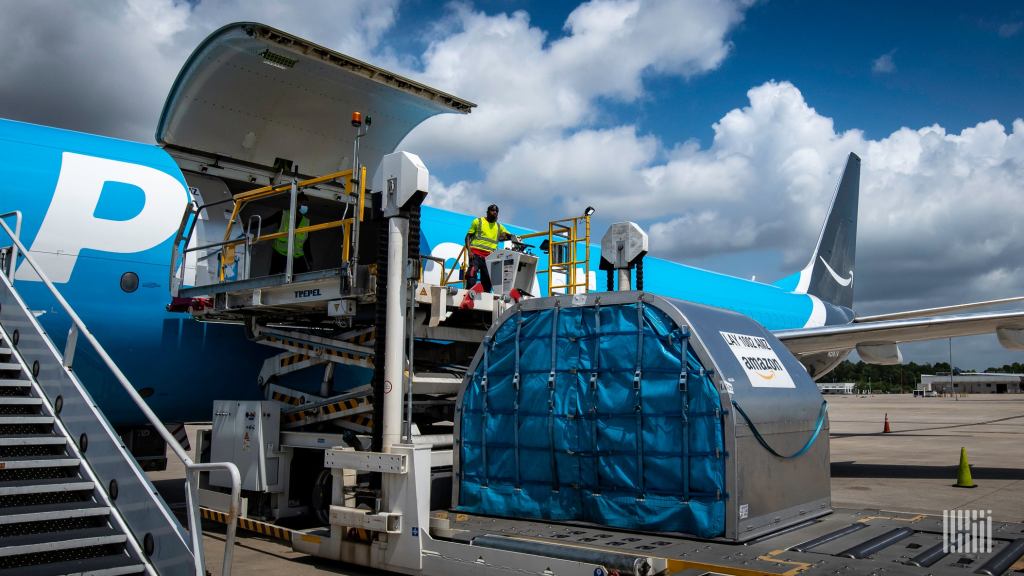
A light blue Amazon Prime plane on the ground with its side cago door open and a container ready to be loaded from the ground.

Amazon’s private cargo airline, Amazon Air, took a different approach with its North American and European networks during the past 12 months. It has been streamlining operations in the U.S. by prioritizing larger planes and major hubs, but relying less on hubs in Europe as flight activity decreases, according to a report published Thursday.

The air logistics unit’s meteoric growth has ended after seven years, but the company was able to maintain operating levels at a time when many cargo airlines, including FedEx and UPS, parked aircraft and reduced flights in response to the downturn in air cargo demand.

Perhaps more noteworthy, Amazon Air (NASDAQ: AMZN) largely kept its fleet and flight schedule intact even as growth in e-commerce sales normalized and the mega-retailer shifted to a regional fulfillment model that decreases reliance on air transport. 

The report from the Chaddick Institute for Metropolitan Development at DePaul University described how Amazon has 4.6% more payload capacity than a year ago despite having one fewer plane. It has also mostly transitioned to a hub-and-spoke model that mirrors FedEx and UPS, with less point-to-point flying. While total daily flights fell by 1.8%, to 202 per day, Amazon Air’s available ton-miles grew.

The researchers, led by Chaddick Institute Director Joseph Schwieterman, relied on geospatial mapping with flight tracking data for their analysis. 

More than four in five Amazon Air flights within the U.S. mainland operate to or from its five largest hubs, up from 65.6% in early 2021. Flight activity at four of its five busiest hubs — Cincinnati-Northern Kentucky (CVG); San Bernardino, California; Ohio’s Wilmington Air Park; and Florida’s Lakeland-Linder — all grew over the past year.

Only Fort Worth Alliance Airport in Texas diminished in flight activity, a result researchers attributed to Amazon’s decision to discontinue use of five ATR-72 turboprop aircraft operated by Silver Airways and which accounted for a tiny fraction of the terminal’s tonnage.

Amazon relies on partner carriers, such as Silver, to operate its network because it isn’t a pure airline with its own operating authority. Amazon’s active fleet has plateaued in the past 18 months at about 80 aircraft, according to various aircraft databases. But during the peak of pandemic home shopping the fleet reached 88 aircraft.

Lakeland is now Amazon’s second-largest hub, with nearly 21 flights per day.

The Ohio Valley has become Amazon Air’s strategic center, accounting for more than half the flights in the U.S. mainland. After initially borrowing space from DHL Express, Amazon opened its own $1.5 billion facility at Cincinnati-Northern Kentucky airport. Flights at CVG increased from 57.5 to 63.3 per day in the past 12 months, not including about six flights by unmarked partner carriers, according to the report. Wilmington Air Park, only 60 miles away, handles 20 flights per day. Concentrating flights at the Cincinnati hub, and clustering them into two tight arrival and departure blocks, allows for efficient plane-to-plane transfers that support overnight delivery.

Amazon Air still lags FedEx and UPS in proficiency, with turnaround times for aircraft of about five hours versus two to three hours for the integrated logistics providers, the Chaddick report said. At 8 years old, Amazon Air is still maturing. FedEx and UPS have operated air transport networks with huge hubs for decades.

Ditching the small turboprops was one of several adjustments Amazon made to its freighter fleet to better align the network with consumer demand and the renewed emphasis on regional order fulfillment. E-commerce sales in 2023 increased 7.6% to $1.1 trillion — more than three times the rate of growth for total retail sales. Last year, online shopping accounted for 15.4% of total sales, according to the U.S. Census Bureau. After exploding 43% during the first year of the pandemic, annual e-commerce sales growth is expected to be less than 10% in the coming years.

Amazon returned five Boeing 767-200 freighters because the lease expired and they were old. (It is scheduled to give back an additional seven 767-200s next month, the lessor recently said.) Meanwhile, Amazon added three 767-300 planes, all operated by contractor Air Transport International, and its first Airbus A330-300, operated by Hawaiian Airlines. In the process, the percentage of the fleet consisting of Boeing 737 or smaller planes, has fallen from 38% to 33% over the past year.

Amazon has signed leases for nine more A330-300 converted freighters, which are larger than the 767 widebodies.

The Silver Airways freighters — and air service to Des Moines, Iowa; Omaha, Nebraska; and Wichita, Kansas — became expendable as Amazon moved to a fully regional, rather than national, fulfillment model. With orders distributed from eight regions, a good truck linehaul can perform as well as aircraft in key city pairs at lower cost with little to no impact for customers in small markets, logistics experts say.

In its effort to simplify the U.S. network, Amazon Air also ended regular flights to Mobile, Alabama; San Jose, California; and Tampa, Florida. Tampa is less than an hour’s drive from Lakeland-Linder airport. The company also halved air service to Las Vegas, which is less than four hours by truck from its San Bernardino hub, and cut service by about a third at Baltimore-Washington airport, which is a 7.5-hour drive from the Wilmington hub. 

Last month, Amazon gave notice it is pulling out of San Antonio’s airport, closing on April 10. Amazon has air service to Austin, Texas, which is only an hour from San Antonio by truck. By April, Amazon will be in 47 U.S. airports, down from 53 last year.

In 2022, Amazon restructured fulfillment operations and transportation networks across the U.S., dividing them into smaller, easier-to-serve regions. That allowed the retailer to better utilize close-by inventory, while reducing stops per package and decreasing reliance on air transportation. Amazon says shortening the distance that deliveries have to travel to reach customers and improving inventory placement have helped achieve the fastest-ever shipping speeds.

Amazon always placed some inventory in regional warehouses to improve delivery times and reduce cost, according to a former Amazon executive who asked not to be named, but has now engineered its entire logistics network around that model. That means distribution centers have a limited mix of products available for same-day or next-day delivery. If a shopper, especially in a non-major metro area, wants a ruffled bed sheet instead of a standard one, he or she may have to wait more than two days for it to be shipped from a larger distribution center farther away.

Trucks do well for short and medium lengths of haul to less populated areas because customers have learned to accept that a special delivery may take longer, or that the order cutoff time may be earlier for day-definite delivery, the industry source said. In this scenario, freighters become more of a luxury used to enhance customer satisfaction with a speedy delivery from one regional center to another when there is a mismatch in regional inventory levels.

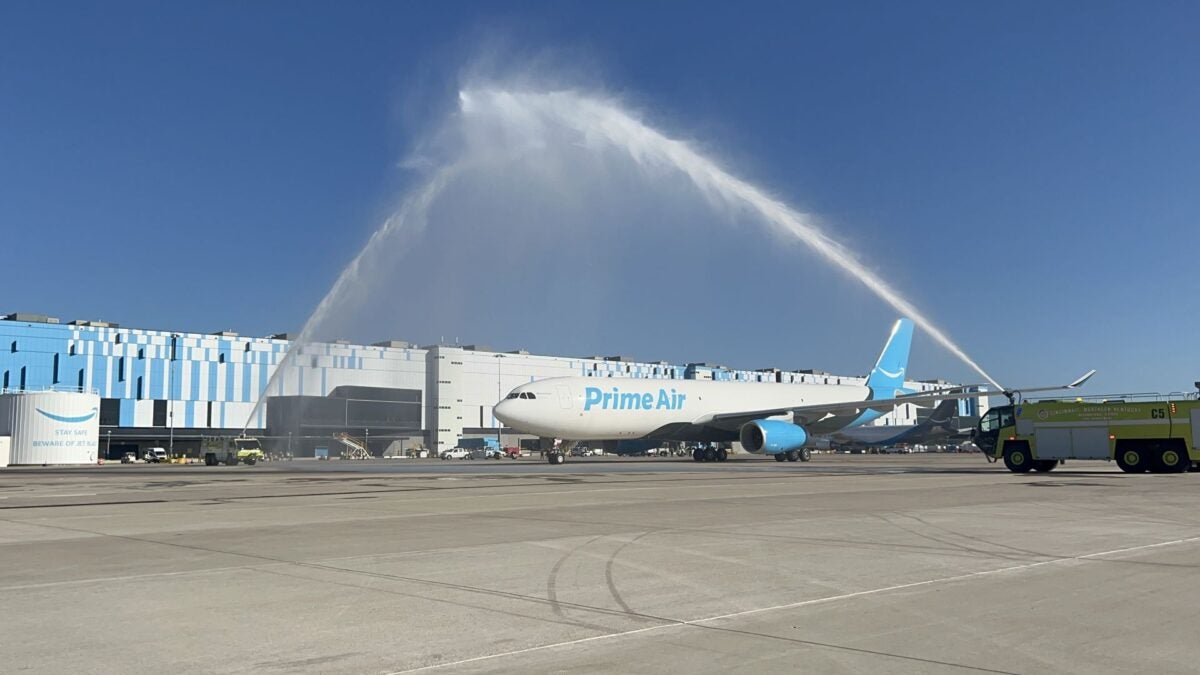
Amazon Air’s first Airbus A330 freighter, operated by Hawaiian Airlines, makes its first commercial flight from the airline’s main hub at Cincinnati-Northern Kentucky International Airport on Oct. 2, 2023. (Photo: Amazon)

“I would argue that some of these 737s that they fly, say from Dallas to New Orleans, are not necessary because nothing you’re flying on short haul is profitable,” the individual said.

The report noted that Amazon is increasingly reluctant to deploy many flights at passenger-focused airports that are crowded and have limited room for warehouse expansion. Chicago-Rockford, Lehigh Valley airport in Pennsylvania and Sacramento airport in California have picked up flights while flights have diminished, or stayed flat, at Chicago O’Hare, New York John F. Kennedy and San Francisco airports.

A Chaddick Institute report last August found that cargo-focused airports outside large metropolitan areas give freighter operators several advantages, including faster shipment discharge and developable land for cargo facilities.

Changes to European network

While Amazon Air slightly increased U.S. capacity and added a handful of daily flights in Canada and India, flight activity in Europe dropped by more than a third over the past year. That followed a 29% reduction in flights in 2022. Reductions included flights carried out by partner airlines using their own unbranded aircraft. Amazon has about nine branded aircraft in its European fleet.

Late last year, Amazon closed its regional air hub at Leipzig/Halle International Airport in Germany in response to a downturn in e-commerce sales and parcel volumes. Activity peaked in early 2022 at 18 flights per day, operated by contractor ASL Airlines Ireland using Boeing 737-800 converted freighters. All but one route was shifted to Hannover in northern Germany and Liege airport in Belgium. Leipzig now averages fewer than two Amazon flights per day.

Amazon Air completely exited Germany’s Cologne/Bonn airport in late 2022 and has sharply cut back flights at two U.K. airports in the aftermath of Brexit.

The network currently serves 10 airports, down from a high of 13 three years ago. More than 80% of Europe’s population remains within 300 miles of an Amazon Air airport. Such distances can be covered within a day on a truck, the report says.

Outlook

Amazon’s domestic fleet outperformed normal seasonality in February with the flight count up 13% year over year after being flat in January, according to the Alpha Parcel Tracker report from Morgan Stanley.

The Chaddick researchers predicted that in the next year Amazon Air will gradually begin to expand flight operations, mostly at its CVG national hub and four large regional hubs. By mid-2025, the combined daily flight activity at CVG and Wilmington will grow to more than 125, including partner flights, with CVG alone having at least 85. Nonhub flying will be simultaneously reduced.

Amazon will remain relatively small in Europe, but it will grow again in a measured way, especially near where logistics infrastructure is being built, the report said. Potential growth areas include Scandinavia, Greece and the Balkan countries. 

Click here for more FreightWaves/American Shipper articles by Eric Kulisch.

Contact Reporter: ekulisch@www.freightwaves.com 

Pilots flying Amazon cargo say employer stalling contract talks

Amazon’s largest cargo jet makes debut

Amazon’s return of leased cargo jets hurts ATSG profit

Uber Freight extends Powerloop drop-and-hook network nationally

LOUISVILLE, Ky. — Managed transportation provider Uber Freight announced Wednesday at the Mid-America Trucking Show that it has expanded its drop-and-hook solution Powerloop nationally and enhanced its load bundling options, and that it’s utilizing new trailer technology to help shippers fight fraud.

Powerloop, first introduced in 2018, enables Uber Freight’s shippers to access over 1,000 dry van trailers, and other carrier’s available trailers, to meet their logistical needs without having to overinvest in the assets themselves. On the carrier end, it allows power-only drivers to obtain preloaded trailers and attempt to maximize their time on the road while also avoiding longer loading and unloading times.

Since its introduction, the Uber Freight offering has served more than 220,000 loads using over 10,000 carriers. Powerloop saw a 43% increase in power-only load volume in 2023, according to the company.

In an interview with FreightWaves, industry veteran Alyssa Correale, head of Powerloop, explained that the larger pooling capacity will give shippers the reliability of having assets available while carriers in the network can focus on utilization of their assets.

“The recipe for high utilization is knowing where your assets are and keeping those assets busy,” she explained. “Powerloop’s technology powers the visibility of those assets and leveraging our carrier-customer network gives us the ability to truly create the most highly utilized assets in the industry. … Everyone wins in a high-utilization network.”

Correale said the offering is more than a marketplace for trailer pools, but rather that Uber Freight takes a managed services approach with its shippers under the Powerloop network. This includes an in-depth lane analysis, a review of shipper seasonal trends, weekly and monthly reporting of service metrics, and an Uber Freight staffing plan.

For carriers, the technology allows them to book multiple drop-and-hook loads through a feature called “bundling.” Using the company’s proprietary algorithms, carriers can maximize their weekly earnings but take multiple Powerloop loads at a time. This option also avoids driver burnout by capping routes at hours-of-service limits.

Uber Freight’s Powerloop bundling function. (Gif: Uber Freight)

Correale explained that all Powerloop trailers are equipped with GPS, cargo sensors, door sensors and monitoring cameras to avoid the high levels of cargo theft the industry has recently been experiencing.

“We partner with SkyBitz, Spireon and FleetPulse [by Great Dane] to watch for fraud,” she said as she detailed how Uber Freight watches out for behavior like trailers out of route or doors opening before delivery appointments are made.

“We are not just dumping trailers wherever; we are building a lane density and network balance for the industry, too,” said Correale.

The company also recently announced it has surpassed $18 billion in freight under management worldwide with goals to grow its European business to over $2 billion in freight under management by 2028.


OneRail survey details retail shippers’ last-mile delivery needs

Locus Robotics launches business intelligence tool LocusHub

Transfix partners with Rocket Shipping for LTL offering

DAT blames ‘external forces’ for intermittent service outages

Oregon-based DAT Freight & Analytics, one of the trucking industry’s largest load boards in North America, has confirmed that “external forces” are to blame for multiple service disruptions on its platform over the past 10 days but declined to disclose the root cause of the intermittent outages.

Since March 11, truck drivers and brokers who rely on the spot market to post or find freight have been documenting on social media their technical issues with using DAT’s platform. Those include issues logging into DAT One, DAT iQ, its benchmarking tool, as well as its other products.

In a statement to FreightWaves Wednesday, a DAT spokesperson said its “engineering organization has been working around the clock since the first disruption to investigate and restore services” and has “successfully safeguarded all customer information.”

The company also posted a statement Tuesday on X, formerly Twitter, about ongoing issues with accessing DAT’s products.

“We know the important role that DAT plays in the freight economy and are continually working to improve the reliability of our networks and defend against outside threats,” DAT said in the statement.

While some frustrated customers said they signed up or planned to sign up with one of DAT’s competitors, the industry has had its share of freight fraud and security breaches.

Idaho-based Truckstop.com launched its weekly series, Fraud Prevention Friday, to fight fraud in the industry in May 2023. The freight-matching platform experienced a malware attack in December 2019.

Depending on the type of freight they haul, some truckers are choosing to wait out the service disruptions and stay with DAT.

“I have been loyal to DAT for 10 years but I’m concerned every day that I wake up that I won’t be able to log in and access the system,” one truck driver, who did not want to be named, told FreightWaves. “I run my business from the cab of my truck so this outage — or whatever it is — is costing me money and time, which I don’t have, if I have to scramble to find a spot load.”

DAT ramps up investment in fraud, security

Over the past year, DAT has been focusing on fraud prevention and cybersecurity since the company’s alleged security breach in February 2023.

In January, DAT announced it had hired Jeff Clementz as its chief product officer and Erika Voss as vice president of information security to address product development and fight fraud. Clementz formerly served as president and CEO at Shift Technologies, an e-commerce platform that specializes in buying and selling used vehicles. Voss previously worked as vice president of security and engineering at Capital One.

DAT is urging customers to call their account managers or DAT’s customer support team at 800-551-8847 with any issues. The company also posts the latest outage information at status.dat.com.

One owner-operator said he is using both DAT and Truckstop platforms to ensure he has access to spot market freight to run his business.

“It’s costing me more money to have access to both load boards, but it’s a price I’m willing to pay because I like things about both companies to find freight and keep the wheels turning,” the driver told FreightWaves.

This is a developing story.

Do you have a news tip to share? Send me an email or message me @cage_writer on X, formerly Twitter. Your name will not be used without your permission.

DAT working with security partners, law enforcement after alleged security breach

DAT load board glitch could cost small-business truckers thousands
Malware hits Truckstop.com sites, services shut days before Christmas
Louisiana ransomware attack disrupts trucking operations

DOT adviser, FLOW members reflect on 2 years of data-sharing platform

“The need for speed” goes beyond the famous quote by Maverick in “Top Gun” — it can also be considered the mantra of the logistics world. 

Trade at rest is not making money. That was made clear two years ago, when the ports around the globe were congested with containers. The cascading impact of the global supply chain out of balance sent inflation soaring and left retailers frustrated at not being able to receive their products.

This tangled mess of trade was the catalyst for the creation of the Department of Transportation’s Freight Logistics Optimization Works (FLOW) platform. The thought of data sharing two years ago seemed like a far-off bet but it was worth the try. One of the brains behind the curation of FLOW is Andrew Petrisin, adviser for multimodal freight for DOT.

Petrisin is referred to by some FLOW participants as “FLOW employee number one.” He was working for the administration during the historic congestion and saw how the logistics industry tried to unknot the tangled system.

“The terminal operators were really trying to understand and forecast future congestion, as well as the future performance of the supply chain,” said Petrisin in an interview on CNBC.

Petrisin explained that operators were trying to understand when the volume of ships would essentially be unloaded and when the cargo would be out of port.

“It was a very manual form of data sharing where we were getting on calls three times a week, talking through it with them,” he said. 

It was during these phone conversations that the DOT saw there was a need to create a public/private partnership in which the data being shared could be seen at any time on a digital platform.

“The partnership would be tech-forward and permanent,” said Petrisin. “FLOW kind of blossomed from there.”

The DOT adviser went into detail, saying that throughout the past two years the platform has grown considerably. There are at present 70 participants in FLOW and about 60 more in the onboarding process.

According to Petrisin, the total cargo volumes being captured by FLOW at some of the major U.S. ports is nearly 80% as it is booked. Announced Wednesday morning, FLOW has expanded its line of sight in the container-tracking process by adding inland ports including rail terminal and warehouse end-destination data.

The result is comprehensive information with visibility into actual demand, with real-time snapshots of port and inland network congestion.

Petrisin explained the data sharing on the platform starts with country of origin and freight volume to ports, and the freight is broken down by reefer, dry, rail, truck, inland ports to warehouse destination.

“If there’s a silver lining from the COVID pandemic,” said Jim Bishop, director of marketing and sales for Union Pacific, one of the first participants in FLOW, “it’s that enhanced communication between each piece of the supply chain is critical. We’re proud of the work we’ve done to engage stakeholders, including collaboration with FLOW to better understand import volume and timing, so we can keep our part of the chain fluid.”

FLOW is able to do this through the aggregation of purchase orders from its shipper and importer partners as well as booking information from ocean carrier partners, to create a model of future demand.

“We’re talking 40 days out for booking information and 60 days out for purchase orders,” said Petrisin.

On the supply side of the capacity, Petrisin said demand is changing daily so it’s vital for FLOW participants to see the interdependent nature of the supply chain system. Participants are able to use information on availability for chassis and terminal usage as a complement to existing data for comprehensive planning.

He stressed FLOW can be used as a proactive tool, and he is seeing it being used like that now as ocean carriers and shippers try to navigate current uncertainties around the Red Sea attacks.

“We’re working with an ocean carrier partner essentially to use the purchase order data that is shared through FLOW to better estimate future bookings inland,” explained Petrisin. “They might receive bookings in the future to help them better do their service planning, working with an IEP or chassis providers to essentially have a better preview of chassis utilization.”

At the West Coast, the DOT sees the potential cargo shift due to the events in the Red Sea, and FLOW participants are using the data gathered to see the big picture and find cost-saving solutions. Petrisin categorizes FLOW as a collaboration tool with partners in warehouses who also tap the data to better predict vacancies and rates. Shippers also use the booking data and terminal data for assessing congestion potential and improving communication with partners on where shipments are and when they will arrive at their destinations.

Petrisin believes FLOW complements the investments being made on the physical infrastructure side at the ports or terminals and that the program is a long-term commitment for both the DOT and participants.

Jason Craig, director of government affairs for CH Robinson, said that for the first time, there’s a U.S. government office advocating for freight transportation.

“Supply chains depend on dozens of government agencies — customs, for example,” Craig said. “None of those agencies have supply chains as their top priority. Now, there’s an office monitoring for disruptions and dedicated to working with all those other agencies to keep supply chains moving. That’s the main reason C.H. Robinson was one of the first members of the FLOW initiative. By virtue of our scale, C.H. Robinson has the industry’s largest data set on shipments, routings and carriers. So we’re happy to contribute our data to the cause.”

Paul Brashier, vice president of drayage and intermodal at ITS Logistics, a recently onboarded FLOW partner, and whose ContainerAI was folded into the platform, said, “For the first time, we are seeing a strategic executive branch effort to accumulate data and milestones and use that to identify and get ahead of supply chain bottlenecks before they metastasize. The data offers us actionable information when determining our logistical planning.”

FLOW is among a number of DOT supply chain initiatives created through President Joe Biden’s infrastructure law. In March the U.S. Maritime Administration announced an initiative to strengthen coastal and inland waterway ports with $450 million from infrastructure funding.

In January, DOT announced nearly $5 billion in grants to build or repair infrastructure projects geared toward relieving trucking bottlenecks and improving the movement of freight on the nation’s highways.

Launched two years ago by the Biden administration, FLOW has partnered with retailers including Home Depot, Nike, Walmart and Target; railroads Union Pacific and BNSF; and logistics providers C.H. Robinson, DHL and FedEx. The nation’s busiest container ports, including Los Angeles, Long Beach and New York, are part of the FLOW platform, as are top ocean carriers including MSC, Maersk, CMA CGM and Hapag-Lloyd.

“We’ve been working closely with DOT Secretary Buttigieg and his team to improve the efficiency and timeliness of America’s supply chain through data sharing and data analysis,” said Peter Levesque, CMA CGM North America president and CEO. “The FLOW initiative is a good example of what’s possible when government and industry work together to solve the big issues that impact the U.S. supply chain.”

An economic report by the White House found that more than 80% of recent progress in lowering inflation (disinflation) in the U.S. economy can be attributed to the supply chain.

“This isn’t a one-month or two-month endeavor,” stressed Petrisin. “This is something we need to do for the betterment of the industry and the betterment of the country.”