Ocean container rates on the key eastbound route from Asia to the United States were the eye of the storm last week as shippers pulled back amid the latest trade war chaos.
“Trans-Pacific container prices were stable last week as well, with reports that carriers are starting to offer discounts,” said Judah Levine, research chief for shipping analyst Freightos (NASDAQ: CRGO), in a note to clients. “Rates starting to slide a little earlier than usual [after the Lunar New Year holiday] suggests carriers are working to capture volumes that may be proving weaker than expected, as retailers exercise caution in ordering decisions given the trade war-driven uncertainty.”
Spot rates for containers moving from Asia to U.S. West Coast ports were unchanged at $2,675 per forty foot equivalent unit, according to the Freightos Baltic Index. Asia-U.S. East Coast prices stayed level at $3,928 per FEU.
Road, rail and maritime services on the eastern seaboard were disrupted by a massive storm that brought ice, snow and arctic temperatures up the I-95 corridor. The Port of New York-New Jersey was forced to close until after the storm passed.
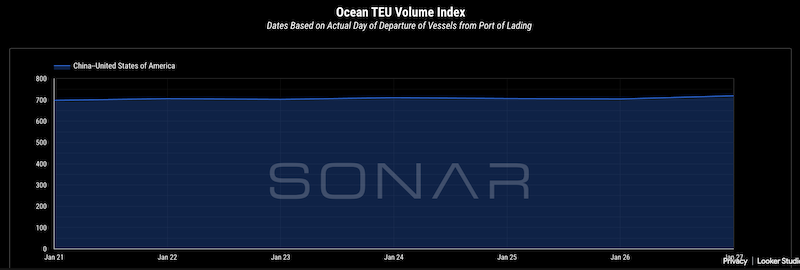
Meanwhile, U.S. trade partners continue to seek out fresh partnerships after President Donald Trump first threatened, then backed off, tariffs on countries objecting to his plans for Greenland. This after a meeting with eight NATO countries in Davos, Switzerland produced a framework of an agreement regarding Greenland.
Trump also turned his trade rage on South Korea, pledging 25% tariffs if its parliament does not approve the U.S. trade deal negotiated in 2025. He similarly warned of 100% levies on Canada goods if Ottawa reaches a free trade deal with China.
“This development reflects growing tensions between the U.S. and Canada ahead of a possible U.S. review of the United States–Mexico–Canada Agreement (USMCA) this summer,” said Levine. “In addition to resolving tariff issues with China, Canada is also holding trade cooperation talks with India, as they and other countries are increasingly looking to diversify away from an over-reliance on the U.S. as trade tensions stretch on.”
This week the European Union and India came to an agreement on trade, another move away from the U.S. that is sure to have a follow-on effect for global shipping.
Find more articles by Stuart Chirls here.
Related coverage:
New FMC probe of ocean carriers restricting chassis for truckers, shippers
VIDEO: New Houthi threat of more Red Sea terror attacks
Brokerage Compliance Symposium
The day before F3. Every compliance issue you face - fraud exposure, carrier liability, FMCSA rules, cargo theft, insurance gaps - navigated by attorneys and operators defining best practices in a changing industry.
F3 Awards Dinner
The night before F3. FreightTech100 companies honored. FreightTech 25 and Shipper of Choice winners revealed live. Cocktail reception into dinner and live music - 300 industry leaders in one purpose-built room.
F3: Future of Freight Festival
Industry-defining keynotes, rapid-fire technology demos, and industry leaders networking in experiences across Chattanooga - plus the inaugural F3 Awards Dinner featuring the FreightTech and Shipper of Choice reveals.
The day before F3. Every compliance issue you face - fraud exposure, carrier liability, FMCSA rules, cargo theft, insurance gaps - navigated by attorneys and operators defining best practices in a changing industry.
The Signal at Chattanooga Choo Choo • Chattanooga, TN Register NowThe night before F3. FreightTech100 companies honored. FreightTech 25 and Shipper of Choice winners revealed live. Cocktail reception into dinner and live music - 300 industry leaders in one purpose-built room.
The Signal at Chattanooga Choo Choo • Chattanooga, TN Register NowIndustry-defining keynotes, rapid-fire technology demos, and industry leaders networking in experiences across Chattanooga - plus the inaugural F3 Awards Dinner featuring the FreightTech and Shipper of Choice reveals.
The Signal at Chattanooga Choo Choo • Chattanooga, TN Register Now