(Editor’s note: The author of this article conducted the interview with Matthew Leffler at F3.)
CHATTANOOGA, Tenn. – With oral arguments in the appeal of the landmark Werner Enterprises nuclear verdict case set to be heard by the Texas Supreme Court Dec. 3, trucking-focused attorney Matthew Leffler said at FreightWaves’ F3: Future of Freight Festival that “this is the most important case facing the trucking industry now.”
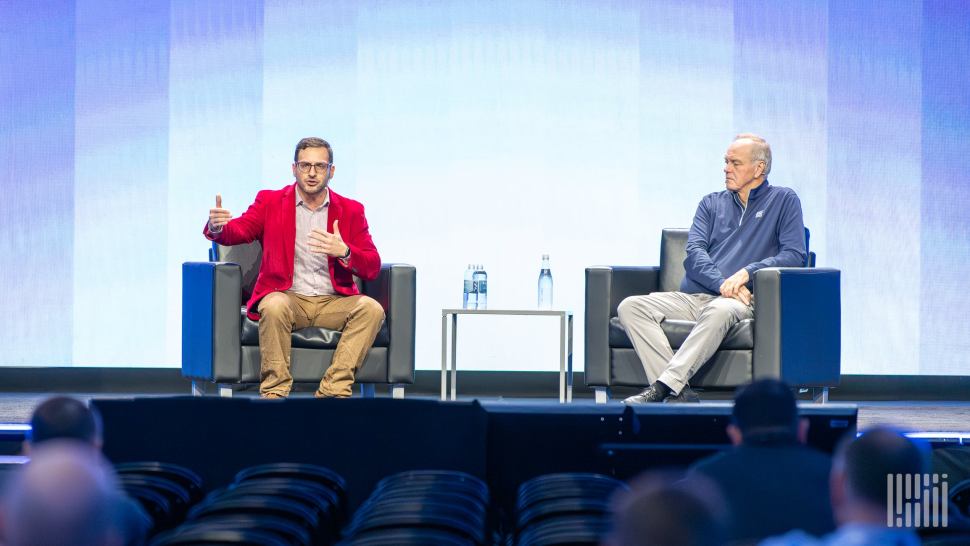
In a fireside chat from the main stage Wednesday at the event in Chattanooga, Tennessee, Leffler recapped what had happened in the 2014 crash that left one child dead and another paralyzed. The facts are not in dispute, though relatively few hands went up when the audience was asked who was familiar with the case.
A car carrying several people in snowy, icy weather crossed a median strip on Interstate 20 near Odessa, Texas, and collided head-on with a Werner truck. The jury ultimately put 70% of the blame on Werner, citing the fact that the relatively new driver’s trainer was asleep in the sleeper berth at the time of the collision and that there was no CB radio in the cab, among other factors. The initial, nearly $90 million verdict from 2018 has since ballooned to well over $100 million with accrued interest.
Werner has said in filings with the Securities and Exchange Commission that its out-of-pocket exposure is capped at $10 million, a figure that is also the generally accepted definition of a nuclear verdict in trucking.
“This is the most important case in our industry, because where these verdicts go is where your insurance premiums begin to rise,” Leffler said. “This is the nature of the industry. So we need to be aware of these things.”
He called the case “bananas” and the argument about lacking a CB “absurd.”
Leffler noted that the chief argument accepted by the jury was that given the wintry conditions, the Werner truck should have been going slower, though the truck was moving below the posted speed limit.
He also seemed to implicitly criticize the strategy of Werner’s attorneys not hammering out a settlement. “One of the things you don’t do as a lawyer is take a trial when a child passes away, because you’re not going to win those verdicts,” he said.
Given that the Werner (NASDAQ: WERN) truck was found to be well maintained and the truck was traveling under the speed limit – though reportedly faster than other traffic that had slowed as a result of the weather – Leffler said the message from the Werner case is, “We have to be vigilant on these things and be educated about what’s happening.”
“Safely delivering freight on time and undamaged is difficult even under the best circumstances,” he said. “But they are at war with our industry, and these cases show us what’s happening.”
Another big case: Wabash National
In filings before the Texas Supreme Court, Werner’s arguments center on legal questions, not the facts of the case or the specifics of the jury findings.
Leffler also skewered the $460 million-plus verdict against trailer manufacturer Wabash National earlier this year.
The attorney recapped what happened in that case: An inebriated driver (whose lack of sobriety was not admissible in court) in 2019 drove at 55 mph into the back of a truck operated by a now-defunct carrier in Missouri, killing the driver and a passenger. The carrier was hauling a Wabash-manufactured trailer.
The jury found Wabash (NYSE: WNC) liable, even though the rear guard complied with federal standards and the victims were not wearing seat belts.
“This case should terrify every single person in this room,” Leffler said.
“Not a single trailer is tested for 55-mile-per-hour rear impact,” Leffler said. “So the question becomes, if this is the standard, what do we do as motor carriers? What do we do as manufacturers? How are we going to think about trailers?”
If the rear guards need to be strong enough to withstand an impact as high as 70 mph, he added, “there is no reasonable way you get to this conclusion.”
The Wabash verdict is expected to go to appeal. Leffler noted that Missouri does have tort reform that on appeal could limit the penalty to $70 million, based on the formulas in the reform legislation.
Wabash is a “great company,” Leffler said. According to Barchart, its current market capitalization is about $804.3 million. “They could not survive a $462 million verdict,” Leffler said.
And then there’s Daimler
A verdict against truck manufacturer Daimler Truck North America in September involved a jury finding fault in part with the driver seat construction and the fact that Daimler (OTC: DTGHF) only offered as an option a seat that might have protected a driver from being paralyzed in a rollover with the cab’s roof being crushed.
That is what happened in the Alabama case that dates back to 2022. The jury verdict in Alabama was $160 million.
“So the question becomes, is a safety measure that is optional now mandatory?” Leffler said. “What will Daimler do? Does it mean that we have to make sure every single truck has every single safety feature at all times?”
More articles by John Kingston
State of Freight live: A bullish post-election trucking market assessment
Diesel benchmark price hasn’t been this low in more than 3 years
Report: Driver shortage claim ‘spurious,’ fixation on efficiency causes turnover
F3: Future of Freight Festival
Industry-defining keynotes, rapid-fire technology demos, and industry leaders networking in experiences across Chattanooga - plus the inaugural F3 Awards Dinner featuring the FreightTech and Shipper of Choice reveals.
Industry-defining keynotes, rapid-fire technology demos, and industry leaders networking in experiences across Chattanooga - plus the inaugural F3 Awards Dinner featuring the FreightTech and Shipper of Choice reveals.
The Signal at Chattanooga Choo Choo • Chattanooga, TN Register Now