The uncertainty that has marked global ocean shipping so far this year struck again this past week –but that may signal a turn for the better for ocean carriers.
Container rates on the eastbound trans-Pacific posted increases, halting steady declines that have challenged lows from 2023.
Rates from Asia to U.S. West Coast ports increased 18% to $1,687 per forty foot equivalent unit, according to the new Freightos Baltic Index, while prices to the East Coast prices increased 2% to $3,071 per FEU.
There is more potential good news on the trade front, Levine said, after a recent run-up in political hostilities between China and the United States.
Chinese Vice Premier He Lifeng is slated to meet with U.S. Treasury Secretary Scott Bessent this week in Malaysia, ahead of President Donald Trump’s convo with President Xi Jinping in South Korea at the end of the month.
Beijing and Washington have been playing a Xenga-like game of tariffs and export restrictions. But the U.S. has granted an array of offsets for autos and exemptions for other strategic imports, while Trump recently acknowledged that soaring levies are “unsustainable”.
The weaponization of ocean shipping and ports continues, though its immediate cost has been limited.
There are no reports of vessels paying the U.S. Trade Representative’s port fees that went into effect Oct. 14 , said Levine, with only one China-built vessel scheduled to arrive at the Port of Los Angeles this week. However, a reciprocal China ship tax reportedly cost a U.S.-flagged Matson (NYSE: MATX) container ship $1.7 million to berth in Shanghai.
“Like on the trans-Pacific eastbound, carriers are shifting their deployment of liable vessels to other lanes to avoid the surcharges at China’s ports,” Levine said.
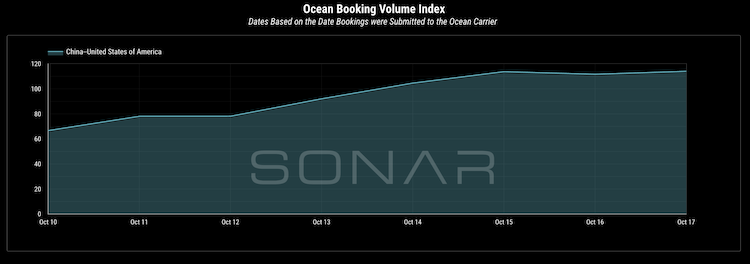
The embargo-like effect of Trump’s 145% tariffs on Chinese goods from early April to mid-May drove a sharp drop in ocean volumes, and a November 1 100% tariff would likely do the same, according to Levine.
“Now, the typical November slowdown and earlier frontloading would likely be a smaller volume drop compared to April-May,” he said.
Asia-North Europe prices were 13% better at $1,975 per FEU; Asia-Mediterranean rates edged up 1% to $2,147 per FEU.
“Asia-Europe prices climbed on October GRIs as well, with daily rates this week approaching $2,300 per FEU,” Levine said. Daily rates to the Mediterranean [posted] a $200 per FEU increase compared to the last couple weeks.”
Levine added that rate gains on Europe lanes may have come in part on port congestion made worse by last week’s strikes in Rotterdam – Europe’s busiest gateway – and Antwerp.
“But rates climbing during low-demand periods for both Asia-Europe and the trans-Pacific has many observers skeptical that prices will remain elevated, though carriers will attempt November GRIs as well,” said Levine.
Find more articles by Stuart Chirls here.
Related coverage:
Report: Top container line may re-flag ships in India
Tariffs, trade changes hit Port of Oakland volumes
Deadlines in doubt for LA-Long Beach zero-emissions port drayage
Brokerage Compliance Symposium
The day before F3. Every compliance issue you face - fraud exposure, carrier liability, FMCSA rules, cargo theft, insurance gaps - navigated by attorneys and operators defining best practices in a changing industry.
F3 Awards Dinner
The night before F3. FreightTech100 companies honored. FreightTech 25 and Shipper of Choice winners revealed live. Cocktail reception into dinner and live music - 300 industry leaders in one purpose-built room.
F3: Future of Freight Festival
Industry-defining keynotes, rapid-fire technology demos, and industry leaders networking in experiences across Chattanooga - plus the inaugural F3 Awards Dinner featuring the FreightTech and Shipper of Choice reveals.
The day before F3. Every compliance issue you face - fraud exposure, carrier liability, FMCSA rules, cargo theft, insurance gaps - navigated by attorneys and operators defining best practices in a changing industry.
The Signal at Chattanooga Choo Choo • Chattanooga, TN Register NowThe night before F3. FreightTech100 companies honored. FreightTech 25 and Shipper of Choice winners revealed live. Cocktail reception into dinner and live music - 300 industry leaders in one purpose-built room.
The Signal at Chattanooga Choo Choo • Chattanooga, TN Register NowIndustry-defining keynotes, rapid-fire technology demos, and industry leaders networking in experiences across Chattanooga - plus the inaugural F3 Awards Dinner featuring the FreightTech and Shipper of Choice reveals.
The Signal at Chattanooga Choo Choo • Chattanooga, TN Register Now