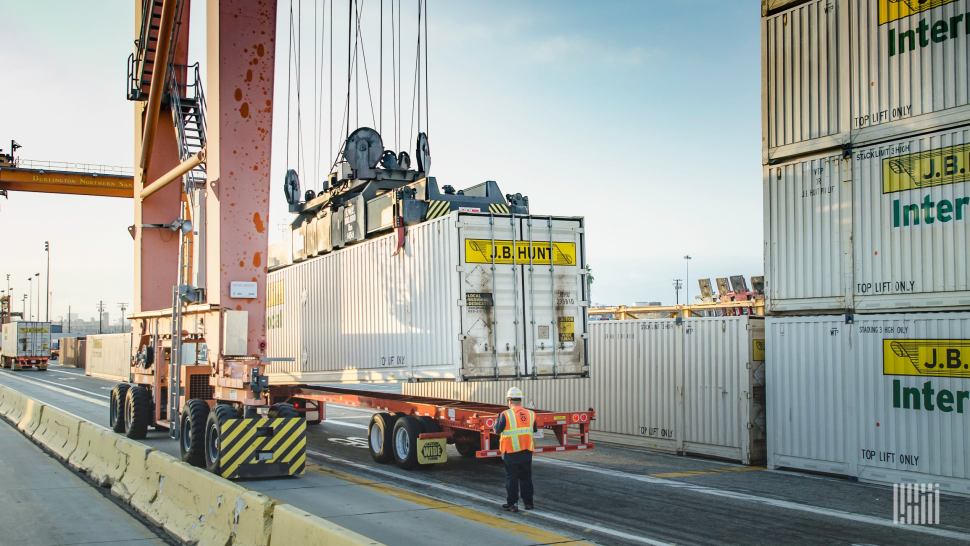
WASHINGTON — Here’s what supply chain stakeholders know for certain about intermodal transportation: It involves freight moving between air, land and sea. Beyond that, well, there are more questions than answers.
The 104th annual meeting of the Transportation Research Board provided a fertile setting for more than 13,000 educators, regulators and private businesses to consider diversified research into how to get from here to there, and the elusive goal of making it all more efficient.
At a meeting of the TRB’s Intermodal Freight Transport Committee, attendees bruited about assorted ideas in free-form brainstorming outside of the conference’s lectern sessions.
The discussions also underpin TRB mandates that its committees develop research needs statements, as a pathway to funding science-based review.
Dominic Menegus of the U.S. Department of Transportation’s Bureau of Transportation Statistics (BTS) detailed progress on the development of a geospatial layer focused on intermodal freight transportation for BTS’ Office of Spatial Analysis and Visualization. A geospatial layer functions like a legend on a paper map with a specific theme or feature, and can be used to aid land use, planning and development.
Menegus said his current focus is on dry bulk shipping of agricultural products, minerals, and scrap and recycling at ports. These surveys can track, for example, the changes in size of a coal pile at a terminal and, when cross-referenced with dock data, railroad waybills and terminals information, provide greater insight that can guide freight transportation investment.
Menegus told the meeting that he is seeking input on public and private data to further understanding as a basis for future conversations. He asked, without a hint of irony, what “the line in the sand” should be for intermodal dry bulk items for, say, defining a dry bulk transload facility.
The overall goal, he said, is to piece together a geospatial one-stop shop for intermodal that will validate trailer-on-flatcar (TOFC) and container-on-flatcar (COFC) facility locations, and physical and operational attributes from data sources including the Intermodal Association of North America, Surface Transportation Board and railroad websites.
The meeting-goers suggested that roll-on/roll-off (ro-ro), construction materials and free trade zones be added to the survey’s scope, and a separate layer created for warehouse/distribution center/intramodal — including Amazon.
The meeting was told that because distribution center leases typically run seven years, it would be useful for a survey layer to help determine the capability of facilities for other uses such as manufacturing, or adjacency to a rail line for delivery of plastic pellets, as they are inherently flexible.
Menegus said funds are available to explore those options, including from metropolitan planning organizations (MPOs) and state transportation departments, which could lead to allocated funding for a new layer in 2026.
One suggestion cited an expected waiver from the Federal Aviation Administration covering cargo drones that should be accounted for, as such activity was already underway in Phoenix and other locations.
Survey talk turned to inland ports, the only area in the supply chain, it was pointed out, where there was elasticity during the pandemic, as well as a layer for barge-to-truck and truck-to-truck movements.
Menegus said a layer covering liquid bulk transport was completed in January 2024, with a beta testing release scheduled for the end of this month that will enhance owner-operator trucking information in the database.
There was a separate discussion of Ukraine and how best to repurpose its army of military drones as the war with Russia winds down and operations and researchers transition to civilian functions, which could make the country the global leader in drone use. Students at the University of Southern California’s Geospatial Sciences Institute are currently looking at techniques for reconstruction.
Talk about data in any setting and the subject of AI is sure to surface. The meeting was told of a business survey that found AI at the bottom of respondents’ interests. Like blockchain a few years ago, AI is buzzy, but machine learning and neural networks, it was pointed out, have been around for years.
Other attendees asked that as far as distribution centers, the committee’s agenda should get away from research and cultural sexiness, and focus more on what it means to be “outside the door.” It’s a challenge, some said, because at the DOT and MPO level, AI and data are in day-to-day use to gauge economic impact and how to leverage future investments. One attendee even suggested improvement in weather forecasting, as it saves so much time, money and effort in the transportation sector.
Talk of where the future supply chain workforce will come from — such as accounting for a demand shift in the next 10 years from diesel mechanics to chemists for battery power — will be a critical need and AI is a huge driver for that.
A participant told the meeting that there was a need for committees and workshops to examine how goods are moving out the door, with a focus on separating development and planning on external transportation from daily operations.
Students, attendees said, need to hear from people engaged in actually moving freight, such as beneficial cargo owners, “who know what it’s like to put boxes on a truck.”
Find more articles by Stuart Chirls here.
Related coverage:
Port deal averts strike ‘disaster,’ but caution urged on container rates
Brokerage Compliance Symposium
The day before F3. Every compliance issue you face - fraud exposure, carrier liability, FMCSA rules, cargo theft, insurance gaps - navigated by attorneys and operators defining best practices in a changing industry.
F3 Awards Dinner
The night before F3. FreightTech100 companies honored. FreightTech 25 and Shipper of Choice winners revealed live. Cocktail reception into dinner and live music - 300 industry leaders in one purpose-built room.
F3: Future of Freight Festival
Industry-defining keynotes, rapid-fire technology demos, and industry leaders networking in experiences across Chattanooga - plus the inaugural F3 Awards Dinner featuring the FreightTech and Shipper of Choice reveals.
The day before F3. Every compliance issue you face - fraud exposure, carrier liability, FMCSA rules, cargo theft, insurance gaps - navigated by attorneys and operators defining best practices in a changing industry.
The Signal at Chattanooga Choo Choo • Chattanooga, TN Register NowThe night before F3. FreightTech100 companies honored. FreightTech 25 and Shipper of Choice winners revealed live. Cocktail reception into dinner and live music - 300 industry leaders in one purpose-built room.
The Signal at Chattanooga Choo Choo • Chattanooga, TN Register NowIndustry-defining keynotes, rapid-fire technology demos, and industry leaders networking in experiences across Chattanooga - plus the inaugural F3 Awards Dinner featuring the FreightTech and Shipper of Choice reveals.
The Signal at Chattanooga Choo Choo • Chattanooga, TN Register Now