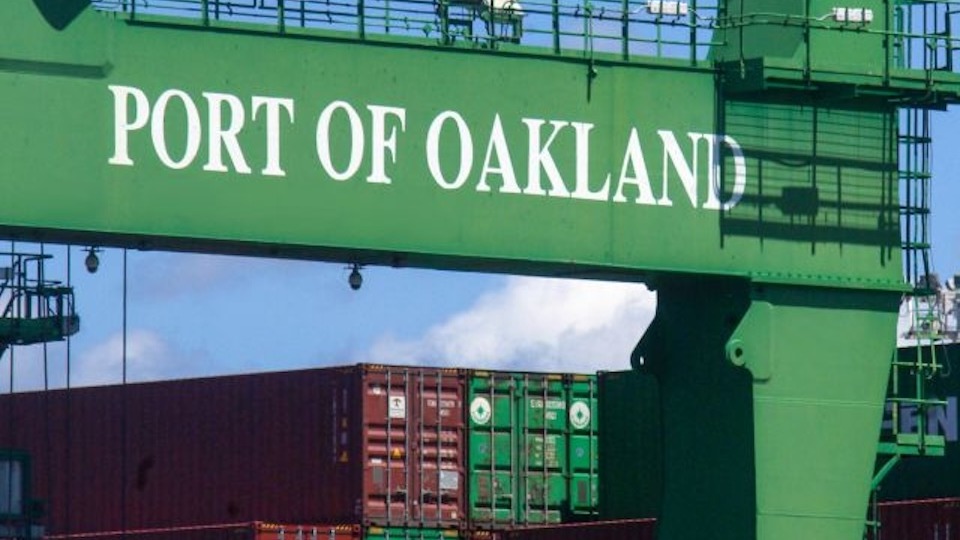
The Port of Oakland handled 182,879 twenty foot equivalent units (TEUs) in October, a gain of 2.2% from September 2025 as full-container activity steadied amid a rebalancing of global shipping.
Loaded imports were up 0.9% and loaded exports were off 0.7% from the same month a year ago. The port attributed the overall 5.5% decline in annual volume to the processing of 24% fewer empty containers y/y in October.
“That reflects changes in how shipping lines are managing their equipment – not a slowdown in cargo demand,” the port said in a release.
Carriers shifted some tonnage and adjusted rotations to minimize their exposure ahead of the Oct. 14 imposition of expensive U.S. port fees on Chinese ships. Beijing and Washington have since announced a one-year pause in the fees as part of a broader trade agreement.
“Full imports and exports are holding their ground despite the headwinds,” said Port of Oakland Maritime Director Bryan Brandes. “The modest month-over-month increase shows cargo flow through Oakland remains steady heading into the holiday season. While we’re seeing fewer empty containers move through the system, that’s just part of the broader market adjustment.”
The flow of empties – an indicator of future imports – has shifted in part to the Canadian ports of Vancouver and Prince Rupert as lines moved business away from some U.S. West Coast hubs.
The port saw 86 vessel calls in October, 6.5% fewer year-over-year, consistent with ocean carriers’ ongoing schedule and service network adjustments.
“Cargo owners and ocean carriers remain cautious,” said Brandes. “Trade flows are adapting to new sourcing patterns and shifting global demand, but Oakland continues to perform steadily in our core full-container business.”
Find more articles by Stuart Chirls here.
Related coverage:
CMA CGM profit collapses on ocean ‘slowdown’
Looted barge returns: Brooklyn Bridge’s unexpected journey
Brokerage Compliance Symposium
The day before F3. Every compliance issue you face - fraud exposure, carrier liability, FMCSA rules, cargo theft, insurance gaps - navigated by attorneys and operators defining best practices in a changing industry.
F3 Awards Dinner
The night before F3. FreightTech100 companies honored. FreightTech 25 and Shipper of Choice winners revealed live. Cocktail reception into dinner and live music - 300 industry leaders in one purpose-built room.
F3: Future of Freight Festival
Industry-defining keynotes, rapid-fire technology demos, and industry leaders networking in experiences across Chattanooga - plus the inaugural F3 Awards Dinner featuring the FreightTech and Shipper of Choice reveals.
The day before F3. Every compliance issue you face - fraud exposure, carrier liability, FMCSA rules, cargo theft, insurance gaps - navigated by attorneys and operators defining best practices in a changing industry.
The Signal at Chattanooga Choo Choo • Chattanooga, TN Register NowThe night before F3. FreightTech100 companies honored. FreightTech 25 and Shipper of Choice winners revealed live. Cocktail reception into dinner and live music - 300 industry leaders in one purpose-built room.
The Signal at Chattanooga Choo Choo • Chattanooga, TN Register NowIndustry-defining keynotes, rapid-fire technology demos, and industry leaders networking in experiences across Chattanooga - plus the inaugural F3 Awards Dinner featuring the FreightTech and Shipper of Choice reveals.
The Signal at Chattanooga Choo Choo • Chattanooga, TN Register Now