The Houthis have seen enough.
The tenuous Gaza ceasefire has led the Yemen-based militia to announce a pause in attacks on merchant vessels in the Red Sea, raising hopes for a return of large-scale container shipping to the Suez Canal trade route for the first time since 2023.
The rebels, who control 40% of Yemen, communicated their intentions this week in a letter to Hamas, the Palestinian governing body in Gaza.
Expectations were further heightened at a recent summit of ocean carriers hosted by Suez Canal officials in Egypt. Waterway tolls have crashed as much as 60% as vessel operators divert the largest container ships and crude oil tankers away from the region and on longer, more expensive voyages around Africa’s Cape of Good Hope.
While the Gaza peace talks have seemingly accomplished what two years’ of U.S. military attacks on the Houthi failed to, analysts warn a return of global container shipping depends on assurances that will satisfy carriers – and their insurers.
“Details are sketchy and you cannot base the safety of crews, ships and cargo on the word of Houthi militia,” said Peter Sand, chief analyst at shipping data platform Xeneta. “Carriers need far more assurance than that and, perhaps more importantly, so do insurance companies.”
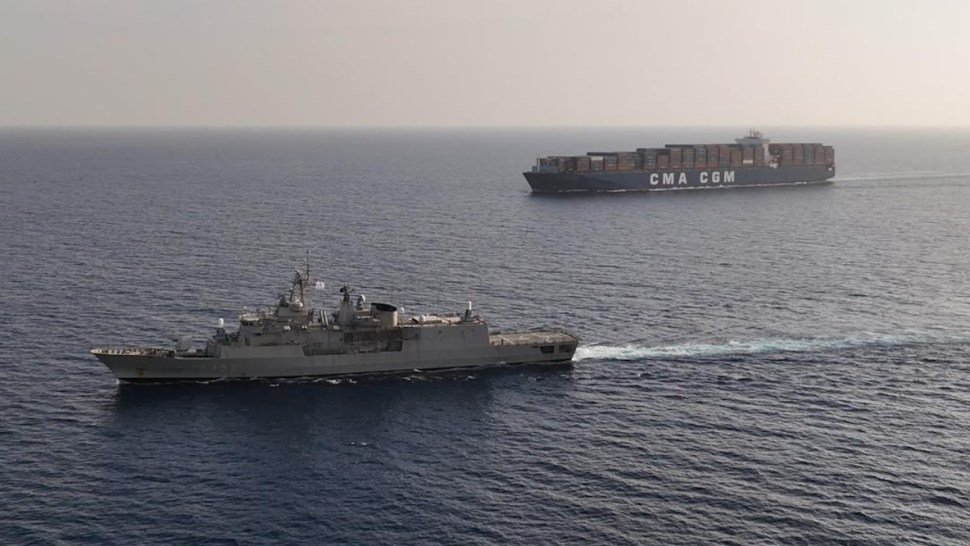
Sand said that risk tolerance varies among carriers. CMA CGM of France, for example, stoked conspiracy theories in the shipping community when it continued to operate scheduled commercial services in the Red Sea despite ongoing Houthi violence. The liner further tested tolerances this month as the mega-capacity CMA CGM Zheng He and CMA CGM Benjamin Franklin transited the region, the largest vessels to ply the route since 2023.
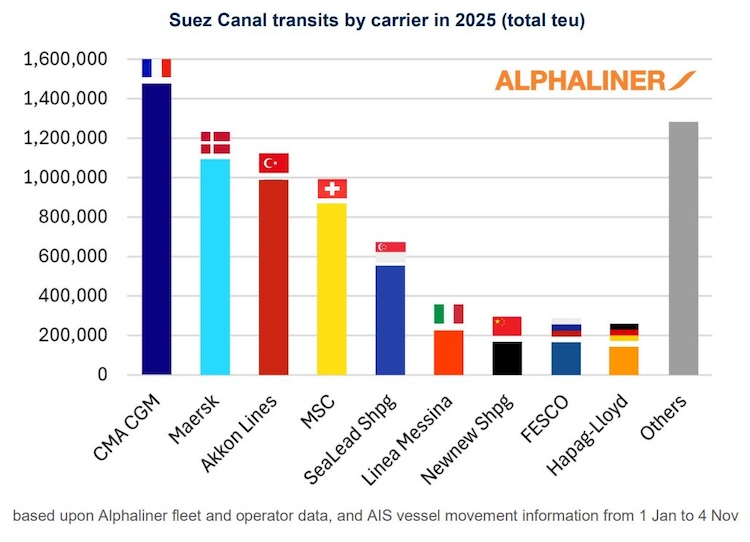
“Transits may start to increase if there is a perceived lower risk, but we are unlikely to see an imminent return to 2023 levels,” Sand said.
Xeneta estimates the longer routes around Africa currently absorb around 2 million twenty foot equivalent units (TEUs) of global container shipping capacity, increasing transport demands on the world fleet.
A full-fledged return to the Red Sea – a key trade route connecting Asia with Europe, the Mediterranean and North America – would ease the stress on the ocean supply chain and potentially cause freight rates to plummet, unless carriers take drastic measures such as idling, scrapping, slow-steaming and blank sailings.
“Carriers now face a dilemma: Follow and accept the remaining security risks, or stay around the Cape and risk losing market share,” wrote Luuk de Gruijter, senior investments manager for APM Terminals, in a LinkedIn post. “If more carriers follow and the Red Sea fully reopens, capacity on the Asia-Europe trade will likely surge and freight rates could drop. Insurers will also be watching closely, with premiums staying elevated until multiple safe transits confirm stability.”
Vincent Clerc, chief executive of A.P. Moller-Maersk (MAERSK-B.CO), parent of APM and Maersk, on an earnings call said that his company must ensure that the Gaza ceasefire “is entrenched and stable”. He added that the shipping industry must assess the Houthis’ position to determine when it’s safe to begin Red Sea passages.
While container lines reaped billions in windfall profits on record demand in 2024, current economic uncertainty has weakened consumer confidence and tamped down industrial development.
“Average spot rates from Far East to North Europe, Mediterranean and U.S. East Coast – three trades that would ordinarily transit the Red Sea – are all down more than 50% since the start of this year,” Sand said. “A largescale return of container ships to the Red Sea would flood the market with capacity and cause freight rates to plunge even lower across trades at a global level, not just those directly impacted by the diversions.”
He warned that carriers are heading into loss-making territory and freight rates are expected to fall up to 25% globally in 2026, Red Sea or no.
“Shippers should also be making contingency plans because a largescale return would cause severe disruption across global ocean supply chains as services transiting Suez Canal are reinstated.
“There are still many questions to be answered, but the impact of a largescale return would be seismic for shippers and carriers.”
Find more articles by Stuart Chirls here.
Related coverage:
Ocean rates tested by capacity conundrum
Container imports off 17.6% at leading US port
Freightos brand adopts Visa/Transcard payment financing tool
Brokerage Compliance Symposium
The day before F3. Every compliance issue you face - fraud exposure, carrier liability, FMCSA rules, cargo theft, insurance gaps - navigated by attorneys and operators defining best practices in a changing industry.
F3 Awards Dinner
The night before F3. FreightTech100 companies honored. FreightTech 25 and Shipper of Choice winners revealed live. Cocktail reception into dinner and live music - 300 industry leaders in one purpose-built room.
F3: Future of Freight Festival
Industry-defining keynotes, rapid-fire technology demos, and industry leaders networking in experiences across Chattanooga - plus the inaugural F3 Awards Dinner featuring the FreightTech and Shipper of Choice reveals.
The day before F3. Every compliance issue you face - fraud exposure, carrier liability, FMCSA rules, cargo theft, insurance gaps - navigated by attorneys and operators defining best practices in a changing industry.
The Signal at Chattanooga Choo Choo • Chattanooga, TN Register NowThe night before F3. FreightTech100 companies honored. FreightTech 25 and Shipper of Choice winners revealed live. Cocktail reception into dinner and live music - 300 industry leaders in one purpose-built room.
The Signal at Chattanooga Choo Choo • Chattanooga, TN Register NowIndustry-defining keynotes, rapid-fire technology demos, and industry leaders networking in experiences across Chattanooga - plus the inaugural F3 Awards Dinner featuring the FreightTech and Shipper of Choice reveals.
The Signal at Chattanooga Choo Choo • Chattanooga, TN Register Now