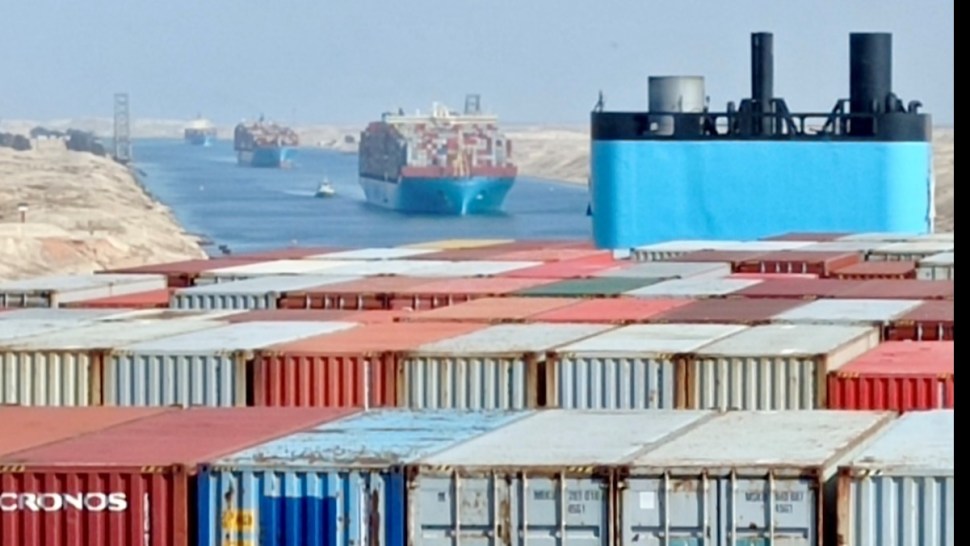
Just weeks after making a high-profile return to the Red Sea-Suez Canal trades, Maersk said it will again divert some voyages, including a U.S. service, away from the volatile Middle East route.
“We are currently experiencing unforeseen constraints arising from the wider operating environment in the Red Sea region,” the world’s second-largest carrier said in a customer advisory. “After conversations with our security partners, it is clear that these constraints are making it challenging to avoid delays in regard to passage through the area. Therefore, we have made the decision to reroute some of our upcoming sailings on the ME11 and MECL services from Trans Suez to Cape of Good Hope.”
Maersk (MAERSK-B.CO) did not offer further details on what it termed temporary changes. FreightWaves has reached out for comment.
The U.S. has been massing naval and air forces near Iran while President Donald Trump has threatened an attack on the eastern Arab nation. Tehran on Friday responded to Trump’s threats, saying it would destroy U.S forces and equipment in a confrontation. Washington on Friday urged American diplomatic staff to leave Israel ahead of a conflict.
Of the six MECL services connecting the Middle East and India to the U.S. East Coast, Maersk over the next three weeks will divert one westbound sailing and two eastbound voyages.
The ME11 service connecting the Middle East/India to Mediterranean ports will divert two of three westbound sailings, and two of four westbound voyages.
The moves allow Maersk to move some ships around while keeping crucial port services and network connections in place with minimal schedule disruption.
Maersk in January announced a return after a two-year absence from the Suez route, under protection of unspecified naval forces.
Both the U.S. and European Union provided military escorts for merchant shipping after Houthi rebels in Yemen in late 2023 began attacking merchant shipping in support of Palestinians in Gaza. The longer, diverted voyages add as much as 14 days’ sailing time to a voyage.
Read more articles by Stuart Chirls here.
Related coverage:
Port Houston posts record January as exports surge; Corpus crude slips
Panama wrests control of Canal terminals from China operator
“Textbook” case: Why trans-Pacific container rates continue to fall
Brokerage Compliance Symposium
The day before F3. Every compliance issue you face - fraud exposure, carrier liability, FMCSA rules, cargo theft, insurance gaps - navigated by attorneys and operators defining best practices in a changing industry.
F3 Awards Dinner
The night before F3. FreightTech100 companies honored. FreightTech 25 and Shipper of Choice winners revealed live. Cocktail reception into dinner and live music - 300 industry leaders in one purpose-built room.
F3: Future of Freight Festival
Industry-defining keynotes, rapid-fire technology demos, and industry leaders networking in experiences across Chattanooga - plus the inaugural F3 Awards Dinner featuring the FreightTech and Shipper of Choice reveals.
The day before F3. Every compliance issue you face - fraud exposure, carrier liability, FMCSA rules, cargo theft, insurance gaps - navigated by attorneys and operators defining best practices in a changing industry.
The Signal at Chattanooga Choo Choo • Chattanooga, TN Register NowThe night before F3. FreightTech100 companies honored. FreightTech 25 and Shipper of Choice winners revealed live. Cocktail reception into dinner and live music - 300 industry leaders in one purpose-built room.
The Signal at Chattanooga Choo Choo • Chattanooga, TN Register NowIndustry-defining keynotes, rapid-fire technology demos, and industry leaders networking in experiences across Chattanooga - plus the inaugural F3 Awards Dinner featuring the FreightTech and Shipper of Choice reveals.
The Signal at Chattanooga Choo Choo • Chattanooga, TN Register Now