Xeneta: Iran tensions could delay Red Sea return
While ocean carriers wrangle with too many ships and too little cargo, continuing weak rates on the Asia-U.S. trade route are starting to show up on other benchmark shipping lanes.
“Average spot rates are down this week across all main fronthaul trades out of the Far East,” said Peter Sand, Xeneta chief analyst, in a note to clients. “From Far East to U.S. West Coast and U.S. East Coast, it is a textbook market development with falling spot rates coinciding with a slight uptick in offered capacity.”
Market average spot rates for the week ending Feb. 19 for Far East to U.S. West Coast were $1,889 per forty foot container (FEU), down from $2,052 the previous week. Far East to U.S. East Coast settled at $2,688 per FEU, from $2,882.
The trans-Pacific has been whipsawed by importers playing a waiting game, while carriers struggle to manage overcapacity.
Xeneta’s four-week rolling average of offered capacity as of Feb. 16 increased 2.7% from the previous week on Asia-West Coast services, and by 2.2% to the East Coast.
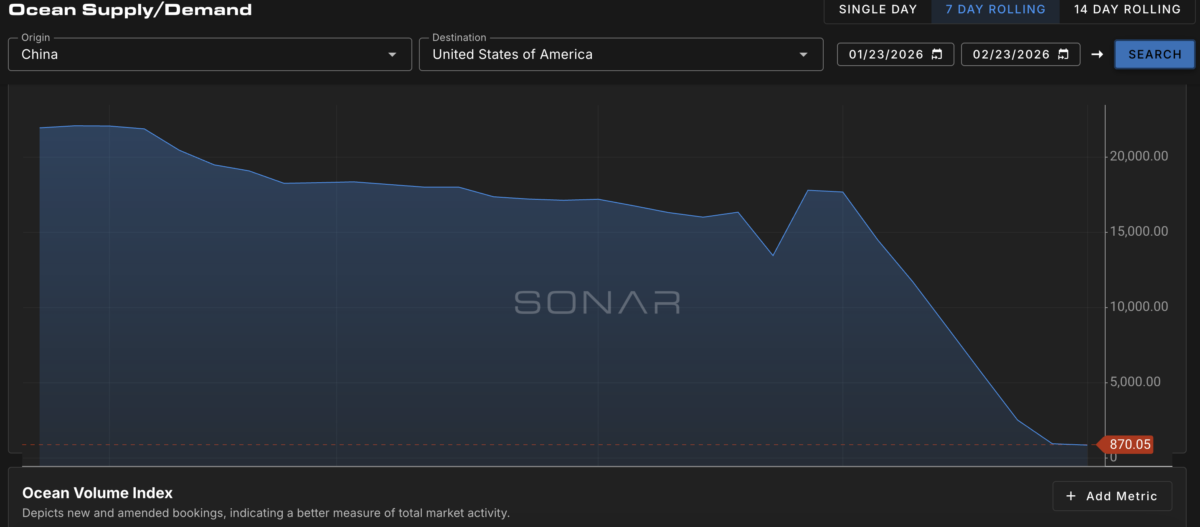
The market uncertainty comes at a particularly inconvenient time for liner companies entering contract negotiations with shippers. An expected push for higher rates after a difficult 2025 that saw year-on-year profit decreases for major public liners may come up short if demand continues to be muddled by economic concerns aggravated by tariffs.
Conversely, the other major Asian trade lanes also weakened, but amid contrary circumstances.
“It is a different story from Far East to North Europe where offered capacity has decreased week-on-week but spot rates continue to fall,” said Sand, suggesting an even weaker market on this trade. That’s headline news since China in 2025 found substantial export markets in Europe after tariffs substantially reduced volumes to the U.S.
“2026 is expected to be a year defined by overcapacity in container shipping, compounded by a large-scale return of services to the Red Sea,” Sand said. “Rising tensions between the U.S. and Iran could influence this situation, especially if it threatens Houthi militia resuming attacks on merchant ships in the Red Sea.
“Even if there is not a full escalation in conflict between the U.S. and Iran, the military posturing and rhetoric from political leaders can influence the security situation in the region and see carriers slow down plans to resume Red Sea transits. If so, this would delay a wider return of container shipping to the Red Sea and ease the overcapacity headache for carriers deeper into 2026.”
North Europe to U.S. East Coast edged higher to $1,492 per FEU, from $1,484 the previous week on capacity that shrank by almost 10%.
Read more articles by Stuart Chirls here.
Related coverage:
Blizzard shuts down container terminals at northeast ports
Why ships could be Trump’s not-so-secret tariff weapon
Hapag-Lloyd, WiseTech Global in container visibility initiative
Asia-U.S. container rates continue to fall as industry change swirls
Brokerage Compliance Symposium
The day before F3. Every compliance issue you face - fraud exposure, carrier liability, FMCSA rules, cargo theft, insurance gaps - navigated by attorneys and operators defining best practices in a changing industry.
F3 Awards Dinner
The night before F3. FreightTech100 companies honored. FreightTech 25 and Shipper of Choice winners revealed live. Cocktail reception into dinner and live music - 300 industry leaders in one purpose-built room.
F3: Future of Freight Festival
Industry-defining keynotes, rapid-fire technology demos, and industry leaders networking in experiences across Chattanooga - plus the inaugural F3 Awards Dinner featuring the FreightTech and Shipper of Choice reveals.
The day before F3. Every compliance issue you face - fraud exposure, carrier liability, FMCSA rules, cargo theft, insurance gaps - navigated by attorneys and operators defining best practices in a changing industry.
The Signal at Chattanooga Choo Choo • Chattanooga, TN Register NowThe night before F3. FreightTech100 companies honored. FreightTech 25 and Shipper of Choice winners revealed live. Cocktail reception into dinner and live music - 300 industry leaders in one purpose-built room.
The Signal at Chattanooga Choo Choo • Chattanooga, TN Register NowIndustry-defining keynotes, rapid-fire technology demos, and industry leaders networking in experiences across Chattanooga - plus the inaugural F3 Awards Dinner featuring the FreightTech and Shipper of Choice reveals.
The Signal at Chattanooga Choo Choo • Chattanooga, TN Register Now