First look: XPO Q2 earnings

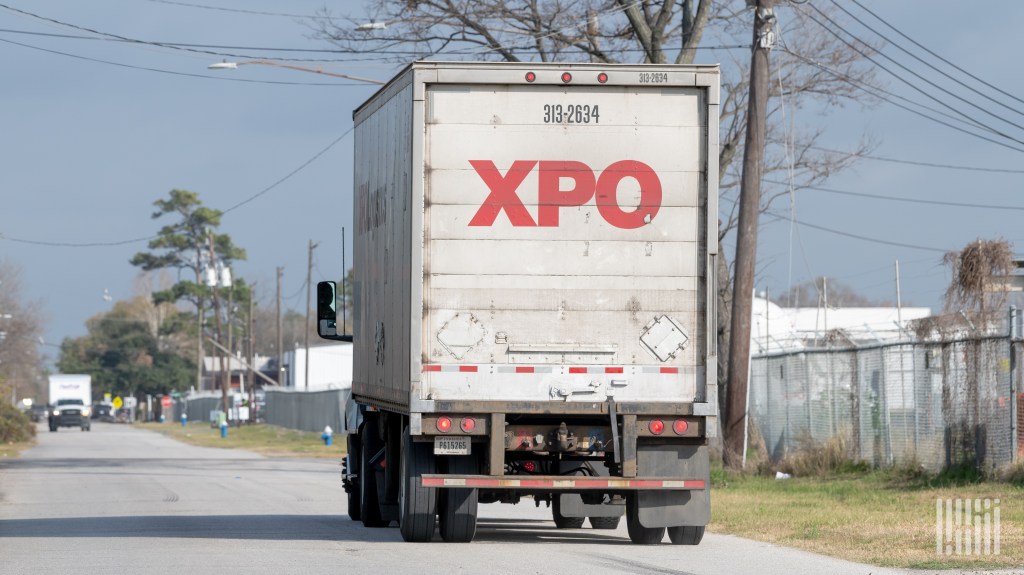
A photo of an XPO straight truck on a side road

Less-than-truckload carrier XPO again reported earnings results ahead of analysts’ expectations on Thursday ahead of the market open.

XPO (NYSE: XPO) reported adjusted earnings per share of $1.05, which was 6 cents better than the consensus estimate but 7 cents lower year over year. (The adjusted EPS number excluded transaction and restructuring costs.)

Consolidated revenue was flat y/y at $2.08 billion, but outpaced the consensus estimate of $2.05 billion.

“We’re executing at a high level and consistently outperforming the industry, with a strategy that positions us to deliver long-term margin expansion and earnings growth,” CEO Mario Harik said in a news release.

XPO’s LTL unit reported a 2.5% y/y decline in revenue to $1.24 billion. A 6.7% decline in tonnage per day (shipments down 5.1% and weight per shipment down 1.7%) was partially offset by a 4.2% increase in revenue per hundredweight, or yield. (Yield was 6.1% higher y/y excluding fuel surcharges.)

Revenue per shipment and yield increased on a sequential basis, which was in line with management’s guidance.

Table: XPO’s key performance indicators

The segment reported an 82.9% adjusted operating ratio (inverse of operating margin), which was 30 basis points better y/y and 300 bps better than the first quarter. The result was at the top end of management’s guidance.

Purchased transportation expenses (as a percentage of revenue) were down 280 bps y/y as the carrier continues to insource linehaul shipments.

XPO continued to see y/y margin improvement as the rest of the legacy public carriers reported material declines in the quarter (340 bps on average) .

XPO’s European transportation segment reported a 4% y/y increase in revenue to $841 million with an adjusted earnings before interest, taxes, depreciation and amortization margin of 5.2%, 80 bps lower y/y.

Shares of XPO were up 0.5% in premarket trading on Thursday.

XPO will host a call to discuss second-quarter results on Thursday at 8:30 a.m. EDT.

More FreightWaves articles by Todd Maiden:

Exclusive: Bendix and Aeva collaborate on 4D LiDAR for advanced truck safety systems

Aeva's 4D LiDAR technology

Bendix Commercial Vehicle Systems and Aeva Technologies announced Wednesday a collaboration focused on developing advanced Level 2+ active safety solutions for commercial vehicles. The collaboration represents the first significant implementation of LiDAR technology in Level 2+ advanced driver assistance systems (ADAS) for commercial trucks.

The partnership aims to integrate Aeva’s 4D LiDAR technology into Bendix’s future active safety systems, expanding capabilities for the North American commercial trucking market, where approximately 300,000 new trucks are sold annually.

Bendix, through its Bendix Fusion flagship ADAS system, is a market leader in collision mitigation technology for commercial vehicles, including those from OEM truck manufacturers Paccar, Navistar and the Volvo Group.

Bendix also brings scalability to the collaboration. The company is part of Munich, Germany-based Knorr-Bremse, a global market and technology leader for braking systems and a leading supplier of safety-relevant subsystems for rail and commercial vehicles, according to the release.

“This collaboration with Bendix brings Aeva’s 4D LiDAR into one of the most impactful commercial vehicle safety markets in North America and is an indication of 4D LiDAR’s maturity and flexibility for high-volume active safety applications beyond autonomy,” said Soroush Salehian, co-founder and CEO of Aeva, in a news release.

The partnership is a shift in ADAS technology for commercial vehicles. Current collision mitigation systems rely primarily on radar and camera technology, which can face limitations in challenging conditions like nighttime driving or adverse weather. Aeva’s 4D LiDAR technology measures both distance and velocity, potentially offering superior detection capabilities in these scenarios.

“We see Aeva’s 4D LiDAR as an enabling technology offering the long-range performance, high resolution, and instant velocity data we believe is needed to expand the capabilities of our future systems, particularly for challenging scenarios like pedestrian detection and nighttime operation,” said Mike Tober, chief technology officer of Bendix.

The collaboration specifically targets upcoming safety requirements for commercial vehicles in North America, including Pedestrian Automatic Emergency Braking (PAEB).

Unlike passenger vehicles, commercial trucks present unique safety challenges due to their size and momentum. As Salehian noted in an interview with FreightWaves, the focus for truck safety systems is often on early detection to enable gradual braking rather than sudden swerving maneuvers that could destabilize the vehicle.

Another component of the partnership involves Aeva’s “unified perception platform,” which allows the same core hardware to be used across different applications, from full autonomy to active safety systems. This approach aims to make LiDAR technology cost-effective enough for high-volume ADAS applications.

“For us, because we have been developing this scalable, what we call unified perception platform, we’re able to use the same core hardware and software, modify the software alone, but the hardware remains the same,” Salehian explained. 

This approach allows for processing perception tasks directly on the sensor itself, reducing overall system complexity and cost.

In the LiDAR space, order size matters and a modest adoption across commercial truck fleets could drive significant sensor volume, as each truck may require multiple sensors for full coverage. A fleet of 10,000-15,000 trucks could potentially utilize 100,000 sensors, creating economies of scale that further reduce costs, a common challenge for LiDAR compared to radar and cameras.

The partnership complements Aeva’s existing relationship with Daimler Truck, which recently made a non-dilutive investment in the company. As part of its growth strategy, Aeva is expanding production capacity to 200,000 units annually at a new USMCA-compliant North American manufacturing facility.

Trump revokes de minimis privilege for global e-commerce imports

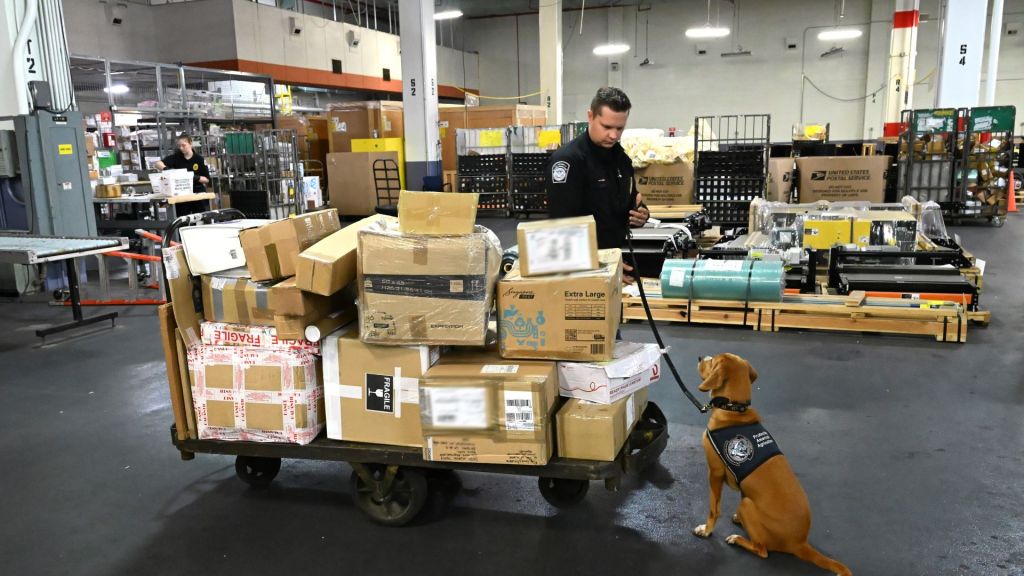
A sniffer dog and a Customs inspector check parcels at an airport import facility.

Not content to wait two years for this month’s congressional repeal of the de minimis exemption to take effect, President Donald Trump on Wednesday signed an executive order that ends the ability of low-value goods to enter the U.S. duty-free and with minimal customs processing on Aug. 29.

Trump said suspending the trade privilege for individual parcel shipments was necessary to prevent people from using the system to evade tariffs systematically being imposed on all nations.

The President earlier this year eliminated de minimis privileges for small-dollar items shipped from China and Hong Kong. The new policy will force importers to pay the full tariff amount for shipments valued at $800 or less and originating from all countries.

The decision is a blow for e-commerce retailers, including mom-and-pop enterprises, that source goods from overseas and ship them directly to online buyers via cross-border parcel networks. International logistics providers and cargo airlines are also expected to lose business.

The de minimis exemption, originally designed to reduce the administrative burden on U.S. Customs and Border Protection from collecting tiny amounts of tariffs on individual parcels, was exploited by Chinese online marketplaces and other e-tailers to enable cheap, direct-to-consumer fulfillment without the need of U.S. warehouses. CBP has said the explosion of de minimis shipments has outstripped its ability to check for potential trade violations and smuggling of illicit products. The agency processes about 4 million de minimis shipments per day. 

The One Big Beautiful Bill, a massive tax-and-spending package Trump signed into law at the beginning of the month, includes a provision that cancels the de minimis rule on July 1, 2027. 

In 30 days, importers will be required to file customs declarations and pay duties and taxes on all imported goods, regardless of value. In many cases, those importers will be individuals who may balk at the complexity of filling out forms or paying higher prices for goods, especially as the Trump administration continues its campaign to significantly increase tariffs on nearly all trading partners. Earlier this week, for example, the EU tentatively agreed to accept 15% tariffs on its exports to smooth relations with the Trump administration.

The National Council of Textile Organizations applauded Trump’s executive order.

“The de minimis mechanism has functioned as a black box for low-cost, subsidized, and unethical Chinese imports and undermined the competitiveness of the U.S. textile industry — a key contributor to the workforce and the U.S. economy,” NCTO President Kim Glas said in a statement. “We thank the president and his administration for listening, acting, and standing with American manufacturers and workers. Today’s executive order is a game changer. It restores fairness for U.S. manufacturers, closes a major gateway for illegal and toxic goods, and lays the groundwork for reinvestment and job creation here at home.”

Trump invoked the rarely-used International Emergency Economic Powers Act to declare that illegal smuggling of fentanyl from Canada, Mexico and China constituted a national emergency and justified revoking de minimis, even though little of the synthetic drug comes via Canada. He quickly suspended the decree until the Commerce Department determined CBP and the U.S. Postal Service had systems in place to collect duties from so many small shipments. In early May, Trump reimposed tariffs on low-value shipments from China and Hong Kong. Since then Temu and Shein sales in the U.S. have fallen 50% by some estimates.

The executive order says those systems are now in place to process parcels from Canada, Mexico and the rest of the world as formal customs entries. Trump said suspending de minimis writ large was necessary as a remedy for the U.S. trade deficit, which he characterized as a national emergency. In recent weeks, the Trump administration has secured agreements from the United Kingdom and Japan to impose 10% and 15% tariffs, respectively. Most countries are currently operating under a universal 10% tariff that is set to expire on Aug. 1. The U.S. has threatened to impose double-digit tariffs of varying degrees on other countries that haven’t reached tariff agreements by that date.

The executive order includes an alternative flat rate option available for six months ranging from between $80 to $200 per item and linked to which emergency tariff rate a country has.

The executive order requires air carriers and other transportation providers to collect and remit duties to CBP for shipments moved through the international postal system since the U.S. Postal Service doesn’t have the ability to process entries through CBP’s automated system.  Since de minimis was removed in May, not a single parcel has been sent by China Post or Hong Kong Post because no airline wants the liability of collecting and remitting the duties to CBP, according to trade practitioners.

U.S.-based logistics providers are expected to benefit from the new trade policy as retailers will need to ship inventory in bulk and store it in domestic warehouses for fulfillment.

Click here for more FreightWaves/American Shipper stories by Eric Kulisch.

Write to Eric Kulisch at ekulisch@freightwaves.com.

House considers universal de minimis ban as fees on China parcels ease

CMA CGM to invest $20B in US shipping, supply chain capabilities

First Look: Profitablity measures at C.H. Robinson point higher in 2Q

C.H. Robinson CEO Dave Bozeman (NASDAQ: CHRW), in releasing the company’s second quarter earnings, said it represented “six consecutive quarters of consistent outperformance through the disciplined execution of the strategy that we shared at our 2024 investor day.”

The revenue figure for the company was down, in part because of the divestiture of the company’s European Surface Transportation business, which housed the basic truck brokerage activities of the company. The decline was 7.7%.

The figure for gross profits was up 0.4% to $679.6 The adjusted operating margin was up 520 bps to 31.1%. That also marked a significant sequential jump from 26.3%.

Income from operations was up 21.2% year on year, to $215.9 million. In the first quarter, that figure was about $177 million.

C.H. Robinson continues to slash headcount. Total average employee headcount in the second quarter was 12,858, down 11.2% from a year earlier. In the first quarter, that number was 13,347.

The North American  Surface Transport sector, which contains its brokerage operations, saw its profitability rise even as it produced less revenue. Total revenue in NAST was down 2.4% for the quarter compared to the year earlier period. But adjusted gross profits rose 3% year-on-year, and income from operations were up 16.2%. 

Average headcount at NAST was 5,283, down from 5,868 a year earlier. It was actually up by 3 from the first quarter.

Adjusted net income of $1.29/share was up 12.2% from a year ago, and was 13 cts/share more than the consensus estimate, according to SeekingAlpha. Revenue of $4.14 billion was short of consensus estimate by $40 million. C.H. Robinson’s stock is up 9.3% in the last 52 weeks. 

Post-market trading was light but suggested a positive reaction to the report. C.H. Robinson closed the day at $97.65, with reports afterward of the stock price hitting the $100 mark.

More articles by John Kingston

Sequential numbers at diversified trucking operator TFI International may mark a turnaround

Ryder’s used vehicle numbers show a bullish corner: tractor sales

Five takeaways from the State of Freight for July: What earnings and the indices are saying about the market

Nissan to close auto plant in Mexico, cutting 2,400 jobs

Japanese automaker Nissan Motor Co. plans to close its CIVAC manufacturing plant in Cuernavaca, Mexico, due to restructuring measures amid sluggish global sales.

The company will transfer all vehicle production from Cuernavaca to the Nissan complex in the Mexican city of Aguascalientes by March 2026, according to a news release on Tuesday.

Cuernavaca is located in south central Mexico, about 360 miles south of Aguascalientes.

“Today we have made a difficult but necessary decision that will allow us to be more efficient, competitive, and sustainable,” Nissan CEO Iván Espinosa said in a statement. “I take this opportunity to reaffirm our commitment to our employees, customers, and to Mexico, which remains a strategic pillar for our company.”

The restructuring will directly impact 2,400 workers at the CIVAC Cuernavaca plant. When the factory opened in 1966, it was the first Nissan auto plant outside of Japan.

The Cuernavaca plant produces versions of its Frontier model built for Mexican and South America markets. The factory also assembles versions of the Nissan Versa model sold in Mexico and the U.S.

Nissan announced in 2024 plans to reduce global production capacity from 3.5 million units to 2.5 million units by reducing production sites in Japan and internationally from 17 to 10 by 2027.

As part of the restructuring, Nissan plans to slash about 15% of its global work force, about 20,000 employees.


While shippers cite merger concerns, rival railroad looks instead to ‘collaborations’

Canadian National this week was the only Class I railroad to publicly comment on the $85-billion acquisition agreement between Union Pacific and Norfolk Southern, a corporate marriage that if approved would create the first U.S. transcontinental freight railroad.

“CN is closely monitoring the ongoing discussions about possible transcontinental rail mergers,” the Montreal-based company (NYSE: CNI) said in a statement to FreightWaves. “Our focus remains on delivering consistent performance for our customers, pursuing strategic growth opportunities, and creating long-term value for our shareholders.

“CN believes this can be achieved through greater collaboration between railways, connecting key markets with critical resources,” as opposed to mergers.

The other Canadian transcon, CPKC (NYSE: CP), as well as BNSF and CSX (NASDAQ: CSX) in the U.S., declined to comment.

In 2021 CN saw its own consolidation proposal with Kansas City Southern end in termination amid tougher U.S. merger rules. KCS eventually merged with Canadian Pacific in 2023.

CN is an interchange partner with both UP (NYSE: UNP) and NS (NYSE: NSC), and is a partner in the UP-run EMP container program. CN also participates in UP’s Falcon Premium intermodal service with GMXT connecting Mexico, the U.S., and Canada.

One shippers group reiterated its opposition to the merger announcement Tuesday that would create an integrated network stretching from New Jersey to Southern California.

“American Chemistry Council (ACC) and its member companies have serious concerns about the negative impacts on American manufacturing from further consolidation in the freight rail industry,” the trade group said in a statement. “We are closely watching the proposed terms of the deal and will actively oppose any merger that fails to significantly enhance competition between railroads.

“Our industry is one of the largest users of the U.S. freight rail system, and we need efficient and reliable service to deliver products that make people’s lives better, healthier, and safer. 

“The four largest freight railroads already control more than 90% of U.S. rail traffic, with two dominating in the eastern U.S. and two dominating in the west. The impact of a transcontinental merger between two of these railroads threatens to leave American manufacturers, farmers and energy producers with even fewer competitive options to ship by rail. 

“Many rail customers are currently dealing with high rates and unreliable service. Further consolidation within the rail industry is likely to make these problems worse. 

“Producing and moving more chemistry here at home is key to growing the economy. From microchips to cars to medicines, if we want to make more things in America and lead in global trade, we must do a better job transporting American made goods. We call on policymakers to help create more competitive and reliable transportation options, not less.”

U.S. Sens. Roger Marshall (R-Kan.) and Tammy Baldwin (D-Wis.) in a letter urged the Surface Transportation Board to “keep the best interests of rail shippers and consumers in mind” during the board’s upcoming review of the merger, expressing concerns about the merger’s impact in a letter to board members.

Meanwhile, Nebraska Republican senators Deb Fischer and Pete Ricketts issued statements supporting the merger because of its economic impacts on their state.

U.S. Transportation Secretary Sean Duffy is not commenting officially on the merger at this time, a DOT source told FreightWaves, who pointed out that the STB has exclusive jurisdiction over rail mergers and acquisitions.
The Federal Railroad Administration (FRA), a modal agency within DOT, “will perform its limited, safety-focused role in the process, specifically, to monitor the safety of railroad operations pursuant to a Safety Integration Plan,” the source said. “Safety is FRA’s top priority.”

Senior Bond Analyst Jay Cushing of researcher Gimme Credit said that the deal would produce combined revenue of $36.5 billion, operating earnings (EBITDA) of close to $18 billion, an operating ratio of 61%, and free cash flow of $2.6 billion.

“We estimate pro forma gross debt of $70 billion and net debt/EBITDA of 3.8x,” Cushing said in an email to FreightWaves. “This is about a turn above current last 12 months net leverage at Union Pacific (2.6x). Management is targeting $2.75 billion of run rate synergies over three years split between revenues ($1.75 billion) and costs ($1 billion). The synergy target amounts to 7.5% of combined revenue and looks reasonable when compared to a 9% target for the recent Canadian Pacific/Kansas City Southern merger.”

Cushing noted that Norfolk Southern was late implementing precision railroading “and we see room for operating rate compression between the industry laggard (NS) and leader (UP). Management expects combined free cash flow (before dividends) to grow from $7 billion in 2024 to $12 billion by 2029 driven by synergies and 10% base-line growth.

“Both companies will suspend share repurchases and with no funding plans until the deal closes, we expect cash to build on the balance sheet ($2 to $3 billion annually) helping moderate debt issuance needs. We view management’s net leverage target of 2.8x by 2028 as achievable.”

— with reporting by Trains magazine and John Gallagher of FreightWaves
This article was corrected July 30 to clarify that CN supports collaboration among railroads.
This article was edited July 31 to include reaction from US Transportation Secretary Sean Duffy and a statement from the FRA.

Subscribe to FreightWaves’ Rail e-newsletter and get the latest insights on rail freight right in your inbox.

Find more articles by Stuart Chirls here.

Related coverage:

CEOs say Union Pacific-Norfolk Southern merger will reverse rail freight decline

Shippers line up against railroad mergers

Union Pacific and Norfolk Southern reach $85 billion merger deal

First look: Norfolk Southern earnings

Aurora announces nighttime driverless operations and Arizona expansion

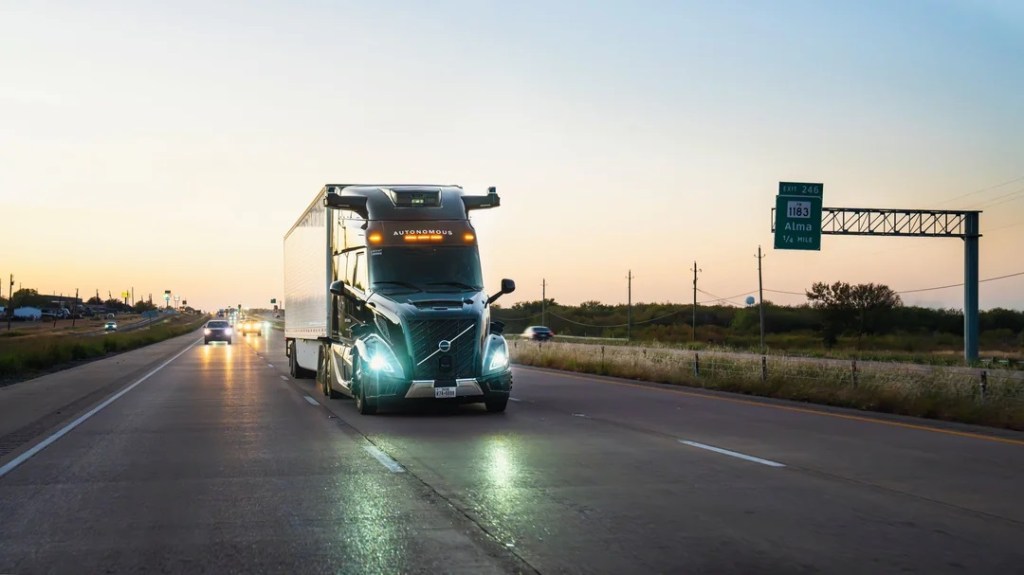
Aurora Innovation autonomous truck at dusk

Aurora Innovation, an autonomous trucking technology maker, announced Wednesday an expansion of its commercial operations, which began in May. The expansion includes growing its driverless fleet to three trucks and surpassing 20,000 driverless miles at the end of June. The company also announced the opening of a terminal in Phoenix.

“Efficiency, uptime, and reliability are important for our customers, and Aurora is showing we can deliver,” said Chris Urmson, co-founder and CEO of Aurora, in a press release. “Just three months after launch, we’re running driverless operations day and night and we’ve expanded our terminal network to Phoenix. Our rapid progress is beginning to unlock the full value of self-driving trucks for our customers, which has the potential to transform the trillion-dollar trucking industry.”

To build on the momentum, the company expanded to nighttime driving on its existing driverless lane from Dallas to Houston. The expansion allows for continuous utilization, shortening delivery times and serving as part of its path to autonomous trucking profitability.

Aurora notes that the unlocking of nighttime autonomous operations can also improve road safety. It cited a 2021 Federal Motor Carrier Safety Administration report on large truck and bus crashes that noted a disproportionate 37% of fatal crashes involving large trucks occurred at night. This comes despite trucks traveling fewer miles during those hours.

Compared to a human driver who may deal with challenges such as low visibility and fatigue, autonomous trucks contain an array of cameras, lidar and radar allowing the vehicles greater visibility.

Aurora’s SAE L4 autonomous driving system, called the Aurora Driver, can detect objects in the dark more than 450 meters away via its proprietary, long-range FirstLight Lidar. The lidar can identify pedestrians, vehicles, and debris up to 11 seconds sooner than a traditional driver, according to the company.

In addition to the fleet and operations expansion, the new terminal in Phoenix, which opened in June, is part of an infrastructure-light approach. Aurora notes this design will closely resemble how the company plans to integrate with future customer endpoints, optimized for speed to market.

This expansion of the more than 15-hour Fort Worth to Phoenix route opens up opportunities to showcase the autonomous truck’s ability to cut transit time in half compared to a single driver, who is limited to the 11-hour hours-of-service limitation. Aurora is piloting the autonomous trucking Phoenix lane with two customers, Hirschbach and Werner.

The company is also expected to announce its second-quarter results on Wednesday, with a conference call at 5 p.m. ET.

Ex-trucking manager charged in $500K embezzlement scheme

truck at night

The former operations manager at a large Gainesville, Georgia-based trucking company has been charged with stealing more than $500,000 from the company in an embezzlement scheme that also involved the carrier’s drivers.

Dustin Jarrard, who worked for Tribe Transportation when the alleged theft occurred, was arraigned on Tuesday in court after being indicted by a federal grand jury for wire fraud.

“This case is a clear example of financial fraud fueled by greed,” said FBI Special Agent in Charge in Atlanta, Paul Brown. “Jarrard allegedly manipulated internal processes to steal hundreds of thousands of dollars. The FBI is committed to uncovering and stopping this kind of corporate theft.”

The stolen money “was intended to help truckers on the road,” said U.S. Attorney Theodore. Hertzberg. “We will hold accountable those who abuse their positions of trust and embezzle funds for their personal use.”

The charges against Jarrard, 38, occurred between May 2018 through May 2024 while he worked for the company, which advertises itself as a Native American woman-owned business.

As operation manager, Jarrad had the authority to request expense reimbursements on behalf of truck drivers, and would do so by sending the driver’s name, the reason for the expense, and the amount of the reimbursement to the company’s accounting department, according to the U.S. Attorney’s Office.

Over the course of more than three years, Jarrard sent fraudulent reimbursement requests – including reimbursement for drivers who were not actually employed by the company – that resulted in payments Jarrard redeemed for his own use, according to prosecutors.

“In other cases, Jarrard enlisted Tribe Transportation drivers in his scheme and falsely submitted payment requests for expenses never incurred and layover bonuses that were not earned,” the attorney’s office stated. “After receiving funds that were not owed to them, the drivers transferred some of the money to Jarrard for his personal use.”

Tribe Transportation operates 283 power units and employs 277 drivers, according to FMCSA data.

Click for more FreightWaves articles by John Gallagher.

ArcBest’s efficiency initiatives helping offset soft demand

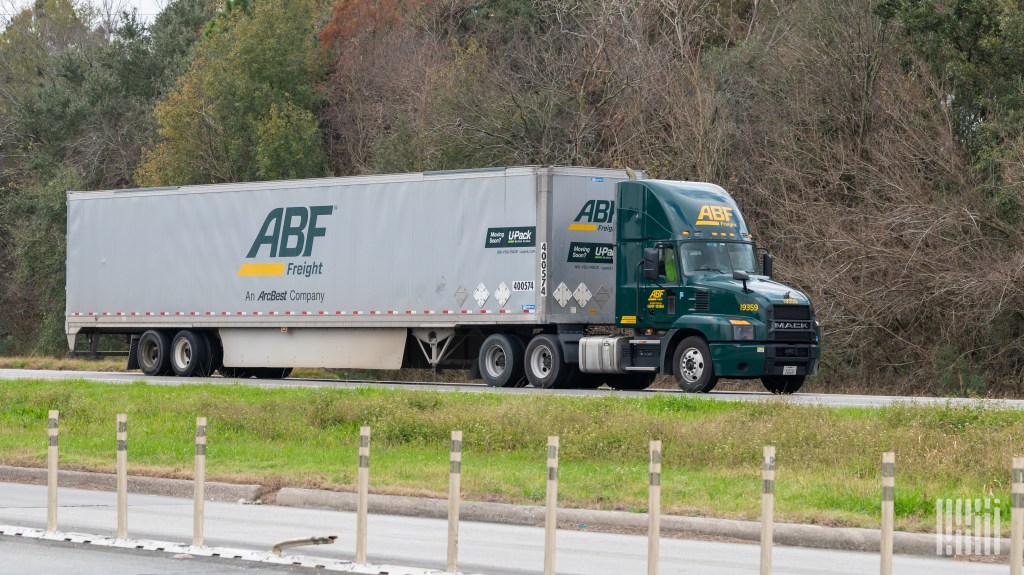
A green ABF Freight daycab pulling an ABF dryvan trailer on a highway

ArcBest leaned on belt tightening and efficiency initiatives to partially offset weak demand during the second quarter. The company said it is “adding good new profitable business to the network” even as the less-than-truckload industry contends with protracted weakness in the manufacturing and housing segments.

Revenue at ArcBest’s (NASDAQ: ARCB) asset-based unit, which includes less-than-truckload subsidiary ABF Freight, came in flat year over year at $713 million. Tonnage per day was up 4.3% y/y but revenue per hundredweight, or yield, was off 3.1%.

The carrier had an easy tonnage comparison to the year-ago quarter (negative-20.3%) but faced a stiff yield comp (plus-23%). ABF is relying on a dynamic pricing model to drive equipment utilization higher. The formula provides discounts to fill space on equipment that is required to move through the network even if it isn’t full.

Asset-based tonnage was up y/y by 3.6% in April, 6.3% in May and 2.8% in June. However, preliminary results for July showed tonnage was flat y/y even against a notably negative comp from a year ago (negative-12.5% in July 2024).

On a two-year-stacked comparison, July was ArcBest’s best tonnage result since February 2024.

The carrier is up against an easier tonnage comp (negative-11.3%) in the third quarter. The yield comp (plus-7.4%) steps down as well.

ABF is focused on growing share among its core accounts and said it is having success at small-to-medium size shipper accounts where rate competition is typically less severe. However, other carriers have been targeting this shipper segment in recent quarters, which could ultimately limit rate gains.

Table: ArcBest’s key performance indicators

Contractual rate increases averaged 4.0% in the quarter, a 9.1% increase on two-year-stacked comparison.

ABF recently announced a 5.9% general rate increase, which will take effect on Monday. It took a similar increase last September. The cadence of GRIs across the industry has shortened from annual implementations to approximately every 10 to 11 months.  

The asset-based unit reported a 92.8% adjusted operating ratio (inverse of operating margin), which was 300 basis points worse y/y. The OR improved 310 bps sequentially, which was in line with the carrier’s historical sequential improvement rate of 300 to 400 bps.

Management said it expects to see roughly 70 bps of sequential OR improvement from the second to the third quarter, which is in line with historical trends. That implies a 92.1% OR for the third quarter, which would be 110 bps worse y/y.

Terminal efficiency initiatives have generated a total of $14 million in cost savings at 18 service centers so far this year. The company sees ample cost levers from the program moving forward.

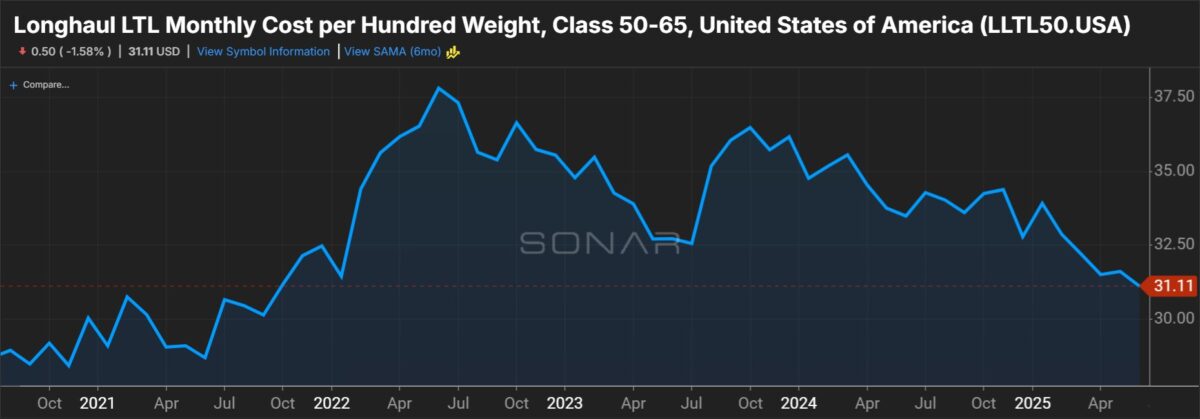
SONAR: Longhaul LTL Monthly Cost per Hundredweight, Class 50-65 Index. Less-than-truckload monthly indices are based on the median cost per hundredweight for four National Motor Freight Classification groupings and five different mileage bands. To learn more about SONAR, click here.

ArcBest’s asset-light segment, which includes truck brokerage, reported an adjusted operating profit of $1.1 million after seven consecutive quarterly losses. The unit is expected to see breakeven results to $1 million in adjusted operating income in the third quarter.

Asset-light revenue was down 14% y/y to $342 million in the quarter, but just 7% lower y/y in July.

ArcBest reported second-quarter adjusted earnings per share of $1.36 on Wednesday ahead of the market open. The result was 10 cents light of the consensus estimate and 62 cents lower y/y.

The company continues to target the low end of a 2025 net capex guidance range of $225 million to $275 million, which it describes as mostly maintenance spending.

Approximately $130 million to $140 million is designated for rolling stock, $60 million to $80 million is slated for real estate projects, and the remainder will be used to make IT and dock equipment upgrades.

ArcBest ended the quarter with approximately $400 million in available liquidity, a $50 million increase from the first quarter. 

The company also announced its first investor day in a decade. The event will take place on Sept. 29.

Shares of ARCB were down 13.4% at 2:50 p.m. EDT on Wednesday compared to the S&P 500, which was up 0.1%. It was a down day for the LTLs as peer Old Dominion Freight Line (NASDAQ: ODFL) posted slightly worse-than-expected results earlier in the day.

More FreightWaves articles by Todd Maiden:

CPKC sees profits and revenue jump on stronger volumes

Canadian Pacific Kansas City profits and revenue grew in the second quarter as the railway carried more intermodal, grain, and coal shipments.

Chief Executive Keith Creel said the elephant in the room — the proposed Union Pacific (NYSE: UNP)-Norfolk Southern (NYSE: NSC) merger — does not change the growth opportunities his railway enjoys thanks to its unique cross-border network linking Canada, the U.S., and Mexico.

“This franchise continues to be positioned to deliver a unique outcome for years to come,” he said on the railway’s earnings call Wednesday afternoon.

Creel affirmed CPKC’s (NYSE: CP) long-term financial guidance despite the impact of ongoing trade tensions, such as the 50% tariffs the U.S. has imposed on steel imports from Canada. The tariffs have effectively stopped U.S.-bound steel shipments, Chief Marketing Officer John Brooks said.

CPKC saw strong international intermodal growth thanks to its Gemini partnership with Maersk and Hapag Lloyd, enjoyed 40% growth in its Mexico Midwest Express domestic cross-border intermodal hotshots, as well as a continued ramp-up in land-bridge traffic between Canada and Mexico.

CPKC’s quarterly operating income increased 6%, to $970 million U.S., as revenue grew 3%, to $2.67 billion U.S., compared to a year ago. Earnings per share surged 37%, to 96 cents.

The railway’s operating ratio was 63.7%, a 1.1-point improvement.

Overall volume was up 6% based on carloads and containers, but 7% when measured by revenue ton-miles.

On a carload basis, the growth was led by a 14% increase in intermodal shipments, an 11% increase in grain, and 9% increase in coal volume. Energy, chemicals, and plastics traffic was flat. The rest of CPKC’s segments — potash; fertilizers; forest products; metals, minerals and consumer products; and automotive — showed declines.

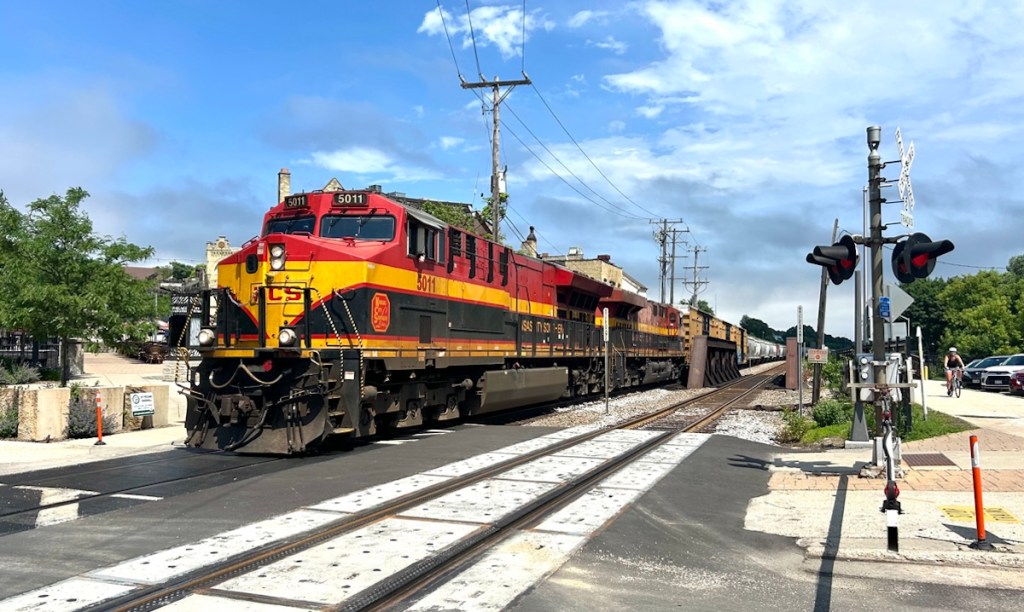
Average train speed was flat, but terminal dwell increased 7% partly due to the impact of congestion in former Kansas City Southern territory in the U.S. after a problematic May 3 computer systems cutover. The tech problems created congestion, missed switches, and significant delays for customers in Louisiana, Texas, and Mississippi.

CPKC has made significant progress clearing up congestion on the legacy KCS lines in the U.S., Chief Operating Officer Mark Redd says, citing a 42% improvement in dwell and a 38% increase in car miles per day.

Subscribe to FreightWaves’ Rail e-newsletter and get the latest insights on rail freight right in your inbox.

Find more articles by Stuart Chirls here.

Related coverage:

While shippers cite concerns, rival railroad sees ‘value’ in mega-merger 

CEOs say Union Pacific-Norfolk Southern merger will reverse rail freight decline

Shippers line up against railroad mergers

Union Pacific and Norfolk Southern reach $85 billion merger deal