Truckload’s diminishing distance

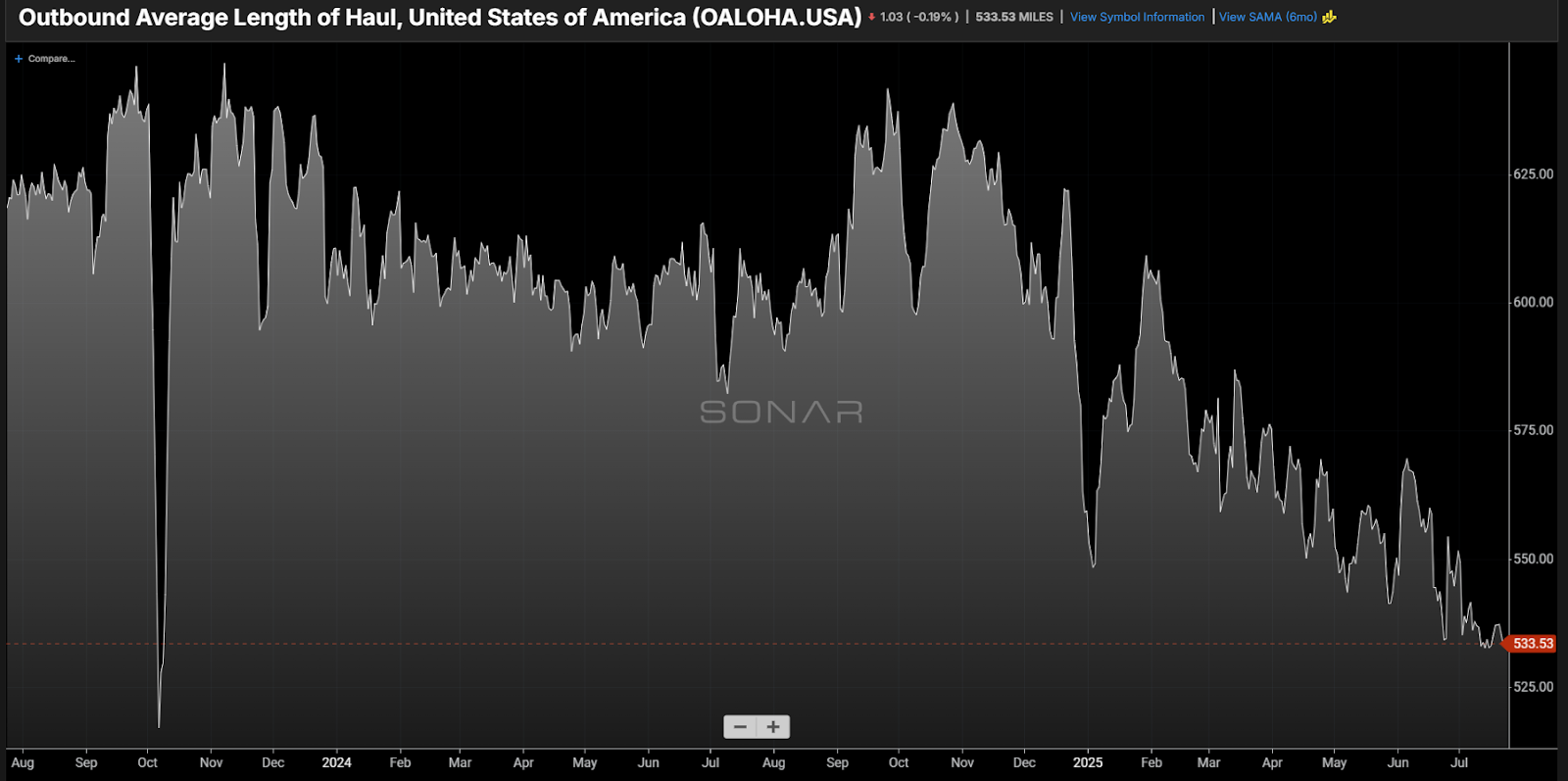
Chart of the Week:  Outbound Average Length of Haul – USA SONAROALOHA.USA

The average length of haul for truckload tenders in the U.S. fell to 533 miles last week—down approximately 70 miles, or 11%, from the same time last year, according to SONAR’s tender data. While the Outbound Average Length of Haul Index (OALOHA) has dipped lower in the past, it has only reached this level during brief periods. Weak overall demand has kept the truckload market from meaningfully rebounding, but the loss of longer-haul freight is compounding that stagnation. Is there any reason to believe this trend will reverse in 2025?

The primary driver behind the declining average is the shift of long-haul freight to intermodal, though demand for regional truckload moves has also softened. Freight moving less than 100 miles, however, has remained relatively resilient.

Just in case

Companies began increasing average lead times on orders in early 2024 as Red Sea attacks disrupted international shipping. While this didn’t reach COVID-era levels of service breakdown, the disruptions were enough to cause some inconsistency. As a result, many goods arrived in the U.S. with extra buffer time for domestic movement.

Inventory levels have been climbing unevenly over the past year, according to the Logistics Managers’ Index (LMI). This follows a strong period of destocking in 2023, driven by collapsing goods demand and over-ordering — a pattern that remains fresh in the minds of importers and may continue to suppress aggressive restocking in the near term.

Tariffs and the renewed trade war have amplified the pull-forward effect this year, reinforcing the shift to earlier, bulkier ordering cycles.

Intermodal has benefited significantly from longer lead times and accelerated shipping schedules. Last week, international loaded container volumes moving by rail were up 7% year-over-year, while domestic intermodal volumes remained flat. Intermodal is inherently more cost-effective, especially for long-haul moves across the country. With more freight landing at large ports—those best equipped with major rail terminals—the shift to rail has intensified.

Notably, intermodal is replacing not just any truckload freight, but some of the most impactful long-haul runs. For example, a Los Angeles to Chicago route takes a truck about four days—capacity that intermodal is increasingly absorbing.

Deals getting done

A breakthrough trade deal with Japan last week, which includes a 15% tariff rate, suggests the beginnings of trade de-escalation. A significant trade partner — the agreement is a positive signal that some fog is lifting from the uncertain trade environment that defined the first half of the year.

At the same time, inventory carrying costs have surged. The LMI’s inventory cost component rose above 80 in June — its highest level since early 2022 — making it harder for companies to justify holding excess goods.

A calmer trade climate, easing geopolitical risks, and rising holding costs could push shippers back toward just-in-time inventory strategies later this year. While economists and the Fed are forecasting a sluggish finish to 2025, that may not matter much for truckload.

With capacity still showing signs of tightening and long-haul demand near a floor, even modest demand shifts could cause a meaningful market reversal. If shippers pivot back to leaner inventories and faster domestic cycles, long-haul trucking could quickly return to relevance.

About the Chart of the Week

The FreightWaves Chart of the Week is a chart selection from SONAR that provides an interesting data point to describe the state of the freight markets. A chart is chosen from thousands of potential charts on SONAR to help participants visualize the freight market in real time. Each week a Market Expert will post a chart, along with commentary, live on the front page. After that, the Chart of the Week will be archived on FreightWaves.com for future reference.

SONAR aggregates data from hundreds of sources, presenting the data in charts and maps and providing commentary on what freight market experts want to know about the industry in real time.

The FreightWaves data science and product teams are releasing new datasets each week and enhancing the client experience.

To request a SONAR demo, click here.
Report: Union Pacific, Norfolk Southern could reach merger deal by next week

Union Pacific, the largest U.S. railroad, and Norfolk Southern could announce a tentative merger agreement as early as next week, according to a published report. 

Bloomberg cited sources familiar with the talks in its report Friday.

Omaha-based UP (NYSE: UNP), the largest Class I railroad and NS (NYSE: NSC), headquartered in Atlanta, recently confirmed that they have been in advanced discussions regarding a merger that if successful would create the first transcontinental railroad. A proposed consolidation would produce a rail colossus with $200 billion in market capitalization. 

Union Pacific had no comment. Norfolk Southern did not immediately respond to a message from FreightWaves seeking comment.

It’s also likely that competitors such as BNSF, CSX (NASDAQ: CSX), CN (NYSE: CNI), and CPKC (NYSE: CP) would importune the Surface Transportation Board, which will ultimately accept or reject the deal, for concessions to balance any emerging competitive issues. Industry observers have said that CN, in particular, could seek access to Mexico, after CPKC’s 2023 tie-up with Kansas City Southern made it the first run-through tri-border carrier.

In a published timeline guide, the STB estimates the review process could take as long as 22 months once formal filings are submitted.

Subscribe to FreightWaves’ Rail e-newsletter and get the latest insights on rail freight right in your inbox.

Find more articles by Stuart Chirls here.

Related coverage:

Union Pacific expands domestic intermodal service

Union Pacific posts record financial results

Five takeaways from the State of Freight for July: What earnings and the indices are saying about the market

Union Pacific and Norfolk Southern confirm advanced merger talks

How to Track Driver Hours Without Drowning in ELD Reports

Running a small fleet means you’re stretched thin—dispatching loads, chasing payments, and keeping trucks rolling. Then ELD reports hit you like a brick wall, piling on data you barely have time to read, let alone understand. Hours of service rules aren’t optional, but you don’t need to drown in reports to stay compliant. If you’re running one to five trucks, every minute spent decoding logs is a minute you’re not booking better loads or building broker relationships. This is about tracking driver hours efficiently, staying FMCSA-compliant, and focusing on what keeps your business alive—hauling freight. Here’s how small fleet owners and owner-operators can cut through the noise and keep their trucks where they belong: on the road.

Why ELD Reports Are a Small Fleet’s Nightmare

ELDs were sold as a time-saver, but for small carriers, they’re often a headache that eats your day. You’re staring at dense logs, sifting through alerts for minor violations, and chasing drivers who log wrong—or don’t log at all. FMCSA rules feel like they change every time you blink, and one slip can mean a fine that wipes out a week’s profit. Here’s what you’re up against:

  • Logs so complicated they take an hour to review
  • Alerts flooding your inbox for every 5-minute overage
  • Drivers forgetting to switch to “off-duty” or logging yard moves wrong
  • Rules that seem designed for big fleets with compliance teams

If you’re a five-truck operation, you’re not staffed to play data analyst. Every hour spent untangling ELD reports is an hour you’re not negotiating rates or planning lanes. A one-truck operator in Indiana lost $3,000 last year on a single HOS violation because he didn’t catch a logging error. The goal isn’t just staying legal—it’s doing it without sacrificing your bottom line.

Build Systems That Work for You

You don’t need a degree in tech to track hours right. It’s about setting up lean, practical systems that save time and keep you compliant. You’re a small fleet owner, not a corporate desk jockey—focus on what moves the needle. Here’s how to make it happen.

1. Choose an ELD That Fits Your Fleet

Not every ELD is built for small operations. Some are bloated with features for mega-carriers, not for you. Pick one that’s simple, mobile-friendly, and doesn’t bury you in menus. Look for:

  • Real-time hours tracking, you can check from your phone
  • Clean dashboards that show available hours at a glance
  • Syncing with your TMS or load board for seamless planning

Motive and Samsara are good bets—starting at $25-$40 per truck monthly, they give you what you need without the fluff. Avoid systems that cost $100 per truck or push features you’ll never touch. A three-truck fleet in Oklahoma switched to a simpler ELD and cut their log review time from 2 hours to 20 minutes a day. Test the app yourself before signing up—make sure it’s built for someone who’s always on the move.  

2. Train Drivers to Log Like Pros

Your ELD is only as good as the driver behind it. Most violations come from simple mistakes—drivers logging drive time as on-duty, forgetting breaks, or messing up personal conveyance. Don’t let bad habits tank your compliance. Set your drivers up to win:

  • Spend 15 minutes (not an hour) walking them through the ELD app’s key features
  • Make a one-page cheat sheet for logging breaks, yard moves, and pre-trips
  • Review logs daily for the first two weeks to catch errors early

Real-world example: A two-truck operator in Ohio cut HOS violations by 80% after one afternoon training his drivers to log pre-trip inspections right. He printed a laminated checklist and stuck it in the cab—problem solved. That’s less time fixing reports and more time hauling $3/mile loads.

ELD reports spit out enough data to fill a book, but you don’t need it all. Focus on the numbers that keep you out of trouble:

  • Available drive time per driver
  • 14-hour duty window status
  • 70-hour weekly limit
  • HOS violations (and what caused them)

Set your ELD dashboard to highlight these upfront. Ignore the rest unless you’re digging into a specific issue. Most ELDs let you tweak alerts—turn off the spam for minor 5-minute overages and focus on big risks, like 11-hour drive limit violations. A four-truck fleet in Virginia saved 6 hours a week by customizing their dashboard to show only critical metrics. That’s time you can spend chasing direct shipper contracts.

4. Automate Compliance to Save Your Sanity

You’re not a machine, so stop doing machine work. Your ELD can handle the heavy lifting if you set it up right. Use automation to catch issues before they cost you:

  • Set alerts for when drivers hit 90% of their drive time or duty window
  • Schedule weekly summary reports instead of daily email floods
  • Use geofencing to auto-log yard moves at docks you hit often

This cuts your review time to 10-15 minutes a day. A five-truck fleet in Texas went from 8 hours a week on compliance to under 2 by automating HOS alerts and only checking flagged logs. That’s a full day back for dispatching or negotiating better rates with brokers.

5. Plan Loads Around Hours, Not Hopes

Tracking hours isn’t just about staying legal—it’s about making money. Smart hours management lets you maximize freight without pushing drivers past their limits. Use load boards like DAT or Truckstop to match loads to your drivers’ clocks:

  • Filter for loads that fit the remaining drive time
  • Save short-haul runs for drivers low on hours
  • Reserve high-mileage loads for drivers with fresh clocks

Check lane history to find shippers with quick turnarounds. Avoid docks known for detention unless the rate covers the wait—$100/hour minimum. A two-truck fleet in Illinois boosted revenue by 15% by picking loads that matched their hours instead of chasing tight deadlines. Keep your trucks moving and your drivers legal.

6. Build a Routine That Sticks

Consistency is your edge. Set up a daily and weekly routine to stay on top of hours without losing your mind:

  • Daily: Spend 10 minutes checking ELD alerts and driver logs
  • Weekly: Run a 70-hour report to plan loads for the next week
  • Monthly: Audit one driver’s logs to spot patterns (wrong status, missed breaks)

A one-truck operator in Nevada caught a recurring logging error by spending 20 minutes a month reviewing logs. That saved him $1,500 in potential fines. Routines don’t have to be complicated—just consistent.

The Load Board Trap

Load boards are a lifeline, but they can make hours tracking harder if you’re not careful. Brokers post loads with sometimes tight deadlines, tempting you to stretch driver hours to grab them. Don’t bite. A $2,000 load isn’t worth a fine or a sidelined OOS driver. Always check available hours before bidding. Build a 1-2 hour buffer into every load for delays—detention, traffic, or breakdowns. Use load boards to:

  • Find lanes that fit your drivers’ clocks
  • Spot shippers with consistent freight for direct outreach
  • Avoid brokers with a history of unrealistic schedules (check Carrier Assure for reviews)

A three-truck fleet in Florida stopped taking last-minute spot loads with tight windows and saw violations drop to zero. Focus on freight that fits your operation, not the other way around.

Tech That Doesn’t Break the Bank

You don’t need a high-dollar setup to track hours like a pro. Stick to tools that save time and money:

  • ELD with a mobile app for real-time updates ($25-$40/truck/month)
  • TMS integration to tie hours to load planning ($50-$75/month)
  • Free spreadsheet or app (like Trucker Tools) to track weekly hours across drivers

Spend $100-$150/month total for a two-truck fleet. That’s less than one HOS fine or one missed load. A four-truck operator in Michigan switched to a $120/month ELD-TMS combo and saved $6,000 a year by avoiding compliance penalties and picking better lanes.

Double-Check Your Drivers’ Habits

Drivers aren’t perfect, and neither are you. Even with a great ELD, human error can creep in. Common mistakes:

  • Logging “on-duty” instead of “off-duty” during breaks
  • Forgetting to log pre-trip or post-trip inspections
  • Misusing personal conveyance for non-personal trips

Spot-check logs weekly to catch these early. A two-truck fleet in Georgia found one driver was logging 30 minutes of drive time daily as on-duty by mistake. Fixing it saved 10 hours of drive time a month—enough for an extra $1,500 load.

Final Word

Tracking driver hours doesn’t have to bury you in ELD reports. Pick a simple ELD, train your drivers to log right, focus on the metrics that keep you legal, and automate the grunt work. Tie your hours tracking to load planning so you’re not just dodging fines—you’re making money. Small fleets don’t win by working harder; they win by working smarter. Get your systems tight, train your drivers, and keep your trucks hauling freight where they belong.

Losses mount at Pamt, TL unit posts 112.5% OR

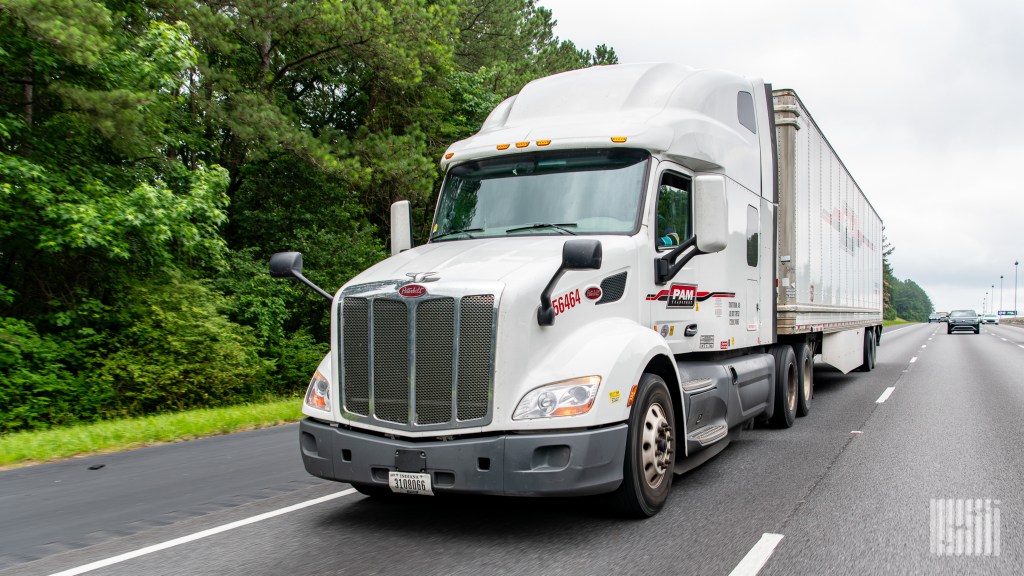
a white Pamt tractor pulling a white Pamt trailer

Pamt Corp., formerly Pam Transportation Services, reported a third straight net loss on Friday after the market closed. Nearly one-third of the company’s revenue is tied to the automobile industry, where demand is starting to be negatively impacted by tariffs.

The Tontitown, Arkansas-based truckload carrier’s second-quarter net loss of $9.6 million, or 46 cents per share, outpaced losses of 13 cents per share in the year-ago quarter and 37 cents per share in the 2025 first quarter.

On a year-over-year comparison, the per-share results benefitted from a $4.3 million increase in gains on equipment sales (a 15-cent tailwind) and a $2.1 million increase in non-operating income (a 7-cent tailwind). Higher interest expense was a 3-cent headwind in the period.

Changes in Pamt’s (NASDAQ: PAMT) non-operating income are largely driven by fluctuations in the market value of its equity securities portfolio (including dividends received) and lease income from a facility, among other items.

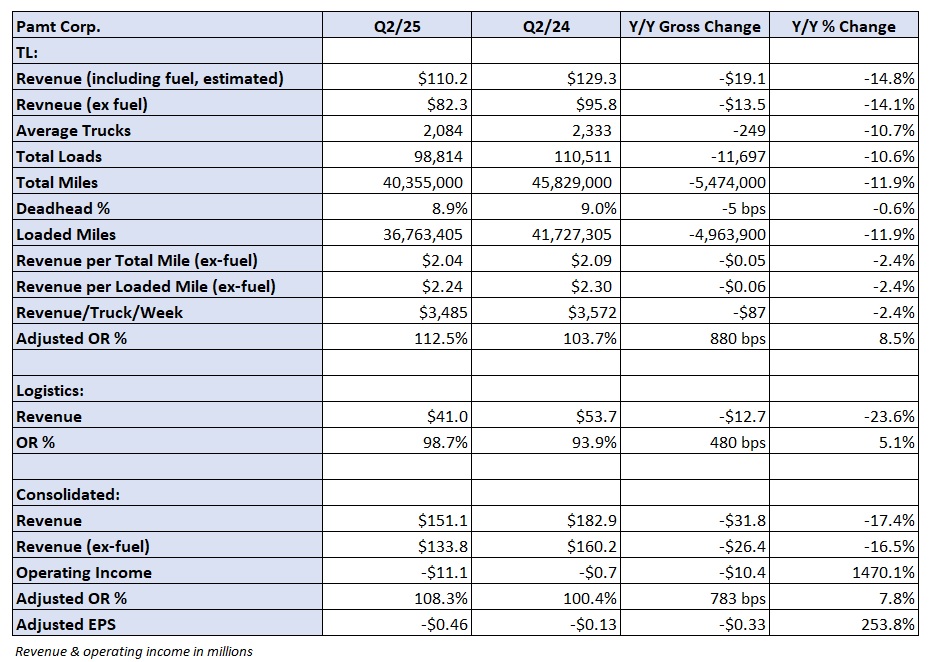
Table: Pamt’s key performance indicators

Second-quarter consolidated revenue of $151 million was 17% lower y/y and 3% lower than the first quarter.

The TL segment saw a 14% y/y decline in revenue as average trucks in service fell 11% and revenue per truck per week was down 2%. Trucks operated by company drivers declined 18% y/y while trucks driven by owner-operators increased 22%.

Loaded miles were off 12% y/y in the quarter and revenue per loaded mile dipped 2% to $2.24, excluding fuel surcharges.

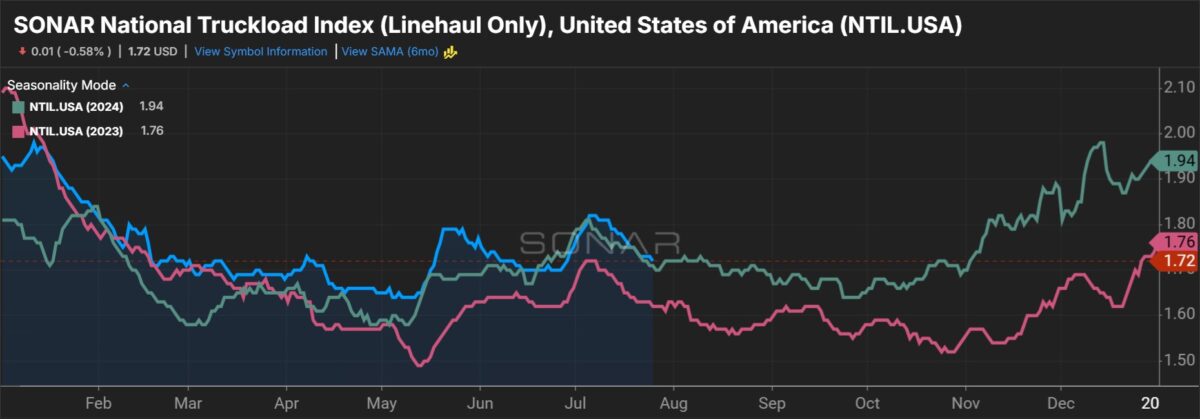
SONAR: National Truckload Index (linehaul only – NTIL) for 2025 (blue shaded area), 2024 (green line) and 2023 (pink line). The NTIL is based on an average of booked spot dry van loads from 250,000 lanes. The NTIL is a seven-day moving average of linehaul spot rates excluding fuel. Spot rates remain slightly higher on a y/y comparison. To learn more about SONAR, click here.

The TL unit recorded a 112.5% adjusted operating ratio (inverse of operating margin), which was 880 basis points worse y/y and 160 bps worse sequentially. This was the seventh straight operating loss for the unit.

Salaries, wages and benefits expenses increased 310 bps y/y (as a percentage of revenue) even with the reduction in company drivers. Rents and purchased transportation expenses were 200 bps higher and depreciation expense was 420 bps higher. (All expense lines are reported on a consolidated basis.) 

The company’s logistics unit reported a 24% y/y decline in revenue to $41 million. A 98.7% OR was 480 worse y/y and 70 bps worse than the first quarter. (Pamt doesn’t provide gross profit margins for the unit, or operating metrics like load counts and revenue per load.)

Pamt generated operating cash flow of $17.2 million in the first half of 2025.

Liquidity (cash, equity holdings and availability on its line of credit) of $177 million at the end of the quarter was $14 million higher than at the end of the first quarter. Outstanding debt of $331 million was $22 million higher sequentially.

Shares of PAMT were off 4.2% in after-hours trading on Friday.

More FreightWaves articles by Todd Maiden:

Nevoya’s $9.3M Bet on AI-powered electric trucks

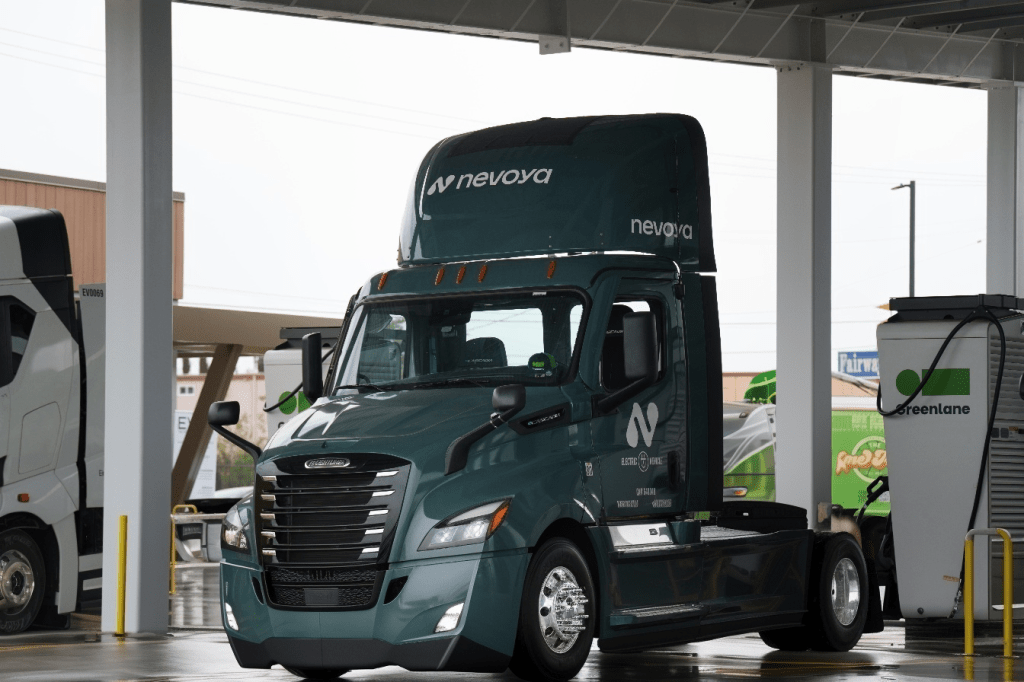
Nevoya electric truck

Nevoya, an all-electric trucking company, has secured $9.3 million in seed financing led by Lowercarbon Capital, with participation from Floating Point, LMNT Ventures, and existing investors Third Sphere, Stepchange, and Never Lift. The San Francisco-based company recently announced the funding as it looks to position itself to redefine logistics through AI and workflow automation.

The investment comes as the global electric truck market is projected to reach $125 billion by 2030. For Nevoya, it looks to demonstrate that zero-emissions trucking can outperform traditional diesel operations both environmentally and economically.

“We don’t just move freight—we embed ourselves in our customers’ operations, uncovering insights that others miss,” said Sami Khan, co-founder and CEO of Nevoya, in the release. “This customer-centric approach drives our technology development, ensuring the transition to zero-emissions trucking is seamless.”

Nevoya uses a proprietary AI-powered Transportation Management System (TMS) to turn the complexity of zero-emissions trucking into a competitive advantage. Part of this comes through intelligent orchestration, predictive operations, real-time visibility, and continuous optimization. Unlike traditional carriers that retrofit electric vehicles (EVs) into existing operations, Nevoya was built from the ground up for EV operations.

“Nevoya is an AI-orchestrated, electric-first freight carrier that’s already outperforming legacy diesel trucking economics, and we’re betting they’ll scale faster too,” said Shawn Xu, partner at Lowercarbon Capital, in the release.

Nevoya plans to use the funding to accelerate expansion into new freight corridors and markets, enhance its TMS platform, accelerate partnerships with industry leaders, and scale its team across sales, customer success, engineering, and operations.

The company notes that in just six months, it has onboarded Fortune 500 customers and leading 3PLs, as it looks to demonstrate that zero-emissions freight can be cost-competitive while at the same time delivering superior and reliable service.

Kodiak Robotics appoints former Cruise executive Mo Elshenawy to board of directors

(Photo: Kodiak Robotics)

Kodiak Robotics, a provider of AI-powered autonomous vehicle technology, recently announced the appointment of Mohamed “Mo” Elshenawy to its board of directors. Elshenawy, who previously served as president and chief technology officer at Cruise LLC, brings more than two decades of experience in AI, product development and engineering across autonomous mobility, e-commerce, cloud infrastructure and healthcare sectors.

The appointment comes as Kodiak prepares to become a publicly listed company through a business combination with Ares Acquisition Corporation II. The deal is expected to close in the second half of 2025.

“Mo guided Cruise through critical phases of technology and operational development, and helped manage Cruise’s integration into a wholly-owned subsidiary of General Motors,” said Don Burnette, founder and CEO of Kodiak, in a press release. “His expertise in technology platform transformation, expanding world-class engineering organizations, and deploying AI into real-world operations will be invaluable as we scale our product deployment.”

While at Cruise, Elshenawy led the transformation of the company’s autonomous vehicle programs, launching and scaling the first commercial driverless rideshare service in San Francisco and expanding operations to multiple U.S. cities. He currently serves as chief technology officer at Hims & Hers Health, Inc., where he focuses on building a next-generation healthcare platform powered by AI.

“Kodiak has a deep history of the kind of focused, pragmatic innovation that’s needed to bring autonomous trucking to scale,” said Elshenawy. “I’m excited to support such an innovative company as they advance a category-defining platform built on safety, performance, and real-world impact.”

Elshenawy joins recent board additions Ken Goldman, a seasoned financial executive, and Kristin Sverchek, president of Lyft, as Kodiak strengthens its leadership team. Upon completion of the business combination, the company will be renamed Kodiak AI, Inc.

You’re halfway there! To read the rest of the Truck Tech newsletter, subscribe below. It’ll be delivered to your inbox every Friday at 11am eastern.

While you’re at it, check out this week’s episode.

The Referral Engine – How to Turn One Shipper into Three

Some small carriers chase new freight like it’s a numbers game. They blast emails, cold call every logistics contact they can find on LinkedIn, and undercut rates just to get a shot at the next load. It’s a hustle. And while it might land you a load here and there, it doesn’t build staying power.

But the smartest carriers don’t chase—they multiply.

They take one shipper, serve them so well it becomes their calling card, then use that relationship to unlock two, three, even five more. No cold calls. No rate wars. Just results that speak louder than sales pitches.

That’s what a referral engine is. And if you’re serious about building a freight book that doesn’t evaporate every time the market dips, it’s time to stop treating referrals like luck—and start treating them like a system.

This article breaks down exactly how to do it.

Start with Execution They Can’t Ignore

The first rule of building a referral engine?

Be referable.

That means delivering service so clean, so consistent, so professional that your shipper doesn’t just trust you—they talk about you. And not because you asked, but because they want to.

On-time delivery, spotless equipment, real-time communication, and issue resolution without finger-pointing—that’s not “above and beyond.” That’s your starting point. You want shippers saying, “I wish all our carriers ran like this.” That’s when doors start opening.

One small fleet we coach doesn’t just meet their pickup windows—they beat them. If the window is 8:00–8:30, they’re in the dock at 7:55. They don’t wait for check calls—they send proactive updates before anyone has to ask. Their trucks are clean, their drivers are courteous, and their paperwork is never missing. That consistency builds confidence. And confidence leads to conversations that go far beyond the current PO.

You don’t need a massive fleet to build this kind of reputation. You just need execution that’s too good to ignore.

Be the Carrier They Brag About

When shippers are impressed, they talk. Not just to their team. To other facilities, other departments, their 3PL partners, their vendor networks. And they don’t brag because they like you—they brag because you made their life easier.

That’s the part most carriers miss. Referrals aren’t about doing a good job. They’re about solving real problems—problems your shipper can explain to someone else.

Ask yourself: Are you giving your current shippers a reason to mention your name in the next meeting they sit in?

We worked with a fleet that took over a nightmare retail account. The previous carrier was constantly late, always blaming traffic or breakdowns. Claims were through the roof. The shipper’s buyer was on the hot seat weekly. This carrier cleaned it up in 60 days—cut late deliveries in half, fixed POD issues, and improved vendor scorecards across the board.

The buyer was so impressed, they introduced the fleet to two other retail divisions under the same corporate umbrella. No cold call. No pitch deck. Just results.

If your service makes your point of contact look good to their boss, they will introduce you. It’s not personal—it’s strategic. And that’s exactly what you want.

Ask Without Sounding Desperate

Once your performance is tight and your shipper trusts you, it’s time to make the ask. But here’s the thing: you can’t sound like you’re struggling.

Too many smaller carriers kill the moment with a weak pitch:
“Hey, do you have any other freight we can haul?”

That doesn’t inspire confidence. It sounds like you’re chasing survival, not delivering value.

Instead, frame it around what’s already working.

Try this:
“We’ve had a lot of success keeping your loads on time and your customers satisfied. If there are other departments or facilities looking for that kind of consistency, we’d be happy to support them too.”

That’s not pushy. That’s not salesy. That’s leadership. You’re showing that your service has impact—and you’re offering to extend that impact where it’s needed.

And it works.

Build a Playbook for Referrals

If referrals are a random win in your business, you’re leaving growth to chance.
Smart carriers don’t wait for referrals to happen. They build them into the process.

Here’s how to turn it from luck into leverage:

1. Set the 60-Day Trigger

After 60 to 90 days of consistent, high-quality service, ask for feedback. Use that conversation to plant the seed:
“We’ve really enjoyed supporting your team. Are there other locations or contacts we should be speaking with?”

You’re not selling. You’re expanding. Big difference.

2. Track and Document Your Wins

Keep a file of every positive result—on-time percentages, reduced claims, thank-you emails, even successful recoveries on tight timelines. These are real-world case studies you can reference when talking to other departments or new prospects.

3. Train Your Team to Listen for Opportunities

Drivers and dispatchers are your eyes and ears. If a dock supervisor says, “You guys are way better than the last outfit,” that’s a referral opportunity. Teach your team to catch those comments and flag them for follow-up. Be sure you have established a referring platform like Google My Business, so that you can document these referrals!

4. Make Referring You Easy

Your shipper isn’t going to write a paragraph explaining what you do. So give them a one-pager: who you are, what you haul, your coverage area, and a few quick bullets on performance. If you make it easy to share, they will.

Referrals aren’t always formal. Most of the time, it’s a quick conversation in a meeting. Be ready for that window. That’s how doors open.

Expand Within the Customer First

Before you knock on cold doors, knock on the warm ones already open.

Many shippers operate across multiple locations, divisions, and business units. If you’re doing well at one DC, odds are there are three more that need help too. But they’re not going to call you. You have to take the first step.

One carrier we coached started with one food distribution center. They focused on cleaning up late loads, improved temp control communication, and built trust with the shipping manager. That led to an intro to the regional logistics team. Three months later, they were covering lanes for four additional DCs. All without sending a single cold email.

No RFP. No rebid. Just proof and process.

It’s always easier to grow from the inside than break in from the outside.
And if you’re already performing, there’s no reason you can’t scale within the same account.

FINAL WORD

Referrals aren’t lucky breaks. They’re earned results.

They’re what happens when you stop trying to “get in” with everyone and start showing up differently for the few customers you already have.

You don’t need to be everywhere. You don’t need 100 shippers. You need five who trust you so much they tell their peers. That’s how sustainable growth works in this industry—one relationship at a time, backed by execution that speaks louder than any cold call ever could.

So stop chasing. Start multiplying.

Serve one account with excellence. Build trust. Document the results. Ask with confidence. Expand where the doors are already open. And turn that one shipper into three, then five, then ten.

That’s how small carriers build big books—by turning service into strategy.

Union Pacific expands domestic intermodal service

Union Pacific has announced a pair of new domestic intermodal lanes, with new service linking the Pacific Northwest with Chicago as well as between Memphis and Dallas.

On Saturday, UP (NYSE: UNP) will launch daily service from Tacoma, Wash., to its Global 4 terminal in Joliet, Ill., outside Chicago.

“This service will be complementary and in addition to the current domestic service from TacSim to Global 2. Service into the heart of the southern Chicago warehouse district offers shorter drays and more cost-effective access to a wide range of the metro and seamless drayage to reach markets beyond Chicago,” UP said in a customer advisory.

Service has already begun between UP’s terminal in Marion, Ark., across the Mississippi River from Memphis, and the railroad’s intermodal terminal in Mesquite, Texas, in the Dallas area.

“We’ve recently initiated service between Memphis, TN (Marion, AR) and Dallas, TX (Mesquite, TX) to offer a solution to convert over-the-road freight to intermodal. This service is also available seven days per week — streamlining your logistics in the South,” UP said.

Subscribe to FreightWaves’ Rail e-newsletter and get the latest insights on rail freight right in your inbox.

Related coverage:

Union Pacific posts record financial results

Five takeaways from the State of Freight for July: What earnings and the indices are saying about the market

Union Pacific and Norfolk Southern confirm advanced merger talks

CSX profits fall on lower revenue, higher costs

Saia beginning to shake off growing pains

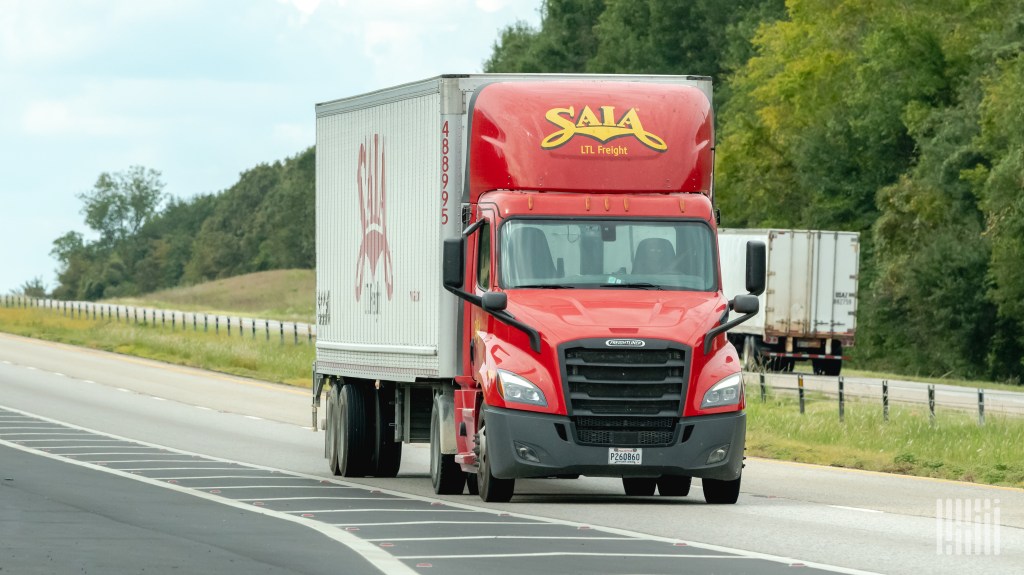
A red Saia daycab tractor pulling a white Saia trailer on a highway

The 2025 first quarter could be the operational nadir for less-than-truckload carrier Saia. The company reported sequential improvement in second-quarter financial results on Friday as it appears to have a better handle on costs following a significant expansion to its terminal footprint.

Saia (NASDAQ: SAIA) had 21 more facilities in the second quarter than it did a year ago. The added costs weighed on results as the carrier is still in the process of matching head count to volumes.

The Johns Creek, Georgia-based company reported second-quarter earnings per share of $2.67 before the market opened on Friday. The result was 28 cents ahead of the consensus estimate and 81 cents better than the first quarter.

However, on a year-over-year comparison, EPS was down $1.16, with the bulk of the deterioration tied to startup costs at new locations. Higher interest expense (debt used to fund the terminal purchases pushed net debt $125 million higher y/y) and a slightly higher tax rate combined for a 10-cent drag on the quarter.

Table: Saia’s key performance indicators

Tonnage comps get tougher after 22-month run

Saia reported second-quarter revenue of $817 million, a less than 1% y/y decline but $9 million ahead of analysts’ expectations.

Tonnage increased 1% y/y, the result of a 3% decline in shipments, which was offset by a 4% increase in weight per shipment. On a y/y comparison, tonnage was 4.4% higher in April, down 0.4% in May and off 0.8% in June. Tonnage is flat y/y so far in July.

The y/y comparisons are now more formidable for Saia following 22 consecutive months of gains, which began just ahead of Yellow Corp.’s July 2023 collapse. Saia faces positive y/y comps ranging from mid-single- to low-double-digits for the rest of the year. The remaining third-quarter comps include y/y increases of 8% and 10% in August and September, respectively.

The carrier noted an unfavorable sequential mix shift toward lighter, retail freight at national accounts. (Weight per shipment was down 2% from the first quarter.)  Also, it had less freight originating in Los Angeles, which pushed length of haul 1% lower sequentially.

Revenue per hundredweight, or yield, was down 2% y/y (1% lower excluding fuel surcharges). The y/y increase in shipment weights was a drag on the yield metric and was only partially offset by a 1% y/y increase in length of haul. The carrier was also up against a plus-9% yield comp from a year ago.

Contacts renewed 5.1% higher on average in the quarter, a step down from the 6.1% average increase in the first quarter. Contract renewals, too, are comping mid- to high-single-digit increases from a year ago.

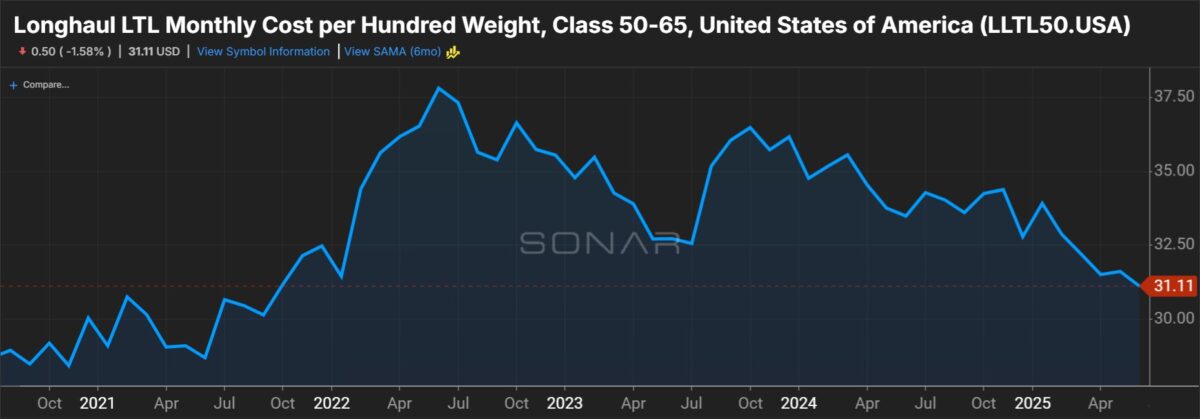
SONAR: Longhaul LTL Monthly Cost per Hundredweight, Class 50-65 Index. Less-than-truckload monthly indices are based on the median cost per hundredweight for four National Motor Freight Classification groupings and five different mileage bands. To learn more about SONAR, click here.

Operating ratio recovers from post-Covid-worst Q1/25

Saia reported a second-quarter operating ratio (inverse of operating margin) of 87.8%, which was 450 basis points worse y/y, but 330 bps better than the first quarter (the carrier’s worst operating performance since the pandemic). The result was also 120 bps better than management’s guidance.

Cost per shipment was up 7.7% but revenue per shipment increased just 1.8%, a 590-bp negative spread. Cost per shipment was down 4% from the first quarter.

Terminals opened less than three years operated at a mid-90% OR during the second quarter, which was an improvement from breakeven results in the first quarter. Most of the newer locations reported improved efficiency metrics. The new locations have also helped Saia reduce the number of shipment touches across the network.

Salaries, wages and benefits expenses were 260 bps higher y/y as a percentage of revenue. The company implemented an annual wages-and-benefits increase of 4.1% in July 2024 but hasn’t decided if an increase is in store for 2025. Head count was reduced 4.2% from March to June, which should begin to take some pressure off the expense line.

Depreciation and amortization expense was up 130 bps y/y due to recent terminal investments. Purchased transportation expense declined 40 bps y/y.

The company normally sees 100 to 200 bps of OR degradation from the second to third quarter. However, it hopes recent cost actions will allow it to minimize the degradation to just 100 bps this year. The OR guidance could be negatively impacted by roughly 75 bps if it decides to implement an annual compensation increase similar to last year.

The loose guide implies an 88.8% OR in the third quarter, which would be 370 bps worse y/y. The company’s long-term OR goal remains at sub-80%.

In aggregate, Saia has inked deals to buy 31 terminals from defunct Yellow (OTC: YELLQ). Saia now operates a full-scale, national network of 213 terminals.

Shares of Saia were up 5.6% at 2:46 p.m. EDT on Friday compared to the S&P 500, which was up 0.5%.

More FreightWaves articles by Todd Maiden:

Creating a Safety Review Process That Doesn’t Slow You Down

You don’t need more meetings. You need better habits. Many carriers hear the word “safety review” and immediately think of three-hour meetings, binders collecting dust, and a compliance officer nobody wants to talk to. That kind of thinking is exactly why safety becomes a scramble—something you deal with after a violation, not before it.

But here’s the truth: safety shouldn’t be separate from the business—it should be baked into the rhythm of your operation. If it slows you down, your team won’t stick to it. And if your team isn’t sticking to it, you’re not building a culture—you’re running on hope.

This article breaks down how to build a real-time, no-fluff safety review process that actually fits into your day-to-day. It won’t pull your drivers off the road. It won’t take your dispatchers off the phone. And it won’t require hiring someone just to manage it. This is the same playbook used by small carriers that stay audit-ready, reduce violations, and stay profitable—without overcomplicating the process.

Start Where the Risk Lives

If you’re only looking at logs, violations, and FMCSA emails, you’re already too late.
Safety doesn’t start on paper. It starts with people. And the real risk shows up long before the paperwork does—in driver behavior, skipped inspections, missed steps, and the pressure to cut corners just to keep loads moving.

That’s where you need to aim your process. Not at the result—the violation—but at the root cause. Most safety breakdowns don’t happen in a training room. They happen on the lot, at the fuel island, during a rushed pre-trip, or late at night when a driver’s pushing through fatigue.

So instead of building a process around quarterly meetings and after-the-fact checklists, build your process around daily visibility and real-time accountability.

Start with this question: Where does risk show up in our operation every single day?
Then build your process right there. Embedded in the work, not on a whiteboard.

Three Simple Places to Start That Don’t Disrupt the Operation

You don’t need a 50-page SOP to start building a safer operation. You need a few consistent moves your team can actually stick to.

1. Daily Walkaround Photos


Before their first load each day, every driver sends in a few quick, timestamped photos of their walkaround inspection. Doesn’t have to be fancy. A few photos showing tires, lights, the fifth wheel, and the trailer connection are enough. Text it. Upload it. However it gets there, it proves the job got done.

Why it works:

  • Puts visual accountability into the pre-trip
  • Helps catch small issues before they become breakdowns
  • Shows your operation has a live trail of inspection activity

You don’t need an app. You need a habit.

2. Weekly 10-Minute Safety Huddles


Skip the all-hands meetings that no one has time for. Every Friday, host a quick 10-minute Zoom, phone call, or in-person huddle. Cover one specific issue: seat belt compliance, distracted driving, brake wear, tire pressure. Rotate topics. Use real examples. Keep it fast.

Why it works:

  • Keeps safety in the conversation without draining hours
  • Creates space for drivers to speak up and ask questions
  • Turns safety from a lecture into a discussion

Keep notes. Save recordings. Build a real track record of your team engaging with safety.

3. Violation Reviews Within 48 Hours


Whenever a driver gets hit with a roadside violation, ELD flag, or maintenance issue, review it within two days—no exceptions. Sit down with the driver (virtually or in person), break down what happened, and log the fix.

Why it works:

  • Prevents repeat mistakes while it’s still fresh
  • Reinforces accountability without turning it into a witch hunt
  • Builds a habit of timely follow-through

If you wait until month-end to review violations, you’ve already lost the opportunity to coach. Addressing it fast shows your team that safety is a priority, not just paperwork.

Track Trends, Not Just Incidents

One flat tire isn’t a crisis. Two in two weeks? That’s a red flag.
One HOS edit might be a mistake. Five in a month? That’s a coaching moment.

You can’t manage what you don’t measure. But more importantly, you can’t fix what you don’t track. Safety isn’t about reacting to random events—it’s about spotting patterns early and acting fast.

Start treating your safety data like you treat your fuel cost or revenue per mile.

Here’s a simple weekly framework that small fleets can manage without hiring a safety analyst:

The 5-Part Safety Snapshot:

  • Category: What kind of issue? (Speeding, log edits, DVIR misses, etc.)
  • Date: When did it occur?
  • Driver: Who was involved?
  • Response: What action was taken? (Coaching, fix, retraining)
  • Preventive Step: What’s the plan to stop it from happening again?

Review your sheet every Friday. Look for clusters. If three different drivers had brake-related issues this week, that’s a systems problem—not just a driver issue. This approach moves your business from reactive to proactive—and that’s where profit lives.

Turn Safety Into a Shared Scoreboard

Here’s the hard truth: Drivers won’t engage with safety if it’s only used to punish them.
You want them to buy in? Make it a performance metric, not a penalty box.

When you track and share safety stats the same way you track fuel economy or on-time percentage, drivers start seeing it as part of their job—not just something they get yelled at about.

How to set it up:

  • Post monthly safety results by truck number, not driver name
  • Include clean inspections, violations, DVIR completion rates
  • Celebrate top performers every month in your team chat, safety huddle, or driver board
  • Tie recognition to something real—better lanes, early dispatch, even simple thank-you calls

This isn’t about gift cards. It’s about pride.
It’s about letting drivers see that their effort is noticed. That their clean inspection matters. That someone’s keeping score—and it’s not just the DOT.

Don’t Wait for the Audit to Get Organized

Most carriers don’t take safety seriously until it’s too late. Either a compliance review letter hits their inbox, or they get caught off guard after a roadside inspection. By then, it’s scramble mode. Everyone’s hunting for files. Logs are out of sync. And the audit clock is ticking.

Let’s be clear: if your safety process only kicks in during a crisis, you don’t have a system—you have a liability.

A strong safety review process means when FMCSA shows up, you’re not nervous. You’re ready.

Here’s your bare-minimum checklist to stay audit-ready year-round:

  • Driver qualification files reviewed and signed every 6 months
  • Maintenance records with part numbers, service dates, and repair logs
  • Drug & alcohol testing results sorted by driver ID and date
  • Weekly review of all ELD violations and HOS edits
  • Documented safety huddles with topic, date, and attendees

If you can’t pull all that up in 5 minutes, fix it now. Not later. Because “later” is how fleets get fined, downgraded, or shut down.

Final Word

Safety isn’t a one-time event or something you handle when you finally have time. If it’s not part of your daily rhythm, it’s already at risk of falling apart.

A good safety process doesn’t add friction—it removes uncertainty. It keeps your team aligned. It keeps your trucks moving. And it keeps your business off FMCSA’s radar.

When safety becomes a daily habit—not a quarterly scramble—you don’t just stay compliant. You build a culture of accountability that protects your people, your freight, and your future.

Build a system that works with your operation, not against it. Make it visible. Make it simple. Make it stick.

Because when safety is part of how you operate—not just what you respond to—it stops being a burden and starts being a business advantage.

Ryder’s used vehicle numbers show a bullish corner: tractor sales

Used vehicle prices have always played a significant role at profitability for Ryder System as well as providing guidance on where the broader market stands. The company’s second quarter earnings report was no different.

With Ryder (NYSE: R) taking a conservative outlook in making its outlook for the remainder of the year–its forecast is earnings per share of $12.85 – $13.30, down from an earlier projection of $12.85 – $13.60–used vehicle pricing’s fortunes aren’t seen as being that much different: stability with some hope for an increase.

The one positive number the company provided in its earnings report was that Ryder’s used tractor pricing rose 3% sequentially from the first quarter, even as Ryder’s used truck prices overall fell 10% compared to the first three months of the year. 

The year-on-year comparison was weaker, with average sales prices of both tractors and trucks declining 17% from the corresponding quarter of 2024.

In the question and answer session with analysts, Ryder CEO Robert Sanchez specifically highlighted the sequential increase in tractor pricing. He noted that the 3% sequential increase in tractor pricing includes a one-time shift to more sales through wholesale channels. If retail sales only were measured, he said, the gain was 10%.

“So we would expect that trend to continue,” Sanchez said. “We’re very encouraged by what we’re seeing in the used tractor market.”

Thomas Havens, the president of Fleet Management Solutions at Ryder, which does the buying and selling of vehicles at the company, said tractors with sleeper berths are “where you’re seeing the most price uplift in used vehicle sales.” He also said the company’s inventory of used sleeper tractors for sale is “relatively low.”

“And that’s what’s driving the pricing,” he said. “I think it’s an indication that you’re getting closer to equilibrium, at least on that class.”

Wholesale vs. retail

In her prepared remarks to the company’s conference call with analysts, Cristina Gallo-Aquino, the company’s CFO, said the results of Ryder’s used vehicle sales in the quarter were “negatively impacted” by its decision to move a lot of its inventory out the door through wholesale channels, which historically brings in less revenue per vehicle than selling through retail outlets.

But it was a one-time development, she added. “We do not plan on executing this level of wholesale trades going forward,” she said. 

Ryder’s used vehicle sales through retail outlets were about 50% of volume in the quarter, Gallo-Aquino said. A year earlier, that number was 65%, she added.  

That leaves the rest of the year, which Gallo-Aquino said Ryder expects to not have “any significant change to market conditions.” The company’s sales levels are expected to be in line with the first quarter for the remainder of the year. Ryder sold 5,100 used vehicles in the first quarter, rising to 6,200 in the second quarter when the wholesale sales channels were heavily utilized.

Two other key metrics for Ryder’s used vehicle inventory are its inventory levels and realized prices versus residual values that are baked into the company’s asset valuation. Gallo-Aquino said at 9,600, the company’s inventory of used vehicles “was slightly above our targeted inventory range.” The prices it is obtaining in its sales are above residual values, she added.    

Ryder also is a buyer of vehicles. Sanchez said trucks at Ryder are about 60% of its rental fleet, and the company has been investing in those vehicles. 

He was more cautious about Ryder’s planned purchase of tractors, saying the company “(expects) that we would invest in some tractors in the rental fleet probably in 2026, but we’ll wait to see as the market improves before we do that and grow that tractor fleet again.”

On a separate issue, Ryder president and COO John Diez reviewed several data points on the call about the company’s balance sheet, including higher cash flow generation and a concurrent deleveraging that he said is “creating incremental debt capacity.”

The result of those changes, he said, would be about $3.5 billion of new debt capacity, which results in about $14 billion “available for capital deployment.” About $9 billion of that will be for equipment replacement and dividends, which leaves about $5 billion that in part could be used for “strategic acquisitions and investments.”

That brought a question from Ravi Shanker of Morgan Stanley, who said it was “great to see the dry powder on the balance sheet here.”

Sanchez in response said the company was “always looking for acquisition opportunities.”

What it would buy

He elaborated later on Ryder’s acquisition strategy. 

“I want to buy companies that are well run,” he said. “We’re not looking for turnaround situations, and we want to buy companies that are certainly within our core businesses. So we’re in the market always.”

Ryder’s two most recent acquisitions, both mentioned by Sanchez on the call, were of Cardinal Logistics, which led to a major growth in the company’s Dedicated division, and IFS, which slotted into its contract logistics Supply Chain Services segment.

Coming back to Shanker’s description of the balance sheet, Sanchez said of acquisitions: “We’ve got plenty of dry powder now to do it, and we’re going to continue to look until we find the right ones.”

More articles by John Kingston

Yet another broker liability case, this time in the Fifth Circuit, adds to the growing mix 

Supply chain software provider Manhattan Associates soars after strong revenue growth

Five takeaways from the State of Freight for July: What earnings and the indices are saying about the market