Small increase in benchmark diesel is fourth in five weeks

The benchmark price used for most fuel surcharges rose this week, resuming an upward trend that broader markets appear to believe have some more room to rise.

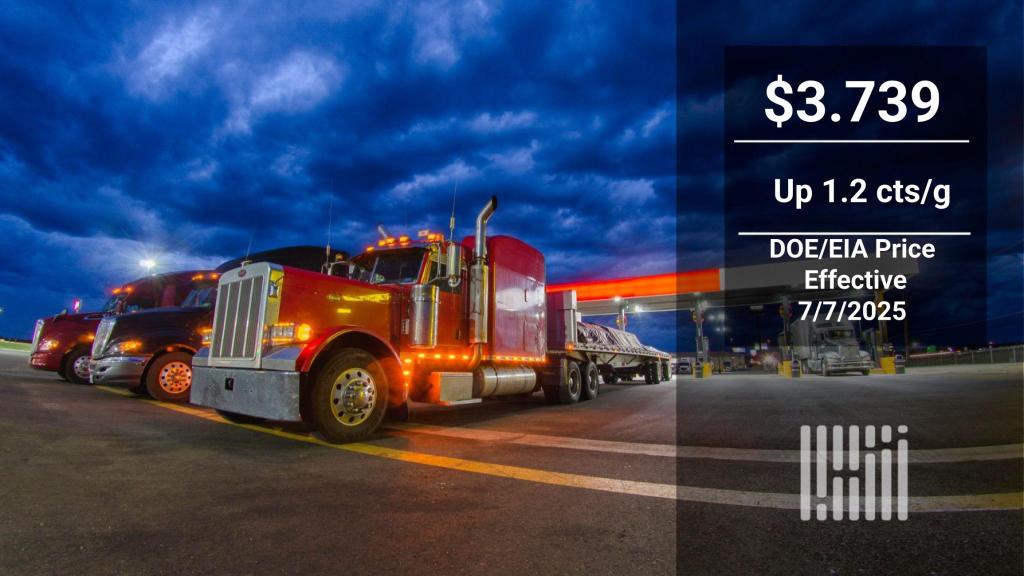
The weekly Department of Energy/Energy Information Administration average weekly retail diesel price rose 1.2 cents/gallon effective Monday, announced Tuesday, to $3.739/g. It’s the fourth increase in the last five weeks, with the price effective June 30, a week ago, posting a decline in that stretch.

While broad market forecasts continue to show an oil surplus in the second half of 2025, the OPEC+ group this past weekend acted as if the supply/demand balance was calling for more oil to be put on the market, and that’s what it did. 

A subset of the OPEC+ group met virtually Saturday and agreed to add 548,000 barrels/day of oil back on to the market in August. That the group was going to increase its supply was a foregone conclusion. 

But market analysts expected the OPEC+ group to add just another 411,000 b/d increase, which has been the size of the increases the group has been approving for several months.

The increases have been an unwinding of a series of cuts in output that the OPEC+ group–which consists of OPEC and a group of non-OPEC oil exporters nominally led by Russia–had in place since 2023.  

The increases are the opposite of what might be expected given the forecasts of a supply/demand imbalance that favors buyers. 

In the most recent monthly report of the International Energy Agency, the IEA said “in the absence of a major disruption, oil markets in 2025 look well supplied.”

The IEA spelled out a scenario in which global oil demand was expected to increase just 720,000 bd this year. The increase for July and August alone would cover that higher demand.

Despite the larger than expected increase in supply coming out of OPEC+, oil markets came out the weekend with a sharp increase. Ultra low sulfur diesel on the CME commodity exchange rose 5.13 cts/g to $2.4211/g, having climbed 11.39 cts/g since June 27.  However, prices have not regained the highs that accompanied the early days of the fiercest fighting between Iran and Israel in mid-June. 

Crude and diesel prices on CME were slightly higher in early trade Tuesday.

In a separate action, according to news agencies, Saudi Arabia announced an increase in its price formula for August sales that reflected a belief in a strong market.

Saudi crude pricing is calculated as a differential against key benchmarks, such as Brent for European sales and a basket of crudes in the U.S. The differential moves up and down in decisions announced by the Saudis a month in advance and are looked to by the broader market as a sign of how the Kingdom views strength in demand. 

The other factor continuing to drive diesel prices higher, at a rate faster than changes in crude markets, remains global inventories. In an article published Monday, Bloomberg quoted the energy analysis firm of Energy Aspects which said in June, diesel output as a percentage of total products output globally was 31.4%, which it said is significantly less than normal levels. 

That can be seen in the spread between ULSD and Brent on CME. A comparison of the front month produces a spread that has settled at more than 70 cts/g for the last five trading days. At the start of June, it was just over 50 cts/g.

More articles by John Kingston

XPO rating cut by S&P, agency cites continuing weak freight market

First legal steps taken, this time by WSTA, to untangle the legal knot of the Clean Truck Partnership

Two positive votes on logistics at Moody’s: GXO and C.H. Robinson

Atlanta freight market outperformed during July 4th

The Fourth of July is a significant benchmark for the U.S. truckload market, marking a seasonal uptick in demand that challenges transportation providers across the country. Historically, this holiday period is characterized by heightened freight activities driven by an increase in consumer spending and the need for timely distributions of goods as various industries prepare for summer events and promotions. This demand surge, while lucrative for carriers, simultaneously strains the logistics network, as evidenced by recent trends in tender rejection rates and spot rates.

Tender rejection rates, a metric for gauging how often carriers decline contracted loads, have demonstrated significant fluctuations leading up to July 4th. According to SONAR , the national average Outbound Tender Rejection Index (OTRI) climbed above 7.8% at its peak on July 1. This uptick indicates that carriers are benefiting from tighter capacity and strained networks, enabling them to opt for higher-paying spot market opportunities over less profitable contract obligations. These conditions create a freight environment where higher rejection rates are symptomatic of a system near full capacity, affording carriers the leverage to be selective and capitalize on elevated spot rates.

(The National Truckload Index is an average of truckload spot rates inclusive of fuel, expressed in USD/mile. Chart: SONAR. To learn more about SONAR, click here)

The National Truckload Index (NTI), which tracks the average national spot rate, recently saw a surge, climbing to $2.39 per mile. These fluctuations are driven partly by seasonal factors and broader economic conditions such as inflation and rising operational costs. The spot market, unlike contract freight, allows for dynamic pricing based on real-time supply and demand imbalances, which can lead to substantial rate increases during periods of elevated demand.

(The Outbound Tender Rejection Index measures the percentage of truckloads tendered by shippers that are rejected by carriers. Chart: SONAR. To learn more about SONAR, click here)

Analyzing the market-level data reveals that Atlanta has recently outperformed other major freight hubs, demonstrating a surge in demand distinct to its region. The Outbound Tender Rejection Index (OTRI) for Atlanta peaked later than the national market, on July 5, at 11.2%, highlighting the localized nature of this demand spike. This pattern of divergence emphasizes the uneven recovery and differing dynamics across the national market. The heightened OTRI levels suggest that carriers in Atlanta are benefiting from a favorable mix of strong demand and constrained capacity, which enables them to refine their pricing and load selection strategies effectively.

In addition to Atlanta, the Dallas market has also experienced significant increases in tender rejections, peaking at 10.2% amid localized pressures tied to specific industry sectors. As regional differences in freight demand become pronounced, transportation providers are likely to find varying conditions challenging, requiring nimble strategies to maintain balance and profitability.

Looking ahead to the rest of the summer, transportation providers should brace for continued volatility in tender rejections and spot rates, as uncertain economic conditions and fluctuating consumer confidence affect freight volumes. The gradual contraction of capacity, a remnant of the post-pandemic market correction, suggests that carriers may continue to wield greater leverage in the freight market. For shippers, this environment necessitates adaptability and proactive engagement with carriers to secure favorable terms.

The driving forces of supply chain interruptions, economic headwinds, and evolving trade policies will likely persist, necessitating a strategic outlook for both carriers and brokers to navigate these complexities effectively. Freight brokers should probably bid conservatively on Q4 projects. Those who can effectively adjust their operations and pricing strategies to accommodate market demands stand to benefit as the transportation sector approaches the latter half of the year.

US imports of Mexican-made cars, pickup trucks rise 14% in June

Mexico’s automotive manufacturing industry exported 331,517 passenger vehicles and pickup trucks in June, a 14% year-over-year increase compared to the same period last year.

Production of vehicles across Mexico increased 4.9% year-over-year during the month at 361,047 units, according to data from Mexico’s National Institute of Statistics and Geography (INEGI).

The U.S. market was the main destination for exports, accounting for 80% in June, followed by Canada at 10.9%, Germany at 2.6% and Colombia at 1%.

Odracir Barquera, general director of the Mexican Association of the Automotive Industry (AMIA), said while results for the month are positive, the market is still facing uncertainty from President Donald Trump’s tariff policy.

“June is the best month in the entire production record and also the best first half of the year, which is good news,” Barquera said during a video conference on Monday. “However, we must be cautious about the continued performance of the markets to which we export, as well as the current situation with U.S. trade decisions.”

Mexico City-based AMIA is a chamber association formed in 1951 to represent the interests of foreign vehicle manufacturers established in Mexico, including Audi, BMW, FCA, Ford, GM, Honda, JAC, KIA, Mazda, Nissan, Toyota and Volkswagen.

From January through June, auto factories in Mexico exported 666,184 cars and pickup trucks, a 2.8% year-over-year decrease. Total auto production during the first six months of the year increased 0.5% to 2 million vehicles compared to the same period in 2024.

Pickup trucks accounted for 76% of total vehicles produced at Mexican auto factories during June, INEGI reported.

GM factories in Mexico exported 72,324 units in June, a 56.4% year-over-year increase.

In Mexico, Detroit-based GM has three production complexes, including plants in the cities of Ramos Arizpe (Chevy Blazer and Equinox), Silao (Chevy Silverado 1500 and GMC Sierra 1500) and San Luis Potosi (GMC Terrain and Chevy Equinox), according to GM Authority

Nissan exported 53,289 passenger vehicles during the month, a 27.1% year-over-year increase. Japan-based Nissan has two factories in Mexico where it produces models such as the Sentra and Kicks.

Toyota exported 26,974 units during June, a 15% year-over-year gain over the same period in 2024. The Japanese automaker produces the Tacoma pickup truck and the Corolla sedan in Mexico.

US parcel market to grow 36% by 2030, Pitney Bowes says

A two-tone blue Amazon Prime delivery van on a city street.

Revenue growth for U.S. parcel shipping lagged volumes last year as an influx of new last-mile delivery companies put downward pressure on prices in a market that is expected to grow 36% by 2030, according to an annual industry report from Pitney Bowes.  

Smaller carriers are increasingly taking market share from legacy carriers FedEx, UPS and the U.S. Postal Service, but their biggest threat is Amazon. The retailer’s logistics operation handled 6.3 billion parcels in 2024, up 7.3% year over year, and is expected to overtake the Postal Service by 2028, Pitney Bowes (NYSE: PBI) said in its recent Parcel Shipping Index

The provider of mail and parcel shipping services, technology and equipment said U.S. parcel volume increased 3.4% to 22.4 billion shipments last year and estimated it will grow 5% per year to $30.5 billion in 2030. Revenue, however, grew 2.7% last year to $203.2 billion.

Carriers are increasingly offering competitive pricing to attract customers, leading to lower revenue. Carrier revenue per parcel ticked down to $9.09 down from $9.10 in 2023, according to Pitney Bowes. Independent couriers gaining market traction in recent years include OnTrac, Better Trucks, Jitsu, Veho, SpeedX, Speedy Delivery and UniUni. Many of them are startups or provide regional service with lower overhead than national carriers. The U.S. Postal Service’s new lost-cost shipping option, Ground Advantage, has also contributed to the pricing pressure.

“Since Pitney Bowes began tracking shipments a decade ago, the parcel market has been dominated by FedEx, UPS and USPS. We are witnessing a turning of the tide, evidenced by the nearly 40% volume growth in the five-year compound annual growth rate of [alternative] carriers,” said Pitney Bowes Executive Vice President Shemin Nurmohamed, in a news release. “This disruption presents a unique opportunity for businesses to take advantage of competitive pricing.”  

(Source: Pitney Bowes)

The Pitney Bowes findings echo earlier research from parcel management and consulting firm ShipMatrix Inc. It put domestic parcel revenue at $188 billion and average revenue per parcel at $8.  Domestic parcel volumes will grow at a compound annual rate of 4% over the next three years, with Amazon, Walmart and other carriers winning the lion’s share of new business. FedEx, UPS and the U.S. Postal Service will likely experience flat to negative growth, ShipMatrix said. 

The U.S. Postal Service retained its hold as the largest parcel carrier by volume with 6.9 billion shipments in 2024, an increase of 3.4% from the prior year, per Pitney Bowes. UPS volume increased 1.7% to 4.7 billion pieces. FedEx was the only carrier to experience a year-over-year decline, with 3.9 billion parcels compared to 3.7 billion in 2023. The combined volume for other small couriers jumped 23% to 800 million pieces. 

The Postal Service is the market share leader by volume at 31%. Amazon moved up a point to 28% of the market, followed by UPS with a 21% share. FedEx’s market share fell a point to 17%, while “other” carriers moved from 3% to 3.5%.

UPS led domestic carriers with $69.8 billion in revenue, followed by FedEx, at $63.2 billion, the Postal Service at $32.3 billion and Amazon Logistics at $31.1 billion. From a revenue standpoint, UPS controls 34% of the market. UPS and FedEx lost about 1% in revenue market share in 2024, while revenue market share for Amazon increased 1 point to 15.3% and from 2.8% to 3.4% for “other” carriers.

(Source: Pitney Bowes)

Domestic parcel growth slowed to 0.4% in the first quarter, according to Pitney Bowes’ figures. Weather disruptions and a freeze on handling shipments from China and Hong Kong valued below $800 after a change in U.S. tariff policy contributed to a 6.2% drop in U.S. Postal Service volumes. Meanwhile, UPS volumes declined 5.4% after the company began to implement a 50% service cut for its Amazon account. 

Pitney Bowes used quarterly and annual financial reports from the major carriers, quarterly operational data from the Postal Service, and data from Shein, Temu and other sources to compile the Parcel Shipping Index. FedEx operates on an unusual fiscal year, so its figures are based on December through November instead of a traditional calendar year. The report counts shipments weighing up to 70 pounds. 

Click here for more FreightWaves/American Shipper stories by Eric Kulisch.

FedEx, UPS lose parcel market share to big retailers, small couriers

DHL Express Canada reinstates service after workers ratify labor deal 

The One-Page SOP Every Owner Operator Should Be Using

Let’s say this upfront: if your dispatcher doesn’t have a one-page SOP taped to the wall, you’re already behind.

I’ve walked into hundreds of dispatch offices—some as clean as a cockpit, others looking like a paperwork tornado touched down. But there’s one thing that separates a dispatcher who owns the day from one who reacts to it: a crystal-clear, one-page standard operating procedure.

Not a novel. Not a flowchart only IT can read. One page. Clear steps. Non-negotiables. No fluff.

You don’t need more software. You don’t need another dispatch meeting. You need structure. And this SOP is the playbook for running your dispatch like a machine.

Why Every Dispatcher Needs an SOP They Can See, Follow, and Own

Most dispatchers are juggling a thousand things—load boards, driver calls, check calls, broker follow-ups, detention fights, fuel stops, the list goes on. Without a system, things fall through the cracks.

Loads get double-booked. Drivers sit too long. Communication gets sloppy. And when that happens, profit walks out the door.

The SOP isn’t about control—it’s about clarity. When the phones ring and the ELD pings, your dispatcher can’t guess. They need a guide that says: “Here’s how we handle it. Every time.”

This one-page SOP keeps your team aligned, focused, and fast. And when you’re trying to scale, that’s everything.

What Goes in the One-Page Dispatcher SOP

Here’s the exact structure I recommend. Keep it simple. Print it. Post it. Live it.

1. Morning Kickoff Checklist

Before they take a call or assign a load, your dispatcher should run through this every single day:

  • Review all driver ELD statuses and Hours of Service
  • Verify truck locations using the live GPS map and driver confirmations
  • Check upcoming scheduled loads for the day and next 48 hours
  • Confirm equipment readiness (reefer temps, securement tools, etc.)
  • Send check-in messages to all active drivers
  • Monitor weather or lane-specific alerts that could impact loads

Starting the day with full visibility avoids mistakes, reduces surprises, and puts your dispatcher in control from the jump.

2. Load Booking Flow

Whether you’re going direct or brokering through a load board, the SOP must lay out a repeatable process:

Step 1: Check your priority lanes and repeat shipper network
Step 2: Evaluate the rate per mile and rate per hour
Step 3: Confirm accurate shipper and consignee locations
Step 4: Verify driver availability, HOS, and equipment type
Step 5: Dispatch with full instructions—written, not verbal only
Step 6: Log appointments and delivery time windows in the TMS

Too many dispatchers skip steps to save time—and it always costs more later. This SOP removes the guesswork and cuts down on errors that wreck your margins.

3. Driver Communication Standards

This section sets the tone for your dispatch professionalism. Your team isn’t just managing trucks—they’re managing trust.

Your SOP should include:

  • The preferred method of driver communication (call, text, or app-based)
  • Expected response times (no longer than 15 minutes for check-ins)
  • Load update expectations (pickup, en route, delivered)
  • When to document, when to escalate

Example:
All check-in messages must be logged in the TMS within 5 minutes. If a driver is unresponsive for 30 minutes during a load, escalate to Operations Manager.

A dispatcher without communication standards is just winging it—and that leads to driver turnover, missed updates, and operational chaos.

4. Delay and Detention Protocol

Profit disappears when delays get ignored or handled reactively. This section of the SOP is your line of defense.

Here’s what it should include:

  • Time threshold for detention eligibility (usually 2 hours)
  • Broker or shipper contact info for escalation
  • What documentation is required—time-stamped texts, BOL, driver notes
  • Who submits the detention invoice and within what timeframe

Example:
If detention exceeds 2 hours, the dispatcher must alert the broker via email and phone, document timestamps in TMS, and submit the claim within 24 hours.

Don’t wait until Friday to chase detention from Tuesday. You either run a business or you chase scraps. This SOP makes sure you protect your time and your money.

5. Post-Delivery Wrap-Up

The job isn’t done at delivery—it’s done when the loop is closed clean.

Your dispatcher should:

  • Confirm POD is uploaded to TMS and billing platform
  • Verify all accessorials are documented (lumpers, scale tickets, etc.)
  • Mark actual delivery time and any delays in the system
  • Notify billing team that load is ready for invoicing
  • Schedule the driver’s next load or reset

A single missed POD can delay payment for days. A sloppy post-load process delays growth. You can’t scale chaos. You scale what’s clear and repeatable.

How to Implement the SOP in Real Life

Build it with your team
Sit down with your dispatcher and build the SOP together. Don’t surprise them with it—collaborate on it. The goal is ownership, not just compliance.

Print it and post it
One page. Big font. Laminated. Hang it up where they see it every day. This isn’t a PDF that collects dust—this is a playbook that runs the day.

Review it weekly
Every week, take five minutes and review one part of the SOP in your check-ins. Are we sticking to it? Are we skipping steps? This keeps the SOP alive and evolving.

Use it to train new dispatchers
Your SOP becomes your onboarding tool. Instead of explaining everything from scratch, you now have a baseline system that sets expectations from day one.

The Real Win – What Happens When You Use This SOP

  • Dispatch stops being reactive and starts being strategic
  • Drivers stay longer because communication is clear
  • Loads get booked and delivered with fewer issues
  • Cash flow improves because billing doesn’t get delayed
  • You stop firefighting and start scaling

All from one page. Simple doesn’t mean small—it means smart.

Final Word

Too many small carriers think dispatch is just about putting freight on trucks. It’s not. Dispatch is the heartbeat of your operation—and if that beat skips, your business suffers.

This SOP isn’t just a document. It’s how you create discipline. It’s how you get your time back. It’s how you build a business that doesn’t fall apart when you add trucks, drivers, or freight.

And if you don’t have one yet? You already know what to do.

If you want help building your dispatch system the right way, we teach this step-by-step inside the Playbook. Let’s build the foundation that actually scales.

Ritchey new CEO of Geodis Americas region

Transport and logistics provider Geodis announced the appointment of Laura Ritchey as president and chief executive officer of its Americas region. 

Ritchey will also join the group’s executive board, which is chaired by Geodis CEO Marie-Christine Lombard.

The company is headquartered in ​​Levallois-Perret, France. The Americas operation is based in Brentwood, Tenn.

In her new role, Ritchey will be responsible for the management and growth of the region’s various business units across North and South America, including contract logistics, freight forwarding, and transportation, the company said in a release. She will lead nearly 20,000 employees across eight countries the U.S., Canada, Mexico, Colombia, Chile, Peru, Argentina, and Brazil. 

Ritchey succeeds Mike Honious, who is retiring.

“With the U.S. being one of the top markets in our global network, Laura has the robust industry and leadership experience needed to continue strengthening Geodis’ position in this critical region,” Lombard said. “Laura’s unique knowledge of the logistics industry, including deep expertise in retail and e-commerce, and business acumen makes her the right leader to further the region’s incredible growth and help navigate in the face of today’s complex and ever-changing landscape.”

Most recently, Ritchey served as CEO at Radial, Inc., a prominent e-commerce fulfillment solutions provider.

Honious will remain in an advisory capacity to Lombard to assist with the transition and will continue to serve as a director for the Geodis Foundation and Geodis Compassion Fund.

Find more articles by Stuart Chirls here.

Related coverage:

Trump announces 25% tariffs on goods from Japan, South Korea 

UPS drivers to receive buyout offer as company shrinks parcel network

DHL Express Canada resumes service after workers ratify labor deal

DHL acquires US e-commerce logistics business IDS Fulfillment

Rules guiding Texas truck crash lawsuits need reform, expert says

Jerry Maldonado, director of Laredo and Mexico operations for Warren Transport Inc., said installing forward-facing cameras on his company’s fleet of trucks saved them from a lawsuit several years ago.

“One of our drivers was involved in an accident,” Maldonado testified during a Texas Senate committee on state affairs for Senate Bill 30 on April 8. “We had just installed our forward-facing cameras on the trucks and that camera saved us, because we got a lawsuit. That video was the first thing we sent to the attorney that sued us. He left us alone, because it clearly proved that our driver did nothing wrong.”

Senate Bill 30, and its companion piece, House Bill 4806, both died in the most recent Texas legislative session as lawmakers couldn’t agree on final versions of the proposed new laws.

The failure of the two bills meant that Maldonado and other trucking industry stakeholders would have to try again next year for tort reforms that put restrictions on injury lawsuit payouts.

“Its one of those battles that we lost, but we haven’t lost the war,” Maldonado told FreightWaves in an interview.

Maldonado said trucking companies are concerned about insurance rates rising because of massive lawsuit rewards.

“All of us that have commercial insurance, we have a minimum of $1 million rate liability insurance, so if there is ever an accident, whether it’s our fault or not, we immediately get a lawsuit for a million dollars,” Maldonado said. “What we consider abuse … where a fender bender that was our fault or wasn’t, could potentially have a $100,000 credible claim, gets a million dollars lawsuit, which is then settled for half a million. What are we doing here? We’ve been fighting that as an industry. Why? Because it affects us all.”

Maldonado said trucking companies even with no accident reports are affected by lawsuit payouts.  

“All our premiums are going to go up a little higher, and every year they continue to go higher,” Maldonado said. “That is one of those expenses whether you are a safe carrier or not, and there’s a lot of instances where a carrier is very safe, that they don’t have any accidents, no fatalities, no claims, yet the insurance premium goes up year over year because we are measured by our peers.”

The original version of Senate Bill 30 would have made significant changes in the financial penalties that could be levied against a defendant in a lawsuit involving injury. 

However, the San Antonio Express News said the death of SB30/HB4806 “came after it already had been pared down to an unrecognizable version that only required disclosure of referrals between lawyers and health care providers. It also would have expanded the options for what evidence could be admitted to estimate damages.”

“By the time it was going to end, the language … how they changed them and did amendments, it would have potentially hurt us more than help us,” Maldonado said.

In 2023, 5,375 large trucks were involved in a fatal crash, an 8.4% year-over-year decrease from 2022, according to the latest data analyzed by the National Safety Council, a nonprofit promoting health and safety in the U.S.

A total of 5,472 people died in large-truck crashes in 2023, NSC said in its report. The number of deaths decreased 8% year-over-year from 2022, but is up 40% in the last 10 years. The majority of deaths in large-truck crashes are occupants of other vehicles (70%), followed by truck occupants (18%), and non-occupants, primarily pedestrians and bicyclists (12%).

Also in 2023, 114,552 large trucks were involved in crashes resulting in an injury, a 4.7% decrease from 2022.

Maldonado said truck drivers are never looking to get into accidents or make mistakes.

“Our drivers are on the clock, that’s how they make a living. Their job, their goal is to get from point A to point B safely,” Maldonado said. “Yes, there are mistakes. Why? Because they’re exposed 10 times more than you and I. Our drivers are on the road every single day for 11 hours.”

Pro-business lobby Texans for Lawsuit Reform (TLR) prioritized SB30 in the Texas Legislature, aiming to limit the amount of damages accident victims could claim in personal injury and wrongful death lawsuits.

“We urge the Texas Legislature to prioritize this issue in the 90th Texas Legislative Session, and to put an end to the blatant fraud on the legal system which jeopardizes Texas’s longstanding reputation as the best place in the nation to do business and create jobs,” TLR said in a prepared statement to FreightWaves.

Lara Brock, president of the San Antonio Trial Lawyers Association and an attorney with Espinoza & Brock, said the bills could have made roadways less safe.

“Texas is the most dangerous state to be on the roads. We have almost twice as many deaths than in any other state in the entire country,” Brock told News 4 San Antonio on April 25.

The ATA’s waning influence irks its leader

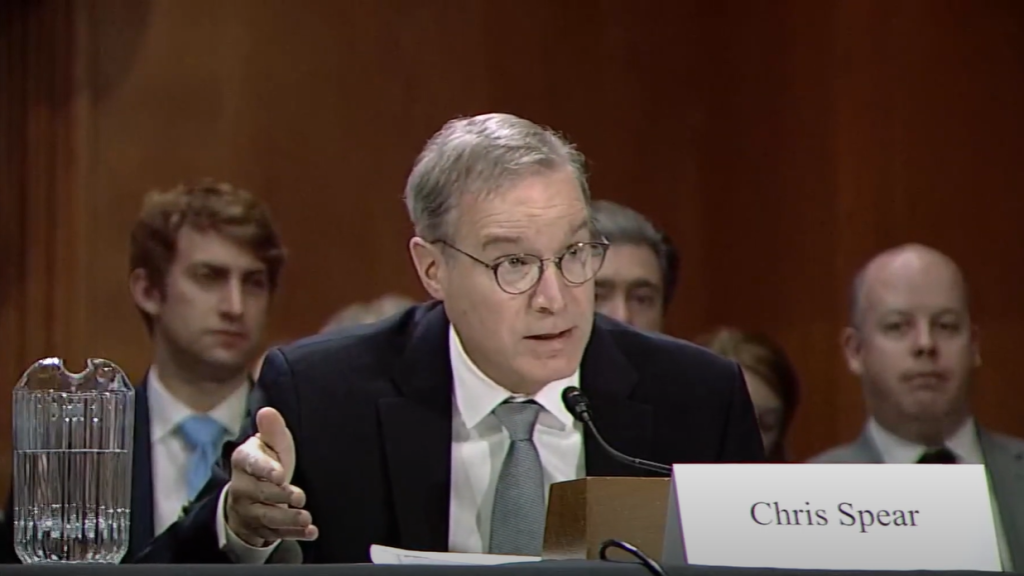
The American Trucking Associations (ATA), once the pre-eminent voice of the trucking industry, is losing ground. Its president, Chris Spear, is not pleased.

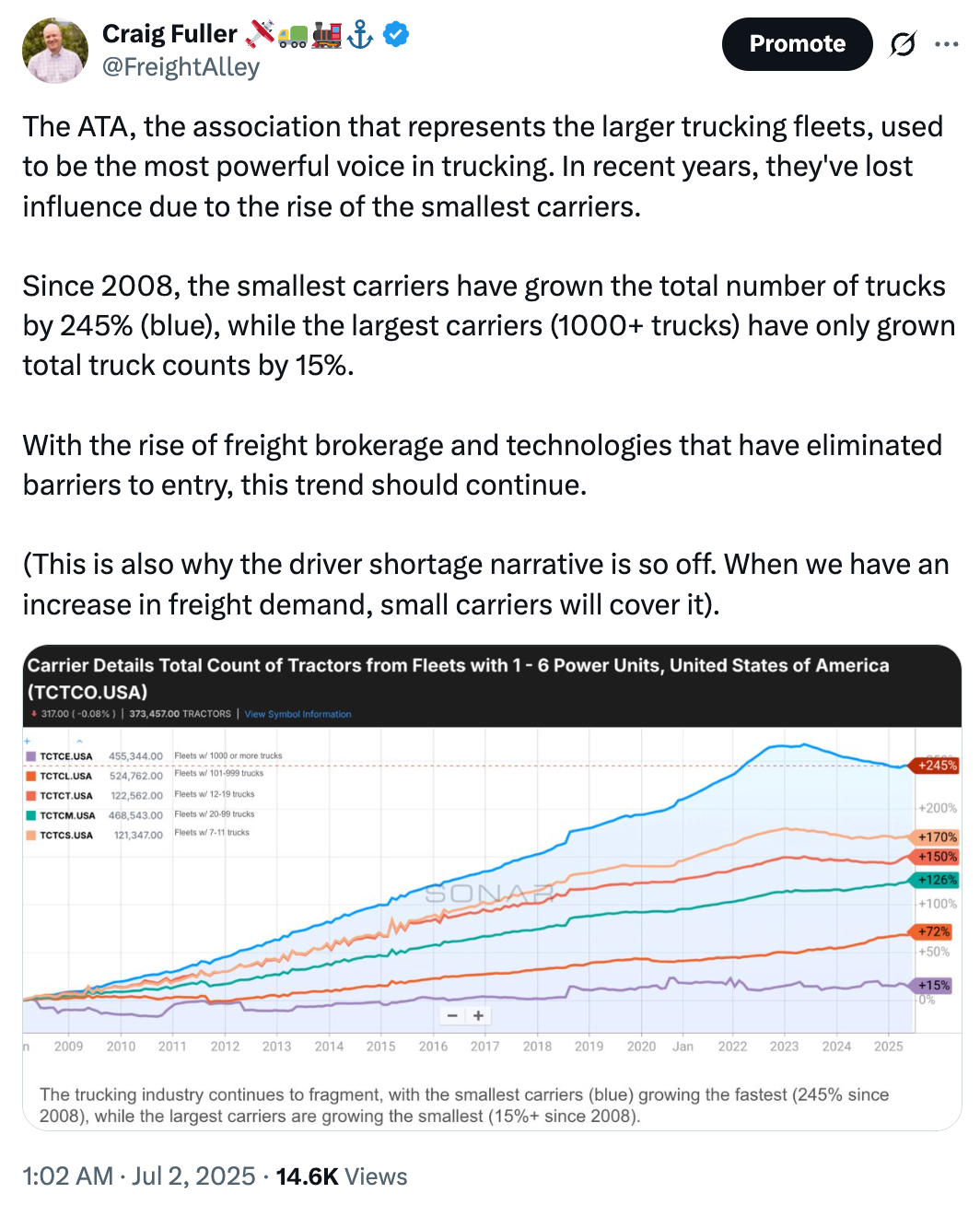
Last week, I posted on X a chart from SONAR, based on Federal Motor Carrier Safety Administration (FMCSA) data, showing that independent owner-operators are capturing a growing share of the trucking industry at the expense of larger fleets. Large fleets typically belong to the ATA; smaller carriers often do not.

Small operators frequently criticise the ATA, arguing it misrepresents the industry and backs legislation that harms independent truckers. The ATA claims to speak for all truckers, citing its membership figures. Yet it is primarily a lobbying organisation, funded by fees tied to members’ company size. Larger carriers, which dominate the ATA’s budget, wield disproportionate influence.

My post on X read:

“The ATA, which represents larger trucking fleets, was once the industry’s loudest voice. Its influence has waned as smaller carriers have grown.

Since 2008, the smallest carriers have increased their truck numbers by 245%, while fleets with over 1,000 trucks have grown by just 15%.

Freight brokerage and technology have lowered barriers to entry, and this trend is likely to persist.

(This also explains why talk of a driver shortage is misleading. When freight demand rises, small carriers fill the gap.)”

Shared on a Facebook truck driver forum, the post drew a sharp response from Mr. Spear:

“Ah, Mr Fuller… again claiming to champion the little guys while deep-pocketed investors keep him out of bankruptcy. How many failed ventures is Craig up to now? Careful who you hitch your trailer to, folks. Best do your homework first.”

Mr. Spear’s homework appears incomplete

FreightWaves, my company, weathered the pandemic with a board-led bridge round in March 2020, as half our 2019 revenue came from in-person events. We ended that month strongly, prompting our board to forgo a Paycheck Protection Program loan on ethical grounds. We have not raised capital since a 2021 growth round, most of which remains untouched.

Mr. Spear targets FreightWaves for two reasons.

First, we challenge the ATA’s claims without owing it allegiance. Second, the ATA owns Transport Topics, a competitor one-tenth our size but with 90 years of history (vs. our 7). As for “failed ventures”, I built Transcard over a decade, selling its fleet card to U.S. Bank, and later developed a bank payment platform sold secondary at a $500m valuation. Claims of failure are baseless.

Had Chris Spear conducted any diligence on his baseless claims, any FreightWaves funding would be disclosed on the SEC’s EDGAR system, with our last filing in 2021.

What provoked Mr. Spear? Perhaps it was the data highlighting the ATA’s declining relevance or our critique of its driver-shortage narrative. Last year, I offered $50,000 to a charity of the ATA’s choice for a live debate on the driver shortage, with Bloomberg willing to host. The offer stands.

Alternatively, Mr. Spear may resent the fading relevance of Transport Topics, the ATA’s publication. In 2018, when FreightWaves was barely a year old, Mr Spear blocked our employee Dean Croke (now at DAT) from speaking at an ATA conference, citing competition with Transport Topics.

FreightWaves has since eclipsed Transport Topics, which holds little sway beyond the ATA’s core members. We draw 1.1m monthly visitors to Transport Topics’ 300,000, with 2.4m page views to their 500,000. Our readers engage longer and wield greater market influence. FreightWaves’ reach extends further, appearing on Yahoo Finance, Bloomberg Terminal, and Dow Jones. Far from failing, we have become the industry’s leading voice, offering transparency and holding the ATA accountable.

A few years ago, when my brother led U.S. Xpress, a large dues-paying member of the ATA, the organisation asked him to curb my criticism of its messaging. We shared a laugh then of the ATA’s arrogance that I would be influenced by such a request, and still do.

Trump announces flurry of new import tariffs on global trade partners 

The Trump administration began sending letters on Monday to U.S. trade partners that higher import tariffs could kick in by Aug. 1.

President Donald Trump’s 90-day pause on the April 2 “reciprocal” tariffs was set to end Wednesday. Trump signed an executive order Monday delaying Wednesday’s tariff deadline by a little over three weeks.

Trump sent similar letters to leaders in each country.

“Starting August 1, 2025, we will charge Japan a tariff of only 25% on any and all Japanese products sent into the United States, separate from all Sectoral Tariffs. Goods transshipped to evade a higher Tariff will be subject to that higher Tariff. Please understand that the 25% number is far less than what is needed to eliminate the Trade Deficit disparity we have with your Country,” Trump said in his letter to Japanese Prime Minister Ishiba Shigeru, the first to be posted on Truth Social.

The latest import duty announcements include:

  • 40% on Laos
  • 40% on Myanmar 
  • 36% on Cambodia
  • 36% on Thailand
  • 35% on Bangladesh
  • 35% on Serbia
  • 32% on Indonesia
  • 30% on South Africa
  • 30% on Bosnia
  • 25% on Tunisia
  • 25% on Malaysia 
  • 25% on Kazakhstan
  • 25% on South Korea
  • 25% on Japan

The Trump administration threatened other nations not to retaliate by increasing their own import taxes, or else the White House would further increase tariffs.

Trump’s initial global reciprocal tariffs unveiled on April 2 ranged from 10% to 49%, including 49% on Cambodia, 25% on South Korea, 24% on Japan, 32% on Taiwan and 26% on India.

The Trump administration’s broad “reciprocal” tariff plan also included a baseline 10% duty rate on almost all goods, as well as 25% tariffs on certain imported vehicles and auto parts.

Trump on Aug. 9 paused the reciprocal tariffs on imports for 90 days, but has kept a 10% baseline import tax in place for almost all U.S. trading partners.

Truckers renew push for guaranteed overtime pay

trucks on highway

WASHINGTON — The Owner-Operator Independent Drivers Association is again leaning on Congress to repeal a labor provision that relieves trucking company employers from having to pay their drivers overtime.

The renewed effort comes after OOIDA failed to get Congress to include the change in the One Big Beautiful Bill Act signed into law by President Trump on July 4.

The bill includes a provision exempting blue-collar workers from paying taxes on their overtime pay – but it doesn’t apply to truck drivers because motor carrier employers are exempt from paying overtime under the Fair Labor Standards Act of 1938. The “no tax on overtime” provision applies only to those employed by companies required to pay overtime under the FLSA.

“Over 20% of OOIDA’s membership is employee drivers,” an OOIDA spokesperson told FreightWaves on Monday. “Their time should be valued just like nearly every other blue collar worker in the United States of America.”

With the big tax bill approved without changes to the FLSA, “it’s time for Congress to fix a nearly century-old oversight by passing the bipartisan GOT Truckers Act and ensure truckers are eligible for both overtime pay and the tax relief extended to other blue collar workers,” said OOIDA President Todd Spencer.

The bill – shorthand for Guaranteeing Overtime for Truckers – would eliminate the FLSA exemption that currently gives motor carriers the right to exempt their drivers from overtime pay, including from guaranteed time-and-a-half pay if they work more than 40 hours a week due to traffic congestion, weather, or delays at loading docks.

Legislation introduced in 2022 and 2023 in the House and Senate did not advance out of committee.

A bipartisan House version was reintroduced this year by U.S. Reps. Mark Takano, D-Calif., and Jeff Van Drew, R-N.J., along with a Senate companion bill reintroduced by Sens. Alex Padilla, D-Calif., and Ed Markey, D-Mass.

OOIDA argues that roads are more dangerous when truckers do not get guaranteed overtime.

“The system allows shippers and receivers to excessively detain truckers at loading docks. The delays truckers face when waiting to be loaded or unloaded is proven to increase safety risks. If a truck spends just 15 minutes more than usual at a facility, it increases the accident rate by 6.2%,” the group asserted, citing a 2018 U.S. Department of Transportation Office of Inspector General report.

Commenting on a truck driver detention time survey that FMCSA began planning in 2023, the Truck Safety Coalition (TSC), which represents crash victims and their families, also encouraged DOT and the Department of Labor to change the overtime exemption.

The group cited a 2022 DOT Supply Chain Report that included repealing the overtime exemption as a Biden administration policy goal. “Implementing this DOT recommendation will better compensate truck drivers who are currently not required to be paid overtime by their employers,” TSC stated. “Any holistic solution to reduce truck crashes must include improving truck driver work conditions, salary, and benefits.”

Trucking employers have opposed the change.

“This proposal is nothing more than a thinly-veiled attempt to boost trial attorneys’ fees,” American Trucking Associations President Chris Spear commented in response to the GOT Truckers Act.

“It would reduce drivers’ paychecks and decimate trucking jobs by upending the pay models that for 85 years have provided family-sustaining wages while growing the U.S. supply chain.”

Click for more FreightWaves articles by John Gallagher.