Why 44% fewer cancelled sailings could be [blanking] bad news for SoCal trucking

Blanked, or cancelled, sailings by container carriers on key east–west routes are expected to fall 6% in June from the previous month, with a steeper 44% decline seen in July, mainly on weaker trans-Pacific lanes.

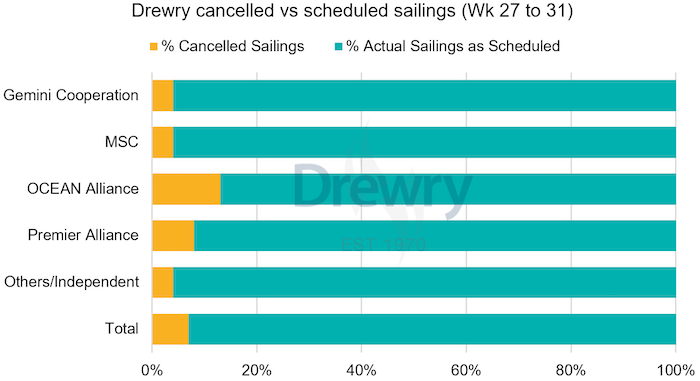
The latest forecast from shipping consultant Drewry found that of the 713 scheduled sailings across the key trans-Pacific, trans-Atlantic, and Asia–North Europe and Mediterranean routes, 48 sailings are expected to be cancelled between weeks 27 (June 30–July 6) and 31 (July 28-August 3), a 7% cancellation rate.

Drewry said the majority of blank sailings over the next five weeks are expected on the trans-Pacific eastbound route (46%), followed by Asia–North Europe/Med (38%), and trans-Atlantic westbound (17%). During the same period, schedule reliability is improving, with 93% of weekly departures expected to sail as planned.

(Chart: Drewry)

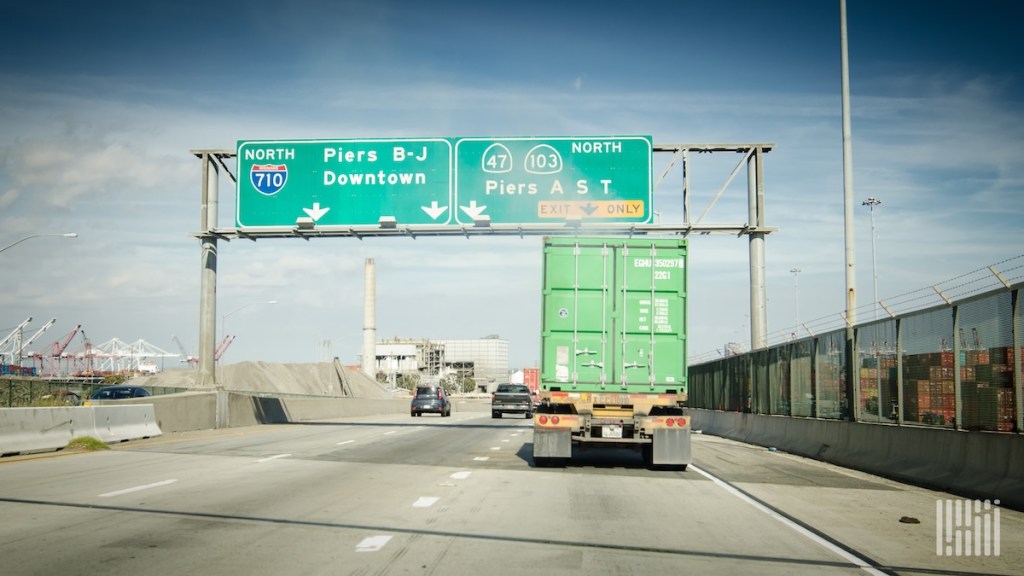
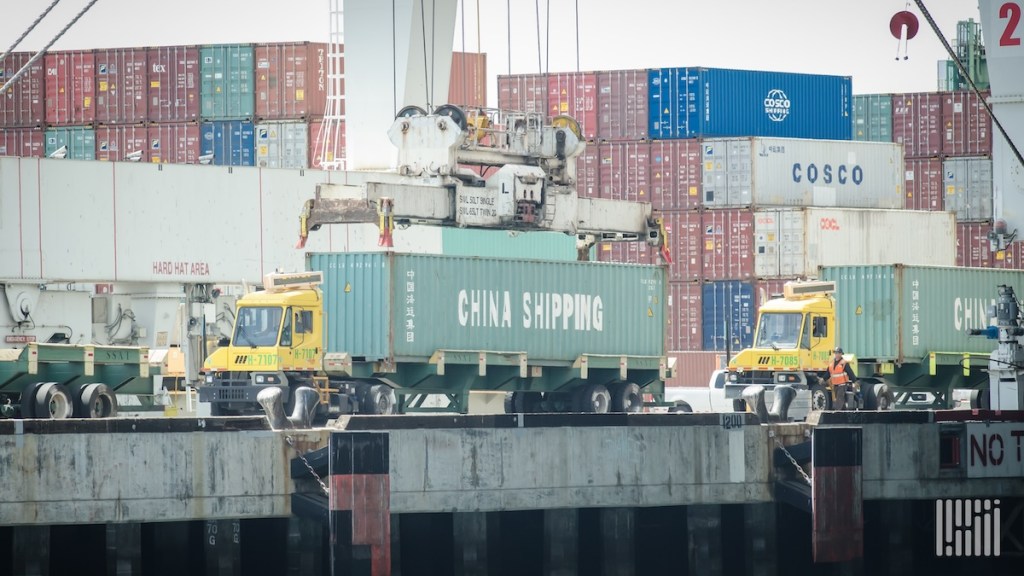
Weaker demand by shippers on Asia-U.S. routes could mean leaner times for logistics providers around the southern California container import gateways. Fewer containers means less freight for drayers and local trucking, and corresponding lower rates for carriers competing for shipments. Blank sailings can also pinch chassis availability as fewer empty containers are picked up from the ports.

Trans-Pacific rates have reversed recent gains, dropping 37% over the past two weeks amid weaker demand and increased capacity, according to Drewry, a data partner in SONAR

“Asia–Europe/Med rates remain 44% above May averages but appear to be stabilizing,” Drewry said. “Carriers are reviewing capacity as demand shows signs of softening. With the U.S. tariff pauses nearing expiry in July and August, demand is expected to ease further. In response, carriers are actively adjusting capacity through blank sailings and service changes.”

Drewry’s World Container Index fell 9% w/w to $2,983 on June 26, with trans-Pacific rates down 16%, Asia–Europe/Med up 1% and trans-Atlantic unchanged.

Find more articles by Stuart Chirls here.

Related coverage:

US maritime chief ‘not a big fan’ of ocean carriers’ ‘approach’ as agency reviews antitrust immunity

Drewry: No “lasting impact” from tariff break as ocean rates fall again

With Mideast shipping on high alert, Maersk re-opens Israel port
Maersk unveils new AI platform to simplify customs tasks

Languish no more: STB clearing rail backlog

Surface Transportation Board Chairman Patrick Fuchs provided an update on efforts to clear a backlog of cases that have languished for years.

The cases include:

Colorado Landowners — Adverse Abandonment — Great Western Railway of Colorado, LLC, in Weld County, Colo.: On Oct. 5, 2022, a group of landowners filed an application asking the board to authorize the third-party, or “adverse,” abandonment of 6.2 miles of rail line owned by Great Western Railway of Colorado, LLC. The final Environmental Assessment was issued in May 2023. Earlier this month, Fuchs offered a draft action for consideration by the full board. He expects a decision in the first two weeks of July.

Union Pacific Corp. — Control — Missouri-Kansas-Texas Railroad Co., et al.: In August 2023, Kansas City Southern petitioned the board to enforce conditions imposed as part of approval of UP’s (NYSE: UNP) acquisition of the Katy. The most recent board action in this docket was in September 2023. In April, Fuchs offered a course of action for consideration by the full board, and expects the board to issue a decision in the first two weeks of July.

Savannah Industrial Logistics, LLC — Construction Exemption — in Effingham County, Ga., and Savannah Industrial Transportation, LLC — Lease and Operation Exemption — Line of Savannah Industrial Logistics, LLC. in Effingham County, Ga.: On Sept. 28, 2023, Savannah Industrial Logistics, LLC filed a petition seeking authorization for after-the-fact authority to construct an 11,404-foot rail line. Its affiliate, Savannah Industrial Transportation, LLC, filed for after-the-fact authority to lease and operate the line. The board issued its Final Environmental Assessment in May. Fuchs intends to offer a draft action for consideration by the full board in July.

Railroad Revenue Adequacy (EP 722): In April 2014, the board instituted this proceeding to explore its methodology for determining railroad revenue adequacy and the application of revenue adequacy to rate reasonableness cases. The board received written comments and held two hearings. The most recent board action in this docket (outside of litigation) was in December 2019. Earlier this month, Fuchs offered a draft action for consideration by the full board, and he expects the board to issue a decision in August 2025, if not sooner.

Joint Petition for Rulemaking — Annual Revenue Adequacy Determinations (EP 766): In December 2020, the board instituted this proceeding to consider a petition by several Class I railroads to change the board’s procedures for annually determining whether Class I rail carriers are revenue adequate and related issues. The board received written comments. The most recent board action in this docket was in July 2021. Earlier this month, Fuchs offered a draft action for consideration by the full board, and he expects the board to issue a decision in August 2025, if not sooner.

Walkersville Southern Railroad, Inc  — Discontinuance of Service Exemption — in Frederick County, Md.: On March 18, 2024, Walkersville Southern Railroad, Inc., filed a verified notice of exemption to discontinue service over an approximately 2.21-mile rail line owned by the Maryland Transit Administration, and Frederick County filed a request for issuance of a notice of interim trail use or abandonment (NITU) for the line under the National Trails System Act. The director of the board’s Office of Proceedings denied the county’s NITU request, and certain parties appealed. The most recent board action in this docket was in August 2024. Fuchs expects the board to issue a decision in August 2025, if not sooner.

City of Philadelphia — Petition for a Declaratory Order: In April 2024, the City of Philadelphia petitioned the board to issue a declaratory order concerning jurisdictional and other matters related to the Philadelphia & Reading Railroad Co. The most recent board action in this docket was in May 2024. Fuchs now intends to offer a draft action for consideration by the full board in August 2025.

Subscribe to FreightWaves’ Rail e-newsletter and get the latest insights on rail freight right in your inbox.

Related coverage:

Rail could boost exports in new Port of LA pact

Bill aims to level playing field for railroad workers

New partners connect rail camera network with telematics visibility

Indiana port taps Louis Dreyfus to restart grain terminal

Switch to UPS saved US Postal Service 43% in air transport costs

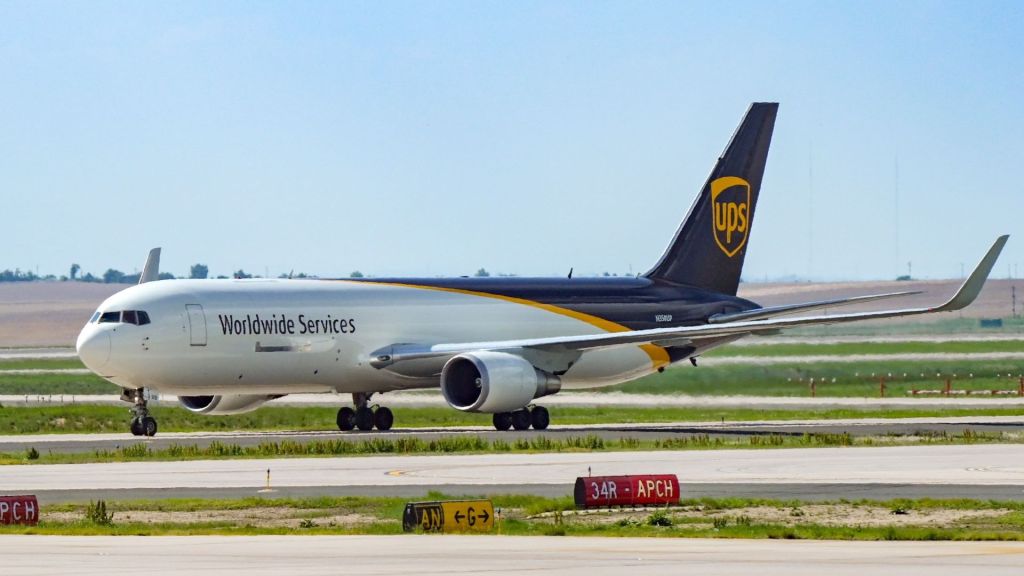
A brown-tailed UPS cargo jet taxis at an airport on a sunny day.

The U.S. Postal Service shipped fewer packages and letters by air and reduced spending by 43% in the first three months after UPS took over a primary air cargo contract from FedEx, but incomplete data collection makes it difficult to determine whether the carrier met on-time performance requirements, according to the agency’s inspector general.

The watchdog also found that postal employees failed to properly scan packages before transferring them to the airline and a small number of hazardous material shipments mistakenly slipped into the UPS (NYSE: UPS) network. It urged the postal operator to improve network planning and how it measures UPS’s performance to capitalize on the arrangement’s advantages and address inefficiencies.

“These issues could limit the Postal Service’s ability to assess performance, ensure timely mail delivery, and maintain mail visibility…. While the new agreement is favorable to the Postal Service, improper handling and lack of visibility over the mail moving through the air cargo network could degrade service performance and customer expectations,” the inspector general said in an audit issued last week.

In October, UPS assumed full responsibility for shipping first-class, Priority Mail and Priority Express packages for the Postal Service after winning a major contract, previously held by FedEx (NYSE: FDX) for more than 20 years, with a minimum base period of 5.5 years. The new agreement is officially valued, according to the report, at about $10 billion — $2.5 billion more than UPS last year said it expected to receive. It supports the postal agency’s plan to save money by shifting more mail delivery from air transport to less expensive ground transportation under a multi-year transformation strategy for reversing financial losses and improving customer service.

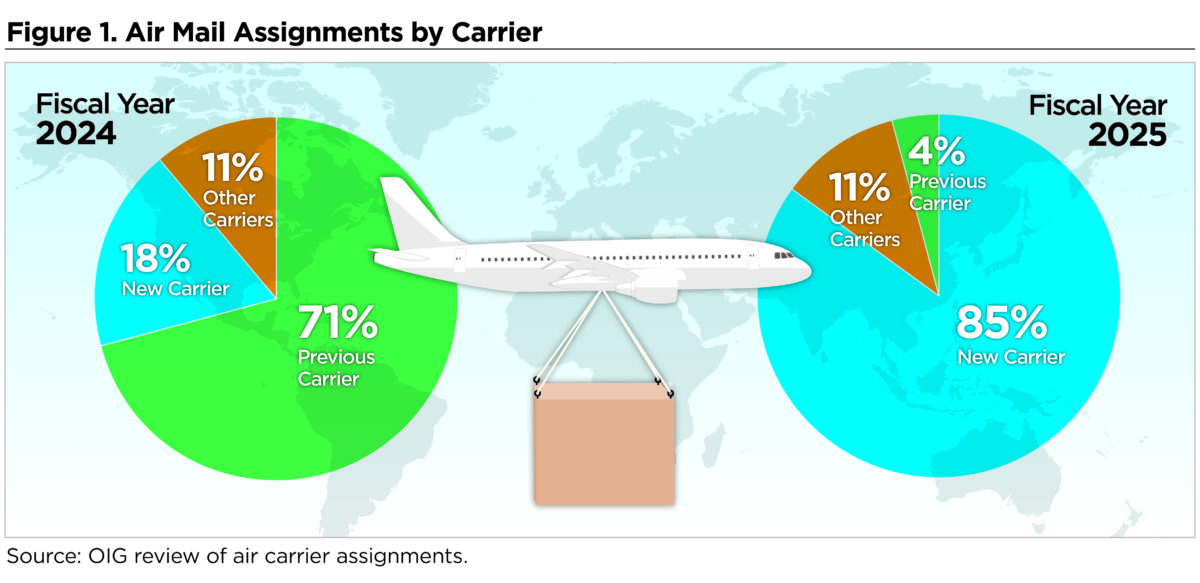
The Postal Service achieved those goals during the first quarter of fiscal year 2025. In an audit issued last week, the Office of Inspector General said the Postal Service assigned 7% less volume to the air network (327 million pounds) and spent $364 million, a 43% decrease compared to the same period in 2024. 

Historically, the Postal Service has spent over $3 billion annually across multiple air carriers to support mail movement. 

The new air cargo agreement is more favorable to the Postal Service than the one with FedEx in terms of cost, number of destinations, with lower volume commitments, more planned capacity and greater operational flexibility. UPS, for example, is using its extensive ground network for packages that can be delivered more cheaply and still meet service commitments. The company is also handling mail in its existing daytime flight operation with limited addition of aircraft and moving some volume directly between city gateways without routing everything through its global hub in Louisville, Kentucky. 

Additionally, the new agreement increases the required percent of mail and packages transported on time, compared with the last contract.

FedEx carried 71% of all air cargo (984 million pounds) tendered by the Postal Service in fiscal year 2024 while UPS received 18% of the air volume. A handful of other airlines carry mail on a few select routes. In the first quarter of the new contract, the national post routed 85% of all air cargo to UPS. FedEx still transports mail requiring special handling, including hazardous materials, live animals and perishable goods. During the same period, it handled 4% of domestic air mail.

Despite the cost savings, the Office of Inspector General said the postal operator needs to improve network planning and how it measures UPS’s performance to capitalize on the arrangement’s advantages and address inefficiencies, the report said.

According to the audit, the Postal Service can’t accurately measure on-time performance because the carrier scoring system excludes pieces when flights are delayed for circumstances beyond UPS’s control and doesn’t count pieces moved under a contract provision that allows a later delivery time, on Sundays, for some mail tendered on Saturdays. Payments can be reduced for late deliveries. 

“Misrepresentation of performance, whether by overstating or understating the carrier’s actual results, can significantly affect decision-making and accountability. Inaccurate data may also obscure true performance trends, hindering efforts to identify areas for improvement or replicate successful strategies, ultimately leading to inefficient operations. Furthermore, trust from customers, partners, and stakeholders, who rely on precise performance metrics to evaluate reliability and efficiency, may be compromised due to incorrect reporting,” the IG report said. “These inaccuracies can result in resource misallocation, such as focusing on non-existent problems or neglecting critical issues.”

Management said it added a new reporting tool in January that will soon allow the agency to better reconcile deliver performance against the benchmark.

Hazmat mixups

The IG also reported that postal employees are improperly accepting and tendering packages identified as hazardous material to UPS, resulting in delayed mail and potentially dangerous conditions. Hazmat shipments are supposed to be sent to FedEx or moved by surface transportation. When they end up at the UPS hub, they are sorted from the package flow and sent to a local Postal Service facility for reprocessing and distribution. In the first quarter, UPS reported a total of 2,411 hazmat-marked packages at its main hub, some of which still had FedEx labels on them. And 84 packages slipped through UPS monitoring and were flown to their final destination. 

The IG acknowledged that mishandled pieces represent a small fraction of total hazmat shipments — FedEx moved 29,000 hazmat pieces during the quarter — and the number of routing errors declined from October through December 2024 because the Postal Service has moved to address the problem. Steps taken include installing new software on mail processing machines to detect hazmat markings and conducting in-person training sessions for retail clerks on proper hazmat acceptance procedures. 

The IG recommended that the Postal Service implement additional measures to hold accountable clerks who fail retail acceptance tests, noting that less than 80% of 630 clerks in a test demonstrated correct hazmat procedures, such as inspecting packages and asking customers whether packages contain lithium batteries or other hazardous substances.  

The audit also identified a problem with postal employees not performing required scans of mail moving to and from the UPS hub by truck, reducing the Postal Service’s ability to track parcels and efficiently schedule employees. At three surface feeder sites it visited, the IG said it observed mail handlers not performing required scans of individual parcels or bins while loading and unloading trailers. During the quarter, employees at all nine surface terminals failed to perform outbound scans 97% of the time and inbound scans 93% of the time because of connectivity issues with wireless networks and poor communication from headquarters. 

Management said it would implement by November processes to ensure surface feeder sites report daily scans and to determine if they are performed. 

Click here for more FreightWaves/American Shipper stories by Eric Kulisch.

US Postal Service to migrate air cargo to UPS during summer

eBook: Optimize your container drayage operations to stay ahead

The competition in today’s intermodal trucking market is fierce. To stay ahead, you need to master the core processes that power reliable container drayage operations. Precision, timeliness, and adaptability aren’t just buzzwords—they’re the foundation of success.

Efficient and resilient drayage operations do more than just move containers; they keep the entire supply chain running smoothly. For those strengthening their capabilities, these technologies are helping to drive a more resilient, efficient, and future-ready logistics ecosystem.

CargoWise Landside’s latest eBook is your guide to modernizing your business for long-term growth and profitability. Whether you’re a small carrier or a large enterprise, this is the roadmap to take your drayage operations to the next level.

Ready to transform your drayage operations with proven best practices? Explore how we’re revolutionizing landside logistics for imports and exports, tackling your daily challenges head-on.

What you will learn:

  • A look at the intermodal drayage industry – what role does it play in today’s supply chain
  • Learn whether your container drayage operation is ready to handle today’s challenges
  • How to enter a new era of container efficiency – a roadmap to drayage success

Download the eBook now and start building a stronger, more competitive future.

English proficiency rule for truckers shaking up cross-border freight market

The Trump administration’s push for stricter enforcement of the English language proficiency (ELP) requirement is already having an impact on the freight market between the U.S. and Mexico.

Many B-1 visa truck drivers from Mexico are scrambling to meet the English language requirements, which is leading to an increase in rates on northbound trucking lanes, Cargado co-founder and CEO Matt Silver, said.

Cargado is a first-of-its-kind, invite-only load board for freight moving into and out of Mexico. 

“There’s a lot of carriers that are not willing to risk their drivers going out right now, because they don’t want their trucks and the loads getting stuck somewhere with the driver, so there are definitely less B-1 drivers on the road right now,” Silver told FreightWaves in an interview.

President Trump’s executive order, signed April 28, aims to strengthen enforcement of existing federal regulations that drivers must “read and speak the English language sufficiently to converse with the general public, to understand highway traffic signs and signals in the English language, to respond to official inquiries, and to make entries on reports and records.”

The Federal Motor Carrier Safety Administration (FMCSA) began stricter enforcement of ELP standards on Wednesday, signaling major operational changes for the trucking industry. 

Truck drivers who fail to meet the ELP requirements could face an immediate out-of-service order under the stricter guidelines.

Dry van spot load rates jumped by almost $1 after Wednesday, reaching just under $4 per mile for northbound freight, according to data from Cargado.

“We are definitely seeing a rate increase happening right now on bidding on northbound freight,” Silver said. “That was an immediate spike [on Wednesday] and we’ll continue to measure it this week to see if it keeps increasing or how that changes. But that was like a surprising jump.”

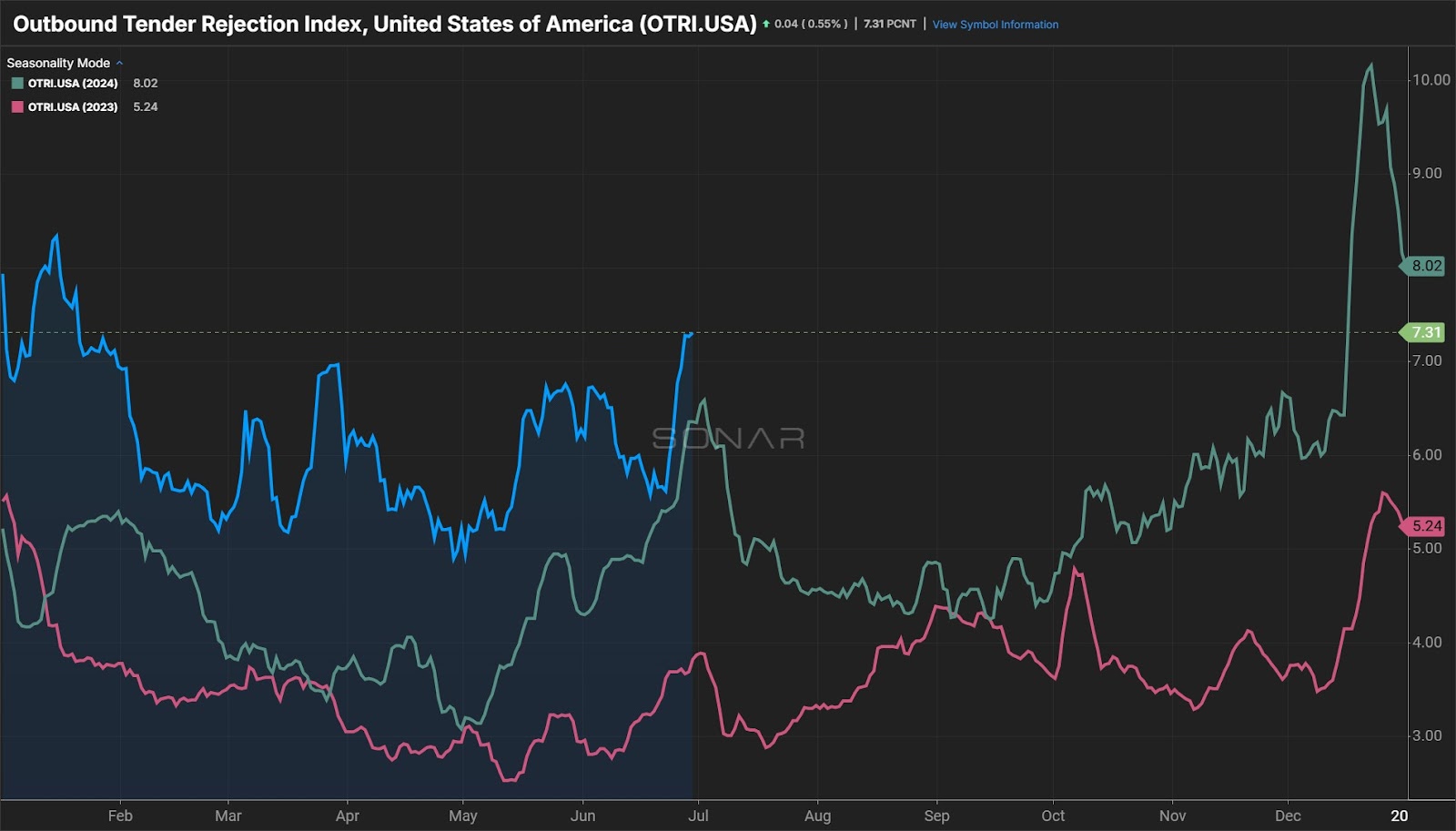
SONAR’s Outbound Tender Rejection Index has also moved up sharply over the past week, another potential sign of tightening capacity because of the stricter ELP enforcement.

As of Monday, the Outbound Tender Rejection Index in SONAR has increased more than 29% since June 22 and sits at 7.3%. To learn more about SONAR, click here.

Cargado, which launched in 2024, has more than 200 logistics customers and over 900 carriers. Clients such as brokers, 3PLs and freight forwarders post their cross-border freight to get bids on Cargado’s load board.

“The carriers have to adapt to it, either they have to get rid of their trucks or they have to get rid of the drivers or train the drivers,” Silver said. 

Jerry Maldonado, chairman of the Laredo Motor Carriers Association, the ELP requirement has been a law for years, but had never really been strictly enforced until recently.

“It is something that has been in the FMCSA website for over 50 years, so it’s not something that was invented three months ago,” Maldonado told FreightWaves. “The punishment or the consequence is what changed, and that’s what unfortunately made a lot of people nervous.”

The Laredo Motor Carriers Association is a trade association that represents 200 trucking companies.

“It also shows that a lot of people had drivers out on the road that were not able to communicate with an officer. So that is concerning, of course,” Maldonado said. “Our stance as an association at both local, state, and federal level is for every one of our members to abide by every regulation, whether it be parking in the wrong place or not being able to communicate in English.”

In Laredo, cross-border trucking between Mexico and the United States is the heart of the local economy and many drivers arrive in the U.S. on B-1 visas.

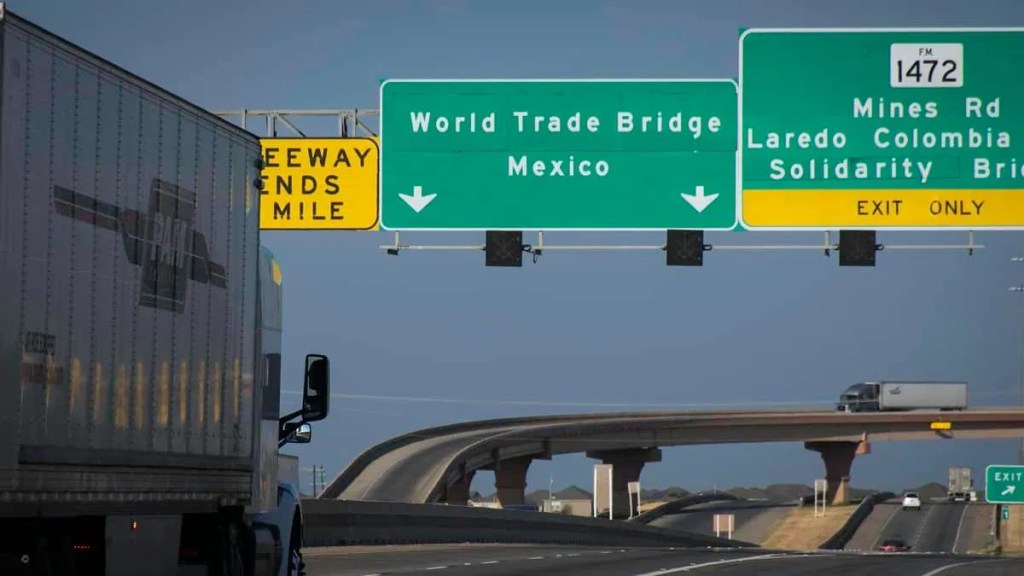
Laredo processes between 15,000 to 18,000 commercial trucks daily at its World Trade and Colombia-Solidarity international bridges. The trucking volume represents almost 40% of all U.S.-Mexico land trade through a single border crossing.

Maldonado said some members of the association have expressed concern about losing drivers to the ELP enforcement.

“They have expressed concern, and there are, unfortunately … Just like when you have new guidance or regulations, there were drivers that said, “hey, I’m going to go home for a couple of weeks while this gets settled in, and I’ll be back later,” Maldonado said.

To help truckers brush up on their English speaking, the Laredo Motor Carriers Association has been offering free English classes on weekends to help drivers communicate more confidently.

“We reached out to our local Texas Department of Public and Department of Transportation officers and asked, “what are the questions that you would ask a driver on a Level 1 inspection? They shared with us, “hey, these are the things that the driver is going to need to know,” Maldonado said. 

“Our goal is not to teach anyone how to speak English. Our goal is to polish your English skills. Our intention is to ensure that the drivers are ready and prepared for these inspections out on the road.”

White Paper: State of the Industry – July 2025

The July 2025 “State of the Industry Report” — presented in affiliation with Ryder — shares an in-depth overview across the trucking, maritime and intermodal markets, as well as what to expect in the coming weeks. The data contained within the report provides breakdowns of capacity, volumes and rates.

In this report, you will find:

  • Driven by geopolitical risk and cooling U.S.-China trade tensions, ocean spot rates and bookings have spiked in recent weeks.
  • Outside of a holiday-induced bump, truckload demand has remained stagnant over the past few months and is unlikely to see significant growth until peak season.
  • The Q3 outlook for intermodal demand is far sunnier, thanks to the coming wave of maritime imports.
  • Macroeconomic data is wavering and has fallen to meet depressed sentiment among consumers, manufacturers and homebuilders.
  • The Federal Open Market Committee was not persuaded by this concerning weakness at its June meeting, however. Citing a stable (though arguably precarious) job market, it once again withheld cuts to the federal funds rate.

Download the complimentary report today to access the full insights.

No Wall Street reaction to truckload carrier Werner’s ‘long overdue win’

Werner Enterprise’s stock price fell Monday, a day after it was freed from the potential burden of one of the biggest nuclear verdicts in history.

But given that the Werner (NASDAQ: WERN) exposure to a verdict of more than $100 million was just $10 million due to its insurance coverage–as the company had said several times and reiterated in an SEC filing after the Texas Supreme Court overturned a pair of earlier court decisions that had gone against the truckload carrier–the decline of 1.16%, even while broader market indexes were higher, was not surprising.

While there will be an outward impact on the company’s balance sheet from the end of the litigation that went back more than seven years, the financial steps to be taken will simply just reverse charges and credits already made by the company previously in anticipation of a large payout.

The facts of the lawsuit were never in dispute: a car driven by Trey Salinas and ferrying the Blake family heading eastbound on interstate 20 near Odessa, Texas in wintry weather amidst reports of cars sliding out of control lost control, blasted across the grass median and into the westbound truck driven by Werner driver Sharif Ali. Ali was in training and his trainer was in the sleeper berth. 

One member of the Blake family–a child–was killed, another child was left a quadriplegic and two other Blakes suffered serious injuries. 

The Blakes won their almost $90 million verdict in 2008. Werner appealed and the Blakes won again on the appellate level in May 2023. Werner appealed to the Texas Supreme Court and won on Friday. 

Interest had been accumulating on the initial verdict. The final amount at stake was more than $100 million.

The state’s highest court dismissed the case; it was not sent back to the lower court for further deliberations. 

Remembering the Blakes

In its prepared statement released Friday, Werner president and chief legal officer Nathan Meisgeier said the company “(has) not and will not lose sight of the tragic loss the Blake family suffered because of this accident. Our continued thoughts and prayers are with the Blake family.”

In a report to clients, the transportation research team at Bank of America Merrill Lynch headed by Ken Hoexter described the court decision as a “long overdue win” and one that was “good for Werner, good for trucking.:”

“We believe this is an important win for Werner and the trucking/broader transportation industry,” the analysts wrote. “The Texas Supreme Court ruled that the sole cause was the sudden, unexpected hurling of the victim’s vehicle into incoming highway traffic, for which Werner and its driver bore no responsibility.”

BOA: Case started a trend

Bank of America Merrill Lynch saw the case as having established a precedent in the trial bar that continues to this day. “The 2018 decision began to set a trend of truck company exposure to landmark verdicts that continues to loom over the industry,” the analysts said. 

“We believe this is an important win for Werner and the trucking/broader transportation industry,” the analysts wrote. “The Texas Supreme Court ruled that the sole cause was the sudden, unexpected hurling of the victim’s vehicle into incoming highway traffic, for which Werner and its driver bore no responsibility.”

Bank of America Merrill Lynch also saw the case as having established a precedent in the trucking trial bar that continues to this day. “The 2018 decision began to set a trend of truck company exposure to landmark verdicts that continues to loom over the industry,” the analysts said. 

In Werner’s prepared statement, Meisgeier called the verdict a “long-awaited win for Werner.”

“After seven years navigating the appellate process, we are thankful the Texas Supreme Court reached the same conclusion as law enforcement – that the Werner drivers and our company did nothing wrong,” he said. “A different outcome would have had far-reaching implications beyond the transportation industry.”

The court decision did not fully exonerate Werner; the Salinas’ truck going out of control was not the “sole cause,” as the Bank of America Merrill Lynch report suggests. 

At one point the judges’ decision says “We can assume sufficient evidence that Ali’s speed–and even his presence on the icy road at all–was negligent under these weather conditions.”

Being on that road, the court decision said, was a “but for” cause of the injuries.

However, “but for” isn’t enough, the court said. The “proximate cause” of the collision was Salinas sliding across the median, the court said.

Speeding might have avoided a crash

It added another perspective. The criticism from the Blakes was that Ali was traveling too fast given the weather. As a result, his truck was at a location that resulted in the Salinas’ pickup truck slamming into him. 

But what if he was going faster? “Surely, as the plaintiffs urge, if Ali had been driving more slowly, Salinas would not have collided with him,” the judges’ decision said. “Just as surely, however, if Ali had been driving 100 miles per hour, Salinas would not have collided with him. Had either driver been driving much slower or faster, this accident would not have happened as it did.”

More articles by John Kingston

State of Freight Takeaways: English language rule for truckers takes effect, early impacts emerging

SCOTUS decision on California Clean Cars waiver could have benefit to trucking later

First legal steps taken, this time by WSTA, to untangle the legal knot of the Clean Truck Partnership

June ends with third Illinois trucking company to file for bankruptcy

A third Illinois trucking company has filed for bankruptcy this month.

Elk Grove Village, Illinois-based freight hauler Elma Transport Inc filed for Chapter 11 bankruptcy on Friday in the U.S. Bankruptcy Court for the Northern District of Illinois.

The company is the third in a series of Illinois trucking businesses that have submitted bankruptcy filings to the northern district court this month. On June 9, Franklin Park-based Nortia Logistics filed for bankruptcy, followed by Dolche Truckload Corp in Palatine a week later.

Elma Transport’s filing stated the company owes $500,000 to $1 million in estimated liabilities to up to 49 creditors. The company estimates it has between $100,000 and $500,000 in assets.

Top creditors were not listed in the initial filing.

According to SAFER data, Elma Transport employs 46 drivers and operates 43 power units. The company hauls general freight, fresh produce, meat, commodities and dry bulk, refrigerated food, beverages and paper products.

Over the last two years, the company had 12 of its 22 vehicles inspected taken out of service. This equates to a 54% out of service rate, more than double the national average of 22%.

SAFER data also shows that Elma Transport had nine accidents over the last two years, three of which reported injuries.

CloudTrucks seeks exemption for its driver-hiring process

trucks at warehouse

WASHINGTON — Trucking technology company CloudTrucks wants approval to use its own system for collecting background data and onboarding prospective owner-operators instead of having to use what it considers to be an outdated FMCSA process.

“To streamline hiring without compromising safety, we validate each applicant’s background through national databases … that collectively provide a more accurate and timely safety profile than the traditional employer-history process,” stated Damien Hutchins, CloudTrucks’ head of safety and compliance, in the company’s exemption application.

“We therefore seek an exemption that would allow us to substitute this modern, data-rich method for the legacy requirement that applicants list every employer for the past three and seven years.”

Granting the relief, he stated, “will let us onboard qualified drivers faster, reduce administrative burden for prior carriers, and-most importantly-enhance highway safety by relying on authoritative federal databases rather than low-return paper chases.”

The Dallas-based “asset-light” carrier provides back-office safety and compliance services for over 700 owner-operators – which it projects to grow to more than 3,000 by 2026 – that lease on to the company’s operating authority.

FMCSA’s regulations require that prospective drivers provide employers with the name and address of the driver’s employers during the three years preceding the date of the application, dates of employment, reason for leaving, and confirmation as to whether the driver held safety-sensitive positions subject to DOT drug and alcohol testing.

CloudTrucks contends, however, that such a requirement was designed for “paper applications and single-fleet carriers,” noting that it tends to yield low response rates for verification requests, results in errors such as misspelled carrier names and defunct carriers, and leads to long wait times of up to 20 calendar days to clear prospective drivers, causing some candidates to abandon the process.

The company instead proposes using its own verification process that consists of cross-referencing national databases to include HireRight’s Drive-A-Check report, as well as FMCSA’s Drug and Alcohol Clearinghouse (DACH), Pre-employment Screening Program, and Commercial Driver’s License Information System.

CloudTrucks asserted that it would include additional safeguards to ensure safety levels equal to or greater than what can be achieved without the exemption, including:

  • 0-100 safety score: Refreshed nightly, and weights ELD compliance, speeding, harsh events, inspections, crashes.
  • Three-strikes program: Coaching, suspension, and termination for repeat unsafe behavior.Continuous in-cab telematics monitoring.
  • Zero-tolerance DACH policy: Prohibited status results in immediate disqualification.

If FMCSA were to decline the exemption request, CloudTruck estimated a “lost opportunity” of a 7% higher driver-hire conversion rate (equal to 200 or more drivers per year) and $350 or more in per-hire costs associated with on-boarding delays.

Click for more FreightWaves articles by John Gallagher.

Container rates from key US trade partner plummet 39%

The latest weekly ocean container shipping market reveals a stark contrast in rate movements across major trade lanes, as the trans-Pacific trade from the Far East to the United States saw a dramatic decline. 

The market average according to analyst Xeneta on Far East to U.S. West Coast services has fallen significantly since a spike on June 1. Declining spot rates have all but erased that recent surge, with rates standing at $3,317 per forty foot equivalent unit on June 27, up just 6% from May 31, effectively neutralizing the recent upward trend. 

This trade lane is particularly impacted by the U.S.-China trade war, and it is evident that capacity is now more than meeting demand, empowering shippers to push back against peak season surcharges by carriers.

In contrast, the market average on the trade from the Far East to the U.S. East Coast has seen a more moderate decline, falling 9% since June 1 to $5,990 per FEU. Despite this drop, the spot rate remains 43% higher on June 27 than on May 31 with the spread between the coasts reaching $2,673, the highest in 10 months.

“Average spot rates have plummeted from Far East to U.S. West Coast, down 39% since June 1, but it has not been so dramatic into the US East Coast with rates holding up stronger – for now,” said Peter Sand, Xeneta chief analyst, in a note. “The trans-Pacific into U.S. West Coast is the key battleground for carriers when it comes to China exports, so spot rates have fallen harder and faster as they prioritized bringing capacity back onto this trade in the immediate aftermath of the lowering of 145% tariffs.”

Meanwhile, average spot rates from the Far East into the Mediterranean and North Europe, which experienced jumps in early and mid-June, remain elevated. On June 27, rates to the Mediterranean were 5% higher and to North Europe 14% higher compared to June 1, indicating sustained demand in these regions.

The trade from North Europe to the U.S. East Coast has seen little change, with the market average staying flat from a week ago at $2,105 per FEU. This represents only a 3% increase from May 31. This trade lane is currently influenced by negotiations between the European Commission and Washington on a new trade agreement before July 9, when a 90-day pause on higher tariffs is set to expire.

“Shippers are seeing how this game is playing out and are calling the carriers’ bluff by pushing back on the higher rates and peak season surcharges,” said Sand. “It is only a matter of time until shippers do the same into the U.S. East Coast and spot rates begin to fall sharply there too.”

Find more articles by Stuart Chirls here.

Related coverage:

US maritime chief ‘not a big fan’ of ocean carriers’ ‘approach’ as agency reviews antitrust immunity

Drewry: No “lasting impact” from tariff break as ocean rates fall again

With Mideast shipping on high alert, Maersk re-opens Israel port
Maersk unveils new AI platform to simplify customs tasks