Surging containerized imports helped railroads’ U.S. intermodal traffic to a double-digit increase as shippers raced to get end-of-year retail merchandise ahead of disruptions in the global supply chain.
Containers and trailers totaled 287,949 carloads, an increase of 17.1% for the week ending Aug. 24, compared with the same week in 2023, according to data released by the Association of American Railroads.
The summer has seen an early peak shipping season as logistics planners wrestle with the effects of attacks on Red Sea shipping by Houthi rebels, labor unrest, and congestion at Asia ports.
Total rail traffic was up 9.5% to 228,858 carloads as the start of the fall harvest boosted grain shipments by 41.2% and seven of 10 commodities saw gains, including petroleum, 9.6%; forest products, 5.4%; and chemicals, 1.2%.
Coal dropped 8.5%, or 5,316 carloads, leaving all freight with a narrow 1.2% increase from the same week in 2023.
For the first 34 weeks of this year, U.S. railroads reported cumulative volume of 7,324,543 carloads, down 3.7%, and 8,811,085 intermodal units, up 9.1% from the same period in 2023. Total combined U.S. traffic was 16,135,628 carloads, a gain of 2.9%.
The data excludes the U.S. operations of CN and CPKC and Mexico’s GMXT.
North American volume on nine reporting U.S., Canadian, and Mexican railroads totaled 310,429 carloads, down 4.5%, and 350,204 intermodal units, up 7.1% compared with the same week in 2023. Total combined traffic was 660,633 carloads and intermodal units, up 1.3%. North American rail volume for the first 34 weeks of 2024 was 22,504,112 carloads and intermodal units, up 2.3% from 2023.
Canadian railroads reported 65,550 carloads for the week, down 22%, and 49,890 intermodal units, down 28% from the year-ago week. Year-to-date Canadian railroads reported cumulative volume of 5,385,867 carloads, containers and trailers, up 0.5%. Intermodal traffic was weakened by the effects of CN and CPKC locking out union employees Aug. 22 during a contract dispute.
Mexican railroads reported 16,021 carloads for the week, up 6.8%, and 12,365 intermodal units, up 5.7%. Cumulative volume on Mexican railroads for the first 34 weeks of 2024 was 982,617 carloads and intermodal containers and trailers, up 3.8% from 2023.
Association of American Railroads.
Atlas Air to invest in Anchorage base expansion as e-commerce surges
Atlas Air is negotiating with the state of Alaska to build a large, dedicated operations base that would improve fluidity and ensure the airport can accommodate continued growth as the airline increasingly focuses on booming e-commerce trade from Asia to the United States, according to public documents and officials.
The proposed deal would see Atlas Air lease a large piece of mostly undeveloped land on the west side of Ted Stevens Anchorage International Airport for 55 years at an annual rent of nearly $533,000, with space for aircraft parking, fueling, and cargo loading and unloading, the Alaska Department of Transportation and Public Facilities said in a public notice this summer.
Plans for a major investment coincide with a significant upsizing of the freighter fleet. Atlas Air, which primarily flies on behalf of other carriers and freight companies, expects to add 11 aircraft this year after announcing last Thursday the signing of long-term leases for three Boeing 747-8 nose-loading jumbo jets.
Anchorage (ANC) mostly serves as a technical stop for airlines to refuel and change crews on long trans-Pacific routes, especially when flying with a full payload from South China or Vietnam. Cargo stays on the planes. Atlas Air is the largest all-cargo operator at ANC, with 7,000 departures per year – about 25 each day. Atlas has about 200 pilots and ground staff who live in Anchorage and an additional 600 fly-in pilots based there.
But Atlas Air’s top executive didn’t rule out using the airport as a cargo hub for consolidating cargo and feeding it to other cities, which would be a major change from how the airline does business there.
“There are some plans and good ideas in place for using Anchorage as an entry point to then do distribution out of there. It doesn’t exist today, but it’s something that could develop in the future. So we’re investing in expanded facilities when it comes to maintaining our operation right, both from a technical perspective and a flight operations perspective and a ground handling perspective, accommodating the growth that we have there with dedicated parking spaces for our aircraft,” CEO Michael Steen said in a video interview.
Atlas Air plans to build the facility, which would include a hardstand for up to 13 widebody aircraft, as well as a warehouse, maintenance hangar, flight crew operations base, storage for ground support equipment and administrative office, said Teri Lindseth, deputy airport director for planning and development, in an email exchange. The project is expected to be completed in 2027, although the timetable is up to Atlas and subject to change, she added.
“Anchorage International Airport is excited about Atlas Air’s lease application in the Airport’s West Airpark, as it will solidify our status as one of the top five busiest cargo airports in the world and support the local and state economy. The planned uses, including aircraft parking and cargo warehousing, underscore our airport’s continued growth in air cargo,” said Lindseth.
The public comment period has closed with no submissions of concern. Negotiations on exact lease terms are underway.
“With the expansions in our feet, we estimate that next year we’re going to be up to 10,000 departures. That’s a 40% increase. That kind of gives you an indication where the market is growing, what trade links are growing, and obviously the investments that we are making as well,” Steen told FreightWaves.
Atlas currently operates on space administered by the airport and lots leased to ground handling companies. The move to a larger, self-controlled site provides Atlas Air more room to accommodate future growth and the ability to get priority for support services, including maintenance, than is available at multi-user facilities.
Air logistics experts say Anchorage needs more infrastructure to deal with the increased traffic and bad weather. Major storms as recently as last winter have crippled cargo operations for days. There is a shortage of paved parking areas and when there is significant snowfall taxiways can become clogged with aircraft. De-icing capacity can also be overwhelmed during weather events.
“I would say a majority of their [Atlas’s] capacity is in the Pacific, so they do really need an effective operation in Anchorage in order to have efficiency through their entire network,” said Neel Jones Shah, who recently left Flexport where he served as chief customer officer and global head of airfreight. “Because if one key point, like an Anchorage collapses on you because of weather and Fairbanks is closed, what are you going to do? You have no choice but to overfly with severe payload restrictions or or start canceling lots of flights. So, it leaves you in a pretty vulnerable spot.”
Harsh weather conditions, which also make it difficult for ground personnel to maneuver cargo for a large portion of the year, are why other freight consultants privately dismiss Anchorage as an effective transload location.
Transloading shipments between aircraft, with all the sortation, storage and consolidation involved, is very different from Atlas Air’s current business model of providing contracted charters. Through long-term or as-needed agreements, Atlas furnishes the whole plane to customers that decide where to fly. Whether the world’s largest operator of 747 jumbo jets could create a true gateway for cargo and take advantage of hub-and-spoke possibilities is an open question.
Another group, private equity-backed Northlink Aviation, is separately developing an air cargo terminal on the airport’s south campus. It too has a 55-year lease and plans a facility with freighter parking areas, an air-side warehouse, a ground service equipment facility, offices and other features.
Express carriers like DHL, FedEx and UPS use Anchorage as a distribution point but have the advantage of controlling their entire air and ground network around the world, including systems, facilities and personnel. Northwest Airlines swapped cargo at ANC for several years before it was acquired by Delta Air Lines in 2008 and United Airlines also had a short-lived hub operation there at the turn of the century.
One logistics professional, who spoke on condition of anonymity so as not to jeopardize business relationships, said a modest warehouse would be useful for Atlas as a place to offload cargo when a plane needs to be removed from service for some reason.
Steen declined to elaborate on how the new facility might go beyond an aircraft support function to a rerouting center for cargo, which would open the potential to serve more destinations, or provide an estimate of the project’s cost.
“The development is going through various approval phases, so I really can’t go into exactly what that plan is going to look like. We will announce that when everything is ready and outlined,” he said. “But it’s going to basically support the growth that we have in our operation up there.”
Focus on international, large freighters
The planned expansion aligns with Atlas Air’s recent decision to concentrate on dedicated widebody service for a growing base of international logistics, manufacturing and retail customers after e-commerce giant Amazon in late May opted to shift 25 aircraft it controls for domestic logistics from Atlas to Sun Country Airlines and ABX Air over a 12-month period. Under the existing agreement, Atlas Air provides crews, maintenance and insurance for the Amazon-supplied aircraft.
Sun Country flies Boeing narrowbody 737-800 converted freighters for Amazon, and ABX Air operates the Boeing 767-300, a medium widebody.
Steen at the time said Atlas Air would reallocate resources to intercontinental operations, where the profit potential is greater and large freighters are in demand.
The incoming 747-8 freighters from BOC Aviation will be deployed by late third quarter primarily for cross-border, e-commerce shipping, according to last week’s announcement. Steen declined to identify which businesses the freighters will be assigned to but indicated one is for a new customer.
Atlas Air operates the largest fleet of Boeing 747 jumbo jets in the world. (Photo: Atlas Air)
Atlas Air currently operates 60 747 freighters, more than any airline in the world.
The three Boeing 747-8s have an interesting backstory: They previously flew for AirBridgeCargo, which is owned by Russian interests and was forced to shut down because of western sanctions following Russia’s invasion of Ukraine in February 2022. Singapore-based BOC Aviation repossessed one of the aircraft in mid-2022 while it was in Hong Kong for maintenance, and temporarily leased it to Air Belgium. The other two, stored in Moscow, were repossessed in March. A U.S. court last year ordered AirBridgeCargo to pay BOC Aviation $406 million after it defaulted on leases when it couldn’t maintain required reinsurance coverage.
Eight other freighters are scheduled to join the Atlas fleet this year. Two 777 production freighters ordered from Boeing last year are expected to enter service in the fourth quarter for an undisclosed customer. Ocean shipping giant CMA CGM’s startup airline is also giving Atlas two Boeing 777-200s to operate on its behalf over the Pacific Ocean. The inaugural flight connected Hong Kong to Chicago on Sunday, CMA CGM announced. Atlas Air also acquired four previously owned Boeing 747-400 cargo jets that will join the fleet in the third quarter. Two of those will be dedicated to Shein and Temu by the end of the quarter.
Two of the 747-400s were bought from Silkway West Airlines in Azerbaijan, which reportedly is standardizing its freighter fleet around the GE Aerospace and Rolls-Royce engines rather than Pratt & Whitney engines. The other two freighters previously belonged to China Airlines and were acquired from a U.S. dealer.
Parent company Atlas Air Worldwide Holdings has 121 aircraft, including 86 freighters in airline operations and 25 aircraft owned by leasing subsidiary Titan Aviation. Among the 86 cargo jets flown by Atlas Air are eight 737-800s that Amazon will take back by next summer. Atlas also operates 10 widebody passenger jets for charter customers.
Atlas Air operates about 15% of the global large widebody fleet, more than any carrier outside express network carriers DHL, FedEx and UPS. And the 11 widebody freighters this year are more than any other carrier in the general cargo sector is adding.
Atlas Air Worldwide last month took $90 million in senior debt financing from Investec Aviation Finance for the acquisition of three Boeing 747-400 all-cargo aircraft.
The 747-400 model is older than the 747-8 and many flying today are becoming candidates for retirement, but Steen said they still have excellent value for Atlas because the fleet is relatively young at an average age of 23.5 years. The two aircraft from Silk Way West are less than 19 years old.
“There’s a lot of life in those aircraft, and they’re performing extremely well in our system,” he said.
The 747-8 has 20% more payload capacity than the 747-400 and is 16% more fuel-efficient than its predecessor.
Titan Aviation last year bought five 777-300 passenger aircraft and leased them to passenger airlines, including two to Qatar Airways and one to Air France, with the understanding they potentially could be modified into freighters, Steen said, confirming initial reporting by Cargo Facts. Three companies have started passenger-to-freighter conversion programs, but aviation authorities have yet to certify any of them for commercial use.
“When those leases are up, which is going to be several years from now, those aircraft will become good conversion candidates, and we will evaluate the various conversion programs that are now being developed,” he said.
Positive market direction
Steen predicted the air cargo market will remain strong into peak season because of a limited supply of widebody lift combined with high demand. Industry freight volumes are up 13% year to date compared with 2023.
“I think you’re going to see the trend continuing. There is going to be an increase in volumes [while widebody freighter capacity is constrained], and rates are going to be affected as a consequence,” said Steen, adding that favorable market conditions will extend into 2025 and beyond as demand grows three to four times more than freighter supply.
Atlas Air did not have any systems go down when the bug in a CrowdStrike security update for Windows systems pushed computers around the world into an unrecoverable reboot loop. But the company was impacted because many pilots who fly to Atlas bases from home were stranded when passenger airlines canceled and delayed flights, the Atlas chief said.
Supply chain sees unexpected impact from Canada rail ramp-up
In Canada, railroad union contract talks and trains came to a near-simultaneous halt, but shippers and logistics executives said the recovery has been almost as swift.
“The work stoppage situation was resolved so quickly, we are not seeing much impact on the recovery,” Shelli Austin, president, InTek Freight & Logistics, based in Indianapolis, said in an email to FreightWaves. “We actually saw more impact on the pro-active planning leading up to the work stoppage.”
The Canada Industrial Relations Board last week upheld a government order ending the lockout of Teamsters Canada union employees by CN and CPKC after bargaining failed to reach a new agreement.
A spokesman for the Port of Vancouver Fraser Authority said the gateway loaded 72,000 feet of intermodal railcars Monday, the first full day of restarted operations. Average daily rail production at Canada’s busiest west coast container gateway from April to just before the work stoppage was 58,000 feet per day, but the spokesman added that the port had seen volume as high as 80,000 feet in the days leading up to the lockout.
The rapid recovery at Vancouver was a good sign for the supply chain, as ports up and down the west coast have been stressed by early peak season eastbound import volume on trans-Pacific services.
“[R]oughly 13,000 containers were already stacked up at the rail ramps before the shutdown and one of the three container terminals there had reached maximum capacity,” said Scott Shannon, vice president, Canada, for U.S.-based C.H. Robinson, in an email. He noted that the stresses of peak traffic previously led the port to ask inbound ships to slow down so terminals could work on the backlog.
The rail shutdown may have been brief good news for motor carriers as shippers diverted from ships to trucks.
“Spot rates for trucking in Canada may remain elevated for a week or two until the dust settles and then slowly return to their pre-strike levels,” Shannon said.
Austin concurred.
“We did a lot of backup plans for our customer for truck solutions in the event it lasted longer and the embargoes took place almost a week before the stoppage date. So that is really when we had to put in alternate plans for coverage to keep products moving.”
The rail situation was the latest hiccup in a period that’s been anything but predictable.
“This ‘peak’ season is odd,” Austin said. “I know there have been surcharges declared but it does not feel yet that it is as tight as what it would normally be during a strong peak and we don’t see the drastic swings in rates out of the West Coast on truck[ing] yet. We continue to put plans in place to protect our customers for a peak because we all know things in this market can turn on a dime.”
Hazmat carrier sues Dali shipowners for negligence
A Baltimore trucking company is suing the owners and managers of the container ship Dali for indirectly crippling its business.
Grace Ocean Private Ltd. and Synergy Marine Group, the owner and crew manager, respectively, of the Singapore-flagged ship that destroyed the Francis Scott Key Bridge in Baltimore after crashing into it in March, have petitioned for liability protection in a federal court in Maryland.
But Underwood Energy Inc., which owns hazmat trucks and runs a rail-to-truck transfer service for other hazmat trucking companies adjacent to where the bridge used to stand, contends that the negligence of the vessel’s owners and managers led directly to the destruction of the bridge.
That negligence “also triggered a broad-scale economic shutdown in Baltimore that will severely impact local business like [Underwood Energy], whose business survival and success relied on the infrastructure and legal system built by our nation to ensure safe passage of essential hazardous materials that many civilians rely upon,” the company argued in a claim filed Wednesday in the case.
“It is imperative that the petitioners be held accountable for their actions, which continue to have devastating and lasting impacts on the surrounding community and businesses like claimant’s.”
Trucks that transport hazardous materials, including nine operated by Underwood Energy and those owned by dozens of other energy companies that use Underwood’s propane and butane rail-truck transfer facility, must now cross the Patapsco River via a 30-mile detour around Baltimore to reach customers south of the city.
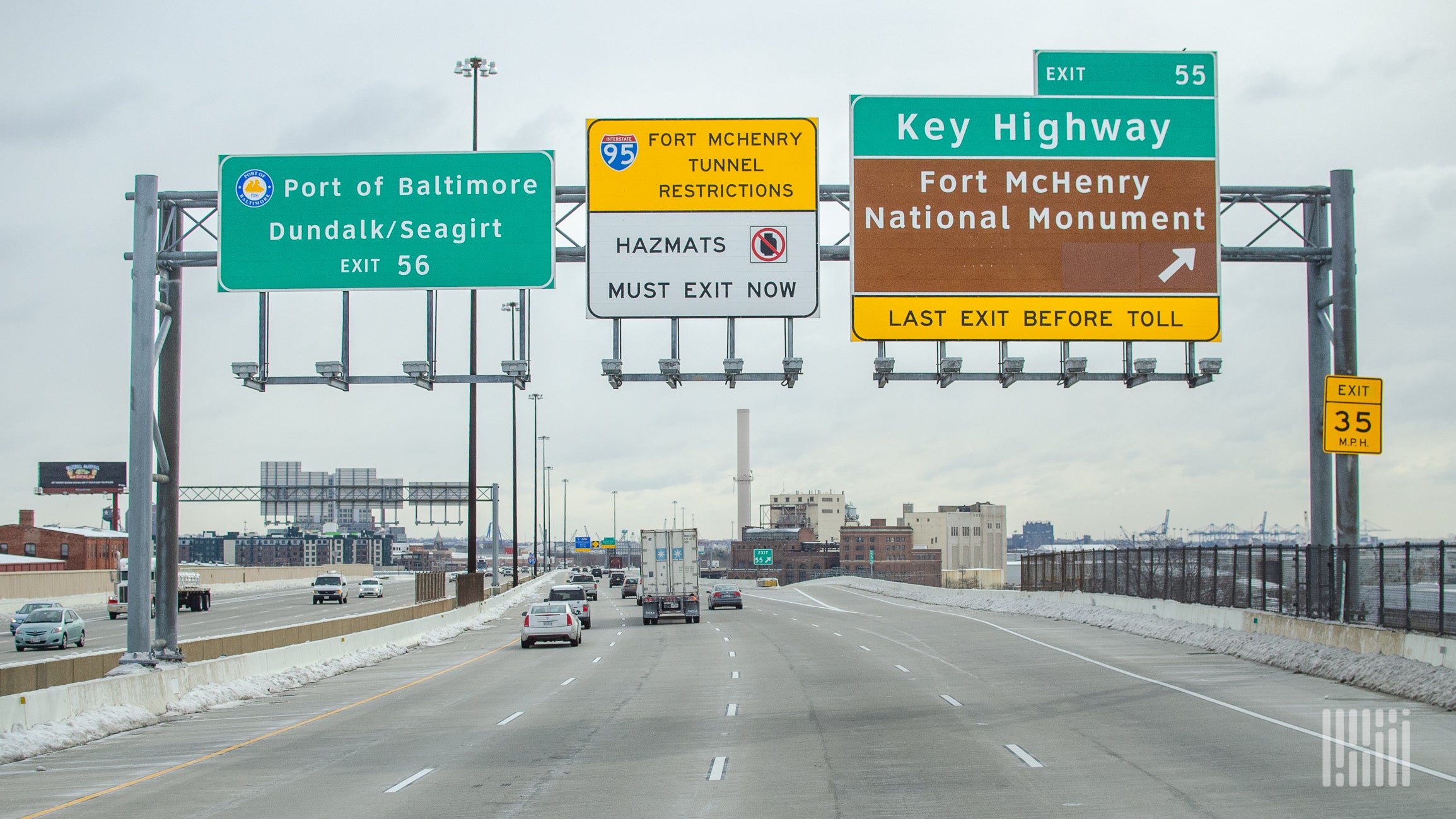
The city’s two river tunnels, the Harbor Tunnel and Fort McHenry Tunnel, prohibit hazardous materials.
“Essentially, we’re circumnavigating the Baltimore beltway to get back to I-95 south, but because we have competition on the south side of the bridge, we’re now at a major disadvantage,” Sean Underwood, owner of Underwood Energy, told FreightWaves.
Losing contracts
In the ultra-slim-margin business of hauling propane and butane, Underwood said a penny or two per gallon of product can translate into significant transportation costs.
“We’re seeing freight increases that are 3-5 cents a gallon higher due to the extra time it takes to detour around Baltimore,” he said, and that is adding 45 minutes to an hour each way. “I would say freight costs have increased as much as 30%, which makes going to another source a more attractive option for our customers.”
Underwood noted that in a busy year, the company services roughly 1,700 to 1,800 trucks at his transfer facility – mostly through annual contracts – and most of those trucks now have to detour to reach customers.
“Our best year we handled 15.9 million gallons of product, but I’ve lost roughly 7 to 8 million gallons in contracts due to the bridge being out,” he said. “We’ll see how many renew next year, but my gut feeling is we’ll lose more contracts, and others that stay may reduce how much business they do with us.”
Because the damages suffered by the company are ongoing, a specific damage amount is not included in the company’s lawsuit, an attorney for the company told FreightWaves.
Most frustrating for Underwood, however, is Grace Ocean’s and Synergy Marine’s reliance on an 1851 maritime law in their attempt to exonerate themselves from or limit their exposure to any liability that stems from the bridge collision.
“That bridge was originally constructed in part to move hazardous materials due to the restrictions in the tunnels, so I built the rail facility as close as I could to make transportation more attractive for customers – it’s almost hard to argue to keep the facility open without the bridge,” Underwood said.
“So to think that a company based in Singapore can be off the hook in the for liability and damages it caused in the U.S. because of a law written before the internal combustion engine? That’s crazy.”
Asked to comment, Darrell Wilson, a spokesman for Synergy Marine and Grace Ocean, told FreightWaves, “Unfortunately, due to the ongoing investigation in which we are fully participating, it would be inappropriate to comment at this time.”
Former trucking company owner in prison after pleading guilty in PPP fraud
A former trucking company owner from Acworth, Georgia, reported to prison Thursday, a day after a federal judge denied a motion to postpone his surrender following his sentencing in a Paycheck Protection Program fraud scheme.
Roderick Billingslea, 30, was sentenced to 30 months in federal prison in the U.S. District Court for the Northern District of Georgia on Aug. 13, nearly four months after pleading guilty in April to one count of wire fraud and one count of falsifying records related to a Paycheck Protection Program (PPP) fraud scheme.
Billingslea was ordered at sentencing to report to prison Aug. 20. However, a day before he was scheduled to report, Billingslea filed a motion seeking to push back the start of his sentence until Sept. 16, because one of his younger siblings had been hospitalized with a life-threatening medical condition.
U.S. District Court Judge Leigh Martin May partially granted Billingslea’s motion, allowing him to remain free for two extra two days and stated that she would consider granting Billingslea a longer extension if he provided “detailed medical records relating to his sister’s condition.” However, May denied Billingslea’s motion to postpone his report date by nearly a month on Aug. 21 after reviewing the medical records he submitted.
The judge also ordered Billingslea to pay nearly $600,000 in restitution and pay almost $50,000 per year for the cost of his incarceration. Once released from prison, he will serve three years of supervised release.
What happened?
Prosecutors say Billingslea submitted a fraudulent loan application to obtain funds through the U.S. Small Business Administration’s Paycheck Protection Program (PPP). He used the funds to continue operating multiple chameleon carriers, despite being barred from creating any successor trucking entities by the Federal Motor Carrier Safety Administration.
“Billingslea falsified documents in order to receive PPP funds to operate illegal and unsafe businesses that he was ordered to stop operating,” Ryan K. Buchanan, U.S. attorney for the Northern District of Georgia, said in a statement.
Federal prosecutors claimed that Billingslea filed multiple registrations with the U.S. Department of Transportation for at least five trucking entities that listed false owners and fake addresses, which violated Billingslea’s permanent ban by FMCSA that prohibited him from operating as a motor carrier.
Court documents alleged that Billingslea controlled and operated these illegal businesses by stealing the corporate identities of legitimate trucking businesses because he was unable to legally obtain insurance and used the drivers until they incurred safety violations, after which he hired new drivers and moved on to another illegal entity.
Feds crackdown on PPP fraud
Billingslea applied for and received a PPP loan for Billingslea Inc. from Atlanta-based Kabbage Inc. for over $564,000 in June 2020, claiming his trucking company had 25 employees and had monthly payroll expenses of over $200,000.
Although he was prohibited from creating any successor trucking entities, federal prosecutors claim Billingslea or someone acting on his behalf registered five trucking companies over a two-year period, from June 2020 through October 2022, which included E Cargo of Blacklick, Ohio; Hidden Valley Transport of Edgewood, New Mexico; US Transport of Harrington, Delaware; Midwest Express of Moorcroft, Wyoming; and Dispatch USA of Birmingham, Alabama.
His PPP loan was forgiven in April 2022 after Billingslea submitted false and fraudulent payroll lists, a false W-3 tax document and a false Georgia Department of Labor Employer’s Quarterly Tax and Wage report, according to court documents.
“This case underscores the critical role of oversight in safeguarding taxpayer dollars and ensuring that pandemic relief programs are not exploited by those who seek to commit fraud,” said Amaleka McCall-Braithwaite, special agent in charge of the Eastern Region of the SBA’s Office of Inspector General.
The PPP loan program was signed into law through the Coronavirus Aid, Relief, and Economic Security Act in March 2020 by President Donald Trump.
The program was designed to help struggling small businesses stay afloat during the pandemic, but federal investigators say fraudsters — including trucking-related businesses — took advantage of the SBA’s chaotic launch to vie for billions in government-backed forgivable loans. Many of the PPP loans weren’t properly vetted and lacked internal controls to prevent fraud, according to the SBA watchdog report that was released in October 2020.
A total of $800 billion was doled out in three waves to pandemic-relief funds to help struggling businesses. Since the PPP rollout, federal prosecutors are attempting to claw back nearly $65 billion in fraudulent and ineligible pandemic relief loans obtained through the program.
In February, Billingslea was charged in a seven-count criminal indictment with two counts of wire fraud for the PPP loan scheme and five counts of falsification of records for the five trucking companies registered after January 2020. When he registered the five trucking companies with FMCSA, court documents allege, Billingslea falsely answered no when asked if he currently had common ownership over the past three years with FMCSA-regulated entities.
However, prosecutors claimed Billingslea lied on the FMCSA applications because he had previously owned and operated three trucking companies over a two-year period before being shut down by FMCSA in January 2020.
FMCSA issued a final order for Billingslea to shut down Billingslea Inc., Freight Angels and Wild Bill’s Heavy Haul after he failed to correct serious violations of FMCSA’s hazardous materials regulations within 60 days of a compliance review conducted in November 2019.
Billingslea opened his first motor carrier, Billingslea Inc., in June 2018, which he incorporated in Florida. He listed its principal place of business as his home address in Acworth. In September 2018, he registered Billingslea Inc. with FMCSA by completing Form MCSA-1. On that form, he changed the company’s principal business address from Acworth to Jacksonville, Florida.
In July 2019, Billingslea registered a second entity with FMCSA, Freight Angels LLC, with its principal place of business as the same one listed for Billingslea Inc. in Jacksonville. However, the company’s mailing address was the same as Billingslea’s home address in Acworth.
Billingslea registered Wild Bill’s Heavy Haul LLC, a trucking company he owned and operated, with FMCSA in October 2019. On his Form MCSA-1, he listed the carrier’s principal place of business in Acworth, and its mailing address was registered to a P.O. Box in Grain Valley, Missouri.
Billingslea attempts to withdraw $1.4M after indictment, plea
In the government’s 12-page sentencing memorandum, it claimed that two days after Billingslea was arrested and arraigned on Feb. 20, the government was alerted that he had deposited $1.5 million into his personal Navy Federal Credit Union account and then tried to withdraw the entire amount in cash. However, the bank became suspicious of the transfer and froze the funds. Billingslea later agreed to the government’s request that he wouldn’t touch the amount owed in restitution, according to court documents.
As part of the conditions of Billingslea’s release after his arraignment, the judge granted the government’s request that he “cease operating all trucking business entities because Billingslea’s criminal conduct included repeatedly filing false motor carrier registrations in order to operate illegal trucking businesses.”
However, prosecutors allege that Billingslea ignored the judge’s order and continued to operate his illegal businesses.
After he pleaded guilty to wire fraud and falsifying records on April 11, prosecutors claimed that Billingslea violated the terms of his plea agreement, which stated that he would not hide any assets worth more than $1,000.
Billingslea opened two new business bank accounts at First Horizon Bank in the names of TLC Logistics and Dispatch USA on April 15, four days after signing the plea agreement. Court documents alleged that he deposited approximately $27,000 in small checks into the Dispatch USA account and deposited a cashier’s check for $1.4 million into the TLC Logistics account.
After depositing the funds into the Dispatch USA account, Billingslea allegedly told bank employees that he needed access to the account to make payroll for his business, prosecutors claimed.
After depositing the $1.4 million check in the TLC account, Billingslea attempted to withdraw the funds, but First Horizon froze the account and contacted the U.S. Secret Service. In court filings, the government said it was unaware of the existence of TLC Logistics, a trucking entity owned and operated by Billingslea, because he registered the business using false information.
“[His] sentence should send a clear message that, along with our law enforcement and prosecutorial partners, we will tirelessly pursue individuals who compromise trucking safety by intentionally ignoring or circumventing federal orders and regulations,” said Joseph Harris, special agent in charge, U.S. Department of Transportation Office of Inspector General (DOT OIG), Southern Region.
The case was investigated by the DOT OIG, Small Business Administration – Office of the Inspector General and the U.S. Secret Service.
Do you have a news tip or story to share? Send Clarissa an email or message @cage_writer on X. Your name will not be used without your permission.
Trucking and intermodal access highlight the Minnesota Department of Transportation’s proposed all-modes State Freight Plan for future infrastructure investments.
The DOT is asking for public comments on the plan website through Sept. 18. Federal regulations require every state to formulate the review and outlook. The plan covers trucking, railroads, water transport, pipelines and air cargo.
In addition to business, markets and infrastructure trends, the plan details changes in population demographics, safety, climate concerns and sustainability weighing on Minnesota’s transportation planning.
The value of freight movement is projected to increase 2.1% annually by 2050 from $517 billion to $978 billion. Truck, multiple modes (including intermodal) and mail will account for 87% of the total freight value in Minnesota by 2050, growing at 2.1% to 2.3% per year.
The plan found that while trucking is the top mode for freight transport and tonnage is expected to climb sharply through 2050, highway bottlenecks and parking difficulties routinely delay truck traffic. Trucking issues are likely to be exacerbated as the industry wrangles with a shortage of drivers, truck platooning and the integration of autonomous vehicles.
The state wants to develop new rail intermodal terminals to expand access and markets for shippers. Currently there are five intermodal facilities in or near Minnesota: BNSF and UP in St. Paul, CPKC in Minneapolis, and CN in Duluth, Minnesota, and New Richmond, Wisconsin.
Rail moves 19% of the state’s total annual freight tonnage and 20% by value but over the past 10 years has seen its share steadily decline as traditional rail shipments were replaced by containerized freight. BNSF has the most track in-state and CN the least, but the latter includes portions of the key intermodal route from the Port of Prince Rupert in western Canada to the carrier’s major intermodal hub in Chicago.
Pipelines have surpassed rail as the second-ranked freight transport mode. The shift followed increasing public safety concerns after a series of disastrous railroad incidents involving hazardous materials, and construction of regional pipeline networks. The Bakken fracking fields of neighboring North Dakota are a top producer of crude destined for refineries in Minnesota.
Canada follows US, imposes 100% tariff on Chinese-made electric vehicles
Canada is launching a 100% tariff on imports of Chinese-made electric vehicles effective Oct. 1, citing unfair trade practices that it says threaten the global EV market.
The country will also put a 25% tariff on imports of steel and aluminum made in China, effective Oct. 15.
“The measures are an important step towards ensuring Canadian workers and businesses can compete fairly. Global trade rules are not always adequate to protect against the type of non-market behavior we have witnessed from China in this sector,” Mary Ng, Canada’s trade minister, said in a news release.
The tariffs include hybrid vehicles, as well as trucks and buses produced in China.
According to the Canadian government, China’s state-directed policy of overcapacity and lack of labor and environmental standards threaten workers and businesses in the EV industry around the world and undermine Canada’s long-term prosperity.
The tariffs announced by Canada on Monday follow the Biden administration’s announcement in May of a 100% tariff on Chinese EVs.
In July, the Biden administration also imposed a 25% tax on foreign-made steel imports routed through Mexico. The measure is aimed at curbing imports of metals from China and other countries that ship products through Mexico to circumvent tariffs, officials said.
Canadian officials will also launch a review on other industries critical to the country, such as batteries, semiconductors and solar products.
Canada’s auto manufacturing industry directly supports over 125,000 jobs, while the country’s steel and aluminum production sector supports over 130,000 jobs, the Canadian government said.
A news release posted Monday on the website of China’s embassy in Canada rejected the tariffs as “typical trade protectionism” that will “hurt the interests of Canadian consumers and enterprises, slow down the green transition process of Canada and won’t help global efforts to address climate change.”
“[China’s] competitiveness is gained through utilizing its comparative advantages and following market principles, rather than relying on government subsidies,” the Chinese embassy spokesperson said in a statement. “The Canadian side’s accusation of China’s so-called ‘overcapacity’ is groundless. The development of China’s EV industry has made positive contributions to the world’s efforts to address climate change and realize green energy transformation.”
Canada’s trade with China was about $76 billion in 2023, with imports of Chinese goods totaling $63 billion last year.
In the first half of 2024, Canada has imported more than $34 billion worth of vehicles and auto parts from global manufacturers, a 6.5% year-over-year increase compared to the same period last year.
Automobile imports from China to Canada’s largest port in Vancouver, British Columbia, jumped 460% year over year to 44,356 units in 2023, according to statistics from the Port of Vancouver.
Trade experts said Canada has seen a large increase in EVs from China since automaker Tesla began shipping EVs from its Beijing factory.
“Canadian imports of Chinese passenger vehicles maintained momentum throughout the year, placing them as the third-largest import category, amounting to $2.64 billion and experiencing a remarkable growth rate of 326% year-over-year,” Daniel Lincoln, a policy research analyst at the University of Alberta, wrote in a study, “Canada-China Trade: 2023 Year in Review.”
“This meteoric growth in imports of Chinese-produced passenger vehicles is likely reflective of Western models produced in China – such as Tesla EVs – as opposed to Chinese vehicle brands, which are largely unavailable in the Canadian market as of 2023,” Lincoln said.
Ex-Guard grille guards prevent major damage, down time
As transportation technology continues to advance exponentially, road incidents have gotten more expensive and more complicated to repair. Preventing damage not only protects an expensive investment but also helps to avoid even costlier downtime for fleets and drivers.
Adam Roorda, head of marketing at Ex-Guard, joined Loaded and Rolling host Thomas Wasson to talk about how carrier fleets can reduce towable accidents and mitigate damage with high-quality grille guards.
Ex-Guard is an Iowa-based company with products that are designed to work seamlessly with advanced safety features, such as sensors and cameras.
To ensure their guards are compliant with new safety technology, Ex-Guard works directly with truck OEMs to verify specifications. “Our guards are designed to work around modern truck sensors,” Roorda said. “As of today, Ex-Guard has been verified to work with the radar in all major manufacturer’s collision mitigation systems. We make sure our guards avoid what’s called the ‘no-zones’ so that these systems work exactly like they’re supposed to with the guard installed.”
However, even the most advanced safety devices are incapable of controlling incoming damage. “There’s a misnomer that today’s technology will prevent most accidents,” Roorda said. “It’s true that it can certainly help drivers and avoid some instances of collisions, but there are so many things coming at trucks that the drivers simply can’t stop. There’s a huge need for dependable protection and a hard product that can mitigate serious damage.”
There is no shortage of hazards on today’s roads. Litter, trees, animals, parking lot collisions and unsecured loads damage thousands of vehicles every day in the U.S. and Canada.
Roorda also noted that major Ex-Guard fleets have shared how Ex-Guard has helped reduce all types of towable accidents by 80%.
“It’s Murphy’s law: What can happen will eventually happen to every fleet, especially with so many miles on the open road,” Roorda said. “Every day we see crazier things. A lot of folks think of our products as deer guards, and that’s true. We protect against deer and elk and moose, but there’s plenty of other occurrences that we see every single day,” he said.
“When carriers think about everything that happens that doesn’t get reported and instances beyond animal strikes, they really see the value in protecting their assets with grille guards.”
Show host Thomas Wasson presented a series of dashcam clips that demonstrated Ex-Guard products in action.
In one video, footage shows a truck driver backing into the grille guard of the truck behind it not once but three times while in traffic.
“That’s what we call the Triple Crown of accidents. You see the driver hit three times, and that’s nothing he could have stopped,” Roorda said.
It’s common for trucks to collide at low speeds in that type of incident, he says, especially when there’s an inexperienced driver, blind spots, or emergencies and distractions ahead.
“Most of the time, that will have to be reported as damage,” Roorda said. “It will usually require a bumper replacement, new paint, headlight repair and potentially much more costly fixes.”
According to Roorda, even these low-speed collisions often cost upward of $5,000 to $6,000. Worse yet are the costs of two to three days’ worth of downtime for driver and truck. “You’re closing in on $10,000 in damage for a lot of minor incidents like that,” he said.
Due to DOT regulations, many damaged trucks cannot continue driving. Although Ex-Guard can and does repair grille guards that have been affected by accidents, cosmetic damage to the grille guard itself does not prevent the driver from legally continuing down the road. “In that particular instance, the grille guard simply bent, and all it took to repair was a bracket replacement. Even then, the driver could have driven as it was,” Roorda said.
Internal rate-of-return data gathered by Ex-Guard shows that about two-thirds of the cost of any given incident can come from the downtime as opposed to repair. Insurance reimbursement for the more intangible costs such as lost potential income can be difficult to recover. “Quality grille guards save you beyond what you pay for repairs,” Roorda said.
Depending on how complex your equipment is, he says, it costs most fleets roughly $1,200 to $1,500 per day to have a truck stranded in the shop for unexpected repairs.
In another dashcam video, footage shows a passenger car swerve in front of a truck and spin away due to the collision. Eventually, both vehicles drove away largely undamaged.
In this incident, not only was the truck spared from costly damage, but the driver of the car was safer due to the force of the impact occurring along the wide area of the grille guard.
“This was thankfully just a medium-speed accident, and in this case the driver of the car was able to simply drive away with no damage except to the paint,” said Roorda. “What a lot of folks don’t understand is that our guards have a demonstrated ability to provide some front-underrun protection. This car was essentially bounced off but could have been much worse.”
“There’s peace of mind knowing that our guards prevent damage that could be not just costly but also much more dangerous to the public,” he said.
Another benefit of equipping a truck with Ex-Guard grille guards comes in the form of lowered insurance costs. “Don’t forget to check with your insurance company and get credit for running the extra layer of protection,” Roorda said. “Your rates can be lower, and insurance companies want to incentivize that damage mitigation, whether that’s through a captive program or other discounts.”
In a third video clip, dashcam footage shows an incident where a trailer in front of the driver has a blowout. As a result, an entire tire bounces off another vehicle and strikes the protected truck directly on the grille guard.
“There’s nothing you could have done to avoid that,” Roorda said. “The other trailer had dry-rotted tires.”
“A new collision mitigation system is going to be close to $5,000, so deflected debris like the tires shown here can lead to massive savings,” said Roorda.
Engineers at Ex-Guard crunched the numbers from the footage and concluded that the force of this impact was roughly equivalent to a bowling ball striking the truck at over 230 mph.
“With that kind of mass flying around at highway speeds, that’s no joke,” Roorda said. “It’s not something drivers can afford to take lightly. Not just from a maintenance standpoint but also a safety standpoint. Your radiator might be replaceable, but your drivers aren’t.”
On episode 752 of WHAT THE TRUCK?!?, Dooner is joined by Titan Casket CEO Scott Ginsberg. He’s here to show off the company’s revolutionary new casket and to talk about the logistics of the ultimate final mile: death.
We’re getting a temperature check on the economy and the freight market with Reliance Partners’ Thom Albrecht.
Another freight magician stops by the show in an attempt to prove a survey wrong that says women find magic to be one of the most unattractive hobbies. YardView Yard Management’s Jason Blanchard attempts to mindfreak us with some sleight of hand and tells us how to make yard issues disappear.
Plus, Zyn’s big expansion in Kentucky; $3.5 million awarded to driver training; trucker hits a remarkable goal; parking at the fuel island; and helicopter with chainsaws.
TuSimple plans to settle federal fraud lawsuit for $189M
Autonomous driving technology provider TuSimple on Monday agreed to a $189 million settlement after being accused of defrauding shareholders. According to reports, all defendants denied any wrongdoing in agreeing to the settlement.
The case, filed in federal court in San Diego, centers on claims that TuSimple inflated its safety record and failed to disclose that three company insiders were governing a Chinese trucking competitor, Hydron.
According to court documents, the autonomous tech provider has already deposited $174 million into an escrow account, while its insurers have contributed an additional $15 million toward the settlement.
The allegations against TuSimple stem from the period leading up to its April 2021 initial public offering, in which it raised $1.35 billion. Shareholders accused the company of exaggerating the safety of its technology, suggesting that its primary goal was to fine-tune the autonomous driving systems on U.S. roads before transferring the improved technology to Hydron in China.
These claims came to a head in August 2022 when The Wall Street Journal reported on an Arizona freeway crash involving a TuSimple truck. The incident, which had occurred four months prior, highlighted growing concerns among analysts and employees that the company’s rapid push to deliver driverless trucks was compromising public safety.
This settlement marks yet another significant challenge for TuSimple. In May, TuSimple reached another settlement, this time with the Committee on Foreign Investment in the United States (CFIUS). The issue involved temporary vacancies in the security director position and on the board’s government security committee in 2022, as well as questions over whether certain intellectual property was transferred in violation of a national security agreement.
TuSimple resolved these matters without admitting fault, and the conclusion of CFIUS’ investigation allowed the company to refocus its efforts. Cheng Lu, the president and CEO of TuSimple, expressed relief at putting the issue behind them, stating that the resolution would enable the company to better concentrate on its next development phase.
As TuSimple continues to navigate its legal and operational challenges, the company’s future remains uncertain. The recent settlements and shift in focus raise questions about its long-term strategy and ability to become a leader in the autonomous driving industry.
In January, TuSimple announced it would voluntarily delist from the Nasdaq and shut down most of its U.S. operations. This decision, coming just a few years after its IPO, signaled a strategic shift as TuSimple appeared to be concentrating its efforts on Asia, where it may see more favorable market conditions and fewer regulatory challenges.
And early this month, the company announced it’s also venturing into the movie and video game industry. It has partnered with Shanghai Three Body Animation to develop an animated film and video game based on the sci-fi series “The Three-Body Problem.” This move leverages TuSimple’s generative AI technology, aiming to accelerate content creation and commercialization.