Liner operator Hapag-Lloyd said it has signed two orders worth $4 billion for a total of 24 container ships with two Chinese shipyards.
An order of 12 ships of 16,800 twenty-foot equivalent units each will be built at the Yangzijiang Shipbuilding Group, for capacity expansion in existing services.
The Hamburg, Germany-based carrier (XETRA: HLAG.DE) said an additional 12 vessels each with capacity of 9,200 TEUs have been ordered from New Times Shipbuilding Co. Ltd. and will replace older vessels that are approaching the end of their service life this decade.
The newbuilds will be equipped with fuel-efficient, low-emission dual-fuel liquefied gas engines that can be powered by biomethane, which can reduce carbon dioxide equivalent emissions by up to 95% compared to conventional drives. The new ships are also ammonia-ready.
Delivery is scheduled from 2027 through 2029.
The newbuilds have a total capacity of 312,000 TEUs; $3 billion in long-term financing has been committed to the $4 billion purchase price.
Hapag-Lloyd operates 287 container ships with total capacity of 2.2 million TEUs. In response to an email a company spokesman said it had not yet been decided which older ships will be removed from the fleet, but that total fleet TEU capacity will be greater once the new vessels are delivered.
“This investment is one of the largest in the company’s recent history and at the same time a significant milestone for Hapag-Lloyd and our 2030 strategy as we continue to grow while modernizing and decarbonizing our fleet,” said Rolf Habben Jansen, chief executive of Hapag-Lloyd AG, in a release. “By operating a more efficient fleet, we are also improving our competitive position and can continue to offer our customers a global, high-quality product thanks to the increase in capacity.”
By 2030 the new vessels are expected to help the carrier reduce greenhouse gas emissions from fleet operations by about a third compared to 2022, and a step toward the goal of net-zero fleet operations emissions by 2045.
Hapag-Lloyd added that emissions goals will be met through a combination of investments in modern, efficient newbuilds, slow steaming, fleet modernizations, the use of new propulsion technologies and alternative fuels.
In April, Hapag-Lloyd announced it would convert five ships to methanol propulsion.
This article was updated Nov. 6 with comments from a Hapag-Lloyd spokesman.
Election 2024: US lawmakers who support initiatives to fight freight fraud
Over the past few years, growing threats in the freight and retail sectors prompted lawmakers to propose legislation targeting freight fraud and organized retail crime.
With increased incidents of organized theft along supply chain routes and sophisticated retail crime schemes, these legislative efforts seek to secure the movement of goods and support law enforcement in tackling these crimes.
Two key bills, the Safeguarding Our Supply Chains Act and the Combating Organized Retail Crime Act of 2023 (CORCA), showcase the federal push to protect domestic supply chains from both theft and fraud.
Here’s a look at the specifics of the bills, their primary sponsors and co-sponsors, and which lawmakers will still be in office to support the initiatives in the coming legislative cycle following the 2024 elections.
Safeguarding Our Supply Chains Act
Introduced by Rep. David Valadao, R-Calif., the Safeguarding Our Supply Chains Act addresses the rise in organized theft targeting critical freight networks across the U.S.
This bill seeks to establish a Supply Chain Fraud and Theft Task Force under the joint authority of Homeland Security Investigations (HSI) and the FBI. With a proposed $100 million in funding, the task force is dedicated to coordinating law enforcement efforts at both the federal and local levels to counter organized theft and fraud along freight networks, which include rail, motor carrier and intermodal systems. The focus of this task force is emphasized by a recent CargoNet study that found a 14% increase in cargo theft events across the U.S. and Canada in Q3 2024 compared to Q3 2023.
The bill has several co-sponsors from both parties, including:
Rep. Bradley Scott Schneider, D-Ill. – reelected.
Rep. Darin LaHood, R-Ill. – reelected.
Rep. August Pfluger, R-Texas – reelected.
Rep. Jim Costa, D-Calif. – too close to call, likely to win.
Rep. Vince Fong, R-Calif. – reelected.
Rep. John Rutherford, R-Fla. – reelected.
Rep. Pete Stauber, R-Minn. – reelected.
Rep. Salud Carbajal, D-Calif. – reelected.
Rep. Robert Wittman, R-Va. – reelected.
Rep. Trent Kelly, R-Miss. – reelected.
Rep. Mark Amodei, R-Nev. – reelected.
Rep. Robert Garcia, D-Calif. – too close to call, likely to win.
Rep. Steve Cohen, D-Tenn. – reelected.
Rep. Bill Huizenga, R-Mich. – reelected.
Rep. Juan Ciscomani, R-Ariz. – too close to call, 1.7% down from Democratic opponent Kirsten Engel.
Notably, Rep. Abigail Spanberger, D-Va., chose to run for governor of Virginia, leaving her seat to be filled by Democrat Eugene Vindman. Whether Vindman will support this legislation remains to be seen.
Combating Organized Retail Crime Act of 2023
CORCA is another bipartisan bill designed to address the escalating problem of organized retail crime. Sponsored by Sen. Chuck Grassley, R-Iowa, and co-sponsored by a bipartisan coalition of senators, CORCA aims to equip federal law enforcement with resources to collaborate with local authorities to dismantle complex retail crime rings. These criminal organizations often engage in elaborate schemes involving cargo theft and e-commerce fraud.
The primary co-sponsors of CORCA were not up for reelection in this year’s race. They include:
Sen. Catherine Cortez Masto, D-Nev.
Sen. John Kennedy, R-La.
Sen. Bill Cassidy, R-La.
Sen. Lindsey Graham, R-S.C.
Sen. Thom Tillis, R-N.C.
Sen. Ted Budd, R-N.C.
Sen. Steve Daines, R-Mont.
Sen. Mark Kelly, D-Ariz.
Sen. Marco Rubio, R-Fla.
Sen. James Risch, R-Idaho
Sen. Mike Crapo, R-Idaho
Co-sponsoring Sens. Martin Heinrich, D-N.M., Amy Klobuchar, D-Minn., and Ted Cruz, R-Texas, won reelection. Sen. Jacky Rosen, D-Nev., is in a close race with Republican Sam Brown, with polls leaning towards Brown, and Sen. Jon Tester, D-Mont. lost to Republican Tim Sheehy.
The Safeguarding Our Supply Chains Act and CORCA are strong indicators of a bipartisan commitment to tackling crime affecting U.S. supply chains. With key sponsors and co-sponsors remaining in office, they are positioned to play vital roles in U.S. supply chain security initiatives.
Reports claim Houthis make Red Sea vessel attacks a $2B business
Houthi rebels are extorting as much as $2 billion a year from shipping lines in exchange for not attacking their vessels in the Red Sea and Gulf of Aden, according to a new study.
The unreleased study based on research by a panel of Yemen experts for the United Nations Security Council found that the Houthis were pulling in $180 million per month in the “tolling” protection racket, one published report said, though the panel could not independently verify that number.
Since November 2023, the Houthis have attacked commercial shipping in the Red Sea — a critical route for ships sailing between Asia, the Mediterranean and the east coast of North America — with drones, missiles and watercraft, killing four people and sinking two vessels. The Red Sea provides access to the Suez Canal to the north and the Gulf of Aden to the south.
The Houthis claim to only block shipping from Israel-connected countries, but the study found attacks on vessels from Houthi-backing countries, including Iran, according to another news article.
Most major shipping companies have diverted containerships and tanker vessels away from the region and on to longer voyages via the Cape of Good Hope around the Horn of Africa. That route adds 10-14 days to the duration of a voyage, adding delays and costs for shippers. But a steady flow of local and region-based vessels continue to ply the Red Sea daily.
Among major carriers, only CMA CGM of France continues to operate scheduled rotations through the Red Sea. The company did not respond to an email request for comment.
The panel found that the Houthis carried out more than 130 attacks on merchant ships from November 2023 through the end of July 2024.
The panel wrote that “[t]he group’s shift to actions at sea increased their influence in the region. Such a scale of attacks, using weapon systems on civilian vessels, had never occurred since the Second World War,” according to the news report.
The U.N. study found that the protection revenue is helping to finance and expand the Houthis’ operations in the region. This extended to cooperation with al-Qaida, Hezbollah and other terrorist groups, as well as pirates in Somalia and links to Iran’s military.
At the same time, the Houthis have built up a far-ranging network for money-laundering, recruitment, smuggling and moving arms.
“The scale, nature and extent of transfers of diverse military materiel and technology provided to the Houthis from external sources, including financial support and training of its combatants, is unprecedented,” the study found.
The TriumphPay Network has resulted in $100M+ in prevented potential losses for network participants. Watch our newest webinar today to learn how.
In this webinar, you will learn about:
The impact of the TriumphPay Network on automation and how it enhances your invoice processing workflows.
How TriumphPay works with Revenova to provide superior verification and validation of invoice data.
How increased network data density can enhance automation and reduce risk.
Strategies for leveraging the Network Effect to scale operations and boost agility.
Hosted by:
Nate Gilmore, SVP, Network Integrations and Innovation – TriumphPay
Mike Horvath, Chief Operating Officer – Revenova
Fill out the form to access the recording.
Schneider National cuts outlook, ‘commoditized’ one-way fleet uninvestable
Schneider National lowered full-year 2024 expectations on Wednesday as seasonal trends, which were favorable in June and July, eroded during August and September.
The Green Bay, Wisconsin-based multimodal transportation provider now expects 2024 adjusted earnings per share of just 66 to 72 cents, down from quarter-ago guidance of 80 to 90 cents, and lower than the 82-cent consensus estimate at the time of the print.
The company did say it expects to see some seasonal improvement in the fourth quarter. The midpoint of the company’s revised guidance range implies fourth-quarter EPS of 19 cents, nearly 20% higher y/y. However, that compares to the current consensus estimate of 28 cents.
Schneider called out continued weakness in its network (one-way) truckload segment on a Wednesday call with analysts. It said that even as contract rate renewals were at the “highest level since first quarter 2022” (up by a mid-single-digit percentage), this segment of the market is highly “commoditized” and not supportive of “additional investment.”
Schneider (NYSE: SNDR) reported adjusted EPS of 18 cents in the third quarter, which was 5 cents worse than the consensus estimate and 2 cents lower year over year. Lower gains on both equipment sales and equity investments presented a 4-cent y/y drag. It also said higher insurance and claims costs were a 4-cent headwind even though incident frequency declined.
Table: Schneider’s key performance indicators
Revenue in the TL unit dipped 0.6% y/y to $532 million as average trucks in service declined 2.6% and revenue per truck per week excluding fuel surcharges was up 1.6%. The dedicated truck count was up 4% while the one-way fleet declined 12% y/y. (Schneider acquired dedicated carrier M&M Transport Services in August 2023.)
President and CEO Mark Rourke said recent channel checks with truck lenders show the one-way market is seeing a capacity shakeup as defaults and repossessions “are growing, and in some cases rivaling the financial crisis levels from 2008 and 2009.”
He also told analysts that account churn within Schneider’s dedicated business is down 50% from last year and that he expects a higher level of customer retention moving forward.
The unit recorded a 95.5% operating ratio, which was 10 basis points worse y/y and 120 bps worse than the second quarter. The one-way fleet operated at a loss in the period.
Chart: (SONAR: OTRI.USA). A proxy for truck capacity, the Outbound Tender Reject Index, shows the number of loads being rejected by carriers. To learn more about SONAR, click here.Chart: (SONAR: NTIL.USA). The National Truckload Index (linehaul only – NTIL) is based on an average of booked spot dry van loads from 250,000 lanes. The NTIL is a seven-day moving average of linehaul spot rates excluding fuel.
Intermodal revenue increased slightly y/y in the quarter to $265 million as loads were up 0.9% and revenue per load was up 0.4%. The company saw double-digit load growth off the West Coast and from Mexico, which was partially offset by lower volumes in the East. Shorter lengths of haul in the Eastern network make truckload and its depressed rates a viable option.
Loads were up 3.2% from the second quarter with yield 1% higher.
The unit reported a 94.1% OR, which was 170 bps better y/y (10 bps better sequentially). Cost actions and improved drayage productivity were the catalysts for the improvement. Average turns per container were also up 3.2% y/y.
Logistics revenue fell 3.8% y/y to $314 million as brokerage loads dipped 1% with brokerage revenue per load closing the gap in the decline. A 97.6% OR was 20 bps worse y/y and 110 bps worse than the second quarter.
Shares of SNDR were up 4.6% at 1:47 p.m. EST on Wednesday compared with the S&P 500, which was up 2.4%.
Will President Trump make freight great again? | WHAT THE TRUCK?!?
On episode 780 of WHAT THE TRUCK?!? Dooner is joined by FreightWaves’ CEO and founder Craig Fuller to discuss President Donald Trump winning the presidential election for a second time.
Is a Trump win bullish or bearish for trucking and global trade? Who wins and loses under his administration? Can he end the freight recession and make trucking great again? Also, is Fuller eyeing the role of DOT Secretary? We’ll find out.
OOIDA’s Lewie Pugh is talking about the dangers of autonomous trucks. He talks about a rule that seeks to address national security concerns related to connected vehicle technologies and components from China and Russia.
Catch new shows live at noon EDT Mondays, Wednesdays and Fridays on FreightWaves LinkedIn, Facebook, X or YouTube, or on demand by looking up WHAT THE TRUCK?!? on your favorite podcast player and at 5 p.m. Eastern on SiriusXM’s Road Dog Trucking Channel 146.
The views expressed here are solely those of the author and do not necessarily represent the views of FreightWaves or its affiliates.
While the final margins may not be determined for some time in several outstanding races, the election results are coming into focus. Former President Donald Trump has been reelected, Republicans have won a majority in the U.S. Senate, and the U.S. House will be split fairly closely, as it has been for the past four years.
With the Senate shifting even just a few seats to the right, it alters what Congress might consider for rail safety legislation. It’s noteworthy that the rail safety legislation pending in the U.S. Senate seems to have fallen short of the 60 votes necessary to proceed – but that doesn’t mean that the next two years will end the same way.
In fact, the next Congress has an excellent chance to make safety-enhancing moves on rail policy, starting with the successor to the 2021 Infrastructure Investment and Jobs Act (IIJA), which expires in 2026. The IIJA is just the most recent in the series of surface transportation packages that Congress authorizes every five or six years.
Congress does not always include a rail component to the surface transportation bill, so this is no slam dunk. However, there are several items Congress is likely to consider, starting as soon as January.
Grade-crossing safety. In the U.S., there are more than 200,000 grade crossings between roads and railroads. This is by far where the deadliest incidents involving trains occur.
The 2021 law included new funding to address grade crossings, although unfortunately the funding is only a small portion of what’s needed. What may be the best solution in most cases is also the most expensive, which is to create new vehicle overpasses. In other cases, closing the intersection may suffice. Congress is all but certain to continue putting additional funds into programs to address grade crossings.
New technology. Policymakers also seem likely to promote the development of new technology and performance-based regulations backed by sound data, and to allow for waivers and pilot programs on new safety approaches. Pilot programs – for the rollout of new techniques, processes, technology or other – can be focused either geographically or by segment to ensure the safest possible gathering of data to support new technology and new approaches.
Rural infrastructure. Congress in recent years has tried to step up its game with rural infrastructure, driven both by the needs of the freight network and the spreading population. Safety is a key consideration here, as accidents in rural areas, almost by definition, usually occur farther from potential medical assistance.
Permitting reform. The challenges to getting major infrastructure permitted have also ballooned over the past few decades, with years spent waiting and billions of dollars at stake attempting to move through the process. Fortunately, permitting reform has gotten a bit more bipartisan in recent years, as members of both major parties are finding difficulties in getting favored projects through.
Congress could expand the One Federal Decision framework, which was used during the Trump administration to get agencies to work together. OFD was pulled back by the Biden administration before being enacted as part of the IIJA. However, the version of OFD in IIJA is only a pale shadow of the concept, leaving work that could be picked up either by Congress or by the incoming administration. Or hopefully both.
Of course, the railroads themselves have internal initiatives on improving safety, and these should be studied and encouraged by Congress and the regulators. In some cases, rail carriers have higher standards than what’s legally required – these in particular should inform how policymakers think about ongoing issues.
The outcome of this year’s election cycle won’t resolve the tension surrounding the U.S. political divide. However, on rail policy, there are areas for policymakers to focus on that stakeholders should watch closely over the next year.
Loren A. Smith Jr. is the president of Skyline Policy Risk Group. He formerly served as deputy assistant secretary for policy at the U.S. Department of Transportation.
Retail and CPG industries grapple with election results
The Stockout Show: Election special
(Image: FWTV)
On Monday’s The Stockout show, I discussed what the election results could mean for the retail and CPG industries. For those who prefer to read, FreightWaves’ Caleb Revill summarized it well. On the show, I went through four major issues: tariffs, taxes, the Federal Trade Commission and food regulations. Producing the show one day before Election Day, I also speculated on how the CPG and retail industries might vote based on their presumed self-interests in those issues.
The outcome of the election made the show more relevant since President-elect Trump was more of a change agent. In particular, the retail industry is wary of Trump’s tariffs, and the CPG industry is wary of a Trump administration overhauling the food and medicine industries by granting widespread power to Robert F. Kennedy Jr. In addition, the FTC could look much different, resulting in more leniency on mergers.
See Monday’s show here or check out the full The Stockout playlist here.
Proposed tax cuts expected to boost freight demand
For a discussion of why, check out last week’s State of Freight election special or Tuesday’s article written by Revill and John Gallagher. In short, tax cuts at both the personal and corporate levels should result in more economic activity. In addition, if tariffs have the intended effect of boosting domestic manufacturing, that production often involves numerous transportation points of handling in the supply chain. That contrasts with imported goods, which typically arrive finished.
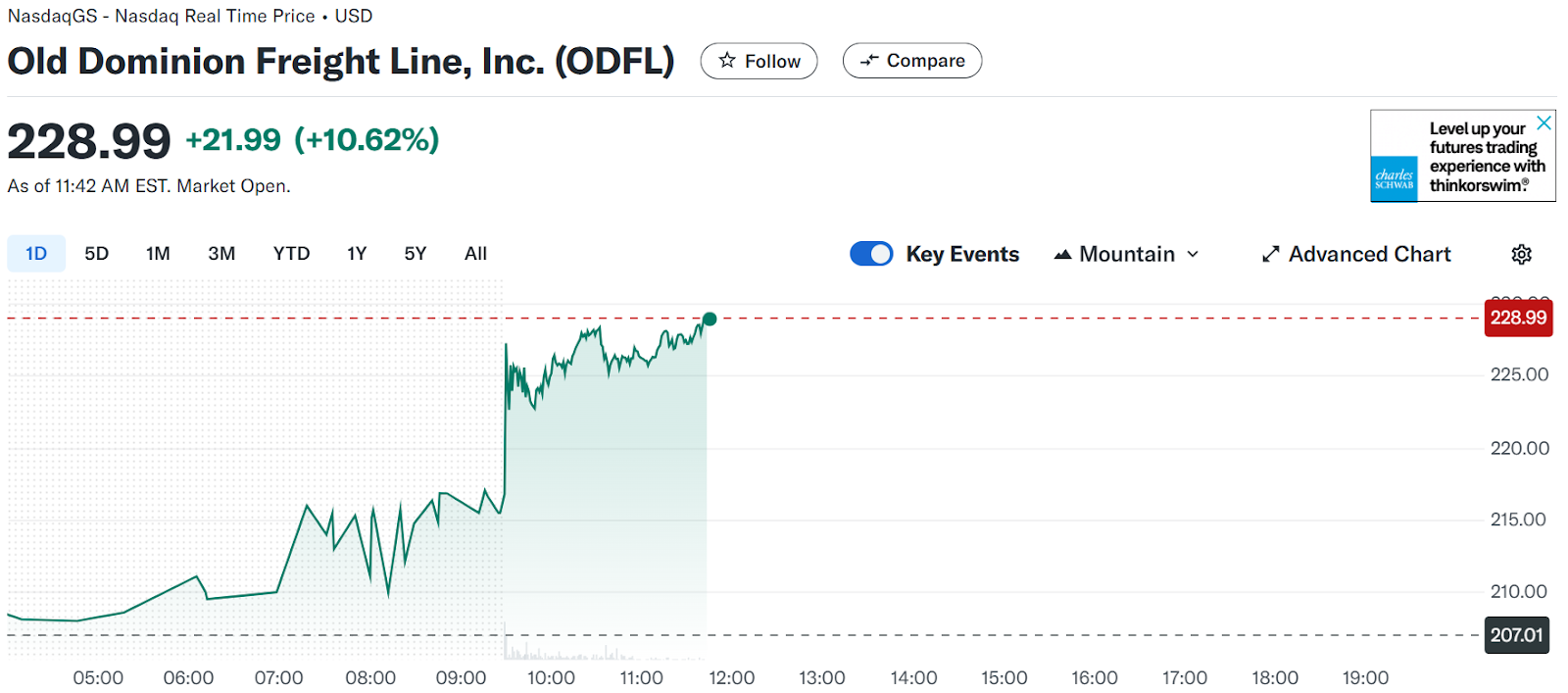
LTL carrier Old Dominion Freight Line (NASDAQ: ODFL) is one of many freight carriers bouncing in Wednesday’s trading as the broad indexes also rise. (Chart: Yahoo! Finance)
Ocean rates should continue moderating from the currently elevated levels
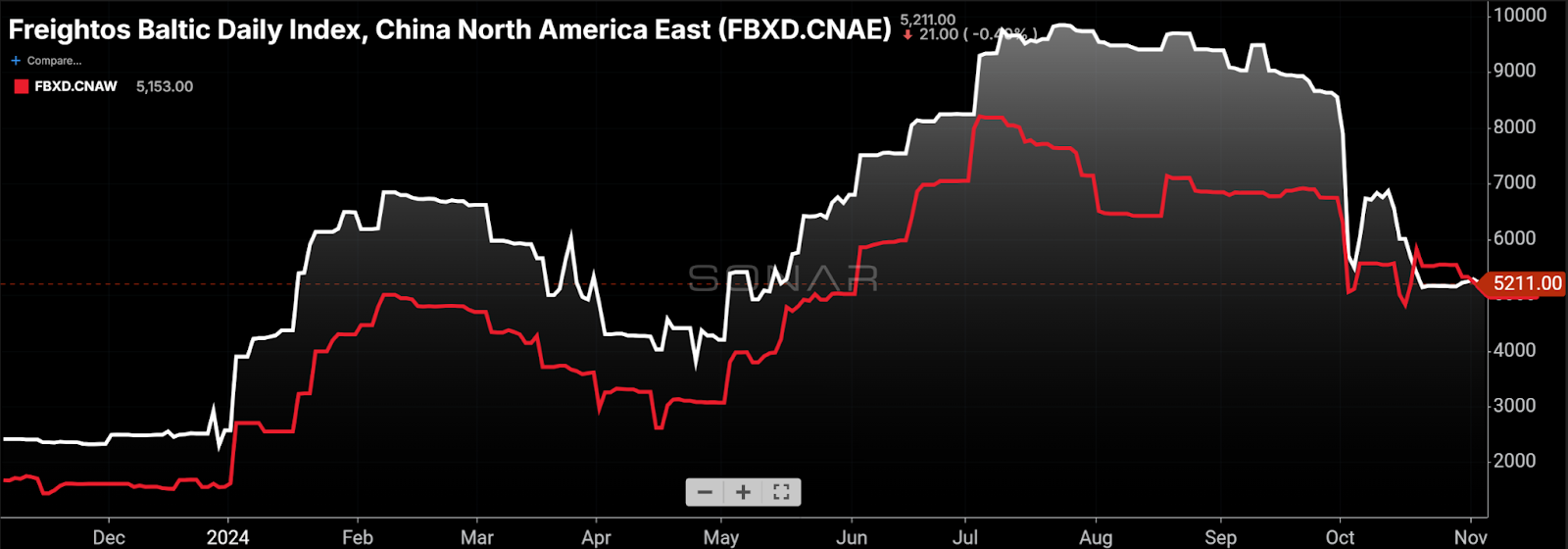
Trans-Pacific ocean spot rates from China to the U.S. East Coast and U.S. West Coast are shown in white and red, respectively. On its webinar, Flexport described the recent volatility in inbound U.S. ocean rates as “extreme” and acknowledged how unusual it is that these rates are roughly at parity. The China to U.S. East Coast lane is typically about $1,000 per container higher than the China to U.S. West Coast lane. But, it did not offer an estimate on when the spread might return to the historical average. The rates for both trans-Pacific lanes appear set to decline next year, with capacity likely to increase faster than demand. (Chart: SONAR: FBXD.CNAE, FBXD.CNAW)
Barring something unexpected happening in ocean demand, ocean capacity is set to increase faster than demand in the coming years. That was one of the primary messages from Flexport’s Oct. 31 webinar. The company is expecting the supply of ocean capacity to grow by 8% in 2025 followed by an additional 6% increase in 2026 due to vessel additions to fleets. If carriers were to again fully utilize the Red Sea, the effective capacity deployed would increase much more. Meanwhile, demand is expected to grow by about 3% annually, which would be roughly in line with to slightly above growth rates of global GDP. I believe the election results and more protectionist trade policies create risk to that demand expectation, potentially creating another factor to pressure rates.
Other takeaways from the Flexport ocean webinar include:
CMA CGM has announced it will return to the Red Sea and Suez Canal – see routing here. The French carrier seems to view risk differently from the rest of the industry, which continues to avoid that area. Shippers with containers going through the Suez should opt for comprehensive general average insurance rather than standard insurance.
If carriers were to return to the Red Sea en masse, schedules would be in flux, making it difficult for carriers to manage capacity via blank sailings. That could send rates plummeting.
Carriers’ avoidance of the Red Sea changes seasonal shipping patterns given the longer sailing times and increased lead times. Therefore, expect the impact of Chinese New Year to come early this year.
Hub Group expects intermodal rates to rise
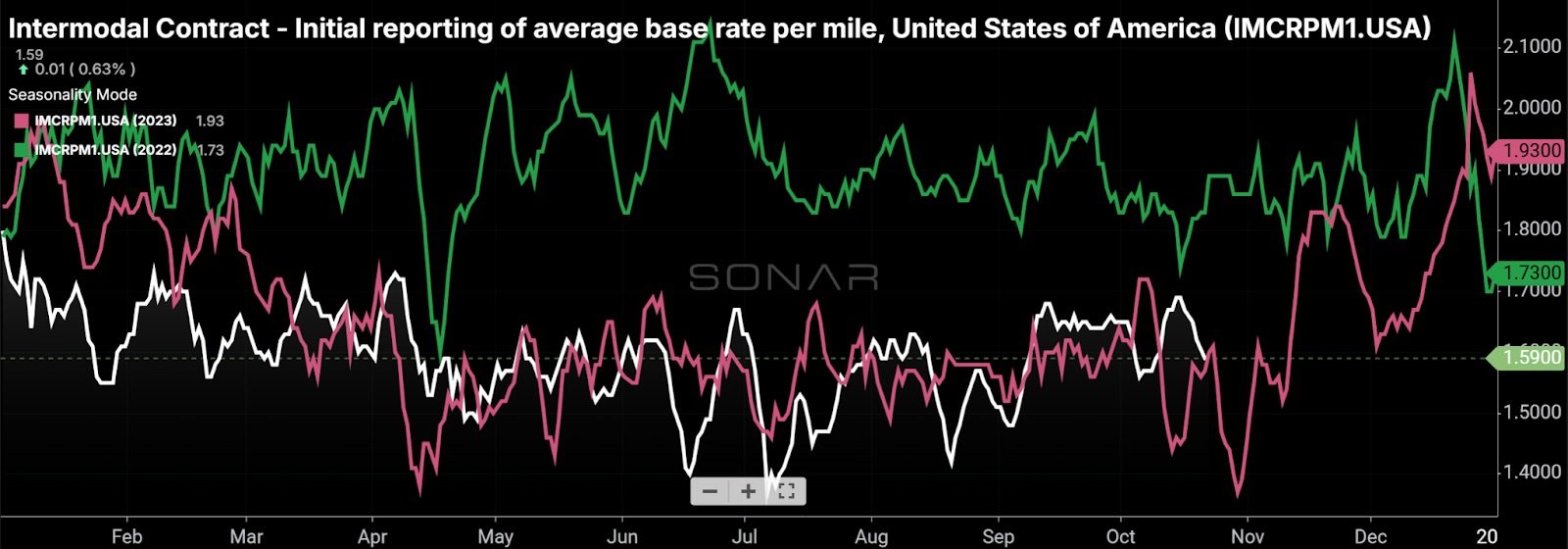
A national index of intermodal contract rates in SONAR shows rates trending roughly in line with year-ago levels. (Chart: SONAR)
When multimodal carrier J.B. Hunt reported earnings in mid-October to start the third-quarter earnings season, its management sounded optimistic on the upcoming bid season, highlighting service levels and the capacity that the carrier is able to provide. Similarly, its competitor Hub Group expressed confidence on its own analyst call last week that intermodal contract rates will rise. In response to an analyst’s question, Hub’s management described pricing as “competitive, but rational” and said it expects rates to rise with a magnitude that is not yet clear. The carrier also mentioned that it has seen disruptions in international intermodal service levels, which should help domestic intermodal volume. For more detail, see Noi Mahoney’s writeup here.
Fighting freight fraud: A playbook to combat holiday theft
With holiday shipping ramping up, freight fraud is top concern for players across the industry. While companies fight all types of fraud throughout the year, strategic theft and straight theft are particularly prevalent in today’s market.
Cargo theft incidents were up 33% year over year in the second quarter of 2024, according to CargoNet. A total of 771 reported thefts during the quarter added up to more than $34 million in lost value, with distribution centers and truck stops being top targets. These threats show no signs of slowing down, reaching record highs earlier this year.
“Cargo theft has been around since there has been cargo,” Bill McDermott, senior investigator at Uber Freight, said. “We used to see lulls, and we’re not seeing that right now. I think as organized groups evolve and start to use different methods, it’s going to continue.”
CargoNet’s predictions for the coming months are in line with McDermott’s assessment. This means it is crucial for every participant in the supply chain to prepare for potential threats now, as we approach the busiest shipping season of the year.
Building a holiday fraud playbook
As companies begin to move larger volumes of high-value goods ahead of the holiday season, McDermott urges people to remember the adage: Cargo at rest is cargo at risk.
Shippers, carriers and brokers should be particularly vigilant about securing and monitoring shipments moving via longer routes that require drivers to stop and rest. It is critical to train every employee in the organization on how to recognize and respond to potential threats – whether they are truck drivers or office workers.
“Companies need to have a playbook and be ready for a theft to occur,” McDermott said.
A comprehensive cargo theft playbook should include key contacts such as local authorities, insurance providers and other investigative resources. Each team member’s role should be clearly defined in case of an incident and include any pertinent information that can be immediately handed over to investigators.
McDermott also recommends that companies store these response plans in physical binders, not digitally on a computer. This ensures that the playbook is accessible even if a theft incident happens in conjunction with a cyberattack, which could disable digital access.
However, simply having a plan is not enough. McDermott emphasized the importance of running regular “tabletop exercises” with company leadership before a theft occurs. This ensures all staff members understand their roles – and the roles of their teammates – during an actual theft event, allowing companies to refine their response.
“You don’t want to have your worst day and be trying to figure it out on the fly,” McDermott said.
Preparing for the worst through collaboration
Being prepared means not only having a playbook, but also creating collaborative relationships with local law enforcement and other investigative teams before an incident occurs. Having established connections in these organizations allows for a quick response when an incident arises, when every minute counts in the effort to recover stolen freight.
“Speed is everything when it comes to recovering stolen goods,” McDermott says. “If you have connections already in place, the chances of a quick response go up significantly.”
It is also crucial to choose the right industry partners that can make or break their security protocols. Aligning with partners who prioritize security can make a difference in preventing theft.
“It is like any relationship. You have to engage a partner that has a like mind,” McDermott said. “Make sure they are security-minded and treat your product as if it were their own.”
Uber Freight’s role in combating theft
When it comes to preventing theft, Uber Freight leads by example in its own playbook. It has implemented a robust suite of security protocols designed to help protect both itself and its partners. From onboarding and compliance checks to an in-house team of investigators, the company is security-minded at every turn.
Last year, Uber Freight was named “Best in Security” by CargoNet, underscoring its commitment to fraud prevention and mitigation. By leveraging machine learning algorithms and building strong relationships with law enforcement, Uber Freight not only strengthens its fraud prevention efforts, but also optimizes their chances of recovering stolen freight after a theft occurs.
Uber Freight doesn’t just try to safeguard its own operations, but also believes in coming alongside others in the industry – including its competitors – to fight fraud.
“You’re not going to lose the market by engaging with people in the fight against fraud or cargo theft,” McDermott said. “If we have an incident, we share that information with others because that is the approach we have to take as an industry. Our approach is to make sure everybody knows what this attack vector is.”
Bad actors take advantage of poor communication and strained relationships within the supply chain. By coming together and attacking fraud head-on, the industry has a better chance to protect itself and thwart bad actors in today’s changing landscape.
Click here to learn more about Uber Freight. For more information on how Uber Freight is fighting fraud with collaboration, watch the Deliver On-Demand webinar now.
Hurricane Rafael could hit US later this week, but impacts unclear
Hurricane Rafael is expected to take aim at the United States after making landfall in Cuba, but the storm’s possible intensity and damage to the U.S. coast remain unclear.
Category 2 Rafael is forecast to strengthen into a major hurricane before making landfall in Cuba on Wednesday but is expected to weaken as it moves into the Gulf of Mexico, the National Hurricane Center said.
Rafael currently has maximum sustained winds of about 100 mph.
The Florida Keys could see 1 to 3 inches of rain and tornadoes Wednesday, the center said. AccuWeather forecasters say the Florida Keys could see 60 mph winds and 2 to 3 feet of storm surge.
Florida ports were open Wednesday but on alert and monitoring the storm.
SeaPort Manatee, the Port of St. Petersburg and Port Tampa Bay were set to port condition Whiskey on Monday, which means gale force winds were expected within 72 hours. Port Tampa Bay’s weather advisory group began monitoring the storm Monday.
The Port of Key West was operating under X-Ray status as of Tuesday, meaning it expected to see gale force winds within 48 hours.
AccuWeather predicts Rafael will lose intensity due to the cooler waters in the Gulf and wind shear. It remains unclear what path Rafael will take after moving into the Gulf, but forecasters say the greatest chance of a U.S. landfall will occur in Louisiana.
Ports in Louisiana were operating under normal conditions Wednesday, according to the U.S. Coast Guard.
“It is also possible Rafael is torn apart by strong winds high in the atmosphere and dissipates in the Gulf of Mexico before making landfall,” AccuWeather Senior Meteorologist Bill Deger said in an announcement.
AccuWeather doesn’t predict Rafael to make landfall as a major storm if it does hit the U.S.
“It is too soon to determine what, if any, impacts Rafael could bring to portions of the western Gulf Coast,” the hurricane center said. “Residents in this area should regularly monitor updates to the forecast.”
Heavy rainfall ahead of Rafael is expected to hit the Southeast Wednesday through Thursday, AccuWeather said. Four to 8 inches of rain is expected from the Florida Panhandle into South Carolina. Some areas of eastern Georgia and southwestern South Carolina could see 8 to 12 inches of rainfall.
Impacts like those seen during Hurricane Helene are not expected, AccuWeather said, but flooding is possible.