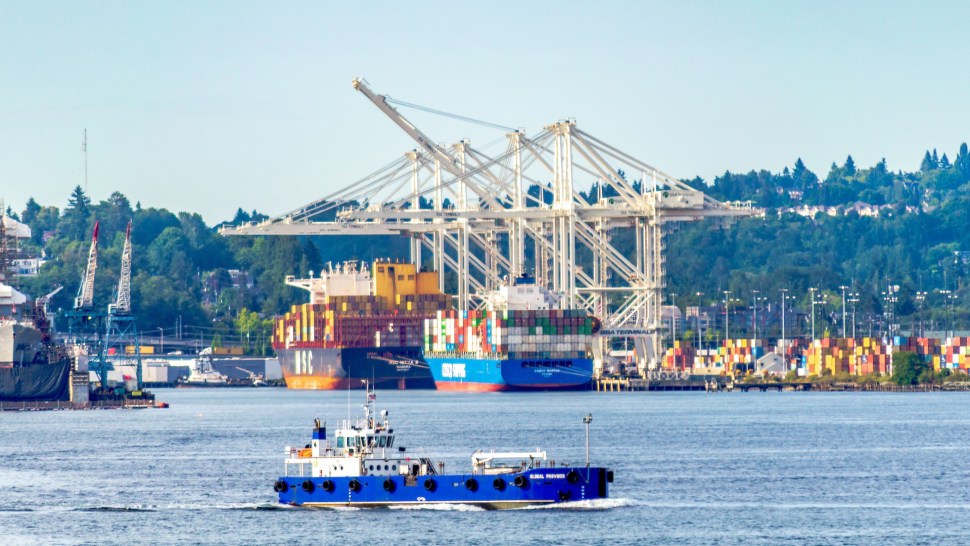
In October U.S. container imports totaled 2,306,687 twenty foot equivalent units (TEUs), off 0.1% from September and below the 2.4 million–2.6 million range of historic peak season volumes.
It’s only the second October in the past decade to show a month-over-month decline, logistics software specialist Descartes said in a report, as importers tread cautiously amid shifting trade and economic conditions and likely tariff-fueled frontloading earlier in the year.
Imports from China posted a modest recovery from losses in September and August, up 5.4%, although year-to-date volumes are 16.3% below 2024’s record pace.
Major gateways saw slight seasonal increases in transit delays but throughput remained stable without systemic congestion. Ocean carriers continue to divert away from the Red Sea around Africa’s Cape of Good Hope, adding up to two weeks to voyages.
The report pointed out that U.S. container import volumes in October were 7.5% lower y/y, but 0.9% better for the first ten months of 2025 compared with 2024. Growth margin has steadily narrowed from around 10% in January to less than 1% in October on likely frontloading in an early peak season, “softer economic conditions, and slower consumer demand [that] has steadily slowed momentum.”
October 2025 import volumes slid 0.1% from September, a change from the month-over-month increases observed in eight of the past 10 years. “While October is one day longer and has no major holidays, this year’s divergence likely reflects importer sensitivity to tariff uncertainty and shifting policy timelines. Many shippers appear to have frontloaded imports ahead of October or deferred orders while awaiting developments in tariff negotiations with key trade partners, dampening [sic] what is typically a seasonal uptick.”
This October was still the fifth-highest on record even as policy uncertainty moderated trade.
Container volumes across the top 10 U.S. ports in October were essentially unchanged from September’s 7.9% drop, down by just 114 TEUs, suggesting that import levels have steadied. Miami was most improved at 12.9%, followed by Long Beach, 9.1%, Oakland, 4%, Houston, 1.2%, and New York-New Jersey, 0.8%.
Import volumes fell at Tacoma, 6.4%, Savannah, 6.1%, Los Angeles, 5.5%, Norfolk, 3% and Charleston, 0.6%.
“Overall, the flat performance suggests importers are maintaining a more cautious pace, deviating from the typical October increase over September,” the report stated.
China imports increased to 803,901 TEUs in October, up 5.4% m/m but off 16.3% y/y, and down 21.4% from the record July 2024 of 1,022,913 TEUs. China’s share of total U.S. imports increased to 34.9% in October from 33% in September.
Long Beach, 20.4%, and New York-Newark, 21.1%, claimed the largest share of China gains, while volume losses were led by Seattle, 20.6%; Charleston, 8.4%, and Los Angeles, 8.3%.
Some ocean lines shifted tonnage and adjusted rotations ahead of the Oct. 14 implementation of U.S. port fees on Chinese ships, which may have been reflected in decreased volumes.
Find more articles by Stuart Chirls here.
Related coverage:
Houthi Red Sea stand down: ‘Seismic’ impact on shipping
Ocean rates tested by capacity conundrum
Container imports off 17.6% at leading US port
Freightos brand adopts Visa/Transcard payment financing tool
Brokerage Compliance Symposium
The day before F3. Every compliance issue you face - fraud exposure, carrier liability, FMCSA rules, cargo theft, insurance gaps - navigated by attorneys and operators defining best practices in a changing industry.
F3 Awards Dinner
The night before F3. FreightTech100 companies honored. FreightTech 25 and Shipper of Choice winners revealed live. Cocktail reception into dinner and live music - 300 industry leaders in one purpose-built room.
F3: Future of Freight Festival
Industry-defining keynotes, rapid-fire technology demos, and industry leaders networking in experiences across Chattanooga - plus the inaugural F3 Awards Dinner featuring the FreightTech and Shipper of Choice reveals.
The day before F3. Every compliance issue you face - fraud exposure, carrier liability, FMCSA rules, cargo theft, insurance gaps - navigated by attorneys and operators defining best practices in a changing industry.
The Signal at Chattanooga Choo Choo • Chattanooga, TN Register NowThe night before F3. FreightTech100 companies honored. FreightTech 25 and Shipper of Choice winners revealed live. Cocktail reception into dinner and live music - 300 industry leaders in one purpose-built room.
The Signal at Chattanooga Choo Choo • Chattanooga, TN Register NowIndustry-defining keynotes, rapid-fire technology demos, and industry leaders networking in experiences across Chattanooga - plus the inaugural F3 Awards Dinner featuring the FreightTech and Shipper of Choice reveals.
The Signal at Chattanooga Choo Choo • Chattanooga, TN Register Now