Insurers Judged By The Trucking “Company” They Keep
When a truck kills someone, we ask who was driving. We never ask who insured them. That question tells you more about what went wrong than anything else in the crash file.
Executive orders, rulemakings, legislation, and court challenges all operate on different timelines with different powers and different guardrails. Yesterday’s historic Duffy-Barrs press conference was the biggest enforcement announcement in a generation, and it still has to survive the process. Here’s why, and what comes next.
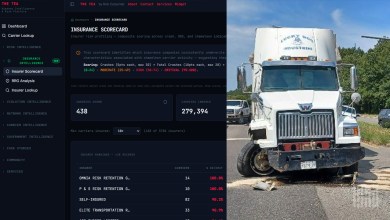
Our investigation reveals that 5% of carriers, as identified by their insurers, account for nearly a third of all truck crashes. No federal or state law requires insurers to review a single page of safety data before binding a policy.
The 287(g) program has turned local law enforcement into immigration officers across 40 states. Compliant hiring is not defensible hiring. Here’s the difference, and why it matters now more than ever.
American agriculture rarely makes front-page freight headlines, yet it quietly underpins a significant portion of trucking demand. Grain, livestock, fertilizer, seed, feed, refrigerated meat, packaged goods, ethanol, farm equipment—entire freight ecosystems depend on a stable farm economy. Recent reporting has highlighted a sharp rise in farm bankruptcies and growing concern from agricultural leaders about systemic […]
You can’t own a fishing boat, fly an airplane, broadcast a radio signal, split an atom, or drill for oil in America without proving you’re an American. But you can operate an 80,000-pound commercial motor vehicle on every highway in every state in the nation without being a citizen of this country, or even setting foot in it. Welcome to the American trucking industry, where the door isn’t just open. It’s been taken off the hinges.
For the better part of three plus years, most small carriers and owner-operators have felt like they’ve been grinding uphill in soft dirt. Rates fell, truckload volumes cooled and tender rejections disappeared. All while new authorities flooded in and every time it looked like things might turn, something else pushed it back down to a […]
For decades, insurance was the one thing you couldn’t fake your way past to start a trucking company. That’s no longer true. As instant-issue coverage and $300 authority fees make it easier than ever to place 80,000 pounds on public highways without verification, a scalable, pre-authority risk-control model could restore the gate the industry lost without adding a single federal employee to the payroll.
My investigation found 76 Risk Retention Groups insure nearly 30,000 motor carriers linked to more than 6,300 fatal crashes, all without state guaranty fund protection for crash victims. The findings come as reports indicate that major insurers, including Chubb and AmTrust, are exiting the Chicago trucking market, funneling high-risk carriers into RRGs that have already incurred $199 million in unpaid losses and multiple insolvencies.
It’s a win.
The non-domicile CDL final rule eliminates EADs as a pathway to a commercial license and restricts eligibility to H-2A, H-2B, and E-2 visa holders. With 97 percent of the current 200,000 non-domiciled CDL holders unable to qualify under the new standard, expect 30,000 to 40,000 drivers removed from the commercial pool every year.
GXO Logistics expects North American freight demand to remain stable in 2026, guiding for flat volumes while leaning on new contract wins.
42 investigative article links covering CDL mills. Chameleon carriers. Fraudulent examiners. Bought legislators. Exposed vehicles. Every failure point in America’s deadliest supply chain crisis, exposed by an 25 year industry veteran.
For most owner-operators and small carriers, the conversation about survival usually starts with rates. Fuel prices come next. Then brokers. Then regulations. But during a recent episode of The Long Haul, one reality kept surfacing over and over again: many carriers don’t fail because they can’t run freight — they fail because they never fully […]
Less than 1% of insurer-carrier relationships are tied to 6% of the crashes and fatalities in America. The scorecard shows exactly who. The fix isn’t just regulation. It’s insurers taking ownership of their books and investing in risk-control professionals who actually know trucking.
The question people always ask is, “Where did they get the money to grow to 500 trucks?” It’s all in the model, and it’s often rinse, reuse, repeat.
A fatal Indiana crash has exposed a pipeline stretching from Kyrgyzstan to Chicago to Philadelphia, chameleon carriers sharing trucks and DOT numbers, a CDL school with no public footprint, an ELD allegedly built with a backdoor, and a driver whose immigration status passed a federal database check. Secretary Duffy is investigating. Will the investigation follow the money?
The agency confirmed investigators visited the carrier linked to a deadly Indiana crash and a massive chameleon network. But the enforcement pathway matters more than the headline.
A Mexican licencia federal de conductor can be obtained without a behind-the-wheel road test. Third-party brokers advertise mail-order processing for as little as $200. Under existing reciprocity agreements, that license can be converted to an American CDL in states that accept foreign credentials, and at least six of those states have been flagged by FMCSA for failing to verify the legal presence of non-domiciled applicants.
On Tuesday afternoon, a 30-year-old truck driver from Philadelphia named Bekzhan Beishekeev failed to stop for slowed traffic on State Road 67 in Jay County, Indiana. He swerved into oncoming traffic and killed four Amish men from the Bryant community: Henry Eicher, 58, his sons Menno, 33, and Paul, 31, and Simon Schwartz, 22.
GenLogs provides a visual, objective source of truth. You can put your eyes on what a carrier is actually doing: where they’ve been, when they last hauled freight, whether they ever hauled freight, and for whom. Instead of asking carriers what they claim to do, GenLogs shows you what they actually do.