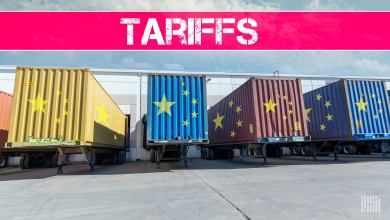
Trump’s tariffs could spark price hikes, supply chain disruptions, experts say
New tariffs by the Trump administration on products from China, Canada and Mexico will hit companies and consumers with increased costs, experts said.
As the reindustrialization movement of the Americas continues to grow, FreightWaves follows its impact on supply chains and freight closely. Check back here for the top stories related to the movement.
New tariffs by the Trump administration on products from China, Canada and Mexico will hit companies and consumers with increased costs, experts said.

With the inauguration still over a month away, President-elect Trump has already announced some of his plans regarding U.S. trade policy. This is a breakdown of a few of the ones most relevant to e-commerce and how brands do business.
Canadian Pacific Kansas City CEO Keith Creel is confident that free trade will continue in North America despite President-elect Donald J. Trump’s threat to impose 25% tariffs on goods imported from Mexico and Canada.
President-elect Donald Trump’s plans to impose 25% tariffs on goods imported from Mexico and Canada could have a chilling impact on cross-border rail traffic, which has been one of the few sources of volume growth for North American Class I railroads.
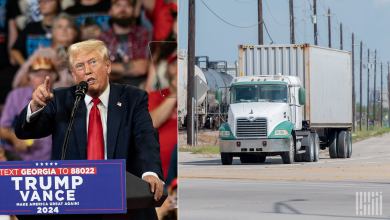
Trump plans for tariffs on all imports from Canada, China and Mexico starting Jan. 20.
High tariffs on Chinese imports, promised by President-elect Trump, will likely slow U.S. trade in 2025 as uncertainty hinders investment in reshoring of manufacturing, a trade analyst predicts.
President-elect Donald Trump’s tech policies could boost FreightTech for AI, warehouse automation and 3D printing.
If China retaliates against tariffs on exports to the U.S. with its own tariffs, it could increase prices for Chinese consumers.
With the next Trump administration expected to drive regulatory changes, experts anticipate a surge in M&A activity across retail, e-commerce and FreightTech, as companies like Amazon and DoorDash look to expand in a pro-business environment.
While imposing tariffs in the past has done damage to the U.S. economy, today’s incoming tariffs are likely to have a different outcome for a multitude of reasons.
Stakeholders from across the supply chain discussed strategies and opportunities at the third annual Houston International Maritime Conference.
President-elect Donald Trump’s campaign focused heavily on tariffs against China. Now that he’s won, tariffs are getting a lot of attention. But the issue has more than economic implications. It is about national security.
In the first episode of the new Bring It Home podcast, co-hosts Craig Fuller and JP Hampstead speak with Dunavant Enterprises CEO Bill Dunavant about the future of Memphis Tennessee as “America’s supply chain capital.”
Tesla plans to ramp up full production of its all-electric Class 8 Semi truck in 2026.
Importers with the National Retail Federation fear a second Trump administration could hurt business with higher tariffs on consumer goods.
This week in Borderlands: Port of Corpus Christi becomes global crude oil supplier; Port of Brownsville secures $43M loan for ship channel expansion; US Lumber Brokers acquires Texas distribution center; and Holt Truck Centers expands across Texas with acquisition.
This week in Borderlands: US-Mexico trade hit $74B in August, Port Laredo No. 1 again; Imperative Logistics Group acquires freight forwarder Jamco; Gebruder Weiss partners with Mexico load board Cargado; and Avery Dennison opens $100M facility in Queretaro, Mexico.
This week in Borderlands: crime, labor top concerns about nearshoring in Mexico; cargo rail theft up 119% across Mexico in July; Texas trucking company owner sentenced for Mexico-to-Chicago drug pipeline; and industrial equipment maker opens factory in Juarez, Mexico.
Ford plans to invest $273 million at its plant in Irapuato, Mexico, to produce EV drive units for the Mustang Mach-E.
Canada is launching a 100% tariff on imports of electric vehicles made in China, citing unfair competition that it says threatens the global EV market.