China is firing back in the U.S. trade war with retaliatory fees on U.S. ships calling its ports.
The tonnage fees announced by China’s Ministry of Transportation go into effect Oct. 14 and mirror the levies set by the U.S. Trade Representative and also scheduled to go into effect on that same date.
The Trump administration in April announced the fees under Section 301 of the Trade Act of 1974 that grants the USTR the authority to investigate and respond to unfair foreign trade practices that harm U.S. commerce. They follow the results of a USTR probe begun during the Biden administration that found China leveraged subsidies, central controls and other unfair practices to build a dominant position in global shipping and shipbuilding.
The ship fees are among several trade measures by Beijing ahead of a meeting between Chinese leader Xi Jinping and President Trump during the Asia-Pacific Economic Cooperation forum in South Korea at the end of October.
China’s fees apply to U.S.-flag and -built vessels, as well as ships owned or operated by U.S. entities, the last two if more than 25% of the ownership, voting rights or board seats of the entity are based in the U.S.
The fees start at $56 per net ton at current exchange rates compared to the $50 USTR fee, and escalate to $90 ($80 USTR) as of April 17, 2026; $123 ($110) as of April 17, 2027 and $157 ($140) from April 17, 2028.
Like the USTR charges, the fees apply only for the first call of a China port on a voyage with multiple calls, and a maximum of five times per year.
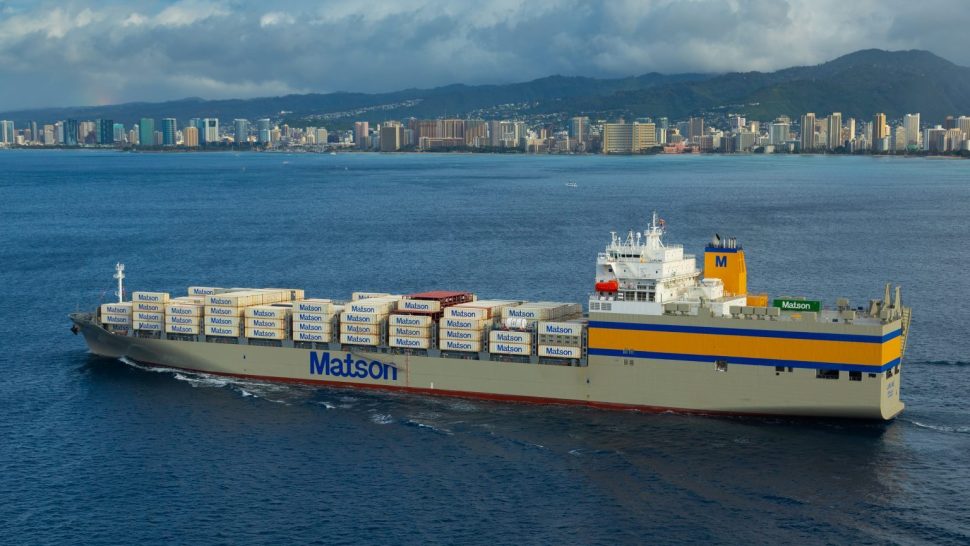
At present the fees would hit U.S.-flag lines Matson (NYSE: MATX), Maersk Line Limited, a subsidiary of Denmark’s A.P. Moller-Maersk (OTC: AMKBY) and APL, a unit of CMA CGM of France.
“Matson has no plans to make any changes to our service schedule,” the carrier said in a customer advisory Friday. “We remain fully committed to providing the fastest, most reliable service offerings from China and the trans-Pacific market to the U.S. We look forward to continuing to serve our customers into the future and will not implement a new surcharge relative to this fee.”
The fees would likely also apply to Israel’s Zim (NYSE: ZIM) as more than 25% of the shares seems to presently be owned by U.S. entities, wrote shipping consultant Lars Jensen in a LInkedIn post. Seaspan, which owns 100 vessels chartered by major container lines and recently shifted its base from Hong Kong to Singapore, could also be affected as it is controlled by Poseidon, with just over 25% U.S. ownership, Jensen said.
The effect on the U.S. lines has yet to be determined but won’t approach the expense to Cosco, the world’s fifth-largest container carrier, or its subsidiary OOCL, estimated by HBSC at $2.1 billion in 2026.
This article was updated Oct. 10 to add information on Matson’s customer advisory.
Find more articles by Stuart Chirls here.
Related coverage:
Maersk ‘closely’ monitoring Red Sea for eventual return to Suez Canal, says diplomat
Tariffs cause some China imports to crash 44% in September
Brokerage Compliance Symposium
The day before F3. Every compliance issue you face - fraud exposure, carrier liability, FMCSA rules, cargo theft, insurance gaps - navigated by attorneys and operators defining best practices in a changing industry.
F3 Awards Dinner
The night before F3. FreightTech100 companies honored. FreightTech 25 and Shipper of Choice winners revealed live. Cocktail reception into dinner and live music - 300 industry leaders in one purpose-built room.
F3: Future of Freight Festival
Industry-defining keynotes, rapid-fire technology demos, and industry leaders networking in experiences across Chattanooga - plus the inaugural F3 Awards Dinner featuring the FreightTech and Shipper of Choice reveals.
The day before F3. Every compliance issue you face - fraud exposure, carrier liability, FMCSA rules, cargo theft, insurance gaps - navigated by attorneys and operators defining best practices in a changing industry.
The Signal at Chattanooga Choo Choo • Chattanooga, TN Register NowThe night before F3. FreightTech100 companies honored. FreightTech 25 and Shipper of Choice winners revealed live. Cocktail reception into dinner and live music - 300 industry leaders in one purpose-built room.
The Signal at Chattanooga Choo Choo • Chattanooga, TN Register NowIndustry-defining keynotes, rapid-fire technology demos, and industry leaders networking in experiences across Chattanooga - plus the inaugural F3 Awards Dinner featuring the FreightTech and Shipper of Choice reveals.
The Signal at Chattanooga Choo Choo • Chattanooga, TN Register Now