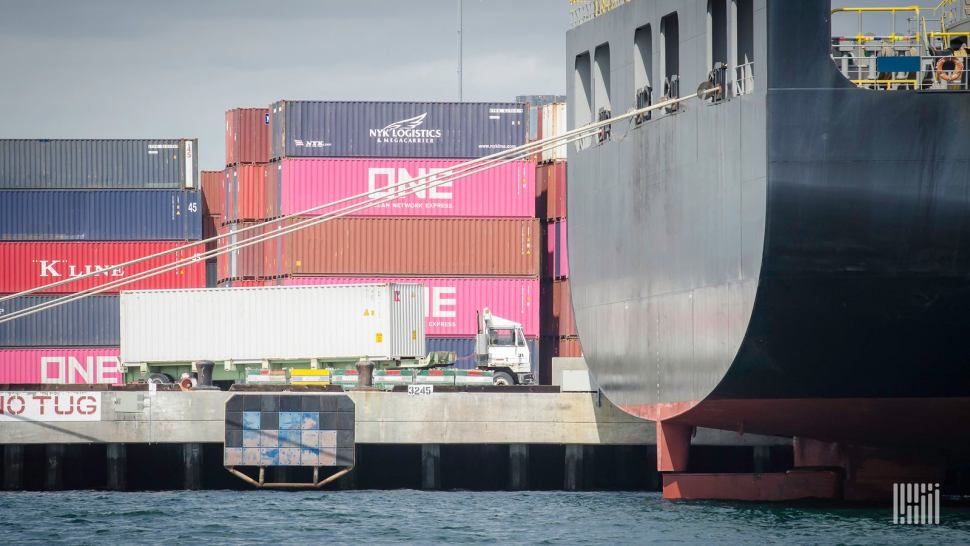
The July momentum fueled by a pause in the Trump administration’s trade war on China carried over into August, as the hub handled 958,355 twenty foot equivalent units (TEUs), just off the record traffic from a year ago.
“The Port of Los Angeles moved nearly 2 million containers in July and August combined,” Port of Los Angeles Executive Director Gene Seroka said in a media briefing. “That’s the best two-month stretch for any port in the Western Hemisphere. Retailers and manufacturers have continued to bring goods in early, both to get ahead of holiday demand and to hedge against any shifts in trade policy.
The August surge mirrored similarly positive results at the Port of Long Beach, LA’s neighbor in the San Pedro port complex, top-ranked among American maritime cargo centers.
But that’s where the growth ends, Seroka said, as a confluence of factors weighs on container traffic through the remainder of this year.
“Looking forward,” Seroka said, “I expect container volumes to ease through the rest of 2025 – especially against last year’s unusually high benchmarks. That’s because much of the year-end holiday cargo has already arrived. And economic signals like slowing job growth and lingering inflation are making both importers and consumers a bit more cautious.”
The port is also bracing for the imposition in October of new ship fees on China-owned and -operated ships, and how that could effect ocean lines’ services. Rough estimates of how much the fees could drive up shipping costs have ranged from $175 to $300 per container, Seroka said, though he expects any increases to hit smaller ports harder than Los Angeles.
In response to a question from FreightWaves, Seroka said that the container supply chain is also wrestling with price pressures from trucking’s long-term freight recession. He noted that two drayage companies that had long served the port, TGS Logistics and GSC Logistics, recently shut down as market dynamics contribute to deteriorating rates.
The past month saw loaded imports total 504,514 TEUs, off just 1% year-on-year. Loaded exports were 127,379 TEUs, up 5% y/y.
While volumes were marginally higher, container dwell, or the time a box is unloaded from a ship until the time it departs the port, dropped to less than three days for truck, and less than eight days for rail.
An indicator of future imports, LA processed 326,462 empty container units, 1% less than in 2024.
Through August, Los Angeles handled 6,934,004 TEUs, an increase of 4.5% from the year-ago period.
Find more articles by Stuart Chirls here.
Related coverage:
Dwell down for LA-Long Beach container trucks, rail
‘TikTok’ of rising ocean rates as China prospects improve
Brokerage Compliance Symposium
The day before F3. Every compliance issue you face - fraud exposure, carrier liability, FMCSA rules, cargo theft, insurance gaps - navigated by attorneys and operators defining best practices in a changing industry.
F3 Awards Dinner
The night before F3. FreightTech100 companies honored. FreightTech 25 and Shipper of Choice winners revealed live. Cocktail reception into dinner and live music - 300 industry leaders in one purpose-built room.
F3: Future of Freight Festival
Industry-defining keynotes, rapid-fire technology demos, and industry leaders networking in experiences across Chattanooga - plus the inaugural F3 Awards Dinner featuring the FreightTech and Shipper of Choice reveals.
The day before F3. Every compliance issue you face - fraud exposure, carrier liability, FMCSA rules, cargo theft, insurance gaps - navigated by attorneys and operators defining best practices in a changing industry.
The Signal at Chattanooga Choo Choo • Chattanooga, TN Register NowThe night before F3. FreightTech100 companies honored. FreightTech 25 and Shipper of Choice winners revealed live. Cocktail reception into dinner and live music - 300 industry leaders in one purpose-built room.
The Signal at Chattanooga Choo Choo • Chattanooga, TN Register NowIndustry-defining keynotes, rapid-fire technology demos, and industry leaders networking in experiences across Chattanooga - plus the inaugural F3 Awards Dinner featuring the FreightTech and Shipper of Choice reveals.
The Signal at Chattanooga Choo Choo • Chattanooga, TN Register Now