UPDATE: Buffett denies Goldman Sachs advising BNSF on potential merger

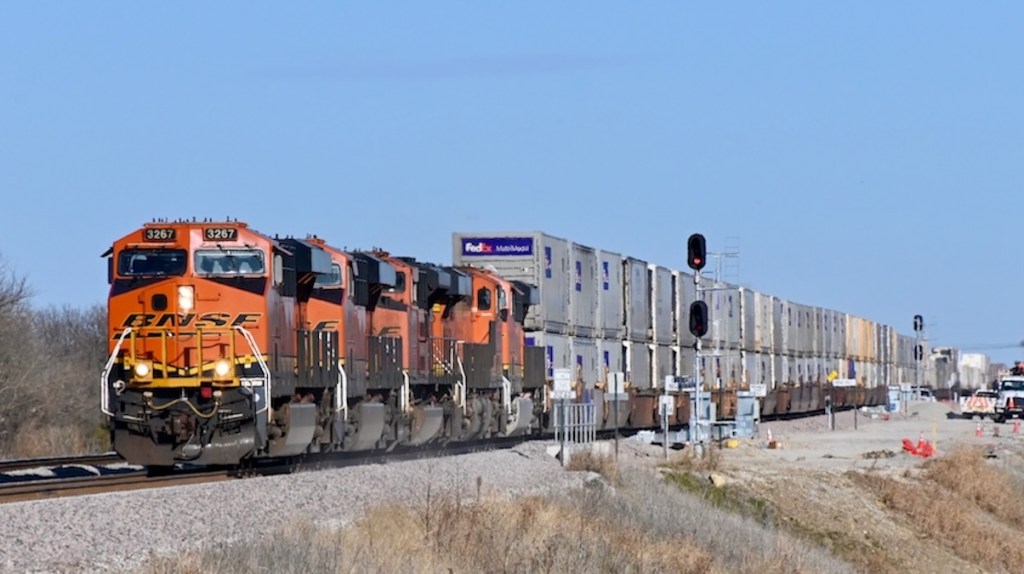
Billionaire investor Warren Buffet today publicly denied that his company has engaged a major investment bank to explore the acquisition of a rival Class I railroad.

Semafor, an online publication, reported Monday evening that BNSF has engaged Goldman Sachs in the wake of Union Pacific (NYSE: UNP) working with Morgan Stanley regarding a potential merger with Norfolk Southern (NYSE: NSC). Both reports cited people familiar with the matter. The railroads and investment banks declined to comment.

But Buffett, who serves as chairman and chief executive of BNSF parent Berkshire Hathaway Tuesday on CNBC denied that the railroad is working with Goldman Sachs regarding a potential acquisition of CSX. The latter had no comment on the reports.

The initial reports said it was not clear whether BNSF was interested in CSX (NASDAQ: CSX) or Norfolk Southern. NS is reportedly the target of Union Pacific, and the two railroads have been in merger talks since the first quarter, the Associated Press reported last week.

The publicly-held Class I railroads begin to report second quarter earnings this week. CSX reports July 23, UP on July 24, and NS, July 29.

There has not been a big merger involving the major Class I systems since the Surface Transportation Board adopted tighter merger review regulations in 2001.

Subscribe to FreightWaves’ Rail e-newsletter and get the latest insights on rail freight right in your inbox.

Related coverage:

Analysis: UP-NS rail merger spotlights individual legacies in a legacy business

Union Pacific, Norfolk Southern in merger talks: WSJ

Report: Investment firm advising Union Pacific on potential rail merger

BNSF, UP settle dispute over Salt Lake City intermodal service

US cargo airlines welcome DOT aviation sanctions on Mexico

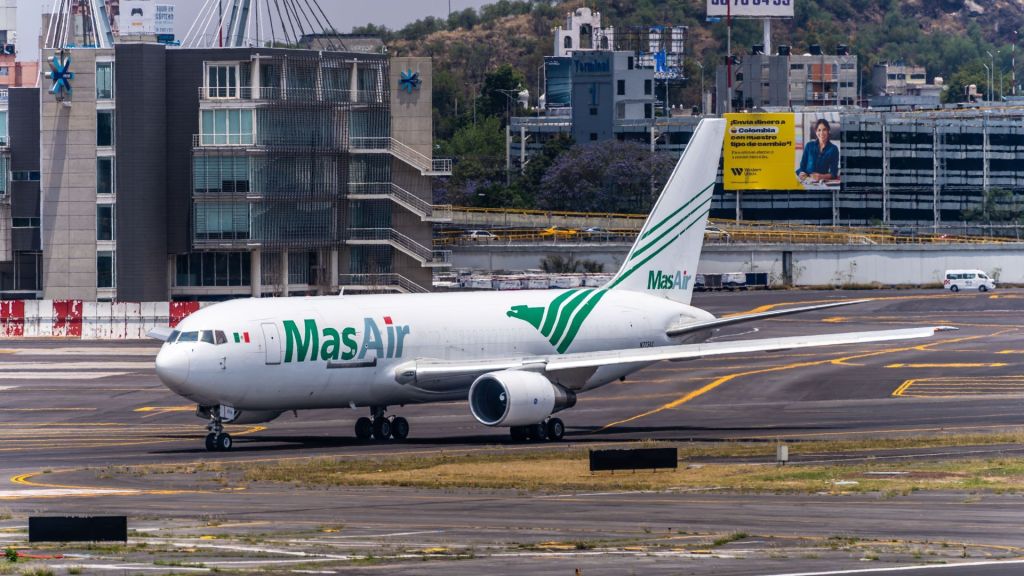
A MasAir cargo jet moves into position at the end of a runway with city buildings visible in the background.

U.S. cargo airlines strongly endorsed the Trump administration’s decision on Saturday to target Mexico for alleged violations of a 2015 bilateral air transport agreement. Mexico’s forced relocation of all-cargo carriers in 2023 to a secondary airport and limits on cargo landing rights prompted the U.S. action. 

The U.S. Department of Transportation will review the flight schedules of Mexican carriers for compliance with U.S. laws, ban Mexican charter flights and consider withdrawing antitrust immunity for the Aeromexico-Delta Air Lines joint venture, Secretary Sean Duffy said. The DOT also put European countries on notice that similar measures could be taken against them if U.S. airlines are unilaterally restricted from their airports in an effort to limit noise levels in city centers.  

“Today’s announcement sends a clear and necessary message: the United States will not tolerate unfair, anti-competitive behavior that is counter to the tenants of the U.S. Open Skies framework and harms American businesses,” said Lauren Beyer, president of the Cargo Airline Association, in a statement. “We thank Secretary Duffy and the entire U.S. government team — including the Departments of Transportation, State, and Commerce — for their leadership in defending the rights of U.S. carriers.”

Mexican President Claudia Sheinbaum said on Monday that her government has not yet received formal notification from the U.S. over potential measures against Mexico’s airline sector, adding that she sees no justification for such sanctions, Reuters reported.

Mexico in 2023 banned freighter operators from the country’s main international airport in Mexico City ostensibly to relieve chronic congestion and allow expansion projects. The government also has rescinded some take off and landing slots allotted to passenger carriers. 

Cargo airlines were forced to switch to Felipe Angeles International Airport, a former military airfield about 31 miles away, with limited advance notice. The relocation, which involved airlines from all countries, added operational costs and complexity for cargo operators, especially hybrid carriers that continued to move shipments in passenger planes serving Mexico City International Airport (MEX) and now have dual facility and delivery systems to manage. Felipe Angeles also was not fully developed and ready to efficiently handle the cargo aircraft, leading airlines to invest in more equipment and facilities.

The Cargo Airline Association, which represents ABX Air, Atlas Air, FedEx and UPS, said Mexico’s action disrupted air cargo operations and “set a dangerous precedent for how all-cargo carriers may be treated in global markets.” It also created uncertainty about how potential safety emergencies could be handled, according to the trade group. (Amazon Air, DHL Express and Kalitta Air are CAA associate members.)

The slot restrictions and mandate that all-cargo operations move out of MEX created market turmoil, cost American companies millions of dollars and represent a “blatant disregard” of the air transport agreement, according to the Department of Transportation.

“Joe Biden and Pete Buttigieg deliberately allowed Mexico to break our bilateral aviation agreement,” Duffy said in the announcement. “That ends today. Let these actions serve as a warning to any country who thinks it can take advantage of the U.S., our carriers, and our market. America First means fighting for the fundamental principle of fairness.”

The slot seizures impacted American Airlines, Delta Air Lines and United Airlines, as well as Mexican carriers. Mexican airlines with confiscated slots have since been able to restore certain services to the United States.

The DOT said in an enforcement notice that Mexico has yet to provide any analysis that MEX is oversaturated, assurance that U.S. carriers can recover their slots when construction is completed and that any construction projects have been initiated. 

The department has initiated a three-pronged initiative to pressure Mexico into changing its policy.

The DOT said it will require Mexican airlines to file schedules with the department for all their U.S. operations by July 29 so it can review whether any services violate the law or affect the public interest. Filings must include the type of aircraft used, flight frequency, origin-and-destination airports and arrival/departure times. 

A second order prohibits Mexican airlines from operating large aircraft for passenger or cargo charter flights to or from the United States without prior DOT approval. The charter restrictions, the DOT said, are a response to U.S. cargo airlines being prevented from repositioning aircraft within Mexico on non-revenue flights or making multiple stops in Mexico to pick up or drop off international traffic without carrying domestic shipments, as allowed under the transport agreement. 

The charter ban could impact carriers such as mas and Aerounion. 

U.S. freighter operators took significant steps to adjust operations in response to Mexico’s 2023 order. The Cargo Airline Association said all-cargo airlines “must be free to choose service points that align with their commercial needs — not [ones] dictated by arbitrary foreign mandates.”

The DOT also proposed to withdraw the approval of antitrust immunity for the joint venture operated by Delta and Aeromexico. The U.S. government extended the approval beyond a 2020 deadline to allow for further review, but the Trump administration now says the conditions for immunity no longer exist and that the joint venture no longer serves the public interest.

A final order terminating approval of the joint venture would not become effective until Oct. 25, at the earliest. 

If antitrust immunity is revoked, Delta and Ameromexico would be required to discontinue cooperation on pricing, capacity management, and revenue sharing. They would, however, be allowed to continue their partnership through arms-length activities such as codesharing, marketing and frequent flyer cooperation. Delta will also be able to retain its equity stake in Aeromexico and maintain all existing flying in the U.S.-Mexico market unimpeded.

The Department also said it reserves the right to disapprove flight requests from Mexico should the country fail to take corrective action.

“We applaud the Department’s use of its authority and regulatory tools to restore fairness and accountability in the U.S.-Mexico aviation market,” said Beyer. 

Wider implications

In 2023, the Biden administration expressed concern that the Netherland’s decision to reduce nearly 10% of takeoff and landing slots at Amsterdam Schiphol Airport to reduce pollution and noise was done unilaterally and would impact U.S. flight levels. It said the issue should be negotiated in the context of the existing U.S.-European Union Open Skies agreement. The U.S. warned the Dutch government that flight cuts could open the door for retaliatory cuts to KLM’s frequencies to the U.S. And the U.S. position is believed to have caused CMA CGM Air Cargo and Air France-KLM to abandon their cargo alliance’s application for antitrust immunity on North American routes last year.

The Cargo Airline Association said it important to send a message that Mexico’s actions don’t set a precedent.

“Around the world, other governments are watching this case closely. If left unchallenged, such actions could erode the core tenets of the U.S. Open Skies framework and embolden other countries to impose unjustified restrictions on cargo access to key markets,” it said in the statement. 

“The Cargo Airline Association and its members are committed to supporting the U.S. government’s efforts to uphold international agreements and preserve the competitive freedoms that are essential to the global movement of goods,” Beyer added.

Click here for more FreightWaves/American Shipper stories by Eric Kulisch.

US moves to restrict Mexican airlines over cargo, competition concerns

Uprooted cargo airlines relocate to secondary airport near Mexico City

New bill seeks more relief for livestock haulers

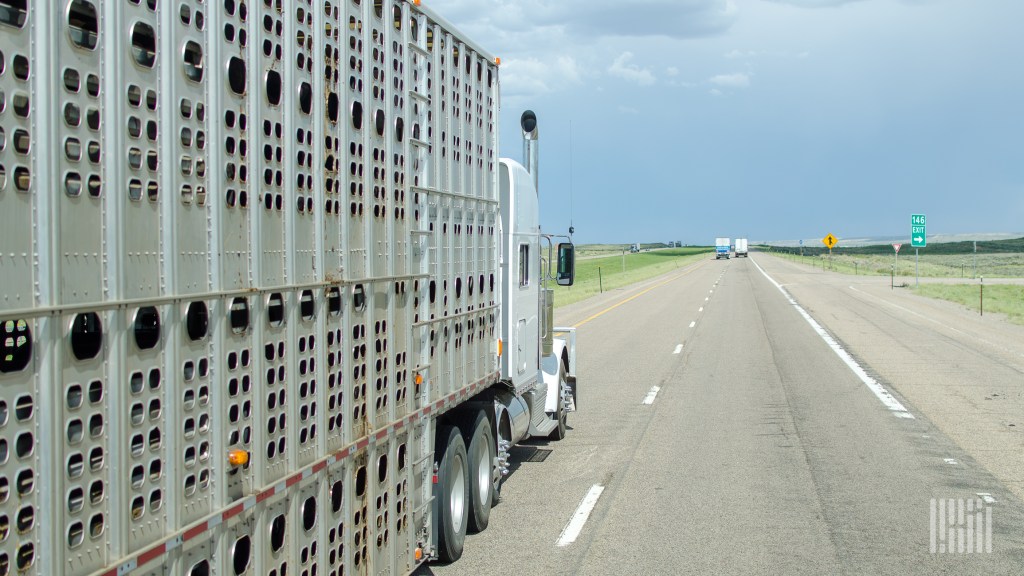
truck hauling livestock

WASHINGTON — New legislation would give truckers hauling livestock relief from regulations governing hours of service and electronic logging devices in addition to what they already receive.

Introduced last week by U.S. Rep. Jeff Hurd, R, Colo., the bill, Hauling Exemptions for Livestock Protection (HELP) Act, aims to “exempt certain livestock hauling vehicles from regulations related to hours of service and electronic logging devices,” according to a draft copy of the bill.

The legislation states that vehicles and drivers hauling livestock, insects, and aquatic animals shall be exempt from:

  • Any requirement relating to hours of service established under subchapter III of chapter 311 of title 49, U.S. Code, or chapter 315 of title 49, U.S. Code.
  • Any requirement relating to electronic logging devices established under section 31137 of title 49, U.S. Code.

ELD and hours-of-service agricultural exemptions are already in place for drivers hauling within a 150 air-mile radius from where the livestock is sourced. In addition, the Infrastructure Investment and Jobs Act signed into law by President Biden in 2021, allows them to also be exempt when driving within a 150 air-mile radius from the livestock’s final destination.

In 2022, FMCSA denied a joint petition for further exemptions filed in October 2018 on behalf of livestock haulers by the National Cattlemen’s Beef Association (NCBA) – which is based in Colorado – and five other lobbying groups.

The petition sought exemptions from the current 11-hour driving limit and 14-hour driving window, contending those rules “were not drafted with livestock haulers in mind” and therefore did not take into account the needs of live cargo.

But FMCSA ruled the groups did not provide evidence that they could achieve a level of safety equivalent or greater than what would be achieved without the exemption.

NCBA’s petition received support from owner-operators and trucking companies that haul livestock, but was opposed by National Transportation Safety Board, the Commercial Vehicles Safety Alliance, and the Truckload Carriers Association, among others.

NCBA notes in its policy priorities for 2025 that it will engage with the Trump administration and Congress to “pursue regulatory actions that enhance producer profitability,” including a “push for further hours-of-service flexibility and continue delaying ELD requirements for livestock haulers.”

Click for more FreightWaves articles by John Gallagher.

Survey: Small businesses would flee Canada Post if mail carriers strike

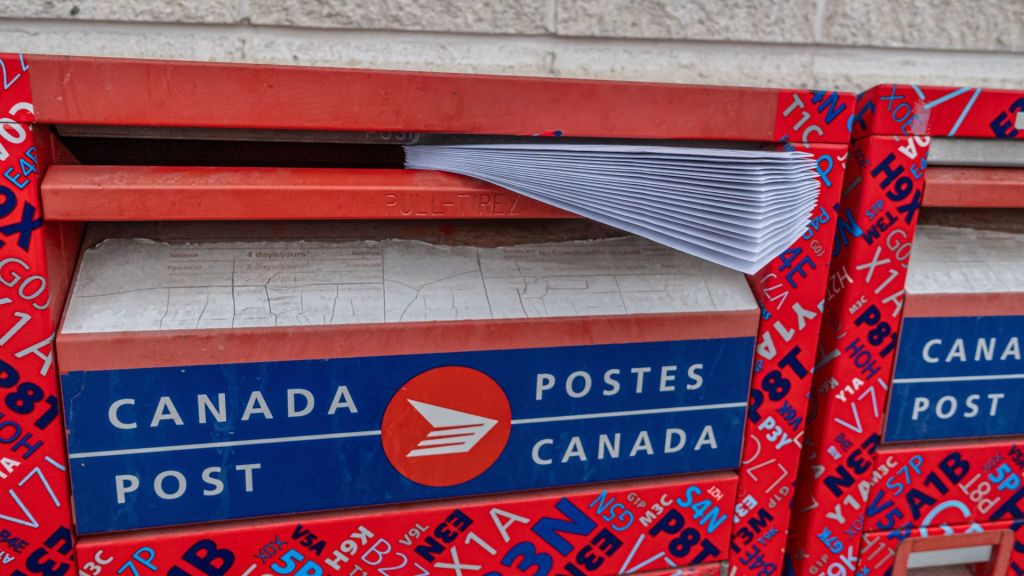
Close up view of envelopes in the mail slot of a red/blue Canada Post drop box.

As Canada Post workers begin to vote on the company’s final contract offer, a survey from the Canadian Federation of Independent Business finds that a postal strike could push two in three businesses (63%) to walk away from Canada Post permanently.

“Yo-yoing in and out of strike mandates is causing Canada’s small businesses — one of Canada Post’s last groups of profitable customers — to leave for good,” said CFIB President Dan Kelly in a news release. “Small business owners and other consumers need certainty. Thirteen percent of small businesses permanently dropped usage of Canada Post during the 2024 strike and every time Canada Post goes on strike, more and more businesses leave forever.”

Canada Post in late May reported a 50% drop in parcel volumes, year over year, because protracted contract negotiations were eroding shipper confidence in the postal operator. Many businesses switched to alternative final-mile couriers after a 32-day strike during the last holiday season and the threat of another strike. 

Mail carriers in Canada have been working without a new collective bargaining agreement for 19 months as the sides remain far apart on key issues, despite extensive mediation by the federal government.

Members of the Canadian Union of Postal Workers at the end of May opted against a strike. Instead, mail carriers are refusing to work overtime shifts, limiting their work to eight hours per day and 40 hours per week. On Monday, the Canada Industrial Relations Board began administering an online and phone vote on Canada Post’s proposed contract. Voting runs through Aug. 1. The government imposed the vote on workers over the objections of the CUPW leadership. Canada Post requested government intervention saying it wasn’t confident union leaders were accurately representing how rank-and-file mail carriers felt about its proposed labor agreement.

Labor experts say it is unlikely the vote will solve the lengthy dispute, the Toronto Star reported
“Another strike at the time of ongoing trade tensions and uncertainty would have a significant impact on small businesses. We estimate the 2024 strike cost small firms between $55 million to $73 million each day. We hope both parties reach a deal to avoid another unnecessary strike,” said CFIB spokeswoman Dariya Baiguzhiyeva in an email to FreightWaves.

The Canadian Federation of Independent Business surveyed members about their attitudes toward Canada Post. (Source: CFIB)

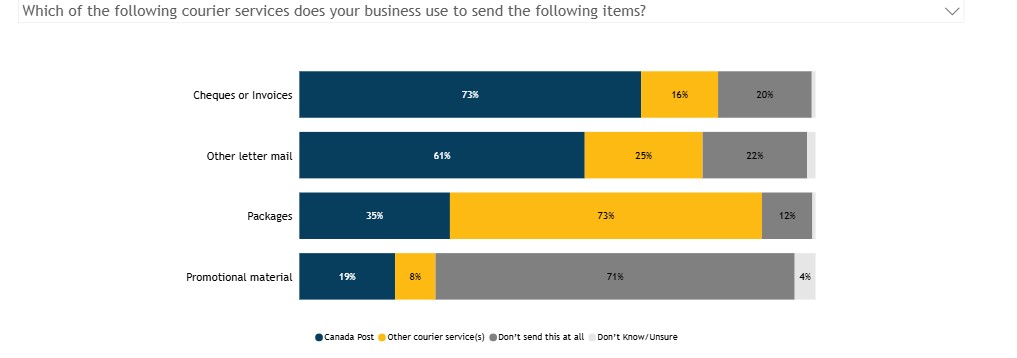
According to CFIB research, four in five businesses still use Canada Post. Nearly three-quarters (73%) of those businesses use it for sending checks, while 61% send other letter mail. Over half (58%) like to use Canada Post for its low cost and convenience, while reliability and customer service ranked much lower as priorities.

Most businesses (71%) responded to the strike disruptions in 2024 by encouraging customers to use digital options. Nearly, nearly half (45%) turned to private couriers, while 27% delayed mail shipping. 

Need for new business model

(Source: CFIB)

Canada Post is pressing the union to accept a series of changes to operations and work conditions it says are needed to turn around years of financial losses as mail and parcel volumes shrink. 

Canada Post’s share of the parcel delivery market has fallen to 24% from 62% in 2019, according to a May report from an industrial dispute commission. Parcel revenue declined by 20.3% in 2024 as volumes fell by 56 million pieces, or 20%, compared to 2023, according to Canada Post’s annual report. 

The government’s review commission noted that private couriers, which dominate in urban and suburban settings, benefit from being able to choose which routes to serve while Canada Post is bound by law to serve all addresses. Private couriers also have access to huge amounts of capital and are typically able to hire nonunion workers, many on a part-time basis or as independent contractors.

The national post wants to adjust delivery routes based on parcel volumes and addresses needing service each day rather than adhering to fixed routes; implement a weekend delivery model using a dedicated part-time workforce as well; and create part-time flex positions for mail carriers to work 20 hours per week, with the potential for mandatory weekend hours. Canada Post also seeks to introduce load leveling, whereby supervisors each morning could transfer mail volumes between workers during scheduled hours without additional compensation. 

CFIB data shows 73% of small businesses mostly rely on private couriers for package delivery.

“The current model at Canada Post is in dire need of massive reform. It’s long overdue for the federal government to implement the well-studied changes that have been required for over a decade,” said Corinne Pohlmann, executive vice president of advocacy at CFIB, in the news release. “Small business owners deserve a long-term plan and a postal service they can count on.”

The CFIB report was based on 2,317 responses collected in June and July. 

Click here for more FreightWaves/American Shipper stories by Eric Kulisch.

Write to Eric Kulisch at ekulisch@freightwaves.com.

Vote on Canada Post labor contract begins Monday as losses mount

Canada Post parcel volumes drop 50% as labor dispute compounds challenges

Ruan Transport laying off 144 workers in Arizona after losing contract

Ruan Transport Corp. is laying off 144 workers in Tolleson, Arizona, including 130 truck drivers, along with mechanics and administrative staff. 

The layoffs will be finalized by the end of August.

 Des Moines, Iowa-based Ruan Transport has 2,980 trucks and 3,612 drivers, according to the Federal Motor Carrier Safety Administration. The company provides dedicated fleet management, logistics management and warehousing solutions for customers across the country.

Ruan Transport had a contract with Kroger to provide transportation services from the Tolleson distribution center, which is located in the Phoenix area. However, Kroger cancelled that contract, according to the Teamsters union.

The Teamsters represents Ruan Transport workers at the Tolleson distribution center. 

“For over 26 years, Teamsters Local 104 members at Ruan have safely and reliably delivered products for Kroger. Now, the company is attempting to replace them with Swift, a move that threatens the hard-won standards Teamsters have built over decades,” Lena Melentijevic, a spokeswoman for the Teamsters, told FreightWaves in an email.

Officials for The Kroger Co. and Knight-Swift Transportation Holdings Inc. did not return requests for comment.

Sean M. O’Brien, general president of the Teamsters, and Fred E. Zuckerman, the union’s general-secretary treasurer, sent a letter to Kroger leadership on June 6 seeking clarification on Ruan’s dismissal.

“Our impression is that Kroger intends to replace Ruan with a 3PL that does not provide reasonable equal wages and conditions of employment similar to those provided for in the Teamsters Local Union 104 collective bargaining agreement currently in effect with Ruan,” O’Brien and Zuckerman wrote in a letter to Kroger shared on Facebook.

“If this unfortunate development should occur, Kroger should expect community standards picketing to occur which truthfully advises the public that Ruan’s successor does not conform to the area standards established by Teamsters Local Union 104.”

AMPLIFY: SearchCarriers – Smarter Carrier Data for the People Who Move Freight

Meet the Founder

Garrett Allen has spent more than a decade immersed in the trucking and freight space, working closely with brokers, carriers, and shippers. He’s not just a tech founder—he’s a builder with firsthand knowledge of how clunky and inconsistent freight data has made life harder for the very people trying to move freight efficiently.

As the founder of SearchCarriers.com, Garrett created something different: a tool that cuts through the noise. It’s fast, clean, and practical. No bloat. No unnecessary clicks. Just the data you need, when you need it. His goal wasn’t to automate decisions. It was to give real people the power to make better ones.

“Where others want to automate the decision, we just want to surface the truth—so you can decide for yourself.”

Garrett’s journey started with LoadPartner, the first open-source TMS platform built for freight. But that work exposed a bigger issue: everyone was rebuilding the same bad FMCSA integrations. The tools weren’t built for the users—they were built for checkboxes. So he pivoted. And what came next was a purpose-built system designed to serve everyone involved in the life cycle of a load.

What Is SearchCarriers?

At its core, SearchCarriers is a carrier research and monitoring platform. It pulls from more than 20 different data sources, organizes millions of data points, and delivers them in a way that’s instantly useful to brokers, shippers, small carriers, and tech platforms alike.

But here’s the difference: it doesn’t just show you the data—it helps you understand it. SearchCarriers is built to make carrier vetting faster, inspection monitoring easier, and risk evaluation more accessible to smaller operators. And it works across mobile, desktop, and API—all lightning fast.

It’s not a generic FMCSA clone. It’s a living, breathing database designed to be part of your daily workflow.

The Origin Story

The idea came to life during the development of LoadPartner. Garrett and his team had to build FMCSA integrations from scratch. Again. And again. And again. The process was inefficient, the data structure was confusing, and the user experience was consistently poor.

But instead of just accepting that as “the way it is,” Garrett saw the opportunity to do something better. What if the industry had a centralized, user-friendly, and affordable platform that made carrier data make sense?

That vision became SearchCarriers—a tool designed to remove the friction from data, surface inspection trends sooner, and empower smarter freight decisions at every level.

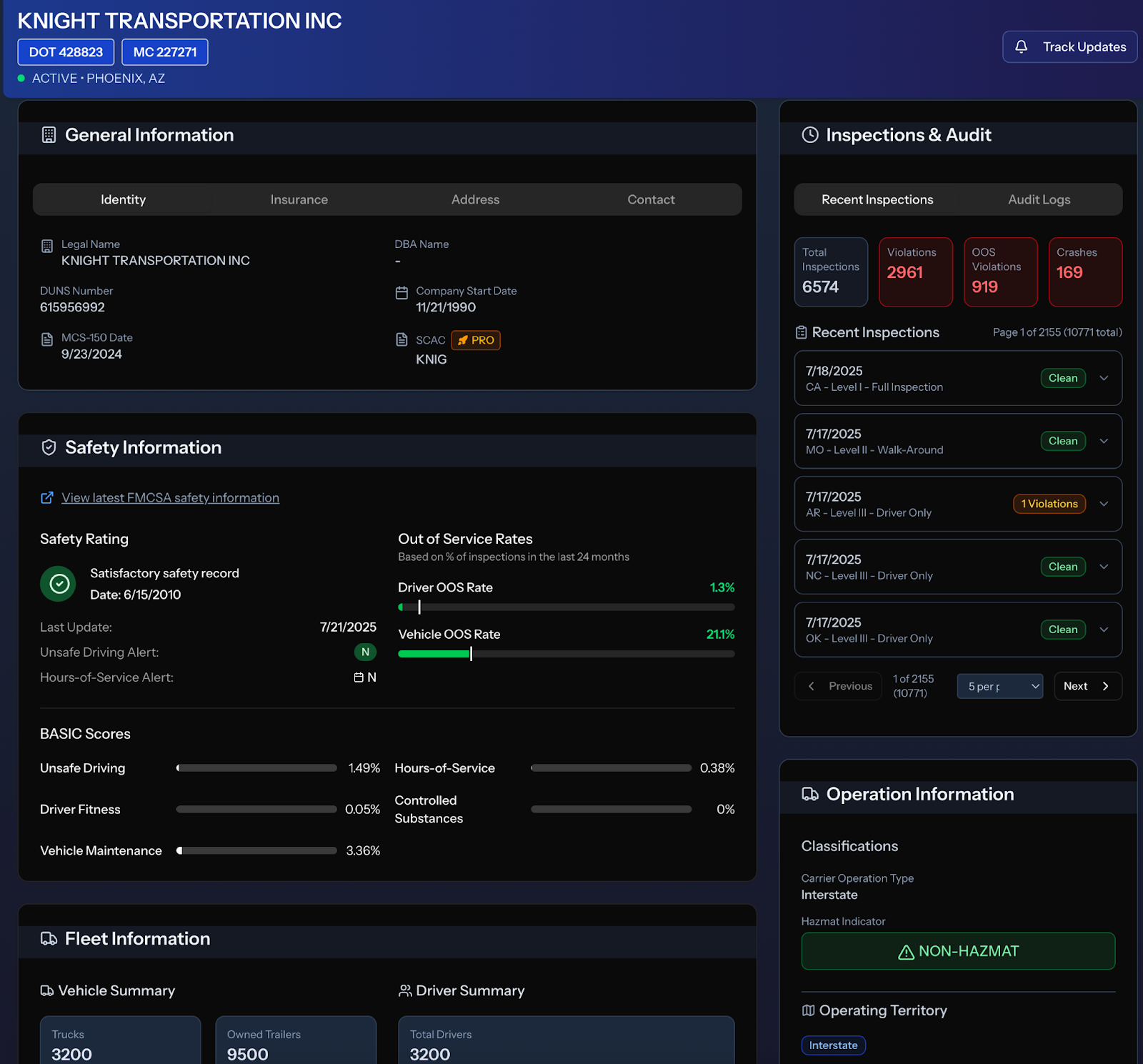
(Photo: Searchcarriers.com. A clean, modern view of carrier data inside SearchCarriers.com—showcasing real-time inspection results, safety alerts, and fleet information in a format designed for decision-makers, not data analysts.)

Who It Serves

SearchCarriers is built to be flexible. It’s used by:

  • Small fleets trying to stay on top of inspections, safety scores, and performance issues
  • Freight brokers looking to vet carriers more thoroughly before they assign a load
  • Shippers who need visibility into who’s hauling their freight
  • Tech teams looking to embed clean data into their own apps or dashboards

Fleets love the “Carrier Watch” feature that sends inspection alerts within hours—sometimes days before that data is visible on government sites. Brokers use advanced filtering tools to source carriers by location, equipment type, and safety profile. And tech platforms rely on the API to bring FMCSA data into their systems with speed and clarity.

Standing Out in a Crowded Space

Most tools are biased toward brokers or built for compliance departments. Garrett’s team took a different route. SearchCarriers was built with all users in mind—especially small carriers who often get overlooked due to limited inspection history or smaller fleet sizes.

Where others push automated carrier scoring or incomplete profiles, SearchCarriers gives users raw, structured insights. They don’t replace your decisions—they just give you better fuel for making them.

A Win Worth Sharing

When SearchCarriers launched their inspection report alert system, they didn’t expect to outpace the FMCSA site itself. But that’s exactly what happened.

“Fleets started getting alerts up to 3 days faster than the CSA website. That one small feature became a big win—helping carriers stay proactive with compliance instead of playing catch-up.”

Lessons from the Journey

One of Garrett’s biggest lessons as a founder? Even simple problems hide massive complexity in trucking. What looks like “just another FMCSA tool” is actually a platform pulling from 20+ sources, aggregating millions of data points, and making it all accessible in seconds.

His advice to early-stage founders and small carriers alike:

“Hire people who give a damn, give them goals, and get out of their way. And do things that don’t scale—until they don’t scale anymore.”

(Photo: Searchcarriers.com. Detailed inspection report from SearchCarriers.com showing a clean walk-around inspection with no violations—giving carriers instant access to VIN-specific data, equipment details, and shipper information in one clear view.)

Where to Find SearchCarriers

A Final Word from Adam

Too many small carriers get overlooked because of how data is presented—not because of how they operate. SearchCarriers is changing that. Garrett and his team are helping level the playing field by making critical information faster, clearer, and accessible to everyone—especially the folks who don’t have a compliance team or data analyst on standby.

This is exactly what AMPLIFY is about—spotlighting the builders who help small carriers succeed. And Garrett? He’s building with purpose.

Analysis: UP-NS rail merger spotlights individual legacies in a legacy business

It’s legacy time for railroads, and that isn’t spoken lightly in an industry that as much as any other, is irrevocably and deeply tied to its past. 

Union Pacific and Norfolk Southern are reportedly in discussions regarding a merger. A consolidation, if approved, would produce the first true transcontinental railroad and all that goes along with it, an event that in many ways would surpass the 1997 merger of aviation giants Boeing (NYSE: BA) and McDonnell-Douglas as the most historically significant corporate deal in modern commercial transportation.

Hard to argue legacy with a business that in less than a century quite literally helped make the United States into the global political and economic behemoth touching both of the world’s great oceans. Union Pacific (NYSE: UNP), whose very existence is owed to Abraham Lincoln’s signature, had in the past honored its legacy with a two-word slogan: “Building America”. They ain’t lyin’.

That’s probably why so many railroads, including Norfolk [& Western] Southern [Railway] have honored their predecessors, post-merger. UP, not so much in name, although so many route-miles along the Class I networks are still referred to by their originating road, or the carrier which did the most to develop a given line.  

At the same time, there’s a reason the dollar rules the world. As someone once said about railroads and the growth of the mighty American industrial machine, “The money comes right up those tracks.”

So, legacies are on the line. But whose, exactly?

Start with UP Chief Executive Jim Vena, an American citizen and Canadian via France via Italy, and the last of his kind — the railroad boss who worked his way up to the corner suite from humble beginnings “on the ground” as a teenager in a track gang. He’s not shy about letting you know, or boasting about his company’s industry-leading metrics, or industry-widest network, or invoking the “elbows up” combativeness of a former hockey player before it lately became fashionable, or poking another CEO at a public forum over which railroad has the biggest, most powerful, most famous steam engine on rails. (That would be UP’s Big Boy, if you’re wondering.)

Vena came out of retirement in 2023 to lead UP, and has been outspoken about what he sees as the benefits of a transcon combination, though it could be argued that handoffs of trains between eastern and western roads has never been smoother. It’s harder to divine the benefits to carload traffic, which has been on a downward trend for all U.S. Class Is paralleling the decline of U.S. manufacturing, and the collapse of coal — the surge in recent shipments for power-hungry electrical grids notwithstanding.    

Not talked about as much as an impact on carloads is the fact that since Donald Trump returned to the White House, investors have been punishing the dollar over the administration’s zig-zagging economic policies. The greenback’s index against a half-dozen currencies including the yen, euro, and pound fell 10.8% through June. That’s hardly an encouraging sign for an administration that’s boosting reindustrialization, since a weaker dollar will make imported raw materials, such as steel and aluminum, for U.S.-manufactured products more expensive, on top of new tariffs.  

There’s another legacy here, that of an already-legendary investor who happens to have his office less than 10 minutes from Vena’s in Omaha. That would be Warren Buffett, whose Berkshire Hathaway conglomerate (NYSE: BRK-B) owns Burlington Northern Santa Fe and whose presence would loom large in any merger talk.

Burlington Northern and the Atchison, Topeka & Santa Fe completed their own merger in 1995 and now is a rival to, and in many places operates side by side with, UP. Buffett is bullish on rail and bought Dallas-based BNSF in 2010. At first blush, it’s expected that BNSF would look to CSX (NASDAQ: CSX) as a merger partner in the current  scenario. But there are a lot more factors to consider. Like 347 billion more, which is how much cash B-H is currently sitting on. That’s more than twice the value of Union Pacific itself, and about six times that of Norfolk Southern. Though little has been heard on mergers from Buffett, or his successor, Greg Abel, the banker’s mind reels contemplating a bidding war for NS (NYSE: NSC). Besides, no one wants to be the last one to the party.

Maybe that’s why investment firms have lately been coming out of the woodwork to express optimism for a final round of rail consolidation. Some interpret that as a signal they’re done propping up the railroad stocks, and it’s time to cash out. Remember, activist investor Ancora Holdings may have failed in its heavy-handed attempt to wrest control of NS after the disastrous East Palestine derailment, but it succeeded in winning a number of seats on the board, and forcing out CEO Alan Shaw.

The triad of legacies is rounded out by Surface Transportation Board Chairman Patrick Fuchs, who was the second-youngest  member ever when appointed to the rail competition regulator by Trump in 2019 but is in his first year as agency head. 

In point of fact, Fuchs established an early legacy as co-author of the Surface Transportation Board Reauthorization Act of 2015, and the Fixing America’s Surface Transportation (FAST) Act, which created the Consolidated Rail Infrastructure and Safety Improvements (CRISI) Program of grants, among other benefits.

Fuchs has been pro-active in modernizing the regulator and making its reviews more streamlined, efficient, and productive. He is deeply committed to the adjudicatory process, which in the case of UP-NS is sure to draw comment across the spectrum of rail stakeholders.

While the Justice Department would contribute comments on anti-trust aspects of a UP-NS deal, final say rests with the STB.

The agency currently seats four of five members, split 2-2 along party lines. Expectations are that a fifth member likely would be recommended to the White House by 2026, but the runup to any approval has the intriguing potential to move over an unknown but semi-synchronous timeframe with the UP-NS review. 

This article was edited July 21 to delete a reference to Ancora Holdings forcing out NS CEO Alan Shaw. Shaw later left the company after an inappropriate relationship with a colleague. Also, the date of the Surface Transportation Board Reauthorization Act was corrected to 2015.

Subscribe to FreightWaves’ Rail e-newsletter and get the latest insights on rail freight right in your inbox.

Find more articles by Stuart Chirls here.

Related coverage:

Union Pacific, Norfolk Southern in merger talks: WSJ

Report: Investment firm advising Union Pacific on potential rail merger

BNSF, UP settle dispute over Salt Lake City intermodal service

Washington rail short lines on Jaguar buy list

“It all unraveled quickly”: Family-owned business laments tariff and trade chaos

While President Donald Trump wages trade war, it’s small- and medium-sized businesses that are in the figurative trenches.

In a recent interview with Port of Los Angeles Executive Director Gene Seroka, Bobby Djavaheri, president of Yedi Houseware, discussed the intricate web of challenges that tariffs have woven around American businesses. 

Djavaheri’s family-owned company, nestled in the heart of Los Angeles, serves as a microcosm of the wider struggles faced by small to medium-sized enterprises grappling with the fallout from fluctuating trade policies.

“It all unraveled quickly with the ocean freight crisis, which was magnified by rapidly escalating tariffs,” said Djavaheri.

Yedi, an importer of kitchen and home products, severely felt the tremors that rippled through the global supply chain. With the implementation of harsh tariffs, particularly on Chinese goods, companies like Yedi found themselves at the mercy of unpredictable policy shifts.

Tariffs have not just been a financial concern but a strategic quagmire, forcing businesses to reassess everything from supply chain logistics to inventory management. Djavaheri candidly described the scramble to adapt, saying, “We had no choice but to stockpile inventory in advance of anticipated tariffs, transforming our warehouses into what looked like a scene out of November rather than January.”

Despite these efforts, Djavaheri confessed that the sheer volume of tariff announcements – more than 70 since January – has left even seasoned business leaders in a cloud of confusion. 

“The result was an embargo of sorts,” he noted, referring to the 150% tariffs that paralyzed operations prior to a 90-day pause between Beijing and Washington announced in April. 

“It’s like a constant roller coaster,” Djavaheri said, capturing the nerve-wracking unpredictability businesses navigate. 

For Yedi, the tariff changes have meant more than just rising costs. Djavaheri outlined the competitive disadvantage faced by those reliant on the Chinese manufacturing sector, where alternatives are scant. 

“No country outside of China can manufacture hundreds of thousands of high-quality air fryers a year,” he said, highlighting the symbiotic relationship which is now under threat. “You think Generation Z is gonna come work on a production line to make air fryers from seven in the morning until seven at night?” 

Djavaheri’s accounts provide a face to the broader tariff struggles. 

While large corporations may cushion the blow with their vast resources, it’s the mid- to small-sized businesses that absorb the hardest hits. The heavy financial burden of tariffs has meant stifling the pace at which businesses like Yedi can innovate or expand.

“We’re looking at a very tough year,” Djavaheri said, acknowledging that profits are being siphoned off to cover escalating import costs rather than being reinvested in growth. The tariffs have meant “hundreds of thousands of dollars going to the federal government from my pocket, not from the Chinese, as the president has suggested.”

The conversation unveiled how the company’s strategic operations transformed into a high-stakes juggling act, balancing inventory management against an unpredictable tariff environment. 

Djavaheri described his pivot towards what he termed “SKU normalization,” focusing only on products with better turnover rates to mitigate tariff-related losses.

“We’ve been practicing SKU normalization in the sense that we carefully pick and choose what SKUs to bring in that we can turn at a better pace,” he said, emphasizing a pragmatic response to the turbulent economic climate.

These tariffs not only affect businesses but ripple out to impact employment and prices for consumers. Djavaheri illustrated a deep personal commitment to his team, expressing a readiness to “close up shop before letting any staff go.” It’s a sentiment that underscores the familial nature of small businesses and the interconnected lives dependent on them.

As Seroka pointed out during the interview, uncertainty has become the new norm, unsettling markets and straining the capacity of supply chains to effectively plan ahead. With the National Retail Federation forecasting a significant dip in cargo volumes, the concern is not just local but stretches into international markets that rely on logistics facilitated by Los Angeles and other U.S. gateways.

The conversation also touched on how the fluctuation in trade policies impacts not just commerce but the broader economic fabric, including consumer experience during major shopping seasons. An illustrative instance was shared by Djavaheri regarding retailer TJ Maxx’s recent alert that “Christmas is in jeopardy,” a stark wake-up call about the cascading effects of persistent tariff hikes.

For many in Djavaheri’s shoes, lobbying and advocacy seem to be the course left in a bid for clarity and reprieve. Engaging politicians and highlighting the realities faced by American businesses under these trade restrictions has become part of his strategy, although, as he admits, the road to tangible change is long and paved with bureaucratic challenges.

Djavaheri recalled an exchange with a U.S. senator who shockingly stated, “[t]he president doesn’t make mistakes,” underscores the disconnect between policy decision-makers and the on-the-ground reality faced by businesses.

Still, Djavaheri remains candid about the toll on smaller and medium-sized businesses. 

“Short pain for the long run, is gonna be better off,” he stated, echoing sentiment within certain political circles. However, he quickly questioned what constitutes “short” and what the “pain” truly entails, considering its grave implications on businesses like his.

“This issue is not gonna discriminate against any American. It impacts all of us.”

Find more articles by Stuart Chirls here.

Related coverage:

Drewry: Ocean rates fall for fifth straight week

Port of Oakland containers off 10% as ‘recalibration’ hits ocean supply chain

China could block sale of port terminals: Report 

Amid uncertainty, sliding Asia-US container rates are a sure thing

Daimler Truck looks to the Old World for its new zero-emission trucks

Daimler Truck Capital Market Day 2025

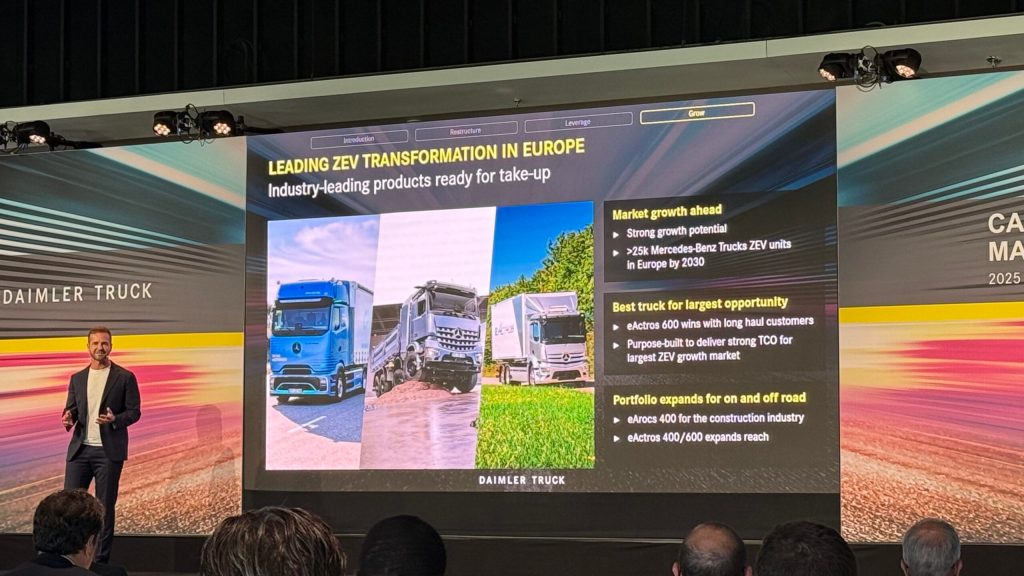
Daimler Truck AG, the world’s largest commercial truck maker, recently announced at its Capital Market Day an ambitious growth strategy called “Stronger 2030,” which includes growth plans for the company’s zero-emission vehicle (ZEV) footprint in Europe. The European pivot for ZEVs came as executives talked about the more favorable regulatory environment and incentives compared with the U.S.

The pivot doesn’t come without a cost. As part of a Costs Down Europe strategy, the company announced a headcount reduction of around 5,000 in Germany that includes a combination of material costs, research and development, operations and sales. These cuts are part of a €1 billion cost savings goal by 2030. This is the largest and most holistic efficiency program ever, according to the company.

For Mercedes-Benz Trucks, maker of the electric eActros 600 cabover, the focus is on turning potential into profit following strong results in 2023 and recent news of Amazon Europe making purchases of the ZEV. The company hopes to grow its unit sales of its zero-emission vehicles in Europe to 25,000 units by 2030.

Across the Atlantic, Daimler Truck North America (DTNA) continues to be a core profit driver within the larger Daimler Truck Group. DTNA has an electric Class 8 via its Freightliner eCascadia, but its diesel Cascadia remains the dominant player in the Class 8 truck space with an approximately 42% market share.

Executives cited ongoing uncertainty over electric vehicle (EV) and ZEV incentives and recent regulatory rollbacks in the U.S. market as reasons behind the European ZEV pivot. Questions still remain over the status of California Air Resources Board rulemaking and clarity on what direction the Environmental Protection Agency wants to go. NOx emissions limits remain another topic under consideration. For a large truck maker, there isn’t a dial one can turn to adjust NOx limits; the engines and NOx filtration systems are planned years in advance.

Additionally, lack of EV charging infrastructure remains a headwind. Daimler notes that it has seen EV progress in markets like Denmark and Germany, where total cost of ownership paired with shorter distances is making EV trucks attractive compared with the North American market, where longer distances prevail.

Outrider builds industry-first safety system for driverless yard operations

(Photo: Outrider)

The autonomous yard truck turf war in the trailer yard is heating up with Outrider recently announcing it has developed the industry’s first safety system designed specifically for driverless movement in mixed traffic trailer yards.

Outrider is a technology developer of autonomous yard operations for logistics hubs. The company’s proprietary functional safety approach recently received validation from TÜV SÜD, a globally recognized independent testing and certification organization, determining it aligns with its AV Conformity Framework requirements.

“Outrider pioneered the yard automation space with the goal of making autonomous yard operations inherently safer than present-day operations, and we have prioritized the safety system from day one,” said Andrew Smith, founder and CEO of Outrider. “It is not hard to create a driverless demonstration. It is a major technical undertaking to design an 80,000-pound robot that operates among over-the-road trucks, delivery trucks and warehouse personnel.”

Smith spoke with FreightWaves about the milestone, noting that the company has been operating with both human drivers and safety observers for several years. According to Smith, the company has completed hundreds of thousands of fully autonomous trailer moves within its customers’ fleets.

Read the full article here.

You’re halfway there! To read the rest of the Truck Tech newsletter, subscribe below. It’ll be delivered to your inbox every Friday at 11am eastern.

While you’re at it, check out this week’s episode.

Borderlands Mexico: US ending tomato trade agreement met with praise, criticism

Borderlands Mexico is a weekly rundown of developments in the world of United States-Mexico cross-border trucking and trade. This week: US ending tomato trade agreement met with praise, criticism; Amports expands vehicle storage capacity at Mexican seaport; and CBP find cocaine in raspberry shipment from Mexico.

US ending tomato trade agreement met with praise, criticism

After the Department of Commerce terminated the 2019 Tomato Suspension Agreement between Mexico and the U.S. on Tuesday, reaction from trade stakeholders and public officials on both sides of the border was divided.

Tomatoes sold in the U.S. from Mexico are controlled by the U.S. Department of Commerce through the suspension agreement, which sets minimum pricing and regulates sales between growers and importers.

The debate centered around whether Mexico-based growers are dumping exported tomatoes into the U.S. at lower prices that undercut the domestic market.

“Mexico remains one of our greatest allies, but for far too long our farmers have been crushed by unfair trade practices that undercut pricing on produce like tomatoes. That ends today,” Secretary of Commerce Howard Lutnick said in a news release. “This rule change is in line with President Trump’s trade policies and approach with Mexico.” 

Along with ending the 2019 Tomato Suspension Agreement, the Trump administration has imposed a 17% duty on fresh tomatoes from Mexico.

The Florida Tomato Exchange, which has been pushing for more restrictions on Mexican-grown tomatoes for years, hailed the termination of U.S.-Mexico Tomato Suspension Agreement.

“[The] decision is an enormous victory for American tomato farmers and American Agriculture,” Robert Guenther, executive vice president of the Florida Tomato Exchange, said in a statement. “We’re grateful for the decisive, bold, and crucial action taken by the Trump administration. This decision will protect hardworking American tomato growers from unfair Mexican trading practices.”

The Florida Tomato Exchange was established to foster cooperation among Florida’s tomato growers and packers.

Since 1996, the U.S. and Mexico have negotiated five separate agreements regarding tomato imports.

In 2019, the Florida Tomato Exchange lobbied for stricter quality control on Mexican-grown tomatoes and more enforcement of import pricing.

Mexican tomato producers signed a Tomato Suspension Agreement with President Donald Trump’s first administration in 2019 to end a tariff dispute.

Mexican-grown tomatoes account for nearly 70% of the U.S. market, while U.S. growers’ share is currently around 30%.

In 2024, the U.S. imported $3.12 billion worth of fresh tomatoes from Mexico. This accounted for the majority of the total U.S. tomato imports, which were valued at $3.63 billion, according to the Observatory of Economic Complexity and Texas A&M

The Laredo customs district in South Texas — which includes Laredo’s World Trade Bridge and the Pharr-Reynosa International Bridge in Pharr — accounts for the majority of tomato imports from Mexico, followed by the border crossing in Nogales, Arizona.

Mexican tomato producers signed a Tomato Suspension Agreement with President Donald Trump’s first administration in 2019 to end a tariff dispute.

As part of the 2019 agreement, Mexico-based growers agreed not to sell tomatoes below a reference price, a seasonably adjusted floor price at which Mexican tomatoes can’t fall underneath and still be exported to the U.S.

In April, the Department of Commerce said the 2019 Tomato Suspension Agreement has failed to protect U.S. growers.

Jacob Jensen, a trade policy analyst at the American Action Forum, said it’s unclear if tomatoes from Mexico were undercutting U.S. growers.

“While it is true that market share for domestic producers has declined over the past few decades, it is difficult to make the case that Mexico is flooding the United States with excessively underpriced tomatoes” Jensen wrote in a recent report titled, “The Cost of a Tomato Tariff.” 

“Notably, the Tomato Suspension Agreement already accounts for this by essentially setting a minimum price for fresh tomato imports from Mexico to prevent Mexican exporters from undercutting U.S. tomato producers. As such, the most likely rationale behind this move is that the Trump Administration would like to replace the import price controls to receive more tariff revenue.”

Jensen said the tariffs will raise U.S. prices by roughly 8 cents per pound, resulting in a 7% increase in prices for the overall U.S. fresh tomato supply.

Trade stakeholders said the end of the agreement and tariff on Mexican imports could put billions in economic activity at risk and threaten thousands of jobs in Arizona and Texas.

Border Trade Alliance President Britton Mullen urged the Trump administration to continue to negotiate with Mexico.

The Border Trade Alliance is a non-profit organization that advocates on issues pertaining to border development and quality of life and trade in the Americas. 

“The Border Trade Alliance is disappointed that the Department of Commerce has withdrawn the U.S. from the agreement that has governed U.S.-Mexico tomato trade for decades. It’s a move that not only hits shoppers in the wallet by driving up the cost of Mexican-grown tomatoes, but it injects yet more disruption into North American cross-border trade,” Mullen said in a news release.
“We encourage the U.S. and Mexico to continue conversations with the goal of reaching a revised agreement that not only will prevent price spikes, but will also preserve the hundreds of thousands of U.S. jobs that depend on the tomato trade. Without a commonsense agreement in place, we risk inflicting lasting damage on the U.S. economy.”

Mexican President Claudia Sheinbaum said her administration will continue to negotiate with U.S. officials to remove the import duties imposed on tomatoes.

“We disagree with this action taken by the United States Department of Commerce,” Sheinbaum said, according to EFE Noticias. “It’s an existing agreement, one that was already attempted to be withdrawn, that was withdrawn, and that had to be reintroduced due to the impact it has on the economy and on American consumers.”

Sheinbaum said Mexico will continue to export tomatoes to the U.S. “even with the tariff, because there is no substitute.”

Amports expands vehicle storage capacity at Mexican seaport

Amports has invested $4.5 million in a new vehicle storage yard near the Mexican Pacific coast Port of Lázaro Cárdenas, according to Automotive Logistics.

The expansion aims to enhance storage capacity and support growing OEM demand in Mexico’s automotive export corridor. The yard has a vehicle storage capacity of 5,000 units.

“The goal is clear: to provide OEMs and logistics providers with a hub that combines strategic location, operational agility and high-quality standards,” Amports said in a statement. “Lázaro Cárdenas continues to position itself as a key link in the automotive logistics chain, and Amports reinforces that vision by investing in smart, resilient infrastructure.” 

CBP find cocaine in raspberry shipment from Mexico

U.S. Customs and Border Protection officers at the World Trade Bridge in Laredo, Texas, recently discovered alleged cocaine in a shipment of frozen raspberries.

The seizure occurred on Monday, when a CBP officer referred a 2015 tractor-trailer hauling frozen raspberries for secondary inspection. CBP officers discovered 32 packages containing 74.6 pounds of alleged cocaine within the trailer’s batteries.

The narcotics have an estimated street value of $996,114.
“The unwavering commitment and sharp instincts of our frontline CBP officers contributed to a remarkable seizure,” Port Director Alberto Flores, Laredo port of entry, said in a news release.