Regional disparity grows as truckload capacity tightens

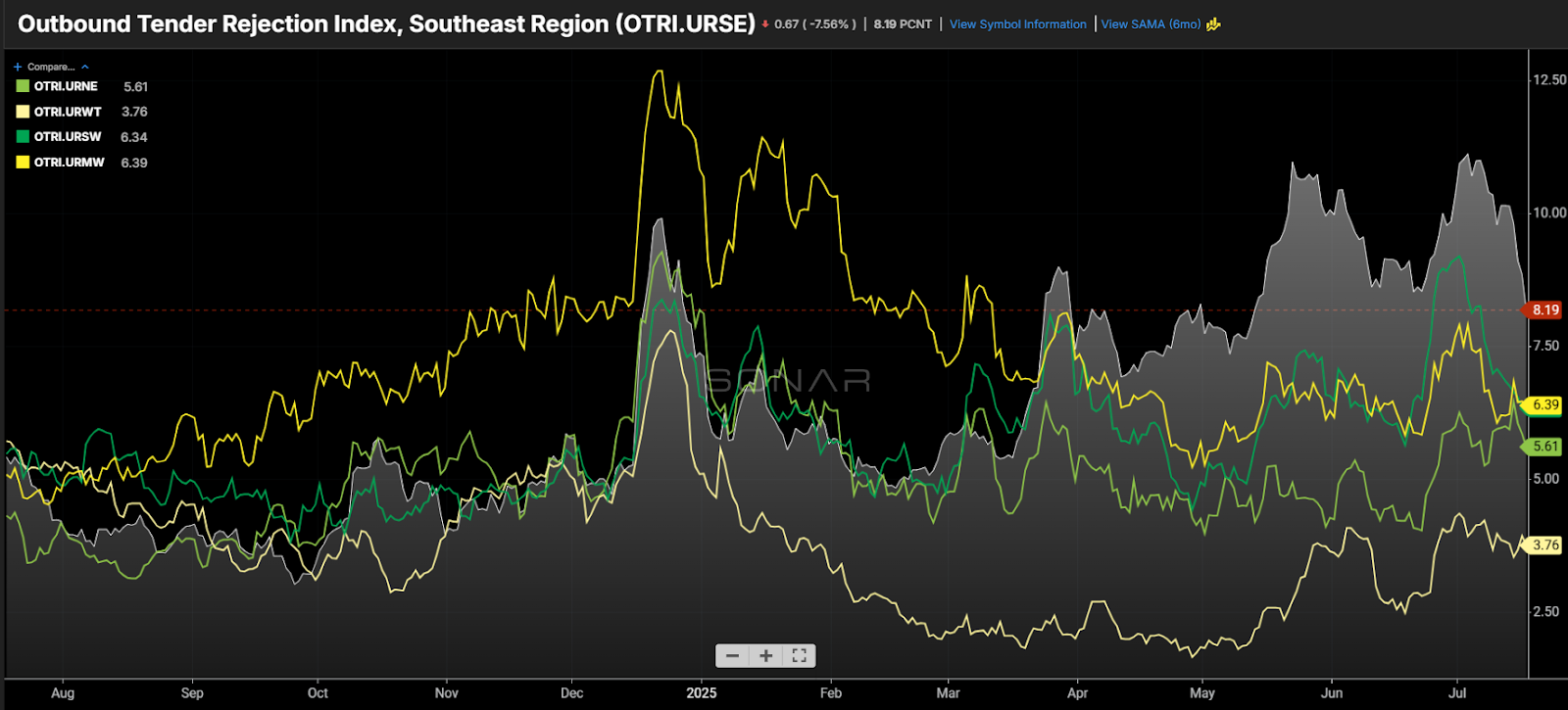
Chart of the Week:  Regional Rejection Indexes – Southeast, Midwest, Northeast, West Coast, Southwest SONAROTRI.URSE, OTRI.URNE, OTRI.URMW, OTRI.URWT, OTRI.URSW

Truckload tender rejection rates have diverged significantly over the past year, reflecting growing regional imbalances in the U.S. trucking market. In the Southeast, rejection rates have averaged close to 10% over the past two months, while West Coast rates have remained around 3.5%. This widening gap signals increasing network and pricing inefficiencies and suggests that the truckload market is less stable than it appears on the surface.

At this time last year, the gap between the two regions was much narrower: the Southeast averaged around 6%, while the West Coast sat only slightly lower at 5.3%. They’re not alone—other regions have also drifted apart. During the winter, the Midwest saw the most disruption, with rejection rates exceeding 12% for the first time in two years, while the West Coast remained under 8%.

For context, rejection rates above 10% are typically problematic for shippers, often triggering rapid rate inflation. These spikes are usually associated with holiday periods like Christmas and the Fourth of July.
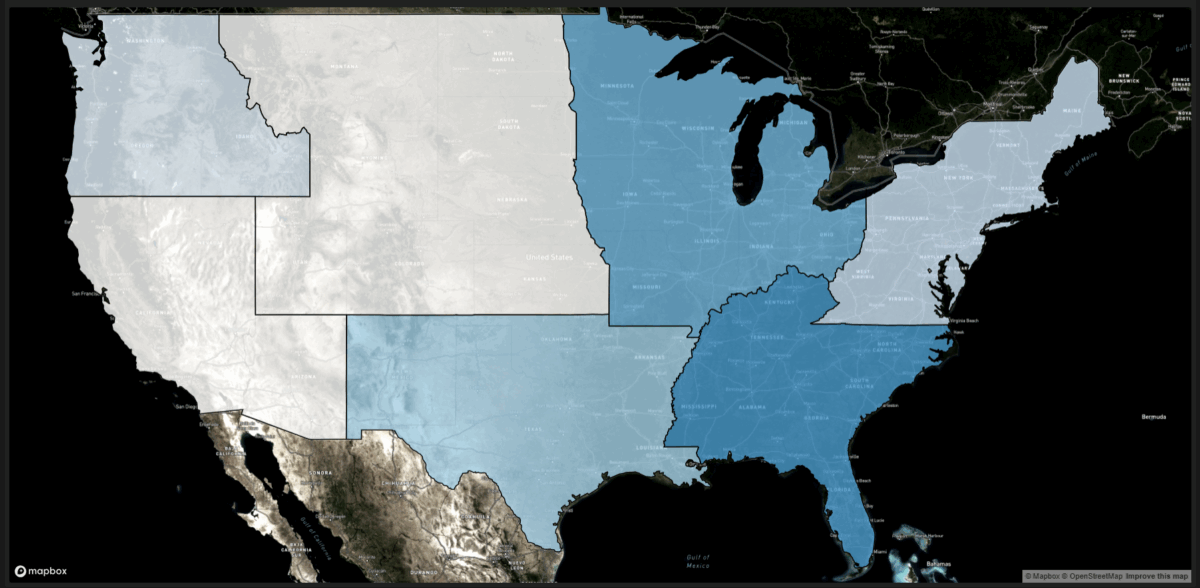
Map of regions in SONAR

The increasing dispersion in regional rejection rates points to a less balanced freight environment. Carrier networks constantly struggle to keep trucks moving toward areas where equipment is needed. When demand shifts—as it has over the past year—networks are slow to recalibrate.

Not so oversupplied

Following the pandemic, truckload capacity was so abundant that regional imbalances were largely absorbed. Trucks were readily available, often waiting on the sidelines. That’s no longer the case.

Since late 2022, the market has been shedding capacity. According to FMCSA data, more than 48,000 registered operators have exited the market. Net revocations have accelerated since last October, now averaging nearly 200 more per week year-over-year.

Still, the increase in total rejection rates has remained modest—hovering around 6% in recent months—insufficient to spark a significant capacity crunch or a market “flip.”

Rates are also driving regional inequity

One contributor to the growing disparity in rejection rates is the diverging trend in contract rates, particularly out of eastern markets.

According to SONAR’s invoice data, the average contract rate per mile from Los Angeles to Chicago has risen about 3% over the past two years. In contrast, the rate from Atlanta to Chicago has declined nearly 7%. While these are just two lanes among many, they illustrate a broader trend: outbound Southern California rates have shown more upward pressure than those in the East.

Length of haul also plays a role. Freight originating in Atlanta averages about 500 miles, while Los Angeles loads average more than 800 miles. This difference incentivizes carriers to prioritize longer West Coast hauls.

Rejection rates out of Atlanta — the Southeast’s largest market — have spiked in recent months. Although this hasn’t yet driven up contract rates, it has had a strong effect on the spot market. Spot rates in the Atlanta-to-Chicago lane are up 41% since mid-April. If sustained, this could eventually lead to higher contract rates. In the meantime, it highlights how fragile the spot market environment is. 

The Bottom Line

The freight market remains relatively soft, with little upward movement in long-term contract rates. But under the surface, conditions are shifting. The fact that spot rates have surged more than 40% in a well-traveled lane — even in a down market — demonstrates just how vulnerable the truckload environment has become.

About the Chart of the Week

The FreightWaves Chart of the Week is a chart selection from SONAR that provides an interesting data point to describe the state of the freight markets. A chart is chosen from thousands of potential charts on SONAR to help participants visualize the freight market in real time. Each week a Market Expert will post a chart, along with commentary, live on the front page. After that, the Chart of the Week will be archived on FreightWaves.com for future reference.

SONAR aggregates data from hundreds of sources, presenting the data in charts and maps and providing commentary on what freight market experts want to know about the industry in real time.

The FreightWaves data science and product teams are releasing new datasets each week and enhancing the client experience.

To request a SONAR demo, click here.

US moves to restrict Mexican airlines over cargo, competition concerns

Aeromexico and Delta jets at a passenger terminal in Mexico City.

The U.S. Department of Transportation on Saturday threatened to dissolve Delta Air Lines joint venture with Aeromexico and restrict Mexican flights in response to alleged anti-competitive behavior by Mexico’s government, including the forced relocation of all-cargo carriers in 2023 to a secondary airport.

It also put European countries on notice that similar measures could be taken against them if U.S. airlines are restricted from their airports in ways that disrupt the competitive balance established under air transport agreements in an effort to limit noise levels in city centers.  

The Department of Transportation said the Mexican government has impaired the operating rights of U.S. airlines under the 2015 U.S.-Mexico Air Transport Agreement.

Mexico banned freighter operators from the country’s main international airport in Mexico City ostensibly to relieve chronic congestion and allow expansion projects. The government also rescinded some take off and landing slots allotted to passenger carriers. 

Cargo airlines were forced to switch to Felipe Angeles International Airport, a former military airfield about 31 miles away. The relocation, which involved airlines from all countries, not just the United States, added operational costs and complexity for cargo operators, especially hybrid carriers that continued to move shipments in passenger planes serving Mexico City International Airport (MEX) and now have dual facility and delivery systems to manage. Felipe Angeles also was not fully developed and ready to efficiently handle the cargo aircraft, leading airlines to invest in more equipment and facilities.

The slot restrictions and mandate that all-cargo operations move out of MEX disrupted the market, cost American companies millions of dollars and represent a “blatant disregard” of the air transport agreement, according to the Department of Transportation.

“Joe Biden and Pete Buttigieg deliberately allowed Mexico to break our bilateral aviation agreement,” said Transportation Secretary Sean Duffy in the announcement. “That ends today. Let these actions serve as a warning to any country who thinks it can take advantage of the U.S., our carriers, and our market. America First means fighting for the fundamental principle of fairness.”

The slot seizures impacted American Airlines, Delta Air Lines and United Airlines, as well as Mexican carriers. The Mexican airlines with confiscated slots have since been able to restore certain services to the United States.

The DOT said in an enforcement notice that Mexico has yet to provide any analysis that MEX is oversaturated, assurance that U.S. carriers can recover their slots when construction is completed and that any construction projects have been initiated. 

The department has initiated a three-pronged initiative to pressure Mexico into changing its policy.

The DOT said it will require Mexican airlines to file schedules with the department for all their U.S. operations by July 29 so it can review whether any services violate the law or affect the public interest. Filings must include the type of aircraft used, flight frequency, origin-and-destination airports and arrival/departure times. 

A second order prohibits Mexican airlines from operating large aircraft for passenger or cargo charter flights to or from the United States without prior DOT approval. The charter restrictions, the DOT said, are a response to U.S. cargo airlines being prevented from repositioning aircraft within Mexico on non-revenue flights or making multiple stops in Mexico to pick up or drop off international traffic without carrying domestic shipments, as allowed under the transport agreement. 

The DOT also proposed to withdraw the approval of antitrust immunity for the joint venture operated by Delta and Aeromexico. The U.S. government extended the approval beyond a 2020 deadline to allow for further review, but the Trump administration now says the conditions for immunity no longer exist and that the joint venture no longer serves the public interest.

A final order terminating approval of the joint venture would not become effective until Oct. 25, at the earliest. 

If antitrust immunity is revoked, Delta and Ameromexico would be required to discontinue cooperation on pricing, capacity management, and revenue sharing. They would, however, be allowed to continue their partnership through arms-length activities such as codesharing, marketing and frequent flyer cooperation. Delta will also be able to retain its equity stake in Aeromexico and maintain all existing flying in the U.S-Mexico market unimpeded.

The Department also said it reserves the right to disapprove flight requests from Mexico should the country fail to take corrective action.

In 2023, the Biden administration expressed concern that the Netherland’s decision to reduce nearly 10% of takeoff and landing slots at Amsterdam Schiphol Airport to reduce pollution and noise was done unilaterally and would impact U.S. flight levels. It said the issue should be negotiated in the context of the existing U.S.-European Union Open Skies agreement. The U.S. warned the Dutch government that flight cuts could open the door for retaliatory cuts to KLM’s frequencies to the U.S. And the U.S. position is believed to have caused CMA CGM Air Cargo and Air France-KLM to abandon their cargo alliance’s application for antitrust immunity on North American routes last year.

Click here for more FreightWaves/American Shipper stories by Eric Kulisch.

Uprooted cargo airlines relocate to secondary airport near Mexico City

Much happened at Triumph Financial during the quarter; USPS dispute settled

An eventful quarter at Triumph Financial produced an earnings report that made some financial numbers seem less important than usual. 

But as has been the case with Triumph Financial (NASDAQ: TFIN) for most of its recent history, the company’s communications in its earnings release focuses on financial performance only to a limited degree. There’s far more about strategy and underlying numbers supporting that strategy. 

On that front, Triumph Financial’s earnings per share on a GAAP basis of 15 cents per share were 10 cents per share better than forecasts, according to SeekingAlpha. Revenue was slightly higher than forecasts.

However, one of the big developments at Triumph Financial for the quarter boosted that bottom line: the settlement of a long-standing dispute with the United States Postal Service. The settlement had a positive impact on pretax income both for the company’s three-month and six-month net income of $12.4 million and $11.5 million, respectively.

The quarterly benefit of the $12.4 million exceeded net income of $4.42 million.

As a result of the dispute with the USPS, Triumph has been carrying a $19.4 million receivable on its books since the issue first arose. With the settlement, Graft said in his letter that Triumph Financial now has recovered all of that and more. 

Dispute goes back to Covenant deal

The just-settled dispute over a wayward payment goes back to the Triumph acquisition of the factoring business of Covenant Logistics (NYSE: CVLG) in 2020. 

Triumph’s stock has slid since the earnings release. Triumph Financial’s stock price closed Thursday at $61.99, down from the $63.58 close that occurred just before the earnings release. 

On Friday, a day that stocks fell broadly, Triumph closed at $58.62, down 5.44% for the day.

For the freight sector, the Triumph Financial quarterly report has voluminous data that says much about the state of the freight market as well as broader long-range plans for the company. Much of it can be found in CEO Aaron Graft’s accompanying letter to shareholders where he shares not just hard information on his company’s business but a philosophical outlook.

That letter from Graft released Wednesday was longer than usual. Graft even joked about it on the earnings call with analysts–unique among the genre in that it is a video call–when he wondered “not sure how many of you made it through all 34 pages of the letter that was published last evening.”

Positive developments at Triumph Financial, even in the midst of a weak freight market, included the fact that annualized combined revenue in transportation–factoring, payments and intelligence–reached $237 million, up from $206 million in the prior quarter. The USPS settlement is not in that figure. 

In his letter, Graft said he believes the opportunity is $1 billion, “and nothing has changed my view.”

The financial impact from the USPS settlement came in Triumph Financial’s factoring segment. Of the group’s 13.3% quarter-on-quarter sequential improvement in revenue, 3.4% of that growth came from the USPS settlement. The group’s operating margin of 48.5% saw 24.7% of that come from the USPS. 

Previous Graft letters and earnings call commentary have focused overwhelmingly on the company’s payments network, which provides fast pay and audit services.

EBITDA in the payments sector was positive for the third time in the last four quarters. The payments sector includes the audit functions that Triumph Financial acquired more than four years ago in its purchase of HubTran. It includes the quick pay activities that previously existed under the TriumphPay banner

The positive EBITDA margin in payments was 13.9%. It was slightly negative in the first quarter, and was 0.5% and 8.6% in the last two quarters of 2024, respectively.

Big push on intelligence

But it was Triumph Financial’s relatively new intelligence sector and the second quarter acquisition of  Green Screens that got a large amount of attention. The intelligence group also includes the late 2024 purchase of  Isometric Technologies Inc. (ISO). 

As a group, it is tiny so far: just $1.7 million in revenue for the quarter. But Graft in his letter said the third quarter will be used to establish a “true base line of revenue and margin so investors can measure our performance in future periods.”

The more significant role that Triumph Financial sees for its Intelligence unit is that it grows the entire package of offerings in its “value chain” that Graft laid out in his letter.

It starts with the audit services of the payments sector, which Graft said will create trust among its broker customers. With that trust established, Graft wrote, the broker customers and their truckers will look to Triumph for financing. 

The next step will be that some of those customers will request a digital wallet to receive those payments, an offering that is at the core of Triumph’s LoadPay product. 

Separately, brokers will want to use the sea of data Triumph Financial holds to aid in their internal pricing models, Graft wrote.  

And that gets down to the intelligence unit. “When you offer a data product, broker customers will also realize that you have a broad database of objective metrics on how carriers perform on certain loads, which they will want to help influence their routing guides, so they will ask for that to be added to the data product,” Graft wrote.

One key metric in Triumph Financial’s earnings has been the average invoice size it either processed in its payments segments or factored by its factoring unit. That latter number in particular has long been a focus of investors and others. 

During the call, Graft said Triumph might have been in error in pushing that number. “We started training investors to look at average invoice size back when all we did was factoring,” Graft said. He said given the wider footprint of the payments unit, the size of the average invoice in that sector was more indicative of market conditions. 

But neither number showed any strength in freight markets. 

The average invoice size in payments fell sequentially to $1,186, down from $1,222 in the first quarter. But that number was higher than in the prior three quarters, including a year-ago second quarter number of $1,103.

As for the factoring sector, the average invoice size there was $1,663. That is well below the second quarter figure of $1,769 and a year ago number of $1,738.

Kimberly Fisk, the president of Triumph’s factoring segment, said changes in the company’s customer base for its factoring offerings are responsible for some of the decline in the average invoice size in that group. 

A change in the factoring customer mix

“As you go upmarket, you might get a diversified mix of carriers that might be doing different types of hauling,” she said on the earnings call. “And so some might do some shorter regional type loads, which will reduce your invoice price.”

If those shorter hauls are taken out of the equation, Fisk said, the average invoice price is closer to $1,200.

Factoring overall has been experiencing solid growth measured by volume. The second quarter figure of 1.7 million invoices purchased came out to a purchased volume of $2.87 billion. That volume is 13.3% more than in the first quarter, but with the lower average invoice size, the purchased volume was only up 6.1%, which is still a solid sequential growth. 

Triumph Financial’s Factoring as a Service (FaaS) offering, which offers a platform for third parties to provide their own factoring services to their own customer base, pulled in a significant new partner during the quarter: RXO. Although the RXO (NYSE: RXO) deal was announced this month, after the second quarter’s close, it still could be seen as an extension of the activity at Triumph Financial that director of investor relations Luke Wyss said on the call provided a “noisy quarter.”  

The partnership between RXO and Triumph involves both the FaaS offering and LoadPay.

As for LoadPay, Graft’s letter said the company had opened its 2,000th load pay account in June after a soft marketing rollout. By July 14, that number was up at 2,729. The 58 days from customer 1,000 to 2,000 is expected to be less than on the road to 3,000, Graft said. 

LoadPay’s digital wallet allows the payments unit at Triumph Financial to make its payments directly to a driver or other customer’s digital wallet. 

More articles by John Kingston

At a conference of mostly green investors, AlFleet pushes marriage of AI and trucking

Oregon ties itself closer to California’s Advanced Clean Trucks rule, even though it may have no future

A smaller Marten turns in a second quarter of 2025 much like a year earlier

Running on Ice: GHX rolls out new AI capabilities to strengthen healthcare supply chains

Global Healthcare Exchange (GHX) is ushering in a new era of intelligent supply chain operations with the launch of several AI-driven tools aimed at transforming how healthcare organizations manage disruptions, reduce inefficiencies, and make smarter decisions.

The core of this launch is ResiliencyAI, GHX’s proprietary platform that brings together predictive analytics, generative AI, and dynamic reporting. These capabilities are designed to help hospitals and suppliers uncover the root causes of supply chain issues, anticipate disruptions, and take swift, informed action. 

One of the new features is Perfect Order Co-Pilot, an AI-powered assistant that helps users understand and improve their order accuracy by analyzing data in near real-time and guiding teams through actionable next steps.

Another key development is the Resiliency Center, which focuses on backorder management, a persistent pain point for many healthcare providers. Using predictive AI, the system identifies products at risk of being delayed, evaluates the clinical and operational impact, and suggests intelligent substitutions before issues escalate. 

According to GHX President and CEO Tina Vatanka Murphy, the goal is to equip healthcare professionals with smarter tools that not only react to disruptions but help prevent them. “By pairing AI and automation with 25 years of trust and deep operational intelligence, we’re empowering the GHX community with the tools to build resilience from the inside out,” Murphy said.

What makes this launch especially notable is how closely it was developed in collaboration with the healthcare community. GHX worked with more than 30 providers and suppliers, along with its AI Council and Customer Advisory Board, to ensure that the tools reflected real-world challenges. Early adopters like AdventHealth and Roche Diagnostics have already reported improvements in strategic planning and operational visibility.

GHX has plans to further expand its AI capabilities later this year, including natural-language querying in reporting tools, new functionality in its Marketplace platform, and a Supplier Resiliency Center that will improve collaboration across the ecosystem.

Get the full edition of the newsletter sent to your mailbox every Friday by subscribing below.

Drewry: Ocean rates fall for fifth straight week

Drewry’s World Container Index (WCI) tracking ocean freight rates declined 2.6% this week, marking the fifth consecutive week of decreases. 

The analyst in an update said that the trend indicates a significant shift in market dynamics following a volatile period induced by increased U.S. tariffs in April, and a subsequent China-U.S. tariff pause. Although the tariffs initially caused a lagged market reaction that saw rates climbing in May and surging into early June, this upward trajectory has not been sustained as rates have steadily dropped since mid-June.

Trans-Pacific spot rates have also felt the impact, with prices from Shanghai to Los Angeles currently down by 4% to $2,817 per forty foot equivalent unit (FEU). Similarly, rates on the Shanghai to New York route have declined by 6%, to $4,539 per FEU. 

Spot container rates for major trade routes. (Chart: Drewry)

Drewry said that despite these decreases, rates on both lanes remain higher than levels observed 10 weeks ago when tariff anxieties were initially escalating. Rates from Shanghai to Los Angeles are still up 4%, while those to New York have climbed by 24% compared to the figures on May 8.

The overarching decline in spot rates can largely be attributed to weakening demand, which is expected to persist according to Drewry’s Container Forecaster. The outlook anticipates a further weakening of the supply-demand balance in the second half of 2025, which could invariably result in continued decreases in spot rates. 

The future volatility and rate adjustments will hinge on subsequent trade policies, particularly any additional tariffs imposed by the Trump administration, and on potential capacity changes prompted by U.S. penalties on Chinese shipping lines.

Find more articles by Stuart Chirls here.

Related coverage:

Port of Oakland containers off 10% as ‘recalibration’ hits ocean supply chain

China could block sale of port terminals: Report 

Amid uncertainty, sliding Asia-US container rates are a sure thing

Report: White House maritime chief leaving

DOT seeks public ideas for next major transportation bill

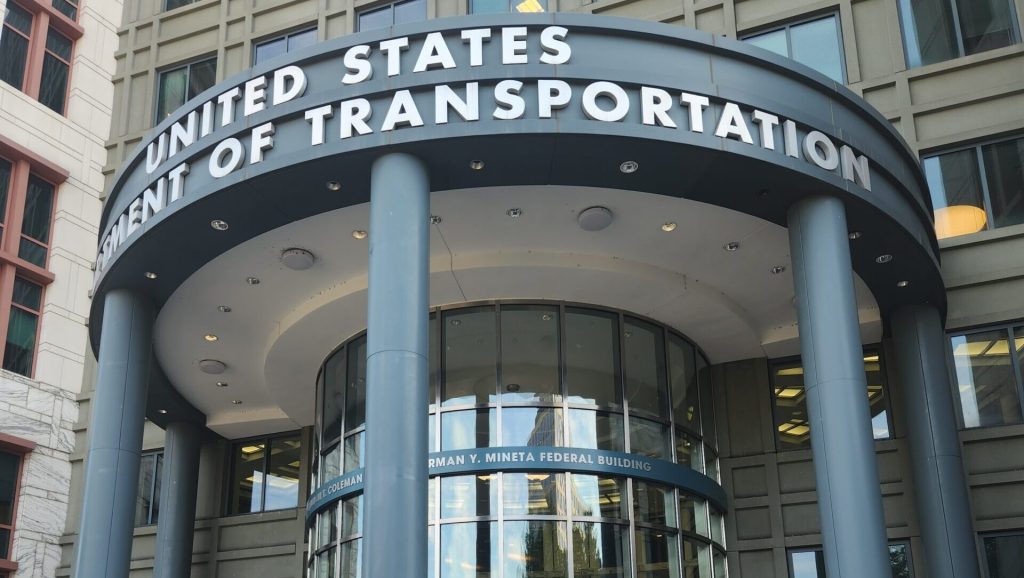
DOT Headquarters in Washington, D.C. (Photo: John Gallagher/FreightWaves)

WASHINGTON — The Trump administration is giving consumers a rare opportunity to help shape transportation policy – a role traditionally reserved for the well-connected on Capitol Hill.

In a U.S. Department of Transportation Request for Information (ROI) made public on Friday, the administration is inviting “ideas, comments and information” that it will use to help shape the development of the next multi-year surface transportation legislation. The current five-year authorization will expire on September 30, 2026.

In addition to freight and passenger carriers, shippers, manufacturers, local governments, and the lobby groups that represent them in Washington, D.C., DOT specifically names consumers as a group from which it is encouraging input “to support the development of the next surface transportation reauthorization bill to address the nation’s most essential infrastructure needs,” according to the notice.

“This RFI is intended to gather feedback, ideas, and recommendations to help inform legislative priorities and ensure future infrastructure programs focus on delivering safe and efficient surface transportation, without attaching unnecessary requirements,” the notice states.

“The reauthorization effort will focus on modernizing America’s infrastructure by improving safety, streamlining Federal processes, promoting economic growth, and strengthening partnerships.”

DOT highlighted several policy themes it would look for in comment submissions:

  • Enhancing transportation safety: DOT mentions truck parking specifically, which has been a top priority for the trucking industry.
  • Accelerating project delivery for transportation projects: Includes reforming the National Environmental Policy Act and project permitting, which can help speed infrastructure improvements for freight.
  • Increasing opportunities through investment in transportation infrastructure that promotes economic growth: Includes expanding capacity to relieve congestion, critical for efficient cargo flow and the overall health of freight markets.
  • Strengthening partnerships with states: To help improve transportation project outcomes and efficiencies.

Comments can be submitted here and search for docket no. DOT-OST-2025-0468, or email submissions to STR2026@dot.gov. Comments must be received by August 20.

Click for more FreightWaves articles by John Gallagher.

The Supreme Court must end the legal chaos threatening freight brokers

(The views expressed here are solely those of the author and do not necessarily represent the views of FreightWaves or its affiliates.)

Imagine a world where a freight broker is liable in one state for hiring a federally authorized motor carrier, but shielded from liability in the next. That’s not a hypothetical—it’s the fractured legal landscape facing America’s logistics industry today. The Supreme Court of the United States must act now to resolve a widening circuit split over whether the Federal Aviation Administration Authorization Act (FAAAA) preempts state common-law negligent hiring claims against freight brokers. And now they have the perfect cases to do it: Montgomery v. C.H. Robinson Worldwide, Inc. out of the 7th Circuitand Cox v. Total Quality Logistics out of the 6th Circuit.

The FAAAA and the Circuit Split

At issue is the interpretation of the FAAAA’s preemption clause—specifically, whether the so-called “safety exception” allows states to regulate broker hiring through tort litigation. Freight brokers like C.H. Robinson and Total Quality Logistics have been caught in the crosshairs of diverging judicial opinions, creating a patchwork of legal exposure that undermines the efficiency and predictability of interstate commerce.

In Cox v. Total Quality Logistics, decided just days ago, the Sixth Circuit sided with the Ninth Circuit’s controversial Miller v. C.H. Robinson decision, holding that a state common-law negligent hiring claim falls within the FAAAA’s safety exception. This directly contradicts decisions from the Seventh (Ye v. GlobalTranz) and Eleventh (Aspen American Insurance Co. v. Landstar) Circuits, which correctly held that such claims are preempted because they interfere with the core services of brokers and are not “with respect to motor vehicles” in the sense Congress intended. And now, a pending Supreme Court petition in Montgomery v. C.H. Robinson Worldwide, Inc. out of the 7th Circuit could (and should) resolve the matter.  

Why the Supreme Court Must Act

Let’s be clear: this is not a minor quibble over statutory language—it’s a fundamental disagreement that places freight brokers in legal limbo. The circuits agree that these negligent hiring claims “relate to” broker services under § 14501(c)(1) of the FAAAA and thus fall within the law’s express preemptive scope. The sole disagreement is over whether the savings clause—the safety exception in § 14501(c)(2)(A)—resurrects these claims by classifying them as legitimate exercises of a state’s motor vehicle safety authority.

But this interpretation stretches the safety exception beyond its breaking point. The phrase “with respect to motor vehicles” should, as the Seventh and Eleventh Circuits have rightly found, refer to laws that directly regulate motor vehicle operation and safety—not to state tort doctrines that second-guess a broker’s business judgment in hiring federally authorized carriers. Freight brokers don’t own or operate motor vehicles. They don’t hire drivers. They arrange transportation. When courts allow states to impose their own de facto hiring standards through negligence claims, they undercut Congress’s goal of uniform, deregulated transportation services.

Restoring Uniformity and Protecting Interstate Commerce

The consequences are dire. A freight broker arranging a shipment must now consider not only the federal carrier registration system, but also whether a jury in Tennessee, Michigan, Ohio, or California might retroactively decide the broker “should have known” a crash might occur. That is not safety regulation—it’s chaos. What’s worse, this balkanization is happening in the most critical artery of our economy. More than 70% of freight in the U.S. moves by truck. Brokers play an essential role in matching that freight to motor carriers. If brokers are held liable for trusting a federally authorized carrier—they will retreat from the market, reduce options for shippers, and increase costs for consumers.

Congress saw this coming. That’s why it passed the FAAAA in the first place. And it’s why the Supreme Court must act now.

Twice the Court has denied certiorari—first in Miller, then in Ye. But the issue has not gone away. It has gotten worse. The Sixth Circuit’s decision in Cox intensifies the conflict. The industry cannot live with uncertainty any longer. It’s time for the Supreme Court to do what only it can: resolve the split, restore uniformity, and reaffirm the preemptive purpose of the FAAAA. Our national supply chain depends on it.

Matthew Leffler is a transportation attorney, adjunct professor of law at Michigan State University College of Law, and the host of the Armchair Attorney® Podcast. He can be reached at matthew@armchairattorney.com 

Higher electricity demand boosts railroad coal carloads

According to data from the Association of American Railroads, three commodities have driven Class I railroad outperformance in 2025: intermodal containers, coal, and grains. Year-to-date, intermodal volume is up 5% compared to the same stretch in 2024; coal is up 6%, and grains are also up 6%.

Union Pacific is moving the most coal: 2025’s week 28 number was up 38% over the same week in 2024, but year-to-date, UP has moved 18% more coal carloads than the same period last year. CPKC’s year-to-date intermodal traffic numbers are up 11% over 2024, and Canadian National’s year-to-date grain volumes are up 17% compared to 2024.

Intermodal traffic, which involves the movement of containerized cargo using multiple modes of transportation without handling the cargo itself, remains a vital segment for Class I railroads. This year, the Western U.S. railroads like Union Pacific and BNSF have seen substantial increases in intermodal volumes. Data shows that Union Pacific’s intermodal volumes were up by 9% in 2025 compared to 2024, partly driven by growing consumer goods and e-commerce demand, particularly in the west coast ports that serve as entry points for Asian markets. BNSF also saw a similar uptick (5%), reflecting a strong recovery in retail and manufacturing sectors that heavily rely on intermodal services for supply chain distribution.

Eastern railroads, namely CSX and Norfolk Southern, are also tapping into the intermodal growth, though their performance varies. CSX reported a marginal increase in intermodal traffic as it continues to enhance its eastern seaboard network efficiency in response to competition from trucking. Conversely, Norfolk Southern has faced a slight downturn, attributed to competitive pressures and network adjustments to improve service reliability.

The grain market for railroads is witnessing robust activity, largely due to an increase in U.S. maize exports. Despite tensions with China leading to reduced shipments, American exporters have successfully diversified their markets in Asia, Latin America, and the Mediterranean, contributing to a 9% increase in seaborne grain shipments year-over-year. This diversification has been crucial, as Chinese tariffs imposed in March 2025 have significantly reduced their share of U.S. grain imports from 26% to 10%. Railroads play a crucial role here, with grain carloads showing a 26% rise, reflecting the increase in domestic grain movement. Kansas City Southern, now operating as part of the Canadian Pacific Kansas City network, and Canadian National are particularly benefiting from this shift, aligning their networks to maximize efficiency and capitalize on higher global demand for U.S. grains.

The coal sector is another area where railroads are witnessing significant volumes, albeit the dynamics are different. The U.S. coal market, generally in decline due to environmental policies and shifting energy preferences, is experiencing a temporary surge in 2025. This resurgence is linked to heightened domestic electricity demands and strong export demand from Asia, particularly India and China. For instance, Union Pacific and BNSF have both reported noticeable increases in coal shipments as power plants ramp up production to meet high summer electricity demands. April 2025 saw U.S. power plants receiving 28.5 million short tons of coal, up from 24.4 million the previous year, indicating a robust domestic push despite longer-term trends towards renewable energy.

International markets are providing a lifeline to U.S. coal exports, which saw their highest levels in six years. Gross exports reached 10 million short tons by June, primarily driven by competitive pricing and unyielding demand from steel production sectors in Asia. This export surge is benefiting eastern railroads as well, such as CSX and Norfolk Southern, which are seeing increased coal traffic leveraging their networks’ proximity to export terminals.

The Class Is are navigating a dynamic landscape in 2025. Their ability to adapt to shifting economic conditions, leverage intermodal capabilities, and effectively manage traditional sectors like grain and coal are underpinning their surprising outperformance.

Mass layoffs continue across freight-related companies in the U.S.

Another wave of closures and layoffs has hit workers and companies tied to commercial transportation, manufacturing, lumber production, distribution and logistics across the U.S.

Over the past several weeks, there have been 4,137 job cuts announced, according to media reports and Worker Adjustment and Retraining Notification (WARN) Act notices.

The companies facing layoffs include: Republic National Distributing Co. (1,756), Canfor Corp. (290), Bluestem Brands (160), DeRoyal Industries (153), Weaber Lumber (145), Howard Miller Co. (133), Ohio Eagle Distributing (124), Pocino Foods Co. (124), Western Forest Products (112), Americold Logistics (110), Lightspeed Logistics Miami LLC (110), Cartparts.com (104), MacMillan-Piper (92), GSC Enterprises Inc. (80), SalonCentric (79), Auto Warehousing Co. (75), BRP Marine US Inc. (72), Marshall Excelsior Co. (71), Backyard PlayNation (66), Spectrum Plastic Group (34) and CHS Inc. (25).

Beverage distributor Republic National exits California

Republic National Distributing Co., a wholesale beverage alcohol distributor, plans to close its operations across California by the end of September and slash 1,756 jobs statewide, according to WARN notices and media reports.

Grand Prairie, Texas-based Republic National Distributing Co. is one of the country’s largest wine and spirits wholesalers.

CEO Bob Hendrickson cited increasing operational costs and “industry headwinds” as some of the reasons for the layoffs.

“This decision was driven by rising operational costs, industry headwinds, and supplier changes that made the market unsustainable”, Hendrickson said in a news release published in Wine Industry Advisor. 

Distribution and logistics firms hit hard by layoffs

Ohio Eagle Distributing LLC, a beer distribution company, is in the process of selling all of its assets, including facilities in Lima and West Chester, Ohio, according to state filings.

The sale of the business will result in 124 jobs being cut at the two facilities, including 39 truck drivers. The sale is expected to be finalized by Sept. 8. 

Cold storage provider Americold Logistics is laying off 110 employees from a facility in Atlanta, citing low volumes. The layoffs are scheduled to begin Sept. 5. 

Lightspeed Logistics Miami LLC will eliminate 110 delivery driver positions and close its same-day delivery service in Hialeah, Florida, by Aug. 17, according to a WARN filing. The company did not provide a reason for the closure or layoffs.

Auto parts distributor CarParts.com is closing its location in Chesapeake, Virginia, and laying off 104 workers, according to state filings. The company did not provide a reason for the facility’s closure and job reductions, which will be by mid-August.

Supply chain solutions provider MacMillan-Piper is laying off 92 employees in Seattle and Tacoma, Washington, according to a WARN notice with the state.

The company said the layoffs were a result of a “sudden and unforeseeable business circumstances resulting from the loss of operational funding,” according to the WARN notice.

MacMillan-Piper is a transloading company that operates six facilities near the ports of Seattle and Tacoma.

GSC Enterprises Inc., a grocery supply chain provider, is laying off 80 workers in Oakland, California, along with Seattle and Tacoma. The layoffs include managerial roles in general, planning and client areas.

GSC Enterprises, which is the parent company of MacMillan-Piper, said the layoffs were the result of “sudden and unforeseeable business circumstances,” in a WARN filing. 

CHS Inc. is closing a grain shipping terminal in Superior, Wisconsin, by the end of August and eliminating 25 jobs, according to state filings.

The facility is “the largest grain terminal in the Duluth-Superior port,” according to mprnews. CHS did not give a reason for the closure.

Lumber production companies hit hard by closures, job cuts

Vancouver, Canada-based Canfor Corp. is closing sawmills in Darlington and Estill, South Carolina, laying off 290 workers.

The Darlington plant employs 120 people, and the Estill plant employs 170 people. Layoffs will start Aug. 25.

Canfor said the mill closures were due to “persistently weak market conditions and sustained financial losses,” in a statement posted on Facebook.

Weaber Lumber is laying off 145 workers at its distribution center in Lebanon Township, Pennsylvania, by Sept. 9. The company is a hardwood lumber manufacturer. 

“As with so many other manufacturers, we have been struggling with challenges in the housing market and with the impacts of inflation,” a Weaber spokesperson told BizNewsPA. “Home sales are down while mortgage rates remain high. Continued uncertainty in the overall economy has prompted consumers to delay building or purchasing a new home or renovating an existing home.”

Western Forest Products, another Vancouver, Canada-based lumber firm, laid off 112 employees from a lumber mill in Vancouver, Washington, according to a WARN notice.

The company’s Columbia Vista sawmill was left inoperable by a fire on June 29, the company said.

Food producers shuttering facilities, laying off 202

Pocino Foods Co. is closing a plant in City of Industry, California, and laying off 124 workers, according to a WARN filing.

The facility’s closure and layoffs will be finalized by Aug. 26. The company said they are closing the plant based on “a recent evaluation of business operations.”

Pocino Foods, headquartered in City of Industry, is a manufacturer of handcrafted specialty pre-cooked meats.

The T. Marzetti Co. is laying off 78 employees due to the closure of its Milpitas, California, production facility. The closure and layoffs were finalized on Monday. 

The Ohio-based company did not provide a reason for closure of the facility. The T. Marzetti Co. makes and distributes salad dressings, fruit and vegetable dips, frozen baked goods and specialty brand items. 

New LTL freight class rules take effect on Saturday

A white sleeper cab pulling two white LTL pup trailers

Major changes to the way less-than-truckload freight is categorized will take effect on Saturday following a rework to the National Motor Freight Traffic Association’s (NMFTA) decades-old classification system.

After many months of internal alterations, public listening sessions and feedback from industry participants, the nonprofit trade group has rolled out a simplified version of its 90-year-old National Motor Freight Classification (NMFC) system. The new guidelines are designed to move the LTL industry toward a density-based approach to classifying freight that more accurately reflects the actual cost of shipping goods.

“The LTL carriers want the full impact of these NMFC changes to be felt, both by them and shippers,” said Scooter Sayers, director of business development (LTL Solutions), at Cubiscan, a maker of freight dimensioners, in an interview.

The new coding system will still evaluate freight on four characteristics — density, handling, stowability and liability. However, it will now prioritize density when there are no special concerns with the other three.

Under the new rules, the number of density-based rating subprovisions has expanded from 11 to 13. Subprovision 11 has been amended to include densities ranging from 30 to less than 35 pounds per cubic foot (assigned class 60). Sub 12 ranges from 35 to less than 50 pounds per cubic foot (class 55), and Sub 13 covers densities greater than 50 pounds per cubic foot (class 50).

“Freight-all-kinds programs limit the impact, so expect LTL carriers to push even harder to eliminate FAK programs. If shippers want to keep their FAK program, they are going to pay for it,” Sayers continued.

The updates are substantial, with roughly 2,000 items being carved out from a list of 5,000 that were under review.

“These changes on July 19 to convert 2,000 NMFC items to a 13-sub table classed by density is just the start,” Sayers said. “More is coming, and we can expect substantially all commodities will have class at least partly determined by density. It is, after all, the number one cost driver for carriers.”

The overhaul aims to make the classification system more user-friendly, reduce costly freight reclassifications and provide more accurate freight rates upfront. The shift aligns pricing with the primary cost drivers for LTL carriers: distance, time and space.

For shippers, the changes promise significant benefits, including a simplified classification process, more predictable billing and greater cost efficiency. However, realizing these benefits requires preparation.

Experts have been advising shippers for months to audit their commodity classes and ensure they are tracking accurate dimensions, weight and density. Optimizing packaging to minimize wasted space will become more critical, as excess volume can result in a higher class and increased costs.

SONAR: Longhaul LTL Monthly Cost per Hundredweight, Class 50-65 Index. Less-than-truckload monthly indices are based on the median cost per hundredweight for four National Motor Freight Classification groupings and five different mileage bands. To learn more about SONAR, click here.

The organization also revamped ClassIT+, an online tool that helps shippers, carriers and 3PLs properly identify freight. Changes include more expansive APIs, an improved search function and faster responses.

Additional updates to the NMFC are expected in the coming months and years.

“The winners on the shipper side are going to be those who embrace the digital capture of dimensions, weight and photos at the handling unit level,” Sayers said. “ If carriers have to pick between shippers who provide this and shippers who don’t, who are they going to pick?

“LTL carriers want their shippers to provide them with accurate data on the BOL, and will both reward and favor those shippers in the long run.”

More FreightWaves articles by Todd Maiden: