Trump announces deal with Vietnam, includes 20% import tariff rate

President Donald Trump said on Wednesday he has reached a trade deal with Vietnam, just ahead of the 90-day pause on “reciprocal” tariffs ending for more than 90 countries that barter with the U.S.

Goods from Vietnam to the U.S. will now face a 20% import tax, instead of the 46% duty rate Trump said he would impose on merchandise from the country during his “Liberation Day” announcement on April 2.

Trump also said goods from Vietnam to the U.S. could also be hit with tariffs as high as 40% if they originated in another country and were transferred to Vietnam for final shipment to the United States.

“It is my Great Honor to announce that I have just made a Trade Deal with the Socialist Republic of Vietnam after speaking with To Lam, the Highly Respected General Secretary of the Communist Party of Vietnam,” Trump posted on Truth Social.

“It will be a Great Deal of Cooperation between our two Countries. The Terms are that Vietnam will pay the United States a 20% Tariff on any and all goods sent into our Territory, and a 40% Tariff on any Transshipping.”

The Trump administration’s broad “reciprocal” tariff plan announced April 2 on about 90 U.S. trade partners included a baseline 10% duty rate on almost all goods, as well as 25% tariffs on certain imported vehicles and auto parts.

Trump paused the reciprocal tariffs on imports from most countries for 90 days on April 9, but kept a 10% baseline import tax in place for almost all U.S. trading partners, including Vietnam.

The general tariff rate against goods from Vietnam to the U.S. will now increase from 10% to 20% under the deal announced Wednesday. Tariffs are taxes on imports that are charged to businesses bringing products into a country.

As part of the new deal, Vietnam will give the U.S. access to its markets with no tariff rate, Trump said.

Vietnam is currently the seventh largest U.S. trading partner, totaling $149.6 billion in two-way commerce in 2024, according to the U.S. Trade Representative. Imports from Vietnam to the U.S. totaled $136.6 billion last year.

The U.S. primarily imports goods like apparel, electrical machinery, and footwear from Vietnam. Top exports from the U.S. to Vietnam include raw cotton, integrated circuits, and telecommunications equipment.

On Tuesday, Trump said that he is not considering extending the pause for countries that the U.S. has been unable to negotiate trade deals with.

“No, I’m not thinking about the pause,” Trump said Tuesday to reporters aboard Air Force One, according to Bloomberg. “I’ll be writing letters to a lot of countries.”

The Trump administration has announced trade deals with the United Kingdom and China —  though neither agreements have been finalized.

Automation Hacks for Small Fleets – What to Set and Forget First

Time is your most valuable resource when you’re running a small fleet. You’re chasing rate cons, handling maintenance issues, answering driver calls at all hours, and still expected to grow the business. It never stops. But here’s the truth—most of the stress isn’t coming from the hard stuff. It’s coming from the repetitive stuff. The daily tasks that could’ve been handled by a system but are still sitting on your plate. That’s why automation isn’t optional anymore—it’s survival. You don’t need a fancy tech stack or a six-figure budget. You just need to know what to automate first and how to do it in a way that actually frees up time instead of creating more confusion.

Let’s break down exactly what to automate, in what order, and how to implement it without sacrificing control or visibility. These are real-world, proven tactics that buy back your time and protect your margin.

First, Understand This—Automation Is Not Delegation

Let’s clear something up: automation is not outsourcing. Delegating means someone else is doing the work. Automation means the work is getting done without anyone touching it at all. That’s a huge difference. You’re not replacing your dispatcher, admin, or yourself. You’re reducing your dependency on manual steps that create bottlenecks, delays, or errors.

In small fleets, the owner often wears five hats: dispatcher, bookkeeper, recruiter, HR, and sales. The goal of automation is to take the predictable and repetitive parts of those roles and let them run quietly in the background—accurately, every time.

Set and Forget #1 — Invoice Delivery and Follow-Up

If you’re still manually generating and emailing invoices, you’re burning 4–6 hours a week—and missing revenue opportunities every time a follow-up slips through the cracks. This should be the first process you automate.

Tactical Steps:

  • Use your TMS or accounting software (like QuickBooks, Axele, or Tailwind) to create a rule: every time a load is delivered and POD is uploaded, generate the invoice.
  • Automate email delivery using preset templates. Include PDF invoice, BOL, and rate confirmation.
  • Set automated follow-ups: 7, 14, and 21 days post-invoice. Use polite but firm language.
  • Tools like Melio or SyncQ can automate follow-up emails and even integrate with factoring companies.

Why This Matters:

Most carriers delay follow-ups because it’s tedious. But delayed follow-ups equal delayed cash flow. Automating this process removes the guesswork and keeps money flowing.

Set and Forget #2 — Preventive Maintenance Alerts

Breakdowns don’t usually happen because of bad luck—they happen because of missed maintenance. You can’t afford to guess when the next oil change or inspection is due.

Tactical Steps:

  • Use Fleetio, Whip Around, or Motive’s maintenance modules to track mileage or engine hours.
  • Set thresholds per truck (e.g., oil change every 20,000 miles).
  • Trigger email or mobile push alerts for the fleet manager and the assigned driver.
  • Include checklists for drivers to submit via app.

Bonus Tip:

Use a shared Google Sheet synced with Zapier if you’re not ready for a full fleet maintenance platform. It’s not about having software—it’s about building systems.

Why This Matters:

Unplanned maintenance kills schedule reliability and cash flow. Preventative alerts protect your uptime and keep you on the road making money.

Set and Forget #3 — Load Tracking and Customer Notifications

Most shippers expect visibility. If you’re still calling or texting updates manually, you’re falling behind—and wasting time you could be using to plan your next move.

Tactical Steps:

  • Enable location tracking through your TMS or ELD.
  • Set triggers for key milestones: arrival, loaded, in transit, delivered.
  • Auto-send tracking links or status emails to the broker/shipper using templated messages.
  • Tools like Project44, MacroPoint, and Motive integrate directly with most systems.

Why This Matters:

The better you communicate, the more loads you get. This system turns your operational performance into customer satisfaction—on autopilot.

Set and Forget #4 — Driver Onboarding and Reminders

Bringing on a new driver shouldn’t feel like a fire drill. Every step—forms, signatures, insurance approvals—should run in a set sequence without you chasing paperwork.

Tactical Steps:

  • Use JotForm or Google Forms for collecting driver info and documents.
  • Automate reminders for pending items with SMS or email alerts.
  • Use HelloSign or Adobe Sign for contract execution.
  • Create a Trello board or Notion checklist for each new hire.

Why This Matters:

Clean onboarding sets the tone. The smoother it runs, the faster you can get drivers on the road and performing.

Set and Forget #5 — Lane and Rate History Tracking

If you’re not tracking your rates by lane and broker, you’re losing leverage. And if you’re doing it manually, you’re losing time.

Tactical Steps:

  • Build a lane database in Google Sheets or AirTable.
  • Use Zapier to pull data from your TMS or load board history.
  • Include rate per mile, deadhead, fuel cost, and net profit.
  • Set weekly or monthly automated reports to your email.

Why This Matters:

This is the foundation of direct freight strategy. You can’t pitch a shipper without knowing your own lane performance inside and out.

Set and Forget #6 — Fuel Spend Controls and Reporting

Fuel spend gets out of hand fast when there’s no control. You need automation that monitors spending and triggers alerts when it gets out of bounds.

Tactical Steps:

  • Use fuel cards like EFS, RTS, or NASTC that offer automated alerts.
  • Set gallon limits, time-of-day usage windows, and zip code restrictions.
  • Use weekly reports to compare fuel purchases against MPG from your ELD.
  • Flag anomalies like repeated fuel-ups in high-cost states.

Why This Matters:

Every dollar saved at the pump is a dollar back into margin. Control systems prevent waste before it happens.

What NOT to Automate (Yet)

Don’t fall into the trap of over-automating. Some parts of your business still need your judgment.

Avoid automating:

  • Load pricing decisions (use data, but apply strategy)
  • Customer outreach (shipper relationships require a human touch)
  • Driver discipline (automate the tracking, but lead with real leadership)

Use automation to create bandwidth—then use that bandwidth to lead better.

Final Word

Most small fleets don’t fail because they don’t work hard. They fail because they’re doing the wrong work. Automating your back office, tracking, maintenance, and invoicing doesn’t just save time—it builds a stable business.

Start small. Pick one process. Automate it this week. Then move to the next. Within 60 days, you can cut your admin hours in half and redirect that time toward better dispatching, customer acquisition, and strategic growth.

Automation is leverage. And in this business, leverage is how you go from surviving load to load—to running a company that actually scales.

China trade outlook improves, container rates — not so much

As the July 9 deadline for the end of the China-U.S. tariff pause speeds closer, the outlook for the trans-Pacific ocean trade is less than clear.

Although tariffs and other details are not known, President Donald Trump said that the U.S. has signed an agreement with China that will see a resumption of the latter’s trade in rare earth minerals in exchange for the U.S. ending some countermeasures.

The administration said it plans to finalize negotiations with its top 10 trade partners after July 4 and may unilaterally impose tariffs on other nations soon.

A tariff reduction on Chinese goods by the U.S. on May 12 led to a rebound in China-US container volumes, but this seems to be losing momentum, SONAR data partner and shipping analyst Freightos said in an update. Carriers, possibly anticipating a more prolonged demand surge, have increased capacity on the trans-Pacific, particularly to the U.S. West Coast, which now appears out of balance with demand.

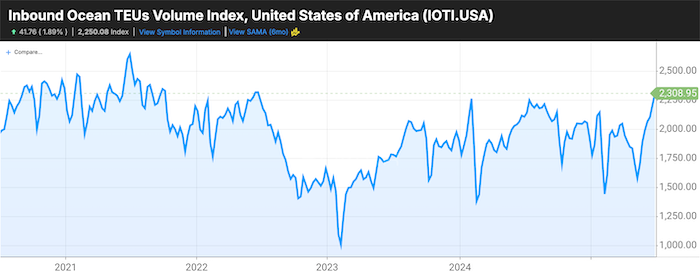
While SONAR data shows loaded containers departing China for West Coast ports approaching record levels, freight rates have suffered a precipitous drop amid weeks of weakening demand.  

SONAR chart shows U.S. inbound ocean container volumes approaching all-time highs.

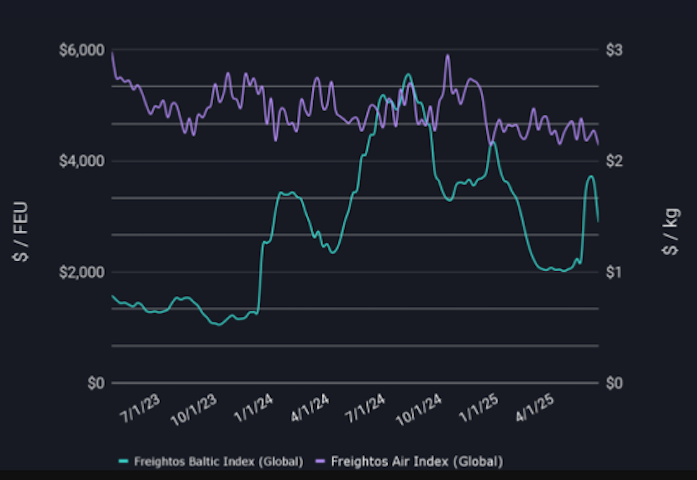
Freightos said that between late May and mid-June, rates for Asia to North America West Coast containers surged by over $3,000 per forty foot equivalent unit (FEU), or 115%, to $6,000. However, by the end of last week, a combination of demand and capacity issues caused a sharp decline in the average rate to $3,388 per FEU, which is 43% below June’s peak, though still 22% higher than late May.

East Coast rates saw a similar, though less dramatic, trend. They surged 80% from late May to mid-June, reaching approximately $7,200 per FEU but fell 15% to $6,116 by the end of the month. This significant drop in rates, occurring early in the typical peak season, has led carriers to consider reducing capacity.

Freightos Head of Research Judah Levine in a note said that even with these tariff-driven pressures that pushed rates up sharply in June, the peaks for both lanes were at least $1,000 per FEU lower than a year ago, and may indicate overall capacity growth in the container market.

Screenshot of Freightos Terminal showing ocean rate changes in green.

Asia-Europe and Mediterranean rates both concluded June with a 25% month-on-month increase, reaching $2,969 and $4,222 respectively. Red Sea diversions initiated an earlier peak season on this lane, with port congestion and capacity shifts to the trans-Pacific contributing to rate increases in early and mid-June.

However, rates on both lanes cooled by month-end, suggesting market conditions may not support upcoming July general rate increases (GRIs) by carriers. Despite this, liner plans for significant capacity reductions — unusual for peak season — could still facilitate additional rate hikes. Similar to the trans-Pacific, current rates on these lanes are substantially lower than a year ago, indicating that increased capacity is exerting downward pressure on rates, even as carriers continue to avoid the Red Sea.

But other market sources say container rates out of China are even lower.

“Spot rates dropped to somewhere between $2,000 to $2,500 (depending upon carrier) and have hovered around $2,500 for two weeks now,” said consultant Jon Monroe in a LinkedIn post. “Rates have fallen fast, space out of China’s base ports is wide open, and so far, carriers haven’t flexed their capacity control muscle to put the squeeze on the market.”

Monroe added that carriers that recently jumped into the trans-Pacific are offering rates at or just below $2,000 to the West Coast.

“The gap between East Coast and West Coast rates has settled back to normal, at about $1,000,” Monroe said. ”Right now, everyone’s just sitting tight, waiting to see what Trump decides to do with tariffs.”

Find more articles by Stuart Chirls here.

Related coverage:

Why 44% fewer cancelled sailings could be [blanking] bad news for SoCal trucking

US maritime chief ‘not a big fan’ of ocean carriers’ ‘approach’ as agency reviews antitrust immunity

Drewry: No “lasting impact” from tariff break as ocean rates fall again

With Mideast shipping on high alert, Maersk re-opens Israel port

SkyWater buys Austin chip factory

SkyWater Technology has successfully completed the acquisition of Infineon Technologies’ former semiconductor fabrication plant in Austin, Texas for $93 million, marking a significant milestone in the company’s strategy to boost its manufacturing capabilities. Closing this deal positions SkyWater to expand its production capacity to meet the increasing demand for domestically produced semiconductors in the United States, which has become a critical area of focus for the U.S. government’s efforts to secure supply chains.

SkyWater Technology, founded in 2017 and based in Bloomington, Minnesota, is recognized as the only U.S.-owned pure-play silicon foundry, providing essential engineering and fabrication services across various sectors including consumer electronics, industrial, military and defense, and automotive industries. The company is well-regarded for its use of 90-nanometer process technology on equipment capable of handling 200-millimeter wafers, and it has garnered a reputation as a Department of Defense-accredited Trusted supplier, underscoring its strategic importance in supporting national security interests.

In its quest for expansion, SkyWater has been proactive in strengthening its manufacturing footprint. In early 2021, the company repurposed a facility at NeoCity, Florida, with plans to continue growing its domestic foundry capabilities. This latest acquisition of the Austin plant is a part of their broader vision to increase capacity at both advanced and foundational semiconductor nodes.

Financially, SkyWater has faced some challenges, as highlighted in its first quarter 2025 results. The company reported a total revenue of $61.3 million, a slight decline compared to the fourth quarter of 2024. ATS development revenue saw a 12% drop quarter-over-quarter, which was attributed to government budget delays affecting funding timelines. However, the company experienced robust demand in its Wafer Services, driven by new products like the ThermaView platform with significant sales to top U.S. defense contractors. Despite the decline in total revenue, SkyWater’s gross profit increased by 10% year-over-year.

The acquisition of the Austin facility represents a strategic inflection point for SkyWater Technology. The move aligns with the company’s ambition to play a pivotal role in the U.S.’s semiconductor sovereignty goals, especially at a time when the semiconductor supply chain is under intense scrutiny amid global disruptions. The acquired plant is expected to provide SkyWater with the ability to deliver on its $1 billion supply agreement and position itself as a leader in foundational semiconductor markets. This initiative parallels the national objective to revive domestic packaging and testing capabilities, recognizing SkyWater as an essential player in addressing the growing semiconductor content across defense, aerospace, automotive, and industrial automation applications.

SkyWater’s efforts to tap into customer-funded capital expenditure models ensure that it continues to enhance its technological capabilities and infrastructure with minimal impact on its balance sheet. By fostering deep partnerships and leveraging outside co-investment, SkyWater anticipates a future marked by modernized facilities and increased production capacity, all while creating new jobs.

The successful integration of the Austin plant’s assets should enhance the company’s operational resilience and drive growth during the later months of 2025. As federal budget negotiations clarify, SkyWater is positioning itself to capitalize on the anticipated funding, improve its revenue prospects and advance down its path towards long-term profitability.

Drug busts at border ports in US, Canada top $31M; rail theft surging

Border agents in the U.S. and Canada seized cocaine, methamphetamine and marijuana worth more than $31.6 million over the past several weeks from commercial shipments at ports of entry in Texas and Michigan; along with Point Edward, Ontario, and Montreal, Quebec.

Supply chain risk management firm Overhaul also recently helped authorities recover stolen cargo from trains in three separate cases in California and Illinois.

Blue Water Bridge port of entry

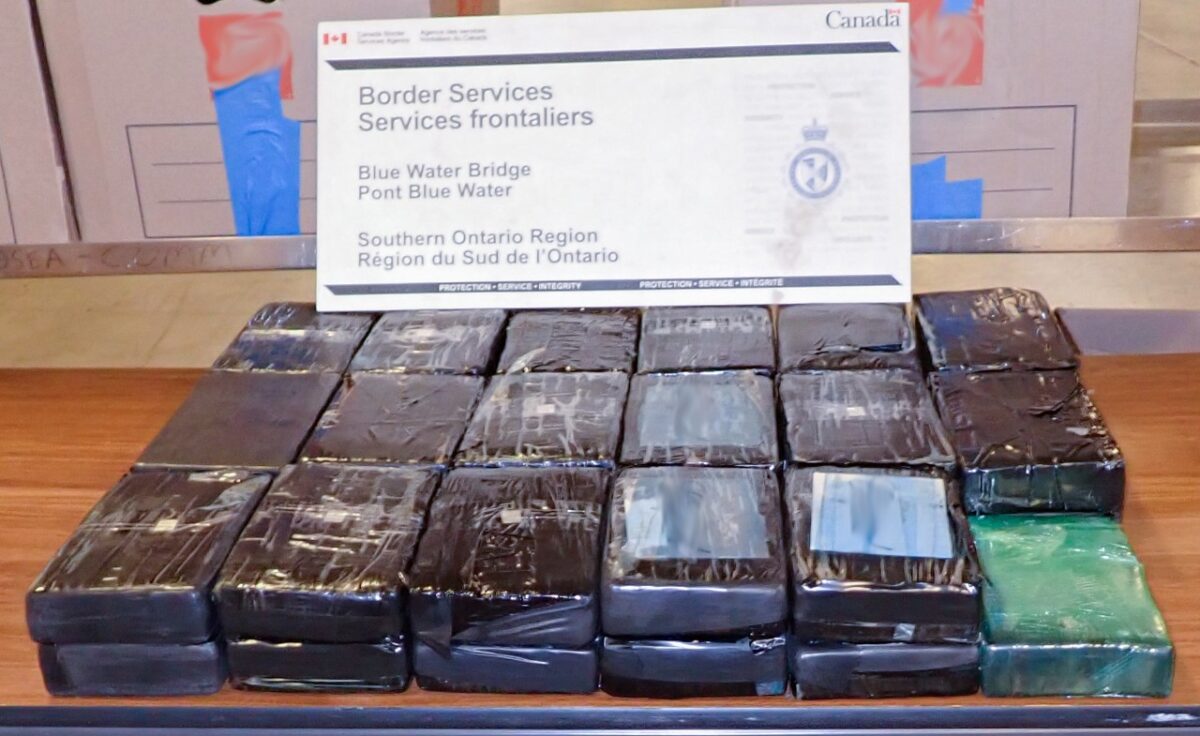
The Canada Border Services Agency (CBSA) seized 161 bricks of cocaine worth more than $20.15 million at the Blue Water Bridge in Point Edward, Ontario, on June 12.

The Blue Water Bridge port of entry connects Port Huron, Michigan, with Ontario.

Canadian border agents seized $20.15 million worth of cocaine at the Blue Water Bridge in Point Edward, Ontario, on June 12. (Photo: Courtesy)

Agents for the Canada Border Services Agency said the drugs were discovered in a tractor-trailer crossing from the U.S. into Canada.

Karamveer Singh, 27, of Brampton, Ontario, was arrested and charged with importation of cocaine, and possession of cocaine for the purpose of trafficking.

Pharr-Reynosa International Bridge

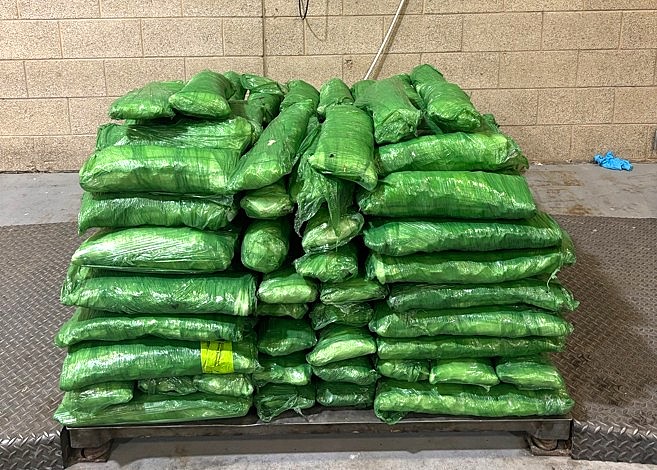
U.S. Customs and Border Protection (CBP) officers at the Pharr-Reynosa International Bridge found $6.7 million in methamphetamine concealed in a shipment of tomatillos from Mexico.

Border agents found $6.7 million in methamphetamine concealed in a shipment of tomatillos arriving from Mexico in Pharr, Texas. (Photo: Courtesy)

On June 10, CBP officers were checking a tractor-trailer arriving from Mexico at the bridge in Pharr, Texas, when they found 166 packages of alleged methamphetamine concealed in the shipment.

CBP seized the narcotics and the tractor-trailer, and the case was turned over to the Department of Homeland Security.

Colombia-Solidarity International Bridge

More than $4.85 million in cocaine was seized by border agents on June 3 at the Colombia-Solidarity International Bridge in Laredo, Texas.

U.S. Customs and Border Protection were inspecting an empty 2013 Fontaine commercial trailer and discovered 149 packages containing 363 pounds of alleged cocaine.

CBP seized the narcotics and the trailer, and the case was turned over to the Department of Homeland Security.

Montreal’s Marine and Rail Service

The Canadian Border Services Agency seized $4.8 million worth of marijuana at Montreal’s Marine and Rail Service on April 30.

Officers discovered 1415.37-pounds of drugs concealed in 1,023 vacuum-sealed packages hidden in custom-built crates and surrounded by bundles of engineered wood in a shipping container, according to a news release.

Authorities said the shipping container was bound for Spain.

The marijuana was seized and turned over to the Royal Canadian Mountain Police, which is investigating the matter.

Overhaul helps recover pilfered rail freight

Supply chain risk management firm Overhaul recently worked with law enforcement to recover stolen rail freight cargo from three separate pilferage cases in California and Illinois.

In California, both incidents occurred on June 19, according to a news release.

“Both thefts occurred on different trains … targeting the same product type, battery operated power tools,” Overhaul said.  

The first recovery was completed on the same day of the theft, with officers from BNSF Railway responding to the location of an alert indicating that a container had been opened. 

The pilfered cargo was found near the tracks at the indicated location near Needles, California, a common tactic for thieves who plan to return to collect the stolen goods, Overhaul said.  

The second recovery was completed on June 23 in the Los Angeles area, with Overhaul working with BNSF police and the California Highway Patrol, who were able to track the stolen cargo over the weekend to a warehouse facility.

The third case occurred around June 26, when Overhaul said helped authorities facilitate the recovery of 70 boxes of rail freight after a pilferage incident near an intermodal facility in Chicago. 

CVSA Safe Driver Week Is Coming

Several times a year, a wave of patrol cars, DOT inspectors, and enforcement units roll out across North America with a shared mission to save lives by improving driving behavior. The Commercial Vehicle Safety Alliance’s (CVSA) Operation Safe Driver Week kicks off July 13–19, 2025. While it might feel like just another inspection blitz, it carries long-term consequences for carriers and drivers alike, especially for those already walking a fine line with their CSA scores or struggling with FMCSA oversight.

This year, CVSA has announced that the spotlight will be on speeding. An issue that remains a leading cause of truck-involved fatalities, accounting for nearly one-third of fatal crashes according to NHTSA data. This week is about more than just tickets. It’s a wake-up call and an opportunity for fleets to course-correct before violations snowball into compliance chaos, increased insurance premiums, customer loss, and, in some cases, shutdowns.

What Is CVSA Safe Driver Week?

CVSA Safe Driver Week is a coordinated effort across the U.S., Canada, and Mexico to identify unsafe driving behavior in both commercial motor vehicle (CMV) operators and passenger drivers alike. Law enforcement will be actively issuing warnings and citations for behaviors such as:

  • Speeding, following too closely, and aggressive lane changes.
  • Distracted driving, including mobile device usage.
  • Seat belt violations.
  • Failure to obey traffic control devices.

CVSA’s focus remains on the safe operation of all commercial vehicles. The goal is twofold: deter dangerous behavior and increase accountability through roadside interventions.

Why It Matters for Fleets and Drivers

It’s easy to view Safe Driver Week as a one-off stressor or enforcement overreach, but in reality, it’s part of a bigger picture. These high-visibility enforcement periods are directly reflected in your FMCSA profile. The data collected might start with warnings or violations, but it shapes your safety reputation, both publicly and in the eyes of insurers, brokers, and shippers.

Every violation reported during these blitzes counts toward your CSA scores, and repeated issues in unsafe driving, HOS, or vehicle maintenance can set off a chain reaction that’s hard to break:

  • Higher ISS Scores: FMCSA’s Inspection Selection System (ISS) flags carriers for increased inspection frequency based on their safety performance. Once your ISS score rises above a certain threshold, you’re more likely to be stopped and inspected even if you’re running clean.
  • More Inspections = More Opportunities for Violations: With each inspection, the odds of being written up increase, particularly if there’s no proactive plan to address past issues.
  • Cycle of Noncompliance: This creates a loop that many fleets struggle to exit. Once your BASIC scores climb into the alert threshold, it becomes harder to attract top-tier freight or maintain insurance renewals, especially in today’s hardened insurance market.

Why You Need a Clean Inspection Strategy

One of the best ways to break the cycle is to start building a “clean inspection” strategy now, not the week of Safe Driver Week, but every day leading up to it and every day after. That means:

  • Proactively training drivers on the behaviors most likely to trigger enforcement stops.
  • Coaching your drivers on how to respond respectfully and accurately during a roadside inspection.
  • Investing in safety technology like AI-enabled dashcams, driver scoring tools, and real-time coaching platforms to detect and correct unsafe behavior before it becomes a citation.

AI-enabled systems, such as dashcams and the Safety Score and coaching platforms that typically accompany them, are already helping fleets detect speed, distracted driving, and seatbelt use, the same violations CVSA officers will be looking for this July. Getting ahead of violations with tech-backed coaching can prevent both accidents and citations. An ounce of prevention is worth a pound of cure. 

What About Other CVSA Events?

Safe Driver Week is just one piece of the puzzle. CVSA runs several targeted campaigns throughout the year, each one focused on a specific compliance risk. The most notable upcoming events include:

  • Brake Safety Week (August 25–31, 2025): This annual initiative focuses on addressing brake system violations, which remain one of the top out-of-service violations in North America. Inspectors will conduct Level I and IV inspections, focusing on brake components, lining condition, and air system integrity.

Each event is an opportunity to get your house in order. If you’re finding out about these blitzes a week before they happen, you’re already behind. Smart carriers are reviewing violation trends year-round, utilizing internal audits, mock inspections, and telematics data to establish a stronger foundation.

Why the Out-of-Service Criteria Matter

CVSA’s Out-of-Service (OOS) Criteria is the rulebook for what gets your truck parked on the side of the highway. These criteria are updated annually and govern what violations will immediately disqualify a truck or driver from proceeding until corrected. Knowing what qualifies as OOS and building checklists around it is crucial to staying on the road and avoiding legal or financial trouble.

The Real Cost of Inattention

Failure to prepare for these events doesn’t just lead to a ticket; it leads to:

  • Higher insurance premiums or non-renewals.
  • Losing contracts with top shippers and brokers who monitor CSA data.
  • Downtime, repair costs, and towing from out-of-service vehicles.
  • A lack of clear compliance structures and accountability often causes driver turnover.
  • Eventual FMCSA audits or interventions.

In a market where margins are tight and freight is competitive, safety isn’t just compliance, it’s your brand, your revenue, and your survival.

If you’re a fleet manager, owner-operator, or safety director, treat Operation Safe Driver Week and upcoming CVSA events not as threats, but as reminders. They’re indicators of what the world and the federal government see when they look at your fleet. Every clean inspection, every corrected behavior, and every investment into driver support is a step toward lowering your ISS score, avoiding intervention, and becoming a top-tier carrier in a highly scrutinized industry.

US Postal Service expands new delivery standards nationwide

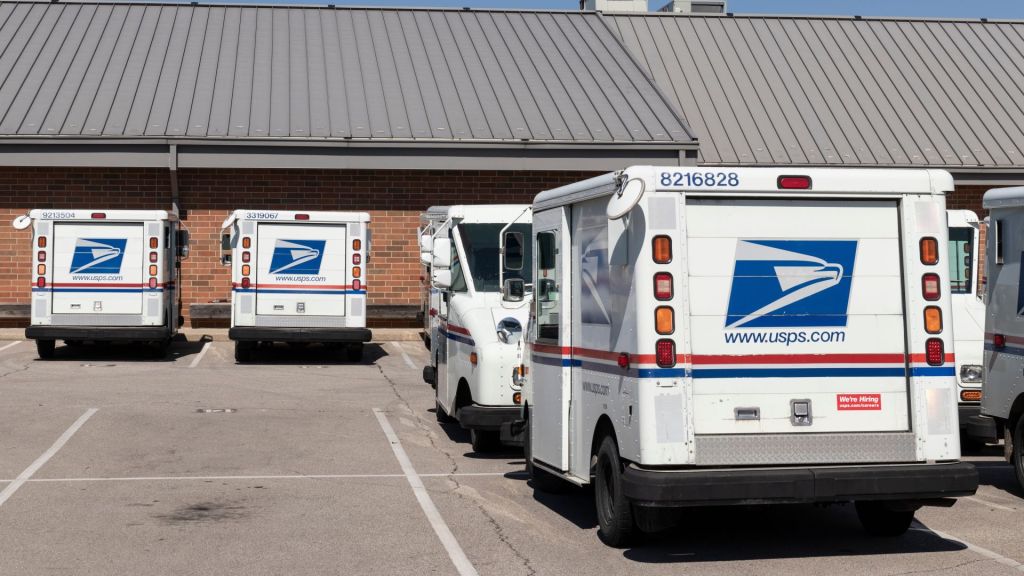
White U.S. Postal Service vans are parked at a local post office.

The U.S. Postal Service on Tuesday implemented the second phase of revised delivery standards intended to improve operational efficiency and reduce transportation costs.

The agency said it is expanding the areas where surface transportation schedules are reduced  from regional processing centers to post offices more than 50 miles away in an effort to eliminate inefficient trucking trips. 

The regional transportation optimization began April 1 with the addition of an extra day to expected delivery times for First-Class mail originating from remote post offices and zip codes. The Postal Service is also streamlining the network of regional processing centers. The aim is to better fill trucks by consolidating mail on fewer trips.

The Postal Service estimates the two initiatives will improve productivity and save $36 billion over 10 years in transportation, mail and package processing, and real estate costs. 

Other touted benefits include customers knowing service expectations for various products based on five-digit zip codes, where before service levels were mapped out by three digits, and allowing the Postal Service to provide two-to-three day turnaround service within a larger region. 

Meanwhile, Sundays and holidays are no longer counted in transit service measurement when accepted on the day prior. Previously, an item mailed on Saturday with a two-day service standard would be delivered on Monday. With Sunday no longer counted as a work day, a two-day delivery should reach its final address on Tuesday. 

The bottom line is that many rural residents will receive slower service.

Network overhaul

Historically, service standards and network development have revolved around letter mail. Over the last 30 years, single-piece First-Class mail has declined by more than 80% — from 57 billion pieces in 1997 to 11.7 billion pieces in fiscal year 2023. And pre-sort volumes from large customers have declined 22% over the same period to 33.2 billion.

At the same time, the Postal Service has seen parcel volumes triple to 6.7 billion pieces over a 10-year period ending in 2023, according to agency figures. 

With the sharp drop in mail density and rising parcel volumes, network costs skyrocketed from $7 billion in 2011 to more than $11 billion in 2021. That year the Postal Service launched its Delivering for America transformation strategy. The shift in volume mix has also generated costs in processing facilities and more wait time, with most processing concentrated during the evening hours after daily collections are completed.

The U.S. Postal Service in 2021 had 427 facilities, many of them operated by contractors or under short-term leases, functioning in an uncoordinated manner. Under the transformation agenda initiated by former Postmaster General Louis DeJoy, the agency is moving to standardize operations by downsizing the network to 250 facilities — 60 regional processing and distribution centers, and 190 local  processing centers that sort letters, flats and parcels for final-mile delivery. Critics say the reorganization has negatively affected service in recent years.

The U.S. Postal Service can’t make the network changes without the new service standards, explained Greg White, executive manager of strategic initiatives during a March webinar. The changes reduce local transportation costs by consolidating drop-off and pick-up activities in the morning for sites that are far from processing plants. 

Post offices within 50 miles of a regional processing center will continue to have mail dropped off in the morning, with the truck returning to the hub and then making another round-trip in the afternoon. For delivery units further away, the Postal Service is condensing the two round-trips into one morning trip to pick up volume from the previous day and bring it back to the plant.

Currently, trucks are only running 20% to 30% on backhauls to the plant from remote locations, said White. 

In addition to reducing transportation costs, the change spreads volume from the crowded night shift to the daytime, allowing the agency to better balance the workload, staffing, and equipment, and improve productivity. 

White said the agency will also enhance network speed. Currently, all the volume is committed to leave the processing plant each night, no matter the distance to the post office. That means a lot of volume arrives early and the plant has to wait for mail from the far-off offices before the next outbound trucks can be filled, much like an airline sometimes holds a plane waiting for a connecting flight to arrive at the airport. 

In Georgia, for example, the Howard and Newman post offices have the same service commitments despite being two hours and 20 minutes, respectively, from the Atlanta regional processing center. That means mail can’t be inducted into the network, for transport to places like Richmond, Virginia, until 6 a.m.

“As you’re waiting, you’re delaying 80% of your volume for 20% of your volume,” White said. “So what we are flipping to with the service center change is saying, ‘Take that 80% and go.’” 

The new process speeds up the middle mile by about four hours, as well as allowing for faster local routing. That translates to First-Class mail having a much greater two, three-and four-day reach, meaning plants can serve destination cities further away. Under the previous system, for example, plants had to be within three hours  of each other — say Norfolk and Richmond, Virginia or Washington, D.C. and Baltimore — to achieve two-day delivery. Now, the distribution center in Norfolk will be able to dispatch a truck to Baltimore, or other destinations within a seven-hour range, for second-day delivery. 

As part of the network restructuring, the Postal Service is also building a network that integrates mail and packages. In the past, many facilities only handled one product or the other. The organization is also collapsing redundant networks — for contract motor carriers, national distribution centers, retail outlets, Priority Mail Express — into one network that runs between regional processing and local processing centers. Streamlining benefits include aggregated volumes, reduced separations and handling, less downtime and improved truck utilization. 

The Postal Service has already exited about 30 terminal handling service locations, which connect shipments to airports and carriers like UPS, and 40 parcel support annexes on short-term leases, White said.

But the consolidation has not gone smoothly in many cases. On-time delivery, for example, plummeted at the Atlanta mega-facility because truck volume was more than it could handle, according to Georgia lawmakers and the agency’s oversight office.

Click here for more FreightWaves/American Shipper stories by Eric Kulisch.

Switch to UPS saved US Postal Service 43% in air transport costs

Postal Service to adjust delivery standards for network efficiency

FedEx navigates tariff swings to modest profit gain

FedEx retires a dozen freighter aircraft in efficiency move

This new LA-NY passenger train will carry long-haul trucks, too

AmeriStarRail, which for some time has been proposing privately owned and operated passenger service on the Northeast Corridor, has gone in a new direction with its latest proposal — literally and figuratively.

The company is now proposing a long-distance train that would offer coast-to-coast service in less than 72 hours between New York and Los Angeles — not just for passengers, but for truck drivers and their tractor-trailers. And it has asked Amtrak to partner in the effort, in a June 30, 2025, letter from AmeriStar Chief Operating Officer Scott Spencer to Amtrak President Roger Harris.

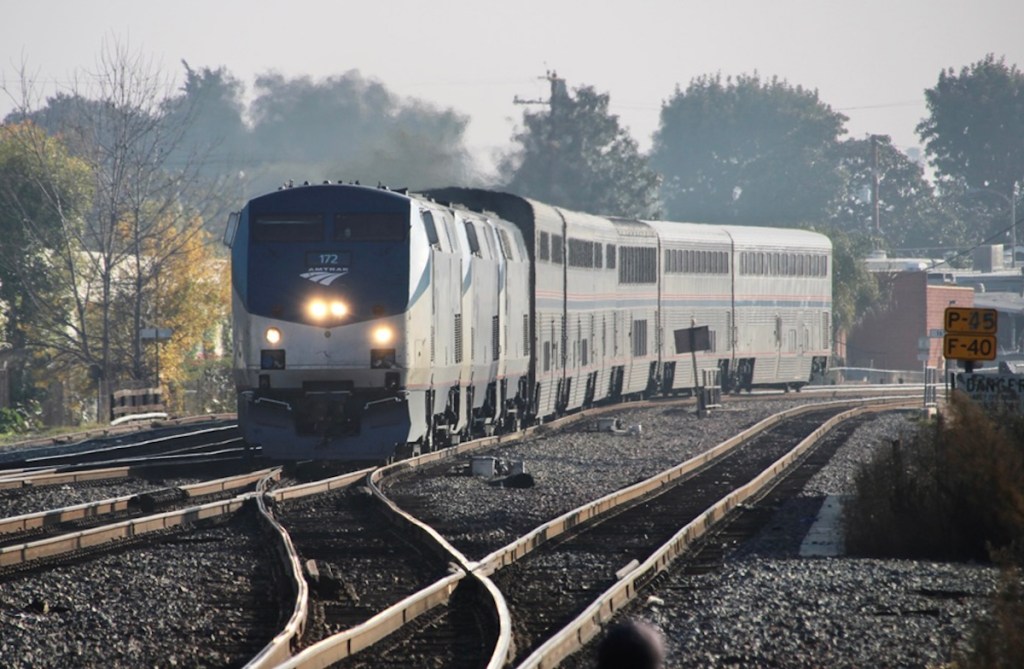
The “Transcontinental Chief” would include drive-aboard service for truckers, allowing them to make use of Amtrak coach, sleepers, and dining cars as they continue to travel during their federally-mandated rest periods. The train would also offer Auto Train-type service for passenger cars and vehicles, including charter buses, and include a Harrisburg, Pa.-Washington, D.C., section.

AmeriStarRail says that the train would replace Amtrak’s existing Southwest Chief and Pennsylvanian service. It would use existing TTX flatcars and vehicle carriers, along with Amtrak locomotives and passenger cars. Because of this, and because it would be on a route that is mostly double track, the company says the operation could begin as soon as May 10, 2026, in time for events marking the 250th anniversary of American independence. It notes that is subject to agreements with the host railroads on its proposed route: BNSF, Norfolk Southern, and NJ Transit.

ASR says in its letter to Harris that its “proprietary operating techniques will help prevent the chronic train delays and service disruptions of Amtrak’s previous inefficient operation of lengthy trains for mail and express services.” The company also says it will complete plans for bilevel trainsets by Oct. 1, 2025, “with features and amenities to ensure that Amtrak passengers will have the finest trains available for travel across America.”

Spencer’s letter concludes, “The Transcontinental Chief will be a great opportunity for Amtrak to team up with the private sector to confront the challenges of its money-losing long distance trains and create opportunities to usher in a profitable Golden Age of rail travel for passengers and truckers, with the ingenuity of free enterprise, as we celebrate our great nation’s 250th birthday next year.

“We look forward to putting together a mutually beneficial, privately funded proposal for The Transcontinental Chief for Amtrak to consider.”

Amtrak previously hauled parcel freight and mail on its passenger trains. This ended when it proved to be less than profitable, and drew complaints from freight railroads to regulators, as well.

Drive-on trains for truckers with sleeping car accommodations have existed in Europe for some time, although they are exclusively for intermodal, not a mixed freight and passenger operation. RAlpin, the company operating such trains through Switzerland, is preparing to shut down this year following the completion of new rail tunnels.

Amtrak declined to comment on the proposal, which AmeriStarRail said it had also sent to President Donald Trump, Transportation Secretary Sean Duffy, members of Congress, and the Federal Railroad Administration.

Subscribe to FreightWaves’ Rail e-newsletter and get the latest insights on rail freight right in your inbox.

Related coverage:

UK investor sees not one, but two, pathways to rail mergers

Drug busts at border ports in US, Canada top $31M; rail theft surging

Languish no more: STB clearing rail backlog

Rail could boost exports in new Port of LA pact

UK investor sees not one, but two, pathways to rail mergers

Talk of the next Class I rail merger is steadily moving beyond backroom chatter and into public conversations.

With only six Class I freight railroads remaining and stringent merger rules set by the Surface Transportation Board’s 2001 framework, the consensus largely held that the window for large-scale transactions was effectively closed. Any potential merger, under these rules, must not only demonstrably enhance competition but also clearly articulate public benefits, typically manifesting as improved service or gains for shippers. This high bar has historically kept serious engagement with the concept of consolidation at bay. However, this long-held view is beginning to undergo a significant transformation.

A recent surge of interest from a diverse array of investors, ranging from long-only funds to event-driven specialists, has prompted a fresh examination of the U.S. rail sector, said London-based analyst MKP Advisors, in a research note. This renewed engagement signals a potential shift in how market participants perceive the viability of rail mergers. Instead of merely relying on a strategic framework, the current analysis is focused on identifying combinations that could credibly be executed within the prevailing political and regulatory environment. While the fundamental logic for consolidation may exist, the thinking goes, its realization hinges on navigating a complex web of governmental oversight and stakeholder interests.

“There’s been speculation about eastern and western Class I railroads merging for years,” said Mike Baudendistel, head of intermodal solutions at FreightWaves and former vice president of equity research at Stifel Financial Corp. “My sense is that the CP-KCS deal was the last Class I merger. I understand that some might look at the STB and say that it’s more likely with [Patrick] Fuchs as chairman than it would have been under [previous chairman] Martin Oberman, but a potential merger would still have to meet very high standards including demonstrating that it would increase competition between the railroads.”

Structurally, MKP said, the rail industry remains one of the most consolidated and profitable segments within the broader transport sector. The six Class I carriers – Norfolk Southern (NYSE: NSC), CSX (NASDAQ: CSX), Canadian National Railway (CNR.TO), Canadian Pacific Kansas City (NYSE: CP), Union Pacific (NYSE: UNP), and BNSF Railway (owned by Berkshire Hathaway) – collectively control the entire long-haul network effectively as regional operating duopolies. 

The advisor noted that these carriers consistently achieve strong margins, typically in the mid-30% to low 40% range for pre-tax earnings, a testament to their entrenched market position. Yet, despite this profitability and strong competitive standing, the industry has grappled with flat volumes over the past decade. More critically, service performance has become an increasingly significant liability. Frustration among customers, particularly shippers, continues to mount, largely centered on poor on-time performance and limited visibility into freight movement, areas where trucking often presents a superior alternative. 

This growing dissatisfaction has shifted investor pressure from pursuing incremental margin improvements to demanding more fundamental, structural change within the industry. MKP framed large-scale M&A as the ultimate expression of such structural transformation.

The natural extension of this line of thinking regarding mergers is that only a select few pairings plausibly meet the rigorous threshold for approval. Its sector analysis points to two east-west combinations as possessing a viable path forward under existing rules: CSX-UP, and NS-BNSF. 

A lower-probability scenario involving a pairing of NS-UP also remains a possibility. Every other conceivable combination, it is argued, encounters insurmountable challenges, ranging from significant operational overlap to substantial political resistance or regulatory dead ends. This narrow set of potential outcomes highlights the demanding nature of the regulatory landscape and the specific criteria that must be met for a deal to even be considered.

Adding another layer of complexity and opportunity, the advisor pointed out, the broader policy environment is also undergoing a notable evolution. The post-pandemic emphasis on supply chain resilience, it argued, coupled with renewed federal attention to domestic manufacturing and infrastructure development, has created a more receptive atmosphere for consolidation discussions. Union Pacific Chief Executive Jim Vena, for instance, recently voiced support for potential east-west combinations, although other executives weren’t as optimistic.

Crucially, a second Trump administration is expected to lean into “American Champion” narratives, said the advisor, particularly where a transaction can be framed as directly supporting industrial growth and job creation. This political alignment is significant. Moreover, existing inefficiencies within the current rail system, such as freight handoffs through critical chokepoints like Chicago or St. Louis that can delay east-west movement by several days, could now be reframed as fixable bottlenecks rather than unavoidable friction. The creation of a truly end-to-end network, complete with unified dispatch, scheduling, and service, MKP claimed, would not only unlock substantial operating synergies but could also potentially meet the STB’s public-interest threshold, especially if shippers experience tangible and consistent reliability gains.

MKP pointed out how historical precedent and rigorous network analysis suggest large-scale rail consolidation could realistically unfold under current conditions. It examines why certain combinations may be more feasible than previously assumed, and outlines how a transaction would need to be meticulously structured and strategically positioned to garner the necessary support. 

This perspective is not solely based on theoretical models or geographical maps, but on insights gleaned from several months of direct engagement in Washington. It said this involved meetings with federal transportation regulators, policymakers actively shaping freight and infrastructure policy, congressional staff, industry executives, and seasoned journalists with decades of experience covering the rail sector. These conversations have provided a deeper understanding of how the STB is likely to evaluate a potential deal, which narratives are most likely to resonate politically, and where the primary focus lies for shippers and other key stakeholders. The result is a perspective grounded in first-hand insight from those closest to the regulatory process.

[FreightWaves did not take part in discussions with MKP.]

It now appears possible, the advisor said, that while the number of truly executable rail mergers remains extremely limited, it may no longer be zero. BNSF and Union Pacific maintain dominant positions in the west, while CSX and Norfolk Southern control the east. Canadian Pacific Kansas City and Canadian National Railway, meanwhile, remain cross-border players with more constrained domestic latitude. Only a small, select set of combinations offers the strategic complementarity, operational benefit, and political palatability required to secure regulatory approval.

[CPKC is struggling with operational issues on former KCS territory after an IT changeover that casts doubt on future mergers.]

For investors, MKP said the paramount challenge will not be merely identifying potential combinations with the greatest synergies; rather, it will be determining which combinations can realistically navigate the intricate political landscape in Washington with the requisite coalition of support.

No recent deal better illustrates the complex realities of rail M&A than the prolonged takeover saga involving Kansas City Southern. This case stands as the clearest modern blueprint for what it truly takes to complete a transaction and why regulatory strategy often significantly outweighs considerations of price. Future rail mergers, MKP said, must be strategically framed by seamlessly combining a compelling strategic logic with unimpeachable regulatory credibility, and critically, by learning from the STB’s decisive rejection of CN’s proposed trust framework for acquiring KCS that derailed the deal.

Similarly, CP’s earlier bid for NS in 2015 offers a stark illustration of what can go awry when regulatory and shareholder dynamics collide.

Despite multiple public offers with generous terms, NS rejected them all, citing valuation and regulatory uncertainty. CP’s use of a proposed voting trust, aimed at sidestepping delays, met resistance from NS, the STB, and even the Department of Justice. A proxy push followed, but pressure from regulators and lawmakers eventually forced CP to abandon the effort.

Activist campaigns, such as Mantle Ridge’s push at CSX in 2017, while relatively rare, proved highly effective as E. Hunter Harrison’s Precision Scheduled Railroading changed the industry’s operational dynamics.

Two viable pathways for approval

MKP said its research revealed two primary pathways for large-scale rail mergers to receive approval under current conditions.

  1. Gaining executive branch support through policy alignment: Proponents must align the transaction with the current administration’s policy and economic priorities. This involves clearly demonstrating how combining eastern and western networks would reduce inefficiencies, increase freight capacity, enhance reliability, and stimulate investment in domestic infrastructure. Positioning a merger as a driver of national industrial competitiveness and supply chain modernization, the advisor said, could garner support from the White House. The current second Trump administration is expected to favor “American Champion” narratives, particularly if a transaction supports industrial growth and job creation.
  2. Securing Surface Transportation Board approval via flexible interpretation of merger guidelines: The STB, the economic rail regulator, would need to apply a contemporary interpretation of its 2001 merger guidelines. These rules, designed for a different industry landscape, have never been tested in their current form. The standard requiring “pro-competitive” outcomes is flexible and could be interpreted to reflect the present-day industry structure and performance. The current STB leadership under Chairman Patrick Fuchs, said MKP, is positioned to apply these guidelines pragmatically, rather than as rigid constraints.

While shipper opposition is anticipated, and concerns about consolidation will persist among various political constituencies including coal, utilities, labor, agriculture, oil, and chemicals, the competitive landscape in most regions would largely remain unchanged. A unified network, said MKP, could improve east-west freight flows, reduce handoff delays, and strengthen scheduling integrity, preserving sufficient competition in core corridors.

There is limited concern from labor constituencies regarding M&A, the advisor claimed, either due to expectations of long-term network/volume expansion or because STB rules mandate six years of employment protection under Class I merger provisions. Resistance is more likely from white-collar redundancies in administrative and headquarters functions, which is unlikely to concern the White House.

To address competitive concerns, particularly from shippers, the STB may consider remedies like reciprocal switching or limited open-access obligations. These approaches, though historically resisted, have precedent, such as CP’s proposal of open access in its attempt to acquire NS. Regulatory models internationally, like Canada’s Maximum Revenue Entitlement (MRE) for grain shipments, demonstrate that targeted pricing constraints can coexist with private ownership and operational autonomy, reinforcing that competitive safeguards can be implemented without undermining the rationale for consolidation.

Potential merger combinations

  • CSX-UP: Widely considered the most logical and likely pairing, this merger would connect CSX’s Eastern U.S. network with UP’s expansive Western footprint, potentially enabling a more integrated transcontinental corridor for intermodal and bulk freight. Operational efficiencies could include reduced interchange delays and improved coast-to-coast service reliability. However, it would likely face close scrutiny from antitrust regulators, particularly regarding its impact on interline competition in key gateway markets such as Chicago and St. Louis, and potential effects on smaller railroads and terminal operators.
  • CSX-BNSF: This merger would form a broad national network linking the Pacific Northwest and California to the Northeast and Southeast, potentially enhancing port-to-port connectivity and strengthening presence in key intermodal corridors. While operationally compelling, the combined network would likely intersect at major interchange hubs Chicago and St. Louis, raising questions about routing flexibility and concentration. The STB may also scrutinize its effects on agricultural exporters and short line railroads in the central U.S.

Potential NS combinations

  • NSC-BNSF: Considered the most likely response if UP initiates a merger, with BNSF partnering with the unaligned eastern railroad. This combination would bring together key coal and intermodal corridors, creating direct service between Wyoming’s Powder River Basin and the Southeast. The strategic rationale focuses on merging BNSF’s Western network strengths with NS’s automotive and port-focused operations in the East. While offering operational synergies, the STB would likely examine potential reductions in routing flexibility through joint interchanges, especially in Memphis and Kansas City, and implications for competition in coal and grain shipping routes.
  • NS-UP: This merger would grant UP direct access to the Southeast, a fast-growing U.S. freight market, while extending NS’s intermodal reach into the West. The operational rationale appears strong, with the potential for improved network integration. However, overlap in key corridors (e.g., Chicago to Houston) may prompt regulatory review regarding impacts on routing flexibility between the Midwest and Gulf coast. Areas of scrutiny could include service bottlenecks, rail competition in Texas, and how vertical integration might affect access at major intermodal hubs.

Subscribe to FreightWaves’ Rail e-newsletter and get the latest insights on rail freight right in your inbox.

Find more articles by Stuart Chirls here.

Related coverage:

Languish no more: STB clearing rail backlog

Rail could boost exports in new Port of LA pact

Bill aims to level playing field for railroad workers

New partners connect rail camera network with telematics visibility

All divisions of Del Monte Foods file for chapter 11 bankruptcy

Updated Jul. 2 @ 12:30 pm

Uber Freight, listed as an unsecured creditor of Del Monte in its filing, responded to the news with a statement from a company representative.

“Del Monte has been a valued customer of Uber Freight for many years. We are proud to serve a critical role to Del Monte’s business and remain committed to supporting them through this court-supervised restructuring process. While the filing includes pre-petition balances, we’re confident those obligations will be addressed appropriately through the bankruptcy process. As a critical vendor of Del Monte, we are confident we will receive full payment for services rendered, and we remain focused on delivering uninterrupted support as a trusted, long-term logistics partner.”

Original Story:

Del Monte Foods Corporation has filed for Chapter 11 bankruptcy, listing more than $1 billion in liabilities and over 10,000 creditors. The case, filed in the U.S. District of New Jersey, ranks among the largest food shipper bankruptcies in recent years, given the company’s national footprint and brand portfolio.

A Legacy Brand with National Reach

Del Monte Foods reported $1.7 billion in U.S. revenue for fiscal year 2024. Its brand portfolio includes household names such as Del Monte canned fruits and vegetables, Contadina tomato products, College Inn broths, Joyba bubble tea, Kitchen Basics stocks, and S&W beans. These products are sold nationally through grocery, mass retail, and club channels.

Freight, Warehousing, and Pallet Vendors Owed Millions

Uber Freight (listed as Transplace, a company that Uber Freight acquired, in the filing) was listed as the second-largest unsecured creditor, owed over $9 million for managed transportation and freight brokerage services. Saddle Creek Logistics is owed $1.3 million for warehousing support, while CHEP USA has $470,000 in exposure tied to pooled pallet services.

Under Chapter 11, these pre-bankruptcy amounts are classified as unsecured claims, placing them behind secured lenders and administrative expenses in repayment priority. There is no guarantee of full recovery, and outcomes typically depend on asset sales or court-approved reorganization plans.

Possibility for Payment on Post-Filing Services

While pre-petition balances remain at risk, logistics providers may be able to negotiate repayment for services rendered after the filing. These post-petition services—such as transportation, warehousing, or pallet pooling—may be granted administrative expense priority if approved by the court and funded under Del Monte’s debtor-in-possession (DIP) budget.

DIP Financing Secured, Asset Sales on the Table

Del Monte has secured $912.5 million in DIP financing, split between a term loan and an asset-based lending facility. The financing is led by Wilmington Savings Fund Society and JPMorgan Chase Bank.

The company’s board has authorized the potential sale of “all or substantially all” of its assets, indicating that major brands or business units could be sold as part of the reorganization. Logistics contracts may be assumed, renegotiated, or terminated depending on how buyers choose to operate.

Logistics Providers in a Transitional Position

In Chapter 11 cases, transportation and warehousing vendors often continue playing a vital operational role while navigating uncertainty over unpaid balances. Post-filing services can be paid on a priority basis, but terms are typically subject to court oversight and tighter credit conditions.