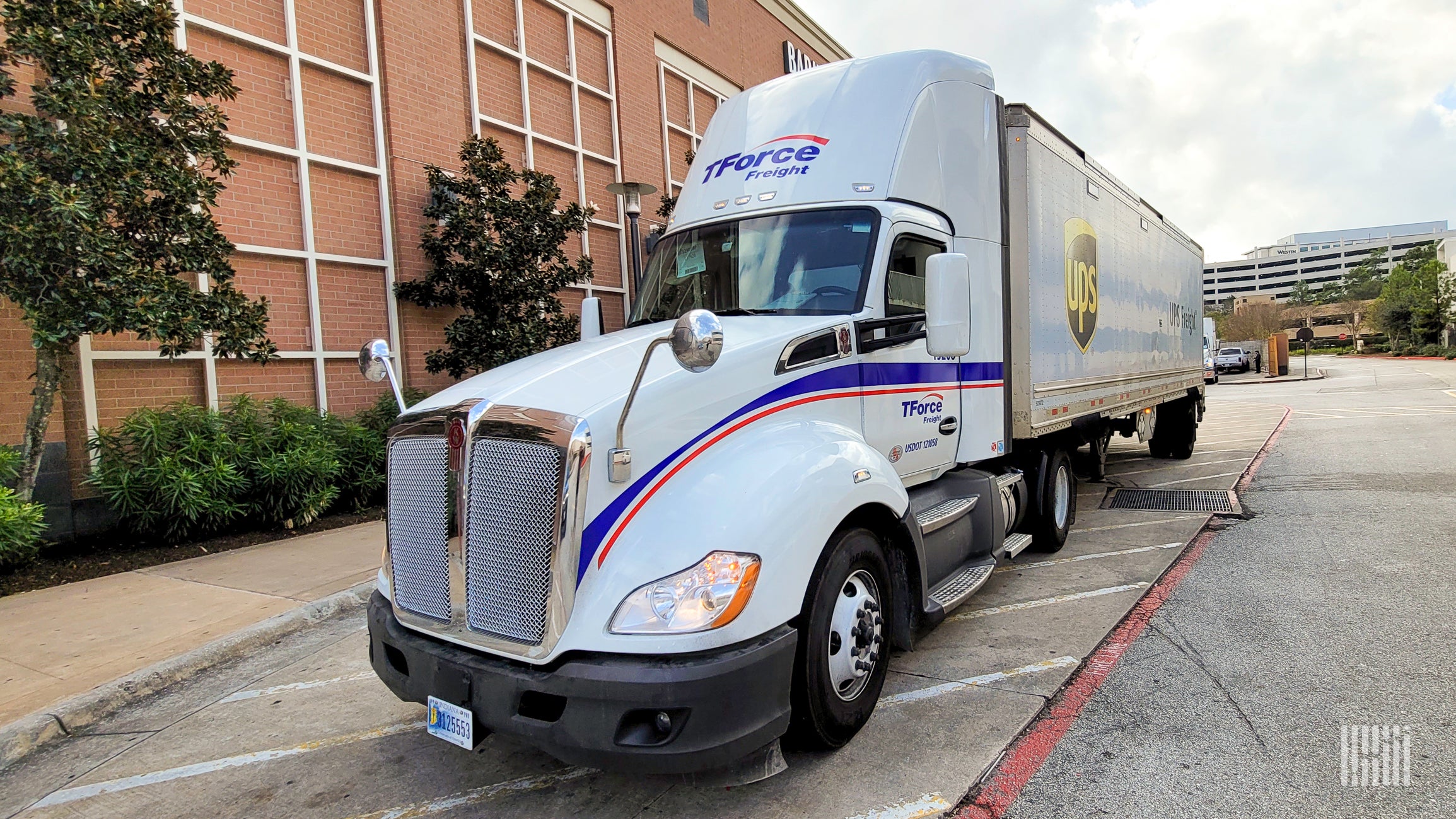
TFI International saw an increase in operating income, it reported in its second-quarter results after market close Thursday. The increase is due to acquisitions, offsetting weaker market conditions. This suggests that the company’s acquisition strategy is successful in expanding its business and generating revenue.
Despite the positive contributions from acquisitions, TFI International also faced weaker market conditions in Q2 2024. This resulted in a slight decrease in net income compared to the same period last year. This indicates that the overall market environment may be challenging for the transportation industry.
Net income declined compared to the same period last year, but adjusted net income and earnings per share increased. The company generated substantial cash from operations and free cash flow, allowing for debt repayment.
Overall, TFI International’s Q2 2024 performance demonstrates the company’s ability to navigate a complex market environment. While acquisitions provided a boost, weaker market conditions posed some challenges.
Paris Olympics will be a true test of supply chains
The views expressed here are solely those of the author and do not necessarily represent the views of FreightWaves or its affiliates.
The opening ceremony for the Summer Olympics in Paris takes place Friday. Thousands of athletes and millions of visitors will spend part of their summer in France to attend the 2024 Games. The past few years, supply chains have looked like an Olympic marathon or sometimes even like a 3,000-meter steeplechase race lined with obstacles.
Besides the complexity of organizing such a massive gathering with 329 events across 32 sports over just 16 days, the 2024 Olympics are expected to significantly impact global supply chains, both positively and negatively. On the one hand, the event is forecast to boost demand for various goods and services, leading to increased production and transportation activities. On the other hand, the influx of people and goods into France will put a strain on existing infrastructure and logistics networks, potentially leading to disruptions and delays.
The Olympics have already created and will continue to create a surge in demand for various products and services, including construction materials, food and beverages, hospitality services, and sporting goods. This increased demand can stimulate economic activity and create opportunities for businesses in the supply chain. The preparation for the Olympics has involved significant investments in infrastructure. Seven billion euros in private funding was invested in long-term infrastructure projects such as transportation networks, stadiums and accommodations. These investments will lead to long-term improvements in logistics capabilities and overall economic development in Paris.
But there are also many challenges and disruptions, as already witnessed by many tourists who are just visiting Paris in the days ahead of the Games. The influx of people and goods into France for the Olympics will lead to congestion at ports and airports and on roads, causing delays and disruptions in the movement of goods. This affects the timely delivery of essential supplies and equipment for the event. Working closely with the Organizing Committee of the Paris 2024 Games since February 2023, CMA-CGM Group and its subsidiary Ceva Logistics are offering a full range of logistics transport solutions for the event. The partnership includes freight services, international transport of goods, customs clearance, storage, delivery, site logistics, special freight and IT systems integration.
Major events like the Olympics often face security threats, which can necessitate heightened security measures and additional checks. This can lead to delays in customs clearance and transportation, impacting overall supply chain efficiency.
The environmental impact of large-scale events like the Olympics is a growing concern as well. Increased transportation activities and waste generation can contribute to carbon emissions and other environmental issues. The organizers of the Olympics plan to power the events’ operations with 100% renewable energy from wind and solar. They are using existing venues, when possible, had new ones built with low-carbon concrete and recycled materials, and brought in thousands of seats made of recycled plastic. This focus on sustainability goes back to 1996, and in 2012, the London Olympics pioneered a new international certification standard, ISO2012, which provides guidelines for any large event to make more sustainable choices, from construction to catering. All furniture and temporary buildings approved for the Games also must have a contractually guaranteed second life, rather than going into a landfill. Further, the Paralympics, which will run from Aug. 28 to Sept. 8, will use the same venues and housing.
Upfront planning and the use of technology can help companies offset the challenges and disruptions caused by such a large event. Proactive planning and coordination with suppliers, carriers and other stakeholders can help identify potential bottlenecks and develop contingency plans. Utilizing advanced technologies like AI, machine learning and real-time tracking can enhance visibility, optimize routes and improve overall supply chain efficiency. Reducing reliance on single suppliers and diversifying supply sources can mitigate the impact of disruptions in specific regions or industries. Implementing sustainable logistics practices, such as optimizing routes, using low-emission vehicles and reducing waste, can help minimize the environmental impact of the event.
The 2024 Olympics present a unique challenge for global supply chains. By anticipating and proactively addressing these challenges, organizers and logistics providers can ensure the smooth and successful execution of the event while minimizing disruptions to the global supply network. But don’t let that keep you from watching the Summer Olympics together with over 1 billion people around the world, and let’s cheer for the U.S. team.
About the author
Bart De Muynck is an industry thought leader with over 30 years of supply chain and logistics experience. He has worked for major international companies, including EY, GE Capital, Penske Logistics and PepsiCo, as well as several tech companies. He also spent eight years as a vice president of research at Gartner and, most recently, served as chief industry officer at project44. He is a member of the Forbes Technology Council and CSCMP’s Executive Inner Circle.
California Supreme Court upholds AB5 exemption for gig workers
Uber and Lyft drivers in California will continue to be protected from the state’s AB5 independent contractor classification law following a decision by the state’s Supreme Court. The ruling possibly ends a legal battle that has gone on almost since November 2020 when California voters approved Proposition 22, creating the gig drivers’ exemption.
In a unanimous decision, the California Supreme Court ruled that the workers’ compensation provision of Prop 22 were not illegal and the gig driver exemption could remain law. The issues in the case were complex, relating to whether the workers’ comp provision in Prop 22 were illegally enacted given other laws that appeared to give full authority over workers’ compensation to the State Legislature.
Prop 22 established that gig drivers such as those who work for Uber (NYSE: UBER) and Lyft (NASDAQ: LYFT) were not covered by the state’s workers’ compensation laws. But as the court recounted, the plaintiffs who brought the lawsuit against Prop 22, which includes the Service Employees International Union, argued that the workers’ compensation provision in Prop 22 “conflicts with … the California Constitution, which vests the Legislature ‘with plenary power, unlimited by any provision of this Constitution, to create, and enforce a complete system of workers’ compensation, by appropriate legislation.’”
In March 2023, the Court of Appeals for the 1st Appellate District reversed part of the August 2021 decision that Prop 22 was unconstitutional, citing the issues regarding workers’ comp. The case was then appealed to the Supreme Court, which handed down its ruling Thursday.
The initiative power in California, which is what was used in the Election Day 2020 vote that approved Prop 22, includes “the power to abrogate existing [laws],” the court said, citing an earlier precedent. “Accordingly, the people may alter existing workers’ compensation policy without running afoul of article XIV, section 4.”
The Supreme Court agreed with a lower court ruling that the law “does not … limit the legislature’s power to enact workers’ compensation laws.”
AB5, enacted in 2019, establishes legal definitions of when a worker can be considered an employee or when the worker is legitimately an independent contractor.
ABC test is the core of AB5
It has at its heart the ABC test, a three-pronged guideline that says a worker can be considered independent if:
The worker is free from the control and direction of the hiring entity in connection with the performance of the work, both under the contract for the performance of the work and in fact.
The worker performs work that is outside the usual course of the hiring entity’s business.
The worker is customarily engaged in an independently established trade, occupation or business of the same nature as that involved in the work performed.
The B prong has proved particularly problematic for independent owner-operator truck drivers and gig drivers, since the entities they provide their services for are transportation companies and they are providing transportation while being classified as independent. No exemption from AB5 has been granted to independent owner operators.
In a prepared statement, the Uber- and Lyft-based group Protect App Based Drivers + Services called the decision “an overwhelming victory for voters’ rights and the integrity of our state’s initiative system.”
The statement, quoting spokeswoman Molly Weedn, said the decision is “not just a win for the nearly 1.4 million drivers who rely on the flexibility of app-based work to make ends meet, but for millions of consumers and thousands of businesses who rely on app-based services across the state. The courts have spoken, and this issue can finally be put to rest.”
What Prop 22 does say about workers’ comp
Prop 22 did call for some degree of compensation for injuries or illnesses on the job, according to a blog post by the law firm of Boxer & Gerson before the 2020 vote.
In the post signed by Julius Young, the law firm said Prop 22 “provides that the companies must maintain occupational accident insurance to cover medical expenses and lost income ‘resulting from injuries while the app-based driver is online with a network company’s online-enabled application or platform.’”
But Young added that the proposition did not define what constitutes injuries.
He also noted the limits of the coverage specified in Prop 22. “Prop 22 would require occupational insurance cover medical expenses incurred only up to one million dollars,” Young wrote. “While this might seem like a big number, in catastrophic injury claims medical bills can sometimes exceed one million dollars. If a worker has a long hospitalization, multiple surgeries, a long period of rehabilitation, and followup care over a period of years, bills can be astronomical.”
Young summed up his post by noting he was voting against Prop 22.
The Prop 22 case put the state of California in the odd position of defending an action meant to limit AB5 while at the same time defending AB5 in the still-ongoing California Trucking Association case against the law. But the state’s position is to defend the people, who had voted on Election Day 2020 in favor of Prop 22, which had been backed and financially supported by Uber and Lyft.
OMAHA, Neb. – Union Pacific’s profits rose in the second quarter despite a sharp drop in coal traffic.
“When you remove coal, our total volume was up 3% in the second quarter. This demonstrates that even in a tough freight environment, we are winning with our customers to bring new business to the railroad,” CEO Jim Vena said on the company’s earnings call on Thursday morning.
Quarterly operating income increased 9%, to $2.4 billion, as revenue grew 1%, to $6 billion. Earnings per share rose 7%, to $2.74. UP’s operating ratio improved 3 points, to 60%.
“Despite a challenging environment, we achieved strong financial results in the quarter,” Vena says. “We continue to drive efficiency into the network, and the commercial team has done a good job generating price for the value we provide our customers.”
Overall, UP’s volume for the quarter was flat compared to a year ago. Bulk traffic declined 5%, due to a 23% drop on coal traffic as natural gas prices remained low and utility coal stockpiles remained elevated. Industrial products volume declined 3%. Premium traffic – which includes intermodal and automotive – was up 6% due to a combination of international and domestic intermodal growth and landing new auto contracts from Volkswagen and General Motors.
UP slightly downgraded its outlook for the rest of the year. The railroad now said its volume expectations are uncertain based on economic indicators and weak coal demand. Previously UP expected muted traffic volumes this year.
The railroad’s key operational metrics held steady despite the impact of flooding in both its southern and northern regions.
“Our service was challenged in the quarter, but I’m pleased with our ability to recover,” Vena says.
Freight car velocity was flat at 201 car miles per day. The manifest and automotive service performance index was flat at 84%. But the intermodal service performance index rose 4 points to 93%.
UP’s locomotive and workforce productivity metrics improved for the quarter. UP set an average train length record for the quarter, at 9,544 feet, which included a highest ever monthly figure above 9,600 feet in June, says Eric Gehringer, executive vice president of operations.
Gehringer praised UP’s maintenance of way teams for quickly rebuilding flooded track, repairing bridges, and clearing trees in the wake of storms that hit the railroad this spring.
“Operating outdoors these past three months has not been easy,” Vena says.
The railroad’s derailment and personal injury rates both improved during the quarter, but UP did not provide specifics.
Union Pacific’s earnings presentation is available online. https://investor.unionpacific.com/static-files/666cca98-8779-48df-8e53-adc443e1a7ae
Embrace the suck – Taking the Hire Road
Karen Smerchek, President of Veriha Trucking, joined Jeremy Reymer on the latest episode of Taking the Hire Road to discuss how carriers can embrace the current operating environment and improve the lives of both truck drivers and trucking industry personnel.
Smerchek was raised working for Veriha, founded and owned by her father, and returned once she graduated from college. “I wasn’t sure what I wanted to do, but you don’t always have good opportunities like that, so I thought I should at least come back to try it,” she said.
Eventually, Smerchek would become the owner of the company, and now she’s proud to be president and owner of one of the few women-owned businesses in the trucking industry.
As she prepared to become the owner of Veriha Trucking, Smerchek attended Truckload Carriers Association (TCA) conferences and seminars to further her education. “They offered educational packages about transferring family-owned businesses and other specifics that I couldn’t get at college,” she said. “It was so refreshing to actually find real-world value.”
While Smerchek initially viewed TCA through an educational lens, she learned that the activist and networking components were just as impactful, if not moreso. Starting with the upcoming term, Smerchek will serve as the chair of the TCA advocacy and advisory committee and hopes to continue the legacy that guided her. “I grew up in this industry alongside TCA, and so getting to serve as the next chair is just giving back to the industry that educated me,” she said.
Political involvement, benchmarking standards and especially networking are all vital for everyone in the transportation industry. Smerchek says that associations like the TCA help carriers leverage trucking industry involvement and community for the benefit of the entire industry.
“There are some conferences that seem like they might not be relevant for me, but when I go, I come back with way more useful information that I could have hoped for just from the conversations I have with fellow professionals during the social moments of conferences,” Smerchek explained. “You can learn so much from people with experience,” she said.
Likewise, forming relationships with mutual trust across the industry is invaluable, according to Smerchek. “Having those relationships means you can lean on each other when you are struggling with a problem,” she added.
In difficult times like today’s freight market, Smerchek says that those networks can help companies survive, along with careful planning and risk mitigation. “Veriha has been able to survive for 45 years precisely because we planned ahead with good business partnerships and diversification, but it’s hard for the people who have only been in this industry for five years,” she said.
Her mantra through the difficult times is to “Embrace the suck.” “I have to encourage my colleagues who haven’t been with me long because they haven’t ever gotten to see the fun side of trucking,” Smerchek added. “Even though we’re dealing with a hard time, I know that a better day is coming.”
According to Smerchek, the fact that trucking was thriving for a time meant that many people and companies were attracted to the industry who are now seeing that there may not be success for them when the margins are slimmer. “As long as you’re appropriately planning from a cash flow, customer and diversification standpoint, hopefully you’ll endure through this season.”
Covenant Logistics sees possible truckload market rebound in 2025
Covenant Logistics Group sees improvement in the overall freight market but not enough for a 2024 recovery, according to Chairman and CEO David Parker.
Chattanooga, Tennessee-based Covenant (NASDAQ: CVLG) reported second-quarter earnings after the market closed Wednesday. Company officials held a conference call to discuss the results with analysts on Thursday.
“I think things have bottomed out, and I do think that it’s all because of the capacity that has left that we’ve all been figuring out how long it’s going to take in the last two years for capacity to leave,” Parker said. “But I have a feeling that until more capacity leaves, I think that what we’re seeing today is kind of where we’re going to be for the next few months.”
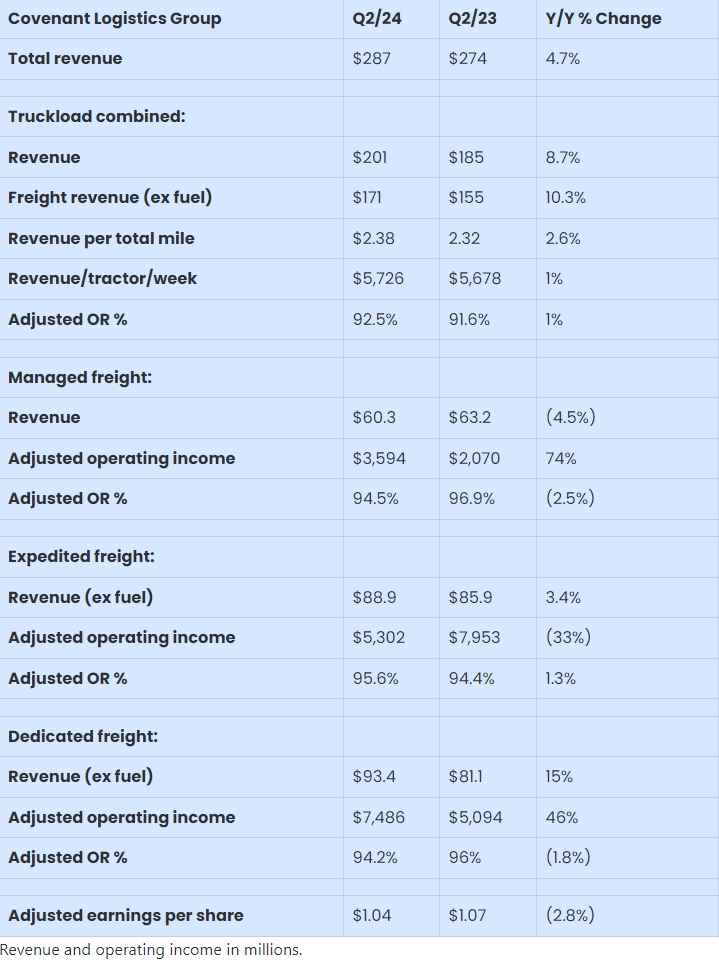
Covenant reported revenue of $287.5 million in the second quarter, an increase of 4.7% year over year.
The company posted adjusted second-quarter earnings of $1.04 cents per share, a 2.8% decrease compared to the same year-ago period.
Parker noted Covenant has seen several rate increases over the past few weeks, something that had not occurred in almost two years.
“We actually have customers that are at least open and willing to have discussions about our costs and those kinds of things. Those are events that have not happened in the last two years, that are starting to happen now,” Parker said. “We don’t have the momentum yet to go full pledge to say rollout rate increases all over to every customer, but we’re looking at that, and the ones that are not performing well are the ones that we’re going to have talks with.”
Covenant’s second-quarter freight revenue, excluding fuel charges, increased 5.3% year over year to $256.5 million, and adjusted operating income increased 15% year over year to $18.7 million.
“The increase in freight revenue was primarily derived from growth in average tractor counts within our asset-based truckload segments consisting of expedited and dedicated,” Tripp Grant, executive vice president, said. “The growth in adjusted operating income was principally derived from our asset-based dedicated segment in both of our asset-light segments, managed freight and warehousing.”
Covenant’s average freight revenue per tractor per week in the second quarter increased about 1% year over year to $5,726, while average freight revenue per total mile increased 2.6% to $2.38. Average miles per tractor per period decreased 0.5% year over year to 20,667.
The company’s number of weighted tractors during the quarter increased 11% year over year to 1,384.
“Regarding our outlook for the future as we head into the third quarter of the year, we believe freight fundamentals are continuing to improve through excess carrier capacity slowly exiting the market with unsustainable conditions, absent an outside catalyst to facilitate improved demand,” Paul Bunn, president and chief operating officer, said. “We remain optimistic about our business model, as evidenced by the durability and growth of our core operations over the last 12 months. In the third quarter, we believe we have the momentum necessary to produce sequential operating income growth throughout the year.”
Heartland Q2 earnings: Nowhere to go but up
Heartland Q2 earnings: Nowhere to go but up
(Table: Heartland Express/FreightWaves)
Heartland Express recently released its Q2 earnings, which saw a net loss of $3.5 million. FreightWaves’ Todd Maiden writes, “This was Heartland’s fourth consecutive quarterly net loss when excluding one-time gains from the sale of real estate. It booked $25.6 million in gains from the sale of three terminals in the fourth quarter, which are viewed as nonrecurring benefits.”
Mike Gerdin, CEO of Heartland Express, wrote in the release, “Our consolidated operating results for the three and six months ended June 30, 2024, reflect the combination of an extended and significant period of weak freight demand, driven by excess capacity in the industry and ongoing operating cost inflation.”
Like bad fast food, Heartland’s purchase of Smith Transport and Contract Freighters Inc. (CFI) may still be causing indigestion. Viewing Heartland’s balance sheet, it appears the company used its cash to pay down the debt and financing associated with buying Smith and CFI. “Debt and financing lease obligations of $237.2 million remain at June 30, 2024, down from the initial $447.3 million borrowings less associated fees for the CFI acquisition in August 2022 and $46.8 million debt and finance lease obligations assumed from the Smith acquisition in May 2022,” said the release.
Paying off debt also leaves less money for capex. Heartland isn’t upgrading its fleet as quickly: Average tractor and trailer age crept up from 2.1 years on June 30, 2023, to 2.6 years as of June 30, 2024. Average trailer age rose from 6.1 years to 6.9 years during that same period.
For Heartland, there’s nowhere to go but up for its operating ratio, a common measure that truckload execs use to measure profitability. Maiden adds, “Heartland’s adjusted operating ratio (expenses as a percentage of revenue) was 99.4% in the quarter, 600 basis points worse y/y but well below the nearly 106% level the carrier operated at in the previous two quarters.”
Marten Transport Q2: Dedicated gets less dedicated
(Source: Marten Transport)
Marten Transport recently released its Q2 earnings, which saw a notable deterioration in both OR and its dedicated business. Management’s pushback on rate concessions and refusal to take rate cuts appear to have impacted its dedicated segment, which saw double-digit declines, more than its truckload segment, which saw low-single-digit declines.
Q2 dedicated revenue fell 22.9% compared to Q2 2023, from $87.4 million to $67.4 million, before a fuel surcharge was added. Compared to truckload, its OR remains favorable, falling only 53 basis points y/y from 86.5% in Q2 2023 to 91.8% in Q2 2024, not including a fuel surcharge. Adding a fuel surcharge saw a slight change from 83.8% to 90.1% during the same period.
Marten’s truckload segment, which management said was “heavily pressured by the freight market recession’s oversupply and weak demand,” fared worse. FreightWaves’ John Kingston writes, “And yet the truckload segment net of fuel surcharges produced an operating ratio of 98.8% compared to 90.6% in the second quarter of 2023. That’s because despite the fact that miles driven increased slightly, revenue net of fuel in truckload dropped to $96 million from $101.3 million a year ago. Average revenue per tractor per week net of fuel declined to $4,093 from $4,472 a year ago.”
There were some positives from the earnings release. Executive Chairman Randolph L. Marten said, “We are seeing increased interest by our customers to secure dedicated capacity and have recently added new multi-year dedicated programs for an additional 133 drivers starting in the third quarter.” Marten reiterated his previous statement that the company has not agreed to rate reductions since last August.
Market update: For-Hire Trucking Index moves closer to balance
On Thursday, ACT Research released its July For-Hire Trucking Index data, which saw the balance between truckload supply and demand narrowing for June. Looking at the index, a value above 50 indicates expansion, while a value below 50 is a contraction. The volume index fell 5.5 points from May’s 54.4 points to 48.9 points in June. While volumes are not great, the report notes that it’s not as bad as June 2023’s reading of 42.8. Carter Vieth, research analyst at ACT Research, said in the release, “Even with consumers under strain, real US retail sales are up 1.8% ytd, and further disinflation helps support our outlook on real income growth. Additionally, intermodal and import volumes are trending positive, which minimally adds to overall surface freight volumes.”
Truckload capacity is nearing equilibrium, up 3.6 points from 45.6 in May to 49.3 in June. Vieth added, “Though the index increased m/m, this month’s For-Hire Supply Demand Balance June 2024 reading marks the 12th month in a row capacity has been below 50, the longest streak of decline since the inception of the survey in late 2009. Fleet capacity contractions occurring at a slower rate suggest the supply-demand balance between the fleet and freight is narrowing.”
Lower revenues and rates continue to impact fleet purchasing decisions, with 32.5% of respondents in June saying they plan to buy equipment in the next three months, below the historical average of 55.3%. The report notes that once rates improve, ACT expects an improvement in purchasing sentiment.
FreightWaves SONAR spotlight: Summer freight doldrums mute July Fourth rally
(Source: FreightWaves SONAR)
Summary: The rally in dry van spot market rates that led up to the Fourth of July holiday appears to have abated, according to recent data from the FreightWaves National Truckload Index, 7-Day Average. NTI continued its stairstep declines following the first week of July, falling 3 cents per mile all-in week over week from $2.35 on July 15 to $2.32. Month over month, spot rates are only 1 cent per mile higher than the $2.31 reported on June 23. The declines in spot market pricing power also extended into the contract space, which saw dry van outbound tender rejection rates fall 48 basis points w/w from 5.21% on July 15 to 4.73%.
The dry van segment was not the only equipment type to see declines following July Fourth. The flatbed and reefer segments fell as well. Reefer spot rates are down 3 cents per mile all-in w/w from $2.64 on July 15 to $2.61. Reefer outbound tender rejection rates dipped below 8%, falling 54 bps w/w from 8.5% to 7.96%.
The return of seasonality has been especially unkind to flatbed contract pricing power, with flatbed outbound tender rejection rates falling to low single digits, 4.91%, which is more similar to 2020’s reading of 5.47% than last year’s reading of 13.73%. A bright spot despite the contract rate declines was the slight uptick in flatbed spot market rates. FTI increased 3 cents per mile w/w from $2.72 to $2.75.
Like the content? Subscribe to the newsletter here.
FMCSA kicks 4 ELDs off registered list
The Federal Motor Carrier Safety Administration has kicked four ELDs off the agency’s registry due to the companies’ failure to meet the minimum requirements.
The agency announced Tuesday that ELDs from CTE-LOG ELD, ELD VOLT, Powertrucks ELD and TFM ELD were placed on the revoked devices list. Motor carriers should stop using those devices.
Motor carriers have up to 60 days to replace the revoked ELDs with compliant ones. They are encouraged by the FMCSA to use paper logs or logging software in the interim.
Beginning Sept. 21, those using the revoked ELDs will be considered as operating without an ELD and can face citations and be placed out of service. Safety officials are encouraged not to cite drivers until then.
The ELDs can be placed back on the registered device list if the companies correct identified deficiencies, the agency said.
The FMCSA did not immediately respond to an inquiry from FreightWaves about the noncompliant devices.
Temperature-controlled logistics real estate investment trust Lineage Inc. said nearly 57 million shares of its common stock were priced at $78 per share ahead of its initial public offering on Thursday. The deal will haul in roughly $4.4 billion in proceeds, better than the $3.4 billion to $3.9 billion range previously expected.
A 30-day option for a 15% allotment (a little more than 8.5 million shares) has been granted to underwriters. The company said it will use proceeds to repay debt, fund cash grants to certain employees and pay transaction expenses. Any additional proceeds will be used for general corporate expenses or to repay other outstanding debt.
The Novi, Michigan-based cold storage warehouse operator is backed by private equity firm Bay Grove. Since its 2008 inception, Lineage had raised more than $13 billion in capital prior to the IPO. The transaction will value the company at approximately $19 billion.
Lineage manages 482 locations with 3 billion cubic feet of space across North America, Europe and the Asia-Pacific region. It also provides freight forwarding, customs brokerage, drayage and truck transportation.
For the 12 months ended March 31, it generated $5.3 billion in revenue, $1.8 billion in net operating income and $1.3 billion in adjusted earnings before interest, taxes, depreciation and amortization.
The deal was originally expected to include 47 million shares with a customary 15% option, but demand drove the need for the increase in deal size. The initial price range was $70 to $82 per share.
Morgan Stanley, Goldman Sachs, BofA Securities, J.P. Morgan and Wells Fargo were listed as lead book-runners on the deal, which included a total of 28 investment banks.
Shares of Lineage debuted on the Nasdaq under the ticker “LINE” on Thursday at $82 per share.
Truckload carrier Pam Transportation Services reported a net loss for the 2024 second quarter but noted some seasonal improvement as the period progressed.
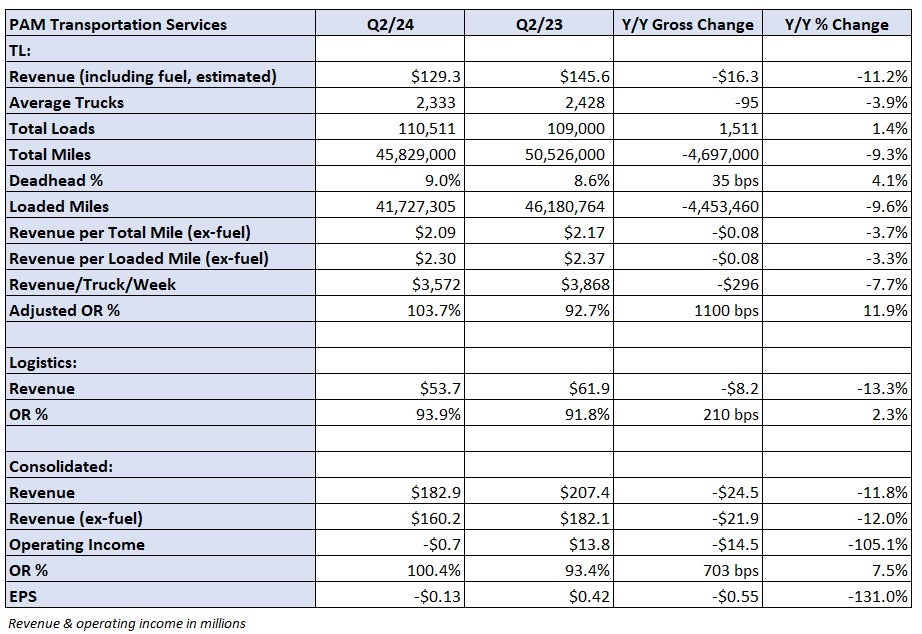
Pam (NASDAQ: PTSI) reported a net loss of 13 cents per share, which was worse than a lone analyst estimate of 8 cents and well below earnings per share of 42 cents in the year-ago quarter. Comparisons to the prior-year period show higher interest expense was a 4-cent headwind (total debt increased 16% year over year to $266 million) and lower gains on equity holdings were a 3-cent headwind, assuming a normalized tax rate.
Consolidated revenue fell 12% year over year to $183 million. The company recorded an operating loss of $705,000, the third straight quarter it has booked a loss on the operating line.
Revenue in the TL segment fell 11% y/y as average trucks in service declined 4% and revenue per truck was down 8%. The decline in revenue per truck per week was due to a 6% decline in loaded miles per truck and a 3% decline in revenue per loaded mile (excluding fuel).
“The quarter started off slower than anticipated but began to show signs of seasonal demand patterns that were more consistent with pre-covid periods and we saw capacity tightening some as we moved towards the end of the quarter,” said President Joe Vitiritto in a news release. “We continue to see downward rate pressure, but we are also seeing some opportunities that tell us we may be getting closer to a cycle change.”
Consolidated expenses declined 5% y/y but revenue was off 12%. Rent and purchased transportation expense increased 310 basis points (as a percentage of revenue), with depreciation expense increasing 260 bps. Salaries, wages and benefits expense was 90 bps higher y/y.
“Our continued focus on cost and efficiency measures helps us to mitigate the current unfavorable freight market as well as positioning us to meet our longer-term mid-80’s operating ratio expectation,” Vitiritto said.
Pam’s logistics segment reported a 13% y/y decline in revenue to $54 million. The company doesn’t provide gross profit margins for the unit or operating metrics like load counts and revenue per load.
The segment recorded a 93.9% OR, which was 210 bps worse y/y but in line with the first quarter.
Shares of PTSI were down 3.5% at 10:54 a.m. EDT on Thursday compared to the S&P 500, which was up 0.2%.