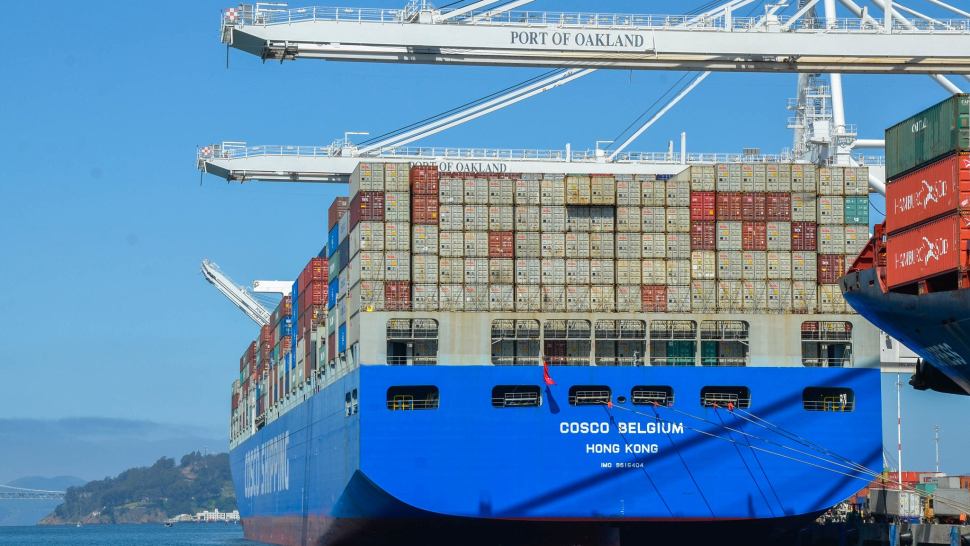
In a major retaliatory move against China, the United States is proposing expensive charges that could add millions of dollars in costs for ocean container lines and other carriers calling U.S. ports.
The proposal by the office of the United States Trade Representative (USTR), published Friday in the Federal Register, sets fees as high as $1.5 million per U.S. port call for ships built in China and $500,000 for a vessel operator with even a single Chinese-built ship in its fleet, or on order with a China shipyard.
A charge of $1 million per call would be assessed on China-based vessel operators including Cosco, the world’s fourth-largest container line.
The plan will send tremors through the maritime supply chain serving the world’s largest market, where major ocean carriers operate in a complex network of cooperation ranging from service routes to berthing arrangements and sharing of vessels. Carriers will likely pass on the expensive new fees to shippers in the form of surcharges and higher rates, who in turn will pass them on as higher prices for imported goods.
The proposal, which also includes new preference rules calling for U.S. export cargo to be transported by U.S.-flagged and crewed ships, follows the results of a USTR investigation in January that found China is leveraging unfair trade practices to dominate the global ocean shipping and shipbuilding markets.
The decision to implement the charges rests with President Trump. Comments on the plan will be accepted through March 24, when the USTR has scheduled a public hearing.
About 17% of the container vessels calling U.S. ports are Chinese-made, according to analysts Linerlytica. That comes to 1.29 million of the total 28.2 million TEUs (twenty foot equivalent units) imported by the U.S. in 2024.
Find more articles by Stuart Chirls here.
Related coverage:
Tariff fears help Port of Long Beach containers to best start on record
No sure thing? ILA head tells rank and file contract vote an ‘obstacle’ to overcome
While supply chain frets, Port of Los Angeles sees record January volume
Federal Maritime Commission dropping DEI from strategic plan
Brokerage Compliance Symposium
The day before F3. Every compliance issue you face - fraud exposure, carrier liability, FMCSA rules, cargo theft, insurance gaps - navigated by attorneys and operators defining best practices in a changing industry.
F3 Awards Dinner
The night before F3. FreightTech100 companies honored. FreightTech 25 and Shipper of Choice winners revealed live. Cocktail reception into dinner and live music - 300 industry leaders in one purpose-built room.
F3: Future of Freight Festival
Industry-defining keynotes, rapid-fire technology demos, and industry leaders networking in experiences across Chattanooga - plus the inaugural F3 Awards Dinner featuring the FreightTech and Shipper of Choice reveals.
The day before F3. Every compliance issue you face - fraud exposure, carrier liability, FMCSA rules, cargo theft, insurance gaps - navigated by attorneys and operators defining best practices in a changing industry.
The Signal at Chattanooga Choo Choo • Chattanooga, TN Register NowThe night before F3. FreightTech100 companies honored. FreightTech 25 and Shipper of Choice winners revealed live. Cocktail reception into dinner and live music - 300 industry leaders in one purpose-built room.
The Signal at Chattanooga Choo Choo • Chattanooga, TN Register NowIndustry-defining keynotes, rapid-fire technology demos, and industry leaders networking in experiences across Chattanooga - plus the inaugural F3 Awards Dinner featuring the FreightTech and Shipper of Choice reveals.
The Signal at Chattanooga Choo Choo • Chattanooga, TN Register Now