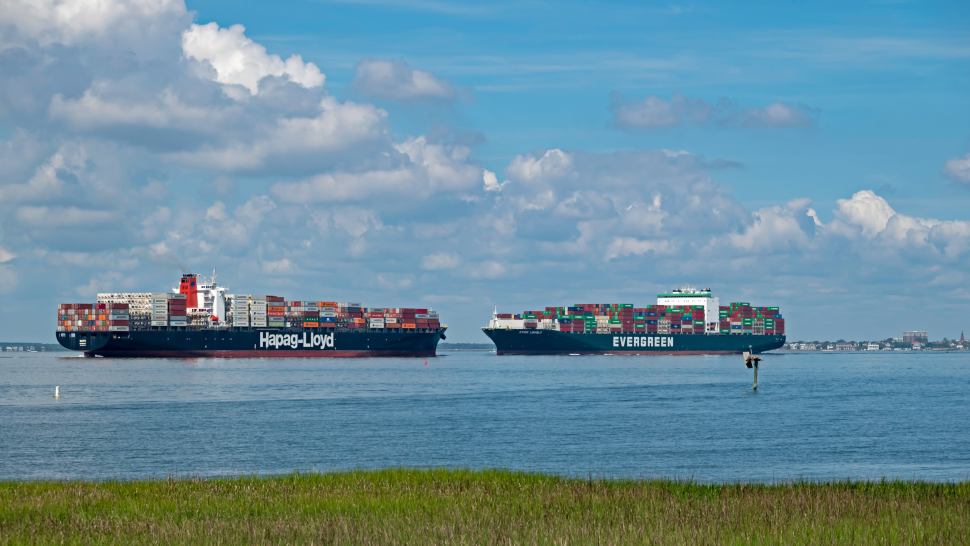
There were 64 container ships waiting off East and Gulf Coast ports on Wednesday morning — and it looks like it’s about to get worse.
The number of liner services calling from Asia will surge to a new record high in the coming months. More cargo is diverting away from the Pacific gateway in Los Angeles/Long Beach, where the ship queue has fallen to 42.
The potential result: escalating vessel backlogs along the East Coast and deteriorating service for importers.
Deployments surge
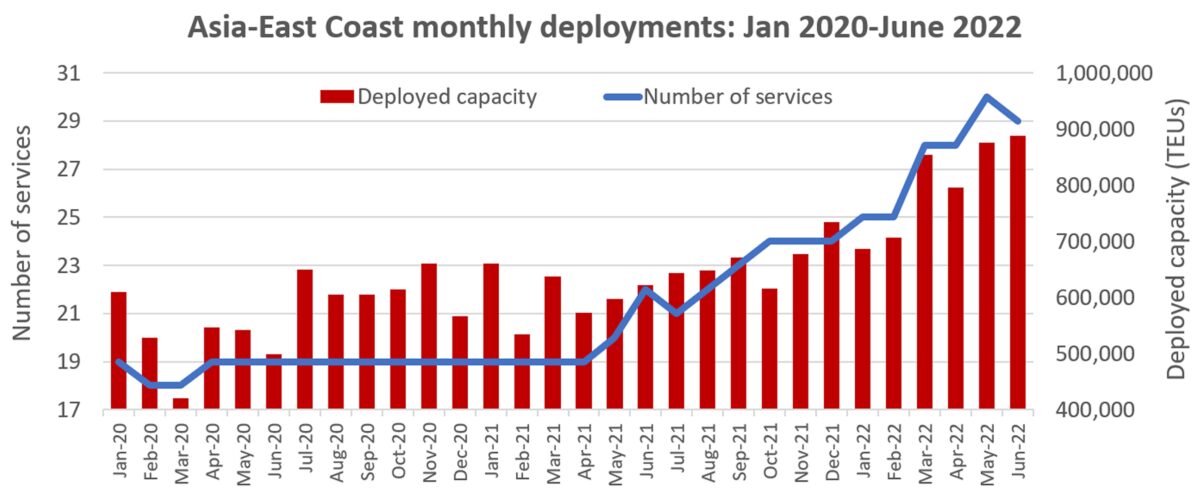
The number of Asia-East Coast services per month was steady at around 19 in 2020. It rose through last year to 24 in December, then jumped 28 this month with 30 planned in May, according to new data provided to American Shipper by eeSea.
Deployed capacity of services is projected to reach 889,000 twenty-foot equivalent units in the month of June. That’s up 40% from the 2021 full-year average and up 56% from the 2020 average.
Ship size decreasing
One of the challenges faced by Los Angeles and Long Beach during the 2021 peak season was that carriers deployed more smaller ships, both in regular services and as “extra loaders.” For ports, it’s more efficient to unload 10,000 TEUs from one 10,000-TEU ship than from two 5,000-TEU ships.
The average ship in Asia-East Coast service had capacity of 9,390 TEUs in both 2020 and 2021, according to eeSea data. In January-June 2022, it’s down 7% to 8,699 TEUs.
The trans-Atlantic trade may drive average ship size even lower. Most carriers have suspended service to and from Russia in the wake of Russia’s invasion of Ukraine. The smaller ships that served Russia are now being redeployed to new services, including the Europe-East Coast route.
Consultancy Alphaliner said this week: “Vessels that have become redundant in the Baltic trade are more than welcome on trans-Atlantic routes, where several carriers have already organized sailings outside of their alliances.”
Vessels shifted from Russian service to extra-loader service in the trans-Atlantic include the 3,005-TEU MSC Shannon and the 2,400-TEU Lisbon Express, said Alphaliner, which now counts 13 extra loaders operating in the trans-Atlantic, many under 4,000 TEUs in capacity.
Drivers of coastal shift
The McCown Report, released Thursday, highlighted what’s driving the faster growth of East/Gulf Coast ports compared to West Coast ports.
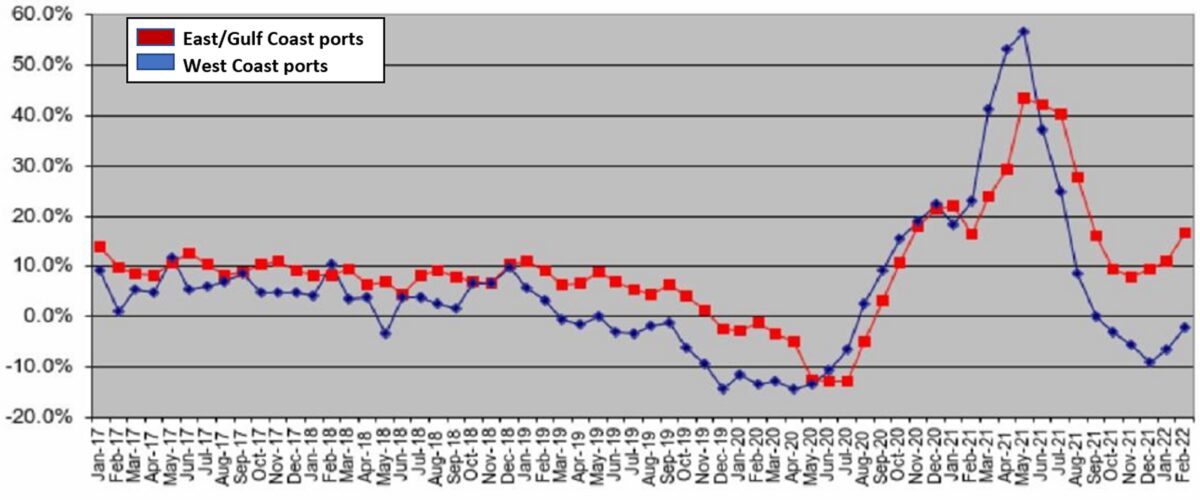
February volumes at East/Gulf Coast ports rose 27.3% year on year compared to 5.9% growth for West Coast ports, according to McCown. It was the ninth straight month that East/Gulf Coast ports outpaced year-on-year growth of West Coast ports.
McCown cited three reasons for East/Gulf Coast outperformance. The “initial pandemic volume surge disproportionately benefited the West Coast ports” so they have tougher year-on-year comps. “Shippers have elected to change routing decisions” and switch to East/Gulf ports due to highly publicized West Coast congestion. And a secular shift continues to favor East/Gulf Coast ports due to their proximity to a great concentration of the U.S. population.
McCown calculated the three-month trailing average of year-on-year volume changes for East/Gulf Coast ports versus West Coast ports. These numbers show that East/Gulf Coast ports were growing faster than West Coast ports pre-COVID; the West Coast jumped far ahead in the first half of last year, then fell back behind in the second half as congestion limited throughput; and East/Gulf Coast ports have widened their growth-pace lead in 2022.
Performance threat
With more ships en route, smaller average ship size and vessel queues already near record highs, the question ahead for East/Gulf Coast ports is: Will they ultimately fall victim to their own success in wooing cargo away from the West Coast? As delays lengthen, East Coast throughput growth could face more of the congestion headwinds that beset Los Angeles/Long Beach.
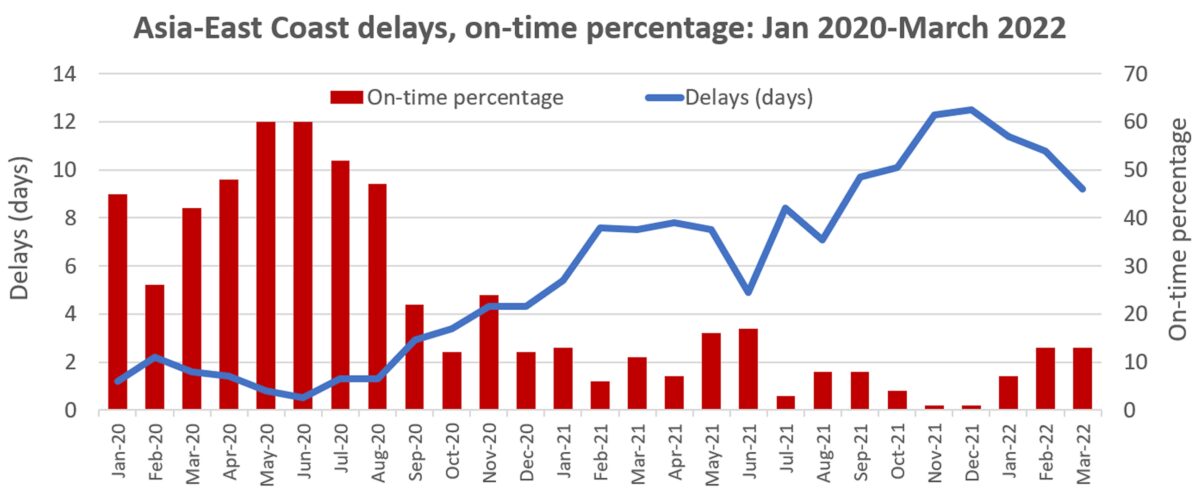
There has already been a big slide in East Coast performance indicators. According to eeSea, Asia-East Coast services were delayed an average of 2.1 days in 2020, while in the first three months of 2022, delays averaged 9.3 days. In full-year 2020, on-time performance averaged 37.5%; it was down to 9.3% in the first three months of this year.
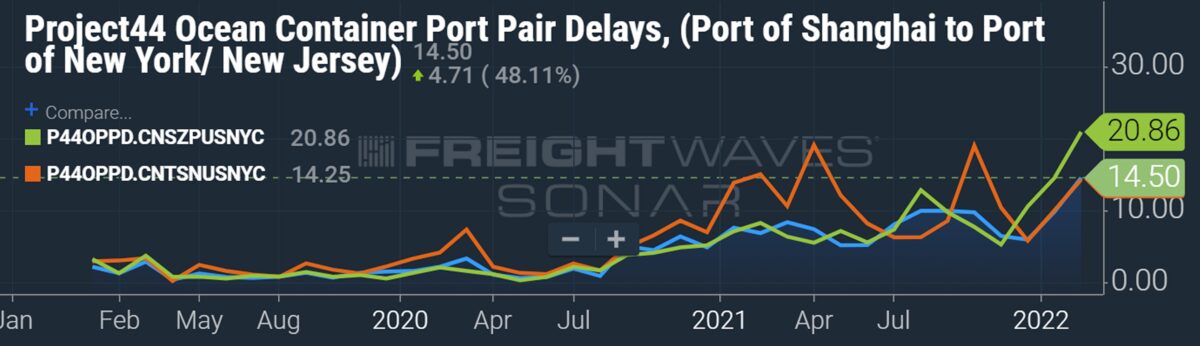
Data from project44 shows the same worsening performance trend. Delays in arrival times for services from China to New York/New Jersey are increasing, with services from Shenzhen delayed an average of 20.9 days in February, services from Shanghai 14.5 days and from Tianjin 14.3 days. In the case of Shanghai and Shenzhen, delays are up by over 100% year on year.
Click for more articles by Greg Miller
Related articles:
- Is this the calm before California ports’ next cargo storm?
- What China COVID spike, massive lockdowns mean to shipping
- Just how extreme is China’s lead in the container port business?
- How invasion of Ukraine could ease shipping logjam off US ports
- Supply chain whack-a-mole: West Coast eases, East Coast worsens
- Glimmer of hope: Has the ship gridlock off ports finally peaked?
Brokerage Compliance Symposium
The day before F3. Every compliance issue you face - fraud exposure, carrier liability, FMCSA rules, cargo theft, insurance gaps - navigated by attorneys and operators defining best practices in a changing industry.
F3 Awards Dinner
The night before F3. FreightTech100 companies honored. FreightTech 25 and Shipper of Choice winners revealed live. Cocktail reception into dinner and live music - 300 industry leaders in one purpose-built room.
F3: Future of Freight Festival
Industry-defining keynotes, rapid-fire technology demos, and industry leaders networking in experiences across Chattanooga - plus the inaugural F3 Awards Dinner featuring the FreightTech and Shipper of Choice reveals.
The day before F3. Every compliance issue you face - fraud exposure, carrier liability, FMCSA rules, cargo theft, insurance gaps - navigated by attorneys and operators defining best practices in a changing industry.
The Signal at Chattanooga Choo Choo • Chattanooga, TN Register NowThe night before F3. FreightTech100 companies honored. FreightTech 25 and Shipper of Choice winners revealed live. Cocktail reception into dinner and live music - 300 industry leaders in one purpose-built room.
The Signal at Chattanooga Choo Choo • Chattanooga, TN Register NowIndustry-defining keynotes, rapid-fire technology demos, and industry leaders networking in experiences across Chattanooga - plus the inaugural F3 Awards Dinner featuring the FreightTech and Shipper of Choice reveals.
The Signal at Chattanooga Choo Choo • Chattanooga, TN Register Now