Borderlands Mexico: Renegotiating USMCA may boost North American trade
Borderlands Mexico is a weekly rundown of developments in the world of United States-Mexico cross-border trucking and trade. This week: Renegotiating USMCA may boost North American trade; Automotive supplier opens manufacturing facility in Guanajuato; Humanscale expands manufacturing operations in Nogales; and New import cold storage facility slated for Texas border city.
Renegotiating USMCA may boost North American trade
The United States-Mexico-Canada Agreement will mark its fifth anniversary on July 1.
The importance of the USMCA cannot be overstated as it governs trade between the U.S. and its two most significant trading partners, supporting over $1.5 trillion in annual commerce.
Since taking office for his second term, President Donald Trump has indicated a desire to renegotiate or possibly terminate the USMCA, after previously touting the agreement as a significant economic achievement.
The USMCA faces a critical juncture as it approaches its first six-year review in 2026, though negotiations are already underway. Mexican senior officials have been making regular visits to Washington since early 2023.
Jorge Gonzalez Henrichsen, CEO of The Nearshore Co., said accelerating renegotiations of the USMCA may bring much-needed certainty to investors.
“What makes me the most happy about it being revised earlier … is that it will bring certainty, because the Trump administration has created such a level of uncertainty that investment really froze from November [2024] to April [2025] companies that were thinking of going to Mexico,” Henrichsen told FreightWaves in an interview.
He said while it’s unclear what the Trump administration will do with the USMCA, the trade agreement has been a success in terms of creating more commerce among the three countries.
Mexico was the top U.S. trade partner for the second consecutive year in 2024, totaling a record-breaking $840 billion.
Canada ranked No. 2 for trade with the U.S. in 2024 at $761 billion, and China ranked third at $582 billion.
The Nearshore Co., based in Brownsville, Texas, is an international trade and development firm that helps companies set up shelter operations in Mexico.
“The North American Free Trade Agreement (NAFTA) was signed in 1994, and the USMCA was 2020, so after 26 years, the economy changed a lot, and I do think that moving from NAFTA to USMCA was positive,” Henrichsen said. “I think for everyone, it was positive.”
One of the biggest changes from NAFTA to the USMCA involved automotive content rules.
Under NAFTA, regional automobile content requirements stood at 62.5%, but USMCA raised this threshold to 75% with new wage requirements. It meant that 75% of the vehicle’s parts must be sourced from the U.S., Canada or Mexico, or all three.
“One of the drivers for nearshoring to Mexico during COVID was that a lot of these automotive suppliers and original equipment manufacturers were from Asia,” Henrichsen said. “So you had these OEMs saying, ‘I have to move from 62.5% to 75%. You have got to relocate to North America.’ It was basically driven by that change, to comply with the local concept.”
Labor rights provisions in Mexico were substantially strengthened in USMCA, driving labor reforms in the country that aimed to improve worker protections.
“One of the other big changes between USMCA and NAFTA is the labor rights. We had a new labor reform, and now we have unions that are more democratic,” he said.
The USMCA also introduced entirely new elements that were not part of NAFTA, including provisions on digital trade and e-commerce and a dispute resolution mechanism, Henrichsen noted.
While he views the USMCA as a positive change from NAFTA, there is still room for improving the agreement, Henrichsen said.
“One of the things that I would like to see discussed is how the three countries can deepen the supply chain resilience and the North American competitiveness as a trade bloc,” Henrichsen said. “I would say the No. 1 driver by far of companies that reach out to us is that they cannot find labor at competitive costs and in large numbers in the U.S. So they’re looking to Mexico to find this labor.”
While Mexico may have lower labor costs than the U.S. and Canada, it still faces challenges with infrastructure and security. If the U.S., Mexico and Canada can work together as a trade bloc, then all three countries could benefit, Henrichsen said.
“Mexico has big challenges on infrastructure, for example … power, electricity generation and transmission. And so why don’t we work as a team,” Henrichsen said. “Like Mexico says, ‘Guys, we can provide labor in Mexico for U.S. companies, for Canadian companies. But, we need support … for infrastructure, bridges to cross to the U.S.’ All that kind of nearshoring supply chain thinking as a bloc … is on my wish list.”
Automotive supplier opens manufacturing facility in Guanajuato
With an investment of $50 million, China-based TYW Manufacturing recently opened a plant in Irapuato, Mexico.
The facility will generate about 500 jobs and manufacture electronic dashboards for Kia and Stellantis targeting markets in South Korea and the U.S., according to a news release.
Irapuato is in central Mexico in the state of Guanajuato, a hub for automotive manufacturing in the country.
TYW Manufacturing is a subsidiary of Heilongjiang TYW Electronics, a company based in Suihua, China, according to Mexico Business News.
Humanscale expands manufacturing operations in Nogales
New York-based Humanscale recently completed a $30 million expansion of its operation in Nogales, Mexico.
The expansion creates 300 jobs and adds a 3,000-square-foot facility that will produce metal components – work previously performed in Asia.
Humanscale is a high-end office furniture manufacturer. The company has four factories, including in the U.S., Ireland and Mexico.
The company has been in Nogales since 2017. The Mexican city is directly across the border from Nogales, Arizona.
New import cold storage facility slated for Texas border city
Public officials and business leaders recently held a groundbreaking to inaugurate construction of a fresh produce cold storage warehouse along the Texas-Mexico border.
Known as the “From Mexico Cold Storage Warehouse,” the facility will feature 10 high-efficiency loading docks and temperature-controlled storage rooms. It will be designed to support growing demand in cross-border produce distribution,” according to a news release.
“This new facility will bring innovation, efficiency, and opportunity to our produce district, and we are proud to welcome From Mexico as a valued partner to our thriving city as we continue to invest in cold storage infrastructure,” Victor Perez, president and CEO of the Pharr Economic Development Corp., said in a statement.
Officials did not provide a timeline for the facility’s construction.
The Pharr-Reynosa International Bridge handles over 65% of the nation’s fresh produce imports from Mexico, contributing to more than $47 billion in annual trade.
Chart of the Week: Outbound Tender Reject Index, National Truckload Index (linehaul only) – USA SONAR: OTRI.USA, NTIL.USA
The truckload market remains poised for a breakout, but the timeline appears to be extending. Analyzing the trend line of tender rejections (OTRI) and spot rates excluding fuel (NTIL) over the past two years reveals a clear upward trajectory with increasing volatility. However, this trend flattened in the first five months of the year, as economic uncertainty continues to dampen demand.
The trucking sector is enduring one of its longest and most challenging economic stretches since deregulation. Truckload demand is currently down approximately 30% from its COVID-era peaks. While those peak levels were never sustainable, they lasted long enough to inflate capacity far beyond what the market required.
Slow capacity correction
From June 2020 to October 2022, the number of active truckload operating authorities grew by roughly 48%. Since then, they have declined by only about 12%. Federal Motor Carrier Safety Administration data is slow to reflect these changes, as it can take up to two years to clear inactive authorities unless operators self-report their exit. Carrier Details helps refine this timeline to around a year, but it still lags. Importantly, one authority can represent a single truck or a fleet of a thousand, so this metric isn’t evenly distributed.
Tender rejections serve as a reliable proxy for market balance. Carriers are unlikely to reject freight in soft markets unless they have alternatives, so rising rejection rates indicate tightening capacity and strained networks.
Capacity has been in correction mode for years and seemed close to reaching equilibrium late last year. Over the holidays, the OTRI exceeded 10% for the first time since 2021. This occurred even as shippers increasingly turned to intermodal for longer hauls, taking advantage of early inventory pull-forwards that gave them more flexibility in shipping.
The trade war effect
The ongoing trade war has further fueled the inventory pull-forward phenomenon. After briefly cooling in late April and early May, tariff activity resumed, sending mixed signals and triggering repeated shifts in shipping behavior.
Import bookings data shows a surge in container volumes bound for the U.S. last summer, followed by erratic swings. Container imports can be a useful demand proxy, but they often give false signals during periods of uncertainty — something that has plagued shippers since COVID.
Import demand remains relatively high, but much of the freight is precautionary. With trade policy and consumer spending still in question, a significant portion of freight is sitting idle in warehouses rather than moving on trucks.
Economic headwinds
The economy seems to be stalling, if not slowing outright, as business investment weakens. This protracted trade policy uncertainty is unprecedented, leaving businesses without a playbook.
Hiring has slowed, and layoffs are rising. Initial jobless claims have increased since January after declining through the latter half of 2024. While aggregate figures remain historically healthy, the trend is concerning. If the labor market continues to deteriorate, consumer spending could contract further. Combined with persistent inflation and reduced investment, these factors suggest a stagnating economy.
A shift in market balance
The fact that rejection rates have stayed above 6% since International Roadcheck in mid-May — despite underwhelming demand — should be seen as a positive signal for carriers and 3PLs. Demand conditions are actually weaker than in mid-2023, when excess inventory caused order slowdowns and pushed OTRI below 3%.
This suggests a meaningful amount of capacity has exited the market, with more likely to follow as demand remains soft. While the outlook isn’t bright for all stakeholders, it does indicate that the imbalance between truck supply and freight demand has narrowed.
Shippers should take note: The market is primed for a sharp reaction if macroeconomic conditions improve. Even if they don’t, transportation is likely to become more challenging going forward, even if not dramatically so.
About the Chart of the Week
The FreightWaves Chart of the Week is a chart selection from SONAR that provides an interesting data point to describe the state of the freight markets. A chart is chosen from thousands of potential charts on SONAR to help participants visualize the freight market in real time. Each week a Market Expert will post a chart, along with commentary, live on the front page. After that, the Chart of the Week will be archived on FreightWaves.com for future reference.
SONAR aggregates data from hundreds of sources, presenting the data in charts and maps and providing commentary on what freight market experts want to know about the industry in real time.
The FreightWaves data science and product teams are releasing new datasets each week and enhancing the client experience.
Rates, Rejections and Red Tape – Reading the Market Before It Moves
Still Foggy at the Top – What the New Logistics Report Means for the Rest of Us
For all the hope around trucking bouncing back, the new CSCMP “State of Logistics Report” just affirmed what most small carriers already feel: Things are still off. Freight isn’t booming, costs haven’t come down, and the people at the top are still “navigating the fog” — while small fleets are stuck in it with no GPS.
Here’s what matters from the Council of Supply Chain Management Professionals report and what you need to take away from it now:
Logistics Costs Are Still High
Based on the report, the industry spent $2.6 trillion on logistics last year. That’s 8.7% of GDP — the same as before — even though volumes didn’t really grow. That means it’s still expensive to move freight, and the system isn’t getting more efficient. If you’re feeling like you’re paying more just to stay in the same place, you’re not imagining it.
Rates Are Stuck Because Capacity Won’t Budge
The report admits it: The market is still oversupplied. And that’s why rates are dragging. Tender rejections barely moved in 2024-2025, and although they’ve ticked up a little recently, it’s not enough to quite call it a turnaround. The market isn’t tight — it’s still crowded. That means brokers are still low-balling and big fleets still have the majority of contract freight.
Tariffs Are Back in the Picture
New tariffs are going to hit certain equipment categories, and it’s already adding more cost pressure. If you’re thinking about adding trucks or trailers, you’ll want to time that decision carefully. Prices could move again. It’s not just about freight anymore — now you have to game out the geopolitical stuff, too.
Sustainability Mandates Are Creeping In
One of the quietest parts of the report is also one of the loudest signals for the future. While Europe is charging full-speed ahead on zero-emissions freight, the U.S. is still stuck in a patchwork of state-by-state rules. That uncertainty means carriers are going to be the test dummies again — dealing with new equipment costs and unclear enforcement.
So What Should Small Carriers Do?
Get real with your costs: Don’t expect market rates to do the work for you. Use your breakeven number as your anchor — if a load pays under it, walk away. Control what you can control!
Avoid overextending: The report shows volatility isn’t going anywhere. Be cautious with debt and expansion right now. Grow where you have control — better broker/shipper relationships, better lanes, better driver performance.
Watch for real capacity shifts: The freight market won’t move until capacity really bleeds off. We’re not there yet. Track net authority changes weekly and listen for shifts — not noise. SONAR’s data still isn’t showing exits fast enough.
Build a resilient business, not a reactive one: The ones who’ll win in this fog are the ones who aren’t hoping it clears — they’re building a GPS system of their own. You do that by tracking your key performance indicators weekly, staying nimble and treating every load like a business decision — not a survival scramble.
Sanjay Singh (Photos: Broward County Jail/Pexels)
$158M Ponzi Scheme Wrapped in a Trucking Company – What You Need to Know
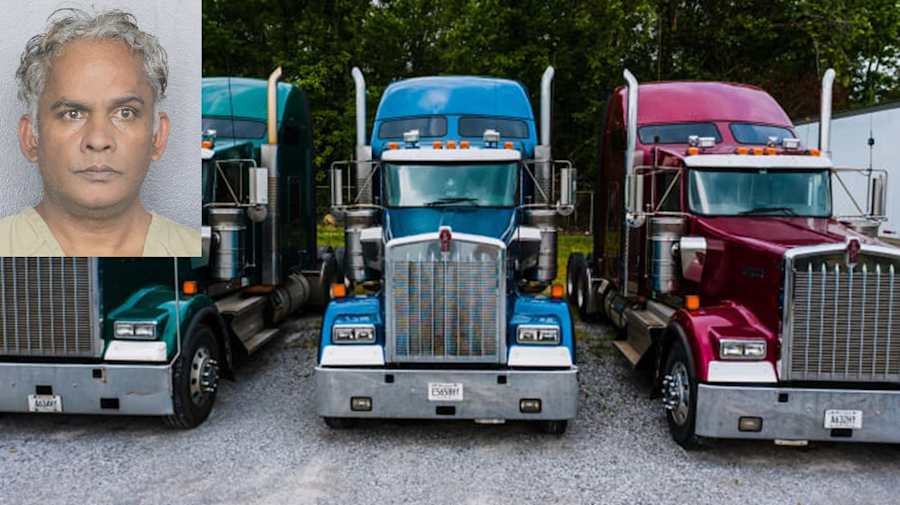
A South Florida man is facing serious federal charges after allegedly using his trucking company, Royal Bengal Logistics Inc., as the front for a multimillion-dollar Ponzi scheme that preyed on hundreds of truck investors across the country.
According to the indictment unsealed by the U.S. Attorney’s Office for the Southern District of Florida, Sanjay Singh, 45, of Coral Springs, Florida, was arrested and charged with wire fraud, mail fraud and money laundering tied to a fraudulent investment operation that took in more than $158 million from approximately 336 investors between June 2020 and September 2023.
The scheme, as outlined in court documents and the DOJ press release, revolved around convincing people — many of them aspiring owner-operators or individuals with no prior trucking experience — that they could earn passive income by investing in the purchase and operation of semitrucks run by Singh’s company.
“Singh is alleged to have tricked investors into thinking they were purchasing commercial trucks to be operated by his trucking company,” said U.S. Attorney Markenzy Lapointe in a May 30 press statement. “Instead, Singh took investors’ money and used it to keep the scheme going and for his own personal benefit.”
Here’s how authorities say the scam worked:
False promises: Singh told investors they were buying trucks that would be leased out through his company and used to generate revenue. Investors were promised high monthly returns, often guaranteed in the form of fixed payouts.
Bogus contracts: According to prosecutors, Singh fabricated trucking contracts and revenue statements to back up his claims, giving the illusion that trucks were on the road and generating profit when, in reality, many didn’t exist or weren’t in use.
No real ownership: While Singh claimed that investors owned physical trucks or had partial ownership in them, court records show he never actually transferred any truck titles into their names. Some trucks allegedly didn’t even exist.
Ponzi mechanics: The indictment describes a classic Ponzi setup — new investor money was used to pay earlier investors, not from actual trucking revenue, but to create the illusion of profitability and keep the scam alive.
Lavish spending: Singh is also accused of using investor funds to bankroll a luxury lifestyle, including high-end cars and personal expenses, rather than running a legitimate logistics business.
The government’s case includes records from wire transfers, bank accounts, and alleged misrepresentations made through email and investor communications. The FBI and IRS are both involved in the investigation.
Singh faces multiple felony charges, and if convicted, could spend decades in federal prison. He has not yet entered a plea at the time of this publication.
The case is being prosecuted by Assistant U.S. Attorneys Elizabeth Young and Gabrielle Charest-Turken.
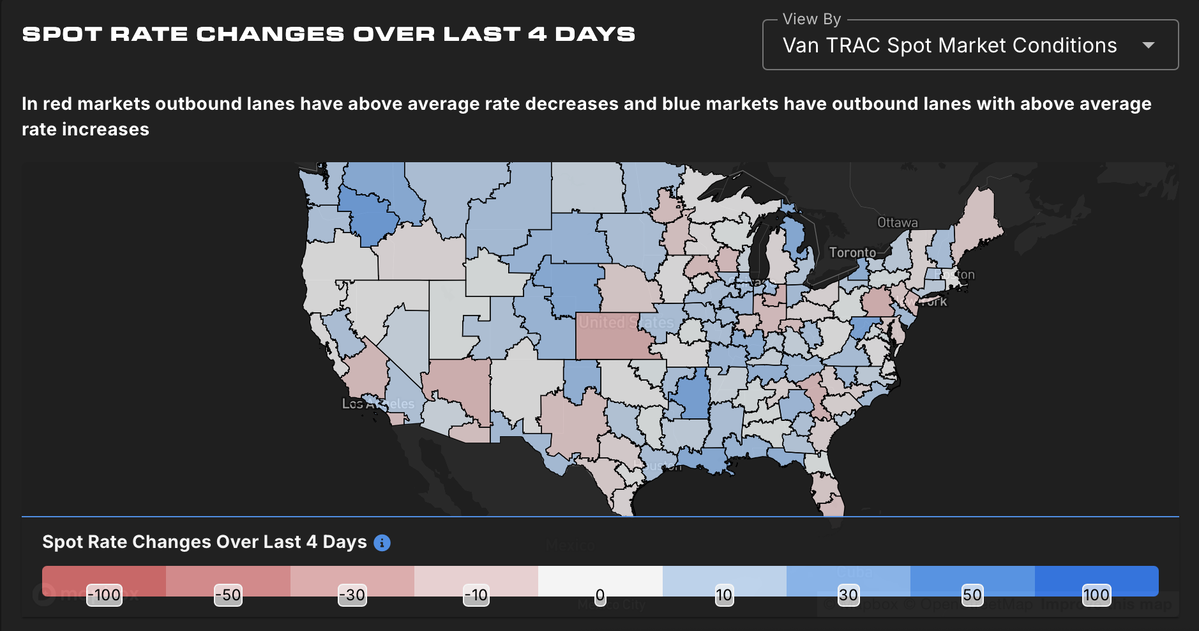
(Source: SONAR Spot Rate Changes Over Last 4 Days (Van TRAC Map).Blue markets are showing above-average rate increases, especially in the Southeast, Mid-Atlantic and South Central regions. Red zones are still cooling.)
Freight Market Update – Rate Bump or False Start?
This week’s charts are a reminder: Just because rates lift, it doesn’t mean the recovery is here to stay. Let’s break it all down for the small fleets and owner-operators who don’t have time to guess what’s next.
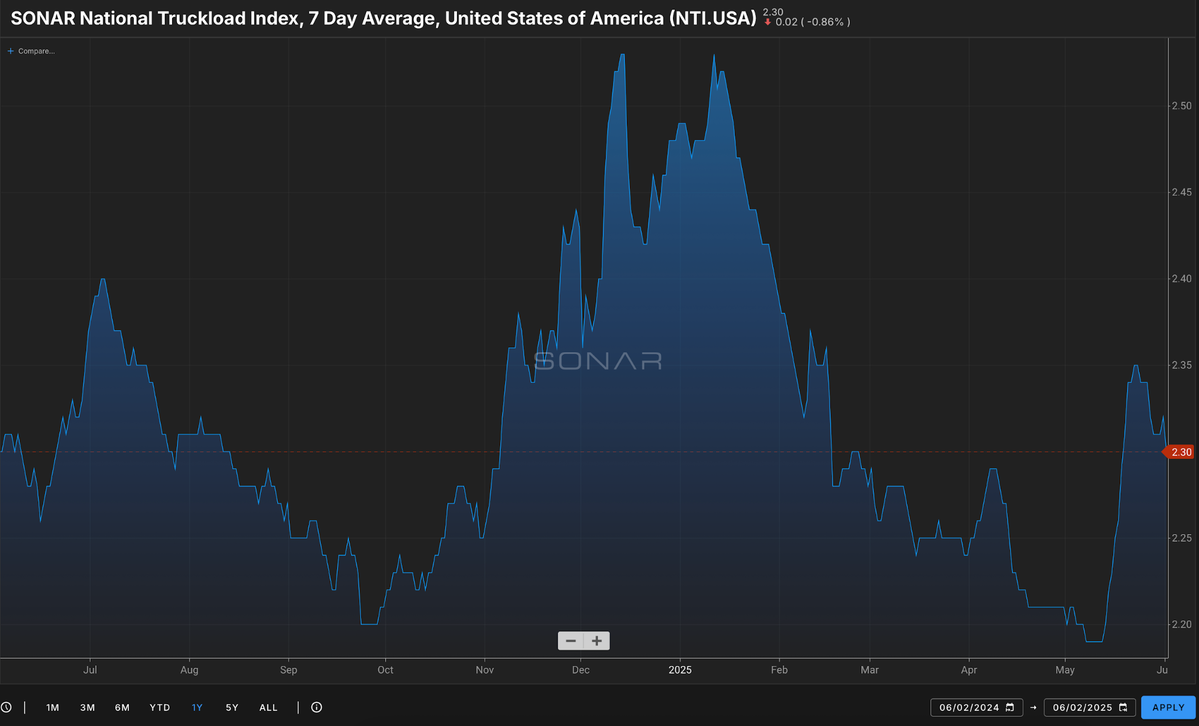
(Chart: SONAR National Truckload Index (NTI.USA). National linehaul rates are cooling slightly after a sharp rebound in May. This $2.30-a-mile snapshot shows the market trying to climb but still not holding firm. Short bursts of rate strength aren’t yet backed by long-term pressure.)
Linehaul rates took a slight dip to $2.30 a mile after last week’s strong climb. This comes after a steep rebound in mid-May, when we saw NTI gain about 10 cents in just over a week. That’s fast — and when that happens in this market, it’s usually tied to short-term pressure, not a long-term shift.
But here’s the truth: This number is still higher than what we saw for most of April, which means capacity did tighten. If you were quick, you likely caught better rates on hot lanes, especially out of the Southeast and parts of Texas. If you waited for confirmation, you probably missed your shot.
What to do now:
Don’t assume this bump will last. This is a week-by-week game. Stick close to your best brokers, stay aggressive on accessorials, and if you’re in a soft market — run short, don’t deadhead far chasing what’s not there.
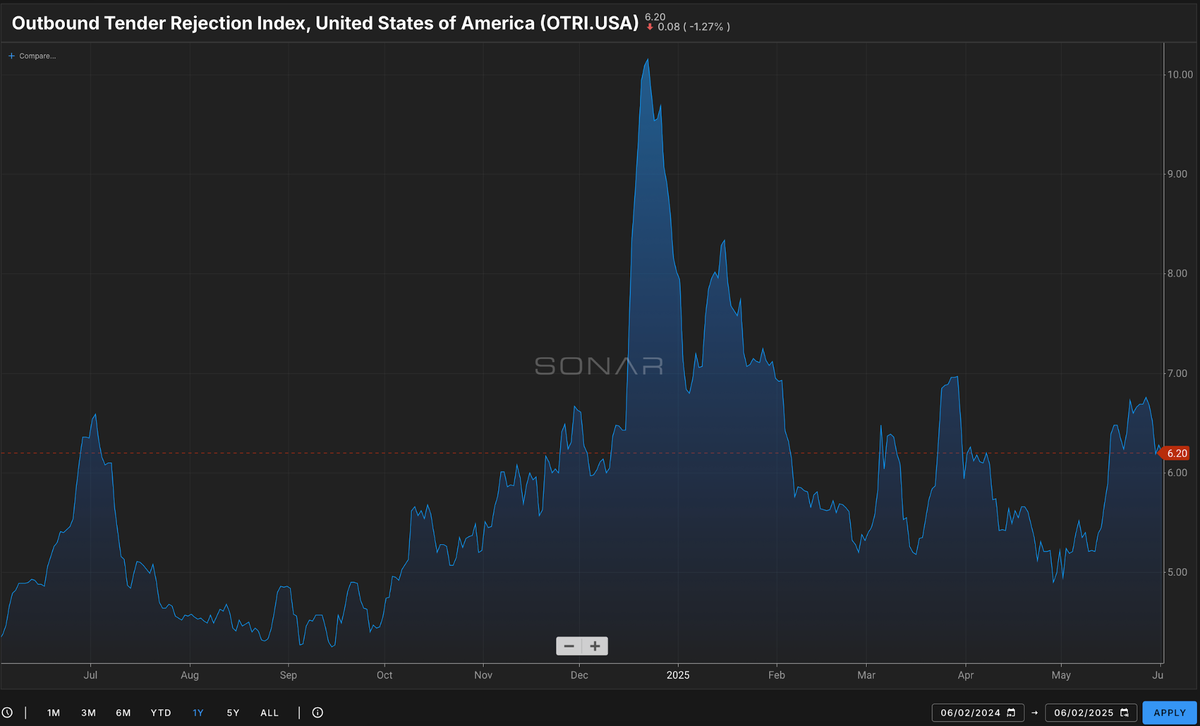
(Chart: SONAR Outbound Tender Rejection Index (OTRI.USA). Rejections dipped to 6.2% but remain elevated compared to earlier this year. That means carriers are pushing back against low-paying freight — and that pushback is what creates upward rate movement. Keep watching this.)
Rejections are down just slightly this week, but here’s what matters: They’re still above 6%, and for the past two months, they’ve refused to drop back into that 5% danger zone.
This means one key thing: Carriers are getting choosier. Brokers are getting pushback, especially on the lowball stuff. And where that happens, rates have room to climb.
Important to note: This is the canary in the coal mine. If this number trends back toward 7% in June, you’re going to see stronger rate floors, even on bread-and-butter lanes.
Small carrier takeaway:
If rejections are up in your outbound market, don’t undercut yourself. Run your breakeven. Ask for more. Use phrases like:
“Rejections are up this week. Trucks are saying no to cheap freight. I need $X to move this.”
You don’t win by staying quiet while the data works in your favor.
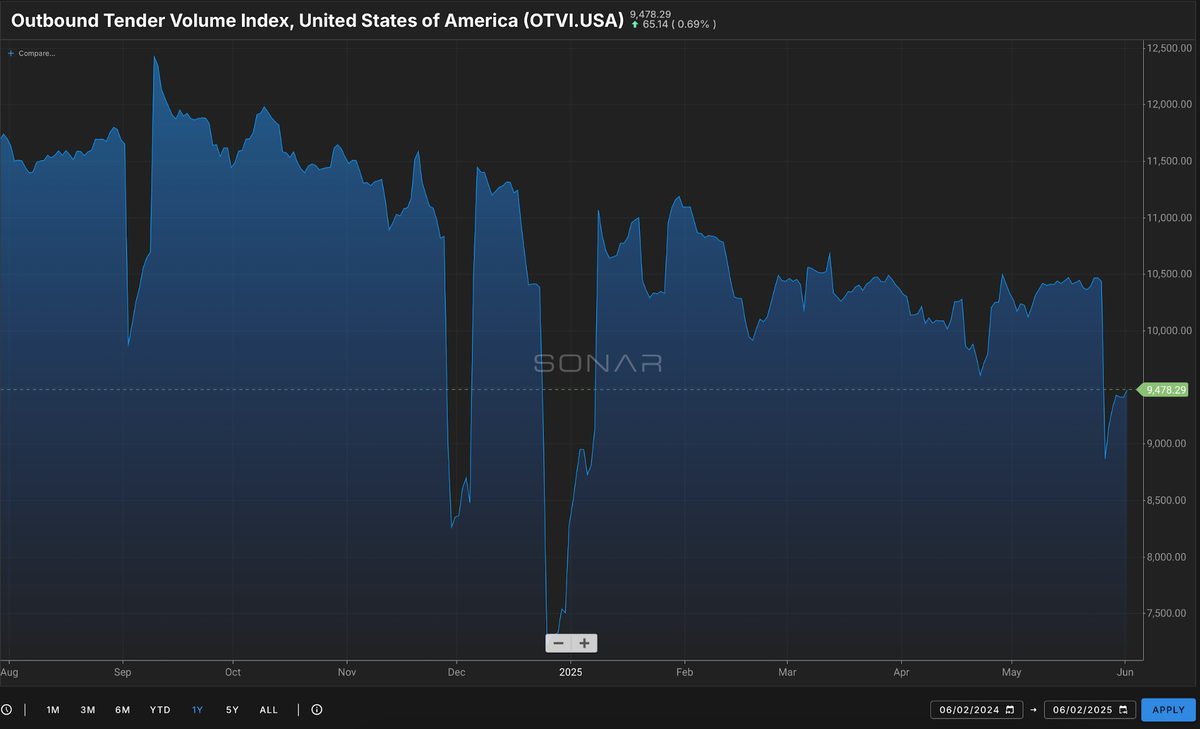
(Chart: SONAR Outbound Tender Volume Index (OTVI.USA). Volumes are holding steady just under 9,500. That means freight is still moving but not enough to force a full rate reset. Solid freight activity with too much capacity=unpredictable rates.)
Load volume is slightly up. A 0.69% bump might not seem like much, but it confirms one important trend: Volume isn’t crashing. We’re still hovering just under that 10,000 index mark — the line that usually signals solid, steady demand.
The good news? More tenders usually mean more choices for carriers. The bad news? If volume is stable but too much capacity is still out here, rates stay unpredictable.
Your move as a small fleet:
Pick your battles. Avoid long-haul loads that drag you into cold markets. Stay clustered around areas where tenders are climbing — North Carolina, Georgia, Alabama, parts of Texas, etc. Work short hops. Stack regional wins.
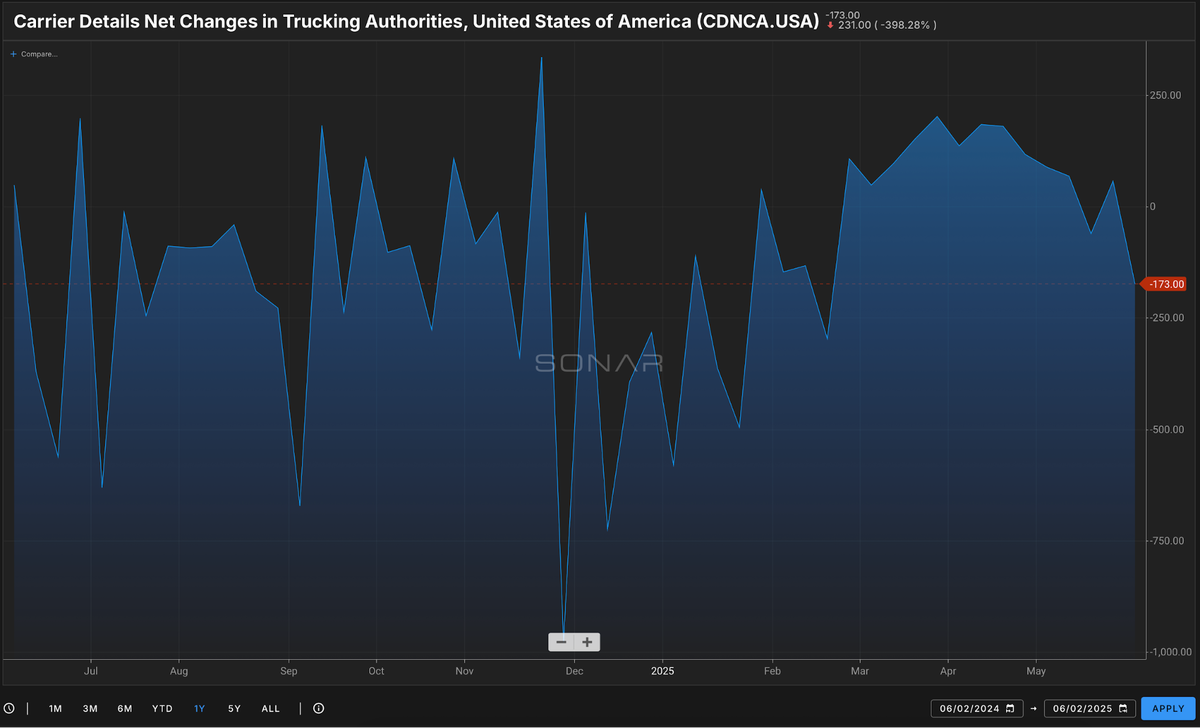
(Chart: SONAR Carrier Details Net Changes In Trucking Authorities (CDNCA.USA). Authority exits are back. This -173 drop means more carriers are parking trucks and shutting down. Fewer authorities on the road could mean better pricing power ahead — if the trend continues.)
This one speaks volumes.
For the first time in several weeks, the market is losing capacity again — 173 authorities dropped off the map. That’s not massive, but it’s notable. If this pace continues through June, we’ll start to feel the gap between freight volume and available trucks widen — and that’s when rates stop flirting with a rebound and actually start moving.
Keep this in mind:
Small fleets and single-truck ops have been holding on since Q4. A decline in new entrants and a slow drip of exits puts the pressure back on brokers to pay up when freight starts moving fast again.
Advice for small carriers:
Watch this number every week. It’s your forward indicator of pricing power. The less competition out here, the more leverage you have. If this negative trend continues, your negotiating seat gets stronger by the day.
Bottom Line
This isn’t a recovery yet — but it’s a setup. The market hasn’t flipped, but it’s coiling. If tender rejections climb while net authority drops and volume holds, you’re looking at an upward freight cycle brewing.
Don’t celebrate. Don’t overextend. Just be ready.
The winners in this type of market are the ones who run lean, watch closely and don’t flinch when it’s time to charge more.
More updates next week. Until then — run smart.
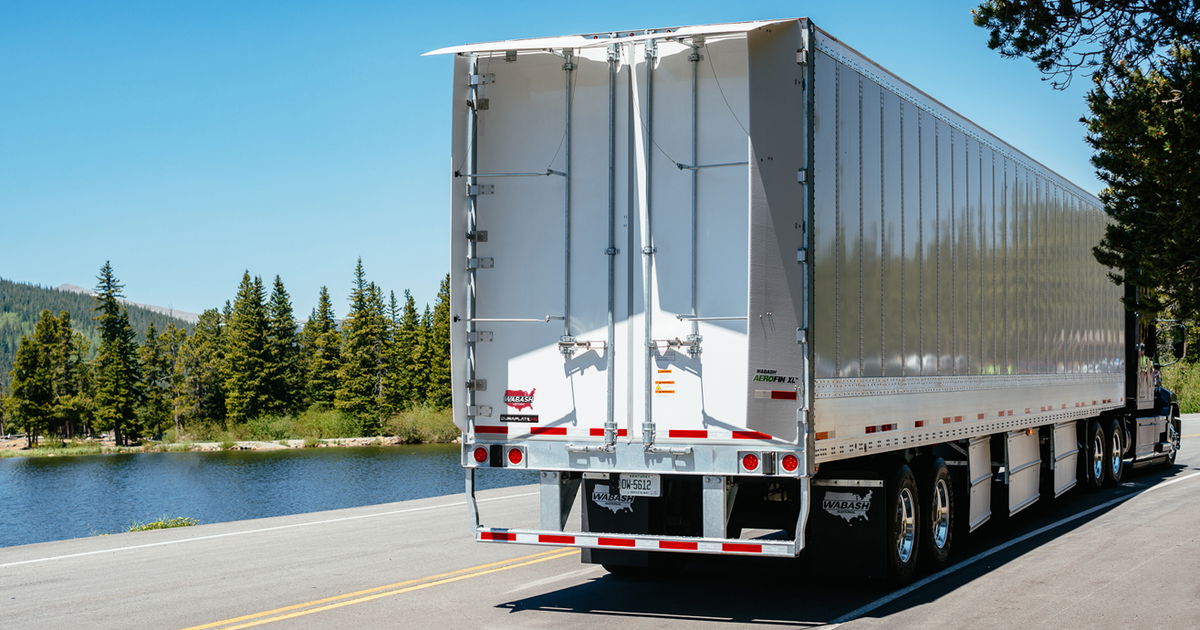
(Photo: Wabash National)
Rear Underride Guards Are in the Hot Seat — But FMCSA Just Rolled Back a Rule
There’s been growing pressure in D.C. for regulators to take underride crashes more seriously — but this past week, the Federal Motor Carrier Safety Administration took a step in the opposite direction.
In a recent move, the agency decided to roll back a rule that would’ve required carriers to add a label showing the manufacturing date of rear underride guards. On the surface, this might sound like a minor tweak, but here’s why it matters. The FMCSA’s proposed rule would eliminate the requirement for these certification labels, asserting that this change would remove an unintended regulatory burden without compromising safety. The agency emphasizes that the physical condition and proper maintenance of rear impact guards remain critical for safety compliance.
Rear underride guards — those metal bars attached to the back of trailers — are designed to prevent cars from sliding underneath in a crash. When they fail, the consequences are catastrophic. Think sheared-off rooftops, instant fatalities and no chance of survival for the folks in those smaller vehicles. That’s why safety groups and crash investigators have been sounding the alarm for years.
The now-rolled-back label rule came from the Infrastructure Investment and Jobs Act, which required FMCSA to implement labeling so enforcement officers could easily verify that the guard was compliant with federal safety standards. It was supposed to be a commonsense step forward — one more way to ensure unsafe or outdated guards weren’t flying under the radar.
So why did FMCSA back away?
According to the agency, it’s all about logistics. It argued that since rear guards are often added after the trailer is built — sometimes by aftermarket shops or upfitters — requiring the OEM to date-stamp the guard itself would be confusing and difficult to enforce. In FMCSA’s view, the existing process of checking the equipment visually during inspections is good enough.
But that position isn’t sitting well with safety advocates. Groups like the Institute for Safer Trucking and the Truck Safety Coalition argue this is one more example of regulators backing off when the pressure gets real. And with fatal underride crashes still making headlines, they say now’s not the time to ease off the gas.
Here’s the takeaway for small carriers and fleet owners:
Even without the label requirement, you’re still on the hook to keep your rear impact guards in top shape. DOT inspectors can (and will) write you up for damaged, rusted or missing components — and that means possible fines and CSA points. But beyond the compliance box, there’s a bigger ethical issue here: These guards save lives. They are the only thing protecting a family sedan from going under your trailer at 70 mph, so they better not be an afterthought.
Keep your maintenance tight. Stay ahead of inspections. And don’t wait for Washington to tell you what’s safe. Regulators may be backpedaling — but that doesn’t mean you should.
Right after another week of headlines around broken systems and business burnout, this week’s podcast couldn’t have landed at a more honest moment. Adam sat down with Rahmel Whatley — entrepreneur, podcaster and former driver recruiter — to talk about the hidden costs of hustling without a solid foundation. From losing $300K on workers’ comp to sending out a driver who failed a drug test, Whatley opens up about the lessons he learned the hard way. In this episode, he breaks down what it really takes to build something that lasts in trucking, how chasing quick money can backfire, and why systems and structure aren’t optional if you want to scale. If you’ve ever felt like you’re working harder but getting nowhere — this conversation will hit home and help you refocus where it counts.(Photo: Jim Allen/FreightWaves)
Honoring Lesa ‘Yo-Yo’ Worley
This week, we say goodbye to a true road warrior and pioneer in the trucking community — Lesa “Yo-Yo” Worley.
Yo-Yo wasn’t just a trucker. She was a trailblazer. Back in 1979, she made history as the first winner of the Atlanta Motor Speedway’s semitruck race — a moment that shattered expectations in a male-dominated field and set the tone for the decades she’d spend behind the wheel. Her CB handle was known far and wide, and her presence on the road earned the respect of drivers from every corner of the country.
She drove for 39 years. Not just for a paycheck — but because trucking was in her bones. It was her identity, her freedom, her family.
In 2011, Yo-Yo was diagnosed with multiple sclerosis and eventually had to park her rig for good. The disease slowly stripped away her physical strength, including the muscles around her heart. Even in the face of terminal decline, Yo-Yo remained sharp, spirited and full of gratitude for the life she lived on the road.
A few years ago, thanks to an outpouring of support from drivers and her Tennessee community, Yo-Yo got to ride in a semi one last time. It wasn’t just a gesture — it was a full-circle moment. Her eyes lit up, her spirit soared, and everyone in that convoy knew they were witnessing something sacred.
She passed away this week, leaving behind a legacy that deserves to be remembered in every driver lounge, fuel island and old CB radio story. Rest easy driver …
If you’d like to honor her memory and help her family with final expenses, you can do so here.
There’s no FMCSA regulation for a life well lived. But if there were, Yo-Yo would’ve passed inspection with flying colors.
Final Word – Between the Lines
This week wasn’t just about data and headlines — it was about reading between the lines of where this market is really heading.
Tender rejections are quietly ticking up. Freight volumes are holding steady. But capacity? Still sticky. That means we’re in a market where discipline matters more than momentum. The wins right now are small — but they add up if you know what you’re looking for.
And while the FMCSA debates rear guard labeling and the courts wrestle with AB5’s long-term impact, small carriers need to be wrestling with something else: how to build staying power. Because surviving isn’t about waiting for the market to change. It’s about being prepared for when it does.
Take the lesson from Yo-Yo Worley’s legacy: Commit to the craft, respect the road, and never lose sight of the bigger picture.
Until next week — stay sharp, and keep rolling.
Windrose and Terawatt deepen strategic partnership
Electric truck maker Windrose Technology and Terawatt Infrastructure recently announced a deepening of their existing strategic partnership through a series of interoperability tests at Terawatt’s flagship site in Rancho Dominguez, California.
The tests include demonstrating Windrose’s dual guan charging capabilities, which deliver over 650 kW using two 350 kW chargers from Delta Electronics. A 240-mile range charge was achieved in around 40 minutes using the two-charger system.
The collaboration also includes software integration. That entails connecting Windrose’s vehicle systems to Terawatt’s site and energy management platform, increasing uptime and charging efficiency.
“This partnership is about more than performance metrics — it’s about delivering real-world solutions to the fleets driving the energy transition,” said Wen Han, founder, chairman and CEO of Windrose Technology, in a press release, “Together with Terawatt, we’re aligning vehicle and infrastructure platforms in a way that scales efficiently and delivers immediate value to customers.”
The collaboration is also extending to join customer programs as Windrose looks to grow its footprint in the United States. The release notes these programs include local customer deployments across Terawatt charging hubs in Southern California, as well as long-haul deployments at future sites along Terawatt’s I-10 corridor between Los Angeles and El Paso, Texas.
“By combining [Windrose’s] next-generation trucks with our infrastructure, and sites designed for quick charging with the least disruption to operations, including pull-through stalls that accommodate trailers, we are unlocking new electric lanes in southern California and beyond,” said Neha Palmer, CEO of Terawatt, in the release. “The deeper our collaboration goes — from power to software to site design — the better we serve our customers.”
Foretellix expands autonomous vehicle development platform
(Photo: Foretellix)
Foretellix, a developer that provides data automation for AI-powered autonomy, recently announced an expansion of its Foretify platform, allowing autonomous vehicle developers to slash development time. As more AV developers move from rules-based software of AV 1.0 to the synthetic and virtual data of AV 2.0 developers are running into issues of validation, as generative AI is more of a black box compared to a rule book.
“Physical AI creates a fast lane to autonomy that will ultimately improve our quality of life and help save millions of lives, but making it a reality requires an intelligent, data-driven approach to address AI’s inherent limitations,” says Ziv Binyamini, CEO and co-founder of Foretellix, in a news release.
Companies like Foretellix work through using data automation to train their own AI-powered AV stack by automatically curating hundreds of driving scenarios from physical operations and pairing them with generative synthetic scenarios. Foretellix’s toolchain uses hyper-realistic scenarios generated by integration with the Nvidia Omniverse Blueprint for AV Simulation and Nvidia Cosmos Transfer World Foundation Model.
These enhancements supplement Foretify’s advanced behavioral search capabilities by leveraging Cosmos’ sensor domain search functionality, which adds greater diversity in weather conditions, lighting scenarios and geolocations.
The company has attracted investment from industry leaders including Toyota’s Woven Capital, Temasek, Volvo and Nvidia. Foretellix customers include Daimler Truck subsidiary Torc, Volvo, Mazda, Woven by Toyota and Nuro.
Binyamini added: “Training, validating and providing evidence of autonomous systems’ safety are the key drivers for this industry to progress. Foretellix’s solution helps foster innovation and reduce the barriers to entry for AV developers, vehicle manufacturers and entrepreneurs, democratizing the road to driverless autonomy.”
You’re halfway there! To read the rest of the Truck Tech newsletter, subscribe below. It’ll be delivered to your inbox every Friday at 11am eastern.
While you’re at it, check out this week’s episode.
Analyst on X: Trucking is set up for inflationary cycle
Market analyst May Ling (@MarketswithMay) recently highlighted an intriguing trend in the trucking industry through her X (formerly Twitter) post, drawing attention to logistics as a significant component of the Producer Price Index (PPI). Her observations come at a pivotal time for the transportation sector, which has experienced dramatic fluctuations since the COVID-19 pandemic.
Specifically, Ling noted that within the PPI, logistics seems to be the first sector that cut capacity in response to soft demand, rather than raising prices to make up for smaller batches.
“Most producers DID NOT reduce capacity — instead, they raised prices to coincide with smaller batch sizes (mostly in goods, but also true in some services),” Ling wrote. “This is what was causing Inflation in many areas and should be deflationary once you get volume increases.”
Very interesting dynamic in trucking. Syncs with what I saw in last Q's earnings $CHRW$JBHT, which was surprisingly constructive.
Logistics is a major component of PPI Services. Unlike CPI, PPI is a leading indicator for inflation. Lest other FinXers get this wrong. Also, I'm… https://t.co/frZVMJ5kyy
The PPI is a critical economic indicator that measures the average change over time in selling prices received by domestic producers for their output. Unlike the Consumer Price Index (CPI), which tracks retail prices paid by consumers, PPI captures price changes from the seller’s perspective. As Ling emphasized in her tweet, “Unlike CPI, PPI is a leading indicator for inflation,” making it particularly valuable for forecasting broader economic trends before they affect consumer prices.
The U.S. truckload market has undergone significant transformation since the pandemic, characterized by extreme swings in capacity, demand and pricing. Following the COVID-19 freight boom, the industry found itself with excess capacity as demand normalized and consumer spending patterns shifted. This oversupply situation was further complicated by volatile trade policies and tariff rhetoric, creating uncertainty in import patterns.
As market conditions deteriorated, thousands of small and midsize trucking carriers faced unsustainable economics. According to research from freight brokerage RXO, “the average cost to operate a truck is 34% higher over the past decade but absolute spot rates are largely the same as they were in 2014.” This economic reality triggered widespread business failures and market exits, initiating a painful but necessary adjustment mechanism to rebalance the supply-demand equation.
This newfound balance has begun manifesting in key market indicators. The national average Outbound Tender Rejection Index, which measures the percentage of tendered loads rejected by carriers, climbed to 6.67% – reaching the threshold where rejections start putting inflationary pressure on spot rates. Truckload spot rates (excluding fuel) rose 9.1% year over year in the first quarter of 2025, following an 11.6% growth rate during the fourth quarter of 2024.
A notable development has been the emergence of significant regional disparities. By June 2025, tender rejection rates for truckload shipments originating in the Southeast surpassed 10% – the first time in nearly three years they had reached that level. In contrast, rejection rates for freight departing the West Coast remained well below the national average. The “interior” markets of Atlanta, Chicago and Dallas showed the tightest capacity conditions among major freight centers.
Ling’s observation that “logistics is a major component of PPI Services” highlights the sector’s importance in the broader economic landscape. Her tweet identified trucking as the first area within PPI where capacity reduction has begun, potentially signaling a shift in the inflation narrative.
In her analysis, Ling pointed to a “period of reverse economies of scale” that has persisted for almost two years. She explained that inflation has been driven by “small batches, not shortage-driven price increases,” contrary to common misconceptions. Most producers maintained capacity but raised prices to accommodate smaller batch sizes, creating inflationary pressure across goods and some services sectors.
Looking forward, Ling outlined several scenarios. One possibility involves producers eventually capitulating and cutting capacity, which could become inflationary if GDP growth follows. Alternatively, rate declines might arrive in time to drive volume growth, restoring profitability before businesses make significant capacity cuts.
The market trajectory for truckload rates remains “inflationary,” according to RXO, though trade policy presents a significant wild card. Transportation prices were forecast to be significantly higher a year from now, with industry respondents returning a reading of 75 for the pricing outlook in the Logistics Managers’ Index.
Ling noted that demand patterns, while showing some strange variations by industry, aren’t the core issue. Instead, she pointed to “weirdly choppy purchasing behavior that is not helpful to Trucking” and emphasized the binary impact of tariffs on the sector.
Ling’s analysis provides a valuable framework for understanding the relationship between logistics, the Producer Price Index and broader inflation trends. By identifying trucking as the first sector where capacity reduction has begun, she offers an early signal of potential shifts in the economic landscape.
The trucking market’s gradual healing has finally restored equilibrium between supply and demand, enabling carriers to regain pricing power. However, as Ling cautioned, the market remains sensitive to external shocks, particularly trade policy developments and potential economic headwinds. The significant reduction in truckload capacity has made the market more responsive even to modest demand changes, positioning the sector for potential volatility in the coming months.
Trac Intermodal preps some of 200K chassis for China container surge
A top executive with the largest provider of intermodal chassis says his company is ready for the coming crush of China container imports headed to the United States.
“We’re preparing for a bounce back of volume this summer,” said Trac Executive Vice President and Chief Commercial Officer Jake Gilene, in an interview with FreightWaves. “We’re staying very close to our customers gathering their forecasting data, so we can see what they see. We are preparing now for volume that’s coming in late June-early July.”
For Trac, which maintains a fleet of 200,000 domestic, marine and specialty chassis, that means making sure there are available chassis in the right markets, and coordinating those efforts across all ports and terminals.
After the pandemic supply chain crisis, Gilene said, Trac worked with major railroads to establish strategic chassis reserves.
“Post-COVID, we began a strategic chassis reserve program where Trac worked with Union Pacific to set aside chassis at specified locations where it makes sense for our host and our customers. This was done in the event of a black swan event. We are actively looking to expand this in other markets where it makes sense,” Gilene said.
To build up sufficient fleet resiliency, “Trac has developed a number of key locations around the country where our usage data and customer demand would indicate the need for safety stock.”
In addition to participating in 12 neutral chassis pools across the country, Trac operates four private pools on the West Coast with ocean carriers CMA CGM, Zim (NYSE: ZIM), Evergreen (2603.TW) and Hong Kong-based Hede International Shipping.
During the lull in China traffic precipitated by the trans-Pacific tariff dispute with Washington, Trac looked to reposition chassis where they could do the most good. Upgraded units sitting idle in California were moved to the Midwest to refresh fleets worn by winter weather.
Trac is anticipating higher-than-normal container volumes come June.
“The ocean services that were suspended are being reinstated and schedules are now booked,” said Gilene. “Carriers are swapping vessels into the eastbound trans-Pacific trade lane to bring in more TEUs. From our customer conversations and forecasting, it’s a mix of goods that were ready to ship and some new factory production, but mostly new, reinstated production.”
One component Trac will be watching closely is dwell time.
“Average dwell is six to seven days, and during COVID we saw that increase [by] two to four times, depending on the market. If the supply chain isn’t making a quick turn, the dwell time is longer for where the chassis is going, impacting chassis availability.”
The big unknown is how long the surge is going to last.
“We’ve seen varying timelines for backlog recovery. During COVID, a three-month supply chain shutdown took 18 months. Building on what we learned, we are proactively repairing additional chassis and are exploring reserve expansions where they make sense.”
Gilene added that since the pandemic, more motor carriers have acquired their own chassis, making them less dependent on pools.
The import surge could give Trac a needed boost. In December, Moody’s revised its outlook for the company to negative, saying then that tariffs posed a risk to import volume growth.
Elevating rail safety standards with state-of-the-art training
Rail is one of the safest options in the transportation industry, and Greenbrier continues to advance that operational safety through innovation.
The company’s latest initiative—the GBX Training Tank Car—represents a significant advancement in tank car education. Built from an actual tank car, this mobile classroom delivers hands-on safety instruction and technical training.
“Rail safety is a core value at Greenbrier and this new training tank car is another example of how we lead the industry,” said Tom Jackson, Greenbrier Vice President of Marketing and General Manager.
Set to launch on August 1, this mobile training platform will be available at select Greenbrier Maintenance Center locations nationwide and at industry events, addressing a persistent challenge in the rail sector: providing consistent, accessible education.
A new era of rail safety
Due largely to the complexity and variety of tank cars on the market, companies operating in the rail industry often struggle to offer comprehensive, hands-on training across different locations. This can lead to knowledge gaps and reliance on expensive and inefficient off-site training options that vary in quality.
The GBX Training Tank Car addresses the inefficiencies by providing instruction at centralized locations, reducing operational disruptions for participants without sacrificing quality.
During training, all instruction is delivered by Greenbrier’s experienced safety specialists, ensuring consistent, expert-level education. Additionally, the GBX Training Tank Car provides exposure to equipment that teams might otherwise rarely encounter in training settings.
“Our mobile classroom is a proactive investment, offering interactive training, regulatory guidance and hands-on demos for shippers, repair crews and owners,” explains Jeff Bobst, Greenbrier Senior Manager of Program Management and Field Services.
The initiative supports key stakeholders across the rail ecosystem, including operators, leasing companies, safety and compliance teams, maintenance crews, technical trainers and customers who rely on tank cars.
A comprehensive learning environment
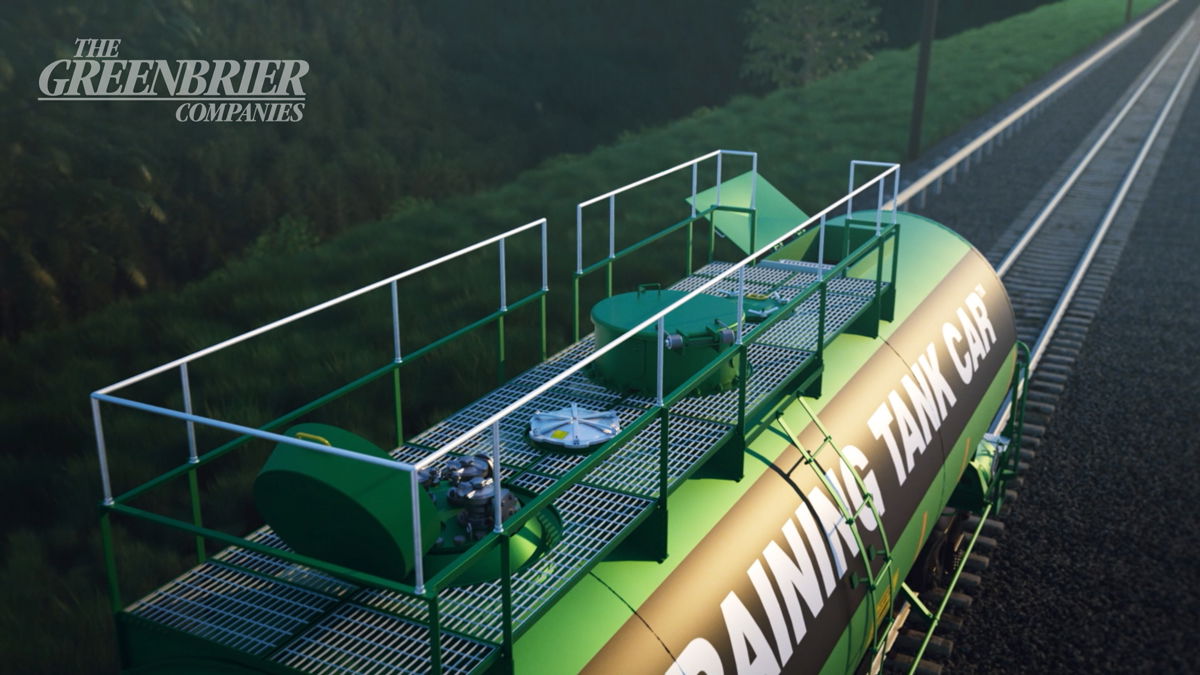
The GBX Training Tank Car™ incorporates multiple educational components engineered for maximum instructional efficacy. For example, the exterior features an elevated rooftop platform with safety railings that facilitate comprehensive viewing of all primary top fitting package types—critical components for proper operation and maintenance protocols.
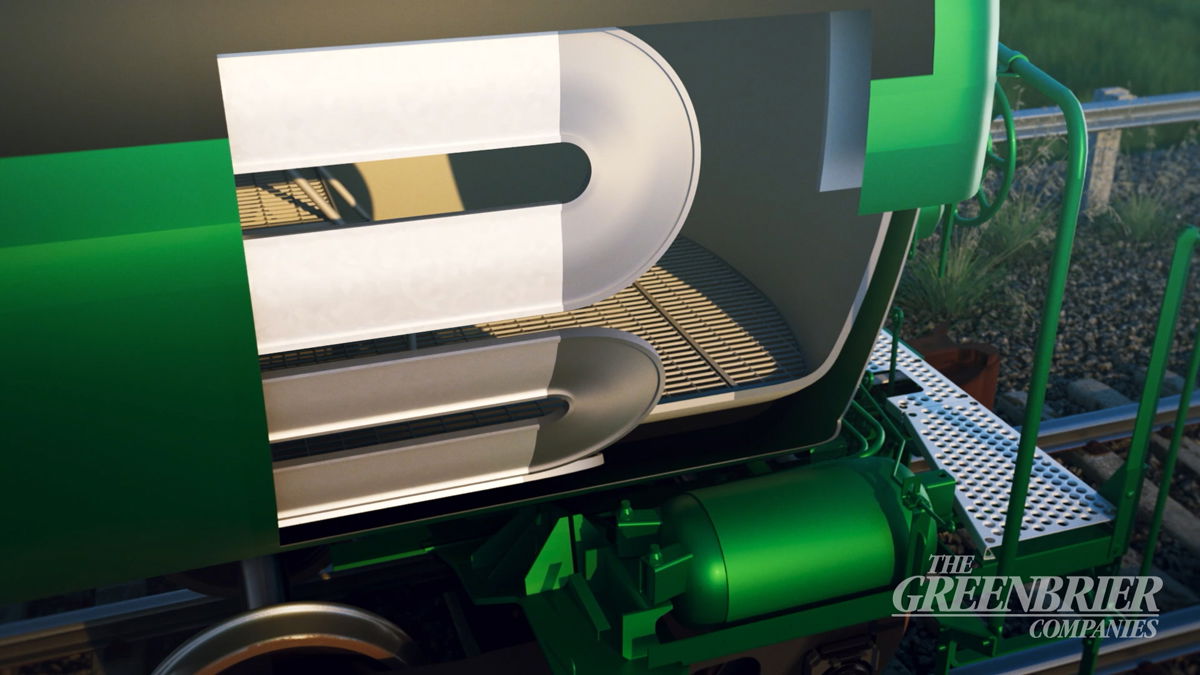
A strategically positioned jacket cut-out window provides visualization of insulation systems, heating coils and thermal protection mechanisms that remain concealed during standard inspection procedures.
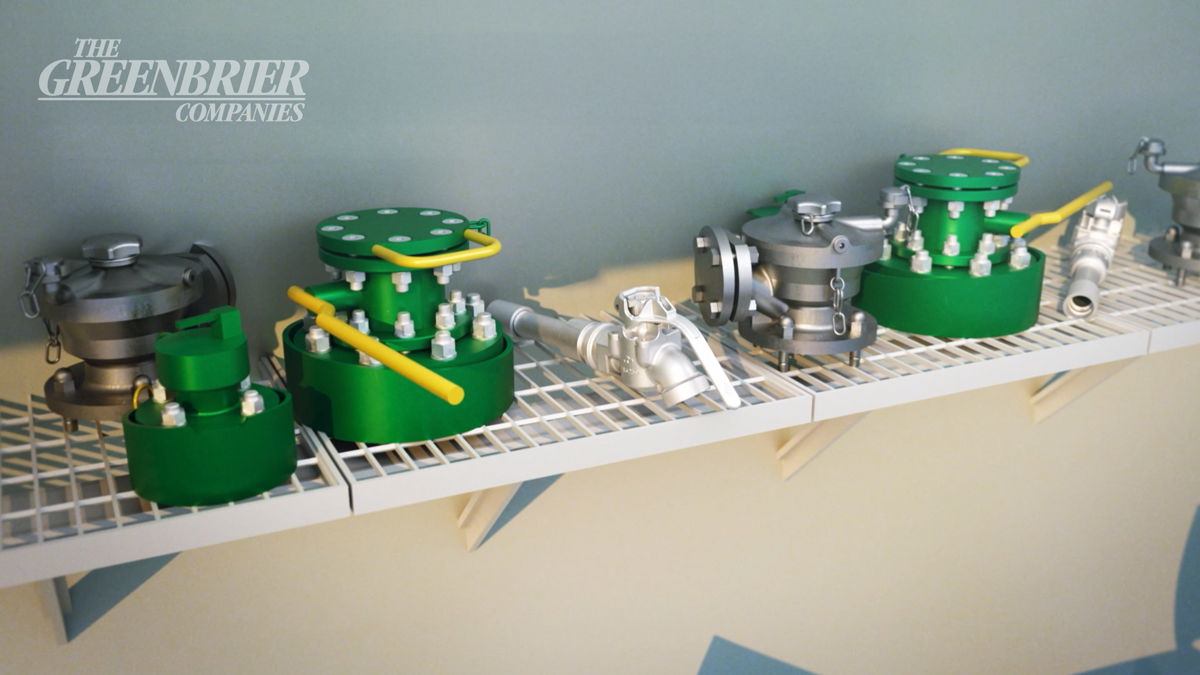
The interior transforms into a climate-controlled classroom, enabling year-round use and accommodating up to 15 participants. In addition, interactive display racks showcase a variety of tank car valves and gauging devices, providing a tactile experience with components regularly encountered in field operations.
Training safety protocols are demonstrated through practical features, including an interior roof ladder with an access hatch, which illustrates proper access procedures and regulatory compliance requirements.
“Shippers, responders and operators are essential to the future of rail safety—and empowering them with critical knowledge keeps pace with the growing complexity of the freight industry,” said Diana Aylward, Greenbrier Vice President of Asset Management and Regulatory Services.
Looking to the future
The GBX Training Tank Car reflects Greenbrier’s forward-thinking approach to the growing complexity of rail freight operations and the evolving industry knowledge demands that come with it. This initiative positions Greenbrier at the forefront of rail safety innovation—not by reacting to industry changes, but by anticipating them and addressing challenges head-on.
The program also supports environmental sustainability by optimizing tank car operations and maintenance. Through comprehensive training, it enhances operational efficiency and supports broader environmental goals—a growing priority across the rail industry.
Greenbrier’s training tank car initiative demonstrates a substantial investment in advancing rail safety, helping build a more technically proficient workforce through accessible, hands-on education delivered directly to operational personnel. The mobile classroom concept removes traditional barriers to specialized training while maintaining consistent educational standards.
By addressing both immediate operational needs and long-term industry challenges, the GBX Training Tank Car exemplifies Greenbrier’s commitment to safety leadership and technological innovation.
For more information about the GBX Training Tank Car™, visit gbrx.com/classroom.
FMCSA eliminates DEI rules for $89M in CDL grants
WASHINGTON — State and local government agencies, schools, small businesses, and others eligible for FMCSA’s CDL grants will see fewer restrictions tied to the application process than was the case under the previous administration.
FMCSA announced on Friday up to $89.4 million available in the latest round of competitive grant funding through its Commercial Driver’s License Program Implementation (CDLPI) grant. The grants are aimed at developing, implementing and maintaining CDL programs.
As is the case with all competitive grant programs now being run by the Trump administration, including infrastructure grants, the latest round of CDLPI grants eliminates the diversity, equity and inclusion (DEI) and climate change requirements mandated under the Biden administration – what Transportation Secretary Sean Duffy refers to as “woke” and “Green New Scam” mandates.
“Previously, recipients of this critical safety grant were forced to prioritize climate change and DEI agendas alongside core safety objectives,” FMCSA stated.
But by eliminating DEI, the agency asserts, “taxpayer dollars are now fully dedicated to genuine safety improvements, appropriate accountability, and real, measurable outcomes. Potential applicants are instructed to thoroughly review the reformed application guidelines to align with these necessary and refocused priorities.”
CDLPI grants help states strengthen compliance with federal safety regulations and enhance the integrity of the National Commercial Driver’s License Program, according to the U.S. Department of Transportation.
The program “focuses on the concept that each driver has only one driving record and only one licensing document, commonly referred to as ‘One Driver — One License — One Record.’”
The National CDL Program also requires states to conduct knowledge and skills testing before issuing a commercial learner’s permit and/or a CDL, to maintain a complete and accurate driver history record for anyone who obtains either document, and to impose driver disqualifications as required by regulations.
Performance goals expected
To be considered for a CDLPI grant, applicants should specify performance goals related to the project. Performance goals for successful CDLPI grant award projects may include, among others:
Sustained compliance with rulemakings: Activities that support a state’s implementation of federal CDL regulatory requirements, such as medical certification, Drug & Alcohol Clearinghouse, and entry-level driver training requirements.
Timely driver history record (DHR) actions: Activities to issue disqualifications, suspensions and downgrades in a timely manner to CLP and CDL holders and post to their DHR, which will allow unsafe drivers to be removed from service.
Data quality, accuracy and completeness: Activities that address a state’s accuracy and completeness of DHRs, including all conviction and disqualification data, medical certifications, entry-level driver training verification, and knowledge and skills testing information.
Innovative approaches to improving CDL issues: Activities that provide a novel technique or approach (program design, use of technology assets, etc.) to benefit national CDL safety and/or improve state driver license agencies’ (SDLA) CDL safety data quality, which may include research projects and pilot testing new approaches to improving compliance.
Human trafficking recognition, prevention and reporting: Activities that deter and reduce commercial truck-based human trafficking-related activities, and increase human trafficking awareness and training for SDLA, judiciary, and law enforcement staff and other industry stakeholders.
Increased testing rates and integrity: Activities that increase a state’s capacity for testing and issuing CDLs, including using new technology to ensure that CDL knowledge and skills testing integrity is maintained.
Cost savings: Activities that reduce costs for SDLAs through the increased use of automated systems.
Reduction in fraudulent CDL activities: Activities that increase the effectiveness of fraud prevention related to driving, medical credentials, skills testing operations and license issuance.
Running on Ice: Walk-in cold storage market grows its footprint
Polar Leasing, a provider of rental walk-in refrigeration solutions, has released a report on one of the cold chain’s fastest-growing segments: mobile and rental walk-in cold storage. The report, “Emerging Trends Shaping the Walk-In Cold Storage Mobile/Rental Sector,” offers insight into how temporary refrigeration is gaining traction across sectors from food service to emergency response.
According to the report, the mobile/rental cold storage market now accounts for approximately 15% of the total walk-in cooler and freezer market by value — a figure projected to exceed $5 billion by 2034.
Key growth drivers identified in the report include:
Evolving food and beverage demands: A boom in ready-to-eat meals, fresh food delivery and seasonal surges is prompting food service providers to seek flexible, short-term cold storage options.
Stricter food safety regulations: Compliance pressures are increasing demand for reliable, hygienic, easily deployable refrigeration solutions.
Life sciences and pharma expansion: The growth of biologics, compounded medications and specialty supplements is spurring demand for temporary, temperature-controlled environments.
Disaster preparedness and events: Emergency response teams and large-scale event organizers rely on mobile cold storage to maintain perishables and critical supplies.
The report points to a broader industry shift: Temporary, mobile cold storage solutions are becoming essential infrastructure, not just stopgaps. As demand fluctuates and new regulatory or operational pressures emerge, supply chain professionals are increasingly turning to flexible refrigeration strategies that can be deployed quickly, scaled as needed, and integrated into both routine and emergency operations.
“This report was designed to serve as a comprehensive resource for decision-makers across industries, including foodservice, life sciences, event management, and emergency response,” said Jimmy Kollmer, national cold chain manager at Polar Leasing Co, in a news release. “Our goal is to provide expert guidance to help businesses match their specific short-term refrigeration needs with the most effective and reliable cold storage solutions.”
Subscribe to get the full newsletter in your inbox every Friday down below
Trump v Elon; Switch 2 review; CA trucking & tariff impacts; Truckstop shake-up | WHAT THE TRUCK?!?
On Episode 846 of WHAT THE TRUCK?!?, Dooner is talking about the news that broke that internet: the Trump versus Elon feud. Musk now says Trump’s tariffs will cause a recession this year. What does the falling out mean for freight? We’ll take a look.
With over 30% of truckers identifying as gamers, is the Switch 2 their new lifeline from boredom during layovers? Is it good for the kids, the dads and the Chads? Dooner has his sons help him review Nintendo’s latest console release.
Big news out of Truckstop as Kendra Tucker steps down as CEO. The company’s founder returns to the CEO desk. Is the loadboard headed toward founder mode?
We’ll take a look at trucking and tariffs north of the border with Luka Korosec, president at 1% Logistics.
Loadsmart COO Geoff Kelley on how to scale a world-class freight brokerage.
Plus, are port futbol teams any good?
Chapters
1:52 Switch 2 review | The Dooner Boys
14:51 Elon v Trump
19:40 Truckstop shakeup
21:35 How to scale a world-class brokerage | Geoff Kelley
29:32 Port futbol teams
31:17 Canadian trucking | Luka Korosec
35:44 Load security | Luka Korosec
39:35 Tariffs and markets | Luka Korosec
Catch new shows live at noon EDT Mondays, Wednesdays and Fridays on FreightWaves LinkedIn, Facebook, X or YouTube, or on demand by looking up WHAT THE TRUCK?!? on your favorite podcast player and at 5 p.m. Eastern on SiriusXM’s Road Dog Trucking Channel 146.