Southern California international intermodal volume sees weekly decline

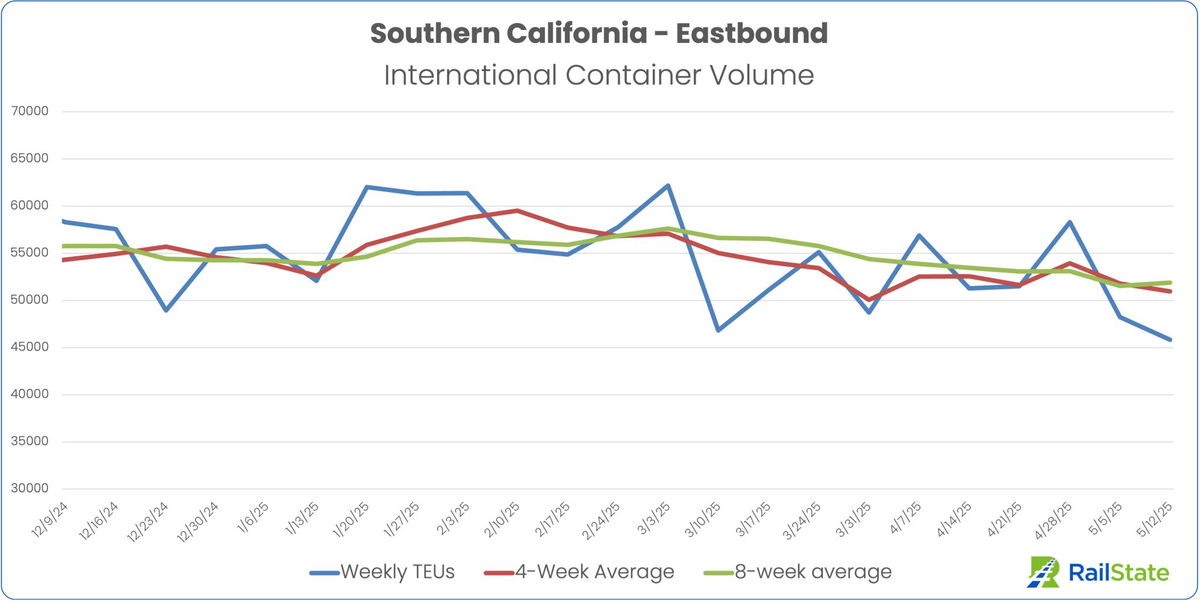
Reflecting the sting of steep tariffs levied on Chinese imports, eastbound international container volume out of Southern California declined to the lowest level in six months during the week that ended on Sunday, according to data from RailState.

The weekly volume was down 5% compared to the prior week and 10% compared to the four-week rolling average, the rail traffic monitoring company said.

The data shows the impact of the decline in shipments bound to the ports of Los Angeles and Long Beach from China amid the U.S.-China trade war, which saw tariffs as high as 145% on Chinese-made goods and materials.

Eastbound international container volume sank to its lowest levels in six months during the week that ended on Sunday. (Chart: RailState)

The international container volume on eastbound trains, tallied by RailState monitors along BNSF Railway and Union Pacific (NYSE: UNP) main lines, was 26.3% lower than the peak 2025 week of March 3-9.

“The early March high point coincided with frontloading by importers in advance of the original start date for tariff increases,” RailState said in a LinkedIn post Monday.

The U.S. and China called a 90-day truce in the trade war last week, with the U.S. reducing tariffs to 30% on most Chinese goods. Many trade experts expect another surge of imports to the U.S. as companies seek to beat the latest tariff deadline.

“We’re expecting to see a return to similar activity in the near-term with companies rushing to build up inventories during the 90-day pause on higher tariffs,” RailState said.

RailState can identify cars and containers by type, including the 20-, 40- and 45-foot international containers that pass its sensor network.

No container tsunami heading to Los Angeles, says port chief

The head of the busiest U.S. container port doesn’t expect a big jump in import shipments during the pause in China tariffs.

“Next we will see an uptick in [vessel] bookings from China, but I don’t see a huge surge that will impact the Port of Los Angeles,” said port Executive Director Gene Seroka, in a monthly media briefing. “Probably less than the 30% that we had during the ‘peak of the peak’ of COVID.

“From all the stakeholders we talk with and all the data we review, we are seeing bookings pick up at Asia ports. But prices are still very much elevated, leading retailers, manufacturers and other importers to carefully evaluate their strategies.”

Representatives from China and the U.S. on May 12 agreed to temporarily pause reciprocal tariffs for 90 days, slashing the levies on Chinese goods from 145% to 30%. 

Heading into June-July and the beginning of the traditional peak shipping season, Seroka expects a four-week stretch with port volume at 70-80% of normal.

“Goods in China that were sitting and waiting to move, we can deal with that [volume]” he said. “There has been lower ship utilization than liners would like, so they have capacity to fill. But we don’t see that we’ll have a surge in cargo that will have ships waiting at anchor like before [during the pandemic]. In fact, one logistics company told me that vessel bookings three weeks out are only 80% of what was usual.”

April volume grew 9.5% year over year at Los Angeles to about 843,000 twenty-foot equivalent units as shippers pushed to bring in cargo ahead of tariffs. It was the third-best April on record and 10th straight month of y/y growth.

Imports totaled 439,000 TEUs, up 5% y/y, while exports tallied just 128,000 TEUs, down 3.5%, and the fifth consecutive month of declining volume. 

But the first week of May saw imports buckle by 30% y/y on tariff-induced uncertainty, and that decline is likely to be “substantial” for the entire month, Seroka said, though he said exact figures were difficult to forecast.

In the short term, Seroka said, “it’s clear we’ll see a pullback in global trade. There’s been a whipsaw effect of financial data, markets, consumer sentiment, and we saw the downgrade of U.S. credit by Moody’s last week.” 

Year to date, Los Angeles has handled 3.4 million TEUs, up 6.6% on 2024. The hub’s container volume grew 19 of the past 21 months since August 2023.

The port moved 25% more empty containers back to Asia, 842,000 TEUs, in April than a year ago.

“There is a concerted effort to better respond to the peaks and valleys of demand by pre-positioning empties by the liner operators,” Seroka said.

Find more articles by Stuart Chirls here.

Related coverage:

US trade representative holds second hearing on Chinese ship fees

Long Beach sees record TEUs on trade war effect

Hapag-Lloyd expects swift China ramp-up after bookings jump 50%

Tariff two-step: After pause, China-US container traffic increases

FMCSA renews Hollywood exemption on truck driver hiring rules

Truck hauling cargo for film production.

WASHINGTON — A third-party consortium that manages drug testing for truckers hauling for movie studios has convinced regulators that it can safely continue a less stringent hiring process than that of general freight haulers.

The Federal Motor Carrier Safety Administration has renewed for an additional five years an exemption granted in 2020 to DISA Entertainment Compliance Solutions (DECS) – doing business then as Motion Picture Compliance Solutions – that allows DECS member carriers to avoid having to conduct a full query of FMCSA’s Drug & Alcohol Clearinghouse as part of its initial preemployment screening process for drivers.

Instead, DECS carriers will be allowed to conduct just a limited query of the database to satisfy the preemployment hiring requirement. The exemption expires in 2030.

“FMCSA determined in 2020 that DECS’s process for identifying qualified drivers for member employers is uniquely designed to accommodate safety concerns related to drug and alcohol testing violations,” FMCSA stated in a notice published on Monday.

“The agency continues to believe that the exemption will not jeopardize safety because the employer and/or their C/TPA [consortium/third-party administrator] must conduct a full query if the limited query shows that information about the driver exists in the clearinghouse.”

DECS asserted in its renewal application, as it did in 2020, that having the exemption, which applies only to DECS members, comes down to money.

“The exemption is needed because … compliance with the [current clearinghouse] rules would significantly impede our members’ ability to hire drivers at the speed needed to keep pace with the operational demands of the motion picture industry, which if not renewed would subsequently increase the number of production days and add millions of dollars of increased production costs operating in the United States,” the group stated.

DECS emphasized that exemption does not degrade safety because employers and their drivers remain subject to all federal drug and alcohol use and testing regulations while also participating in DECS’ own drug and alcohol testing protocols and procedures.

DECS’ renewal request was supported by major Hollywood movie studios, including Sony Pictures Entertainment and Netflix Studios LLC.

“The DECS clearinghouse exemption has played a pivotal role in the entertainment industry by enhancing operational efficiency and streamlining processes, allowing companies to navigate regulatory landscapes with greater ease,” Netflix Studios, a subsidiary of entertainment company Netflix Inc. (NASDAQ: NFLX), stated in comments filed with FMCSA.

“This exemption reduces administrative obstacles, enabling faster project turnarounds with a consistent pool of drivers. DECS has developed additional safety protocols to prevent any driver from performing safety-sensitive functions without the proper requirements. This approach protects workers, audiences, and the general public, supporting the industry’s growth and vitality while maintaining its commitment to safety.”

Click for more FreightWaves articles by John Gallagher.

Freight thefts slam Southern California shippers; retail and consumers left holding tariff bag | WHAT THE TRUCK?!?

On Episode 840 of WHAT THE TRUCK?!?, Dooner is talking about yet another freight theft in Southern California. The thieves spoofed a bill of lading and made off with a shipper’s freight. Travelers’ Scott Cornell stops by to talk about the rise of strategic theft and why your cargo may be at risk.

President Donald Trump told Walmart to “eat the tariffs,” but is that a realistic ask? With steep 30% tariffs across a lot of Walmart and many other retailers’ items, they’re saying cost increases are unavoidable. Rodney Manzo at Anvyl by Sage breaks down the company’s latest state of the supply chain report, which looks at shipper fears around increasing costs related to tariffs, transportation, and shipping delays. 

The truckload market got tight last week due to International Roadcheck, but can it last? We’ll take a look at the latest data in SONAR’s Trade War Command Center, and we’ll look at how rates, volumes and tender rejections are holding up.

Catch new shows live at noon EDT Mondays, Wednesdays and Fridays on FreightWaves LinkedIn, Facebook, X or YouTube, or on demand by looking up WHAT THE TRUCK?!? on your favorite podcast player and at 5 p.m. Eastern on SiriusXM’s Road Dog Trucking Channel 146.

Watch on YouTube

Check out the WTT merch store

Visit our sponsor

Subscribe to the WTT newsletter

Apple Podcasts

Spotify

More FreightWaves Podcasts

International Paper closes Texas plants, cuts 117 jobs 

International Paper Co. recently said it was shuttering two Texas facilities and laying off 117 workers as it restructures its presence along the U.S.-Mexico border.

The company is closing two production facilities in Edinburg, Texas, one that manufactures containers and another that makes paper sheets. The sheet plant will be converted into a warehouse.

While the company is closing two production plants in Edinburg, it is investing more funds at a nearby facility in McAllen, Texas, as well as a plant across the border in Reynosa, Mexico, officials said.

“There are 117 positions impacted; however the expansion at McAllen will create 40 new hourly positions to be filled,” International Paper Co. said in an email to FreightWaves. “The company will assist employees and customers through this transition.”

However, according to a Worker Adjustment and Retraining Notification (WARN) Act notice filed on May 9 in Texas, International Paper will lay off a total of 132 workers in Edinburg, as well as five employees in McAllen.

International Paper did not immediately respond to a request from FreightWaves for clarification on the number of employees being laid off in Texas.

Memphis, Tennessee-based International Paper (NYSE: IP) is a global provider of paper and packaging solutions. It has more than 260 facilities in 30 countries and employs more than 65,000 workers..

The Reynosa operation will be moving to a more modern and capable facility that is currently under construction.

“The decision to cease operations at our two Edinburg facilities while investing in McAllen and Reynosa allows us to focus our efforts, provide excellent customer experiences and maintain a competitive cost structure that we believe positions us for profitable growth,” Tom Hamic, International Paper’s executive vice president and president of packaging solutions North America, said in a news release.

Since October, International Paper has laid off over 2,500 employees and closed facilities in Arizona, Illinois, Pennsylvania, Louisiana, South Carolina, North Carolina, Missouri, Tennessee and Texas.

During a first-quarter earnings call with analysts on April 30, International Paper CEO Andy Silvernail said demand for packaging and paper products declined across North America in recent months.

“Industry demand in North America was down 2% in the first quarter, and based on our order patterns, we expect that level of demand to continue into the second quarter,” Silvernail said.

Big Fleet Tactics Small Carriers Can Borrow

You don’t have to manage a fleet of 3,000 trucks to start thinking like someone who does. In fact, some of the most innovative tactics enterprise carriers use aren’t exclusive to the megacarriers. They have better systems, more data and the discipline to act on that data. Many of the advantages big fleets enjoy come from habits and perspectives that small carriers can adopt without massive investments or teams of analysts.

As someone who started as a driver turned owner-operator, built a fleet, and later helped run and oversee enterprise operations, I’ve seen firsthand how the mindset shift is what separates survival from scalability.

The Record-Keeping Mindset

Enterprise carriers track everything, not because they enjoy paperwork, but because compliance failures, missed preventive maintenance intervals and expired medical cards lead to exposure, and exposure costs money. Whether you’re a one-truck owner-operator or managing 20 power units, you need a system that tells you when your federal annual inspection is due, when a tire’s warranty is up, or when your drivers last completed their MVR self-certs. Fleet tech and data-focused tools are your first line of defense against costly violations, downtime and audit failures.

Smaller carriers often think, “I’ll just remember,” or “I’ll check it later.” Enterprise fleets don’t leave it to chance; they build automated workflows and let systems remind them, track exceptions and log history. That mindset saves time, preserves records and protects revenue from preventable mistakes.

The Lag Time Trap

Big fleets know that lag time kills claim outcomes. A crash reported and responded to within 30 minutes versus three hours can be the difference between a closed claim and a nuclear verdict. Motive’s AI dashcams, for example, can alert fleet managers before the driver even picks up the phone, shaving precious time off your response and giving you control of the narrative before opposing counsel gets involved.

Smaller fleets often delay, unsure of what to do or whom to call. That delay is deadly. Big fleets build post-incident workflows. They don’t wait. They document, coach, investigate and prepare for litigation before it happens.

Vehicle Utilization, Dwell Time and Dead Miles: Minutes Count

Big fleets track vehicle utilization like airlines track planes. How much time is your asset sitting still versus earning? How long are your drivers dwelling at the shipper, and how does that time relate to on-time performance or revenue per mile?

The best-run fleets know the value of every hour and every wheel turn. Smaller fleets often look only at a rate per mile but ignore how much time they spend sitting at a port or waiting to be loaded or unloaded. Motive and other fleet telematics providers give you tools to measure that in real time. When you start thinking about margin per minute, you see what enterprise fleets see: Time is your highest-cost variable.

Risk vs. Cost

You’d be amazed at how many fleets fight tooth and nail over $250 a month for secure truck parking and then get sued into oblivion when a truck parked on an off-ramp gets broken into, struck or worse. Big fleets finance risk. They see paid, safe parking as a reduction in potential liability from both a security and compliance and enforcement perspective.

When you start thinking like a risk manager and not just a driver, you realize the shortcut is seldom the cheapest option, and “free” parking can be your most expensive decision. Risk has a cost, and enterprise carriers know that cheap is rarely cheap in the long run.

Fuel Management Isn’t Just for Discounts, It’s for Fraud Detection

Here’s a big one: fuel fraud. Fuel cards like Motive’s fuel card program offer competitive discounts and fraud insurance (up to $250,000 in protection) and flag suspicious activity. Do you think your driver can’t pump 200 gallons into a 150-gallon tank three times a week while running 800 miles? Motive’s AI will tell you otherwise. It’ll even show you nearby cheaper alternatives and alert you when your driver pays 20 cents more at the TA when a Love’s was across the street.

Big fleets treat fuel as a controlled asset. They rely on telemetry, alerts and oversight. Pennies make dollars, and dollars make sense. 

Safety and Risk Management as a Revenue Preservation Department

Most small carriers don’t have a safety department. Big fleets do, but they know it’s not a revenue-generating function. It’s a revenue preservation function. Think about that.

Systems like Tenstreet, Driver iQ, Samba Safety and Checker help enterprise fleets ensure they’re hiring safe, qualified, insurable drivers. Defensive driving programs from Luma Brighter Learning, Smith System and the National Safety Council are baked into onboarding. Small fleets assume these are “too expensive” until a wrongful death claim makes them realize prevention is the cheapest path.

Spot Market vs. Strategic Freight

A significant difference between small and large fleets is how you find and access freight. Small fleets chase boards. Big fleets build relationships. They know that direct shipper freight, negotiated contracts and longer-term rate stability allow you to plan capacity, build lanes and reduce uncertainty.

The difference in mentality is night and day. Spot freight is survival, whereas contract freight is strategy. It’s not just about price, it’s about predictability, reputation and relationship leverage.

Captive Insurance. Becoming Your Own Insurance Carrier

Here’s where it gets real: captive insurance groups. Some larger carriers have figured out that by banding together, they can form their own risk pool, essentially becoming part-owners of their insurance company. If they run clean and safe, they profit on underwriting surplus instead of just paying premiums into the wind.

Can small fleets do this? Not alone. But by joining vetted groups or building toward the qualifications, you shift from price-taker to price-setter. That’s how real businesses think about risk.

Mindset Over Fleet Size

You don’t need 1,000 trucks to think like someone who does. You need data. Systems. Automated, consistent workflows and above all, a business-first mindset. If you’re still saying, “That’s for the big guys,” you’re already falling behind.

Big fleets don’t win because they’re big. They’re big because they win at the margins, over and over, by thinking smarter, acting faster and eliminating waste. You can borrow that playbook today. All it takes is the willingness to stop trucking like it’s still 1998 and start building like it’s 2030. After all, there is so much more to running a trucking business than turning a wheel.

KAG Canada acquires milk hauler Fisher Transport

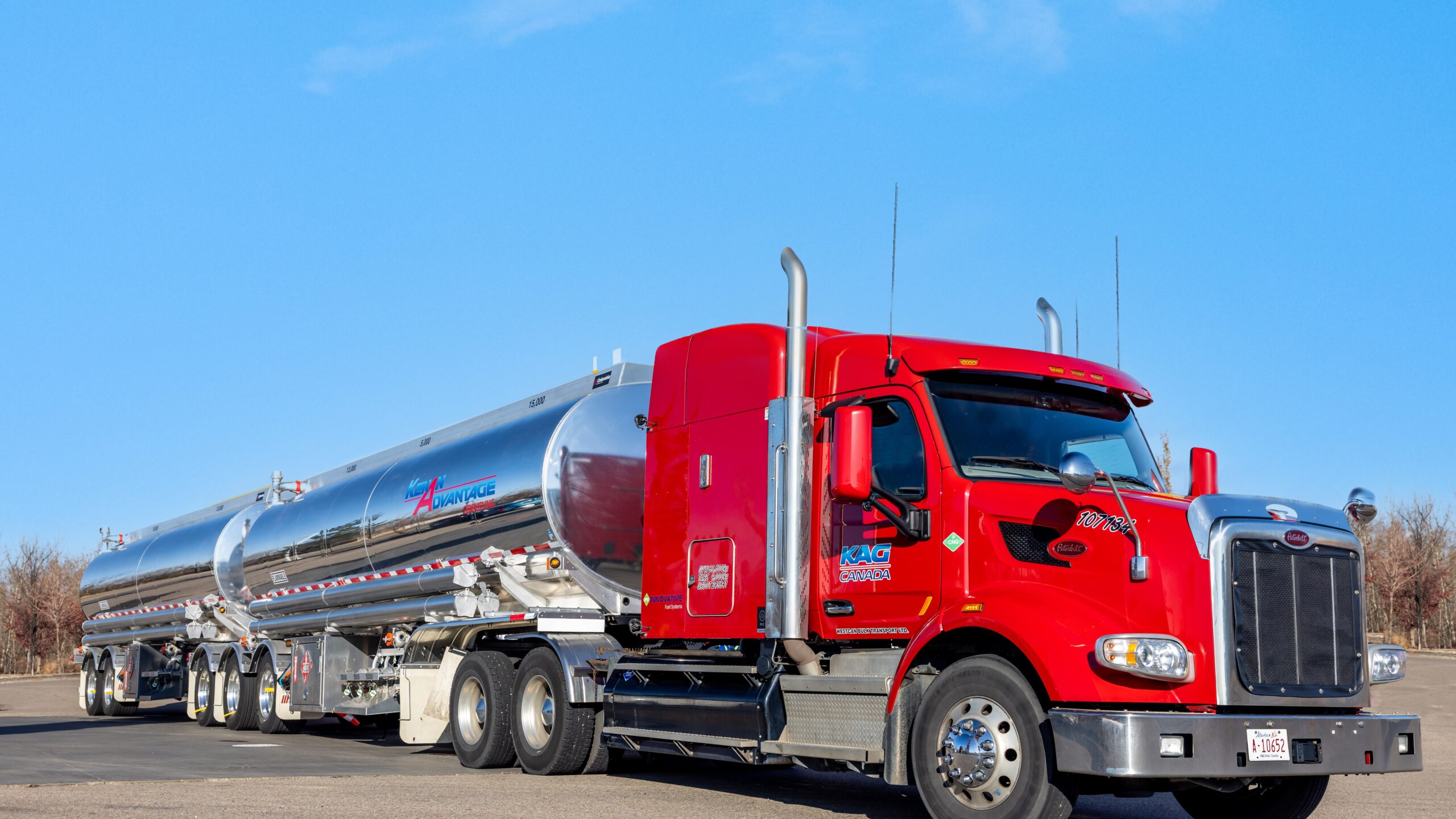
A red KAG Canada tractor pulling two liquid tank trailers

North America’s biggest tank trucking company, Kenan Advantage Group (KAG), announced it has acquired Nova Scotia-based liquid bulk hauler Fisher Transport through its Canadian subsidiary, KAG Canada.

Fisher Transport is a 60-year-old carrier focused on hauling milk along Canada’s Atlantic Coast. In addition to moving 200 million liters (53 million gallons) of raw milk annually, Fisher hauls other food-grade products and chemicals out of three locations in Nova Scotia, New Brunswick, and Newfoundland and Labrador.

The deal includes 60 tractors and 70 specialized trailers and gives KAG new alliances with Canadian dairy farmers.

Financial terms of the transaction were not disclosed.

“Fisher Transport has an excellent reputation within the industry, among their customers, and within their local communities,” said Grant Mitchell, president and chief operating officer at KAG, in a news release. … “Together our team will execute this strategic journey of offering coast-to-coast bulk transportation services to all of our customers.”

Fisher Transport President Jordan MacDonald and Chief Financial Officer Charlie Eisener will remain in senior leadership positions with the company. Fisher Transport’s 60 drivers and operations staff of 15 will also join KAG Canada.

“I look forward to the opportunities that will emerge for the Fisher group of companies and for the valued members of our team by joining KAG, the industry leader in bulk transportation,” said Fisher Transport CEO Ken MacDonald.

North Canton, Ohio-based KAG operates roughly 300 terminals and a fleet of 7,000 tractors. It acquired a bigger presence in the International Organization for Standardization tank services market in March when it acquired MC Tank Transport.

More FreightWaves articles by Todd Maiden:

US trade representative holds second hearing on Chinese ship fees

United States Trade Representative Jamieson Greer will hold a second round of hearings Monday in Washington on port fees for China-built, -owned and -operated ships docking at American ports.

The punitive fees are meant to blunt China’s maritime dominance and help kick-start U.S. shipbuilding.

Public comments ahead of the USTR’s first hearing in April led to dramatic changes, notably from a scheme of blanket charges on all ships to fees based on net tonnage and number of containers carried.

Expectations are that any changes by USTR this time will be less substantial in regard to container shipping. 

“We might expect fewer revisions this time around – simply because the first proposal would be highly destructive to the maritime supply chain servicing the U.S., whereas the second proposal is more manageable from a container shipping perspective – although it still contains problematic elements … for example in relation to car carriers,” said Lars Jensen of consultant Vespucci Maritime in a LinkedIn post.

American exporters of bulk commodities such as grain and soybeans say the fees will make their products less competitive in the global market.

“Individuals don’t pay [directly] to build aircraft carriers; farmers don’t want to pay to build ships,” said Peter Friedmann, executive director of the Agricultural Transportation Coalition. “If we are not competitive on price, buyers will find other markets.”

Jensen said shippers should expect that ocean carriers will attempt to pass on resultant costs in the form of new surcharges.

He added that U.S. companies still face higher costs due to the Trump administration’s proposed new tariffs on containers, cranes, chassis and chassis parts.

Any new changes could go into effect either in mid-October or in 180 days depending on whether USTR revises the implementation date.

Find more articles by Stuart Chirls here.

Related coverage:

Long Beach sees record TEUs on trade war effect

Hapag-Lloyd expects swift China ramp-up after bookings jump 50%

Tariff two-step: After pause, China-US container traffic increases

Maersk looks to fill up corridors in a flash (sale)

Borderlands Mexico: Cargo crime continues to disrupt Mexican transport sector

Borderlands Mexico is a weekly rundown of developments in the world of United States-Mexico cross-border trucking and trade. This week: Cargo crime continues to disrupt Mexican transport sector; Bulkmatic plans $250M intermodal terminal near Monterrey, Mexico; Automotive supplier announces $84M expansion in Mexico; and Amazon plans new delivery station in South Texas.

Cargo crime continues to disrupt Mexican transport sector

Cargo theft remains one of the biggest challenges affecting the trucking industry between Mexico and the United States, transportation stakeholders said.

Mexico’s National Public Security System (SNSP) reported first-quarter cargo theft cases dropped 20% year over year to 1,636 compared to the same period in 2024.

SNSP’s claim of a reduced number of cases has been disputed by the Mexican Association of Private Security and Satellite Industry Companies (AMESIS), which said there were more than 2,000 cargo thefts incidents in just the first two months of the year.

“In robberies, we have one every 33 minutes … so we have a problem there,” Rodrigo Larracilla, secretary for AMESIS, told Reforma.

While the number of cargo thefts across Mexico in 2025 is disputed, SNSP said 81% of reported cases in the first quarter involved violence against drivers.

“Cargo theft continues to be one of the main problems affecting logistics chains in the country,” supply chain visibility firm Overhaul said in its “Mexico: Q1-2025 Cargo Theft Report” released on Tuesday.

Overhaul said 77% of cargo theft incidents in the quarter took place in the central (61%) and western regions (25%) of the country.

The central states of Mexico and Puebla each accounted for 19% of the total cargo theft cases in the quarter.

The states of Guanajuato, Hidalgo, Querétaro, San Luis Potosí and Veracruz all showed increases compared to the first quarter of 2024. 

The three most stolen product types from trucks in the first quarter of 2025 were food and beverages (34%), building and industrial (10%), and auto parts (9%).

The auto parts category increased by 4% year over year, with the most stolen products being

transport cars, tires, and electrical auto parts, Overhaul said.

Cargo theft from trucks in transit was the main tactic used by criminals in the first quarter, accounting for 62.6% of the cases.

Theft from parked trucks was the second most common cargo crime, accounting for 36.8% of

the incidents. Most of these events occurred in high-risk areas for cargo theft such as rest areas or fueling stations.

To protect cargo, Overhaul said transporters should use tracking and monitoring devices that provide real-time visibility into the location and status of loads. 

“In this way, companies can take immediate action to address potential security threats,” Overhaul said.

Bulkmatic plans $250M intermodal terminal near Monterrey, Mexico

Bulkmatic de Mexico recently began construction of a new intermodal terminal in the municipality of Pesquería, Mexico.

The terminal has an initial investment of $250 million and is expected to generate more than 2,300 jobs. Pesquería is on the northern outskirts of Monterrey.

The terminal will handle bulk materials, such as grain, along with food and beverages, plastics, chemicals, and energy, according to a news release. It is expected to begin operations in 2026.

Monterrey-based Bulkmatic de Mexico, founded in 1965, is a transportation and logistics company that operates 14 rail terminals connecting with more than 40 destinations in the country.

Automotive supplier announces $84M expansion in Mexico

China-based Kingfa plans to invest $84 million to expand operations in San Luis Potosi, Mexico.

The investment includes building a manufacturing, research and development complex in the Logistik III Industrial Park in the municipality of Villa de Reyes.

The expansion, scheduled to be completed in 2027, will create 500 direct jobs and enhance the local production chain by attracting more suppliers, officials said.

Kingfa is a global supplier of plastic injection and molding parts for the automotive and consumer products industries. The company operates 20 manufacturing sites across China, India, the U.S., Europe, Malaysia, Mexico and Vietnam.

Amazon plans new delivery station in South Texas

Amazon plans to build a 62,000-square-foot delivery station in Brownsville, Texas. 

The facility will serve as a last-mile delivery hub, receiving packages from fulfillment and sorting centers for final delivery to the local area.

Construction began earlier this month, but officials did not provide a timeline for the facility’s completion. The delivery station is expected to create about 100 jobs.

Amazon recently announced it will spend $4 billion to build more than 200 delivery stations by the end of 2026 to triple the size of its rural delivery network in order to speed up delivery times in more parts of the country.

International Roadcheck tests trucking market

Chart of the Week: Outbound Tender Reject Index, National Truckload Index – USA SONAR: OTRI.USA, NTI.USA

Truckload capacity tightened noticeably during the annual CVSA International Roadcheck inspection period, with tender rejection rates (OTRI) increasing by over half a percentage point in just a few days. The National Truckload Index (NTI), which tracks aggregated dry van spot rates, rose approximately 1.8% over a three-day span. While the full impact of the safety blitz on capacity will take several more days to become clear, early indicators suggest this is the most vulnerable the truckload market has been in years.

The market has not experienced sustained tightening capable of driving consistent upward pressure on transportation rates since 2022. Although there are signs that supply and demand are moving closer to equilibrium, the environment remains challenging, and carrier exits continue at elevated levels.

Roadcheck week provides a unique, short-term pulse check on market conditions. Many drivers and owner-operators opt to take time off during this period, as the risk of being placed out of service or cited for violations outweighs the revenue potential of hauling freight. A stronger reaction to the inspection period typically signals a softer, more fragile market vulnerable to disruption.

Since the Roadcheck period is brief, it functions as a quick stress test for underlying market weakness.

Historical context

In 2021, Roadcheck had a limited effect on the market, as spot rates were increasing at a pace of 1%-2% per week. This created strong financial incentives for drivers to stay on the road despite the inspections.

In 2022, despite a collapsing demand environment, the sheer number of carriers on the road — due to the market being in a transitional phase — muted the impact of Roadcheck.

In 2023, the response was more noticeable, though still marginal and complicated by Memorial Day. Last year marked the most significant reaction to Roadcheck in several years.

Market in waiting

Spot rates have declined by 8% over the past three months, reflecting broader stagnation across the economy and freight sector. In this environment, the primary financial incentive for carriers is simply to stay operational and cover basic costs.

Large fleets are typically less concerned about inspections but may be unexpectedly called upon to cover freight normally handled by smaller operators, who often step back during Roadcheck week. This dynamic puts additional strain on large carriers’ networks and drives up rejection rates.

This year introduces a new variable: The Trump administration has authorized states to enforce an existing rule requiring drivers to speak and read English. While it’s unclear if this was a focal point in this year’s inspections, it likely contributed to an increased number of drivers choosing not to operate, further tightening capacity.

Importantly, the surge in rejections wasn’t driven by demand. The National Outbound Tender Volume Index (OTVI) showed stable tender volumes from shippers to carriers, suggesting the tightening stemmed from the supply side.

Looking ahead

Although impactful, Roadcheck week alone will have limited long-term impact on the difficult conditions facing brokers and carriers. The inspection period lasts only three days, and demand is expected to face continued headwinds in the coming weeks.

However, potential disruptions loom. Import bookings surged this past week following the administration’s softening stance on tariffs with China. This could trigger a wave of inbound freight and a summer uptick in demand. While the impact of Roadcheck will fade, evolving trade conditions and possibly low inventory levels could become the catalyst the transportation industry has been anticipating.

About the Chart of the Week

The FreightWaves Chart of the Week is a chart selection from SONAR that provides an interesting data point to describe the state of the freight markets. A chart is chosen from thousands of potential charts on SONAR to help participants visualize the freight market in real time. Each week a Market Expert will post a chart, along with commentary, live on the front page. After that, the Chart of the Week will be archived on FreightWaves.com for future reference.

SONAR aggregates data from hundreds of sources, presenting the data in charts and maps and providing commentary on what freight market experts want to know about the industry in real time.

The FreightWaves data science and product teams are releasing new datasets each week and enhancing the client experience.

To request a SONAR demo, click here.