Landstar Q4 earnings: First Look

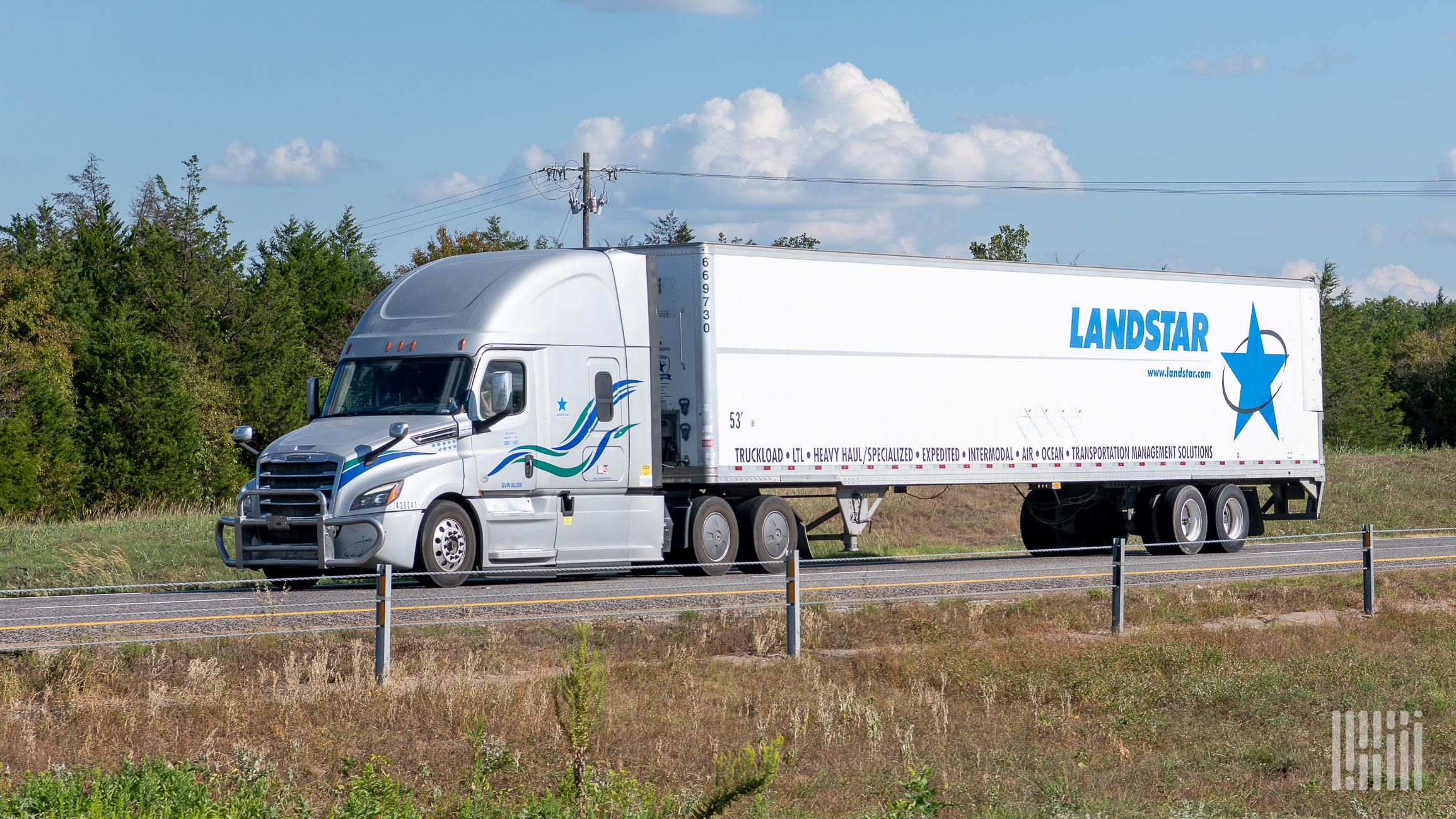
A silver sleeper cab pulling a white Landstar dryvan trailer on a highway

Freight broker Landstar System missed fourth-quarter expectations Wednesday after the market closed.

The Jacksonville, Florida-based company reported earnings per share of $1.31, which fell short of the $1.34 consensus estimate. Management’s guidance range was $1.25 to $1.45.

Revenue of $1.21 billion was up 0.4% year over year and slightly ahead of the $1.2 billion consensus estimate (in line with management’s forecast of $1.15 billion to $1.25 billion).

Total loads hauled by truck fell 3.4% y/y (compared to management’s forecast of down 4% to up 1%). Revenue per load was up 3.1% (compared to guidance of flat to up 4%).

Click for full article – “Landstar stuck between cycles; Q1 guidance disappoints”

SONAR: The National Truckload Index (linehaul only – NTIL) for 2025 (blue shaded area), 2024 (green line) and 2023 (pink line). The NTIL is based on an average of booked spot dry van loads from 250,000 lanes. The NTIL is a seven-day moving average of linehaul spot rates excluding fuel. To learn more about SONAR, click here.

Landstar (NASDAQ: LSTR) issued first-quarter EPS guidance of $1.05 to $1.25, well shy of the $1.36 consensus estimate. A revenue forecast of $1.075 billion to $1.175 billion was also below consensus of $1.19 billion.

Loads hauled by truck are expected to be 7% to 2% lower y/y in the first quarter, with revenue per load 2% lower to 3% higher y/y.

Landstar will host a call to discuss fourth-quarter results with analysts at 4:30 p.m. EST on Wednesday.

Click for full article – “Landstar stuck between cycles; Q1 guidance disappoints”

Table: Landstar’s key performance indicators

More FreightWaves articles by Todd Maiden:

Check Call: Global supply chains hurry up and wait on possible tariffs

people gathered around a desk of computers. Check Call news and analysis for 3pls and brokers

(Gif: GIPHY)

It’s been a little over a week under a new presidential administration, and with it come changing rules, regulations and just about everything else at breakneck speed. Focusing on supply chain impacts proves to be a bit of a wait-and-see exercise.

Along the campaign trail, there were promises of imposing tariffs on Mexico, Canada and China. Most of those promises have yet to come to fruition. That’s left a majority of those in the global supply chain wondering what is in store for the future and how to plan around potential hurdles.

As of right now, there are no new tariffs on goods coming into the U.S. The normal tariffs are still in play, and the International Trade Administration can help sort out what the current tariffs for goods are. 

The future? Well, that is where things get a little messy. There are threats of tariffs, according to CNN: “25% tariffs on all imports from Mexico and Canada, anywhere from 10% to 60% across-the-board tariffs on China and 10% or 20% tariffs on everything else that comes into the United States.”

The when of it all is still very much up in the air.

There is some clarity as to the goods that could be affected by a potential tariff first. As quoted in a CNN article, “We are going to look at pharmaceuticals, drugs. We are going to look at chips, semiconductors, and we are going to look at steel and some other industries and you are going to see things happening,” President Donald Trump told House Republicans.

A consensus has emerged among supply chain professionals on how to prepare for whatever a tariff rate might be whenever it takes place. Global supply chains can’t keep waiting in limbo, and a Kuehne + Nagel webinar, “Navigating the Unprecedented Global Trade Disruption,” drew 1,500 people to get a picture of the future.

An article by FreightWaves’ Noi Mahoney noted, “While [Greg] Tompsett [vice president of customs brokerage USA at Kuehne + Nagel] believes the threats could be a bargaining tactic, he said if they are implemented on Saturday, shippers will need to immediately take stock of what goods they have in the supply chain.

“What is already out on the water,” Tompsett said. “What purchase orders have already been booked? What are things that we can’t really change or shift, and what temporary options do we have to buy us a little time? Can we move something in bond – that’s where it hasn’t technically been imported yet, but it gets in and we set it off at a bonded warehouse, and we can keep it at bay for a little bit – and what’s that cost? Can we defer or hold off importing it? Do we have the ability to move it in a foreign trade zone – those are things we’ll be looking at.”

It’s now a matter of how well global shippers can plan and adapt to ever-changing components of their supply chains. 

SONAR TRAC Market Dashboard

TRAC Tuesday. This week’s lane is going from Chicago to Kansas City, Missouri – a solid 507 miles of Midwestern roads and endless cornfields. The per-mile rate for this lane is $2.57, which is 17 cents above the National Truckload Index of $2.40. Chicago is experiencing significant market tightening as outbound tender rejections have risen to 8.45%, a 1.39% increase week over week. Kansas City on the other hand has some tightening  but has consistently been seeing an OTRI above 10% since mid-December. Current outbound tender rejections are at 12.84%, indicating an inflated spot market. 

Spot rates for this lane are maintaining their higher-than-average rate and will continue to do so as long as the OTRi in KC stays above 10% and Chicago continues to experience extreme tightening. Loads originating in either location will likely be trickier to cover than most. Let shippers know that outbound tender lead times will need to be increased. 

(Gif: GIPHY)

Who’s with whom. The one downside of a global supply chain is that when there is a massive cultural holiday in one region, parts of the world essentially shut down. In the same way the U.S. closes up shop for the Fourth of July, Thanksgiving and Christmas, Asia is having that moment right now with the Lunar New Year. This is the Year of the Snake and according to Chinese mythology, “Snakes are also known as ‘little dragons,’ and the skin they shed is known as ‘the dragon’s coat,’ symbolizing good luck, rebirth and regeneration. The snake also symbolizes the pursuit of love and happiness.”

I’m not sure how love and happiness will tie into global supply chains. As major operations in China, Vietnam, Korea and other Asian countries are shut down in celebration of the holiday, there is a lack of happiness in other countries waiting on Asian-produced goods. 

Most shippers affected by the disruption should have already made plans. Whether that involved pulling freight forward or alternating a production schedule, it should be squared away by now. If not, well that shipper is about to have a bad few weeks. 

Imports on the West Coast ports are poised to see a decline in volume, which means those carriers might be available and looking for surplus freight. The Asian ports are either closed or working in an extremely limited capacity for the next two to three weeks as people travel for the holiday.

The disruption should be fully resolved by Feb. 12 as that is the official end of the new year period and everyone is to return to work. That said, it can take longer for factories, ports and other businesses to return to business as usual.

The more you know 

Western Express prevails at federal appeals level in ‘wall of water’ case ATA saw as important 

Logistics workers charged with importing $200M in fake goods via LA, Long Beach ports 

US cross-border freight stalled in November

Senate debates ways to gain leverage over Panama Canal

Southern California softness cited for 2024 drop in logistics real estate rents

J.B. Hunt builds 40-acre solar farm to power headquarters

Spilt screen of JB Hunt headquarters in Lowell, Arkansas and new solar farm in Gentry, Arkansas

J.B. Hunt Transport Services announced Wednesday that it has built a solar facility to power its corporate headquarters in Lowell, Arkansas.

The multimodal transportation provider said a facility in nearby Gentry, Arkansas, will be capable of powering 80% of its main campus, which includes three buildings. The 40-acre solar field has nearly 18,000 panels and more than 10,000 bi-facial solar panels, which capture sunlight and produce power on both sides of the panel.  

Approximately 9.3 million kilowatt hours of electricity are expected to be produced annually at the location. Electricity harvested is being transmitted to a local power grid for the Carroll County Electric Department.

Construction on the site began last year. The new location is part J.B. Hunt’s (NASDAQ: JBHT) sustainability initiative to reduce carbon emissions by 32% from 2019 to 2034.

“The annual amount of clean energy generated by the J.B. Hunt Solar Facility will be equivalent to that used by nearly 1,200 homes,” said Greer Woodruff, J.B. Hunt’s executive vice president of safety, sustainability and maintenance. “And, by drawing power from the sun and not a carbon-based source, the carbon dioxide kept from entering the atmosphere will be equivalent to eliminating 1,400 passenger vehicles from the road each year.”

More FreightWaves articles by Todd Maiden:

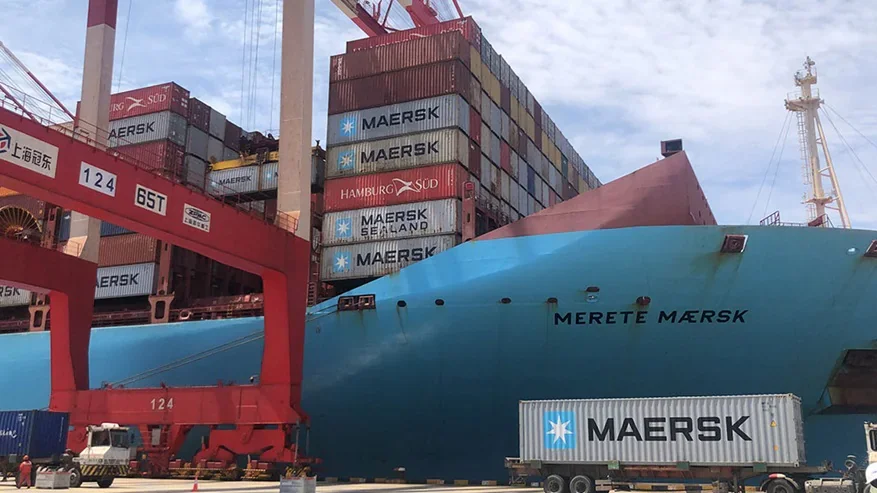
Maersk wins China cargo relay extension

Maersk has won an additional two years for domestic container transshipments between ports in China.

China’s Transport Ministry this week announced an extension of the pilot cabotage program through December 2027.

The program aims to improve domestic export and import container flows between Yangshan port in Shanghai and select ports in northern China. It will also give Maersk (MAERSK-A.CO) more service options in Asia. 

A Maersk spokesperson confirmed the extension in an email to FreightWaves. The Copenhagen, Denmark-based company has handled transshipment relay volume of 100,000 containers since May 2022.

The Shanghai container port complex is the world’s busiest; in 2024 it became the first hub to handle 50 million twenty-foot equivalent units in a single year. 

Cabotage historically has been a tool to protect domestic cargo and passenger transportation within a country’s borders from foreign competition. 

Aiming to boost international shipping through Shanghai, China announced the cabotage plan in 2019, permitting foreign-owned ships to haul relay cargo between Yangshan and Dalian, Tianjin and Qingdao.

Liner operators in the past used Busan in South Korea, as well as Singapore and other ports, for transshipment.

Find more articles by Stuart Chirls here.

Related coverage:

Asia-US ocean rates trend lower but Trump tariff threats shadow trade

Los Angeles, the busiest US container port, plans even bigger future

Red Sea now a ‘case-by-case basis’ for CMA CGM

Love’s in California: Gauging impact of Advanced Clean Fleets rule demise

When Love’s Travel Stops announced a new location in Bakersfield, California in August, it was not only a new travel stop in its network. It added 111 parking spots and was described as one of the biggest outlets in the Love’s network. 

But it also raised a question: Why build a travel stop that dispenses diesel fuel as a major part of its business in a state that had a pair of regulations in place, the Advanced Clean Trucks (ACT) rule and the Advanced Clean Fleets (ACF) rule, that were designed to mostly eliminate diesel use in more than 20 years?

That question is moot, at least for now, with the recent decision by the California Air Resources Board to withdraw its request for a waiver from the Environmental Protection Agency that would have cleared the decks for the ACF to proceed. The ACT is still in place, but its effectiveness has been brought into question given that the ACT’s mandate for truck suppliers to sell zero-emission vehicles into California may run up against the fact that there is, for now, no mandate to buy them. 

In what is becoming an annual discussion with the media about the company’s plans for the coming year, Love’s President Shane Wharton said the company is still reviewing the demise of the ACF and its impact on customers. 

But he also indicated that the ACF was not a factor in deciding to build a big new travel center in Bakersfield.

The highway hospitality business

“The way we look at it is we’re in the highway hospitality business,” Wharton said. “We’re in the business of taking care of customers on the road. So we know what the customers are using [for fuel] today, and we know what they will be transitioning to, whether it’s an electric vehicle or hydrogen. So it’s a combination of being ready for that. And whatever our customer needs, we have always said, that’s our business.”

Wharton said Love’s will “continue to build in the right places to be” and will be ready to transition on the fuel side when that need occurs.

Love’s actually has a hydrogen subsidiary: Trillium. Trillium has hydrogen fueling facilities at four Love’s facilities in California and one near Urbana, Illinois. Trillium is not operating any public fueling stations; all the customers are private. Its experience with hydrogen through Trillium is part of what Wharton said is “just having to be prepared to provide the products and services our customers need.”

20 new locations, a lot of rebuilding

Wharton’s presentation is an opportunity for it to lay out the company’s construction plans as well. Love’s is planning on opening 20 new stores in 2025 and will begin updating 50 existing outlets under what it calls its Strategic Remodel Initiative. The SRI involves extensive remodeling, not just on the margins.

The pace of new construction and remodeling means Love’s is on track to have what amounts to new or redesigned facilities at more than half its 655 outlets by 2035.

Love’s truck parking is free. Wharton said the company plans to add about 1,000 parking spaces this year, in line with what the company projects most years.

Wharton, asked how much of that parking capacity is utilized each day, said Love’s does not have a direct technology tracker of its parking spots to know how many are occupied at any given time but has “explored and talked about some technology solutions that would track that and report it out.”

But he said on an average evening, all of those spots, now approaching 50,000 through the network, are being utilized.

“Days of the week can matter but not dramatically, because the truck traffic is so heavy,” Wharton said.

Growth in factoring

When Wharton was asked about acquisition activity, he gave a standard response of “We’re always looking at opportunities to build our travel stop network.” But when he got specific, he turned to factoring as a likely area of growth.

Love’s did make one factoring acquisition in 2024: REV Capital. Wharton made clear the company is looking to build that factoring group. 

“Our freight factoring business is something that we’ve been aggressively growing,” Wharton said. “We did an acquisition in 2024 to add to that book of business, and we think there could be some opportunities in 2025 in that space.”

Among other developments he discussed:

  • The company is a sponsor of the NBA’s Oklahoma City Thunder, located in the same city where Love’s is headquartered. A Love’s patch is visible on all the jerseys of the players. “It’s turned into a pretty decent recruiting tool in terms of people noticing it and the size and scale of the presence that we have here in Oklahoma City,” Wharton said. But the Love’s sponsorship also helps give the company exposure when the Thunder games are broadcast elsewhere, which they are increasing this year; at this writing, the Thunder have the best record in the NBA.
  • It won’t help fuel any Class 8 trucks, but Wharton and a company news release said Love’s received a grant of $83 million to build chargers in 13 states. Fast-charger construction is expected to start this year in eight states.
  • Love’s hired 250 veterans last year and will try to increase that by 10% this year. “We’ve also launched a hire program for military spouses, so we have our talent acquisition team that’s out attending recruiting events across the country to help us attract and get the right talent on the team,” Wharton said.

More articles by John Kingston

Western Express prevails at federal appeals level in ‘wall of water’ case ATA saw as important

Drivers settle class action with Lytx over in-cab surveillance, data gathering

Connectivity, generative AI’s impact key supply chain software themes at NRF ’25

Texas Gulf Coast ports see year-over-year gains in freight volumes

Ports in Houston and Corpus Christi, Texas, reported increased year-over-year cargo movements in 2024 versus 2023. 

New Orleans, which did not provide year-end totals for 2024, recorded increased container volumes for the month of December.

Port Houston breaks cargo volume record in 2024

Container volumes at Port Houston rose 8% year over year to a record 4.14 million twenty-foot equivalent units in 2024 versus 2023.

Port Houston also handled a record 53 million tons of cargo at its two public terminals in 2024, up 6% year over year from 2023.

The Bayport and Barbours Cut container terminals also received 4.53 million short tons of steel, the second-highest amount in five years and the third-highest in the past decade, according to a news release.

“It was just a spectacular year,” Charlie Jenkins, CEO of Port Houston, said during the port’s monthly commission meeting on Tuesday. “Loaded exports were up 8% and our loaded imports, which are primarily consumer goods, were up 6%. In 2024 we also made a lot of investment in equipment and infrastructure. Our total capital investment was $630 million last year.”

In December, the port handled 340,418 TEUs compared to the same month last year, a 4% year-over-year increase.

Loaded exports surged 12% year over year to 135,446 TEUs. Loaded imports fell 1% year over year in December to 149,396 TEUs.

Steel imports saw a 4% year-over-year drop for the month to 343,884 short tons.

Empty container imports increased 24% year over year to 19,082 TEUs, while exports of empty containers fell 8% year over year to 36,494 TEUs.

Ship calls for December totaled 701, compared to 700 vessels last year. Barges calling Port Houston decreased 1% year over year to 310.

Port of Corpus Christi cargo volumes up 1.7% in 2024

The Port of Corpus Christi reported a 1.7 % increase in cargo tonnage in 2024 to 206.5 million tons compared to 2023.

Leading commodities at the port for the year included crude oil, refined products and liquefied natural gas.

Crude oil shipments increased 3.5% year over year to 130.5 million tons in 2024. Dry bulk and agricultural goods increased 8.1% and 39%, respectively.

In December, Corpus Christi handled 18.4 million tons of cargo, a 4% year-over-year increase compared to the same year-ago month.

Total shipments of crude oil fell 7% year over year at the port in December to 11.2 million tons.

Exports of crude oil totaled 10.7 million tons, a 5% year-over-year decrease. Imports fell 16% year over year to 742,997 tons.

Petroleum shipments decreased 2% year over year to 5.6 million tons, while exports fell 2% year over year to 4.5 million tons during the month.

Dry bulk cargo rose 83% year over year in December to 926,508 tons, while shipments of chemicals decreased 29% year over year to 369,139 tons.

The Port of Corpus Christi had 428 barge calls in December, a 14% year-over-year decline. Ship calls totaled 215, the same number of ships calling in December 2023.

Port of New Orleans reports 5% increase in container volumes 

The Port of New Orleans saw a 5% year-over-year increase in container volume to 39,432 TEUs in December.

The port did not provide year-end totals for 2024.

Container cargo volumes during December consisted of exports of plastic resins, chemicals and paper. Coffee and chemical products were the main imports.

The Port of New Orleans recorded breakbulk tonnage of 81,616 short tons in December, a 1% year-over-year decrease. Imports of steel and lumber were the top breakbulk commodities during the month, port officials said.

In December, the port handled 8,194 Class I railcar switches, a 6% year-over-year decrease from December 2023. The port handles switching operations for six Class I railroads: BNSF, CN, CSX, CPKC, Norfolk Southern and Union Pacific.

Willy Wonka of the Midwest talks chocolate and the Valentine’s Day supply chain | WHAT THE TRUCK?!?

On Episode 797 of WHAT THE TRUCK?!?, Dooner is talking to all about chocolate and the Valentine’s Day supply chain with Bissinger’s Chief Chocolate Officer Dan Abel Jr. With Valentine’s Day just two weeks away, we’ll find out how this more than 300-year-old chocolatier is filling mailboxes and relationships with the best handcrafted chocolates in the nation. 

Harbor Trucking Association CEO Matt Schrap gives us the down and dirty on the drayage scene in California. With the Advanced Clean Fleets waiver now officially withdrawn by Trump, what does this mean for fleets serving some of America’s busiest ports?

Plus, $200 million Chinese smuggling ring busted at Southern California ports; judge blocks Trump funding freeze; BelugaST goes belly-up and more.

Catch new shows live at noon EDT Mondays, Wednesdays and Fridays on FreightWaves LinkedIn, Facebook, X or YouTube, or on demand by looking up WHAT THE TRUCK?!? on your favorite podcast player and at 5 p.m. Eastern on SiriusXM’s Road Dog Trucking Channel 146.

Watch on YouTube

Check out the WTT merch store

Visit our sponsor

Subscribe to the WTT newsletter

Apple Podcasts

Spotify

More FreightWaves Podcasts

Norfolk Southern touts operational, service and financial improvement

ATLANTA — Norfolk Southern is back.

That was the message CEO Mark George and the railroad’s executive team delivered on the fourth-quarter earnings call Wednesday. They emphasized how operational improvements helped NS meet or exceed the financial targets it set amid last year’s nasty proxy battle with activist investor Ancora Holdings.

“Our network is running fast, our terminals are efficient. Service metrics are as strong as they have ever been. Our customers are noticing and rewarding us with more business, and we continue to exercise strong cost discipline,” George told investors and analysts on the call. “When you put it all together, we delivered a Q4 that was in line with the guidance we gave, wrapping up a year where we delivered or exceeded on all the commitments we made.”

The operational improvements included boosting average train speed by 10%, reducing terminal dwell by 15%, cutting the unplanned recrew rate by 20% and storing 500 locomotives even as traffic increased 5% for the year.

Running a faster, more fluid railroad produced $300 million in cost savings, which was $50 million above the target set in the spring. Even though annual revenue declined by 2% due to slumping coal rates and volume, NS was able to top its operating ratio goals.

“It’s not just the financial results that are worth celebrating,” George said. “Our safety metrics improved dramatically throughout the year.”

Norfolk Southern’s overall Federal Railroad Administration train accident rate improved 27% for the year, while its mainline accident rate declined by 44%. The personal injury rate rose, however, by 5% for the year.

Chief Operating Officer John Orr says the NS Precision Scheduled Railroading 2.0 operating model delivered both efficiency and service improvements.

“We finished the year very strong, culminating with a successful intermodal perfect peak season, year over year, handling 7% more parcel volume per day with zero controllable failures,” Orr says.

Overall, the railroad’s intermodal service composite was up 7 points for the quarter, to 86%, while merchandise trip plan compliance was up 6 points, to 80%, compared to a year ago.

“We now have reliable service that’s consistent, resilient and is built to grow in the market,” Chief Marketing Officer Ed Elkins said.

Fourth-quarter volume was up 3% overall thanks to a 5% increase in intermodal traffic. Merchandise volume was flat, while coal was down 1%.

The railroad’s volume outlook for this year is clouded by uncertainty over potential tariffs. “The potential for new tariffs will introduce some near-term uncertainty into many markets that we serve,” Elkins says. “Despite these uncertainties, we are confident that we’re well positioned to recapture market share.”

Nonetheless, Elkins expects to see intermodal and merchandise traffic growth this year as the railroad regains business lost due to service problems that followed the East Palestine, Ohio, hazardous materials derailment in 2023.

“We expect growth in most of our markets,” he said. “Coal is really the only place where we see a lot of overt weakness.”

Orr says he expects to see continued operational and service improvements this year. NS will refresh its operating plan this quarter by reducing car handlings and tightening standards for terminals and car connections. The railroad also will focus on fuel efficiency and mechanical improvements.

A “need for speed” war room aims to reduce bottlenecks that can slow service and hurt fuel economy. “They are now turning their attention to challenging every permanent and temporary slow order to actively reduce stops and drive additional fuel efficiencies over the road,” Orr said.

In light of three of Ancora’s candidates being elected to the NS board in May, George was asked about the board’s dynamics and priorities.

“Our board has been really remarkably unified. They came from different avenues. We’ve got a lot of new board members. The majority of them are within the past 18 months, yet they’ve all congealed in a beautiful way in the boardroom,” George said. “And I’m really pleased to see the engagement from all quarters and the mutual respect that’s being shown given everybody’s unique background.”

He says the board remains united behind the management team and the railroad’s Better Way strategy, which aims to boost volume and profits by ensuring that service remains consistent and resilient through economic peaks and valleys.

The NS financial outlook for 2025 includes 3% revenue growth, generating $150 million in productivity savings, and improving operating ratio by 1.5 points. The capital plan includes $2.2 billion in spending. NS will resume share buybacks this quarter after pausing them in the wake of the East Palestine wreck.

Adjusted for the impact of one-time events – including line sales and line items related to the $2.2 billion East Palestine derailment – the railroad’s full-year operating ratio improved 1.6 points to 65.8%. For the second half of the year, adjusted O.R. was 64.1%, a 4.8-point improvement that was in line with the railroad’s expectations.

On an adjusted basis for the fourth quarter, operating income increased 11%, to $1 billion, as revenue declined 2%, to $3 billion. Earnings per share grew 7%, to $3.04. Operating ratio improved 3.9 points to 64.9%.

The Super Bowl LIX supply chain

After an exciting season of helmet-crushing football, we finally know who’s going to play in one of sports’ top events in North America. The Philadelphia Eagles and the Kansas City Chiefs will face off in the Super Bowl on Feb. 9 in New Orleans.

The best players in the NFL do not always make it to the Super Bowl. You can ask Joe Burrow of the Cincinnati Bengals, who led the league with 4,918 passing yards. Or Jared Goff from the Detroit Lions, who threw for 39 touchdowns, the most in the league. Or even Lamar Jackson from the Baltimore Ravens, who had an impressive 119.6 passer rating, demonstrating exceptional efficiency.

The Baltimore Ravens had the best offense, with a league-leading average of 424.9 yards per game, while the Lions had the highest-scoring offense, averaging 35.3 points per game. On the other hand, the San Francisco 49ers posted a league-best defense, allowing only 276.4 yards per game. Yet they didn’t make it to the Super Bowl, either. The Buffalo Bills just narrowly lost to the Kansas City Chiefs. Buffalo had the stingiest defense, giving up just 19.6 points per game. But they were beaten by the Chiefs, who lead the AFC with a 15-2 record.

Just as in football, supply chain is a team sport. Individual stars do not make the best supply chains, which are truly collaborative in nature. Only the best teams have the most efficient supply chains. The Super Bowl is an incredible sporting event requiring incredible planning and coordination. But it is also a logistical feat of epic proportions. Here are some behind-the-scenes facts that show the sheer scale of operations needed to pull off a Super Bowl.

It takes a caravan of trucks to transport everything needed for the game and halftime show. The actual playing field often travels on refrigerated trucks to ensure pristine condition. The halftime show stage, lighting, sound systems and props require dozens of trucks. Each team has its own gear, requiring dedicated trucks for transport. With millions of fans watching on TV, the food and drink supply chain is massive. Hundreds of trucks bring concessions to the site of the game itself, with enough hot dogs, burgers, popcorn and more to feed a small city. And in-person and remote viewers consume millions of gallons of beer, soda and water.

Logistical planning for the Super Bowl starts years in advance and involves coordination among the NFL, the host city, vendors and transportation providers. Technology plays a crucial role in managing the complex logistics, including transportation management systems for route optimization and tracking, warehouse management systems for efficient inventory management, and real-time visibility tools for monitoring shipments and ensuring on-time delivery. The NFL has increasingly focused on sustainability initiatives, including recycling, waste reduction and the use of renewable energy sources.

New Orleans is a great city, which people love to visit for yearly events like Mardi Gras and the New Orleans Jazz & Heritage Festival. This year it is the host of the Super Bowl for the 11th time. This ties New Orleans with Miami for the most Super Bowl hosting gigs. The last time New Orleans hosted was in 2013 for Super Bowl XLVII. The Baltimore Ravens defeated the San Francisco 49ers 34-31 in that game. The Caesars Superdome (formerly the Louisiana Superdome) will host its eighth Super Bowl, making it the stadium with the most Super Bowls under its belt.

New Orleans is a great and fun city, but it also faces multiple risks that pose challenges to the Super Bowl and its supply chain. New Orleans is prone to hurricanes and other natural disasters. It requires close monitoring of weather forecasts and having contingency plans in place for potential disruptions as well as developing and communicating clear evacuation plans in case of emergencies.

Other risks include terrorist threats – the attacks in New Orleans on New Year’s Day killed 14 and hurt 35 people – as well as security breaches, crowd-related incidents, and potential disruptions due to protests or civil unrest. It requires coordination of law enforcement, private security and cybersecurity experts to secure the safety of attendees, players and staff, while managing potential threats and disruptions. Cybersecurity measures are put in place to protect against cyberattacks that could disrupt event operations, compromise data or impact critical infrastructure.

This year’s Super Bowl will see the introduction of some new technologies, from enhanced cellular connectivity to advanced camera technology for broadcasting, as well as integrated security systems. Drones equipped with cameras and sensors will provide aerial surveillance and real-time situational awareness. Facial recognition technology will be used to enhance security and identify potential threats. Real-time monitoring of social media will help identify potential security risks and manage public safety. While not confirmed, it’s possible that AI and machine learning are being used behind the scenes to optimize logistics operations in real time for dynamic routing of delivery trucks based on traffic conditions, predictive modeling to anticipate potential bottlenecks and adjust resource allocation, and AI-powered security systems to detect and respond to potential threats.

Comparing the Super Bowl’s supply chain to that of a large manufacturing company reveals fascinating similarities and stark contrasts. Both involve intricate networks, but their scale, focus and challenges differ significantly. The Super Bowl requires planning and coordination, logistics and transportation, technology, and risk management just as modern-day supply chains of manufacturing companies. But the Super Bowl is a single event with a highly predictable demand that sees a massive surge in a short period and that relies on a diverse group of suppliers, making it highly complex. Its success is not measured by cost efficiency, but by fan satisfaction, safety and smooth execution.

Whether you are attending the Super Bowl in person or watching it with family and friends, enjoy this epic battle and let’s hope the event will not be impacted by hurricanes, floods, snowstorms or fires that have impacted much of the United States in recent weeks and months.

Look for more articles from me every week on FreightWaves.com.

Bart A. De Muynck

Strategic adviser

Freight markets improve slower than carriers would like

Trucking market still on track to tighten, but progress only gradual

While most evidence still suggests that freight markets are on a path toward tightening, comments by public carriers so far this earnings season highlight the lack of an immediate inflection. As JP Hampstead described in his article earlier this week, “progress in tightening capacity and rising rates is halting and gradual.” Knight-Swift, the largest U.S. truckload carrier, reported a 0.7% decline in truckload revenue per loaded mile despite a major efficiency effort that included a 6% reduction in its number of tractors in service. SONAR data that suggests the market is still on a trajectory toward tightening include rising tender rejection rates, which are high relative to January the past two years, and rising spot rates, resulting in a narrower spread to contract rates. It’s worth noting that an increase in demand, which typically occurs in March, may be what the market needs to break out of its seasonal depression

Spot rates have risen to be $0.40/mile below contract rates, on average. That is within the normal range, giving credence to the view that the freight recession is over. (Chart: SONAR

Rail intermodal contract rates may not rise sharply until 2026

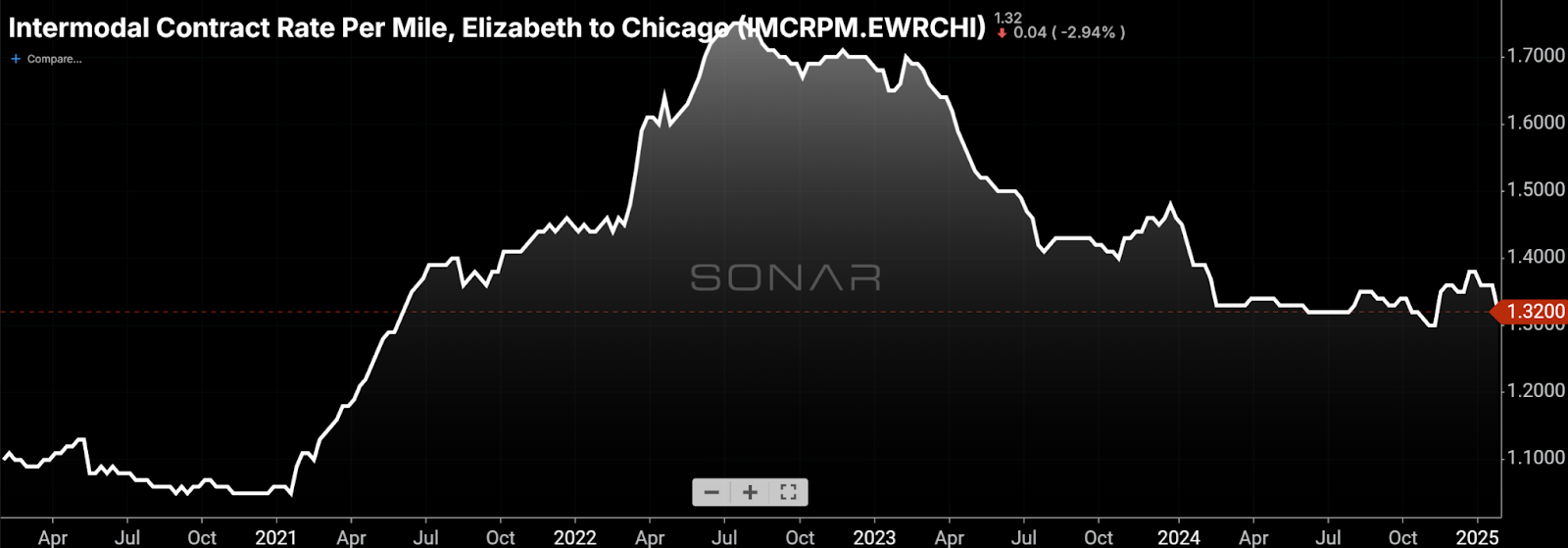
Domestic intermodal contract rates, including fuel, in the Chicago to Newark lane started the year below early 2023 and 2024 levels. CSX suggests that major rate increases may not be felt until early next year. (Chart: SONAR

That was the main takeaway from eastern Class I railroad CSX’s earnings call last week. The truckload market is highly competitive with the intermodal market in the eastern U.S., where CSX competes, and according to executives at the railroad, “the truck cycle has yet to inflect.” While CSX is guiding analysts to positive intermodal volume growth this year which includes conversions from truckload to intermodal, it cautioned analysts about how its pricing lags market dynamics. Shorter intermodal contracts are one-year in duration and a large portion of the contracts roll over early in the year, so while there may be some pricing momentum this year, according to the railroad, the bigger impact could be felt next year. 

Will deportations lead to a labor crunch? 

(Image: FWTV) 

On Monday’s The Stockout show, in addition to a discussion on Trump’s executive orders, inventory and labor, Grace Sharkey and I debuted a new segment titled, “Who asked for this?” 

(Image: People.com) 

The aim of the new segment is to highlight a newly introduced CPG item each week that the audience at large has not heard of. This week, it was Totino’s pizza-flavored Cinnamon Toast Crunch, which is only available online. While largely for comedic relief, the segment also highlights an emerging trend in the CPG industry of introducing new eye-catching products to spur excitement and demand. That reflects a departure from the strategy in recent years which largely involved frequent price increases and reducing the number of SKUs to focus on those with the fastest turn times. Most mid-range CPG items appear to have reached a point at which further price increases will be met with resistance, both from retailers and customers defecting to private labels. Exceptions will largely be items where CPGs can clearly demonstrate to retailers that there is significant inflation in a key ingredient, such as cocoa.