FRA approves first autonomous railcar test program

WASHINGTON — The Federal Railroad Administration will allow Parallel Systems to test its autonomous, self-propelled flatcar system on a pair of Genesee & Wyoming short lines in Georgia.

The FRA last week approved the request from Parallel, Georgia Central Railway and Heart of Georgia Railroad. In August 2023, Los Angeles-based Parallel and the G&W railroads sought FRA permission to test the battery-electric container cars, which target short-haul intermodal markets.

The agency’s Railroad Safety Board reviewed the waiver petition and supporting documentation, attended a demonstration at the MxV Rail test facility in Pueblo, Colorado, and conducted a public hearing.

“The Board has determined that granting the Petitioners’ request for relief for the purpose of performing the testing, related to the petition for a pilot test program, is in the public interest and consistent with railroad safety,” Karl Alexy, the FRA’s associate administrator for railroad safety, wrote in a Thursday letter to Georgia Central Railway President James Irvin.

It was not immediately clear when the pilot program would begin. Trains News Wire has sought comment from G&W and Parallel.

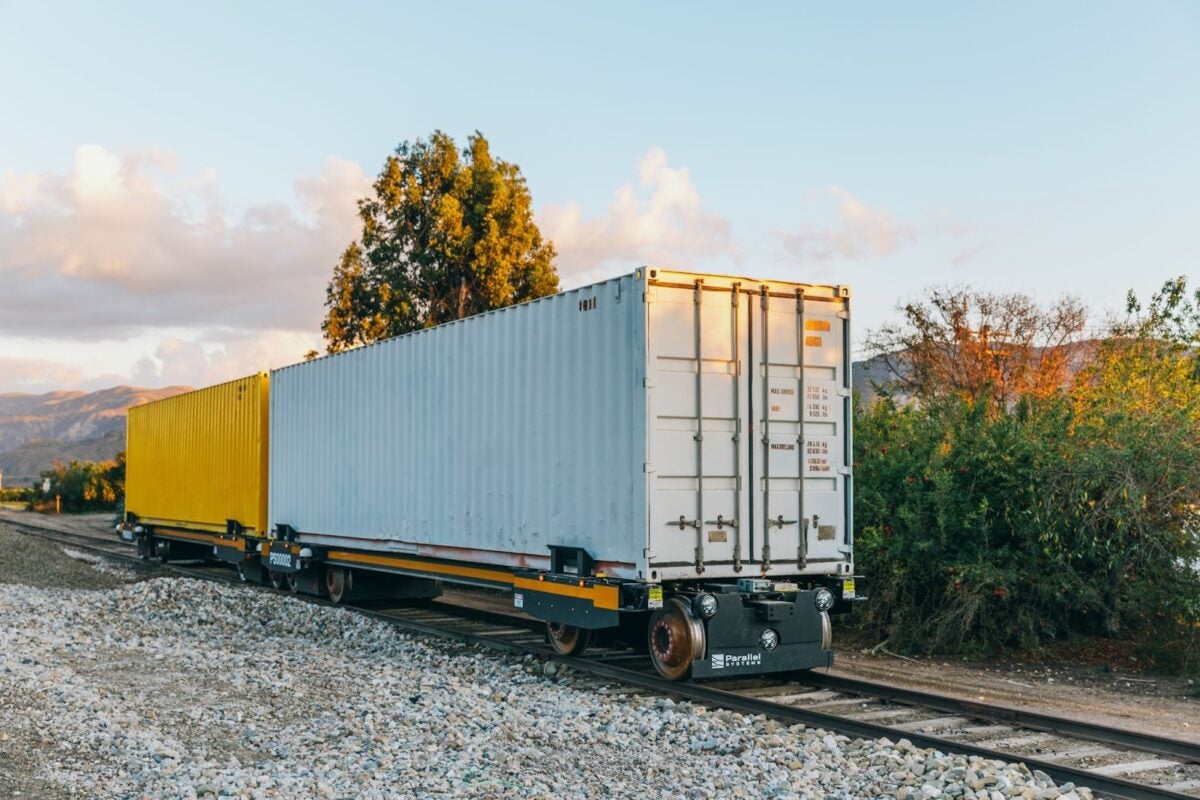
Parallel’s prototype flatcar can carry one intermodal container 500 miles on a single battery charge. The batteries in each truck power the car’s traction motors. The autonomous system relies on cameras and sensors, as well as software in computers on board the car and at a data center. Electronic brakes can bring cars to a stop in one-tenth the distance of conventional equipment with air brakes.

The approval grants Parallel, Georgia Central and Heart of Georgia railroads 22 waivers from car and locomotive regulations that cover everything from cabs and sanders to brake valves and uncoupling levers. The decision includes 23 conditions that Parallel and the railroads must follow during the pilot program.

Parallel and G&W plan a seven-phase test program. The complexity of the operations will increase with each phase. The FRA must deem each phase successful before the companies can move on to the next phase.

The FRA received 154 comments during the public comment period. Of those, 32 supported the pilot program while 122 raised concerns.

“Although many of the public comments were directly related to safety, many comments, both supporting and opposed to the proposed program, are relevant only if this type of operation were to be approved to operate on the general railroad system, but are not relevant to this specific pilot test program,” Alexy wrote. “These comments will certainly be important when/if railroads seek approval for further testing or to operate.”

Parallel and the G&W short lines have said safety is the first priority of each phase of the test program.

Parallel’s battery-electric cars — which can run alone or together as an autonomous platoon of up to 50 cars — can each carry a single container. They can operate at up to 25 mph and tackle grades as steep as 3%. They’re also undergoing testing in Australia.

“These design features are intended to help railroads better compete against trucks in the short-haul movement of intermodal containers rather than to replace conventional railroad rolling stock,” the application says.

The tests aim to evaluate the three primary components of the Parallel system: the autonomous vehicles themselves, the user terminals that allow people to control the equipment, and the computer servers that send data between the vehicles and the user terminals.

The test program will be conducted on portions of the Heart of Georgia from Milepost 663, just east of Cordele, to the connection with Georgia Central at Milepost 577.8 in Vidalia, and then on Georgia Central from Milepost 577.8 to Milepost 503 near Pooler.

The first phase will involve only a 2-mile section of track on the Heart of Georgia that’s free of grade crossings. The test track will be severed from the rest of the railroad by removing the rails at both ends.

Phase two will be expanded to a 30-mile section of the Heart of Georgia. Testing will be performed under track warrants with no other rail operations present and all public grade crossings protected by flaggers.

Phases three and four will operate over an 84-mile section of track between Vidalia and Cordele on the Heart of Georgia and will include tests under track warrant control as well as in yard limits. The HOG-Norfolk Southern diamond at Milepost 610.7 will be protected by derails.

The fifth phase of testing will incorporate updated hardware and will involve the first use of containers on the Parallel cars on a 30-mile section of the Heart of Georgia, between Vidalia and just east of Helena.

Testing ramps up in phases six and seven and will operate over a 160-mile section of the Heart of Georgia and Georgia Central.

“Phase Six operations are intended to evaluate the operational effectiveness of the System in field conditions operating intermixed with conventional rail service as governed by the railroad dispatchers and operating rules. Containers containing test weights will be transported on the Vehicle,” the application says.

The final phase will evaluate platooning with loaded containers. “A limited number of revenue containers may be moved in Phase Seven, allowing for an assessment of damage-in-transit, to compare this unique new technology with direct truck competition. Otherwise, containers will carry test load weights,” the application says.

The G&W railroads are viewed as ideal test beds due to their proximity to the booming Port of Savannah and their isolated sections of track with no grade crossings.

Ultimately, the plan would be to use platoons of autonomous cars to deliver containers to the small intermodal terminal in Cordele on the HOG, which has been dormant since 2017.

The goal, as East Coast ports grow, is to take trucks off the road in short-haul markets where the railroad has already proved it can’t currently compete.

Trump prepares opening moves on trade

Following his inauguration on Monday, President Donald Trump set his sights on a dramatic restructuring of global trade, with an aim to impose significant tariffs on key trading partners — Canada, Mexico and the European Union among them.

These actions mark a continuation of his campaigning on an “America First” agenda, aiming to reduce trade deficits and boost domestic manufacturing. The rollout and potential impacts of these tariffs, however, have instilled a mix of optimism and uncertainty into global markets.

Tariffs delayed as strategy comes into focus

On his first evening in office, Trump announced plans to impose tariffs of up to 25% on imports from Canada and Mexico, citing concerns over immigration and trade imbalances. While these tariffs were initially set to commence immediately, no tariffs were implemented on Day 1, granting a stay of execution to foreign markets and jittery stakeholders.

Instead, Trump stated that he was considering Feb. 1 as a deadline for tariffs against Canada and Mexico, directing federal agencies to evaluate existing trade policies and assess compliance with recent trade agreements like the U.S.-Mexico-Canada Agreement (USMCA).

Jan Hatzius, chief economist at Goldman Sachs, remarked that Trump’s initial comments regarding trade and tariffs came across as “more benign than expected.” This notably softer pivot may reflect an underlying intent to leverage tariffs as a bargaining tool, aiming to extract favorable concessions without causing shockwaves through global trade dynamics.

Indeed, Stephen Miran — now Trump’s nominee to chair the Council of Economic Advisors — previously advocated for wielding the threat of tariffs without guaranteeing their implementation. The currencies of Canada and Mexico depreciated in response to the recent tariff discussions, reflecting investor apprehension about the economic implications of higher trade barriers. The relationship between tariffs (whether possible or actual) and the devaluation of foreign currencies is one that Miran termed “currency offset.” Currency offset, Miran argues, should minimize any inflationary impact to the consumer that Trump’s tariffs are feared to inflict.

Economists express concern

Economists polled by The Wall Street Journal have raised concerns that these tariffs risk reigniting inflation [article behind paywall], with consumer prices now projected to rise by a yearly 2.7% in December 2025. This forecast, should it come to pass, would potentially force the Federal Reserve to interrupt its cutting cycle with a return to interest rate hikes. Such inflationary forecasts are partially linked to elevated import costs due to the tariffs, which are likely to impact a broad range of economic sectors, from manufacturing to consumer goods.

For instance, an increase in import costs can cause a cascading effect, driving up prices of locally manufactured goods that rely on imported components. As a result, higher production costs often translate into higher retail prices for consumers, stretching household budgets and reducing disposable income. These economic dynamics create a feedback loop where price increases in one sector can propagate through supply chains, ultimately contributing to generalized inflation.

Industries heavily reliant on imported raw materials, such as construction and automotive manufacturing, would be particularly vulnerable to this cycle. The tariffs could lead to significant increases in the cost of building materials and vehicle components, which might, in turn, be passed on to consumers as higher retail prices. This ripple effect could contribute to a slowdown in consumer spending — the engine responsible for three-quarters of the U.S. economy — as individuals and businesses tighten their purse strings in response to price increases.

The inflationary pressures introduced by these tariffs hold the potential to complicate monetary policy, as the Federal Reserve weighs the consequences of inflation against other economic indicators. The need to curtail inflation might prompt the Fed to raise interest rates more aggressively than anticipated, thereby increasing borrowing costs for consumers and businesses. Such a move could further dampen economic activity by making credit more expensive and less accessible, affecting everything from home loans to business investments.

Europe readies contingencies

The EU has responded to Trump’s tariff threats by seeking to protect its own industries and prepare for potential retaliation. With the U.S. being the EU’s largest trading partner, any imposition of tariffs could significantly damage the bloc’s economy and its exports to the United States.

EU officials are considering a range of responses, including tariffs targeting products from politically sensitive U.S. states, as seen in past retaliations against U.S. steel and aluminum tariffs. Moreover, the EU aims to strengthen its trade with other regions, as a recent deal with Mexico indicates. This deal, a revision to their existing agreement from 2000, would see Mexico remove its tariffs on European goods like wine in exchange for heightened EU investment in Mexico.

The possibility of a trade war thus looms if retaliatory tariffs are imposed by affected countries. Such a scenario could lead to a decline in global trade volumes, increased costs for businesses and strained international relations. Ongoing negotiations and strategic responses from trading partners like the EU will play a crucial role in determining the future trajectory of U.S. trade policy.

Big jump puts benchmark diesel price back at August levels

The benchmark diesel price used for most fuel surcharges is back up to a level not seen since August.

The Department of Energy/Energy Information Administration average weekly retail price posted for Monday – but released a day later due to the Martin Luther King Jr. holiday – rose 11.3 cents a gallon to $3.715. It has not been that high since Aug. 5, when the price was $3.755 a gallon.

It’s also the biggest one-week increase since Feb. 12, when a 21-cent gain was driven by the increase in shipping attacks in the Red Sea.

With recent increases, the DOE/EIA price has now risen 25.7 cents a gallon since a recent low of $3.458 per gallon posted on Dec. 9.

A big jump was not unexpected, given recent gains in the price of ultra low sulfur diesel (ULSD) on the CME commodity exchange.

The recent increase in oil prices – which was tempered Friday and Tuesday by declines – is being attributed almost completely to a reaction to the sanctions on Russian oil shipping that former President Joe Biden put into effect in the final days of his administration.

ULSD on CME settled Jan. 8 at $2.3507 a gallon. A little more than a week later, it rose to settle at $2.6172 last Thursday before slipping back the past few days to a settlement Tuesday of $2.5581 a gallon, a drop of 6.29 cents on the day.

Energy economist Philip Verleger, in his weekly newsletter, said of the sanctions that 

“our view is that the sanctions lay the groundwork for much higher oil prices, especially since incoming Treasury Secretary Scott Bessent endorsed them at his confirmation hearings.”

A recent article in Bloomberg was more stark. “The latest US sanctions on oil tankers hauling Russian petroleum look set to cause severe disruption across the nation’s export machine, with some of Moscow’s flows at risk of a near wipeout if history is any guide,” the article published last week said.

In its monthly report released earlier this month, the International Energy Agency summed up the potential impact of the sanctions, which was targeted at two major Russian producers, Gazprom and Surgutneftegaz, more than 160 tankers, and a number of insurance companies that provide coverage for those tankers.

The Biden administration had also tightened sanctions on Iranian exports in December. ‘

The IEA said it was not adjusting its forecast for supplies from Russia and Iran “until the full impact of sanctions becomes more apparent, but the new measures could result in a tightening of crude and product balances.”

“While it is too early to fully quantify the potential impact from these new measures, some operators have reportedly already started to pull back from Iranian and Russian oil,” the IEA added.

In an interview with BloombergTV last week, Jeremy Irwin, senior oil markets analyst of Energy Aspects, said that consultancy’s estimates are that 500,000 to 1 million barrels per day of Russian crude flows into Asia will be disrupted. 

The Bloomberg interviewer noted that there are higher estimates on the impact circulating in the oil market, which led Irwin to describe the market as “an evolving situation.” 

“We definitely see China and India as the most affected parties” Irwin said. “And we’re seeing that in the market, of them going out and aggressively sourcing some alternative barrels.”

More articles by John Kingston

The day after: Speculation abounds on California trucking regulation with no ACF 

Louisiana staged accident murder: Harris pleads guilty but fingers others for the shooting
Supreme Court, in case involving TQL, again declines to review broker liability

Trump administration could sideline female truckers’ anti-harassment agenda

WASHINGTON – Policies aimed at protecting and elevating women in the trucking industry will face tough new scrutiny by the incoming Trump administration.

The Federal Motor Carrier Safety Administration sent to Congress on Friday its status report on recommendations made by the Women of Trucking Advisory Board (WOTAB). The panel was created during the Biden administration to help recruit and retain women as owner-operators and within the ranks of trucking companies, with a focus on eradicating sexual harassment and violence against women – particularly drivers – in the industry.

After a year of meetings, the panel hammered out a list of recommendations that the FMCSA could use to help achieve those goals. That led to the agency’s plans for an Advance Notice of Proposed Rulemaking (ANPRM) “regarding ways FMCSA can enhance the physical safety of women truck drivers and trainees and address the negative impacts of workplace sexual harassment, among other challenges,” the agency stated in the report sent to Congress.

The ANPRM, “Minimum Training Requirements for Entry-Level Commercial Motor Vehicle Operators and Additional Curriculum and Training Provider Requirements,” was scheduled to be issued in December.

But on Monday – just days after FMCSA sent Congress the status report – President Donald Trump issued a regulatory freeze order barring all executive departments and agencies from proposing or issuing a rule “until a department or agency head appointed or designated by the President … reviews and approves the rule.”

While the Office of Management and Budget can exempt rules subject to statutory or judicial deadlines that require prompt action, according to presidential action, FMCSA’s ANPRM is not such a rule.

That means the proposed rulemaking could be placed – along with other regulations affecting the trucking industry, like speed limiters and broker contracts – on the agency’s back burner indefinitely.

The Biden administration took a number of steps to address harassment against women and others within the industry, including a 104-page “Crime Prevention for Truckers Study” released in November 2022. The report was criticized by a WOTAB panel member, contending that it downplayed the seriousness of rape in the trucking industry.

In 2023, Biden’s Equal Employment Opportunity Commission issued new guidelines aimed at cracking down on workplace harassment, which saw potential by women and minorities in trucking to provide them more leverage in fighting back against bad-actor carriers.

Later that year, FMCSA, under Administrator Robin Hutcheson, issued a new policy statement aimed at addressing sexual assault within the industry.

Building on that policy, FMCSA began planning a study in 2024 to better understand the scope of sexual assault and sexual harassment (SASH) throughout trucking.

“The study will expand upon FMCSA’s previous research and promote a deeper understanding of SASH data and issues by following the best practices in SASH methodology related to sample size and design, including categories of gender, sexual orientation and ethnicity to determine the prevalence of SASH and identifying resources for victims,” FMCSA stated in its report to Congress on Friday.

In addition to taking on crime and sexual harassment, WOTAB’s recommendations included addressing the promotion of women within the trucking industry and barriers to paying fair wages.

Click for more FreightWaves articles by John Gallagher.

Rebuilding American munitions production

Beginning in March 2022, Russia’s full-scale invasion of Ukraine was marked by a massive advantage in artillery, giving Russian forces a substantial advantage on the battlefield. In the first year of the war, Russia averaged more than 50,000 artillery shots per day, while Ukraine never managed more than 10,000 daily artillery fires through the end of 2023. The sheer volume of artillery fire overwhelmed Ukrainian defenses, illustrating gaps in the country’s own munitions production capabilities.

This is JP Hampstead, co-host of the Bring It Home podcast with Craig Fuller. Welcome to the 10th edition of our newsletter, where we get caught up on supply and demand for 155 mm artillery shells.

American and European munitions came to Ukraine’s rescue. Ukraine was able to bolster its artillery operations and gradually close the gap in artillery fires. Western allies, particularly the United States, played a crucial role in supplying essential munitions and enhancing Ukraine’s artillery capacity. This support included the provision of advanced 155 mm artillery shells, propellant charges and other critical components necessary for effective artillery use.

The surge in demand for 155 mm artillery shells and related munitions exceeded the United States’ own manufacturing capacity. The Ukraine conflict exposed vulnerabilities in the U.S. defense industrial base, particularly in the production of 155 mm artillery ammunition. The United States sent more than 1 million 155 mm shells to Ukraine; the Center for Strategic and International Studies estimated that it would take the U.S. more than five years to rebuild its inventories. Prewar production levels were insufficient to meet the escalating demand, leading to shortages that threatened not only the support provided to Ukraine but also the readiness of U.S. artillery units.

An M777A2 howitzer from the 3rd Marine Division fires a 155 mm shell during training at Twentynine Palms, California, in 2015. (U.S. Marine Corps photo by Lance Cpl. William Hester)

The U.S. Army initiated a series of measures to rapidly expand its munitions production. The Joint Program Executive Office for Armaments and Ammunition (JPEO A&A), alongside the U.S. Army Contracting Command – New Jersey (ACC-NJ), awarded multiple contracts exceeding $961 million aimed at enhancing the production of critical 155 mm artillery components. These contracts are pivotal in significantly increasing production capacity and ensuring a reliable supply of the shells for both U.S. forces and international partners.

The contracts include the procurement of 500,000 M119A2 Propellant Charges and support for the load, assemble and pack (LAP) of 260,000 M231 Modular Artillery Charge Systems (MACS) and 2.2 million M232A2 MACS. Additionally, 16,900 of the M1128 High Explosive (HE) projectiles, the newest “go-to” war rounds, are being prepared. The M1128 projectiles are designed to provide extended-range capabilities, enabling brigade combat teams to deliver near-precision fires at distances up to 18.64 miles or 30 kilometers without relying solely on precision munitions.

Moreover, the U.S. Army has taken steps to diversify its supplier base to prevent future bottlenecks. By awarding contracts to multiple domestic companies across diverse states such as Arkansas, Ohio, Iowa, Illinois and Florida, the Army aims to eliminate reliance on single-source suppliers. This strategic diversification ensures a more resilient supply chain capable of meeting both current and future demand.

In a bid to further expand production capabilities, the Army is investing heavily in the organic industrial base. As noted by Maj. Gen. John T. Reim, the Joint Program executive officer for armaments and ammunition, new facilities are being commissioned domestically and internationally, including a new metal parts production facility in Canada. By year’s end, three additional domestic facilities dedicated to 155 mm production will be operational, significantly boosting the U.S. stance in munitions manufacturing.

The substantial investment is part of a broader $4.2 billion effort to modernize and expand the munitions production infrastructure, in alignment with the Department of Defense’s National Defense Industrial Strategy. This initiative not only aims to replenish the munitions used in Ukraine but also prepares the U.S. military for potential conflicts across multiple theaters, ensuring sustained overmatch and the availability of necessary resources on the battlefield.

Scaling production lines is critical as the demand for artillery shells continues to rise. Prior to the war, the U.S. could produce approximately 14,400 shells per month. However, the demand surge driven by Ukraine’s extensive use of artillery in its defense against Russian forces demanded fast action. Production eventually ramped up to 40,000 shells per month, with plans to reach a goal of 100,000 shells per month by the U.S. government’s fiscal year 2026.

The Russia-Ukraine War has underscored the imperative for the United States to bolster its munitions production capacity, particularly for 155 mm artillery shells.

Quotable

“For several months now, the artillery ammunition expenditure rates in the Russian army have practically halved. Here is a vivid example: If previously the figure reached up to 40,000 rounds per day, it is now significantly lower.”

– Oleksandr Syrskyi, commander in chief of the Armed Forces of Ukraine, in comments released Jan. 19, 2025.

Infographic

(Chart: Reuters)

News from around the web

Anduril Building Arsenal-1 Hyperscale Manufacturing Facility in Ohio

Anduril, a leader in autonomous systems and weapons manufacturing, announced it has selected Columbus, Ohio, as the location of Arsenal-1, its first hyperscale manufacturing facility. Arsenal-1 will redefine the scale and speed at which autonomous systems and weapons can be produced for the United States and its allies and partners. Anduril is investing nearly $1 billion of its own money into the development of Arsenal-1 and will bring more than 4,000 direct jobs in the largest single job creation project in the state’s history.

Governor Hochul Announces Corning to Invest More Than $315 Million and Create up to 300 Jobs at Semiconductor Glass Manufacturing Facility in North Country

Corning Inc., a New York-based global leader in specialty glass and ceramics, is investing more than $315 million and anticipates creating up to 130 manufacturing jobs and up to 175 construction jobs at its facility in Canton, St. Lawrence County.

Samsung, LG may move some home-appliance manufacturing from Mexico to US, paper says

Samsung Electronics is considering moving the manufacturing of dryers from its plant in Mexico to its plant in South Carolina, Korea Economic Daily reported, citing unnamed industry sources.

LG Electronics is also considering moving the manufacturing of refrigerators from Mexico to its factory in Tennessee, which makes washing machines and dryers, the newspaper said.

Most recent episode

Yellow settles 2 classes of WARN claims

Orange cones blocking entrance at a Yellow terminal with trucks and trailers in the background

Two separate plaintiff classes with claims alleging that defunct Yellow Corp. failed to provide proper notification ahead of mass layoffs have been settled, a Tuesday hearing in a Delaware federal bankruptcy court revealed.

Counsel for Yellow said tentative agreements with the Moore class, approximately 3,200 nonunion employees, and Coughlen claimants, a group of 482 mostly union employees, were settled for undisclosed amounts.

Roughly 2,700 of the former employees in the Moore class had already signed severance agreements releasing the company from further liability. The court previously ruled that those releases are valid and enforceable.

The former less-than-truckload carrier released most of its nonunion employees on July 28, 2023, with Teamsters employees being released two days later – the same day it ceased operations. The company has said it didn’t have ample time ahead of the shutdown to provide 60 days’ notice as required under the Worker Adjustment and Retraining Notification Act.

The court previously ruled out the “faltering company” and the “unanticipated business circumstances” defenses proffered by Yellow (OTC: YELLQ) as justification for shortening the notification period. The former is allowed when a company is trying to work with lenders to obtain additional funding while the latter allows for a shortened notification period if the company didn’t have a reasonable expectation that it would fail when the notice was required – in this case late May 2023.

The WARN notices provided by Yellow were “insufficient” as they lacked detail the court said in December. Those notices excluded mention of a July 18, 2023, Teamsters’ strike notice over missed benefits payments, which Yellow said scared off customers and ultimately led to its demise.

Former Yellow CEO Darren Hawkins said at trial on Tuesday that WARN notices to union and nonunion employees contained different language, according to sources that were able to listen in on the closed portion of the trial. Hawkins said the company decided not to mention the damage the strike threat had in its layoff notifications to union employees to keep from further fanning the flames in what had become a heated public back-and-forth. He also said the company had previously pointed to the strike notice as the reason for its closure.

The timing of Yellow’s last shipment could determine if it can use a “liquidating fiduciary” defense. Yellow contends it saw no viable path forward on July 26, 2023, and that it was a fiduciary unwinding its affairs and preparing to sell assets at the time of its closure, not an employer. Yellow has said its last delivery was on July 29, 2023.

The court already sided with the nonunion WARN claimants who were terminated on July 28, saying Yellow was indeed an employer on that date. Whether or not it was an employer on July 30 will have bearing on the claims from roughly 22,000 terminated Teamsters.

The court will rule on the company’s operating status and on whether Yellow acted in good faith in its handling of the WARN notifications. If the court finds Yellow was aboveboard the claim amounts may be reduced.

Separate testimony from Yellow CFO Dan Olivier on Tuesday provided some clarity on the last shipment, sources said. However, it still hasn’t been determined when the last delivery was made by a city driver and whether trucks returning to terminals on July 30 were pulling trailers. Counsel for the claimants also said shipments still on the railroads and freight being held at Yellow’s terminals when it closed meant it was an active transportation provider at the time.

The court will also determine if certain employees who received severance payments are required to sign liability releases after the fact. Yellow accelerated severance payments to some employees ahead of its Aug. 6, 2023, bankruptcy filing with the expectation that employees would later sign a release. It said it did so to avoid the payments getting delayed by its bankruptcy petition to the court.

These issues are expected to be decided at the three-day trial that began on Tuesday.

More FreightWaves articles by Todd Maiden:

Asia-US container rates decline in slack season

The Port of Shanghai. (Photo: Shutterstock)

While the traditional slack shipping run-up to Lunar New Year has weakened container freight rates for services from Asia to both U.S. coasts, a slew of factors is weighing on longer-term prices.

Asia-U.S. West Coast rates fell 10% to $5,321 per forty-foot equivalent unit in the week ending Jan. 17, according to the Freightos Baltic Index.

Asia-U.S. East Coast prices slipped 3% to $6,715 per FEU.

“For the time being ex-Asia rates are easing as the lead up to Lunar New Year has ended,” wrote Judah Levine, head of research for Freightos, in an update. “As the new [carrier] alliances prepare to launch, some of the rate decrease may also be due to some increased competition between carriers.

“Trans-pacific prices could rebound somewhat just after Lunar New Year on some backlog of shipments not moved before the holiday, though a backlog and price bump are less likely for Asia-Europe as shippers moved goods earlier than usual this year.” 

Lunar New Year, which begins Jan. 29, marks a period when factories in Asia shut down for several weeks. The weaker rates follow frontloading of imports by shippers ahead of the holiday — and tariffs threatened by President Donald Trump.

Trump backed off first-day global tariffs he had campaigned on but announced that the U.S. would levy promised 25% tariffs on imports from Mexico and Canada by Feb. 1.

“Despite that short timeline, which some observers think is possible via the International Emergency Economic Powers Act, Trump’s America First Trade Policy memorandum, issued just after the inauguration, implies a longer runway before those new tariffs,” Levine wrote.

While tariffs are usually the culmination of a monthslong process, “[t]his week’s memo sets April deadlines for the requested reports and recommendations, which may make a Feb. 1 tariff hike less likely.”

A recent statement by Houthi rebels based in Yemen that they intend to cease attacks on most merchant vessels in the Red Sea following a ceasefire in the Gaza war was an encouraging  sign, Levine said, but it will likely be some time until ocean carriers and shippers are confident that the Suez Canal route is safe for global shipping.

“[E]ven assuming the Houthis stand down for the next six weeks, sustained quiet is contingent upon Hamas and Israel agreeing on terms for the second and then third stages of the ceasefire,” the update stated. “Negotiations for the second stage are set to begin on Feb. 5, but President Trump already stated that he is not confident the ceasefire will hold into the, in many ways more challenging, later stages.”

When Red Sea transits do resume, Levine expects the adjustment period to the shorter route for traffic from Asia to Europe, the Mediterranean and North America “could last for several weeks or longer.”

For the week ending Jan. 17, the Freightos Baltic Index found Asia-North Europe rates fell 17% to $4,694 per FEU.

Asia-Mediterranean prices slid 7% to $5,283 per FEU.

“Schedule disruptions and vessel bunching in Europe and Asia as ships start arriving early will cause some congestion and delays at these hubs, which could put upward pressure on rates in the short term.

Longer term, when capacity that was absorbed by Red Sea diversions that doubled rates through 2024 is deployed back into the market, it will put “significant downward pressure on rates.” 

Levine noted that some carriers believe slow steaming, idling, blank sailings and even an increase in scrapping in a seller’s market could stave off a collapse in rates.

“But the possible supply surplus could result in loss-making prices as low as those seen in late 2023 when trans-Pacific rates dipped to $1,200/FEU and Asia- Europe and trans-Atlantic prices slumped to about $1,000/FEU.”

Find more articles by Stuart Chirls here.

Related coverage:

Ocean rates could fall as Houthis say they will end Red Sea attacks

ILA to review tentative longshore contract; union ratification vote next

Cosco says blacklisting won’t affect US services ‘at all’

Israel’s Challenge Group prepares to fly all-new 777 converted freighter

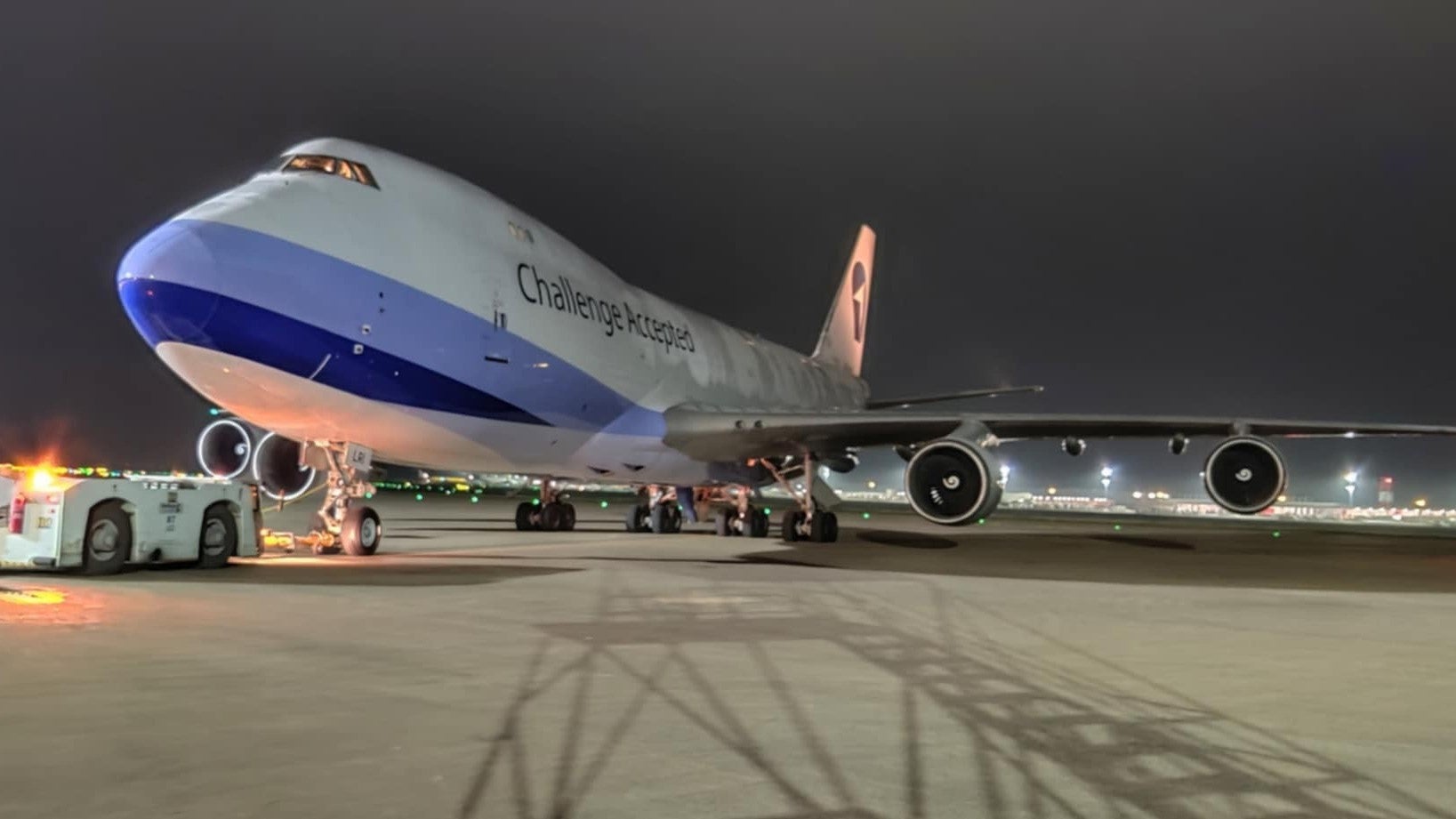
A jumbo cargo jet with blue accent paint sits on the tarmac at night, viewed from the left-front side.

Challenge Group, Israel’s only all-cargo operator, on Monday announced plans to lease two additional Boeing 777-300ER converted freighters as it aggressively pursues fleet expansion to increase market reach amid strong shipping demand.

The airline said it reached agreement with global lessor AerCap for two of the former passenger jets, which are being retrofitted by Israel Aerospace Industries to carry large cargo containers. It previously committed to take four 777-300 passenger-to-freighter conversions.

IAI is expected this year to be first to market with a converted 777 freighter, once its design for adding a wide cargo door, reinforcing the fuselage, modifying the crew compartment and making other changes is approved by regulators. The 777 freighters in service today are all production models made by Boeing. 

It’s unclear when Challenge Group will receive its initial 777 freighter, but when it does it will likely be the first to operate a converted 777 from a base in Europe. The 777s will be registered to its Maltese operation.

Tel Aviv-based Challenge Group operates 10 aircraft (six Boeing 747-400s and four 767-300s) across three airlines licensed in Israel, Belgium and Malta. Its main hub is at Liege Airport in Belgium, where it has a 430,500-square-foot cargo terminal. A logistics subsidiary also handles middle-mile delivery to distribution centers at European destinations. Having an air operators certificate in different countries allows the company to make use of each jurisdiction’s traffic rights.

Last year, Challenge Group added two Boeing 767-300 converted freighters by IAI and two Boeing 747-400 cargo jets. One of the 747s was owned by China Airlines and in desert storage until August, according to the Planespotters.com database.

Two and a half years ago, Challenge, formerly CAL Cargo Airlines, only had four 747-400 cargo jets. The 747s allow the company to handle a large amount of nonstandard cargo.

Challenge Group last month said the latest jumbo jet is primarily being deployed to carry e-commerce shipments from China but also will address rising demand for perishable transportation out of Africa and support trans-Atlantic business.

The additional 767 aircraft enabled the company to launch a new twice-weekly service to Delhi, India, in early October, complementing its three existing weekly flights to Mumbai used by pharmaceutical, automotive, textile, electronics and high-tech customers. Challenge Group in December launched twice-weekly 767 service to Nairobi, Kenya, from Liege. Earlier in the year, it opened a route to Dubai via Tel Aviv.

The medium-size freighters also freed up capacity on 747 aircraft for increased long-haul work between Europe, Asia and the United States, according to a Challenge Group news release.

Last year the airline transported more than 200,000 tons of cargo, including 5,000 horses and 600 aircraft engines. The company recently invested in a specialized engine dolly with advanced shock-absorbing cushions that protects sensitive engines from tarmac vibrations during the journey from the offloading point to the aircraft door.

777 conversion waits for green light

The 777-300 passenger-to-freighter development program is entering its final phase, Israel Aerospace Industries said in a statement provided to FreightWaves. 

IAI, which has decades of experience converting Boeing 737s, 767s and 747s, said it has secured dozens of orders for the 777-300 conversion. An IAI official in June 2023 claimed the company had 60 firm orders for the aircraft. Canadian all-cargo operator Cargojet early last year pulled its reservation for four production slots because of concerns about tepid market conditions.

IAI partnered with AerCap (NYSE: AER) on the conversion program. AerCap is supplying used 777s from its portfolio that have reached their useful life as passenger aircraft and is leasing the modified units to cargo airlines.

Michigan-based Kalitta Air is the Big Twin launch customer and committed to lease seven airframes. Other customers include Emirates, with an order for 10 777 conversions, and Taiwan-based EVA Air.

A Challenge Airlines 747-400 jumbo jet rests in a hangar with its nose door open. (Photo: Challenge Group)

The redesigned jets are dubbed the “Big Twin” because of the 777’s size and two GE-90 engines. With 25% more interior volume than a 777-200, the 777-300 Extended Range freighter is well suited for lightweight e-commerce shipments that take up a lot of space and don’t weigh as much as other commodities. It has 14% more volume than a 747-400 converted freighter and is 21% more fuel-efficient, according to IAI. 

The reconfigured 777-300 is scheduled to conduct final validation flights with the Federal Aviation Administration in the U.S. during February. The FAA and Israel Civil Aviation Authority are expected to issue supplemental type certificates (STCs) for commercial use by the end of the first quarter or early second quarter, the IAI statement said.

The company has already completed conversions on four aircraft. Five more aircraft are at different stages of modification at IAI hangers.

“Following STC approval, five to six aircraft will be released to the market immediately,” IAI said.

The aircraft will help an air cargo market where demand increased more than 10% last year and widebody freighters could ease capacity constraints, especially in the busy trans-Pacific corridor where only 15% of pre-pandemic passenger services have been restored because of tensions between the U.S. and China.

IAI originally planned for the plane to enter service in 2022, but the pandemic disrupted development and the supply of components. U.S. and Israeli certification of the airframe modification design has also been slowed repeatedly since 2023. The prototype took its first test flight in the fourth quarter of 2023.

Aerospace executives say many new conversion programs have been delayed because the FAA and other air safety regulators are dealing with manpower shortages and have been preoccupied overseeing Boeing’s extensive manufacturing problems in recent years.  FAA officials are also extra cautious after fallout from the deadly crashes of the 737 MAX, quality control problems with 787 fuselages and a door plug on a 737 MAX9 that blew out during flight raised questions about the thoroughness of the agency’s oversight.

IAI has arranged production partnerships for 777-300 conversions with Etihad Engineering in Abu Dhabi, Sharp Technics K at Incheon airport in Seoul, South Korea, and Ascent Aviation Services in Marana, Arizona, to help expedite deliveries. 

(Correction: An earlier version of this story incorrectly said that the maximum payload weight of the 777-300 converted freighter is greater than that of a 747-400.)

Click here for more FreightWaves/American Shipper articles by Eric Kulisch.

Write to Eric Kulisch at ekulisch@freightwaves.com.

Emirates leases additional Boeing 747 freighters to meet shipper demand

Check Call: The ‘No Rules Rules’ review 

people gathered around a desk of computers. Check Call news and analysis for 3pls and brokers

(GIF: GIPHY)

To pick this month’s book was chosen through a very specialized process in which I Googled top management books and chose something that seemed fun. This month’s choice is “No Rules Rules” by Reed Hastings and Erin Meyer.

The book is basically about how Netflix created its renowned culture of freedom and responsibility – essentially empowering workers to act in the best interest of the company without the need for a lot of oversight but with heavy feedback loops and top talent. The TLDR (too long, didn’t read) is that the book has solid strategies for creating a high-performance culture but ultimately might not be the most applicable for everyone. Still, a solid read.

It starts with three basic principles: Build up talent density, increase candor and remove controls. The most interesting one and the one that allows everything else in a company to run as it does is the buildup of talent density.

Hastings’ basic theory is, why would you keep average performers who bring down the overall productivity and morale of the team when you can have rock stars? It was a lesson Hastings learned in the early days of Netflix after having to lay off a sizable chunk of staff. After that layoff, those who were still around were able to absorb the work and continue to grow. It’s something the company regularly revisits with “The Keeper Test.”

The test asks management, “If a person on your team were to quit tomorrow, would you try to change their mind? Or would you accept their resignation, perhaps with a little relief? If the latter, you should give them a severance package now, and look for a star, someone you would fight to keep.”

A wildly refreshing take. 

The book breaks down the process of attracting and retaining top talent: It turns out just paying them top-of-market rates and surrounding high performers with other high performers does wonders for reducing turnover. More shockingly, Hastings and Meyer advocate for full transparency, including breaking down quarterly financials before they are publicly released, and removing a lot of common rules organizations have in place, such as expense policies. To keep spending in check, managers are encouraged to lead with context not control and maintain healthy audit practices to ensure no one is getting out of control. 

The strategies in the book might not work out for everyone or every company, and it would be nearly impossible to implement them at some large companies that are wedded to a particular policy or rule. However, for the more creative and outside-the-box thinkers, it could help significantly with growth, morale and other areas.

Toward the end, Hastings even breaks down what types of companies would absolutely fail in this type of environment. Specifically, an organization that needs a strong culture of employee safety, like trucking companies. If a carrier ops for a more freedom approach instead of rules and processes it could result in significant losses to the company, not just financially. 

Some of the thoughts and practices Netflix has in place sound absolutely wild when first presented in the book – such as allowing someone who isn’t in senior leadership or legal to sign off on a multimillion-dollar contract for the rights to a movie without necessarily getting approval. However, for each “There is no way this is sustainable or even feasible,” there is a real-life story, anecdote or scenario told from an employee that shows it is a possibility.

The best part was the emphasis on candor and feedback. Netflix’s culture prioritizes feedback for everyone in the organization – not just in the form of an annual review it calls Live 360 but constantly throughout the year. For example, if someone gets heated in a meeting and dismisses someone’s idea right away without hearing it out, the rest of the team is encouraged and expected to step up and say that was uncalled for and to be more open-minded – truly a novel concept in most organizations. 

The biggest takeaway from the book is the emphasis placed on treating employees as adults, allowing them to make their own decisions and trusting that they’ll act in the best interest of the company; oversharing, communication and transparency aren’t the enemy, and if you pick the best people they’ll continue to pick you back.

The second book into this review series was solid. I’ll give it a four out of five stars. While it might not be applicable for every organization, there are some solid strategies to create the strongest team for an organization. 

SONAR Key Market Insights – Ontario, California

Market Check. This week’s market goes to Southern California, home of the ports of Los Angeles and Long Beach and most commonly considered the market to watch. With a heavy volume of imports coming through LA and Long Beach that are then shipped to the rest of the country, this market has been setting the pace for the rest of the U.S. 

That said, this SoCal giant has seen some tightening capacity in recent weeks. With outbound tender rejections rising faster than outbound tender volumes, a slight capacity crunch lies in wait. There hasn’t been a significant crunch as outbound tender rejections are hovering around 5%, which doesn’t give much impact to spot rates. Rejection rates would need to climb closer to 10% to see an impact on spot rates.

(GIF: GIPHY)

Who’s with whom. The comment period on the Federal Motor Carriers Safety Administration’s proposed rule on broker transparency ends today. The rule comes at the urging of drivers, carriers and the organizations that represent them. It’s unclear which side of the argument the new administration supports, but if I were to wager a guess, I’d say the administration would come down on the side of the driver. If pressured, the administration could urge the FMCSA to hasten its decision on a final rule, though it’s not likely a top priority for a administration.

The proposed rule would require freight brokers to provide all financial and other supporting documentation digitally to a carrier within 48 hours of the request. Carriers are pushing for it following the freight recession, during which some rates had carriers losing money every time they hauled a load. There is a belief that freight brokers are making healthy margins that are causing financial strain to carriers.

“We’re not suggesting that broker transparency will set rates or guarantee certain rates,” the Owner-Operator Independent Drivers Association asserts. “We support the free market and are trying to even the playing field so that truckers aren’t systematically negotiating with one hand behind their backs.”

It’s the last day for comment on the rule, so it’s a last chance to make your voice heard, whatever side of the argument you’re on. Comments can be left through this link on regulations.gov. 

The more you know 

Borderlands Mexico: Trump tariffs won’t stop nearshoring investments in Mexico

Ocean rates could fall as Houthis say they will end Red Sea attacks

Rig on Wheels celebrates 15 years of driver recruitment

Winter weather has been more disruptive to transportation than hurricanes 

Pitt Ohio adds express lane to Mexico border

Trump vows to ‘take back’ Panama Canal, increase tariffs

President Donald Trump reiterated in his inaugural speech Monday his desire to acquire the Panama Canal.

During his first official day in office, Trump also said he would impose 25% tariffs on goods imported from Mexico and Canada — the United States’ two largest trade partners — starting Feb. 1.

Trump repeatedly vowed during his campaign to take ownership of the Panama Canal, and he refused to rule out using military force in pursuit of his goal. The U.S. signed over ownership to Panama in 1977.

“American ships are being severely overcharged and not treated fairly in any way, shape or form … and that includes the United States Navy. And, above all, China is operating the Panama Canal, and we didn’t give it to China, we gave it to Panama, and we’re taking it back,” Trump said after beginning his second term in office.

The Panama Canal carries an estimated 3% of global maritime traffic, connecting 180 maritime routes that reach 1,920 ports in 170 countries around the world. Almost 9,000 Panamanians work at the canal.

Panama President José Raúl Mulino rejected Trump’s claims.

The Panama Canal, which opened in 1914, was built by Panama and the United States. The 51-mile waterway connects the Atlantic and Pacific oceans. It was administered by the U.S. until 1999, when control of the waterway was given solely over to Panama under a treaty signed by President Jimmy Carter in 1977.

“The Canal is and will remain Panama’s and its administration will continue to be under Panamanian control with respect for its permanent neutrality,” Mulino said in a news release on Monday. “There is no presence of any nation in the world that interferes with our administration.”

Hong Kong-based CK Hutchison Holdings has licenses that it won through a bidding process in 1997 to operate two ports adjacent to the canal.  

Chinese officials have not directly addressed Trump’s allegations that China is running the Panama Canal, but on Tuesday, Chinese Vice Premier Ding Xuexiang said there are “no winners” in a global trade war.

“Admittedly, economic globalization will bring some tensions and disagreements on distribution. These issues can only be resolved in the process of promoting economic globalization. Protectionism leads nowhere,” Ding said during a public speech at the World Economic Forum in Davos, Switzerland. “Trade war has no winners. We must seize all opportunities to steer economic globalization in the right direction, tackle the development challenges with universal benefit, and pool strengths with inclusive cooperation, so as to usher in a new phase of economic globalization that is more dynamic, more inclusive and more sustainable.”

Russian officials were critical of Trump’s vows to take back the canal.

The Panama Canal legally belongs to Panama, according to Alexander Shchetinin, director of the Latin American department of the Russian foreign ministry.

“Hopefully, in their anticipated discussions on control over the Panama Canal, which is clearly a bilateral matter, the Panamanian authorities and U.S. President Donald Trump will honor the established legal procedures governing this key water route,” Shchetinin said in a statement posted Monday.

The Trump Organization, the business conglomerate owned by Trump, has an ongoing tax evasion case in Panama centering around the former Trump Ocean Club International Hotel & Tower in Panama City, according to Newsweek

Also Monday, Trump said he would begin to impose 25% tariffs on imports from Mexico and Canada starting Feb. 1.

During his campaign, he had said he would place 20% tariffs on imports from all countries, along with a 25% tax on goods from Mexico and Canada and a 60% levy on goods from China, on his first day in office.

“We are thinking in terms of 25% on Mexico and Canada because they’re allowing vast numbers of people to come in and fentanyl to come in,” Trump said during an interview with media in the Oval Office after the inauguration. “I think we’ll do it Feb. 1.”

Canada Prime Minister Justin Trudeau said if Trump imposes tariffs on his country, Canada will retaliate with tariffs on U.S. goods.

“If the president does choose to proceed with tariffs on Canada, Canada will respond and everything is on the table,” Trudeau said during a news conference Tuesday, according to Globalnews.ca. “I support the principle of dollar-for-dollar matching tariffs. It’s something that we are absolutely going to be looking at if that is how they move forward.”