New Jersey truckers await–with dread–possible changes in state’s independent contractor law

New Jersey is the latest battleground over the legal definition of an independent contractor, with a proposed change in state regulation seeking to move the state’s ABC test closer to the California-like definition found in AB5.

In California, AB5 first came out of a court decision known as Dynamex. It then was codified into state law by both houses of the state legislature with Gov. Gavin Newsom signing the bill into law. 

In New Jersey, the proposed changes are also aimed at codifying various court decisions that define independent contractor status in the Garden State, which already had an ABC test in its regulatory framework. Unlike California, the latest changes are being pursued through a rulemaking procedure rather than the state legislature.

However, the end goal is the same: making the ABC test in both California and New Jersey more likely to find that a worker is an employee rather than an independent contractor (IC) when it becomes an issue in a regulatory or legal action.

New Jersey’s current process is being driven by the state’s Department of Labor (DOL). In late April, DOL posted the proposed rule and opened up a 60-day period in early May for comments. The comment period later was extended until last week. 

New Jersey already had an ABC test in its labor regulations. But the latest proposal is seen as putting a thumb on the scale of a court or regulatory agency more likely to find a worker is an  employee rather than an independent contractor.

That has brought out critics through public statements, press releases or in at least one case, publicly sharing their comments to the state’s DOL online. Comments submitted to the DOL are not available online, unlike how they would be for federal rulemaking. But the state is reportedly telling people they will be made available soon.

‘Hostile and unworkable’

The instance of a publicly-released comment–or at least a summary of them–comes from Richard Reibstein, an attorney with the firm of Troutman Pepper Locke. Reibstein specializes in independent contractor law. He shared the summary of his comments to the DOL, filed near the end of the comment period, on his IC-focused blog.

The proposed changes, Reibstein said, “if finalized in their current form, would create a hostile and unworkable legal environment in this state for legitimate ICs and the companies that engage legitimate ICs, which would likely prompt freelancers and other New Jersey-based ICs to lose work opportunities and cause many businesses in New Jersey that use ICs to cease operating their businesses in the State, similar to what has occurred when California enacted Assembly Bill 5, which codified the ABC test in that state back in 2020.”

ABC tests are alike but not identical

While the wording between California and New Jersey’s ABC tests are not identical, they follow a similar structure.

The first of the three–the A prong–deals with the question of defining an employer’s control over a worker.  The B prong, long seen as having the most potential to disrupt trucking in California, creates a standard that an IC can not be performing the same basic function as the company that employs them. So a trucking company hiring a service to clean the office is acceptable; a trucking company hiring an independent owner operator to move freight might not be. 

And the C prong requires an IC to be able to show that they are operating an independent business, based on tests such as whether they own their own tools and equipment and whether they can show a history of running that business based on number of customers and financial performance. (Reibstein, in his summary, said the proposed changes with the C prong in the DOL plan were minor enough that they were not likely to garner many comments). 

One notable difference between California and New Jersey is that while the Golden State’s Democrats were solidly behind AB5 and continue to be, there are significant pockets of opposition to New Jersey’s proposed changes coming from that party, which controls both houses of the state’s legislature and the governor’s office.

As an example, Democrat Sen. Angela McKnight, who represents the 31st district that includes New Jersey’s ports, took aim at the possible impact on their operations.

In an August 1 letter sent to Robert Asaro-Angelo, the head of the state’s Department of Labor and Workforce Development, McKnight said, “75% of New Jersey-based truck drivers are independent contractors, reclassification could disrupt operations, reduce flexibility and earnings and push drivers to relocate to less restrictive states, causing supply chain issues, empty shelves and higher consumer costs.”

While the same fears were raised about AB5 in California, at least at the ports of Long Beach and Los Angeles, the evidence of a disappearance of drayage drivers has not occurred. The City Outbound Tender Rejection Index in SONAR out of Los Angeles, a measure of short haul capacity like drayage, has remained at less than 5% almost consistently since the end of the post-pandemic freight boom.
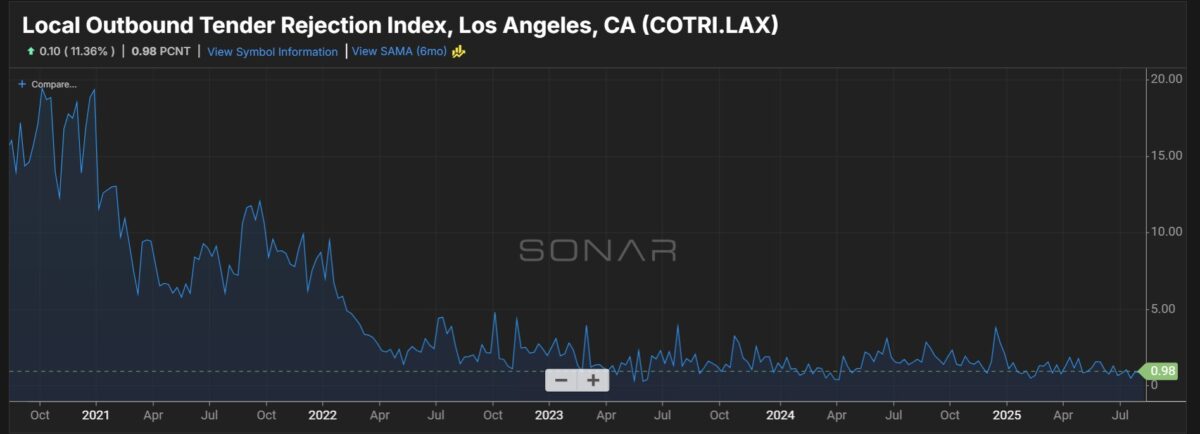
The consistently low numbers are occurring even as import levels are strong. For example, June box cargo volume at the port of Los Angeles was at a record level with no significant reports of freight being unable to be transported from the port. West Coast ports in general are picking up market share relative to the East Coast. As the Los Angeles COTRI affirms, there is no sign of an inability to secure trucking capacity to move that freight. 

However, there are no known enforcement actions in California against any trucking companies since AB5 was allowed to be enforced in the state starting in 2022. That might have allowed the state–so far–to dodge any tightening of capacity related to AB5. 

Reibstein, in his blog post, summarized the issues he saw with the New Jersey ABC proposal. Among the red flags he raised:

–The A prong as proposed would look at various parts of the relationship between employer and worker and see them as control, whereas in other areas they are seen as standard practices necessary to make the employer-IC relationship work. An example: a requirement for an IC to follow the law.

“Under the proposed regulation it appears that a hiring party cannot, without jeopardizing the IC classification, terminate the IC agreement” for an act as basic as stealing from the employer or a customer. According to Reibstein, that is seen as “control.” And the A prong says an employee can not have control over a worker and consider him or her an IC.

–On the B prong, which is a two-part rule in New Jersey unlike AB5, a “place of business” is interpreted widely, according to Reibstein. It could include areas “outside of the employer’s physical plant, which greatly widens the question of whether a worker is a true IC.    

“This view of the second part of the B prong almost entirely eviscerates any chance for most ICs and companies using their services from establishing the workers’ IC status,” Reibstein wrote. It also is in opposition to the Carpet Remnant decision in New Jersey, which in other parts of the proposal is cited as a reason to make the overhaul in the state’s IC law.

Process is largely over

A hearing before the Department of Labor was held in late July. There are no other scheduled public steps in the process. The next formal step is likely to be the DOL releasing the comments (which is not required) and the rule itself.

Lisa Yakomin,the President of the Association of Bi-State Motor Carriers, which represents the drayage community for the port of New York and New Jersey, said the Department of Labor can implement the changes without any further approval needed. But there still would be hurdles.

The department, which is part of the executive branch headed by Gov. Murphy, can be overruled by the governor, she said. “We’ve appealed to the governor to call of this rule proposal and to tell commissioner Angelo to rescind the proposal,” Yakomin said.

If the rule is implemented, Yakomin said the legislature “does have the power to put forth any number of pieces of legislation to try and reverse this. They can put forth legislation that further defines what is an independent contractor and what is not.”

As one observer noted, there is an unofficial deadline: Election Day. Gov. Phil Murphy, who appointed Asaro-Angelo, can not succeed himself as governor. A tight race between Democrat Mikie Sherrill, a member of Congress, and former New Jersey state assemblyman Jack Ciattarelli, could result in a Ciattarelli victory with a replacement for Asaro-Angelo less likely to embrace the changes now under consideration in the state’s independent contractor law. 

If the state gets the IC changes in place before the end of the year, it could then set up the type of whipsaw changes in regulation that have hit the federal IC rule under the Wage and Hour division of the Department of Labor. 

More articles by John Kingston

In brief comments, Trimble CEO introduces new product for matching capacity with shippers

Each driver’s payout in Lytx Illinois biometrics case will be between about $650 and $850

Truck sales in the second quarter might have been the worst performing metric of all

US and China extend tariff hike suspension for 90 days

The U.S. and China on Monday extended a pause on higher tariffs for goods from each country until Nov. 10, just hours before a previous delay on duties was set to expire.

The pause means the U.S. will hold its levy on Chinese imports at 30%, while China will keep a 10% tariff on American products.

The extension prevents U.S. tariffs on Chinese goods from increasing up to 145% starting Tuesday, while Chinese tariffs on American goods were set to hit 125%.

President Donald Trump signed an executive order on Monday to extend the tariff deadline, saying China was taking steps to address U.S. concerns on “economic and national security matters.”

“The United States continues to have discussions with the People’s Republic of China (PRC) to address the lack of trade reciprocity in our economic relationship and our resulting national and economic security concerns,” the executive order said. “Through these discussions, the PRC continues to take significant steps toward remedying non-reciprocal trade arrangements and addressing the concerns of the United States relating to economic and national security matters.”

Chinese officials said the extension gives time for both countries to continue to negotiate on key trade issues such as the trade deficit and lowering tariffs.

“The move serves the interests of both sides in achieving their respective development goals and will contribute to the development and stability of the world economy,” China’s Customs Tariff Commission of the State Council said in a statement, according to China Daily News.

The U.S. largest trade deficit is with China at $295.4 billion in 2024. The deficit has been a long-standing issue in the U.S.-China trade relationship and a key point of contention in trade negotiations.

China also reportedly agreed to ease some restrictions on exports of rare earth metals to the U.S., another top trade issue for both countries, according to NBC.

China was the third largest U.S. trading partner in June at $28.4 billion in two-way commerce. In 2024, China was the ranked third U.S. trade partner at $582 billion.

Planning Your Week by Freight Zones, Not Just Load Boards

If your entire week is shaped by whatever pops up on the load board that morning, you’re not running a plan—you’re reacting. That approach is what keeps carriers in the cycle of inconsistent weeks, poor reloads, and missed opportunities. The top-performing small fleets don’t operate like that. They plan based on zones, not just lanes. They anticipate freight patterns, not just chase posted loads. And they run their weeks like a process, not a gamble.

This article is going to show you how to build that process for yourself—how to stop chasing loads and start running weekly strategies based on zones. You’ll learn what zone-based planning looks like, how to use load boards the right way, and how to build a repeatable, profitable rhythm in your business.

Why Zone-Based Planning Crushes Load-by-Load Dispatch

Here’s the truth: The load board gives you a screenshot. Zone planning gives you the full movie.

When you build your week based on where freight flows, not just what happens to be posted, you’re planning moves instead of reacting to noise. Think about it:

  • Load boards change by the hour.
  • Freight zones trend by the season.
  • Smart carriers plan for both.

Let’s say you’re a dry van carrier based in Atlanta. If all you do is grab whatever outbound load pays the best that morning, you’re reacting. But if you understand your zone relationships, you can start thinking 3 steps ahead:

  • Southeast to Midwest: Solid volume, reasonable return options.
  • Southeast to Northeast: High outbound rates, but poor returns.
  • Southeast to Texas: Decent outbound, but returns require strong broker ties.

Zone planning forces you to ask better questions:

  • What happens after I drop this load?
  • Does this move set up the rest of my week?
  • Am I entering a hot market or a dead zone?

You don’t get that from chasing loads. You get that from studying zones.

Understanding Freight Zones: Where Freight Lives and Moves

DAT and other platforms divide the country into 135 Market Areas (MAs), also known as freight zones. These zones naturally cluster into broader regions:

  • Midwest
  • Southeast
  • Northeast
  • West Coast
  • South Central

Each of these has different behaviors based on equipment type, customer mix, and seasonality. For example:

  • The Midwest often sees strong volume midweek.
  • The West Coast tends to spike outbound early in the week.
  • The Northeast may offer high-paying outbound, but bad returns.

Once you understand these patterns, you can start to plan:

  • Where do I want to be on Monday?
  • Where does that get me by Wednesday?
  • What’s my best reload for Friday?

You’re now running the week with purpose.

Real Tactics: Building a Weekly Freight Zone Plan

Here’s what most small carriers miss: They don’t build the week before it starts. High-performing carriers do.

They sit down Sunday night or early Monday morning and ask:

  1. Where am I starting?
  2. Where do I want to be by midweek?
  3. Where do I want to end for a strong reload or weekend home time?

For example, here’s a reefer carrier’s plan:

  • Monday: Florida to Georgia (short, tight outbound)
  • Tuesday/Wednesday: Georgia to Chicago (long, strong-paying lane)
  • Thursday: Chicago to Arkansas (solid reload market)
  • Friday: Arkansas to Tampa (home run)

Notice: Each move sets up the next. There’s no guessing. There’s no scrolling for 3 hours. And there’s no getting stuck in a cold zone Friday night.

You want your week to flow like this.

How to Use Load Boards the Right Way

The load board is not your plan. It’s the place you check your plan.

Once you’ve mapped your moves by zone, go to the board to validate:

  • Are there enough loads to support my plan?
  • What are rates doing for my target lanes?
  • Are truck-to-load ratios healthy?

Instead of searching “Atlanta to anywhere,” you’re now filtering:

  • Southeast to Midwest, dry van, 500-800 miles

This gives you trend lines, not noise. You start to see that Midwest reloads drop by Thursday, or that Texas rates spike after storms. That’s real-time intelligence. Use it.

Create a Freight Zone Playbook

You don’t need a fancy TMS to run a freight zone strategy. You need a whiteboard or spreadsheet.

Set up a simple table like this:

ZoneBest DaysOutbound RateReturn MarketsSeasonal Notes
ATLMon-Wed$2.75+/miMidwest, TXStrong Q1/Q4
CHIWed-Fri$2.50/miSE, KSVolatile Q2
DFWMon-Thurs$2.30/miOK, ILHot Summer
NJFri-Sat$3.00+/miGA, PAWeak Returns

Update this weekly. Keep it visible. Over time, it becomes your freight intelligence—not just what you read online.

Zone Strategy Builds Broker Relationships

Consistency builds trust. When brokers know you run Southeast to Midwest every week, they start to count on you. You’re not another random truck. You’re a known solution.

That leads to:

  • Better rates
  • First-call status
  • Potential for direct contracts

You’re not begging for freight. You’re earning it by being predictable and reliable in specific zones.

Start Today: Tactical Action Steps

If you want to make the shift from load-chasing to zone-running, here’s your playbook:

1. Pick 3 Freight Zones You Know and Like
Start small. Learn their strengths, return lanes, rate trends.

2. Use Load Board Filters by Region
Stop searching city-to-city. Search by zone clusters. Example: Midwest to Southeast.

3. Track Daily Patterns for 2 Weeks
Spend 15 minutes each morning checking rate per mile, volume, and load ratios.

4. Build a Weekly Template
Plan your moves Sunday night. Block out your desired path: Mon-Wed-Fri stops.

5. Make a Heat Map
Color-code your zones: green (hot), yellow (ok), red (dead). Tape it to the wall.

6. Review and Adjust Weekly
Market shifts happen. Adjust your strategy, not your standards.

Final Word

Carriers that succeed in this industry do one thing better than the rest: They plan.

They don’t guess. They don’t wait to see what the board offers. They don’t blame the market for every bad week.

They run their weeks like pros. They know their lanes. They track their zones. They operate with discipline.

The load board is a tool. Freight zones are your strategy. And if you want to stop riding the rollercoaster of freight, you have to step back and start building a plan.

Don’t let Monday morning shape your week. Shape it yourself.

Build your map. Track your zones. Run your plan.

Because if you’re just looking for whatever pays best today, you’re already losing tomorrow.

Plan zones, not loads—and start running your business like you intend to grow.

Lazer Logistics expands with Chicago, Dallas-Fort Worth acquisitions

Third-party yard management provider Lazer Logistics announced the acquisition of three companies – NetCorp Trailers, EJR Logistics and Stein & Sons Cartage Contractors – that provide trailer leasing and yard spotting services in the Chicago and Dallas-Fort Worth markets.

The three brands collectively serve over 20 customers.

Financial terms of Lazer Logistics’ acquisition were not provided.

“Chicago and Dallas-Fort Worth are two of the most dynamic logistics markets in the country,” said Lazer CEO Adam Newsome in a news release. “This acquisition increases our density and expands our service capabilities in both regions.”

This was Atlanta-based Lazer’s 13th acquisition.

The Lazer Logistics fleet of yard spotting and shuttling equipment now includes more than 11,000 units. Lazer has nearly 6,000 employees managing yard operations at over 700 locations in the U.S. and Canada.

“Joining Lazer allows us to grow that legacy with expanded resources, technology, and opportunities for both our customers and our employees,” said Peter Stein, co-founder and CEO of the three companies. “The transition will be seamless and non-disruptive for existing customers, as Lazer has a proven process for integrating local expertise into its national platform.”

Stein will join Lazer as a vice president.

More FreightWaves articles by Todd Maiden:

UPS settles Teamster grievances, averts strikes in multiple states

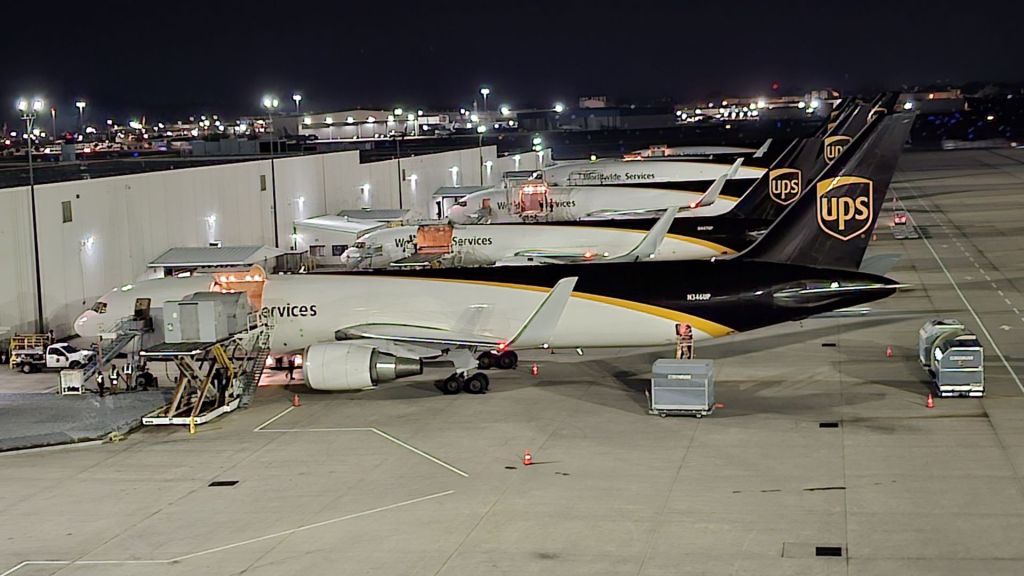
UPS brown tail aircraft at the main hub in Louisville at night.

The union representing some 340,000 workers at UPS said shortly after midnight Tuesday that it called off a strike at the global air sortation hub in Louisville, Kentucky, and package terminals in six other states after the company agreed to resolve several outstanding grievances and a local contract dispute.

The resolution, however, did little to resolve testy relations as the Teamsters remain upset with UPS (NYSE: UPS) for offering drivers a buyout package to reduce labor costs, not hiring the promised number of full-time employees and allegedly not complying with a commitment to purchase more package vans equipped with air conditioning. UPS is in the processing of streamlining its delivery network to align with lower parcel volumes, especially as it moves to unload 50% of its business with Amazon, and trying to cut 20,000 jobs.

The Teamsters claimed in a news release that they were prepared to set up strike lines Tuesday morning at the Worldport, across the Chicago area and in California, Massachusetts, Pennsylvania, Georgia and Ohio before the last-minute settlement.

“The Teamsters have lost all patience with UPS’s ongoing attacks on our members’ rights and our contracts. The gloves are off,” General President Sean O’Brien said. “Since the ratification of our National Master Agreement in 2023, UPS has displayed disdain and shameless disrespect for the workforce. They have refused to settle grievances, they are overworking drivers and our part-time members, they have failed miserably to deliver heat relief, and they are illegally trying to pay our members off. Our union’s actions Monday and Tuesday are just the beginning of an aggressive new chapter for the Teamsters at UPS. We will be UPS’s conscience.”

According to the Teamsters, UPS agreed to stop giving assignments at the Worldport’s Aircraft Maintenance Distribution Center to workers paid a lower rate. After more than a year of complaints, UPS will honor the right of Teamsters Local 89 members to conduct the work. The Aircraft Maintenance Distribution Center is responsible for ordering, receiving, storing, delivering and returning parts to Local 2727 aircraft mechanics. The grievance appears to stem from a union jurisdictional dispute in which UPS sided with Local 2727’s attempt to control the warehouse functions at the new North Hanger, which opened in 2024. 

In Chicago, Teamsters Local 705 achieved a first contract for administrative and specialist workers after protracted negotiations.  The new classification of workers will be elevated to earn the top wage rate for their respective job duties, the union said. 

UPS also agreed to setting grievances regarding seniority and workplace safety at Teamsters Local 20 in Toledo, Ohio, and Teamsters Local 455 in Denver.

“There’s only one thing that UPS cares about and that’s money. Their behavior at the corporate level as of late proves it. Executive bonuses. Stock buybacks. These things are far more important to CEO Carol Tomé than the rights and livelihood of the men and women who deliver all those packages,” said Teamsters General Secretary-Treasurer Fred Zuckerman. “Let this be a warning to UPS that in any state, at any facility, the Teamsters are prepared to fight back against continued abuse of our members.”

The Teamsters chose locations in other states in an effort to exert maximum pressure on UPS, said spokeswoman Kara Deniz.

“UPS and the Teamsters have resolved local matters as part of our normal, established processes for handling disputes. We remain committed to delivering reliable service to our customers without disruption. The company also continues to adhere to the agreements made during our contract negotiations in 2023,” UPS said in a statement shared with FreightWaves.

The Teamsters have aggressively called out UPS in recent weeks for alleged violations of the master contract in a tone usually reserved for stalemated contract talks. It has called the voluntary separation offer for drivers a “bribe” and “illegal” because the changes to employment terms weren’t negotiated with the union. FreightWaves reported Saturday that UPS has extended the deadline to accept the offer until Aug. 14 because of low participation so far. 

The union in late June challenged UPS to explain why it has only provided less than 10% of the 28,000 vehicles equipped with air conditioning at the midway point of the contract. It says drivers are routinely exposed to unsafe heat conditions this summer in large swaths of the country, especially in the South and along the eastern seaboard. 

The Teamsters also say UPS is violating rules on overtime work. Frontline workers are protected from being forced to work more than 9.5 hours per day  — or UPS is required to pay significant penalties to compensate workers for the additional hazard and time. In the first six months of the year, UPS has had to pay tens of millions of dollars in penalty wages to workers, according to the union. 

UPS is also dragging its feet on creating at least 22,500 full-time positions, as required under the contract, according to the Teamsters.

“The enforcement of our national contract must now only heat up. We need all members ready to punch back at a moment’s notice,” O’Brien said. “The Teamsters demand that UPS make good, now, on delivering thousands of additional vehicles with air conditioning to our local unions in Zone 1, the hottest working environments for delivery drivers in the nation. UPS is fully and finally out of time to do right by our members. No more excuses, no more delays.”

(This story was updated at 3:30 p.m. ET with a statement from UPS.)

Click here for more FreightWaves/American Shipper stories by Eric Kulisch.

UPS extends buyout offer deadline after low driver interest

UPS posts tepid results amid tariff, restructuring challenges

Teamsters call UPS driver buyout offer ‘paltry’

Firecrown Media is the 75th fastest growing private company in the US

NEW YORK, August 12, 2025 – Inc., the leading media brand and playbook for entrepreneurs and business leaders, announced that Firecrown Media is number 75 on the annual Inc. 5000 list, the most prestigious ranking of the fastest-growing private companies in America. The list provides a data-driven snapshot of the most successful companies within the economy’s most dynamic segment—its independent, entrepreneurial businesses. Past honorees include companies such as Microsoft, Meta, Chobani, Under Armour, Timberland, Oracle, and Patagonia. 

“This recognition is a testament to the quality of our model and the audience’s love of the 50+ brands that encompass our portfolio,” said Firecrown founder and CEO Craig Fuller. “Our audiences are showing now more than ever that they remain committed to consuming stellar content… we remain committed to delivering it.”

Firecrown focuses on the affluent enthusiast category, delivering content to engage audiences across aviation, marine, and hobby industries. It also has a large B2B presence in the industries it serves, including marine and supply chain.

Firecrown was founded by FreightWaves’ founder, Craig Fuller. The company operates a model of acquiring audiences in major brand categories and offering commerce opportunities to those brands, which include finance, e-commerce, real estate, and events.

About Firecrown

Firecrown Media houses 51 unique brands covering the aviation, marine, hobby & model railroading, and supply chain industries. It produces over 20 different print publications and over 35 digital publications, runs an in-house television and production studio, runs an in-house ecommerce business, and puts on over 15 in-person events each year. 

In 2025, Firecrown has successfully completed 3 acquisitions, bringing the total number of acquisitions in the company up to 20.

It has 2 main office bases in Chattanooga, TN and Milwaukee, WI, plus a small office base for its AvBuyer and GA Buyer Europe properties in the United Kingdom.  Firecrown employs over 200 people across the US and Europe. 

Methodology

Companies on the 2025 Inc. 5000 are ranked according to percentage revenue growth from 2021 to 2024. To qualify, companies must have been founded and generating revenue by March 31, 2021. They must be U.S.-based, privately held, for-profit, and independent—not subsidiaries or divisions of other companies—as of December 31, 2024. (Since then, some on the list may have gone public or been acquired.) The minimum revenue required for 2021 is $100,000; the minimum for 2024 is $2 million. As always, Inc. reserves the right to decline applicants for subjective reasons. 

About Inc. 

Inc. is the leading media brand and playbook for the entrepreneurs and business leaders shaping our future. Through its journalism, Inc. aims to inform, educate, and elevate the profile of its community: the risk-takers, the innovators, and the ultra-driven go-getters who are creating the future of business. Inc. is published by Mansueto Ventures LLC, along with fellow leading business publication Fast Company. For more information, visit www.inc.com.

Proficient, its stock under siege, turns in solid numbers for the second quarter

Even as the stock of Proficient Auto Logistics was getting hammered for the quarter and then some–dropping about 34% from early April to Monday’s close at $5.97–the auto hauler racked up several performance metrics during those three months that were solidly above that of the first three months of the year.

Among the key numbers at Proficient (NASDAQ: PAL), its operating ratio came in at 96.7%. While that is far worse than the 91.8% recorded in the second quarter of 2024, it marked a sequential improvement of 200 bps from the 98.7% it posted for the first quarter.

That improved OR helped lead the company to an adjusted operating income of $3.8 million for the quarter, an improvement sequentially from the $1.2 million recorded in the first quarter. But the year-on-year comparisons were not positive; the company had adjusted operating income in the second quarter of 2024 of $8.7 million.

CEO Rick O’Dell, who on the company’s first quarter earnings call had spoken of late quarter strength in the market (possibly the first signs of the impact from the Jack Cooper closure), said that stronger  trend continued into April, resulting in record revenue for Proficient (which admittedly has only been around since May 2024). Revenue and unit volumes for the month were up 13% and 25%, respectively, though the comparisons were impacted by Proficient acquisitions in August 2024 (Auto Transport Group) and at the start of this year’s second quarter (Brothers Transport).

Still going strong

But the strength has continued, O’Dell said. Between the impact of the Brothers acquisitionand gains in market share that may have been bolstered by the collapse of auto hauler Jack Cooper–though O’Dell did not specifically reference the company–O’Dell said “June did not decelerate from May, and revenue performance finished above our expectations for the combined May and June months.”

Sequential comparisons have been highlighted by several companies this quarter. Year-on-year comparisons were always going to be negative, and the market is looking for some signs of life from the freight market.

Proficient’s volume almost certainly got a significant boost from the first quarter closure of Jack Cooper.

Proficient delivered 220,758 vehicles in the quarter while its subhaulers moved 401,848 vehicles. A year ago, the corresponding numbers were 152,714 and 354,998, respectively. In the first quarter of this year, when the Jack Cooper shutdown would have first been hitting the market, the numbers were 163,754 and 330,755.

One metric that was not a positive for Proficent in the quarter was its measurement of yield, revenue per unit on company deliveries. It was $178.82 in the second quarter, down 15.8% from a year earlier when the figure was $212.25. It was also down 3.5% sequentially.

The yield figure for subhaulers was $166.50, down 12.7% from a year ago and 3.8% sequentially.

Amy Rice, Proficient’s president and chief operating officer, said the huge decline year-over-year was primarily a function of the fact that the third quarter of last year was “when we really started to see the softness in the spot market. The dedicated business came down pretty precipitously.” She said that had a large impact on the yield but that it had stabilized since then.

No summer slowdown

O’Dell said a normal seasonal slowdown in July did not occur this year. It often is a feature of the automobile market because of plant shutdowns for a week or two during that month. But O’Dell said “many domestic plants have continued to operate to meet the higher demand for US based production.”

All of the five original companies that were merged to form Proficient, as well as the two acquisitions since then are now using a common accounting platform and transportation management system, O’Dell said, “providing key visibility and actionable insights into our customer base, operating efficiency opportunities and profitability.”

That also has allowed greater inter-company transfer of freight, which has reduced empty miles, O’Dell said. 

Another key goal for Proficient to boost profitability is to move more of its freight on company-owned vehicles rather than through subcontractors.  It’s a goal that the company has made progress on; company drivers moved 32% of its cars a year ago, 35% in the first quarter and 37% in the second quarter of this year.  

Despite the improved operating metrics, Proficient had a loss before income taxes of $1.9 million. But that was down from the first quarter loss before taxes of $3.9 million, but far below the positive income before taxes of $5.8 million a year ago. 

Adjusted EBITDA for the quarter was $11.3 million, compared to $12.4 million a year ago and $7.8 million sequentially. 

More articles by John Kingston

In brief comments, Trimble CEO introduces new product for matching capacity with shippers

Each driver’s payout in Lytx Illinois biometrics case will be between about $650 and $850

Truck sales in the second quarter might have been the worst performing metric of all
Echo Global Logistics buys fellow 3PL FreightSaver

a white trailer being pulled by a red tractor on a highway

Echo Global Logistics announced on Monday that is has acquired 3PL peer FreightSaver.

Huntington Beach, California-based FreightSaver was founded in 2014 by Ryan Renne and Buster Schwab. Its tech platform specializes in truckload, less-than-truckload, expedited and specialized freight shipments. The company also boasts a notable managed transportation client base.

In addition to its headquarters, FreightSaver also has offices in Utah, Michigan, Ohio and Temecula, California.

Financial terms of the transaction were not provided.

“FreightSaver has built a customer-centric, tech-enabled business that complements our strengths and accelerates our ability to deliver value through managed transportation,” said Echo CEO Doug Waggoner in a news release.

Chicago-based Echo is a multimodal, technology-enabled freight broker with over 60 offices across North America. Its platform connects its 35,000 customers with over 50,000 transportation providers.

“Joining Echo is a natural next step in FreightSaver’s journey,” said FreightSaver CEO Renne. “We’ve always focused on agility, personalized service, and long-term client relationships—values we clearly share with Echo.”

More FreightWaves articles by Todd Maiden:

Forward Air posts Q2 EBITDA beat; investors waiting to see if company will be sold

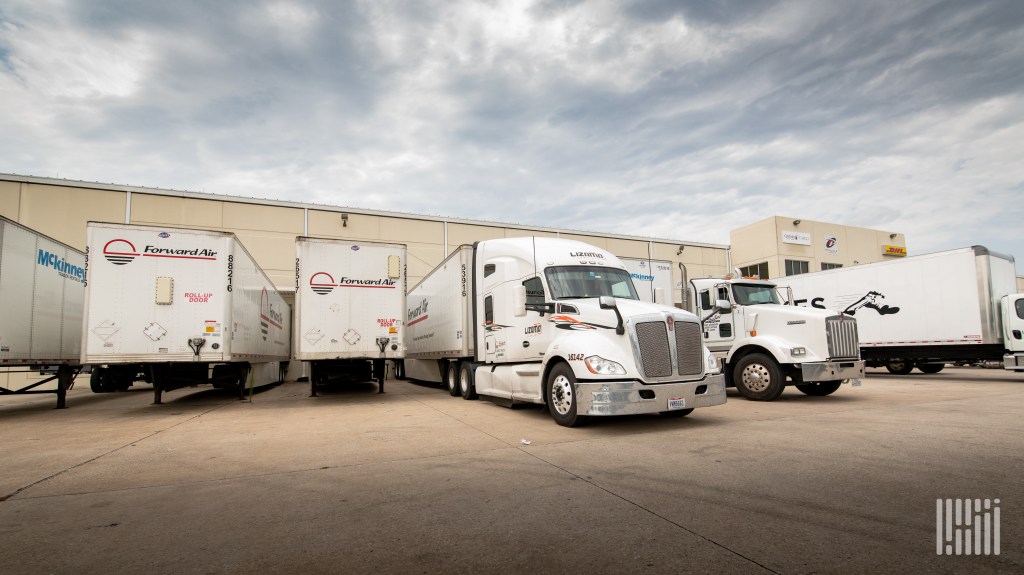
Forward Air trailers at an airport terminal

Transportation and logistics provider Forward Air beat second-quarter adjusted earnings before interest, taxes, depreciation and amortization (EBITDA) expectations on Monday after the market closed. A net loss, however, was worse than expected.

Forward Air didn’t provide an update on an ongoing strategic review process that could include selling the company following the fallout from its heavily contested merger with Omni Logistics. For the time being, Forward’s current leadership team is tasked with executing a marketing plan that now includes a freight forwarding business alongside its legacy linehaul operations.

Forward (NASDAQ: FWRD) reported a second-quarter net loss from continuing operations of $20.4 million ($12.6 million attributable to Forward Air, or 41 cents per share). The result was worse than the consensus estimate calling for a per-share loss of 26 cents.

Consolidated adjusted EBITDA of $74 million was $5 million higher than the first quarter result and $2 million ahead of consensus.

Revenue of $619 million was 4% lower year over year. Revenue increased 1% from the first quarter.

Forward’s management team touted “across-the-board” business wins in truckload, international airfreight and ground transportation on a Monday evening conference call. It said many of the wins came from existing customers.

Recent press releases from the company referenced the addition of 15,000 annual expedited TL shipments from a “leader in the package delivery services industry,” as well as a separate distribution services and TL contract with an athletics brand.

Table: Forward’s key performance indicators

The company’s expedited segment, which includes less-than-truckload operations, reported a 12% y/y revenue decline to $258 million. Tonnage fell 13% y/y (up slightly from the first quarter) while revenue per hundredweight, or yield, increased 2% y/y excluding fuel surcharges (flat sequentially). The yield improvement was attributed to “pricing actions” taken earlier this year.

Forward again increased shipment weights in the quarter. Weight per shipment was up 3% y/y in the period (up less than 1% sequentially). (Higher shipment weights negatively impact the yield calculation.)

Expedited reported a 7.6% operating margin, which was 10 basis points higher y/y and 130 bps better than the first quarter.

Salaries, wages and benefits (as a percentage of revenue) declined 100 bps y/y. Purchased transportation expenses were down 60 bps.

Adjusted EBITDA of $30 million in the unit was $4 million higher than in the first quarter. An 11.6% adjusted EBITDA margin was 120 bps better sequentially.

SONAR: Midhaul LTL Monthly Cost per Hundredweight, Class 70-85 Index. Less-than-truckload monthly indices are based on the median cost per hundredweight for four National Motor Freight Classification groupings and five different mileage bands. To learn more about SONAR, click here.

Omni reported revenue of $328 million, a 5% y/y increase. The segment recorded adjusted EBITDA of $30 million (a 9% adjusted EBITDA margin) compared to $26 million in the first quarter (a 7.9% adjusted EBITDA margin).

Last 12 months’ (LTM) consolidated adjusted EBITDA was $298 million at the end of the period.

Net debt of $1.69 billion stood at 5.7 times LTM adjusted EBITDA, an increase from 5.3 times at the end of the first quarter.

Liquidity at the end of the second quarter was $368 million, a $25 million decline from the first quarter. However, the change included $34 million in semi-annual interest payments. Cash flow from operations totaled $14 million in the first half of the year. (The company used $13 million in cash in the second quarter.)

Shares of FWRD closed on Monday at $28.57, down 5.6% on the day and well below the $110 closing price on the last trading session before the merger was announced in August 2023. The stock was 1.3% higher in after-hours trading on Monday.

More FreightWaves articles by Todd Maiden:

My Freighter opens new China-Europe air route

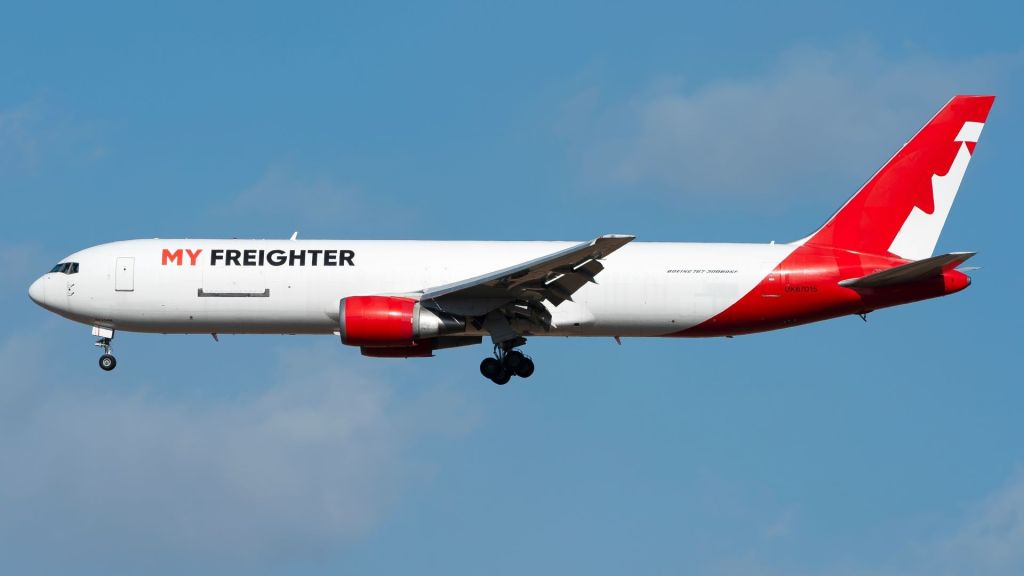
A red-tailed My Freighter jet approaches an airport.

Startup Uzbekistan-based cargo airline has launched a new international route between Shanghai, China, and Amsterdam in response to demand from Chinese companies shifting attention to Europe because of rising tariffs in the United States.

The new service, made possible with the help of cargo sales agent Air Cargo APAC, marks the first time that My Freighter has engaged in scheduled cargo operations. Until now it functioned as a charter carrier. 

My Freighter will operate a Boeing 767-300 cargo jet two times per week with a stopover in Tashkent, the airline announced Monday. The route offers an alternative to busy transshipment airports such as Dubai and Istanbul, Turkey.

Shippers can also move goods through Tashkent to, and from, other countries in the region that once were republics of the Soviet Union. 

The flights are expected to be used by companies shipping auto parts, high-tech equipment, semiconductors, e-commerce and express packages, My Freighter said. 

The World Trade Organization forecasts that China exports to Europe are expected to grow by 6% in 2025 versus last year. 

My Freighter began operating in 2023. It leases eight 767-300 freighters, several from U.S.-based Air Transport Services Group, and one Boeing 757-200 freighter. 

Click here for more FreightWaves/American Shipper stories by Eric Kulisch.

Write to Eric Kulisch at ekulisch@freightwaves.com.

Uzbek airline My Freighter adds 2 more Boeing 767s