Norfolk Southern expands portfolio of certified rail-served industrial sites

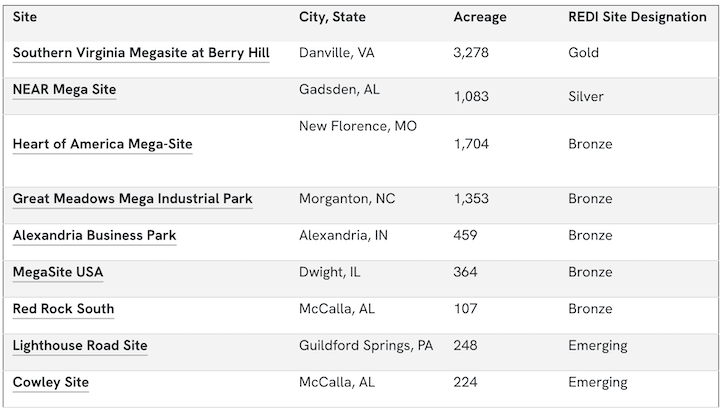
Norfolk Southern continues to strengthen its industrial site development with the recent certification of nine additional rail-served properties in seven states through the Redi Sites program.

This brings the total number of NS Redi-certified sites to 12, showcasing the company’s commitment to providing prime locations for businesses seeking rail-integrated solutions.

The Redi Sites program, administered by the U.S.-based Site Selectors Guild, offers a standardized and rigorous evaluation process for site readiness across the United States. Launched in 2024, this program aims to simplify the site selection process for consultants and businesses by providing a comprehensive database of project-ready locations.

“These designations underscore Norfolk Southern’s (NYSE: NSC) dedication to making site selection easier for companies that can benefit from integrated rail solutions,” said Craig Hudson, group vice president of industrial development at Norfolk Southern, in a release. “Smart site development helps companies grow, and helps communities thrive. That’s the power of rail in the right place.”

The Redi Sites program assesses various critical factors, including infrastructure capacity, ease of development, ownership status and entitlements.

(Chart: Norfolk Southern)

Based on these criteria, sites receive one of five designations: platinum, gold, silver, bronze or emerging. This tiered system allows potential investors and developers to quickly identify locations that best suit their specific needs and project requirements.

Based in Atlanta, Norfolk Southern manages a portfolio of 700 rail-served industrial development properties across its network. 

This article was updated March 25 to correct the number of newly-certified sites to nine.

Subscribe to FreightWaves’ Rail e-newsletter and get the latest insights on rail freight right in your inbox.

Find more articles by Stuart Chirls here.

Related coverage:

Proposed US port fees on Chinese vessels may alter intermodal shipping patterns

Weekly US rail traffic remains ahead of 2024 levels

County Line Rail acquires Sabine River & Northern Railroad

OmniTRAX joint venture acquires California short line railroad

Trump nominates trucking official to head FMCSA

DOT Headquarters

WASHINGTON — The Trump administration has nominated Derek Barrs of Florida to be administrator of the Federal Motor Carrier Safety Administration, according to Senate documents published on Tuesday.

FMCSA acting Administrator Adrienne Camire abruptly left the agency after less than two weeks in the position.

Derek Barrs. Credit: Flagler County School Board

Barrs, who was appointed by Florida Gov. Ron DeSantis in October to the School Board of Flagler County, is a member of the American Trucking Associations’ Law Enforcement Advisory Board, as well as a member of the Florida Trucking Association (FTA).

FTA President and CEO Alix Miller called Barrs “an instrumental leader in the trucking industry,” in a press release praising Barrs’ nomination.

“His proven leadership and understanding of both public safety and transportation operations make him an ideal candidate to guide FMCSA through today’s complex challenges.”

If confirmed by the Senate, Barrs would become the ninth administrator of FMCSA since it was created in 2000.

“We look forward to working with [Barrs] in advancing the priorities of small business truckers across America, including fighting freight fraud, rolling back unnecessary regulations, and closing regulatory loopholes to ensure the safest truck drivers remain in the industry,” commented Owner-Operator Independent Drivers Association President Todd Spencer in a statement.

“We encourage a swift confirmation in the Senate and look forward to working with Mr. Barrs to improve the safety of our roadways.”

The FMCSA administrator has often spoken on an FMCSA leadership panel at the Mid-America Trucking Show, which starts later this week in Louisville, Ky. FMCSA did not confirm to FreightWaves the agency official speaking on this year’s panel, scheduled for March 27.

FreightWaves correspondent Grace Sharkey will be reporting from the event.

Click for more FreightWaves articles by John Gallagher.

Arkansas lawmakers debate crackdown on undocumented truckers

This article was updated at 10:53 a.m. ET to include comments from the Owner-Operator Independent Drivers Association.

The Arkansas House of Representatives and Senate are debating two bills to enact harsher punishments against truck drivers who are in the U.S. illegally and obtain or use commercial driver’s licenses.

Arkansas House Bill 1569 (HB1569), filed in February, calls for commercial motor vehicle drivers operating in the state to “demonstrate proficiency in the English language.” 

These drivers must be able to “read road signs and warning signs,” “understand traffic control devices” and “communicate effectively in an emergency” with emergency services, law enforcement and other drivers.

The bill, named the “Secure Roads and Safe Trucking Act of 2025,” would fine truckers without sufficient English proficiency $5,000.

HB1569 also calls for harsher penalties for drivers operating without a valid CDL, including a fine of $5,000 and impoundment of their motor vehicle. In addition, it would stiffen laws against undocumented drivers who injure another person while operating their vehicle, making it a Class D felony carrying a minimum six-month prison sentence.

Undocumented drivers who commit vehicular homicide with a commercial motor vehicle – regardless of intent – would face a minimum 10 years in prison. This would be a Class B felony.

Additionally, carriers who “negligently provide” CMVs to individuals in violation of HB1569 would be fined $10,000.

HB1569 is strongly supported by the advocacy group American Truckers United. The group also opposes House Bill 1745 (HB1745), which passed in the House on Thursday, and has argued it would legalize foreign CDLs in the state.

HB1745, now awaiting action in the Senate, would make presenting a fake CDL or operating a commercial vehicle without an employment authorization document a Class D felony.

HB1745 allows a person to drive a CMV if he or she has a CDL or commercial learner’s permit issued by a state, territory or possession of the U.S., the District of Columbia, or Puerto Rico.

Drivers with a CDL issued by Canada, Mexico “or any other jurisdiction under a waiver or exemption recognized by the Federal Motor Carrier Safety Administration,” would also be permitted as long as they have a valid employment authorization document.

The Owner-Operator Independent Drivers Association (OOIDA) said while it supports the intent of HB1745, it wished the bill went further to address hiring issues by larger carriers.

“We generally support the intent of HB 1745 in the Arkansas legislature, but wish the bill went further to address the underlying issue: corporate megacarriers recruiting foreign truck drivers to undercut the ability of American truckers to earn a decent living,” said Doug Morris, OOIDA director of state affairs. “Corporate megacarriers will use every loophole available, including those previously established by the FMCSA, to save a buck on the backs of American truckers. We are actively pursuing solutions on the state and federal level to right this wrong.”

FreightWaves reached out to the American Trucking Associations for comment.

Breaking: Postmaster General Louis DeJoy announces sudden departure

Head shot of Postmaster General Louis DeJoy, as seen from side.

U.S. Postmaster General Louis DeJoy on Monday announced he was stepping down immediately, getting ahead of what several media accounts from Washington said was a possible ouster by President Donald Trump with intent to assert greater control over the Postal Service.

Critics say DeJoy’s departure is the opening shot in a hostile takeover of the Postal Service by the Trump administration. 

“Make no mistake, the postmaster general was forced out by a White House intent on breaking up and selling off the public United States Postal Service. Statements by President Trump last month and recent statements from his billionaire advisor Elon Musk made it clear that the White House has been planning for a hostile takeover of the USPS,” said Mark Dimondstein, president of the American Postal Workers Union, in a statement. 

“This attack on the USPS is part of the ongoing coup by oligarchs against the vital public services APWU members and other public servants provide to the country. Privatized postal services will lead to higher postage prices, and a lower quality of service to the public.”

The news comes days after DeJoy invited Musk’s Department of Government Efficiency (DOGE) to root out wasteful practices. DeJoy gave his resignation notice last month but never set a departure date as he continued to work on his multiyear reorganization plan to bring financial stability to the Postal Service.

Trump has signaled interest in consolidating power over independent agencies and has openly entertained the idea of bringing the mail system under oversight of the Commerce Department or privatizing it. It’s unclear why Trump is displeased with DeJoy, who took over nearly five years ago after a long career leading successful logistics companies and who was in the process of streamlining transportation networks and saving billions of dollars.

The Washington Post reported that DeJoy was reluctant to give DOGE full freedom to make changes, which angered Trump. Sources told The Wall Street Journal that Trump was preparing to force him out.

In December, before taking office, Trump suggested he was open to the idea of taking the Postal Service private. In public comments earlier this month, Musk said he was exploring privatizing the Postal Service.

“The law is clear that the USPS was created by Congress as an independent agency, designed to be free from shifting political winds and dedicated solely to serving the people of this country,” Dimondstein said. “The law also is clear that the USPS’ board of governors, and it alone, is empowered to hire and fire the postmaster general. Any attempt by this administration to seize power from the board of governors is unlawful and a brazen attempt to begin breaking up and selling off the public postal service to private corporations.

“The APWU calls on the board of governors to stand its ground. The board should move as quickly as possible to hire as the next permanent postmaster general someone committed to the public service mission of the USPS, who respects the rights of hardworking postal workers, and who will not break up and sell off this service that delivers to 169 million addresses,” he said.

The board of governors named Deputy Postmaster General Doug Tulino to lead the agency on an interim basis while it searches for a successor. The board said Monday it has retained the executive search firm Egon Zehnder to find DeJoy’s replacement. 

“I believe strongly that the organization is well positioned and capable of carrying forward and fully implementing the many strategies and initiatives that comprise our transformation and modernization, and I have been working closely with the deputy postmaster general to prepare for this transition. While our management team and the men and women of the Postal Service have established the path toward financial sustainability and high operating performance – and we have instituted enormous beneficial change to what had been an adrift and moribund organization – much work remains that is necessary to sustain our positive trajectory,” DeJoy said in a statement.

DeJoy took over the Postal Service with a mandate to address operational inefficiencies and a financial crisis stemming from years of underinvestment and a regulatory business model that limited innovation. Under his leadership, the Postal Service quickly developed a 10-year transformation plan, including consolidating mail-processing centers and shifting domestic air transport to cheaper ground transportation, to modernize the quasipublic agency and save money. He also oversaw the rise in voting by mail in two presidential elections. Some complain that the streamlining has slowed delivery, especially in rural areas.

At the time, the Postal Service had 60 days of remaining cash, had incurred $90 billion in losses over two decades and had more than $20 billion in deferred facilities maintenance. Projections were for the independent agency to lose an additional $200 billion over the next decade. The Postal Service is now near breakeven on an operating basis.

Click here for more FreightWaves/American Shipper stories by Eric Kulisch.

US ranks low among international postal services on financial flexibility

Postal Service weighs serving as logistics partner for federal agencies

Postal Service to adjust delivery standards for network efficiency

Navigating uncertainty: The power of location intelligence in supply chains

By Bart De Muynck

The views expressed here are solely those of the author and do not necessarily represent the views of FreightWaves or its affiliates.

The 20th century witnessed a revolution in supply chain management. Innovations like the automobile, airplane and computer transformed how goods moved, fueling globalization and the rise of multinational corporations. Complex, interconnected supply chains, spanning continents and involving countless stakeholders, became the norm. The latter half of the century saw the introduction of bar code scanners, as well as electronic data interchange and enterprise resource planning systems, enhancing efficiency and visibility. Today, we stand at the cusp of another transformation, driven by digital technologies like cloud computing, AI and blockchain, promising unprecedented levels of agility and resilience.

In this era of constant change, supply chain visibility has become paramount. Geopolitical conflicts, extreme weather events and other unforeseen disruptions can wreak havoc on even the most meticulously planned operations. This is where location intelligence emerges as a critical tool, providing the real-time insights needed to navigate uncertainty and maintain operational continuity.

Real-time location intelligence, the core offering of companies like Glympse, is revolutionizing how businesses manage their supply chains. Imagine knowing the precise location of your people, jobs and valuable assets at any given moment. This level of visibility enables proactive decision-making, allowing businesses to adapt quickly to changing conditions.

Glympse provides businesses with powerful location intelligence, enabling everything from precise curbside delivery tracking for retailers like Crate & Barrel, to in-yard navigation and safety solutions for manufacturing giants in the U.S. Glympse integrates seamlessly with leading TMS, routing and telematics vendors, offering an exception-based user interface and multiparty visibility. It goes beyond simple tracking, providing actionable insights that optimize operations, improve safety and enhance the customer experience.

This multi-industry applicability, spanning retail, manufacturing, field services and logistics, underscores the universal need for enhanced visibility. Whether it’s managing curbside pickups, tracking trade equipment or navigating complex manufacturing yards, Glympse delivers the real-time clarity needed to succeed.

The benefits are clear. Efficiency is optimized through precise routing and real-time tracking, reducing delays and minimizing costs. Safety is enhanced through location-based monitoring and alerts, ensuring compliance and mitigating risk. Customer satisfaction is improved through transparent communication and accurate delivery estimates.

The demand for real-time visibility is driven by the increasing complexity of supply chains, the rise of e-commerce and the need for greater transparency. Location intelligence is becoming increasingly valuable, enabling businesses to gain insights into customer behavior, optimize operations and make better decisions.

Last-mile delivery optimization, particularly curbside pickup solutions, is a critical area of focus. The adoption of industrial internet-of-things technologies is driving the need for real-time tracking and monitoring of industrial assets and equipment. Safety and compliance are top priorities, with location data being used to track employee location, monitor equipment and ensure regulatory adherence.

Multiparty collaboration is essential in today’s interconnected supply chains. Glympse’s “rendezvous” feature facilitates real-time sharing of location data and information, enabling seamless collaboration among stakeholders.

In times of geopolitical conflict, real-time location intelligence allows businesses to identify and mitigate risks, rerouting shipments and adjusting operations as needed. During extreme weather events, it enables proactive monitoring and rerouting, minimizing disruptions and ensuring timely deliveries.

By providing actionable insights and seamless connectivity for people, assets and processes, Glympse empowers businesses with real-time location intelligence, connecting people, assets and operations for unparalleled visibility, efficiency and safety across their entire supply chain and customer experience. Gain control and optimize your operations with our real-time location intelligence platform. Whether it’s managing curbside pickup, tracking trade equipment or navigating complex manufacturing yards, we deliver the visibility you need to succeed.   

In a world defined by uncertainty, real-time location intelligence is no longer a luxury, but a necessity. By leveraging this powerful technology, businesses can build resilient supply chains, navigate disruptions and thrive in an ever-changing landscape.

About the author

Bart De Muynck is an industry thought leader with over 30 years of supply chain and logistics experience. He has worked for major international companies, including EY, GE Capital, Penske Logistics and PepsiCo, as well as several tech companies. He also spent eight years as a vice president of research at Gartner and, most recently, served as chief industry officer at project44. He is a member of the Forbes Technology Council and CSCMP’s Executive Inner Circle.

Benchmark diesel price up first time in 3 weeks, futures markets edge higher

For the first time in three weeks, the benchmark price used for most fuel surcharges has risen.

The weekly average retail diesel price published by the Department of Energy/Energy Information Administration rose 1.8 cents a gallon to $3.567. It comes after three weeks of declines that totaled 14.8 cents a gallon. 

The price of diesel in the futures market has been gradually climbing higher but in small increments compared to the volatility that has been a feature of markets for five years, pushed down at first by COVID and then boosted by the Russian invasion of Ukraine.

In the past few weeks, possibly because confusion about tariff policy makes forecasting oil prices difficult, prices generally have traded in a relatively narrow range.

However, the price of ultra low sulfur diesel on the CME commodity exchange in the past week has taken a relatively strong upward move.

Two steps by the Trump administration have contributed to that increase. 

One was the move last week to increase sanctions against Iranian shipments of oil, including singling out a small Chinese refinery that had been a buyer of crude from Iran. 

Second, on Monday, a threat to put a 25% tariff on any country buying Venezuelan crude brought another bullish reaction. However, much of that spike was mostly gone by the end of the day, and ULSD was up just 0.75 cents a gallon to settle at $2.2571.

Still, that is up 9.48 cents a gallon from a recent low of $2.1622 on March 13 and up more than 6 cents since Tuesday.

An article by Reuters published Friday questioned why diesel prices have not risen further, saying the price level of the fuel is “increasingly disconnected from tightening supply and demand conditions, reflecting deepening concerns over the outlook for global economic activity.”

The argument by commodities columnist Ron Bousso is that diesel prices relative to crude should be higher. He cited various statistics about inventory levels and industrial activity, which are the backbone of diesel demand.

“Everything about this supply-demand picture points toward rising diesel prices, yet the profit margin refiners make from converting crude oil into diesel has fallen well below the seasonal levels seen in recent years,” he said.

ULSD on CME at the end of January was running about 65 cents a gallon more than the cost of global crude benchmark Brent, converted into gallons. The past few days, the spread has hovered around 50 cents a gallon, though in the past several trading days it has started to move up a few cents per gallon.

A year ago, the spread was trading near 60 cents a gallon.

“The diesel price disconnect suggests that this negative sentiment – the deep uncertainty concerning the direction of global trade and manufacturing – is trumping the reality of tight supply-demand dynamics in the physical market,” Bousso wrote. “While the weakening diesel price may ultimately end up being an accurate signal – if the feared contraction in global economic activity materializes – investors may be getting ahead of themselves.”

More articles by John Kingston

Trucking company owner gets almost 4 years in prison for lying to FMCSA

Clash on legal status of California transportation waivers highlighted at TCA

Carriers big and small at TCA wait for signs of freight market turnaround

Port Authority of New York and New Jersey signs 33-year lease with APM Terminals

In a groundbreaking move, the Port Authority of New York and New Jersey has announced a 33-year lease extension with APM Terminals, operator of the region’s second-largest container terminal. 

The agreement, to run through 2062, marks a milestone in the port’s development and sets a new standard for container terminal contracts.

The deal includes substantial commitments from APM Terminals, a division of Danish shipping conglomerate A.P. Moller–Maersk (OTC: AMKAF). The company will invest over $500 million in the coming years to enhance cargo-handling capacity at its 350-acre terminal. This investment aligns with the Port Authority’s Master Plan 2050, which anticipates a doubling or tripling of cargo volumes by midcentury.

In an increasing trend, major shipping lines including CMA CGM and MSC have been pursuing terminal development as a means to better expand and control port operations.  

New York-New Jersey is the second-busiest U.S. container gateway after Los Angeles-Long Beach. The East Coast hub handled 8.7 million twenty-foot equivalent units in 2024. 

Unlike traditional leases, this contract incorporates performance, infrastructure and sustainability requirements. These provisions ensure the terminal can handle growing cargo volumes while prioritizing customer service and environmental responsibility.

In a release, New Jersey Gov. Phil Murphy highlighted the port’s economic importance, stating, “Our region is an irreplaceable driver of the U.S. economy, serving as home to one of the busiest ports in our nation’s supply chain.” He emphasized the port’s role in job creation and efficient goods distribution across the country.

The agreement also addresses sustainability concerns. APM Terminals has committed to achieving net-zero greenhouse gas emissions in its operations, supporting the Port Authority’s goal of reaching net-zero agencywide by 2050. This commitment includes investing in zero-emission cargo-handling equipment over the coming years.

“This agreement delivers long-term certainty for the port, its customers, and the entire supply chain,” said Bethann Rooney, port director at the Port Authority, who emphasized the long-term benefits that solidify the Port of New York and New Jersey as a stable, reliable choice for shippers.

This lease extension is part of a broader strategy to secure long-term agreements with major tenants. With APM Terminals now committed through 2062, and other key operators like Port Liberty Bayonne and New York under lease through 2047, and Port Newark Container Terminal secured until 2050, the port sees itself as well positioned for future growth and stability.

The Port Authority Board of Commissioners is scheduled to vote on the lease extension on Thursday.

Find more articles by Stuart Chirls here.

Related coverage:

Report: Top-secret US plans to attack Houthis accidentally shared with journalist

NTSB faults Maryland in Key Bridge collapse, warns dozens of other bridges at risk

China’s largest shipping line sees stunning gains in revenue, profits

Trans-Pacific container rates below lowest 2024 levels: Freightos

Trump may take softer approach on April 2 ‘reciprocal’ tariffs

President Donald Trump said he is considering a more targeted slate of reciprocal tariffs on April 2 than previously expected.

Trump has called April 2, when the tariff policy is to be revealed, “Liberation Day,” and could include broad reciprocal tariffs to match duties that other countries charge on U.S. imports.

The White House said the tariffs set to begin April 2 likely won’t be as wide-ranging as previously planned.

“I may give a lot of countries breaks. It’s reciprocal, but we might be even nicer than that. You know, we’ve been very nice to a lot of countries for a long time,” Trump told reporters at the White House on Monday, according to The Hill

Trump’s reciprocal plan calls for imposing tariff rates on all countries that have tariffs on U.S. goods. But the Trump administration has not made clear which goods and specific countries it will impose tariffs on beginning April 2. 

The countries the White House could be targeting for reciprocal tariffs could be “the Dirty 15” – countries that persistently treat the U.S. unfairly in their trading practices, Treasury Secretary Scott Bessent told Fox Business.

Among those could be Australia, Brazil, Canada, China, the European Union, India, Japan, South Korea, Mexico, Russia and Vietnam.

While Trump said he may soften the impact of reciprocal tariffs, the plan will likely include additional tariffs on imports of autos, aluminum, lumber, pharmaceuticals and semiconductor chips.

The administration “will be announcing some additional tariffs over the next few days having to do with automobiles, cars – and also having to do a little bit with lumber down the road – lumber and chips,” Trump told reporters Monday, according to Morningstar

Trump also said during a cabinet meeting Monday, “We’ll be announcing pharmaceuticals at some point in the not-too-distant [future] because we have to have pharmaceuticals,” Politico reported.

On Monday, Trump also said he is placing a 25% tariff on all imports from any country that buys oil or gas from Venezuela, along with imposing new tariffs on the South American country.

“Venezuela has been very hostile to the United States and the Freedoms which we espouse. Therefore, any Country that purchases Oil and/or Gas from Venezuela will be forced to pay a Tariff of 25% to the United States on any Trade they do with our Country,” Trump posted on Truth Social.

The U.S. was the No. 2 global importer of Venezuelan oil in 2024, totaling 233,000 barrels per day, according to data obtained by CNBC from Kpler. China was the No. 1 importer of Venezuelan oil last year, averaging 270,000 barrels per day.

Trump has already imposed 25% tariffs on all steel and aluminium imports from all countries, along with a 20% duty on Chinese goods.

Canada and Mexico could face broader 25% tariffs on April 2 after a roughly 30-day pause was announced March 6.

For the past 18 days, importers weren’t required to pay tariffs on imports from Canada and Mexico that adhered to the United States-Mexico-Canada Agreement.

Proposed US port fees on Chinese vessels may alter intermodal shipping patterns

A Trump administration port fee proposal designed to boost the U.S. shipbuilding industry could scramble international intermodal traffic, shift some container business to ports in Canada and Mexico, and help Canadian National and Canadian Pacific Kansas City railroads in the process.

In February, the Office of the U.S. Trade Representative floated a plan to impose steep fees on Chinese vessels that call on U.S. ports. Vessels operated by Chinese companies would face a $1 million port call fee. Ships built in China would have to pay a $1.5 million fee per port call. And any shipping line that has placed more than 50% of its new vessel orders with Chinese shipyards would incur a $1 million port entry fee.

The White House says the fees would be used to subsidize the U.S. shipbuilding industry, which no longer produces commercial vessels in meaningful numbers. The administration says the plan also would reduce the global dominance of China’s shipyards.

Ocean shipping expert John D. McCown in a LinkedIn post says the fees on a Chinese-built, Chinese-flagged ship could amount to as much as $2,100 per 40-foot container, which is just $800 below the current cost to ship a container from Shanghai to Los Angeles.

“If the intention is to drastically increase costs for U.S. importers and make U.S. exports uncompetitive, this proposal is likely to do the job,” said maritime expert Lars Jensen, also on LinkedIn.

Nearly three dozen groups representing U.S. importers and exporters, manufacturers, farmers, retailers, railroads, and ports told the U.S. trade representative Monday that the proposal would hurt the overall American economy while reducing trade and worsening the trade deficit.

In a report released Monday, the groups said shipping lines would likely take steps to minimize or avoid the port entry fees. First, they would drop calls at smaller U.S. ports in favor of discharging containers at large ports like Los Angeles and Long Beach, California, and New York and New Jersey. Second, they might divert 5% of their port calls to Canadian and Mexican ports.

“Some U.S. ports, notably those on the West Coast but also the East Coast, compete with ports in Canada and Mexico. If the cost of calling a U.S. port is suddenly much higher, some carriers may feel pressure to divert U.S.-bound ships facing those higher costs to a Mexican or Canadian port instead, forcing their customers to transport their goods by truck or rail from there to U.S. destinations. The ability to do this, however, is also constrained by the infrastructure and prevailing business load at these ports,” the groups’ report said.

Representatives of the ports of Vancouver, British Columbia, and Halifax, Nova Scotia, told Trains News Wire that their terminals must ensure that any potential surge of U.S.-bound traffic does not slow Canadian freight.

Railroads are closely watching developments on the port call proposal. 

CPKC Chief Executive Keith Creel says U.S. port fees would create an economic incentive for ocean carriers to use Canadian and Mexican ports. CPKC serves ports in Vancouver; Saint John, New Brunswick; and Lazaro Cardenas on Mexico’s Pacific coast.

If enacted, the port fees could lead to significant growth at Lazaro Cardenas, Creel told an investor conference earlier this month. The container port has plenty of capacity but currently primarily handles goods bound to and from Mexico. CPKC, like Kansas City Southern before it, sees the port as a congestion-free alternative to Los Angeles and Long Beach.

Ocean carriers likely would drop service to smaller ports in favor of making just one call at a large port, executives from CSX and Union Pacific told an investor conference this month.

A cargo shift to major ports would concentrate volume at fewer locations, which is both an opportunity and challenge for the railroad, CSX Chief Financial Officer Sean Pelkey says. “We can be a part of the solution for that, but it could also result in more congestion as well, which could have significant disruptive effects and of course lead to higher inflation. So it’s a watch item for us,” Pelkey said.

The disruption also would affect export coal shipments handled on Chinese-built bulk ships that call at CSX-served terminals at Newport News, Virginia, and Baltimore, Pelkey says. And that could make U.S. metallurgical coal exports less competitive in global markets.

BNSF spokesman Zak Andersen says the impact of the port fees is uncertain but would hurt U.S. ports. “Anything that increases the cost of international trade will be challenging for all supply chain stakeholders,” he said. “Diversion from U.S. ports has long been a concern and we hope that any proposed trade policy recognizes the likelihood of diversion and contemplates mitigation to prevent it.”

BNSF is planning a $1.5 billion terminal and adjacent transload center in Barstow, California, to handle international intermodal volume.

“If this proposal is enacted as currently conceived, we could certainly see meaningful cargo diversions to Canadian ports, particularly Vancouver and Prince Rupert, although I don’t have specific figures to offer,” said Cherilyn Radbourne, a Toronto-based analyst at TD Cowen. “That said, I imagine that the U.S. ports and other interested parties will argue exactly that point during the comment period, and it’s hard to imagine that the Trump administration would want to hurt U.S. ports, which already see themselves as somewhat disadvantaged versus Canadian ports due to the Harbor Maintenance Tax.”

The lack of a harbor maintenance tax at Canadian ports is among the factors that have helped make them gateways to the U.S. Midwest via the CN and CPKC intermodal networks.

Intermodal analyst Larry Gross in a report says the proposed port fees are large enough to change shipping patterns and drive some share shift to Canadian ports. Vancouver and Prince Rupert likely would gain business currently handled at Seattle and Tacoma, Washington, he says, while Halifax and Saint John might grow at the expense of the Port of New York and New Jersey.

Related coverage:

Report: Top-secret US plans to attack Houthis accidentally shared with journalist

NTSB faults Maryland in Key Bridge collapse, warns dozens of other bridges at risk

China’s largest shipping line sees stunning gains in revenue, profits

Trans-Pacific container rates below lowest 2024 levels: Freightos

Pilot first in US to offer B99 biodiesel for commercial fleets

B99 biodiesel is now available for refueling at select Pilot Travel Centers in a green initiative involving the company and several of its partners.

Pilot has installed the country’s first B99 fuel pump for commercial fleets, according to a news release from the Knoxville, Tennessee-based company. B99 launched at Pilot’s Travel Center in Decatur, Illinois, in recognition of National Biodiesel Day on March 18.

B99 biodiesel has lower carbon emissions and boosts fuel efficiency for long-haul trucking. It is made from vegetable oils, animal fats or recycled grease.

Pilot said the launch was “made possible” through a collaboration with PepsiCo, operator of one of North America’s largest private fleets, and global agricultural supply chain manager ADM.

Clean energy technology company Optimus Technologies was credited with enabling this rollout by developing upgrades for diesel engines to operate on up to 100% biodiesel.

“We know how important sustainability is to our customers and strive to help meet these growing needs for more sustainable fuel options for commercial fleets,” said Eric Fobes, head of renewables at Pilot, in the release. “Introducing B99 at our travel centers is another way we support fleets committed to reducing carbon emissions.”

The first rollout of B99 biodiesel pumps is taking place at three Pilot locations:

  • It is currently available at 4030 East Boyd Road in Decatur, Illinois.
  • Later this spring, it will become available at 11957 Douglas Ave. in Des Moines, Iowa.
  • This summer, it will become available at 8787 South Lancaster Road in Dallas.