KF Aerospace acquires replacement aircraft for Purolator regional fleet

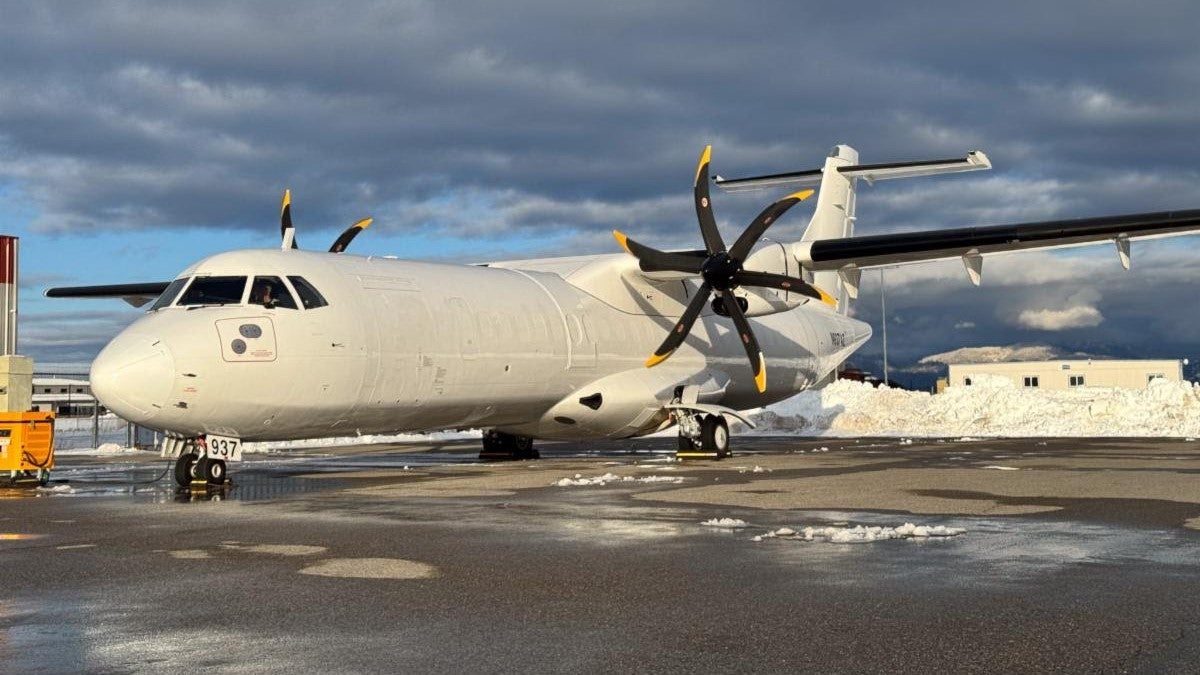
A white, twin-turboprop plane sits on the tarmac.

KF Aerospace is moving quickly to replace its fleet of 70-year-old turboprop freighters that provide feeder service in British Columbia for integrated parcel carrier Purolator Inc.

KF Aerospace, which provides heavy maintenance, airframe modifications, passenger charter operations and other aviation services, has exclusively operated Purolator’s air network in British Columbia since 2015 through its Kelowna Flightcraft division.

The company said on Tuesday it has acquired a used ATR72-500 freighter that can accept bulk loads from ACIA Aero Leasing in Dublin. The aircraft will be introduced in KF Aerospace’s air cargo fleet as soon as April as part of a renewed 10-year contract with Purolator. Under the agreement, KF will also add two containerized ATR72-500 freighters to replace Convair 580s built in the 1950s.

KF said the bulk loader will require minimal work to bring it into service.

KF has already conducted a full cargo door conversion on its first ATR72-500 for the program at its main facility in Kelowna. A third aircraft will be sourced later this year.

KF Aerospace in November said the fleet modernization will deliver improved fuel efficiency and more flexibility in handling diverse cargo needs. It also has the potential to help Purolator expand into other markets.

Purolator’s network in British Columbia connects Victoria and Nanaimo on Vancouver Island, as well as Kelowna, Kamloops and Prince George with Purolator’s hub at Vancouver International Airport. Purolator, which is mostly owned by Canada Post, partners with Cargojet, Air Canada and other commercial airlines and regional carriers to move packages by air across the country.

Click here for more FreightWaves stories by Eric Kulisch.

Canada’s Purolator buys Livingston to boost cross-border trade capacity

Rise in China e-commerce traffic lifts Cargojet to record revenue

US weekly rail traffic shows slight gain over 2024

The Association of American Railroads (AAR) on Thursday reported total U.S. rail traffic for the week ending Feb. 15 of 480,740 carloads and intermodal units, up 1.5% compared with the same week in 2024.

A total 209,216 carloads was down 4.8% y/y, while intermodal volume of 271,524 containers and trailers was up 7%.

Just one of the 10 carload commodity groups, petroleum and petroleum products, posted an increase compared with the year-ago week, up 1,501 carloads, to 10,948. Commodity groups that posted decreases compared with the same week in 2024 included coal, down 4,472 carloads, to 54,447; metallic ores and metals, down 2,130 carloads, to 17,270; and chemicals, down 1,655 carloads, to 32,246.

For the first seven weeks of 2025, U.S. railroads reported cumulative volume of 1,453,273 carloads, off 0.7%, and 1,885,295 intermodal units, up 9.3% y/y. Total combined U.S. traffic for the first seven weeks of 2025 was 3,338,568 carloads and intermodal units, an increase of 4.7%.

Graphic: AAR

North American rail volume for the week on nine reporting U.S., Canadian and Mexican railroads totaled 311,694 carloads, down 5.9%, and 349,663 intermodal units, up 3.5% y/y. Total combined traffic was 661,357 carloads and intermodal units, down 1.2%. 

North American rail volume for the first seven weeks of 2025 was 4,584,752 carloads and intermodal units, up 3.6% compared with 2024.

Canadian railroads reported 87,034 carloads for the week, down 6.3%, and 65,628 intermodal units, down 7.1% y/y. For the first seven weeks of 2025, Canadian railroads reported cumulative volume of 1,091,660 carloads, containers and trailers, up 2%.

Mexican railroads reported 15,444 carloads for the week, down 17.3% compared with the same week a year ago, and 12,511 intermodal units, down 7.1%. Cumulative volume on Mexican railroads for the first seven weeks of 2025 was 154,524 carloads, containers and trailers, down 8.5% y/y.

Subscribe to FreightWaves’ Rail e-newsletter and get the latest insights on rail freight right in your inbox.

Related coverage:

New Orleans Public Belt Railroad expands liquid bulk capacity

UP locomotive to honor Abraham Lincoln

Local service still a sticking point for Class I railroads

Trucking braces for immigration crackdowns

Truck driver at Laredo border crossing

WASHINGTON — Trucking companies, independent contractors and owner-operators may start seeing enhanced scrutiny of their business as a result of several Trump administration executive orders aimed at clamping down on illegal immigration.

Hadeel Abouhasira. (Credit: Holland & Knight)

Four in particular — the America First Trade Policy, Protecting the United States from Foreign Terrorists and Other National Security and Public Safety Threats, Declaring a National Emergency at the Southern Border, and Securing Our Borders — give U.S. Immigration and Customs Enforcement (ICE) enhanced oversight that could affect trucking, particularly companies specializing in hauling between the U.S., Canada and Mexico.

Hadeel Abouhasira, a business immigration attorney with the law firm Holland & Knight, provided insight into how these new policies could affect trucking operations, including the potential for higher costs.

FREIGHTWAVES: Broadly speaking, how will the policies under the new executive orders affect trucking?

ABOUHASIRA: The biggest concern for trucking specifically are the executive orders and policies that have to do with cross-border trucking for truckers traveling between the U.S., Mexico and Canada.

The National Emergency at the Southern Border and Securing Our Border executive orders could lead to longer processing times.

If the America First Trade Policy leads to increased scrutiny of truck drivers, some might face more difficulties renewing work permits or crossing the border, further complicating operations for companies that rely on international logistics.

Stricter criteria under the Protecting the United States from Foreign Terrorists and Other National Security and Public Safety Threats executive order could result in higher denial rates for visas or in travel restrictions, affecting the availability of foreign drivers.

FREIGHTWAVES: What about long-haul trucking?

ABOUHASIRA: One concern is if drivers are contracted out by a company and that company gets a raid or audit from ICE and they want information about their truck drivers, the best general recommendation for drivers would be to make sure they carry evidence of their legal status.

Whether that’s their visa, whether that is their green card, whether it is their U.S. passport — whatever it is that they have that shows they are permitted to be in the U.S. doing the job they’re doing, whether they are an owner-operator or driving for a company. If there’s an accident on the road and a truck driver is pulled over, I think it’s important to make sure you have your documentation on hand to present to law enforcement.


Truck cargo volume out of Laredo, Texas have been outperforming 2024 levels. Source: SONAR

FREIGHTWAVES: Should companies that employ independent contractors expect possible enhanced scrutiny of documentation as well?

ABOUHASIRA: All companies, including those that employ independent contractors, can expect possible enhanced scrutiny of documentation. However, where an employer hires an independent contractor, it is not required to do the I-9 employment verification form — that’s just for employees.

But there could be more scrutiny with companies that are hiring independent contractors where, for example, during an ICE audit or raid, ICE may ask for a list of everybody affiliated with the company, or companies you subcontract with, and it may trickle down to the driver.

FREIGHTWAVES: Could an ICE raid or audit affect an owner-operator out there hauling his own loads?

ABOUHASIRA: Yes, absolutely. Do I think ICE is likely to show up at an owner-operator’s home and ask to see documents? Probably not, but if an incident happens while on the road — a breakdown for example — or a driver is pulled over, that can become an immigration issue, potentially. In addition, if an owner-operator lacks proper work authorization, they may be detained or deported during an ICE raid. Always carry evidence of valid work authorization (visa and I-94), work permit (EAD), green card or passport on hand in case of an ICE inspection or traffic incident.

FREIGHTWAVES: What about drivers who are here legally? Can they expect to see more scrutiny?

ABOUHASIRA: Yes. Even though you’re here legally or employing drivers legally, one thing we’re recommending for clients is to conduct an I-9 audit for their employees — making sure they have all their I-9s in order and making sure they’re updating those I-9s when they need to.

We have a lot of clients that do internal audits of their I-9s so that they can correct errors that they may find during that internal audit. That way if there’s an audit from the government and they want to review it, they can see that the company already caught the error and made the correction.

FREIGHTWAVES: What are the larger implications for the trucking industry and the supply chain?

ABOUHASIRA: It could potentially lead to more administrative burdens and additional costs for these companies. The transportation industry is critical to our economy, and transportation workers are critical to those businesses, so if we continue to see pushback on some of those programs and visa authorizations, ultimately the result may be that consumers notice supply chain disruptions or higher prices.

Click for more FreightWaves articles by John Gallagher.

First look: More weak numbers out of TFI’s US LTL operations

The struggles continue at TFI International’s U.S. less-than-truckload operations, which has at its core the former UPS LTL division that TFI bought in April 2021 – and that CEO Alain Bedard felt compelled on his third-quarter earnings call to insist the company did not regret acquiring

The U.S. LTL division at TFI (NYSE: TFII) posted an adjusted operating ratio of 97.3% in the fourth quarter of 2024, compared to 91% in the fourth quarter of 2023. The OR for the group was 92.2% in the third quarter. Revenue per hundredweight excluding fuel, the key yield benchmark, fell to $27.73 from $28.81 a year ago. Operating income at the LTL division including its Canadian operations was $70.3 million, down from $106.2 million. 

The truckload division at TFI saw a big jump in revenue year on year due to the integration of flatbed operator Daseke into the numbers. Revenue grew to $693.2 million from $399.3 million a year earlier. But operating income only rose to $59.7 million from $50.7 million a year earlier. 

Logistics operating income was $42.9 million, down from $54.7 million.

The biggest nonmonetary announcement in the earnings for TFI International might be that the Montreal-based company will re-domicile in the U.S. It did not say what city would be its new home. TFI said about 70% of its operations are in the U.S., presumably owing primarily to that acquisition of UPS Freight.

The adjusted earnings per share at TFI International were $1.19, well below the consensus estimate of $1.58 reported by SeekingAlpha. Revenue of $2.077 billion was also below the SeekingAlpha consensus forecast of $2.18 billion.

Adjusted earnings before interest, taxes, depreciation and amortization was $315.3 million, down slightly from $320.9 million in the corresponding fourth quarter of 2023. But operating income was down far more, to $160.2 million from $198.3 million.

After the earnings release, post-market trading was decidedly negative. At approximately 5:30 p.m., TFI stock was down almost 6% from its close at $127.61. It is down about 12.5% in the past year and almost 5% in the past month.

TFI will hold its earnings call with analysts at 8:30 a.m. Thursday.

More articles by John Kingston

XPO lawsuit against 2 ex-employees gives look into noncompete agreements

EPA starts uncertain attempt to revoke several California truck emissions waivers

Missouri truck company owner gets 9 years for PPP fraud, other felonies

J.B. Hunt working on intermodal mix, awaiting rate inflection

A yard truck moving JBI containers at a warehouse

J.B. Hunt Transport Services said it’s focused on finding the right intermodal freight to improve efficiency and minimize costs as market fundamentals remain tepid.

The Lowell, Arkansas-based multimodal transportation provider outlined a three-pronged approach centered on rates, volumes and freight mix for the current intermodal bid season at Barclays 42nd Annual Industrial Select Conference held in Miami on Wednesday.

While rate increases are the most impactful lever the company has to drive margins higher, it may have to settle for improving mix as there is no guarantee pricing will move up materially this year with capacity readily available.

J.B. Hunt (NASDAQ: JBHT) said it’s focused on winning the right freight that allows it to run a balanced network with minimal empty containers and repositioning costs. It views freight selection as the primary “controllable” at this point of the cycle.

“It might not necessarily do a lot to revenue per load or rate or yield, but it can do a lot in terms of making us more efficient and productive with our assets and with utilization,” said Brad Delco, senior vice president of finance.

The unit saw record volumes for a second straight time during the fourth quarter, but the operating ratio (inverse of operating margin) deteriorated 170 basis points year over year to 92.7%. Equipment repositioning costs from network imbalances and peak season hiring expenses were the culprits, along with a decline in revenue per load.

J.B. Hunt’s long-term operating margin target for intermodal is 10% to 12% (90% to 88% OR). Part of the recent overhang on the business is the company’s decision to grow capacity ahead of demand. J.B. Hunt has been carrying incremental costs tied to equipment acquisitions but believes the gamble on capacity will pay off over time. It estimates there are 7 million to 11 million loads that should be moved off the highway and onto the railroads.

On the current demand front, management said it’s “still a little too early” to say what intermodal rates will do this year. It said more will be known in May and June but also noted that March is an important month. Importantly, it said the recent volume surge is not from customers pulling forward inventory due to tariff concerns as some analysts have suggested. It also said some customers have indicated they will be converting truck shipments to the rails this year as one-way truckload rates rise.

SONAR: (ORAILDOML.USA) for 2025 (blue shaded area), 2024 (green line) and 2023 (pink line). The daily volume of intermodal containers moving in the United States, Canada and Mexico. The index is a 7-day moving average using the date that containers were in-gated at a point of origin. Intermodal trailers (trailer-on-flatcar, or TOFC) are excluded. To learn more about SONAR, click here.

It said the fact that it has nothing negative to report after a 30-month-plus freight recession is a positive. It believes the market has reached an inflection, noting normal seasonal trends from the fourth to the first quarter.

The company guided to a 20% to 25% sequential decline in consolidated operating income for the first quarter during its fourth-quarter call one month ago.

Management reiterated its expectation for dedicated account losses to end in the second quarter.

J.B. Hunt spent 2024 adding more than 1,700 trucks into service at new or existing customers, but those additions only offset account shrinkage and customer losses. It expects to get back to a net addition run rate of 800 to 1,000 trucks annually and views dedicated as a $90 billion market.

It noted that new accounts are usually unprofitable in the first three months, reaching breakeven by month six, and profitability thereafter. That means it will likely continue to run under a long-term margin target of 12% to 14% in the near term.

The company’s 2025 capital expenditures budget doesn’t include trailing equipment purchases. It could be awhile before those investments are required again.

Shares of JBHT were down 2.7% at 2:52 p.m. EST on Thursday, a down day for trucking and intermodal providers. The S&P 500 was up 0.3% at the time.

More FreightWaves articles by Todd Maiden:

For Nikola, the writing was on the wall

On Wednesday, Nikola Corp. — once a darling of the electric vehicle industry — filed for Chapter 11 bankruptcy protection.

This move signaled the culmination of a tumultuous journey from a company valued at $26 billion in 2020 to one now seeking to liquidate assets and restructure operations. Its bankruptcy filing paints a stark picture of Nikola’s financial woes, with assets estimated between $500 million and $1 billion against liabilities ranging from $1 billion to $10 billion.

As the company pursues an auction and sale process for its assets (pending court approval), the outcome remains uncertain for stakeholders and the broader zero-emissions transportation sector.

The bigger they are …

Nikola’s inception in 2014 marked an ambitious entry into the nascent field of hydrogen-powered trucks. The company quickly garnered attention for its bold claims of revolutionizing the trucking industry with zero-emissions technology.

By June 2020, Nikola had reached its zenith, going public through a merger with VectoIQ Acquisition Corp., a special purpose acquisition company. This move catapulted Nikola’s market valuation to a staggering $26 billion, surpassing even that of established automakers. The fervor surrounding Nikola’s potential disruption of the transportation sector led to a peak share price of $79.73 on June 6, 2020.

However, the exuberance surrounding Nikola belied a series of red flags that would ultimately presage its downfall.

In 2022, Nikola founder Trevor Milton was convicted on three federal counts of fraud. Milton’s deceptive claims about Nikola’s technological capabilities — most notably the nonfunctional Nikola One truck — significantly eroded investor confidence.

The legal repercussions of Milton’s actions not only tarnished Nikola’s reputation but resulted in costly penalties, including a $125 million fine imposed by the Securities and Exchange Commission in December 2021.

Nikola’s operational challenges compounded these financial difficulties. The acquisition and liquidation of Romeo Power in 2022 and 2023, respectively, highlighted the company’s struggles with battery supply chain management.

This issue came to a head in June 2023 when Nikola began experiencing battery fires in its trucks, necessitating a recall of 209 battery-electric vehicles. The recall incurred a substantial financial burden, with $61.8 million set aside for battery replacements.

These setbacks, coupled with high borrowing costs and intensifying competition in the electric vehicle market, created a perfect storm of financial pressure for Nikola.

… the harder they fall

The company’s recent financial filings reveal a litany of concerns that foreshadowed its impending bankruptcy.

Nikola’s earnings from Q3 2024 disclosed alarming net losses of $481.2 million for the first nine months of 2024. This figure, when contextualized within the broader pattern of the company’s financial performance, indicated a systemic inability to achieve profitability with its remaining runway.

Perhaps most telling was the stark admission in Nikola’s SEC filings regarding its ability to continue as a going concern.

The company’s liquidity crisis became increasingly apparent as CFO Thomas Okray warned investors that Nikola only had sufficient cash to fund operations into, but not through, the first quarter of 2025. This prognosis was further supported by the reported cash reserves of a mere $198.3 million at the close of September 2024, a figure woefully inadequate given the company’s annual cash burn rate of approximately $500 million.

The closing act for Nikola was characterized by increasingly desperate measures to secure capital.

The company resorted to selling assets, including its Phoenix headquarters, in a bid to stay afloat. Nikola’s stock price, which had once soared to lofty heights, plummeted below $1 on multiple occasions, triggering concerns about potential delisting. The market’s reaction to Nikola’s continuous stream of negative news, including vehicle returns and recalls, further depressed investor sentiment and the company’s ability to raise much-needed capital.

Nikola’s descent into Chapter 11 bankruptcy can be attributed to a confluence of factors: unparalleled operational challenges, persistent financial losses, legal ramifications stemming from fraudulent activities of its founder, and broader market pressures within the highly competitive electric vehicle industry.

The company’s arc from a celebrated disruptor to a cautionary tale underscores the importance of transparency and strict financial management in the ever-changing automotive sector.

Trimble’s Q4 transportation and logistics revenue tops $206M

Trimble Inc. posted fourth-quarter revenue of $206.8 million in its transportation and logistics segment, a 6% increase from the same period in 2023.

The supply chain technology provider reported total revenue of $983.4 million in the quarter, up 5% on a year-over-year basis. Adjusted quarterly earnings per share increased 27% year over year to 89 cents.

Trimble (NASDAQ: TRMB) released its fourth-quarter earnings results and hosted a call with analysts before the market opened on Wednesday.

“The transportation team did a terrific job, obviously, with controlling what they can control. The macros continue to be difficult … really globally in the freight market,” Rob Painter, president and CEO, said during the call with analysts. “We won many new [clients] throughout the year, some of the biggest company names you’ll find in any vertical, and then the team did a nice job of cross-selling within that.”

Trimble’s Transporeon business achieved a record 20% year-over-year increase in bookings for full-year 2024, the company said.

Transporeon is a cloud-based TMS connecting carriers, logistics providers and shippers that Trimble acquired in 2022.

Westminster, Colorado-based Trimble is a provider of technology for trucking companies, freight brokerages and 3PLs. In addition to transportation, the company operates in industries such as buildings and infrastructure, geospatial hardware and software, and resources and utilities.

The company’s guidance for the first quarter of 2025 calls for total revenue between $794 million and $824 million and adjusted earnings per share of 55 to 61 cents.

Trimble expects full-year 2025 revenue ranging from $3.37 billion to $3.47 billion and earnings between $2.76 and $2.98 per share.

For full-year 2024, Trimble’s total revenue fell 3% year over year to $3.68 billion. The company’s 2024 transportation and logistics revenue increased 9.5% year over year to $788.8 million.

Painter said the transportation and construction markets remain in flux with the possibility of a U.S. tariff war with Canada, Mexico and European nations.

“On the change in demand since the president came into office, nothing discernible is in the pipeline. You hear sentiments: … Are we going to have onshoring, reshoring or supply chains moving around?” Painter said. “I think overall, we’re in a wait-and-see mode.”

As the freight market continues to improve, Painter expects to see more bookings from existing customers for the company’s logistics and transportation solutions.

“An economic recovery that translates into a freight market recovery is more transactions happening for each of the customers that we already have,” he said.

During fiscal year 2024, Trimble repurchased 2.9 million shares for $175 million.

Painter announced during the call that Trimble’s board of directors had increased the company’s repurchase authorization of common stock to $1 billion, which replaces the existing authorization and goes into effect immediately.

TrimbleQ4/24Q4/23Y/Y % Change
Total revenue$983.4$875.812%
Transportation and logistics revenue$206.8$195.26%
Architects, engineers, construction, owners segment revenue$413.8$30635%
Field systems$362.8$374.6(3%)
Adjusted EBITDA$298.1$237.425%
Adjusted operating income$283.6$224.826%
Adjusted earnings per share$0.89$0.7027%
Trimble Inc.’s key fourth-quarter performance indicators. $ in millions except earnings per share.

Trucking groups praise DOT termination of NY congestion tolls

This article was updated on February 19, 2025, at 5:51 p.m. ET to include New York Gov. Kathy Hochul’s response on social media to the DOT reversal of New York City’s congestion pricing plan.

The U.S. Department of Transportation has terminated New York City’s congestion pricing plan, drawing praise from the Owner-Operator Independent Drivers Association and a vow from the city to fight the decision.

In a DOT news release announcing the decision on Wednesday, Transportation Secretary Sean Duffy said the tolls were a “slap in the face to working class Americans and small business owners.”

“Commuters using the highway system to enter New York City have already financed the construction and improvement of these highways through the payment of gas taxes and other taxes,” he said in the release. “But now the toll program leaves drivers without any free highway alternative, and instead, takes more money from working people to pay for a transit system and not highways. It’s backwards and unfair.”

Duffy added that the program hurt small businesses in New York that rely on customers from neighboring states.

President Donald Trump posted on social media that “CONGESTION PRICING IS DEAD.”

“Manhattan, and all of New York, is SAVED,” he wrote. “LONG LIVE THE KING!”

Governor responds

New York Gov. Kathy Hochul responded to the reversal with her own social media post saying: “We are a nation of laws, not ruled by a king.”

“Since this first-in-the-nation program took effect last month, congestion has dropped dramatically and commuters are getting to work faster than ever,” she said. “Broadway shows are selling out and foot traffic to local businesses is spiking. School buses are getting kids to class on time, and yellow cab trips increased by 10 percent. Transit ridership is up, drivers are having a better experience, and support for this program is growing every day.”

Hochul said New York’s Metropolitan Transportation Authority has initiated legal proceedings in the U.S. District Court for the Southern District of New York to preserve the congestion toll program.

Stakeholders react

OOIDA told FreightWaves in an emailed statement that the organization “welcomes the DOT’s decision to rescind tolling authority for New York’s congestion pricing plan.”

“Truckers often have very little control over their schedules, so this congestion pricing plan is particularly problematic for owner-operators and independent drivers,” said OOIDA President Todd Spencer. “We routinely have no other choice than to drive through metropolitan areas during periods of high congestion because of the rigidity of current federal hours of service requirements. Additionally, shippers and receivers generally have little regard for a driver’s schedule, frequently requiring loading and unloading to occur at times when nearby roads are most congested.

“New York City’s congestion pricing plan was anti-trucker to begin with and we will continue fighting to ensure it doesn’t come back. Beyond New York City, we encourage the Trump Administration and Congress to fight the expansion of tolling across the country.”

New York City Comptroller Brad Lander released a statement Wednesday denouncing the Trump administration for “illegally reversing approval of congestion pricing.”

“Congestion pricing is working: traffic is down, travel times have plummeted 30%, transit ridership has surged, and hundreds of millions of dollars are flowing to improve our subways and buses,” he said in the news release. “We must not let Trump drag us back to crappier subway service, standstill traffic, and smoggier air.

“Having been at the forefront of the fight to implement congestion pricing, I am appalled that President Trump and his U.S. Department of Transportation put this in reverse, purely for political purposes. Let’s be clear: the U.S. DOT properly approved this program after extensive environmental review.”

Lander said his office is exploring all available options to reverse “yet another instance of illegal federal overreach by the Trump administration” and keep the tolls implemented.

The Trucking Association of New York (TANY) told FreightWaves in an emailed statement that the group “stands with President Trump and Secretary Duffy in their efforts to end the congestion pricing program.”

“We agree with their decision to halt this program, and we hope it leads to an immediate cessation of the collection of tolls,” said Kendra Hems, president of the Trucking Association of New York. “This will allow New Yorkers to continue enjoying the city, receive their goods at reasonable rates, and ensure the economy keeps running smoothly.”

Background

The pricing plan, which went into effect in early January, charged vehicles to enter or exit Manhattan’s “congestion relief zone.” The zone covers streets and avenues at or below 60th Street, excluding bordering West Side Highway, FDR Drive and Hugh L. Carey Tunnel main roads.

“Small,” one-unit trucks were charged $14.40 to enter the area, while “large” two-unit trucks were charged $21.60. Regular toll rates applied from 5 a.m. to 9 p.m. on weekdays and 9 a.m. to 9 p.m. on weekends, and a 75% cheaper overnight toll outside those time frames aimed to encourage off-hours truck deliveries.

The tolls were criticized by local small businesses and trucking organizations as too costly. The TANY argued that the pricing plan unfairly targeted trucking operators who transport 90% of the goods in the state.

Proponents of the pricing program have said it will cut down on environmentally harmful emissions, unclog streets and allow for better public transit options.

FreightWaves reached out to Gov. Hochul for comment.

AI virtual agents making the call

Brokers and other logistics companies with a high volume of incoming calls tend to rely on tedious automated phone navigation menus and are often forced to leave customers on hold for more complex issues. With a sophisticated AI voice agent, many of those calls can now be solved without needing a transfer.

David Bell, founder and CEO of CloneOps.ai, recognized the value of a powerful AI tool that could help streamline call centers and customer support operations. 

“When I first saw AI being used for solutions in the logistics industry, I knew I had to understand how it would impact my business and what I could do to get involved with the future,” Bell said. 

“What customers need now is simple,” Bell said. “They want to know how we’re going to help them save money and help their employees work better. That’s what I’m focusing on at CloneOps.ai.”

With his team at CloneOps.ai, Bell is building a voiced AI platform that will make employees in the U.S. and in nearshore call centers more productive and more valuable.

“Most of our competitors are from a primarily tech background, but our decades of experience in logistics sets us apart,” Bell said. “There are professionals who blow me away with how tech-savvy they are, but my experience in logistics and the tech skills on my team combine to make a product that’s tailored for what logistics companies need.”

Just as important as technical knowledge is the relational aspect of the freight industry. According to Bell, successfully launching a new integrated tool comes down to trust.

“We need full integrations to get all the data points that we need, and to get all of those integrations you really need to be a trusted partner,” Bell explained. “Anyone who knows logistics knows that proprietary data is very sacred to the companies who have spent a lot of time and resources developing their data models.

“Coming from a career where I’ve hauled freight for more than 25 years, consolidated broker freight throughout the country and partnered with many of these companies in their nearshoring efforts, I have great relationships and credibility among this community. I couldn’t be undertaking this new effort at CloneOps.ai without that trust and credibility in the logistics space.”

CloneOps’ AI voice agent integrates into existing systems cleanly and easily. Users can give the virtual agent a custom voice, provide it with prompts and scripts for various scenarios, and integrate it into any necessary systems.

Because the virtual agent relies on the relevant data, callers feed it whatever may be necessary for typical calls – information such as load specifics, delivery and accounts receivable data, invoices, and payables.

“The virtual agent takes the info from your system or an uploaded CSV and summarizes it or answers questions about it verbally like a person would,” Bell said. “As long as you have the data, you can train the agent like you would any other employee to speak to that data and have a dynamic conversation.”

According to Bell, CloneOps.ai’s virtual agent is much more advanced and convenient than traditional systems in which users have to navigate menus with prewritten scripts prior to reaching a representative.

“We’re building our agent to be interactive so that you can avoid a lot of those scenarios where you’d need to transfer a call,” Bell said. “In our case, you can jump right in and take over at any point with a human agent, whereas our competitors still rely on menus that force the customer to transfer the call.”

From the CloneOps.ai dashboard, users can take over any call manually and interrupt the AI agent. “No one likes to deal with being on hold during the transfer process,” Bell said. “That defeats the purpose. The main benefit of using an AI agent like ours is so that people don’t have to be on hold.”

Having experience and relationships with people all over the industry, Bell was poised to figure out exactly what the big brokers need.

“You have to continually evolve in this space to remain competitive,” he said. “If it’s going to cut your cost or make your people more productive, you have to look at what solutions are right for your business. If you deal with a high volume of calls that require straightforward information requests, it’s an indispensable tool.”

The CloneOps AI agent is immensely scalable, since it essentially operates as one liaison that can handle multiple calls instead of leaving numerous callers on hold. Often, the AI agent can solve the problem without needing an employee to be involved.

Additionally, Bell said, one of the most important features of the CloneOps AI agent is that it can identify the caller and prioritize based on urgency.

“If you have your best customer calling, you don’t want them in the queue behind four unknowns or potential customers,” Bell said. “When a major carrier calls to get a bill paid, you don’t want that person sitting on hold. A huge percentage of calls at high-volume brokers sit on hold or go unanswered.”

To check out the CloneOps virtual AI agent, visit CloneOps.ai to book a demo today.

Severe weather, Delta crash disrupt air shipments in US and Canada

Orange deicing trucks drive on a snowy airfield with an airplane in the background.

Parcel and air cargo customers are experiencing shipping delays in parts of North America because of winter storms and Monday’s crash of a Delta Air Lines regional jet at the Toronto airport.

Adverse weather conditions disrupted flight activity at the FedEx (NYSE: FDX) global air hub in Memphis, Tennessee, and some customers could experience delivery delays on Wednesday, the company said in a service alert posted online. FedEx does not provide refunds or credits under its money-back-guarantee program when it declares a National Service Disruption.

Several inches of snow and sleet fell across the mid-South, including Memphis, Tuesday night. Bitterly cold weather is forecast to continue in the region through Friday, according to weather reports.

FedEx earlier this week notified customers of possible delays related to the heavy flooding in Kentucky.

The snowstorm also reached Louisville, Kentucky, home to UPS’ (NYSE: UPS) main air hub. The express delivery and logistics giant said scheduled delivery times for a limited number of air and international packages may be affected by operational disruptions at the Worldport facility. 

Further north, Toronto Pearson International Airport has closed two runways, one of which is the busiest runway in Canada, resulting in reduced flight capacity as it recovers from the Delta crash and three major snowstorms last week. Two other runways are open to traffic, according to airport duty manager Jake Keating. 

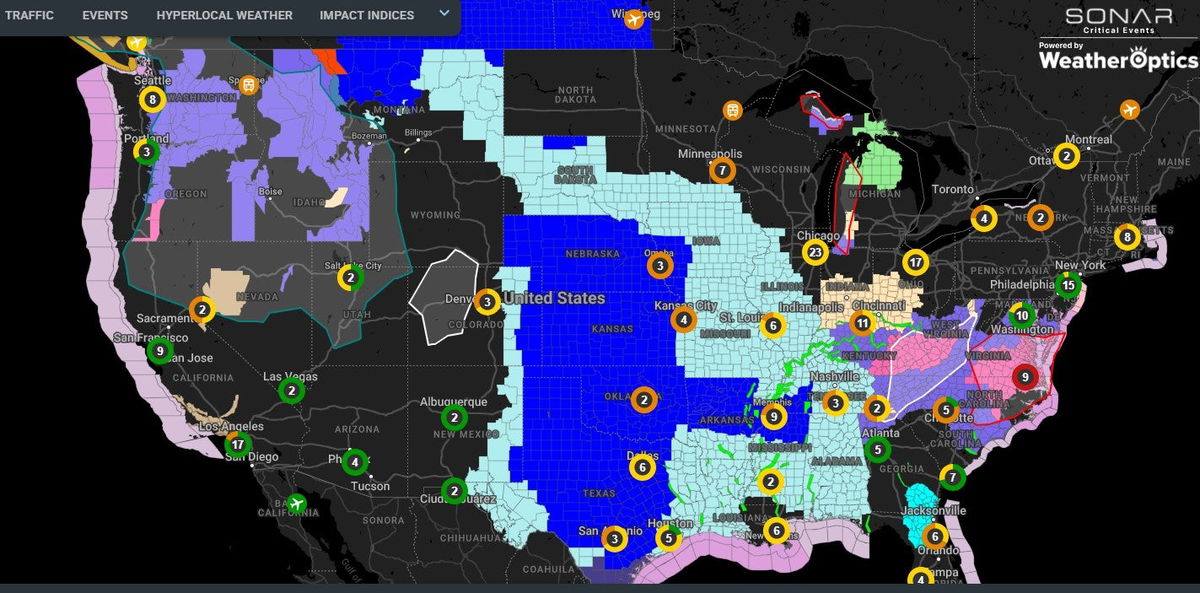
The FreightWaves SONAR platform shows critical weather events, including Arctic temperatures, that are impacting freight transportation.

The airport is limiting the number of departures it will allow throughout the day to ensure operations aren’t overwhelmed and aircraft aren’t stuck on the airfield waiting for gates. And Nav Canada, the air traffic control manager, is also limiting arrivals, he said on the Toronto morning show “CP24.”

About 950 flights are scheduled to arrive and depart on Wednesday at Toronto Pearson. As of 7 a.m., about 5.5% of flights had been canceled, the airport said on X.

Investigators say the Delta CRJ-900 jet that flipped over will remain on the runway for 48 hours while they continue to gather information about the cause of the accident. After the aircraft is removed from the runway, the airport will still need to conduct inspections to make sure the runway and equipment are not damaged before it can be opened to commercial traffic, Keating said.

The severe weather has made life challenging for airlines operating in eastern Canada.

Air Canada (TSX: AC) on Tuesday said it has canceled nearly 1,300 flights over the past six days, but the flight limitations at its Toronto hub are slowing the recovery. 

“We anticipate it may take several more days, depending on the weather, to return to fully normal operations,” it said in a news release.

The airline’s cargo division, which operates six Boeing 767-300 freighters and manages shipments carried on passenger aircraft, separately said shipments are pushed back because of flight delays, diversions and cancellations to and from Toronto.

“Given the impact of the weather events in Toronto and Montreal, as well as the temporary runway closure in Toronto as a result of Monday’s incident, there has been a knock-on effect to our cargo operations, but it is too soon to determine the extent of the impact as it remains a fluid situation,” Air Canada said in a statement provided to FreightWaves.

Canadian all-cargo operator Cargojet (TSX: CJT), which operates a hub in Hamilton, Ontario, near Toronto, has not experienced any operational impact from recent weather events, spokeswoman Courtney Ilola said via email. She did not address whether some shipments transferred by international carriers to Cargojet in Toronto for onward transport in its domestic network could be delayed.

The carrier handled record volumes during the holiday peak season while dealing with challenging weather conditions, according to fourth-quarter results published on Tuesday. 

Click here for more FreightWaves stories by Eric Kulisch.

Rise in China e-commerce traffic lifts Cargojet to record revenue