What shippers should know about ocean carrier alliance changes in 2025

The Getting to Zero Coalition released a report about how to make zero-emissions shipping commercially viable.

Timing is everything, but as international ocean container lines ready the February launch of reorganized alliances and vessel-sharing agreements, a miasma of global events is sure to put pressure on carefully crafted business plans.

The reshuffle is headlined by a pair of notable carrier groupings.

The Premier Alliance of ONE, Yang Ming and HMM is the newly named version of the former THE Alliance, which Hapag-Lloyd departed to partner with Maersk. 

ONE (Ocean Network Express) was formed in 2016 as the integrated container businesses of Japan-based trio Kawasaki Kisen Kaisha (K-Line), Mitsui O.S.K. Lines (MOL) and Nippon Yusen Kaisha (NYK). Headquartered in Singapore, ONE focuses on key east-west routes and collectively operates more than 240 vessels with capacity of 1.9 million twenty-foot equivalent units, on 165 services to 120 countries.  

The alliance also has strategic ownership stakes in container terminals in North America including TraPac at the ports of Oakland and Los Angeles; Yusen Terminals, also in LA; and in Northern Europe at Rotterdam World Gateway at the Port of Rotterdam, the Netherlands. ONE also operates Magenta Singapore Terminal, its Southeast Asia center.

As of February ONE will schedule three trans-Pacific Asia-Pacific Northwest services, and five Asia-East Coast North America voyages.

After a request for information, the Federal Maritime Commission has approved the Premier Alliance to take effect Feb. 9.

The new Gemini Cooperation joins the aforementioned Hapag-Lloyd and Denmark’s Maersk, which left the pioneering 2M 10-year vessel-sharing agreement (VSA) formed in 2015 with Mediterranean Shipping Co. (MSC).  

The Gemini partners have been public about their goal of providing 90% schedule reliability in an industry that has struggled to make good on half its promised arrivals amid disruptions stretching back to the start of the pandemic. The simplified, hub-and-spoke network similar to those pioneered by airlines features mostly single operator loops and fewer port calls per service, calling high-efficiency terminals with 29 mainliner services and interregional shuttle services, and covers the full scope of U.S. trades including Asia to the West and East coasts, and trans-Atlantic.

In Gemini, Maersk will compete with former partner MSC of Geneva, which is going it alone. Analysts say this may produce lower rates for shippers as the carriers compete head-to-head on global routes. MSC is the world’s largest container line, operating a total of 887 owned and chartered ships with capacity of 6.4 million TEUs, or slightly more than a 20% share of the worldwide market, according to data compiled by analyst Alphaliner. Maersk is second with 726 ships carrying 4.5 million TEUs, for a 14% share. 

It’s notable that the Gemini, ONE and Premier alliances control 80% of worldwide container capacity. Capacity is a tricky balancing act for any logistics provider, and the current fleets don’t reflect orders for new vessels, some of which will come online this year.    

MSC is leveraging its position as the leading container line by also outdistancing competitors on newbuilds, with a staggering 130 ships on order with estimated capacity of 2 million TEUs, or more than a third of its existing capacity. The company’s thirst for new ships even led to a reported reopening of Chinese mega-shipyard Jiangsu Rongsheng Heavy Industries, idle since 2014.

In comparison, Maersk has 50 ships on order at 723,000 TEUs, or 16% of current capacity. 

The capacity equation becomes more muddled due to the changing situation surrounding the Red Sea in the Middle East.

Situated between the Suez Canal and Gulf of Aden, the Red Sea is a critical link connecting Asia and the Mediterranean, Europe and the east coast of North America. But attacks on merchant shipping begun in late 2023 by anti-Israel Houthi rebels based in Yemen led most major lines to divert services away from the Red Sea in 2024, making voyages up to 14 days longer via the Cape of Good Hope around the Horn of Africa. French liner CMA CGM was an exception, maintaining its scheduled BEX2 service, sometimes under escort by naval forces patrolling the region.

The Red Sea violence turned into an unexpected jackpot for shipping lines, as the diverted voyages took capacity out of the market and helped boost container rates, resulting in billions in profits across the industry in 2024.

But a ceasefire in the Israel-Hamas war, the collapse of the Assad regime in Syria and domestic issues roiling Houthi sponsor Iran changed the calculus in the region. Red Sea attacks dwindled, and shippers are now wondering when carriers will return to the Suez route.

Shipping executives have mostly deferred a definitive answer, citing uncertainty but also mindful of projections that container rates could fall by as much as 70% when Suez services resume. 

A re-opening of the Suez route would boost U.S. East Coast container volumes, but likely undermine gains seen by West Coast gateways.

In a service advisory, Maersk said that due to ongoing high security risks, it will phase in the east-west Gemini network by continuing to route vessels away from the Red Sea and around Africa.

In the trans-Pacific, American consumers helped pump up eastbound volumes toward record highs through late 2024. But carriers are also trying to make sense of the growing anti-China sentiment in the U.S., as well as threatened tariffs and shifting supply chains that make forecasting a speculative study.

Among other carriers, the Ocean Alliance of CMA CGM, Evergreen, Cosco and OOCL has been extended to 2032. CMA CGM is the world’s third-largest carrier, with 662 ships and capacity of 3.9 million TEUs. Cosco is fourth, at 512 ships and 3.3 million TEUs; Evergreen is seventh, at 224 ships and 1.8 million TEUs. 

Cosco has 52 ships on order, for a total 881,000 TEUs, or 26% of current capacity.

In an announcement, OOCL said that as of February it will offer six trans-Atlantic services calling the U.S. East, West and Gulf coasts, with alliance partners “and beyond”. In April the partners will offer 22 rotations calling ports on the U.S. coasts as well as the west coast of Canada.

While MSC and Israel’s Zim left previous alliances, the companies in late 2024 announced a new long-term trans-Pacific partnership on services connecting Asia and U.S. Gulf ports and Asia and U.S. East Coast hubs, effective in February.

This article was updated Feb. 7 to add Federal Maritime Commission approval of operations of the Premier Alliance effective Feb. 9.

This article was updated Feb. 1 to add Maersk’s Gemini network advisory regarding the Red Sea.

Find more articles by Stuart Chirls here.

Related coverage:

Texas Gulf Coast ports see year-over-year gains in freight volumes

Asia-US ocean rates trend lower but Trump tariff threats shadow trade

Los Angeles, the busiest US container port, plans even bigger future

White House: Expect first tariffs on Saturday

Trucks wit tariff motif

WASHINGTON — Mexico and Canada will see a 25% tariff on imports into the U.S. starting on Saturday if President Trump holds to his word.

The memorandum outlining his administration’s “America First Trade policy” does not set a specific date that the tariffs will take effect, but rather directs federal departments and agencies with tariff oversight to provide reports and make recommendations by April 1.

After issuing the memo, however, Trump told reporters they would go into effect on Feb. 1, and he suggested days after that an additional 10% tariff on China (because of its alleged role in the fentanyl crisis), as well as possible tariffs and sanctions on Russia related to the war with Ukraine would be imposed.

“The February 1 date for Canada and Mexico still holds,” White House Press Secretary Karoline Leavitt told reporters on Tuesday, adding that Trump is also “still very much considering” the 10% added tax on China starting Saturday as well.

But will the president actually stick to that date?

“No one knows the answer to this question, and it would be improper to speculate,” said Timothy Brightbill, an international trade law expert and partner at the law firm Wiley Rein, speaking during a webinar hosted by the firm last week.

“But the memo does indicate that the administration is going to be smart about this, get its teams across the executive branch in place and do a comprehensive assessment of many of these issues.

“At the same time, it’s wrong to assume that nothing will happen before April 1, so don’t discount these statements by President Trump as mere posturing, and don’t make assumptions. For companies that would be affected by tariffs, hoping and wishing is not a strategy.”

According to a recent report by supply chain consultancies Iter Consulting and AIMMS, 38% of US companies are only somewhat prepared for trade policy changes and instead plan to rely on suppliers to absorb increased tariff costs.

“This leaves them vulnerable to unplanned cost surges and supply chain disruptions if suppliers pass on tariff related costs,” the report asserts.

And if the tariffs do begin on Saturday, shippers will need to immediately take stock of what goods they have in the supply chain, customs broker Kuehne + Nagel recommended.

Key players

Wiley Rein noted four key people in the Trump administration who will be responsible for carrying out its trade and tariff agenda:

  • Treasury Secretary Scott Bessent.
  • Commerce secretary nominee Howard Lutnick.
  • US Trade Representative Jamieson Greer.
  • White House Senior Counsel for Trade and Manufacturing Peter Navarro.

Three others who will have significant influence over how and when tariffs are rolled out:

  • Secretary of State Marco Rubio.
  • Office of Management and Budget Director nominee Russell Vought.
  • White House National Economic Council Director Kevin Hassett.

Nazak Nikakhtar, who served in the first Trump administration as assistant secretary for industry and analysis at the International Trade Administration, compared the approach Trump and his team took during that term with regard to tariffs to what she expects in the current term.

“I characterize the first Trump administration as being experimental,” said Nikakhtar, now a colleague of Brightbill’s at Wiley Rein.

“He used these [economic] tools not as much as he would have liked but kind of wanted to see how far he would get. He took these tools right up to the red line but didn’t cross those red lines, and his actions were upheld in courts.

“Now I think the entire team feels emboldened. They know how the rules work, they know they want to move fast, and they’re going to be executing quickly. They’ve witnessed the steady hollowing-out erosion of our manufacturing base, and they want to stop that and reshore as much as possible.”

A widespread review

The departments of Treasury and Commerce and the Office of the U.S. Trade Representative are responsible for 22 of 23 reports required under the America First trade plan, according to the memo.

Those reports, as summarized by the law firm Blank Rome, direct executive branch reviews of a range of trade and tariff policies, among them:

  • The cause of annual trade deficits and potential policies to remedy them.
  • The feasibility of establishing and the best methods for designing and implementing an External Revenue Service to collect tariffs.
  • Unfair trade practices by other countries and actions needed to remedy them.
  • Preparations for the July 2026 review of the United States-Mexico-Canada Agreement.
  • Policies and regulations regarding the application of antidumping and countervailing duty laws.
  • The impact of all trade agreements on the United States. 
  • Current exclusions and exemptions from the Section 232 tariffs on steel and aluminum.
  • Migration and fentanyl flows from Canada, Mexico and China.
  • Whether China is living up to its Phase One trade agreement with the U.S.

Whether or not Trump holds to his word for starting the tariff rollout on Saturday, companies will soon be feeling pressure to make potentially significant changes to their supply chains.

“My message to every business in the world is very simple: Come make your product in America, and we will give you among the lowest taxes of any nation on Earth,” Trump told the World Economic Forum in Davos, Switzerland, on Jan. 23.

“But if you don’t make your product in America, which is your prerogative, then, very simply, you will have to pay a tariff – differing amounts, but a tariff – which will direct hundreds of billions of dollars and even trillions of dollars into our Treasury to strengthen our economy and pay down debt.

“Under the Trump administration, there will be no better place on Earth to create jobs, build factories or grow a company than right here in the good old USA.”

Click for more FreightWaves articles by John Gallagher.

Takeaways from State of Freight: Volatility in Washington, intermodal surge

With so much focus on Washington in the first days of the Trump administration, the January State of Freight webinar with FreightWaves and SONAR CEO Craig Fuller could have focused solely on politics and its impact on freight markets.

But in the monthly discussion between Fuller and SONAR’s director of market intelligence, Zach Strickland, they found a few other key topics to discuss as well as the machinations in Washington and what they will mean for logistics. Here are five takeaways.

The surge in intermodal

After Strickland displayed a chart showing that rail volume in the past year has risen while the Outbound Tender Volume Index (OTVI) has fallen during that time, he noted that so much of the discussion in markets focuses only on trucks as a source of capacity. “They’re talking about how many trucks are there, and where are the trucks going?” he said. “How many trucks are leaving?” But meanwhile, he said, “they grew capacity in the intermodal market by 5% to10%.”

Fuller said there is a concept of “dispatchable capacity,” which puts intermodal and trucks together as a total. And railroads are in a position to take a bigger share of that, he added.

“The railroads have their act together and they didn’t necessarily have that a few years ago,” Fuller said. With labor peace in place that Fuller said “actually favors labor quite a bit more than it did in the past,” it means that “crews are largely supportive of where the railroads want to be. The railroads are taking advantage of these opportunities and inflection points,” he added.

Another force in the market pressuring over-the-road trucking companies is the rise in private fleets, Fuller said: “They’ve expanded exponentially over the last couple of years.”

Leaning into the chaos

Supply chains will be impacted by the volatility that comes with a Trump presidency. “Even when you think things are settled or not, he’s always negotiating in his mind,” Fuller said. The webinar took place two days before sweeping tariffs on Canada and Mexico are due to be put into place. Fuller cited the recent stand-down by Colombia over a dispute that would have involved steep U.S. tariffs on Colombian imports, “and I think what this means is that if you’re in the supply chain, you really are not going to catch your breath, because there’s always something.”

But the relatively quick end to the Colombian conflict reveals another part of the Trump playbook, Fuller said. “Oftentimes, he makes a huge threat and is happy to take some type of victory. Never underestimate Donald Trump’s willingness to accept victory at any moment in time.”

Why the continued bankruptcies if things are getting better?

With bankruptcies still piling up in the industry, Fuller said he was talking to somebody on Wall Street who wondered why, if the freight market is showing signs of improvement, there are still bankruptcies.

As Fuller put it: “The balance sheets have memory. You can have an improving situation in the market, and you still have all these operating deficits that you have to contend with. That is the reason the market can still be in decline.”

In an unusual twist, Fuller said sometimes improving markets can help trigger a bankruptcy that had been bubbling under the surface for a while. The reason: used truck values. “The equipment now is more valuable to banks because they feel like they can sell it and flip it so they will repossess it,” he said. “When the market is bad, they don’t want the equipment. So when you see a firming of residual values, they’re like, ‘Hey, we can actually liquidate this equipment.’ Getting half your money on a payment is better than nothing at all.”

Still bullish?

Fuller is still bullish even as Strickland noted that the OTVI in SONAR has started to slip. Through most of the freight recession, OTVI has held relatively firm. “I’ve been burned a number of times over the last couple of years by being really bullish in January when things do collapse,” he said. But there are other data points, like the rise in the Outbound Tender Rejection Index to a level near 7%, that still point to bullishness.

Fuller also said various statements on earnings calls this quarter suggested strength. “They’re seeing some of the shippers start to get ahead with higher rates earlier in the cycle than they have in the past,” he said. “And that suggests to me that everyone is sort of positioning themselves for a better year.” For shippers, the increasing risk is that “you could run out of trucks or have high spot rates.”

Fuller also said the narrowing gap between contract and spot rates suggests continued market tightening. A weak market has contract solidly above spot; a stronger market can see the reverse. Trends now point to spot rates catching up with contract rates. 

What do deportations have to do with trucking capacity?

Fuller began his remarks on the subject of deportations and trucking capacity by saying he didn’t want the discussion to be political. He also noted that the highly publicized arrests of undocumented immigrants in the early days of the Trump administration obscure the fact that arrests and deportations were at higher rates in other administrations, including the eight years of Barack Obama.

But given their visibility, Fuller offered two scenarios. One is that a worker in a visible location like a meatpacking plant who is concerned that the site will be raided by U.S. Immigration and Customs Enforcement might think he’s safer in a truck if he has the capability to drive. But offsetting that in terms of capacity is the fact that a lot of the people who are being arrested might be found working in such occupations as construction. And there has always been a trade-off between workers going back and forth between construction and trucking.

“Those businesses are losing people, and when they lose people, those jobs become competitive,” Fuller said. “So we will pull some capacity out of the market, because drivers are ultimately the determinant of capacity.”

More articles by John Kingston

5 takeaways from State of Freight: Preparing for East, Gulf Coast port strike

State of Freight for October: The bullish feeling is starting to grow
State of Freight takeaways: Impacts of the deep freeze; data looking up

Lawmakers reintroduce anti-fraud freight bill

Truck on road with fraud paint

WASHINGTON — The growing threat of freight fraud in trucking has led to another effort by Congress to crack down on scammers that steal millions from legitimate brokers and motor carriers.

Bipartisan legislation introduced in the House of Representatives by Congresswoman Eleanor Holmes Norton, Washington’s nonvoting delegate in the House, would give the Federal Motor Carrier Safety Administration more power over fake companies attempting to register with the agency.

Specifically, the Household Goods Shipping Consumer Protection Act “would clarify that FMCSA has the authority to assess civil penalties against fraudulent actors that hold consumers’ personal goods hostage, allow FMCSA to leverage states’ enforcement of federal consumer protection laws related to the transportation of household goods and establish requirements to ensure that motor carriers, brokers and freight forwarders that seek registration are operating legitimate businesses,” Holmes Norton said in a statement.

“This bill would also provide explicit authority for FMCSA to withhold registration from any applicant that fails to provide a valid principal place of business or disclose common ownership with any other registered entities at the time of registration.”

While a major target of the legislation is fraud that occurs in the household goods sector, the stricter registration requirements and enforcement provisions would apply to all freight carriers and brokers that register with FMCSA.

The legislation is endorsed by the Transportation Intermediaries Association, the American Trucking Associations, the Owner-Operator Independent Drivers Association, the National Association of Small Trucking Companies, the Commercial Vehicle Safety Alliance, the Institute for Safer Trucking and Road Safe America.

“Freight fraud committed by criminals and scam artists has been devastating to many small business truckers simply trying to make a living in a tough freight market,” said OOIDA President Todd Spencer in a press release.

“Because of the broad industry support for these common sense reforms, we hope this bipartisan legislation will move through the committee process without delay.”

Similar legislation introduced in the last Congress with 24 co-sponsors (14 Republicans, 10 Democrats) was approved out of the House Transportation and Infrastructure Committee by a vote of 62-2. This year U.S. Sens. Deb Fischer, R-Neb., and Tammy Duckworth, D-Ill., are introducing a Senate companion bill.

“Re-introducing this bill shows their commitment to implementing strong anti-fraud laws, which could markedly reduce fraud in the supply chain, minimize financial losses to small business and restore integrity to the nation’s freight sector,” said TIA President Chris Burroughs in a news release. “This bill is good for the industry, consumers and the American economy.”

Click for more FreightWaves articles by John Gallagher.

Best fleets to drive for in ’25

Welcome to the WHAT THE TRUCK?!? Newsletter presented by Truck Parking Club. In this issue, best fleets to drive for; Crawler turns 60; ride-along; and more.

Best driver seats in town

CarriersEdge

The list — As Chris Jericho used to say, “You’ve made the list!” CarriersEdge has dropped its annual list of best fleets to drive for. According to the provider of online driver training, “To be considered for the 2025 Best Fleets program, for-hire carriers operating 10 tractor-trailers or more were nominated by a company driver or owner-operator currently working with them.” 

Those nominations were then evaluated based on criteria such as driver compensation, HR, operations, work/life balance and more. The highest-scoring fleets made the list, while those that have been on it for 10 consecutive years were inducted in the Hall of Fame.


WWE

“Despite what’s been a tough economy the past couple of years for fleets, the Best Fleets Top 20 and Hall of Fame members have continued to show that the well-being of their drivers remains a top priority.” – Jane Jazrawy, CarriersEdge CEO


CarriersEdge

Top 20 Best Fleets to Drive For

  • – America’s Service Line – Green Bay, Wisconsin
  • – American Central Transport – Kansas City, Missouri
  • – Brenny Specialized Inc. – St. Joseph, Minnesota
  • – C.A.T. Inc. – Coteau-du-Lac, Quebec, Canada
  • – Challenger Motor Freight Inc. – Cambridge, Ontario
  • – Chief Carriers Inc. – Grand Island, Nebraska
  • – Continental Express Inc. – Sidney, Ohio
  • – Crawford Trucking – Des Moines, Iowa
  • – Decker Truck Line Inc. – Fort Dodge, Iowa
  • – Fortigo Freight Services Inc. – Etobicoke, Ontario
  • – Fremont Contract Carriers Inc. – Fremont, Nebraska
  • – Ippolito Transportation – Burlington, Ontario
  • – K & J Trucking Inc. – Sioux Falls, South Dakota
  • – Kriska Holdings Ltd. – Prescott, Ontario
  • – Leonard’s Express Inc. – Farmington, New York
  • – PGT Trucking Inc. – Aliquippa, Pennsylvania
  • – Thomas E. Keller Trucking Inc. – Defiance, Ohio
  • – TLD Logistics Services Inc. – Knoxville, Tennessee
  • – TransLand – Strafford, Missouri
  • – Wellington Motor Freight – Aberfoyle, Ontario

That list will be culled down to the two finalists in the small and large fleet categories. That pair of winning fleets will receive the Stratosphere award at the Best Fleets Education & Awards Conference, March 3-4, at the NASCAR Hall of Fame in Charlotte, North Carolina.

Do you agree? Had a good or bad experience with any of these? Email me.

Happy birthday NASA heavy haul


X

The beast turns 60 – Aside from the shuttle, the crawler may be NASA’s coolest piece of equipment. Before you even put a rocket on it, this thing has a mass of 6,000 pounds! The only good news: If one starts to chase you, it wouldn’t be hard to outrun. They’re called crawlers for a reason: They move at 3.5 mph. 

In total, they’ve driven 3,400 miles. At 3.5 mph, it would take almost 40 days to cover that distance in one go. No speed limiters required here!

The first two crawlers each cost $14 million in 1965 dollars ($139 million in 2025 bucks), and if that doesn’t pump you up, their names will: Hans and Franz.

Watch a great video on the history of the crawler right here. And stay tuned to WTT in February when we have NASA on to talk all about crawlers!

The Motion Museum’s journey to Chattanooga

X

Ride-along – On our first episode of the year, we talked about our purchase of the world’s largest model rail set from EnterTRAINment Junction. You can watch this episode for all the details. Coming next week, the journey to Chattanooga, Tennessee, begins. It’s taken about 20 trailers to load the set, and on Tuesday I’m doing a ride-along with one of the drivers hauling it back to Chattanooga. Check out the coverage next Wednesday on WHAT THE TRUCK?!? and follow along on my social media, where I’ll be vlogging some of my journey.

WTT Friday


Freight Essentials vs. WWEX Group; project44 vs. MyCarrier – Friday on WHAT THE TRUCK?!?, I’m catching up with Freight Essentials’ Dylan Admire to learn the latest about the company’s RICO lawsuit against WWEX Group. 

Project44 is battling MyCarrier in court. The FreightTech visibility leader claims MyCarrier breached their contract when it went behind project44’s back and created its own electronic bill of lading and APIs.

Truck Parking Club has been scaling massively as it continues to expand its mission to provide truck parking for drivers. Reed Loustalot stops by the studio to talk about how the company has managed to scale and why we’re partnering again this year at the Mid-America Trucking Show.

AI-driven virtual agents are starting to answer the call. We’ll talk to David Bell about how CloneOps is innovating in supply chain AI.


Plus, all the latest headlines, trends and viral weirdness since our last show.

Catch new shows live at noon EST Mondays, Wednesdays and Fridays on FreightWaves LinkedIn, Facebook, X or YouTube, or on demand by looking up WHAT THE TRUCK?!? on your favorite podcast player and at 5 p.m. Eastern on SiriusXM’s Road Dog Trucking Channel 146.

MAFA

MAKE AMERICA FREIGHT AGAIN – We are so back. Head on over to WTTGear.com to get our newest merch! Use code WTTFans for 10% off.

Now on demand

Willy Wonka of the Midwest talks chocolate and the Valentine’s Day supply chain

Nikola FCEV: 1-year performance review; Trump vs. Colombia; Motion Museum

Thanks for reading, and feel free to forward this to a friend. 


Tweet @ Dooner

Email me

Subscribe to the newsletter

Subscribe to the show

Apple Podcasts

Spotify

YouTube

TikTok

Twitter

Or simply look up WHAT THE TRUCK?!? on your favorite podcast player. Or, if you have SiriusXM, tune in to the show Monday, Wednesday and Friday at 5 p.m. Eastern time on Road Dog Trucking Channel 146.

Exit through the gift shop: WTTGear.com 

Don’t be a stranger,

Dooner


Heartland posts Q4 loss but sees positive shift for Q1

Heartland posts Q4 loss but sees positive shift for Q1

(Table: Heartland/FreightWaves)

Iowa-based truckload carrier Heartland Express reported its sixth consecutive quarterly net loss (excluding one-time gains) in its Q4 earnings report. The company posted a net loss of $1.9 million. For the 12 months ending Dec. 31, 2024, operating revenue was $1 billion, with an operating loss of $20.2 million. 

Despite the ongoing financial challenges, CEO Mike Gerdin expressed cautious optimism regarding the company’s outlook for the first quarter of 2025. Gerdin highlighted a “positive shift in customer rate and volume negotiations,” anticipating strengthened momentum as the year progresses. However, he noted that extreme winter weather conditions have complicated year-over-year comparisons.

Revenue for the fourth quarter stood at $242.6 million, marking an 11.9% decrease from the previous year and an 8.9% decline when excluding fuel surcharge impacts. The company achieved an adjusted operating ratio of 98.9% in Q4, an improvement from the previous quarter’s 105.8% but still above industry benchmarks.

Heartland’s efforts to reduce debt have been noteworthy, with $100 million repaid in 2024 alone, bringing the total debt reduction since the 2022 acquisitions to nearly $300 million. The company ended the year with $187.9 million in net debt and no balance on its revolving credit facility, which remains largely unused with $88.3 million in available credit.

Operationally, Heartland’s tractor fleet increased its average age from 2.2 years on Dec. 31, 2023, to 2.5 years on Dec. 31, 2024. The average age of Heartland’s trailer fleet also rose during that period, from 6.4 years to 7.4 years. Legacy operations, including the 2019 acquisition of Millis Transport, showed an operating ratio of 96.3% in the fourth quarter, while newly acquired fleets including CFI and Smith Transport operated at 102.6%.

Looking ahead, Heartland did not give a timeline but aims to achieve an operating ratio in the low to mid-80s, expand its profitable revenue base through organic growth and future acquisitions, and return to a debt-free balance sheet. Gerdin adds, “In addition to margin progress, we are making strides toward our goal to be debt free. Even in this challenging and prolonged negative operating environment, we continued to generate positive operating cash flows. Since making the acquisitions in 2022, we have repaid almost $300 million of debt and capitalized leases while maintaining a relatively young fleet. From a capital allocation standpoint, we believe we are nearing the place where all alternatives will be equally available once again.”

December saw slower growth in freight volumes, slight contraction in capacity

On Monday ACT Research released its For-Hire Trucking Index, which saw declines in for-hire trucking volumes despite positive indicators like declining fleet capacity. The diffusion index is based on a survey of carriers in which a reading above 50 shows growth and a reading below 50 indicates degradation.

The volume index fell 1 point in December to 51 compared to November’s reading. The report notes that despite the economy exceeding expectations in consumer spending, for-hire volumes “have yet to find meaningful purchase out of the trough.” Carter Vieth, research analyst at ACT Research, added, “While freight is growing broadly, two years of private fleet capacity additions have diminished for-hire carriers’ slice of the freight pie. Additionally, while the retail sector is healthy, interest rate sensitive sectors like manufacturing and construction are sluggish. Tighter financial conditions are likely to slow volumes in these sectors, despite support from hurricanes and wildfires.”

The pricing index saw an increase of 3.8 points m/m in December to 55.3 seasonally adjusted. Both truckload spot and contract rates are rising but at a more modest rate compared to previous freight cycles. One factor behind the pricing increase may have come from the Federal Motor Carrier Safety Administration’s updated driver rules from the Drug & Alcohol Clearinghouse. ACT noted DAT equipment postings fell 33% y/y in December. 

The capacity index was mostly flat, down 0.3 points m/m to 49.7 in December from 50 in November. Vieth adds, “Approaching three years of weak profitability, for-hire carriers aren’t in the position to add significant new capacity. Given the current volume and rate environment, we would anticipate for-hire capacity additions to remain at replacement levels, leaving the index at or around 50.”

While capacity was flat, driver availability rose 3.5 points m/m from 52.8 in November to 56.3 points in December. It’s the 31st consecutive month the index has been above 50. Private fleets were again noted. The report stated, “A large factor begetting for-hire driver availability is likely the 4-5% market share grab by private fleets the past two years. Struggling owner-operators turning in their operating authorities have also provided a steady supply of experienced drivers for fleets.”

Reefer rises while dry van and nationwide rejection rates soften slightly

(Source: SONAR)

Summary: The past week saw softening nationwide and dry van outbound tender rejection rates while the reefer segment experienced an uptick. Nationwide outbound tender rejection rates fell 49 basis points in the past week from 7.74% on Jan. 20 to 7.25%. Dry van outbound tender rejection rates continued to underperform the nationwide average and posted a larger decline of 75 bps w/w from 7.28% to 6.53%. The more volatile and smaller-by-volume reefer segment posted a gain of 43 bps w/w from 16.6% to 17.03%.

Despite the recent declines in OTRI, nationwide outbound tender rejection rates remain more favorable for carriers. Looking back over the past two years, OTRI is 190 bps higher than 5.35% in 2024 and 352 bps higher than 3.73% during 2023. Excluding the lingering impacts from the COVID-era freight boom and resulting bust from 2021 through 2022, seasonal nationwide outbound tender rejection rates are 65 bps higher than 2020 but 73 bps lower than 2019’s reading of 7.98%.

Looking ahead, truckload capacity continues to leave the market, but structural shifts from private fleets gaining greater share from the for-hire sector make for a cloudy freight crystal ball. Knight-Swift CEO Adam Miller best characterized the current conditions as more balanced but said guarded optimism remains.
Miller said in the company’s Q4 earnings release: “While current freight market conditions have been choppy, we are encouraged by customer sentiment, seasonal spot rate progression, the continued erosion of capacity, and early bid season activity — all of which point to a more balanced market than we have seen in roughly three years.” Miller added that so far in bid season, the company is asking for mid-single-digit rate increases, an improvement from the low-to-mid-single-digit range it was asking for in Q3.

Tech, culture determine success of LTL trucking M&A (Trucking Dive)

Truckstop & FTR: Van spot rates continue to normalize (The Trucker)

Kenworth and Peterbilt predict pricing power returns to OEMs by summer (Fleet Owner)

Love’s in California: Gauging impact of Advanced Clean Fleets rule demise (FreightWaves)

Western Express prevails at federal appeals level in ‘wall of water’ case ATA saw as important (FreightWaves)
Marten Transport’s earnings turn the corner in Q4 (FreightWaves)

Most recent episode

Like the content? Subscribe to the newsletter here.

Schneider sees truckload tide turning

Orange Schneider trailers parked at a facility

Schneider National noted some green shoots across the modes it serves and said truckload demand has returned to normal seasonal patterns.

The Green Bay, Wisconsin-based multimodal transportation provider said Thursday it started seeing spot rates exceed contract rates (typically the requisite precursor to a positive inflection in contract rates) around last Thanksgiving, with the trend accelerating from that point into 2025. Schneider’s customers have been, “more receptive to rate restoration,” as “the freight market is continuing its path to recovery,” President and CEO Mark Rourke told analysts on a quarterly call.

He said seasonal strength in retail-related shipments was partially offset by prolonged auto production shutdowns in the fourth quarter. The company benefitted from “unseasonal strength” in intermodal volumes in the quarter and in January.

SONAR: The National Truckload Index (linehaul only – NTIL) for 2025 (blue shaded area), 2024 (green line) and 2023 (pink line). The NTIL is based on an average of booked spot dry van loads from 250,000 lanes. The NTIL is a seven-day moving average of linehaul spot rates excluding fuel. To learn more about SONAR, click here.

Schneider (NYSE: SNDR) reported adjusted earnings per share of 20 cents for the fourth quarter, which was in line with the consensus estimate and 4 cents higher year over year. The number included a 3-cent drag from insurance reserve adjustments tied to three prior accident claims. The result excluded nonrecurring costs from prior acquisitions, including the Dec. 2 purchase of dedicated carrier Cowan Systems.

Schneider issued full-year 2025 adjusted EPS guidance of 90 cents to $1.20, which at the midpoint was approximately 5% below the $1.10 consensus estimate at the time of the print.

The TL segment reported a 1.7% y/y increase in revenue (excluding fuel surcharges) to $560 million. Average trucks in service were off 0.2% y/y while revenue per truck per week increased 1.1% y/y (3.2% higher sequentially). The dedicated fleet saw a 1% increase in revenue per truck per week with the network (one-way) segment seeing only a slight increase. (The tractor count in one-way was cut 13% y/y, the result of a utilization improvement initiative.)

The period included a one-month contribution from Cowan, which operates 1,900 trucks and 7,600 trailers.

The TL unit reported a 96.5% adjusted operating ratio (inverse of operating margin), 10 basis points better y/y. Most of the insurance adjustment hit the TL unit, likely resulting in a more than 100-bp drag in the quarter.

The Cowan acquisition was accretive to earnings in the period.

Schneider’s full-year guidance assumes improving revenue per truck per week in dedicated as it tightens truck-to-driver ratios across recently acquired fleets. That will allow the company to allocate more equipment to new startup accounts. The dedicated unit is also expected to benefit from organic growth within existing customer accounts.

The Cowan fleet is forecast to see administrative cost synergies of $20 million to $30 million annually (after one full year of ownership), with benefits starting to be realized in the first half of the year.

The network fleet is forecast to return to profitability in the back half of the year due to improved pricing, cost cutting and better asset utilization.

Table: Schneider’s key performance indicators

Intermodal revenue increased 6% y/y to $277 million as loads were 3.3% higher and revenue per load was up 2.1%. The unit recorded a 93.8% OR, 380 bps better y/y.

Scheider’s forecast includes growth in intermodal volumes and pricing this year. Revenue per load was up nearly 3% from the third to the fourth quarter. Intermodal pricing is expected to increase as TL rates move higher this year but with less intensity, which is the norm.

Schneider currently has 10% of its intermodal containers stacked and out of service. It said it could handle up to 30% more volume without additional investments in the fleet. Loads per container, or box turns, improved 5% y/y in the fourth quarter.

Management downplayed the impact tariffs could have on its cross-border intermodal business as most of what it moves from Mexico into the U.S. is unlikely to ever be manufactured domestically.

Logistics revenue fell 5.3% y/y to $324 million. The unit reported a 97.4% OR, which was 80 bps better y/y.

The company expects the logistics business to continue to be profitable this year. However, it did lower the long-term operating margin target range for the unit to 3-5% from 5-7%. A lower mix of power-only brokerage given the addition of Cowan’s traditional 3PL operations was cited as the reason for the change.

Long-term margin targets for TL (12-16%) and intermodal (10-14%) were reiterated.

Shares of SNDR were up 0.6% at 1:47 p.m. EST on Thursday, compared to the S&P 500, which was up 0.5%.

More FreightWaves articles by Todd Maiden:

UPS slashing Amazon volume by 50% in push for profitability

UPS said it will cut the volumes it handles for Amazon by 50% going into the second half of 2026 as part of a plan to improve profitability at the parcel carrier.

The news was announced during the company’s fourth-quarter earnings release and call with analysts Thursday before the market opened.

E-commerce giant Amazon accounted for 11.8% of revenue at UPS in 2024, but “looking ahead, we project this business, if we take no action, will drive diminishing returns,” CEO Carol Tomé said during the call with analysts. “Amazon is our largest customer but not our most profitable.”

After the announcement about Amazon, UPS stock fell by as much as 15% by noon.

UPS (NYSE: UPS) also announced an initiative called “efficiency reimagined,” which aims to reduce spending by $1 billion and will include reductions in labor and the closing of a number of facilities in its logistics network over the next several quarters.

The company reported fourth-quarter revenue of $25.3 billion, a 1.6% year-over-year increase compared to the previous year.

Adjusted earnings per share in the quarter came in at $2.75, up 11.3% year over year compared to the fourth quarter of 2023.

UPS missed Wall Street revenue expectations of $25.419 but beat EPS predictions of $2.53.

The company’s U.S. domestic segment fourth-quarter revenue increased 2.2% year over year to $17.3 billion, reflecting a 2.4% year-over-year increase in revenue per piece, along with increases in air cargo volumes. 

UPS’ international segment quarterly revenue grew 6.9% year over year to $4.9 billion, reflecting an 8.8% year-over-year increase in average daily volume. 

“International domestic average daily volume increased 5.8% compared to last year, driven by strong performance in Canada,” CFO Brian Dykes said. “On the export side, average daily volume increased 11.7% year over year, with all regions delivering average daily volume growth. Asia export average daily volume was up 15.4% year over year, delivering growth for the third consecutive quarter.”

Dykes said 17 of UPS’ top 20 export countries grew export average daily volume during the fourth quarter, led by Mexico and Germany.

“In Germany, which is our largest export market, average daily volume increased 8.6% compared to last year in the fourth quarter,” Dykes said.

The supply chain solutions segment’s fourth-quarter revenue declined by 9.1% year over year to $3 billion.

For 2025, UPS expects total revenue of $89 billion, down about 2.3% from 2024. 

The company is planning capital expenditures of about $3.5 billion, dividend payments of around $5.5 billion, subject to board approval, and share repurchases of around $1 billion. The effective tax rate is expected to be around 23.5%.

During the call, an analyst asked UPS officials if they believed they had seen “the last of the big shoes to drop on some of the changes to the competitive landscape, or could there be more seismic shifts?”

“I think the world is changing, and the rate of change is accelerating,” Tomé said. “It’s hard to imagine another big shoe to drop. I don’t think we fully understand the impact of generative AI and what it can mean for productivity amongst industries broadly. We need to be mindful that trade follows policy, and tariffs aren’t necessarily good for trade. So there may be changing trade lanes. I don’t know if it’s a big shoe to drop, but it could be changing trade lanes. But we do know that the largest trade lanes in the world are in Asia, and we’re expanding our air hub in Hong Kong and building a new one in the Philippines.”

UPSQ4/24Q4/23Y/Y % Change
Total revenue$25.3B$24.9B1.6%
Domestic parcel revenue$17.3B$16.9B2.3%
Daily domestic package volume22,38222,449(0.2%)
International parcel revenue$4.9B$4.6B6.5%
Supply chain solutions revenue$3.0B$3.3B(9%)
Adjusted earnings per share$2.75$2.4711%
UPS key performance indicators

CPKC sees higher Q4 profits, forecasts continued growth despite trade concerns

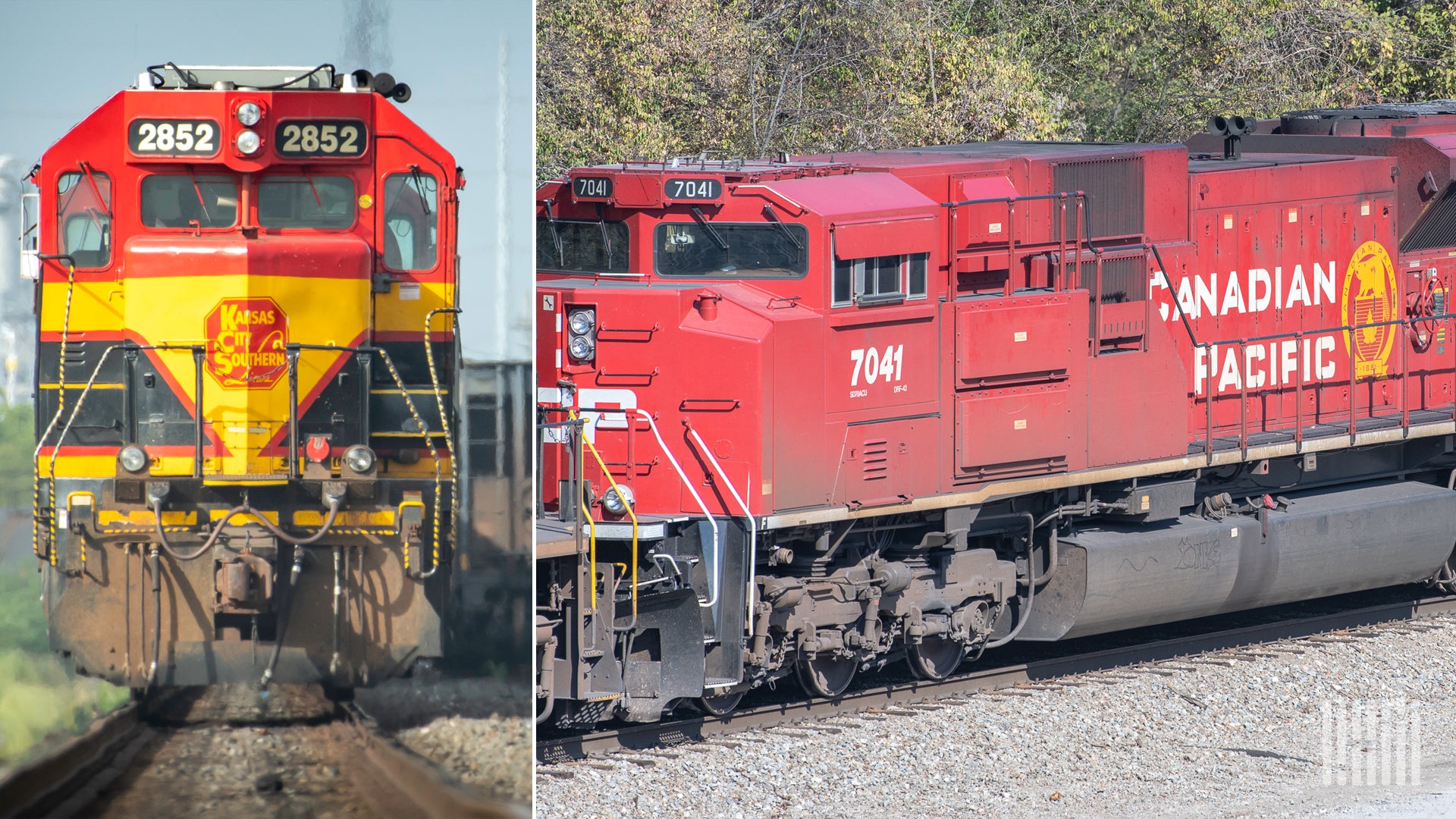
CALGARY, Alberta — Canadian Pacific Kansas City (NASDAQ: CP) reported higher fourth-quarter profits and revenue as the railway’s merger-related synergies accelerated.

“Despite a number of challenges, we delivered on the guidance that we set out at the start of the year, to produce double-digit earnings growth. And we did it safely,” CEO Keith Creel told investors and analysts on the railway’s earnings call Wednesday.

Despite economic uncertainties and the Trump administration’s threat of imposing 25% tariffs on goods imported from Canada and Mexico, CPKC expects revenue ton-miles to grow between 4% and 6% this year, which will help generate earnings growth of 12% to 18%.

With the only rail network linking Canada, Mexico and the U.S., CPKC is the Class I railroad that’s most dependent on North American trade.

“We’ve entered into 2025 with a tremendous amount of momentum that we fully expect to build on as we move throughout the year,” Creel said. “The long-term fundamentals of the North American economy and trade between the three countries this network uniquely connects remain unchanged.”

The bottom line, he says, is that no one knows what impact tariffs and trade negotiations may have on the U.S., Canada and Mexico — and what risk they pose to CPKC, which was created to tap trade growth through a CA$31 billion ($21.5 billion) merger in 2023.

But the three countries’ economies and supply chains remain inextricably linked.

Auto manufacturing is but one example, Creel says. Engines and transmissions made in the U.S. are shipped to assembly plants in Mexico, which then sends finished vehicles to U.S. dealers.

“The fact is we’ve got 75% of production capacity in the U.S. and 25% that’s got to come from somewhere else based on what we consume on an annual basis,” he said. “So that type of interdependence, that type of need, is woven into this economy.”

Plus, concerns about supply chain security are driving increased nearshoring of manufacturing, Creel says. “Trade between these three nations has never been, in my assessment, more critical,” he said.

Chief Marketing Officer John Brooks says there wasn’t much change in supply chains after tariffs were raised during the first Trump administration.

“The reality was that these supply chains are very complex. It’s commodity by commodity, it’s lane by lane, it’s customer by customer,” Brooks said. “And ultimately what happens, and I think what we saw, is there wasn’t a lot of change. It’s hard to change these complexities overnight.”

CPKC continues to invest in cross-border capacity in anticipation of ongoing traffic growth, Chief Operating Officer Mark Redd says.

Eight new passing sidings, along with segments of centralized traffic control (CTC), entered service in the U.S. last year, while capacity projects reduced bottlenecks in Mexico. “These investments are paying off,” Redd said.

The Patrick J. Ottensmeyer International Bridge over the Rio Grande at Laredo, Texas, opened last month and has more than doubled CPKC’s capacity at the busiest rail gateway to Mexico.

“The increased capacity is allowing my team to optimize border crossings and improve the efficiency at the border,” Redd said.

CPKC will continue to add passing sidings and CTC this year on its north-south spine linking the Midwest and Mexico.

“Our timing to in-service these investments is aligned closely with our growth outlook, ensuring that our network performance … and our volume growth are in lockstep,” Redd says.

CPKC also will take delivery of 100 new Tier 4 locomotives this year — the largest locomotive order in years. Officials did not mention the builder. Last year Wabtec disclosed that it had received a $600 million, multiyear order for Tier 4 locomotives but did not name the railroad. [See “Wabtec earnings surge …,” Trains News Wire, July 24, 2024.] CPKC continues to upgrade former Kansas City Southern locomotives so that they can lead trains in Canada, which will improve operational flexibility.

For the quarter, CPKC’s volume was up 2% on a revenue ton-miles basis, or down 4% when measured by carloads and containers. For the year, RTMs grew 3%, while carloads and containers were down 4%.

Brooks outlined a number of merger-related synergies that have driven growth on CPKC. Among them:

  • The railway is sending more Canadian grain to markets south of Kansas City, Missouri, including Mexico.
  • Automotive had a record year, with volume up 23% in the fourth quarter alone thanks in part to the new CPKC Dallas-area auto terminal in Wylie, Texas, and its closed-loop movement of auto racks between automakers’ assembly plants in Canada, the U.S. and Mexico.
  • There has been cross-border intermodal growth with its flagship Mexico Midwest Express service linking Chicago with points in Mexico, plus the new interline service with CSX between the Southeast and Mexico via interchange on the former Meridian & Bigbee short line in Alabama.
  • Forest products shipments from Canada to the Dallas-Fort Worth market grew despite overall softness in housing construction.
  • New aggregates and aluminum facilities on CPKC in the Southeast and Mexico.

For the fourth quarter, CPKC’s operating income increased 8%, to CA$1.5 billion, as revenue grew 2%, to CA$3.87 billion. Earnings per share, adjusted for the impact of one-time items, increased 9%, to CA$1.29.

The quarterly operating ratio improved 2.1 points, to 59.7%.

For the full year, CPKC’s operating income grew 18%, to CA$5.1 billion, as revenue grew 16%, to CA$14.5 billion. Earnings per share increased 11% on an adjusted basis.

Full-year operating ratio was 64.4%, a 0.6-point improvement over 2023.

CPKC again led the industry with the lowest train accident rate in 2024, while its personal injury rate improved by 17% for the year.

Norfolk Southern poised for opportunistic growth in 2025

On Wednesday, Eastern Class I railroad Norfolk Southern (NYSE: NSC) reported a solid operating beat for the fourth quarter of 2024, surpassing Wall Street expectations for earnings even on revenue that was slightly down. 

The company has gotten leaner under EVP and COO John Orr’s operational leadership, reducing overtime by 20% in the second half of 2024, accelerating its trains and cutting down on terminal dwell.

A renewed focus on asset utilization saw NS put 500 locomotives into storage over the course of 2024, allowing it to juice a performance metric that Orr started reporting in the first quarter of the year: GTMs per available horsepower, or average gross ton-miles moved per day divided by available (locomotive) horsepower. The number measures the efficiency with which the railroad uses its power units to generate revenue; the more gross ton-miles moved for every locomotive, the better the railroad is at assigning work to its assets. GTMs per horsepower got as low as 94 in the second and third quarters of 2023; by Q4 2024, it was up to 129.

When Paul Duncan ran operations at Norfolk Southern, the railroad reported car-miles and GTMs per transportation and engineering man hour. Car-miles are simply the terminal-to-terminal linehaul distances traveled by the railcars, which indicates something about network fluidity and length of haul, but not necessarily profitability. (Are these cars necessarily loaded? Not according to Norfolk Southern’s definition.) GTMs per man hour measures labor efficiency, but after a year of cuts and reduced overtime, there likely isn’t much more juice to squeeze there. Orr’s preferred metric, GTMs per horsepower, directly gets at how much revenue is being generated by the railroad’s most expensive assets, and it will be exciting to see how it continues to improve as train lengths increase.

“The refreshment of the new operating plan is really the next iteration of continuous improvement,” Orr said on Norfolk Southern’s Q4 earnings call. “We’ve been churning out improvements in our terminals — that was our starting point, on-time performance and over-the-road speed. And as we’ve moved through the progression of improvement on our network health, our asset efficiencies and our customer-facing metrics, the next evolution is tightening down standards. So, connection standards and terminals, creating better yield for our train weights, for our customization of the service that [EVP and CMO Ed Elkins] needs in order to be competitive and to grow the business.”

In the fourth quarter, the railroad reported an adjusted operating income increase of 11% to $1.06 billion, even as revenues saw a slight decline of 2% to $3.02 billion. The rail earned $3.04 per share, beating the Wall Street consensus by a dime.These figures underscore the company’s effective cost management and operational efficiencies.

A key metric highlighting Norfolk Southern’s financial efficiency is its operating ratio — operating expenses divided by revenue — which improved by 1.6 points to 65.8% for the full year when adjusted for one-time events such as line sales and the aftermath of the East Palestine, Ohio, accident. For the second half of the year, the adjusted operating ratio stood at 64.1%, roughly meeting the company’s expectations.

(The Outbound Rail Container Volume measures the number of containers moving by rail on a daily basis. Chart: SONAR. To learn more about SONAR, click here).

Looking ahead, Norfolk Southern has guided for a conservative but achievable financial outlook for 2025. The company anticipates 3% revenue growth, aiming to generate $150 million in productivity savings and improve its operating ratio by 1.5 points. The capital expenditure plan for the year includes a substantial $2.2 billion, signaling continued investment in infrastructure and technology. Additionally, after pausing share buybacks in response to the East Palestine incident, Norfolk Southern plans to resume these programs, reflecting confidence in its financial stability and prospects.

On this week’s Q4 earnings call, CEO Mark George hinted that under the right economic conditions, Norfolk Southern was poised to grow opportunistically and take its operating ratio down even further.

“And with regard to the long-term OR, I think we definitely have the self-help opportunities here to continue to improve OR,” George said, answering a question from Wells Fargo’s equity analyst, Chris Wetherbee. “We put out the 100-to-150-basis-point improvement guideline on the long-term basis on kind of a regular where-we-are volume environment. And once we get the kind of the surge, the economic recovery that we’re expecting, that’s kind of the turbo boost where I think we’ve got a path to that 60 range.”

Central to these positive developments are the leadership transitions at Norfolk Southern, influenced significantly by activist investor Ancora Holdings. In May, Ancora successfully secured three seats on the Norfolk Southern board, a strategic move that has reshaped the company’s governance landscape. The board, now comprising a mix of seasoned professionals and recent members brought in by Ancora, has shown remarkable unity and commitment to the company’s “Better Way” strategy. This strategy focuses on boosting volume and profits by ensuring consistent and resilient service through varying economic conditions.

The appointment of Lori J. Ryerkerk to the board marks a significant shift in Norfolk Southern’s leadership dynamics. Ryerkerk, with over three decades of global leadership experience in the energy, manufacturing and chemical industries, brings valuable operational acumen to the board. Her insights as a large rail customer are expected to drive Norfolk Southern toward customer service and sustained growth.

Mark George’s ascension to the role of CEO following the departure of CEO Alan Shaw has been pivotal in steering Norfolk Southern toward its current trajectory of improvement. Under George’s leadership, the company has implemented several operational enhancements, including a 10% increase in average train speed, a 15% reduction in terminal dwell time and a 20% decrease in unplanned-recrew rates. These measures have not only improved efficiency but also contributed to significant cost savings estimated at $300 million, surpassing the company’s spring targets by $50 million.

Furthermore, Norfolk Southern’s focus on Precision Scheduled Railroading (PSR) 2.0, led by Orr, has been instrumental in driving both efficiency and service improvements. The successful execution of PSR 2.0 is evident in the improvement of the intermodal service composite by 7 points and merchandise trip plan compliance by 6 points compared to the previous year, although both on-time/service metrics slipped quarter on quarter. 

The company’s commitment to safety has also seen substantial improvements. Norfolk Southern’s overall Federal Railroad Administration train accident rate improved by 27% for the year, and its mainline accident rate declined by 44%. These safety metrics, however, were slightly offset by a 5% rise in the personal injury rate. Nevertheless, the overall safety enhancements reflect the company’s dedication to maintaining high safety standards while expanding its operational capacity.

Norfolk Southern’s strategic initiatives extend beyond operational efficiencies to include significant investments in fuel efficiency and mechanical improvements. The establishment of a “need for speed” war room is aimed at reducing bottlenecks that can impede service and negatively impact fuel economy. By challenging every permanent and temporary slow order, the company is actively working to minimize stops and drive additional fuel efficiencies across the road network.

Right-sizing the workforce and locomotive fleet took most of 2024, but in 2025, Norfolk Southern is in position to capitalize on any growth that comes its way.