Borderlands Mexico: Entrepreneurs, small business see value of investing in Mexico

Borderlands is a weekly rundown of developments in the world of United States-Mexico cross-border trucking and trade. This week: Entrepreneurs, small business see value of investing in Mexico; Automotive supplier plans third plant in Mexico; Cargo vessel makes first call at Port Houston; and $31M worth of meth found hidden in hot peppers shipment.

Entrepreneurs, small business see value of investing in Mexico

Business owners continue to see Mexico as a positive place to invest in manufacturing opportunities, according to Tatiana Skumatenko, branch manager for Wise PanAmerican Solutions (WPS).

Austin, Texas-based WPS offers services aimed at assisting firms looking to expand or establish cross-border operations in Mexico.

“American entrepreneurs maintain a strong interest in Mexico’s nearshoring potential for 2025, carefully weighing the country’s strategic advantages against both ongoing challenges and emerging political uncertainties,” Skumatenko, who oversees WPS’ business development between the U.S. and Mexico, told FreightWaves.

Skumatenko recently attended the Austin Small Business Expo, an event bringing together entrepreneurs and small business owners from across the Lone Star State.

“During my recent participation at the Small Business Expo in Austin, I noticed that small business owners are interested in working with Mexico, especially in sourcing ingredients, raw materials, and products,” Skumatenko said. 

“I think the general sentiment regarding nearshoring in Mexico remains optimistic, albeit with caution. While recent U.S. election outcomes, Trump’s threats to impose tariffs, and the upcoming review in 2026 of the United States-Mexico–Canada Agreement (USMCA) pose concerns, Mexico has faced challenges even before the elections, including water shortages, energy supply limitations, and infrastructure issues.”

U.S.-Mexico trade totaled $72.5 billion in September, an increase of 8% year over year compared to the same month last year, according to the latest data from the Census Bureau.

It was the ninth consecutive month and 19th of the past 20 months that Mexico has been No. 1 in trade with the U.S.

Canada ranked No. 2 for trade with the U.S. at $63.8 billion in September, while China was third at $54.3 billion.

Through the first eight months of the year, trade between the U.S. and Mexico totaled $632 billion. Trade with Canada totaled $632 billion, while China trade came to $437 billion.

The Port of Los Angeles overtook Laredo, Texas, as the No. 1 U.S. trade gateway in September among the nation’s 450 airports, seaports and border crossings, according to Census Bureau data analyzed by WorldCity.

The top three exports from Mexico to the U.S. through Laredo during the month were auto parts ($2.3 billion), computers ($1.9 billion) and passenger vehicles ($1.58 million).

Top imports from the U.S. to Mexico in September were auto parts ($1.1 billion), electric storage batteries ($449 million) and passenger ($317 million).

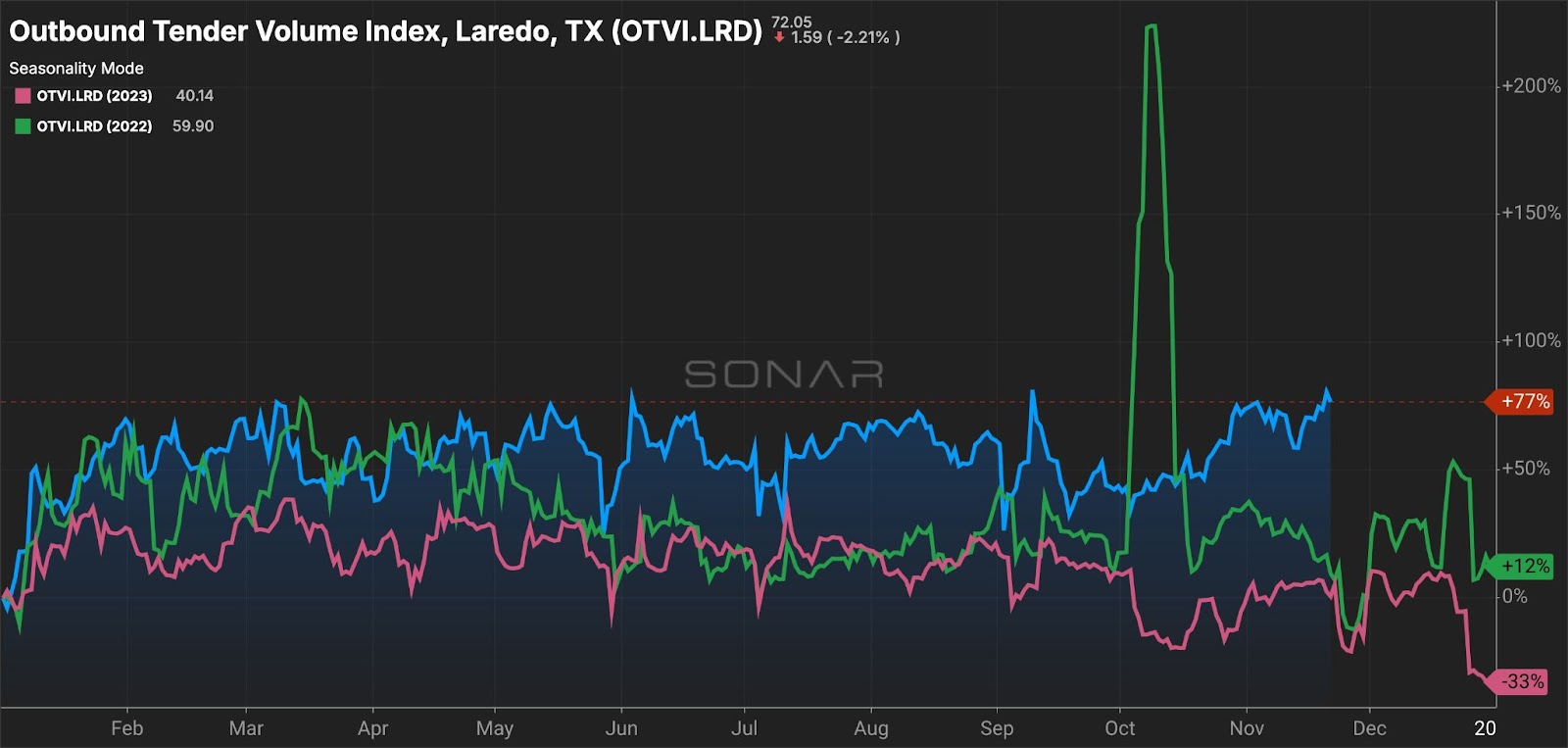
As of Nov. 21, outbound truck volumes out of Laredo are up significantly compared to the same periods in 2023 and 2022, according to the SONAR Outbound Tender Volume Index (OTVI.LRD).

SONAR’s Outbound Tender Volume Index for Laredo, Texas, (OTVI.LRD), shows 2024 trucking volumes (blue line) have been trending higher compared to the past two years. To learn more about SONAR, click here.

Skumatenko said the momentum that nearshoring has gained in 2024 is unlikely to drop dramatically next year.

“Those who recognize and value the benefits of Mexico as a nearshoring destination are willing to take on these risks and establish operations south of the border. Notably, the Mexican Association of Private Industrial Parks expects around 450 new companies to arrive in Mexico by 2025,” Skumatenko said.

Automotive supplier plans third plant in Mexico

Germany-based automotive supplier Mubea plans to open its third plant in the Mexican city of Ramos Arizpe.

The $60 million factory will create 200 direct jobs and produce components for automotive chassis for the North American market. The 2.2 million-square-feet facility is scheduled to open by the end of 2025.

“This new location represents an exciting expansion for Mubea and reinforces our commitment to innovation and excellence in automotive components,” James Sheehan, CEO of Mubea North America, said according to Pro Mexico Industry.

Mubea is a global producer of automotive components. The company employs more than 17,000 people at 54 locations in 18 countries.

Cargo vessel makes first call at Port Houston

The Saudi Arabia-flagged Bahri Diriyah, a multipurpose dry cargo vessel, recently arrived at Port Houston’s Turning Basin Terminal.

The ship traveled to Houston from Dammam, Saudi Arabia.

The 31,241-ton vessel can hold up to 1.3 million cubic feet of general cargo. Operating as a tramp vessel, the Bahri Diriyah will call Port Houston on an as-needed basis to offer cargo solutions for the trade community in Texas, Bahri officials said.

“Houston is one of our largest markets, and this milestone underscores our strong partnership with Port Houston,” Rajith Aykkara, vice president of Bahri Line, said in a news release.

Riyadh, Saudi Arabia-based Bahri is the national shipping carrier of Saudi Arabia. Bahri is the largest owner and operator of very large crude carriers (VLCCs) and chemical tankers in the world, according to its website. The carrier operates 40 VLCCs. 

$31M worth of meth found hidden in hot peppers shipment

U.S. Customs and Border Protection (CBP) officers in South Texas recently intercepted $31.2 million worth of methamphetamine concealed in a shipment of serrano peppers arriving from Mexico.

The incident occurred Nov. 10 at the Pharr-Reynosa International Bridge in Pharr, Texas. CBP officers found 1,859 packages of alleged methamphetamine concealed in the shipment of peppers on a tractor-trailer.

CBP seized the drugs and the tractor-trailer. Homeland Security Investigations is investigating the case.

Newfane, Vermont Post Office 05341

Newfane Virginia Post Office

The Newfane, Vermont Post Office serves ZIP Code 05341. Photo by Jimmy Emerson, some rights reserved. Photo shared under the Creative Commons License.

Newfane Post Office
562 VT-30
Newfane, VT 05345

Location at Google Maps

OTR division of 38-year-old Texas carrier ‘absorbed’ by MVT

Nearly 100 truck drivers for Stagecoach Cartage and Distribution of El Paso, Texas, were notified earlier this week that its over-the-road division was being absorbed by its parent company, which also owns Mesilla Valley Transportation (MVT) of Las Cruces, New Mexico.

A source familiar with the situation confirmed to FreightWaves on Friday that the OTR division would be operating under MVT’s DOT number moving forward. The source, who didn’t want to be named for fear of retaliation, said its other divisions, which include its local or regional drivers, intermodal, tanker, flatbed and warehouse, will continue to operate under Stagecoach Cartage and Distribution’s name.

“The market has definitely turned and it’s made mid-sized companies like Stagecoach very difficult to compete,” the source told FreightWaves. “Our operating costs are very high and our rate-per-mile has just tanked. So, it just  became incredibly difficult to operate, especially if you don’t have the infrastructure of a large company like Mesilla Valley Transportation, which has yards across the country.”

In April of 2020, FreightWaves reported that Roadrunner Transportation Systems Inc. had sold Stagecoach Cartage and Distribution to a third-party logistics (3PL) firm, J.H. Rose Logistics LLC of Santa Teresa, New Mexico. Royal Jones owns J.H. Rose Logistics as well as several other transportation-related companies, mainly located in New Mexico and Texas, including MVT

Although the Federal Motor Carrier Safety Administration’s SAFER website lists Stagecoach Cartage as having 135 drivers and 142 power units, the source said that number included both OTR and local/regional drivers. The source added that just under 100 drivers were affected by the decision to shutter Stagecoach’s OTR division and move its operations over to MVT, which is one of the largest private fleets in the U.S. 

Although the decision to fold Stagecoach’s OTR division into MVT was made last week, its long-haul drivers and customers weren’t notified until Wednesday. 

“Our drivers are already working under the MVT name,” the source said. “We had some older drivers who decided to retire and we had some drivers who didn’t feel comfortable moving over to work under MVT’s requirements, which was expected. If the parent company absorbs another company, some employees want to go elsewhere.”

Stagecoach was founded in 1986 and was the first motor carrier permitted into Mexico under the North American Free Trade Agreement in 2006. 

According to the Federal Motor Carrier Safety Administration’s SAFER website, Stagecoach had one fatal crash, two injuries and three tow-aways over the past 24-month period. 

Over that same time period, MVT, which has over 2,000 drivers and nearly 2,500 power units, had six fatal crashes, 58 injuries and 96 tow-aways over the the past 24-month period.

“Stagecoach Cartage is very diversified and profitable, except the OTR division, which will be absorbed by Mesilla Valley, so the decision just makes sense,” the source said.

KAG acquires Michigan-based dry bulk hauler

A KAG tractor on a highway

Specialized transportation provider Kenan Advantage Group (KAG) announced Friday that it has acquired dry bulk hauler PRM Trucking.

Financial terms of the transaction were not disclosed.

Michigan-based PRM operates a fleet of 39 tractors and 91 trailers with a staff of 33 drivers and a 12-person operations team. The carrier specializes in the transloading, storage and transportation of lime and sand across the Midwest.

The acquisition includes PRM’s terminal and 3,000 feet of railroad track for its transloading operations.

“The further expansion of our dry bulk transportation services will be supported with the latest addition of PRM, allowing us to capitalize on our growing Midwest presence,” said John Rakoczy, executive vice president at KAG Specialty Products, in a news release.

Leadership at PRM is joining KAG as well.

North Canton, Ohio-based KAG is the largest tank trucking company in North America. It operates roughly 300 terminals, providing bulk transportation of fuels, energy products, chemicals and food products.

KAG Logistics acts as a broker in the same markets, providing capacity solutions, managed transportation and logistics services.

“We are pleased to provide our expertise and knowledge to KAG in the dry bulk space,” said PRM’s owners, Shari and Tom Morris.

Left Lane Associates was the exclusive financial adviser to KAG on this deal.

More FreightWaves articles by Todd Maiden

Conspiracy to disable truck emission controls nets guilty plea

trucks on the highway

In exchange for a fee of up to $4,500 per truck, a New Jersey man was able to remotely reconfigure heavy-duty diesel truck engines allowing company drivers to bypass federal pollution-control regulations.

He now faces up to five years in prison and a $250,000 fine.

Jonathan Achtemeier pled guilty in a Washington state federal court on Wednesday, admitting that between 2019 and 2022 he removed the pollution control software on hundreds of trucks from around the country.

Defeating emission controls can boost engine performance and improve fuel economy – at the expense of emitting more pollution. The Environmental Protection Agency estimates that removing pollution control equipment and disabling the software results in trucks polluting at 30 to 1,200 times the level of a truck with pollution control systems. Tampering with the systems is a violation of the Clean Air Act.

According to court documents, Achtemeier, 44, advertised his services on social media nationwide, doing business as Voided Warranty Tuning (VWT), based in Columbia, New Jersey.

Records filed in the case revealed that Achtemeier conspired with five truck fleet operators and garage mechanics to disable the anti-pollution software. Two of Achtemeier’s co-conspirators based in Washington state worked for trucking companies that owned fleets of 2016 and 2017 model-year diesel trucks manufactured by Freightliner and Peterbilt.

The coconspirators sought Achtemeier’s services to trick their trucks’ software into believing the systems were still working, a process known as “tuning,” the U.S. Attorney’s Office said in a statement. The process could take less than an hour per truck.

“Monitoring software on a deleted truck will detect that the pollution control hardware is not functioning and will prevent the truck from running. Achtemeier disabled the monitoring software on his client’s trucks by connecting to laptops he had provided to various coconspirators. Some of the coconspirators would pass the laptop on to others seeking to have the anti-pollution software disabled on their trucks.

“Once the laptop was hooked up to the truck’s onboard computer, Achtemeier could access it from his computer and tune the software designed to slow the truck if the pollution control device was missing or malfunctioning. Achtemeier could ‘tune’ trucks remotely, which enabled him to maximize his environmental impact and personal profit.”

Between 2019 and 2022, VWT made more than $4.3 million.

U.S. District Judge Tiffany Cartwright scheduled sentencing for Feb. 14, 2025.

Click for more FreightWaves articles by John Gallagher.

Trucking company co-owner sentenced for falsifying driving logs after crash probe

A co-owner of a Massachusetts trucking company was sentenced to two months in prison after admitting that he falsified driving logs and lied to investigators in connection with a June 2019 fatal collision involving the driver of one of the company’s vehicles. 

Dunyadar “Damien” Gasanov, 39, of West Springfield, co-owner of now-defunct Westfield Transport, pleaded guilty in August in the U.S. District Court for the District of Massachusetts to three counts of making false statements to federal investigators. 

U.S. District Court Judge Mark G. Mastroianni also sentenced him to one year of supervised release, during which he is prohibited from driving a commercial vehicle. 

Federal prosecutors had recommended a sentence of one year in prison, according to the U.S. Department of Justice’s sentencing memorandum. 

According to court documents, Damien Gasanov also admitted that he had lied about how long he had known the Westfield Transport driver, Volodymyr Zhukovskyy, who was involved in the 2019 fatal crash in which seven motorcyclists of the Jarheads Motorcycle Club died in Randolph, New Hampshire. He also admitted to knowing that Zhukovskyy had been charged with operating a vehicle while under the influence of alcohol years before the crash, according to court documents.

Trucking company owner pleads guilty to falsifying logs in fatal motorcycle crash
Owners of Westfield Transport indicted on charges of falsifying driving logs

According to Westfield Transport’s business filings with the Massachusetts Secretary of State’s office, Dunyadar Gasanov, who was listed as the supervisor of Westfield Transport, was indicted in February 2021, along with his brother, Dartanayan Gasanov, who has pleaded not guilty and is awaiting trial. Business filings with the state agency listed Dartanayan Gasanov as president, treasurer, secretary and director of the shuttered auto transport company.

“By falsifying safety records and lying to investigators, [Damien Gasanov] put profits over public safety, with potentially devastating consequences,” said acting U.S. Attorney Joshua S. Levy in a statement. “Adhering to federal safety regulations is critical to protecting public safety and our office is committed to holding accountable anyone who flouts them in this manner.”

Westfield driver acquitted

In July 2022, a jury acquitted Westfield Transport’s driver Zhukovskyy, now 30, of killing seven members of the Jarheads Motorcycle Club. He originally faced seven counts of negligent homicide, seven counts of manslaughter and one court of reckless conduct in the collision on June 19, 2019, in rural New Hampshire. 

However, jurors found that the lead motorcyclist of the Jarheads, Albert “Woody” Mazza, was impaired and over the centerline of the road at the time of the collision. Zhukovskyy was pulling an empty flatbed trailer at the time of the crash. It was his first trip as a driver for Westfield Transport.

What happened?

According to court documents, from May 2019 to June 23, 2019, the owners of Westfield Transport allegedly falsified driving logs “in order to evade federal regulations designed to ensure the safety of roadways and drivers.”

In court filings, Dunyadar Gasanov admitted that he had instructed at least one Westfield Transport employee to falsify records to exceed hours-of-service limits. He then “made a false statement to a federal inspector regarding the manipulation of recording devices that track drivers’ on and off duty hours in order to evade regulations,” according to federal prosecutors.

The National Transportation Safety Board (NTSB), an independent agency called in to investigate the fatal crash, claims in its report that Westfield Transport’s owners tried to add Zhukovskyy to its insurance policy an hour after the driver was involved in the fatal crash.

NTSB investigators also confirmed that on the day of the fatal crash, Zhukovskky was using paper logs. 

Read more articles by Clarissa Hawes.

Florida trucking company owner convicted in $112M Ponzi scheme
Tech battle continues as Samsara files new lawsuit against rival Motive

UPS hit with SEC fine over its internal valuation of UPS Freight before TFI sale

The former UPS Freight LTL carrier – which has been enough of a headache for its subsequent owner that its CEO felt the need to defend its acquisition in a recent earnings call – was not properly valued by UPS when its sale was being considered, according to the Securities and Exchange Commission. 

The penalty levied against UPS, after what the SEC said was a settlement with the logistics provider, was a $45 million fine. UPS, in the settlement, did not admit or deny the SEC findings, according to the agency. 

UPS Freight is now known as TForce Freight within TFI International. UPS sold the LTL carrier to TFI in an $800 million deal that closed in April 2021 and was announced in January of that year. 

At issue for the SEC was the UPS valuation of goodwill attached to the UPS Freight unit. 

Goodwill is a balance sheet line item that has been described as an “intangible asset” that reflects such amorphous non-financial capital as reputation and the strength of a company’s customer base. Its valuation is always a challenge, and according to financial information company Finance Strategists, it is reported by a company “only if its valuation can be supported by a transaction involving the purchase of a firm.” 

“In general, it refers to a kindly feeling of approval and support,” Financial Strategists said.

According to a prepared statement released by the SEC, UPS in a 2019 internal review concluded that the top price it could receive for UPS Freight was $650 million (or $150 million less than it ultimately received in 2021). 

Given that calculation, according to the SEC, the provisions of Generally Accepted Accounting Principles (GAAP), if properly implemented, should have been considered by UPS in a determination whether to write down the value of goodwill it had assigned to UPS Freight. Approximately $500 million in goodwill attributed to UPS Freight should have been considered “impaired,” which normally would lead to a writedown, the SEC said.

(In its latest quarterly earnings, UPS listed approximately $4.4 billion in goodwill for the company as a whole. At the end of 2019, that figure was approximately $3.8 billion).

But the SEC said that UPS turned to an outside consultant to value UPS Freight “without giving the consultant information necessary to conduct a fair valuation of the business.”

Outsider sees a $2 billion business

That consultant estimated UPS Freight was worth about $2 billion, which would have been about 150% more than what TFI ultimately paid for the LTL carrier. It was also well above the internal valuation that UPS could expect to receive no more than $650 million for the asset.

As a result of what the consultant estimated, according to the SEC, “UPS did not record a goodwill impairment in 2019. Had UPS properly valued Freight, its earnings and other reported items would have been materially lower.”

When UPS (NASDAQ: UPS) entered into the deal with TFI (NASDAQ: TFII) for $800-million (TFI was not identified by name by the SEC), there were adjustments agreed to in the deal “that were likely to reduce the final price,” the SEC said. 

“Despite its own analysis and its entry into this term sheet, UPS relied again on a consultant’s valuation of Freight in 2020 to support not impairing the business’s goodwill,” the SEC said. “UPS also did not inform the consultant of the term sheet.”

UPS, in a statement provided to FreightWaves, noted that the investigation had already been previously disclosed by the company. 

The statement reiterated that UPS was not admitting or denying the allegations. 

“The settlement amount had previously been fully accrued in our financial statements, and the settlement will not have a material effect on our business, financial condition, results of operation, or liquidity,” UPS said, adding that the investigation has concluded.

In the quarterly earnings calls at TFI, CEO Alain Bedard, frustrated by the unit’s performance, said of operations at TForce that its practice of taking shipments that he believed were too light were “stupid” and that the unit was “too fat.”

In an email to FreightWaves, Bedard said he had no comment on the SEC fine against UPS and its report. 

UPS stock at approximately 12:15 p.m. EST was up 2,15% to $134.19, a gain of $2.82. It has been an industry laggard in the last year, down about 11%. 

TFI was up less than 0.5% Friday morning. It is up about 28.4% in the last 12 months.

More articles by John Kingston

Werner nuclear verdict case in Texas is hugely significant, says attorney at F3

Latest nuclear verdict in trucking: $141.5M against defunct Florida carrier

Owner and head of LTL carrier elected mayor of Portland

Running on Ice: Drones cozy up to cold warehousing 

Blue Truck on a sheet of ice over a blue background and Running on Ice Logo

All thawed out

(Photo: Gather AI)

Drones are everywhere. While some of the most exciting topics for the use of drones are Walmart deliveries in residential areas and 15-minute-or-less food delivery, the most accessible and approachable way to get drones involved in the supply chain is by adopting them in warehouse inventory management.

Gather AI has developed a drone solution that now encompasses the cold chain. The company says it has the first inventory management automation setup using drones for inventory monitoring automation. The cool part about this is that the operators of the drone don’t have to be on lifts or right next to the drone. They can be on the ground or even in a toastier part of a warehouse if they don’t enjoy the prospect of standing in a cold warehouse for 12-plus hours at a time.

Langham Logistics CEO Cathy Langham said in a news release: “We use business intelligence solutions like Gather AI to give our life sciences customers total inventory visibility, control, and compliance. After engaging Gather AI in 2022, we went from a 97% accuracy rate to over 99% accuracy. With the expansion into cold storage and freezer locations, we expect the same accuracy gains and up to 10X faster cycle counts.”

Temperature checks

(Photo: Shutterstock/SORN340 Studio Images)

The rise of direct-to-consumer and e-commerce shipping isn’t showing any sign of slowing down as the market continues to grow. Grip, a logistics tech and fulfillment leader for e-commerce companies that ship perishable goods, has announced the opening of its fifth fulfillment center in Michigan. This expansion positions Grip to service 70% of the U.S. population within 24 hours.

Juan Meisel, CEO and co-founder of Grip, said in a news release, “Expanding to Michigan is a significant milestone for Grip as we continue to support DTC brands with unmatched speed, cost savings, reliability and technology. Our goal is to empower brands to scale with confidence, knowing their operations and logistics are optimized at every step.”

The perishable goods transportation market size is forecast to increase by $9.23 billion, at a compound annual growth rate of 8.8% between 2023 and 2028. Perishable e-commerce has a larger emphasis on reliability and efficiency than traditional e-commerce models as temperature-sensitive goods can’t be easily replaced if something happens, and the risk of damaged or unusable goods is higher. 

Food and drug

(Photo: Jim Allen/FreightWaves)

Southern hospitality at its finest invites you to come in and have a bite. Nestle USA is taking that sentiment literally, announcing plans to invest $150 million to increase production at its food processing plant in Gaffney, South Carolina. Food processing doesn’t always involve the cold chain, especially when talking about one of the largest consumer packaged goods shippers in the U.S.

This investment is primarily targeted to increase production of single-serve frozen meals in the form of a new production line. The company is also looking to enhance some automation and technology. Reaping the rewards of this enhanced facility are fan favorites of the frozen food aisle with Stouffer’s, Lean Cuisine, Vital Pursuit, Sweet Earth bowls, and Hot Pockets sandwiches, as well as DiGiorno, Jack’s and Tombstone pizza.

Nicole Caldwell, manager of the Gaffney factory, said in a news release, “This investment further solidifies our dedication to the Gaffney community, where Nestlé has been an integral part for nearly 45 years. It also reflects our continued commitment to enhance our US manufacturing footprint and in-house capabilities.”

Cold chain lanes

SONAR Tickers: ROTVI.RDU, ROTRI.RDU

This week’s market under a microscope is Raleigh, North Carolina. Raleigh’s reefer market is facing a mild capacity crunch as outbound reefer rejections are on the rise. Reefer rejections are technically down week over week but made a strong recovery compared to the sharp drop earlier this week. As one of the largest food holidays of the year approaches, rejection rates aren’t likely to change trajectory anytime soon.

Carriers will prioritize higher-paying lanes and shippers face tighter capacity, especially in regions with strong seasonal demand. Rejection rates are expected to creep up as late-year demand strengthens. Shippers should secure capacity to mitigate risks.

Is SONAR for you? Check it out with a demo!

Shelf life

McCain, Lamb Weston among frozen-food firms facing price-fixing lawsuits

Performance Health Selects ketteQ’s AI-powered solutions to optimize life sciences supply chain

Grocery chains vie for seats at Thanksgiving tables with deals

ALDI US is up to 745 transcritical CO 2 stores

Wanna chat in the cooler? Shoot me an email with comments, questions or story ideas at moconnell@www.freightwaves.com.

See you on the internet.

Mary

If this newsletter was forwarded to you, you must be pretty chill. Join the coolest community in freight and subscribe for more at www.freightwaves.com/subscribe.

How the end of the freight recession will shape 2025, according to Werner chairman and CEO

The trucking industry is undergoing a transformative shift, fueled by market changes, geopolitical factors and evolving consumer behavior.

Werner’s Chairman and CEO, Derek Leathers, recently joined FreightWaves Founder and CEO, Craig Fuller to discuss these current industry trends and look ahead to what is coming next. The duo tackled a full suite of pertinent topics, including the market turn, nearshoring, fraud and the future.

The freight recession comes to an end

Earlier this month, FreightWaves officially acknowledged the end of the Great Freight Recession. Fuller cited SONAR data confirming the market turnaround, including some of the same metrics that enabled him to predict the downturn early.

This aligns with the “up and to the right” market trajectory Leathers reports seeing over the past few months. He attributes this long-awaited shift to the growing carrier attrition—a trend that was delayed during the most recent freight recession.

Freight is a cyclical market, meaning downturns are common and often predictable. However, during the Great Freight Recession, the market behaved completely out of line with traditional expectations. Leathers credits the lasting impacts of the coronavirus pandemic for this anomaly. 

“A global pandemic is something completely different, and we probably all underestimated the impact,” Leathers said. “The increase in demand, the wallet share shift between services and goods, and the vast amount of stimulus that a lot of small and mid-size carriers participated in created a cash vault they could dip into for longer than we have ever seen previously during a downcycle.”

According to Leathers, some small and mid-size carriers stowed away as much as $150,000 per truck during the last COVID-fueled upcycle. That money would then be transformative for carriers historically operating on razor-thin margins.

With bolstered margins going into the freight recession, small and mid-size carriers could continue operating longer than expected. This led to a very long attrition cycle and, in response, a lengthened recession that has only recently abated.

How nearshoring is shaping the supply chain

The market’s overdue change happened alongside nearshoring trends and the U.S. presidential election, which Leathers described as positive forces for the trucking industry. 

Trade relations between the U.S. and China have been strained for several years. This tension will only continue as the Trump Administration’s expected tariffs take effect over the coming months. 

As manufacturers work to move their operations away from China, many have set their sights on Mexico. The country’s proximity to the U.S. and its robust labor force make it a standout contender for companies hoping to streamline their supply chains while keeping costs down. 

In 2023, Mexico surpassed Canada and China to become the largest U.S. trading partner. This trend is expected to continue as more companies establish a presence in Mexico and the relationship between the two nations grows stronger. 

Werner has a robust presence in Mexico. The company has operated in Mexico for more than 25 years and transports more cross-border freight to and from the country than any other carrier, generating nearly $400M in annual revenue. 

Shippers establishing a presence in Mexico should seek out this level of expertise from their carrier partners. Werner understands the unique opportunities in Mexico and has the solutions and expertise needed to navigate potential challenges. 

Looking into 2025

Looking toward 2025, Leathers expects the attrition cycle to continue, creating a more stable environment. 

“2025 has the opportunity to clearly show that 2024 was the trough and 2025 is the slow climb out,” Leathers said. “As we get further along, I think it gets better from there.”

For shippers, this means now is the time to create a game plan for the flipped market. According to Leathers, a prepared shipper is already looking ahead and considering who their core carriers are and how they can solidify those relationships for long-term growth.

As the industry adapts to the changing landscape, the most successful companies will proactively secure their networks and focus on collaboration.

Roadrunner changes hands, accelerates growth efforts

A Roadrunner tractor-trailer at a truckstop

Less-than-truckload carrier Roadrunner announced Friday that its CEO is part of a private equity group that has taken a controlling interest in the company.

Prospero Staff Capital has acquired a majority stake in the Downers Grove, Illinois-based company. The deal was co-led by Chris Jamroz, Roadrunner executive chairman and CEO, and investor Ted Kellner. The group replaces activist investor Elliott Investment Management as the majority holder. Elliott will retain a minority interest in the company.

Prospero is part of Jamroz’s investment company, LyonIX Holdings, which has holdings in other transportation and logistics companies as well as investments in real estate, infrastructure and cyber security companies.

Kellner runs various investment vehicles, including Fiduciary Management Inc., which has more than $17 billion in assets under management. Kellner is a longtime investor in Roadrunner.

Financial terms of the transaction were not provided, but Roadrunner (OTC: RRTS) said it would use “fresh capital” to fund organic growth and acquisitions.

“After comprehensively unwinding the prior management’s roll-up strategy to get to a pure-play LTL network, Roadrunner now stands as a premium long-haul carrier,” Jamroz stated in a news release.

Jamroz has transformed Roadrunner into a standalone LTL operation specializing in long-haul, metro-to-metro shipments. The company’s national network serves more than 40 major metro markets.

The company spun off Ascent Global Logistics, a freight forwarding and brokerage operation, in 2020. The spin off was part of a broader breakup at Roadrunner after it struggled for years to integrate acquired trucking and logistics assets.

Jamroz is credited with seven business exits, generating nearly $10 billion in value to financial sponsors.

“From its roots in my home state of Wisconsin, Roadrunner has grown into the largest direct metro-to-metro LTL carrier, and I’m looking forward to growing our roster of direct corporate shippers and new investment in the business, as we continue driving Roadrunner’s success,” Kellner said.

Shares of RRTS, which trade on the pink sheets, were up 41.9% to $1.49 at 12:28 p.m. EST on Friday. Shares remain off 6% year-to-date.

More FreightWaves articles by Todd Maiden